
Recent research on public attitudes toward AI reflect a rising level of unease and concern about the technology and its potential impacts on the workforce, relationships, and education. A closer look at public priorities suggests the views of the public are more nuanced than other polls may indicate and the path forward for AI-focused corporate leaders is clearer than overall sentiment polling implies.
In March 2026, Just Capital prompted the American public to prioritize AI-related issues rather than measure general sentiment. The results reveal that public support for AI is not absent but conditional: it depends on whether companies can demonstrate how they are managing risk responsibly while delivering on AI’s greatest potential to improve society. An early review of corporate disclosure suggests most companies have not yet made that case clearly or consistently.
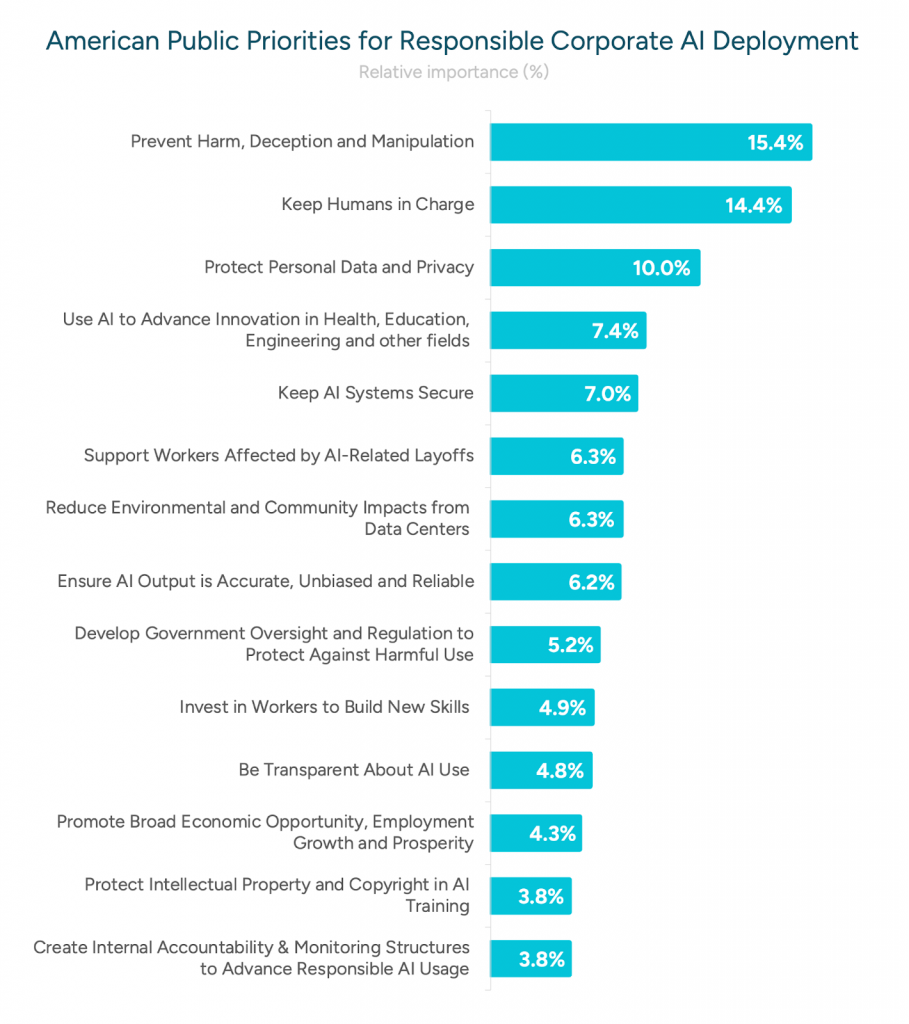
When asked to rank priorities rather than express general views, Americans reveal a more balanced perspective than headline sentiment polls suggest. They highly prioritize the use of AI to advance innovations in health, education, and engineering to solve complex societal problems, even ranking this above concerns around workforce disruption and environmental impacts.
At the same time, the three highest-ranked priorities are focused on safety concerns: preventing harm, deception, and manipulation; keeping humans in charge; and protecting personal data and privacy. This suggests public support would be bolstered by companies articulating the guardrails around the technology. Americans are watching to see whether companies can deploy AI responsibly.
We reviewed AI-related disclosures at six hyperscalers and 104 additional companies that rank highly in the organization’s measure of overall responsible business practices. Even among these 110 companies, most with strong disclosure track records across workforce, community, environment, customer, and governance issues, AI-related reporting is inconsistent and lacks common definition.
Two of six hyperscalers publish dedicated AI Transparency Reports. Fifty percent of companies disclose board-level involvement in AI risk oversight, but just 37% of the 110 companies analyzed disclose responsible AI principles or guidelines. Among those that do, disclosure is uneven on the issues Americans rank highest: only 16 companies mention preventing harm, deception, and manipulation; 27 mention human oversight; and 37 mention customer privacy and data protection.
Across Just Capital’s broader analysis of 933 public American companies, the picture is even less clear. The share of companies committing to not selling user data in any context dropped 3.5% year over year, and 3% fewer companies commit to not using user data for advertising. The average number of employee training hours fell from 24.34 per employee in 2024 to 21.96 in 2025, despite calls for more AI-focused training and reskilling opportunities. Among the smaller group of 110 companies analyzed further, 39 disclose formal AI training programs for employees.
As companies accelerate AI deployment, clearly and consistently defining responsible AI development and deployment will be a meaningful point of distinction for the American public. This analysis suggests the public will be more likely to extend trust to companies that demonstrate they are using AI to deliver genuine social benefit while protecting people from the greatest risks.
The full list of public priorities identified by Just Capital is below. These priorities are being translated into trackable metrics for ongoing analysis.
Methodology
Just Capital regularly conducts independent surveys to track Americans’ priorities, values, and expectations for corporate behavior, which serve as a foundational input into its Just Intelligence tool, rankings, and research products. Priorities weights were determined via maximum-differential (Max-Diff) to quantify the relative importance of each of the AI-related issue statements.
This survey was conducted online within the United States by Just Capital from March 12–16, 2026 among 2,012 U.S. adults ages 18 and older. Data from this survey have been weighted to align with known population parameters from the U.S. Census Bureau on key characteristics including [age, gender, geography, etc.]. While weighting adjusts for demographic imbalances, this survey is based on a non-probability sample and therefore no estimate of theoretical sampling error can be calculated. Findings should be interpreted accordingly.
