
Companies today are desperately searching for growth, better margins, and market-beating returns, especially amid ongoing AI-driven transformation. Our latest research offers clues where to look.
We scored 767 companies over five years on how they treated their workers, their customers, their communities, their shareholders (on governance factors), and the planet, then evaluated what happened in subsequent years to their revenue growth, margins, and excess returns.
TL;DR: the results suggest that strong stakeholder performance can indeed presage future financial and market performance, but not always. It varies by industry, by stakeholder, and over time. When the connections were statistically significant, positive links beat negative ones by nearly two to one, with strong clusters around the twin goals of revenue growth and alpha.
The key to success at the individual company level appears to be knowing when, how, and where the stakeholder-financial performance connections occur, anticipating future shifts and executing better than others; precisely what the new Financial Opportunity feature in Just Intelligence facilitates. In technology, for example, the firms that invested most in communities, environment, and governance went on to grow fastest.
None of this was a surprise to Jen Huffstetler, Chief Sustainability Officer at HP Inc. — our top-ranked company of 2026 — who joined me for a conversation last week. Culture, trust, and innovation, she argued, are essentials for overall leadership today. At HP, whose stock is up over 30% YTD, culture is grounded in accountability – a feature that can be traced back to the firm’s founders. You can read the full summary of our conversation on LinkedIn.
In a volatile market obsessed with AI-driven growth, profitability and returns, the stakeholder model might offer more value than expected.
Be well,
Martin
P.S. Just Intelligence now contains additional AI-focused insights. Explore them here.
79% of investors feel AI should face significantly more regulation than social media has, alongside 78% of corporate leaders. Explore the data here.
NVIDIA CEO Jensen Huang speaks to Axios about how AI is creating more jobs, pointing to how its use in radiology is creating demand for more radiologists.
Mark Zuckerberg writes an op-ed in The Wall Street Journal outlining his optimistic vision for an AI-driven future.
The New York Times looks at AI companies’ search for more electricians and plumbers for their data center build-outs, and how many are investing in the trades.
Inc. reveals that 55% of leaders regret AI-related layoffs, and more companies are hiring back roles they thought they could do without.
The Wall Street Journal looks at how after-tax wage growth has improved for low-income Americans, but those gains are likely being swallowed by rising gas prices and overall inflation.
Forbes takes a surprising look at why engineering majors are struggling to find jobs at higher-than-expected rates.
More companies than ever are turning to older and retired CEOs when their business is in need of stabilization. The Wall Street Journal has the story.
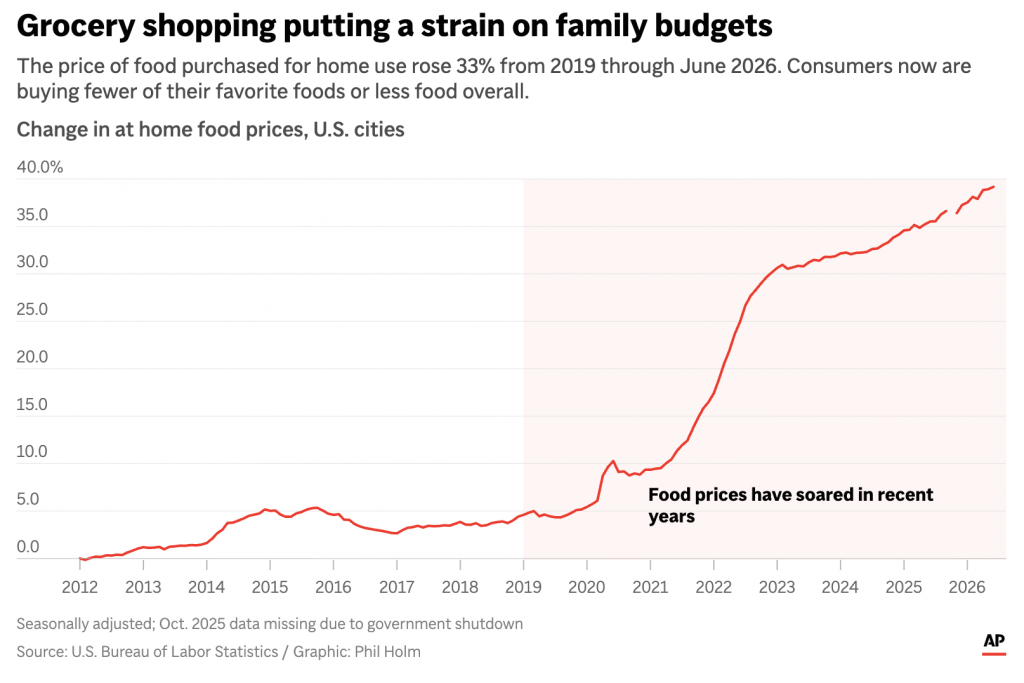
This chart comes from an Associated Press investigation on how the increase in food prices is affecting U.S. families, showing that prices have risen 33% since 2019.
