Conversations around AI safety reached a fever pitch this week. AI leaders shared manifestos, and policymakers are set to meet next week behind closed doors. As always, I found myself asking where the American people stand in the debate. How are they experiencing AI? Are they really as negative as some would have you believe? Is it making their lives better, and what if anything are they afraid of?
This week we launched the National AI Monitor, a unique new research initiative that objectively tracks if-and-how people are feeling the effects of AI in their daily lives. Incorporating quantitative and qualitative responses, it captures how Americans truly see AI today – as workers, customers, community members, investors, and stewards of the environment – and their expectations for the future.
So what did we learn? We see a public that is generally positive about the many ways AI can make their lives more fulfilling and more productive – a headline that runs contrary to recent reports. 57% of Americans say AI positively impacts them at work, compared to just 9% who say it affects them negatively. Positive qualitative responses most commonly cite productivity and quality gains (27%), efficiency and time savings (19%), and automating routine tasks (8%).
Conversely, there is very real anxiety around ensuring AI systems are safe and secure, protecting jobs in their communities, and, most notably, mitigating harm to the environment. On the last point, 23% of Americans say AI is positively impacting the environment, compared to 40% who say it is producing a negative impact.
We also learned that many Americans are not aware of any effects of AI on their economic wellbeing – 42% say it has had no effect on them as an investor. This is key. As I wrote in Forbes this week, capitalism does not survive on efficiency alone. It survives thanks to its social license. If people see the benefits of AI flowing to fewer and fewer people, they’re apt to stop believing in the underlying systems of capitalism and democracy on which AI’s future success depends. That is not a good outcome for anyone.
AI leaders and enterprise deployers should see this as a guide for how to build trust in AI’s future. People don’t want promises and pledges. They want concrete improvements in their daily lives. The National AI Monitor will be the benchmark by which that is measured.
Be well, Martin
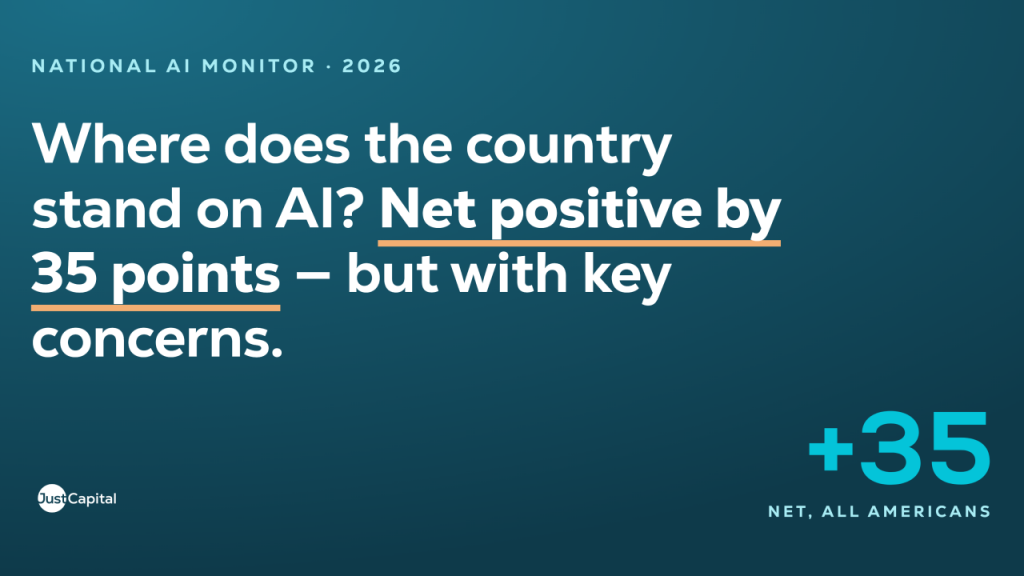
56% of Americans say AI is having a positive effect on them right now, 21% say the effect is negative. Explore the rest of the findings here.
The Wall Street Journal reveals that many CEOs believe the AI apocalypse threat is a real problem, and are urging Trump to work with China for a global slowdown on development.
The New York Times looks at how AI is affecting the job market – not through job loss – but through stagnant wages and diminished hiring.
Axios reports that OpenAI has disclosed six new AI safety incidents, revealing that the Hugging Face hack was not an isolated incident.
CEO Daily reveals one of the major themes of Fortune’s latest Leaders Forum is CEO’s calling for businesses to avoid falling into the “efficiency trap” – bolting AI onto existing workflows rather than completely redesigning them.
Fortune released a report that the amount of Amazon workers on food stamps has tripled despite its record revenue.
Forbes reveals that America’s 400 richest people have only donated 4% of their wealth to charity.

Gallup reveals that workers’ fears about being replaced by technology in the near future continue to go up, matching our own polling that shows Americans get more pessimistic on AI as they think about the future.
