Since 2015, Just Capital has asked more than 225,000 Americans how well our current form of capitalism is working for them and how large companies can play a role in creating a stronger economy and society.
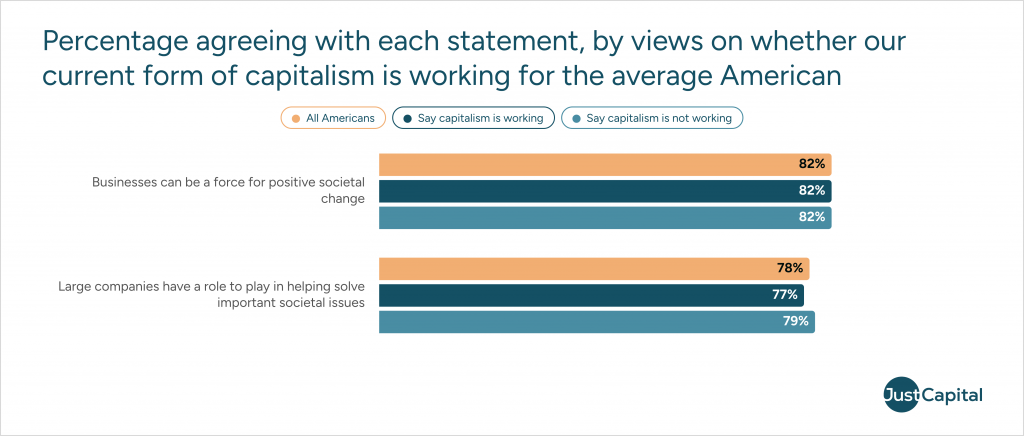
The 2026 Americans’ Views on Business survey found that while Americans consistently feel our current form of capitalism is not working for the average American they also believe business can and should be a force for positive change. Some views have shifted based on the current operating backdrop. The share of Americans believing shareholders are companies’ top priority has returned to 54% in 2026, after employees briefly gained ground during the COVID-19 pandemic (20% in 2019 to 37% in 2020).
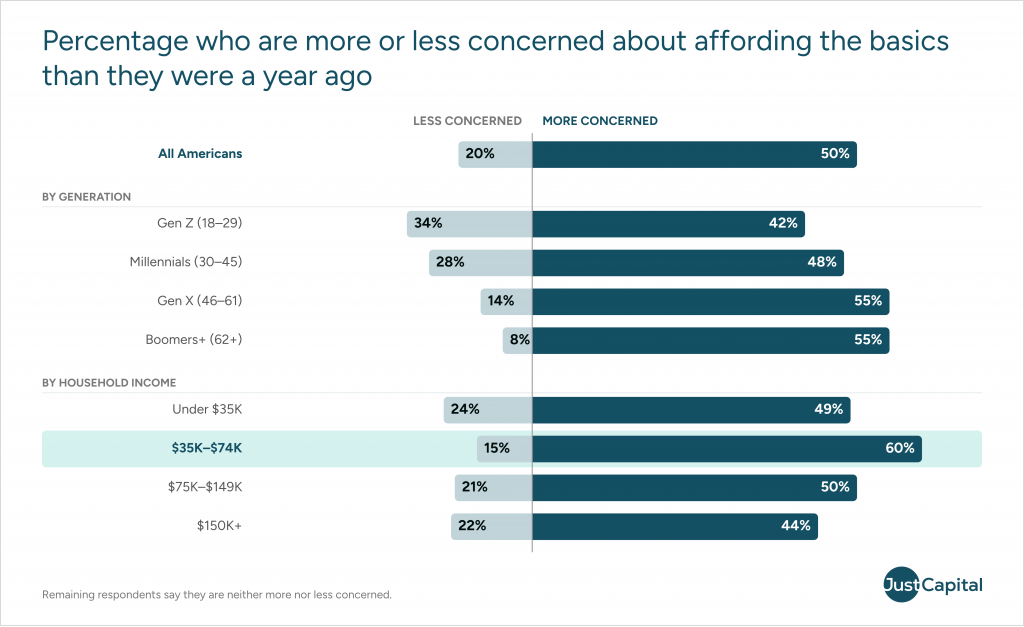
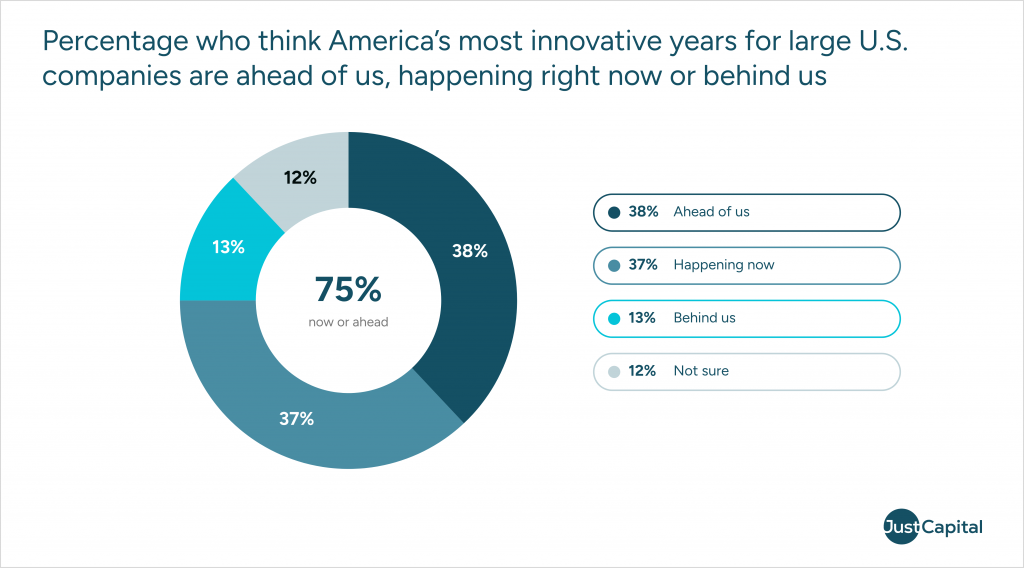
If COVID defined business in 2020, artificial intelligence (AI) defines it in 2026. Three in four Americans say our most innovative years are happening now or still lie ahead, but with labor’s share of national income at a new low and a crisis of affordability, they want innovation that creates tangible value in their everyday lives.
“2026 has highlighted trust and economic participation as defining factors in the AI era. Those who earn the trust of their stakeholders, and help them gain access to opportunity, will be the ones who win over time,” said Just Capital CEO Martin Whittaker. “We hope our research will help leaders in business, government, and finance better understand and navigate the current operating environment and identify how they can create value both for themselves and for the country.”
Explore the full report or view the key findings below.
Economic anxieties compound concerns about capitalism.
Despite this, belief in the power of business to create a better system remains steadfast.
Americans feel the country is in a golden age of innovation.
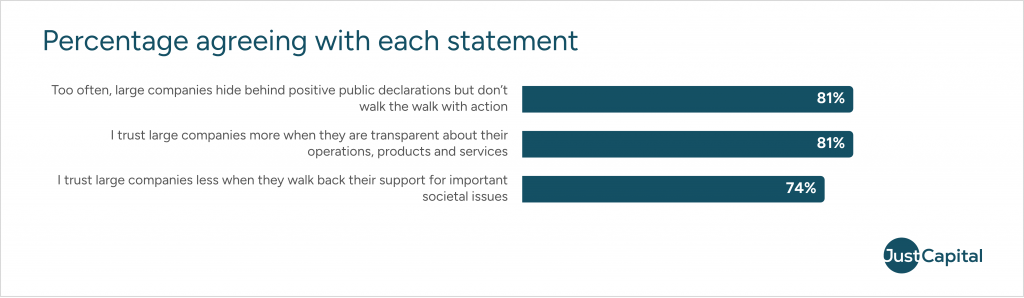
The public wants leaders to speak up and follow through.
Americans’ Views on Business Survey
This survey was conducted online within the United States by The Harris Poll on behalf of Just Capital from October 13 to 15, 2026, among 1,007 U.S. adults ages 18 and older. The sampling precision of Harris online polls is measured by using a Bayesian credible interval. For this study, the sample data is accurate to within +/- 3.6 percentage points using a 95% confidence level. This credible interval will be wider among subsets of the surveyed population of interest. For complete survey methodology, including weighting variables and subgroup sample sizes, please contact Jennifer Tonti at jtonti@justcapital.com.
Comparisons to prior years
The 2025 wave of the survey was fielded by Social Science Research Solutions (SSRS) among 2,004 U.S. adults. Because of the change in research partner and sample size, results for whether companies are going in the right direction and how well companies are performing are reported for 2026 only. Where other trends are shown, the change from 2025 to 2026 appears as a dotted line, and wording changes are noted beneath the relevant charts.
Generations
Generations are defined by age in 2026: Gen Z (18–29), Millennials (30–45), Gen X (46–61) and Boomers and older (62+).
