

The question of who shares in the wealth AI creates is a defining one. Should there be an “AI tax” for hyperscalers? Or an AI-based sovereign wealth fund? Maybe you think no special measures are needed. What’s clear is that most of the debate is happening among the people building the technology and the people who will regulate it, not the people it will potentially impact the most. So, this week, we fielded a national survey to ask Americans directly whether the wealth AI generates should be shared, and how.
The headline finding represents a point of agreement across demographics. Nearly two-thirds of Americans, 65%, say everyone should receive a direct financial benefit from the wealth AI companies generate. That view holds across the political spectrum, with 75% of Democrats, 62% of Republicans, and 57% of Independents in agreement. It runs strongest among the 25-to-44 year-olds most exposed to AI in the workforce, where support reaches a massive 78 to 80%, and it stays steady across income levels and gender.
What people want done with that wealth is more revealing. Across nearly every group, a direct cash payment funded by a tax on AI profits is the first choice. The exception is the youngest cohort. They lean instead toward structural mechanisms like public ownership stakes and sovereign-wealth-style funds, share transfers, and investment in worker retraining and AI safety.
I find this striking. The generation most likely to be impacted by AI, and with the most working years ahead of it, is not asking for a check. It wants a stake in the future and the means to compete. Business leaders and politicians seeking to win the favor of young Americans should pay close heed.
Be well,
Martin
For the last three quarters, Just Capital has been polling the American public, investors, and corporate leaders on AI deployment, tracking where perceptions converge and where gaps are widening.
Our third installment of quarterly polling on responsible AI deployment is now available in Just Intelligence for all registered users.
This research is designed to offer a roadmap for companies looking to build trust in the AI era and make informed decisions as the AI landscape evolves. It is the first iteration of an ongoing series that will continually surface insights from key stakeholders as companies aim to build trust, manage risk, and unlock AI’s upside potential for workers, customers, communities, and shareholders.
Axios examines new polling that shows data centers are turning into the focal point for anti-AI sentiment across the nation.
Reuters reveals that despite the fears, AI proliferation is having a muted effect on wages and workers.
At the same time, Gallup writes that while downsizing is continuing across the U.S., laid-off workers are only citing AI as the primary reason 1% of the time.
The Wall Street Journal speaks with Microsoft CEO Satya Nadella about his belief that we “can’t let AI giants eat the economy”. Read the full interview.
While they are experiencing a harder job search, The Guardian reveals that Gen Z employees who managed to snag a job are actually making more money than millennials did right after college.
Fortune takes a look at why men continue to drop out of the workforce at higher rates.
Yahoo! Finance holds a magnifying glass to CEO pay, and how more CEOs than ever are making more than $100 million a year.
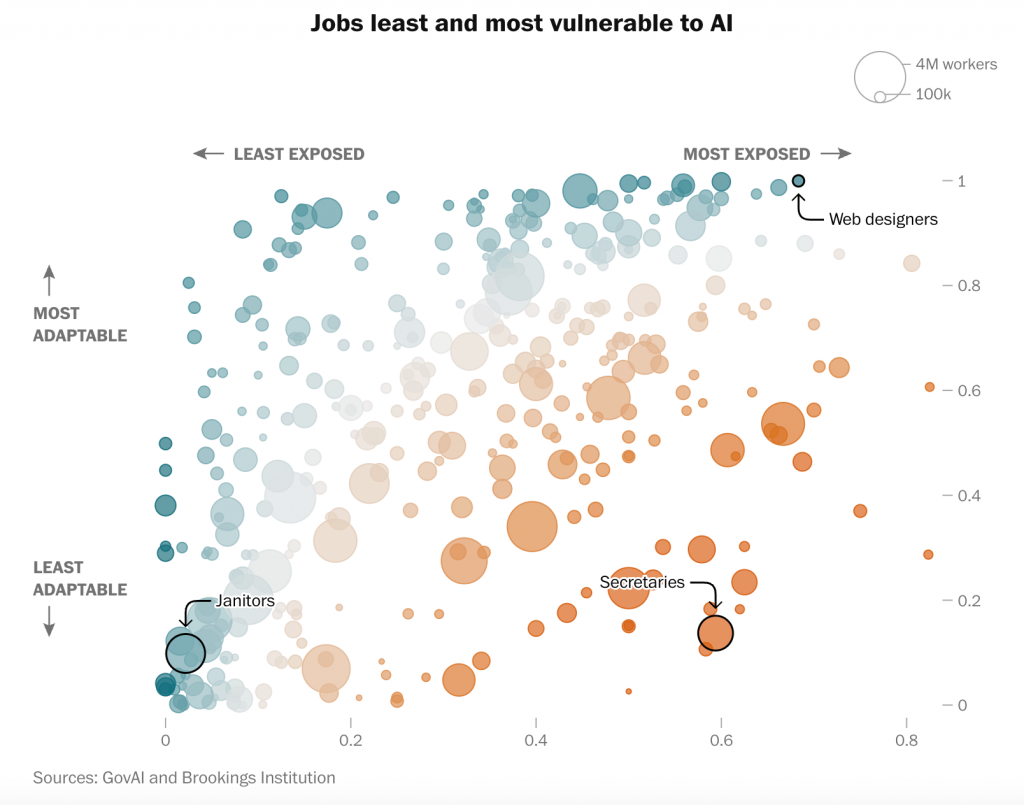
The Washington Post teams up with the Brookings Institute to examine which jobs are most-and-least vulnerable to AI-driven displacement.

Our third quarterly AI survey of the American public, investors, and corporate leaders is out this week and the results are striking.
Twenty-seven percent of corporate leaders report providing advance notice of AI-driven layoffs, 31% say they are offering transition support to laid off workers, and only 13% report contributing to an industry-wide fund to support displaced workers. Nearly a quarter of corporate leaders — 23% — say none of these support mechanisms exist at their organization, despite the fact that 22% now believe large-scale job losses are on the horizon (compared to 13% just one quarter ago).
We think one possible explanation for these wide-ranging responses is that most companies don’t anticipate or aren’t yet laying off at the scale that would trigger displacement programs, so those programs haven’t been built. Only 19% of corporate leaders report significant job cuts to date. Nevertheless, the gap between investor and public expectations and corporate action is widening. Sixty-four percent of the public and 57% of investors expect advance notice of workforce changes. Seventy-two percent of investors say companies should fund training and skill development. These stakeholders are concerned about widespread layoffs even if they’re not yet materializing.
Other interesting datapoints: The share of company leaders who believe business should spend over 5% of total AI investment to support displaced workers has more than doubled since Fall 2025 from 8% to 17%. And nearly 75% agree companies should invest in local communities through training and workforce development programs.
Are business leaders getting more concerned about what’s to come? Or more committed to building support with key stakeholders? Maybe both.
Be well,
Martin
This newsletter was written mostly by humans with a bit of help from AI.
We are expanding Just Intelligence to track how America’s largest companies are deploying AI responsibly and we want your feedback.
Through polling conducted over the last year, we have identified several AI issues that matter most to the American public and developed new data points that capture how corporate disclosures meet those expectations. We plan to incorporate these data points into our 2027 Rankings methodology.
If you belong to a company being measured, your perspective is essential to ensuring this research is relevant and actionable.
Please submit your feedback by July 8, 2026.
View the Data Points and Provide Feedback
Fortune highlights comments from Vista Equity Partners CEO Robert Smith imploring companies who are expanding their AI capabilities to continue to invest into intern programs for the next generation, saying “that’s an important part of bringing people along and, honestly, of creating optimism and a new group of technologists and thinkers who can carry this world.”
NBC News covers a historic bill that just passed in Illinois that would require AI companies to have 3rd party safety audits.
Fortune examines Goldman Sachs data showing new college students are shifting majors to those that are less at risk for AI automation.
Our CEO Martin Whittaker joined Yahoo Finance to discuss the findings in our latest AI polling.
The New York Times reports on the UK’s social media ban for children under 16, and the worries from company executives that other countries may follow suit.
Yahoo Finance examines the “30% rule” – the idea that Americans should only spend 30% of their income on housing – to see if it’s actually still feasible in this era of slowing wages and hyperinflation.
Axios looks at rising CEO optimism despite the current headlines.

Axios looks at how, for the first time, a majority of U.S. households have both parents working full-time.
63% of the American public and 67% of institutional investors and analysts believe AI-driven profit gains should be reinvested in workers. Corporate leaders instead prioritize reinvesting in R&D (72%) and delivering returns to shareholders (54%).
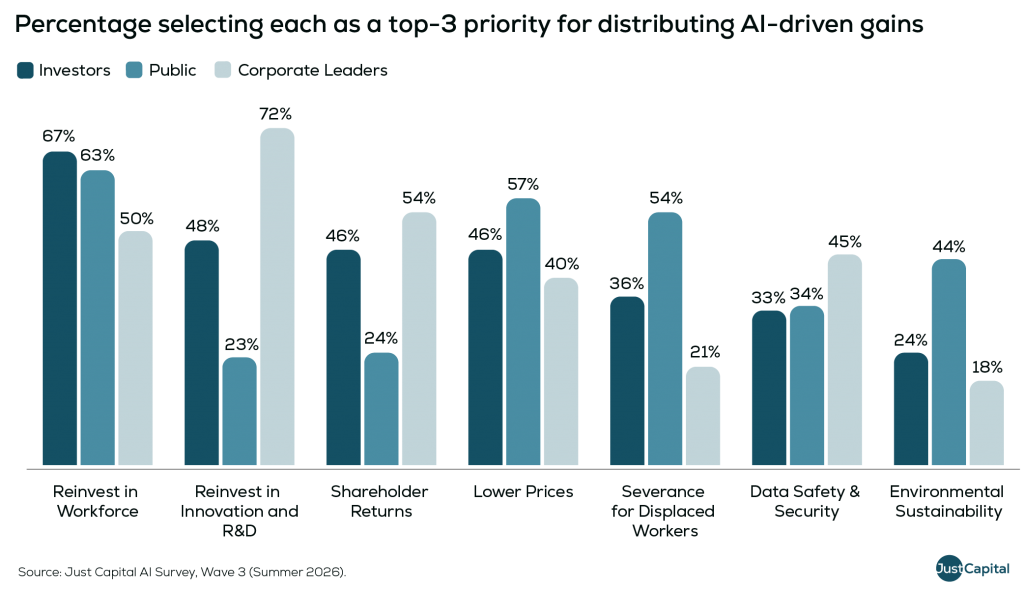
“Our research suggests some sizeable gaps exist between how corporate leaders think about AI deployment and what the public and investors would like to see,” said Just Capital CEO Martin Whittaker. “The public understands the economic upside AI helps to create – but they need convincing that they stand to benefit from the gains. Companies that are able to do that will be rewarded with greater trust and a stronger overall license to operate. As the impacts of the AI transition continue to take shape, this will be extremely valuable.”
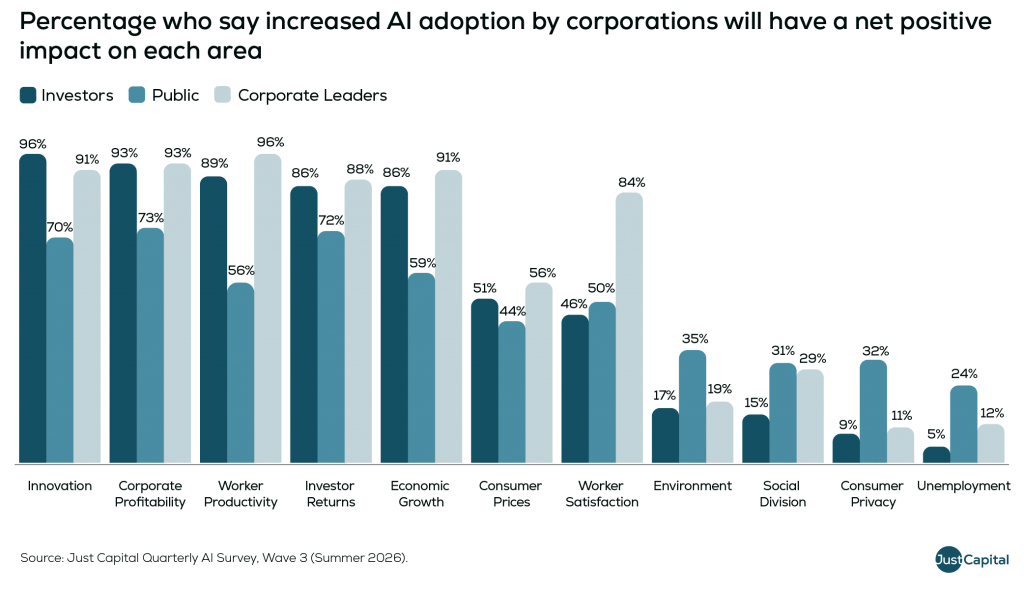
Public optimism on economic growth climbed 12 points (47% Fall 2025 to 59% Summer 2026).
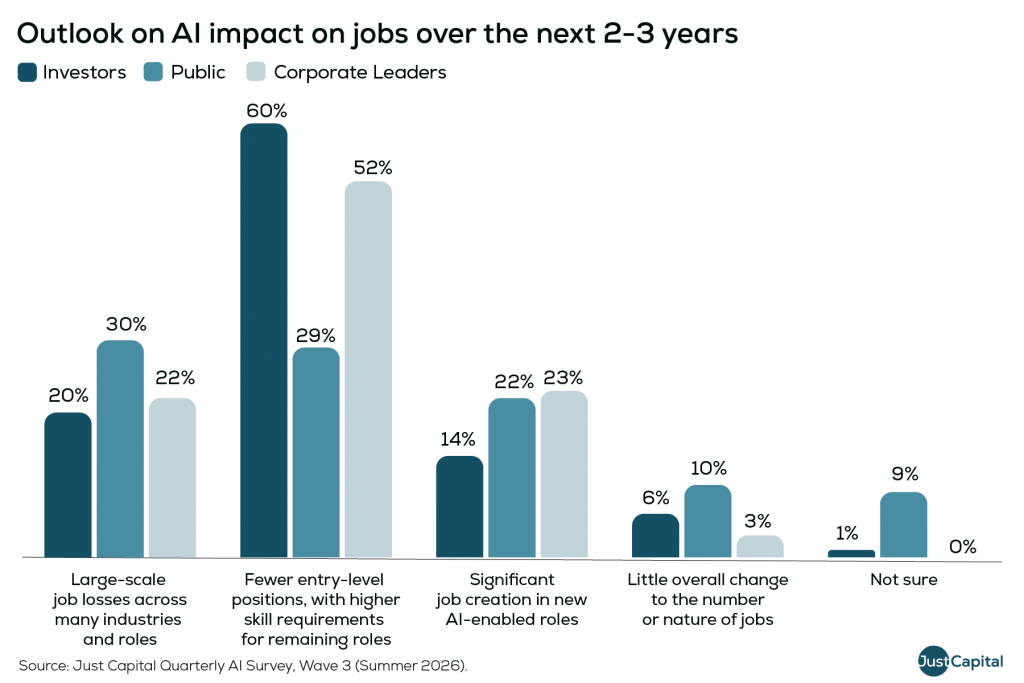
Worryingly, the share of corporate leaders expecting large-scale job losses within the next 2–3 years nearly doubled, from 13% in Spring 2026 to 22% in Summer 2026. The public remains equally concerned about large-scale job loss and fewer entry-level positions.
The share of corporate leaders willing to dedicate more than 5% of AI investment to support displaced workers has more than doubled in the past six months (9% in Fall 2025 to 17% in Summer 2026).
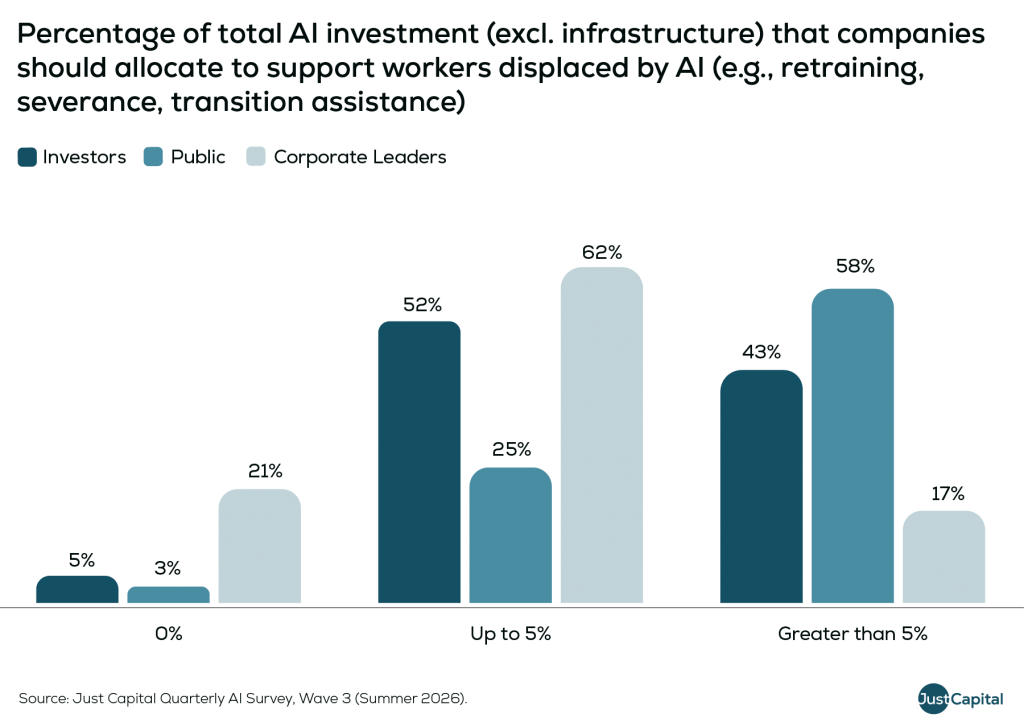
The analysis above comes from the third wave of Just Capital’s unique quarterly survey of the American public, investors, and corporate leaders, which is designed to offer executives insight from key stakeholders as they aim to build trust, manage risk, and unlock AI’s upside potential. By measuring how perceptions and priorities shift across these groups over time, Just Capital aims to help business leaders make fully informed decisions as the AI landscape evolves. The inaugural wave was conducted in Fall 2025, and the spring wave was released in April 2026

SpaceX will begin trading this morning with what is projected to be the largest IPO on record. I tend to look at these historic moments through a just lens. What does the average American expect of a company worth trillions of dollars? And what do they think of a single person being worth $1 trillion?
We decided to take these questions to the public. The results are illuminating for anyone looking to build trust in this era of extreme wealth – and were more measured and nuanced than one might expect.
Only 10% of Americans said a trillion-dollar company’s first responsibility is to its shareholders. Fully 80% want these companies to pay their workers well, give employees a real stake in the business, and reinvest in the communities where they operate. Creating value for stakeholders ranked far ahead of philanthropy. No-one is asking companies for a handout. They’re asking them to give others a stake in their success.
When it comes to extreme personal wealth, a majority, 57%, said it is acceptable for a single individual to be worth a trillion dollars or more. In today’s climate of anti-capitalist backlash that might be a surprise. But it comes with a string attached. The largest group, 34%, called it acceptable only if the wealth was built responsibly and without exploiting others.
The public is savvy. It’s OK to be wildly successful financially provided it has been done in a way that widens access to opportunity and builds value for others rather than extracting from them.
Be well,
Martin
This newsletter was written mostly by humans with a bit of help from AI.
The Wall Street Journal spoke with over a dozen leading economists on the effect AI will have on companies, workers, the country at large, and more. As expected, opinions run the gamut.
Fortune reports on Palantir CEO Alex Karp’s comments that companies touting AI layoffs are creating their own regulatory demise, stating: “if you run around saying AI allowed you to fire two-thirds of your workforce…you might as well just go sign up for the Bernie Sanders manifesto.”
Axios looks at how AI is helping mask America’s literacy crisis – with nearly 160+ million Americans unable to read past a 6th grade level – and how it might continue to exacerbate the problem.
The New York Times looks at Trump’s idea for the government to take a stake in major AI corporations.
Courts have struck down President Trump’s $100,000 fee on H1-B visas. The Washington Post has the story.
Meta is launching America’s Workforce Academy, an initiative to fast-track more Americans into trades with a starting investment of $115 million.
CNBC looks at why 51% of U.S. adults believe that the American dream is out of reach for most people right now.
The Disruption Lab highlights the life and work of former Just Capital board member Dan Hesse, and the lesson that “If your system separates business from community, it will produce growth that doesn’t reach the people who need it most…because the architecture wasn’t built to connect them.”

Axios looks at how inflation has risen to its highest point in the last three years, and how it’s affecting families across the U.S.
For years, the working assumption has been that performing well on so-called “non-financial” stakeholder metrics is detrimental to a company’s profitability and financial performance. New analysis from Just Capital finds that, in fact, the two move positively together in statistically significant ways much more frequently than they diverge.
The research compares Russell 1000 company performance across five stakeholder groups – workers, customers, communities, environment, and shareholders and governance – with four financial metrics: economic profit margin, excess return (alpha), gross margin, and revenue growth. Overall, the results provide insight into the connections between financial and stakeholder leadership, how it varies across industries and issues, and where it appears to be strongest and weakest.
1. All industries have at least one opportunity to improve financial performance through strengthened stakeholder performance. Each company’s unique opportunity is dependent on their industry, and the stakeholder and financial metric in question.
2. The research identified the strength of relationships between each stakeholder and each financial outcome. Among the relationships that reach high statistical confidence, positive links outnumber negative ones by nearly two to one.
3. The strongest relationships between worker performance and returns are in the Consumer Discretionary, Financials, and Real Estate industries; companies that led on worker-related issues subsequently posted the greatest improvements in excess returns, suggesting a potential cause-and-effect relationship.
4. In Technology, companies that made meaningful investments in communities, environment, and governance practices saw the highest subsequent gains in revenue growth.
5. In Telecommunications, the firms with the strongest customer and environment performance delivered the highest improvements in gross margin.
The strongest overall positive relationships across stakeholder metrics and industries were found to be with revenue growth and excess return (alpha), indicating that both the market and customers can reward companies for their stakeholder leadership.
To enable companies to explore how their specific financial and stakeholder performance profile matches up, Just Capital built a new Financial Opportunity module within the organization’s flagship Just Intelligence product.
Although these correlations do not represent a causal relationship with forecasted or guaranteed returns, they provide a valuable input to C-suite decision making and a directional signal for where and how stakeholder and financial performance appear to be linked.
“This is the connection leaders have long sensed but struggled to prove,” said Just Capital CEO Martin Whittaker. “We can now show, industry by industry, where strong stakeholder investment and impact can align with strong financial performance. That moves the conversation from whether the two are related to where a company should focus first.”
The Financial Opportunity module is currently available to subscribers of Just Intelligence.
Just Capital will conduct additional analyses related to financial performance including the mechanisms that underlie these relationships. Future analyses will explore issue-level performance and the relationship to other financial performance measures such as return on invested capital and total shareholder return. The organization will also be building additional modules within Just Intelligence to inform business strategy and responsible AI deployment.
“Our commitment is to keep improving Just Intelligence so leaders always have the sharpest possible view of what drives performance,” said Whittaker. “That work is in service of something bigger, a vision of business where financial success and the wellbeing of workers, customers, and communities move forward together.”
The research builds on Just Capital’s history of exploring how meeting the expectations of the American public drives business results. The organization’s Just 100 Index has outperformed the Russell 1000 equal-weighted benchmark by 79% since inception in 2019.
The research that underpins the Financial Opportunity module was completed in collaboration with New Constructs and used a statistical approach that involved all 767 companies present in the Russell 1000 universe between 2021 and 2025. The analysis was conducted industry-by-industry based on the 11 Industry Classification Benchmark Industries.
For each company, Just Capital compared their annual financial performance measured by economic profit margin, excess return (alpha), gross margin, and revenue growth to their annual performance on key issues that the public has identified as priorities in Just Capital’s polling. The issues are aggregated by stakeholder: workers, customers, communities, environment, and shareholders & governance.
The analysis contained two periods: Period 1 (2021-2023) and Period 2 (2024-2025). The research compared average stakeholder performance in Period 1 with the change in financial performance between Period 1 and Period 2, in order to determine whether strong stakeholder performance results in improved financial performance over time.
For media inquiries, please contact:
Evangeline DiMichele: edimichele@justcapital.com
The boos that greeted Eric Schmidt when he raised the subject of AI during his commencement speech at the University of Arizona reflect an interesting cultural touch point. Days earlier, a real estate executive at the University of Central Florida got the same response. New graduates, it seems, are voicing their fears over one of the toughest hiring markets in years.
It’s against that backdrop that ServiceNow President and CFO Gina Mastantuono shared an interesting perspective on LinkedIn this week. One of the biggest mistakes companies can make in the age of AI, she wrote, is overlooking early-career talent. AI is automating some of the repetitive tasks that used to define entry-level roles, but the answer is not to pull back on investing in young workers; it’s to rethink how we develop them. Early-career employees are often the most AI-native people in the building, Mastantuono points out. They come in with “fresh eyes and fewer assumptions.” Pair them with experienced leaders, she asserts, and reverse mentoring happens naturally.
ServiceNow’s showing in our measures of workforce performance reflects that conviction. The company sits in the top 5% of its industry on career development, a measure that draws on internal hiring rate, tuition reimbursement, talent retention, and average hours of training delivered to employees. It also ranks in the top 5% for percentage growth of U.S. jobs. Oh, and their revenue is on track to grow more than 350% since Bill McDermott became CEO in 2019.
The boos at graduation ceremonies speak to understandable anxieties and fears. ServiceNow’s approach shows a concrete way forward for business leaders looking to become stewards of the next generation and drive growth.
Be well,
Martin
This newsletter was written mostly by humans with a bit of help from AI.
Semafor looks at how recent college graduates are dealing with a distorted labor market as companies reduce junior hiring while increasing AI adoption.
Meanwhile, The Wall Street Journal reports that in fact some companies are hiring more entry-level workers, particularly those with AI skills.
The Economist argues that governments need to start implementing additional safety nets now before the full impact of AI on the labor market is felt.
Meta is laying off roughly 8,000 employees as it restructures around AI priorities and operational efficiency.
Fortune reports that Pope Leo is launching an AI commission to look at the effects the technology poses for the well-being of humanity.
Inc. reports on a recent statement from Barnes and Noble’s CEO that he’d be willing to sell AI books if they were clearly labeled.
Bloomberg reports that roughly one-third of American workers are now treated as highly replaceable labor.

This chart from Axios looks at the public’s growing concern around the speed of AI development.
