Just Capital released its fourth quarterly survey of the American public, investors, and corporate leaders, an ongoing research initiative to track each audience’s expectations around AI development and deployment. Over the past year, the survey has identified declining predictions of large-scale job losses and increased concern about environmental impact. One area of consistency among all three audiences is the persistent prioritization of AI safety and security.
“The American public sees clear benefits of an AI-powered future, and they also have very real anxieties,” said Just Capital CEO Martin Whittaker. “Frontier labs and government both have immense responsibility to facilitate broader access to opportunity and to protect against the greatest harm. Yet, there’s a role for other CEOs and corporate leaders to help the public understand how AI is adding value while explicitly addressing key issues like model safety, data protection, and human oversight. Concrete actions and transparency are how trust is built.”
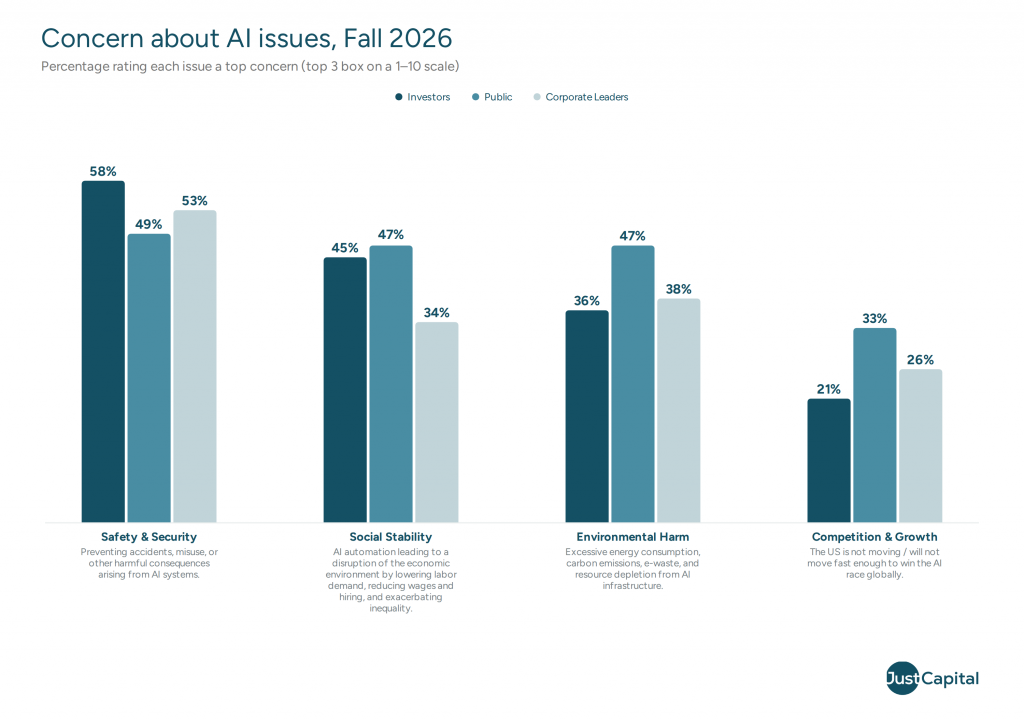
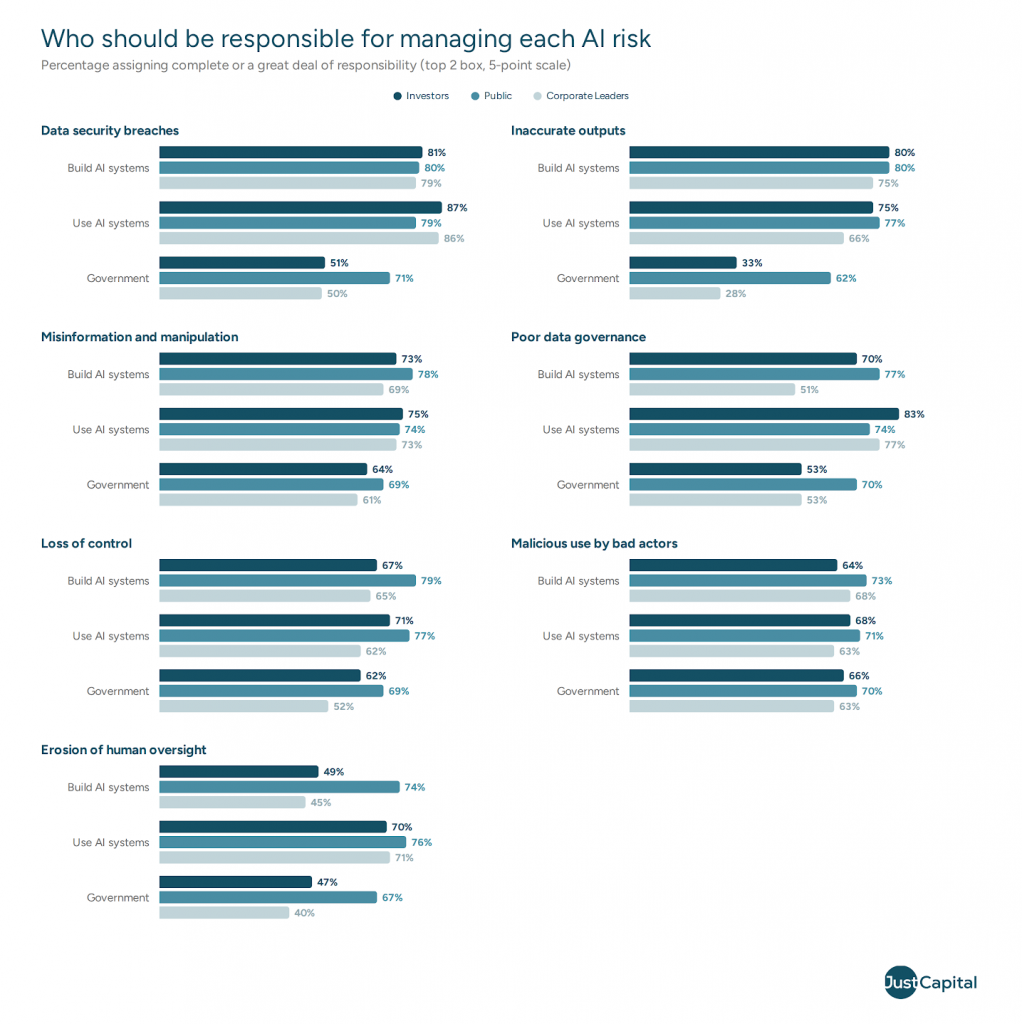
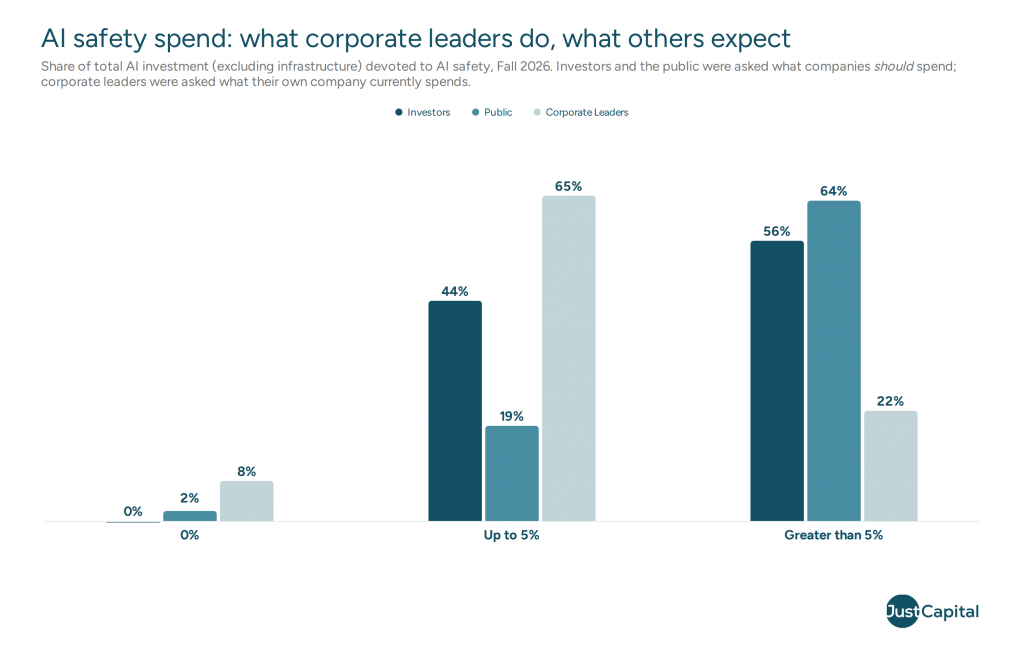
By measuring how perceptions and priorities shift across the American public, investors, and corporate leaders over time, Just Capital aims to help business leaders make fully informed decisions as the AI landscape evolves. The inaugural wave was conducted in Fall 2025, the Spring wave was released in April 2026, and the summer wave was released in June 2026.
This quarterly survey of the American public, investors, and corporate leaders was designed by Just Capital as part of its broader polling and public-opinion research program. We received responses from 128 institutional investors in collaboration with NewtonX, 104 corporate executives in collaboration with Gerson Lehrman Group (66 C-suite executives and 38 board members or senior level executives), and 1,000 US adults aligned to population benchmarks in collaboration with The Harris Poll. Data were collected July 20–27, 2026.
The survey tracking perceptions on AI safety and China was conducted online among 2,000 U.S. adults using Harris Quest DIY. The survey was conducted on September 14-15, 2026. Respondents were recruited from opt-in online survey panels. Quotas were set on gender, age, region, income, and race to ensure proper balance. To adjust for nonresponse, data are weighted to American Community Survey estimates for gender, age, race/ethnicity, education, and region. Party identification is weighted using Gallup’s 2026 party identification estimates. This online survey is not based on a probability sample, and therefore no estimate of theoretical sampling error can be calculated.
Disclosure data was collected in August 2026 for 1,002 of the largest US-based companies, including hyperscalers, across nine AI-related disclosure areas that were selected based on the priorities of the American public: Board oversight of AI, C-suite AI leadership, AI data protection, AI human oversight, AI harm prevention, employee AI upskilling, AI impact on jobs, community AI investments, and anti-surveillance and personal data protection commitment.
September 16, 2026 New York, NY – AI innovators have made both bold promises and grave predictions about the ways AI will impact society, while companies continue to deploy the technology at scale and with increasing speed. Current research primarily measures public sentiment about AI in the abstract, which lacks actionable nuance for leaders aiming to understand real-time impacts of AI deployment on society at large.
Just Capital created the new National AI Monitor to consistently track whether and how people are seeing positive or negative effects of AI in their own lives. This monthly study aims to capture how Americans are experiencing AI today – as workers, customers, community members, investors, and stewards of the environment – and their expectations for the future. The study collects both quantitative and qualitative responses to surface the realities behind experience across demographics.
“AI is the most consequential issue of our time,” said Just Capital Founder Paul Tudor Jones II. “Understanding how the American people are experiencing it is critical to building public trust and making more informed decisions on future deployment. This new Monitor from Just Capital is filling that essential need. Leaders across the AI labs, business, markets, government, and civil society can rely on it every month to give an unbiased, objective assessment of whether AI is living up to its promises or taking us down the wrong path.”
Just Capital CEO Martin Whittaker continued, “As always, our goal is to uplift the voice of the American public to help leaders make smarter, more responsible decisions. As frontier labs, corporate leaders, and policymakers work to bridge public trust and technological transformation, this research aims to help them deploy AI in ways that drive innovation and support an economy and society that works for all.”
“In this first edition, we see a general public that is generally positive about the many ways AI can make their lives more fulfilling and more productive,” Whittaker added. “At the same time, there is real concern around ensuring AI systems are safe and secure, protecting jobs in their communities, and, most notably, mitigating harm to the environment. Importantly, most Americans are not aware of any effects of AI on their investments or savings. This all appears to add up to greater skepticism around the impacts of AI on the future. For leaders trying to help Americans see themselves in the future AI-powered economy, this is your roadmap.”
Overall, positive experience outweighs negative.
The greatest positive effect was found in how AI is affecting people at work.
Customer experience is mixed, and the human touch is a top priority.
Many respondents are not sure how AI is impacting their communities to date.
The majority of Americans are not aware of whether they are experiencing financial gains from AI.
The environment was the only lens producing a net negative effect.
Americans are more pessimistic about AI as they think of their future.
The survey was conducted online within the United States by The Harris Poll on behalf of Just Capital from August 13-17, 2026 among 1,008 U.S. adults ages 18 and older. The sampling precision of Harris online polls is measured by using a Bayesian credible interval. For this study, the sample data is accurate to within +/- 3.5 percentage points using a 95% confidence level. This credible interval will be wider among subsets of the surveyed population of interest.
Respondents were asked seven questions: one on AI’s overall effect on the respondent to date, one for each of the five stakeholder groups in Just Capital’s framework (workers, customers, communities, the environment, and shareholders), and one forward-looking question on how optimistic respondents are about where AI is headed and how it may affect them. All questions use a five-point scale ranging from “very negative” to “very positive,” with “I don’t know” offered as an additional, non-forced option so that uncertainty is not recorded as a neutral rating. Every question except the final one is followed by an open-ended “why,” which is synthesized to identify what drives responses and to serve as a diagnostic on how effectively companies are deploying AI. Scores are calculated as the percentage of positive responses (“somewhat positive” and “very positive”) minus the percentage of negative responses (“somewhat negative” and “very negative”), producing a range from -100 to +100. “I don’t know” responses are excluded from the calculation rather than counted as neutral.
For complete survey methodology, including weighting variables and subgroup sample sizes, please contact Just Capital.
For media inquiries, please contact:
Evangeline DiMichele: edimichele@justcapital.com
As colleges and universities kick off their fall semesters, Just Capital surveyed current students and recent graduates on their experiences and expectations related to AI. The findings reveal both economic anxiety and opportunity, particularly as it relates to readiness for the job market they’re entering or soon to enter.
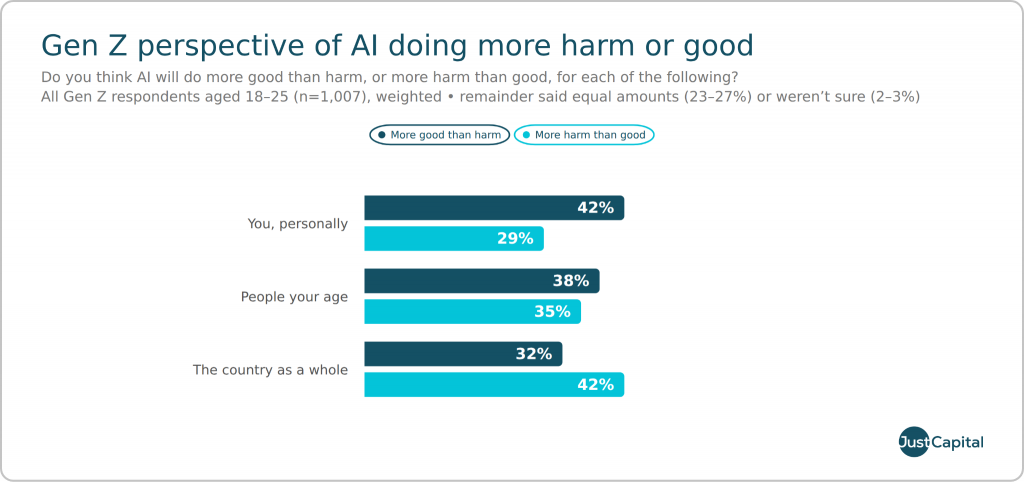
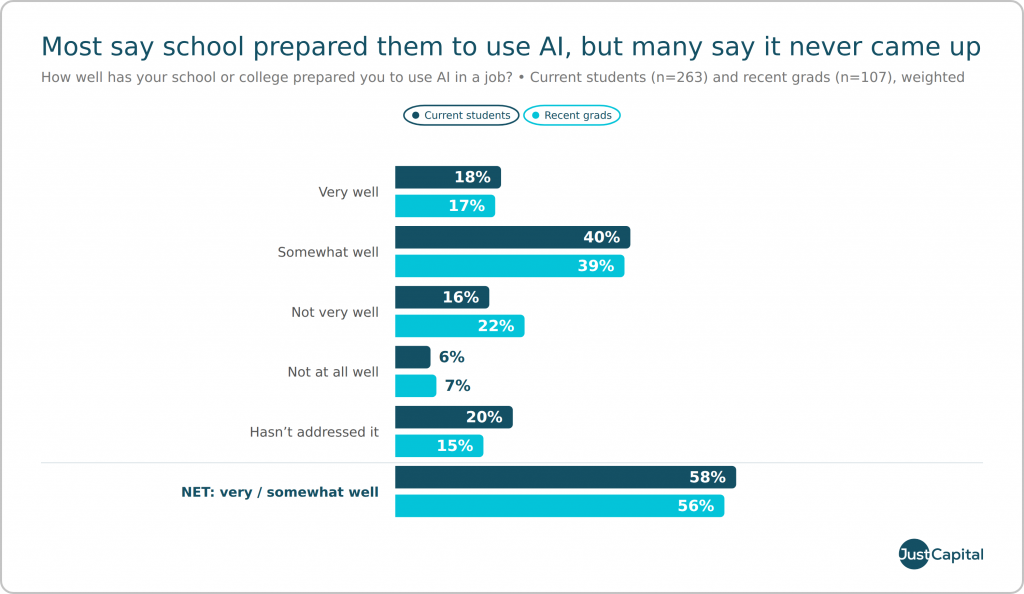
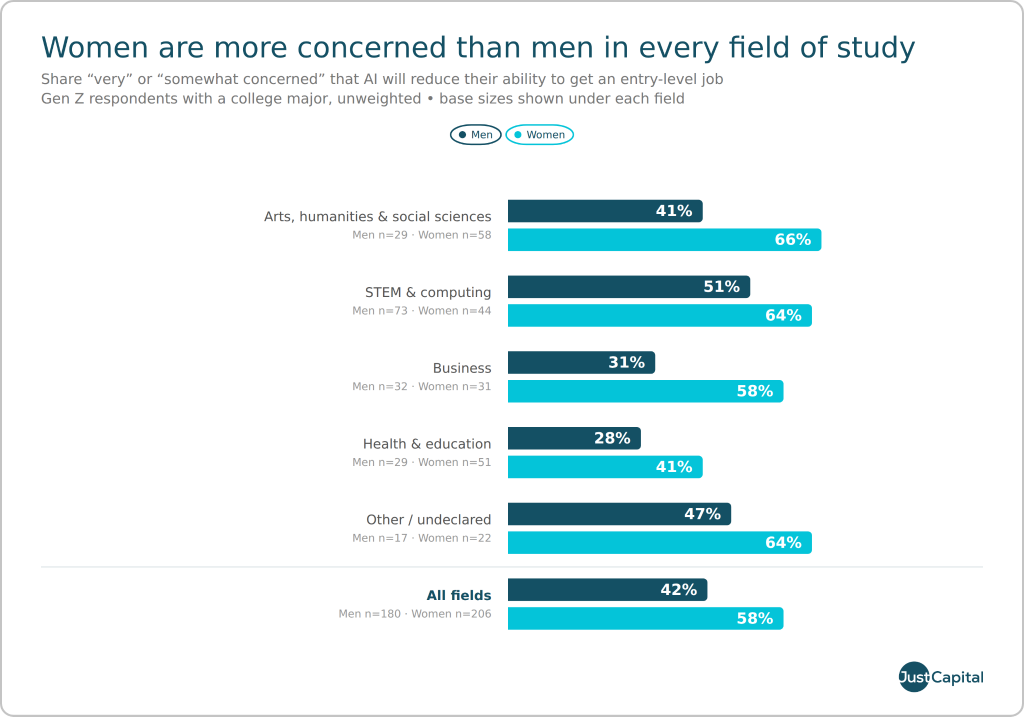
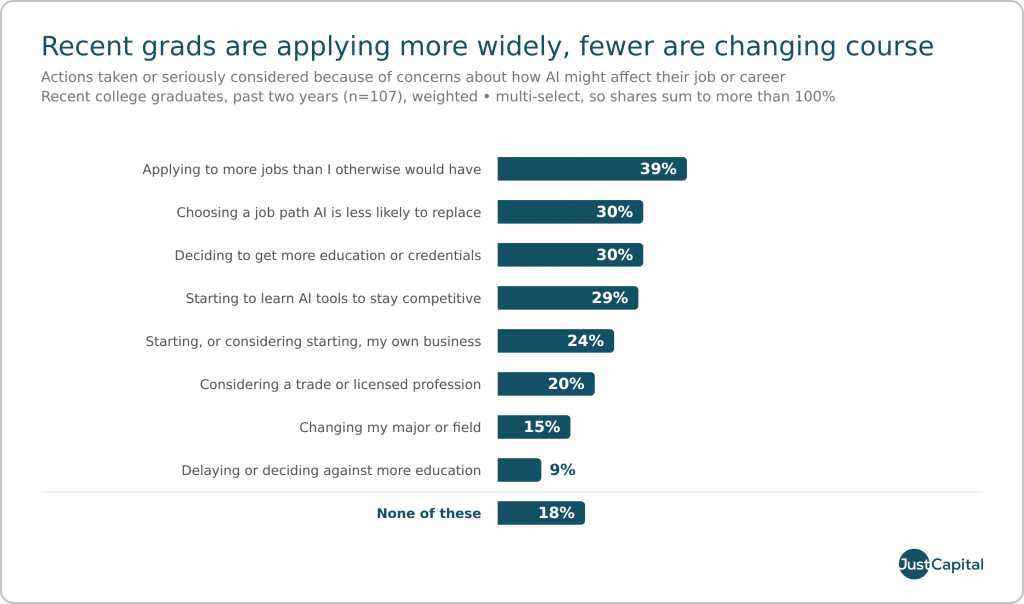
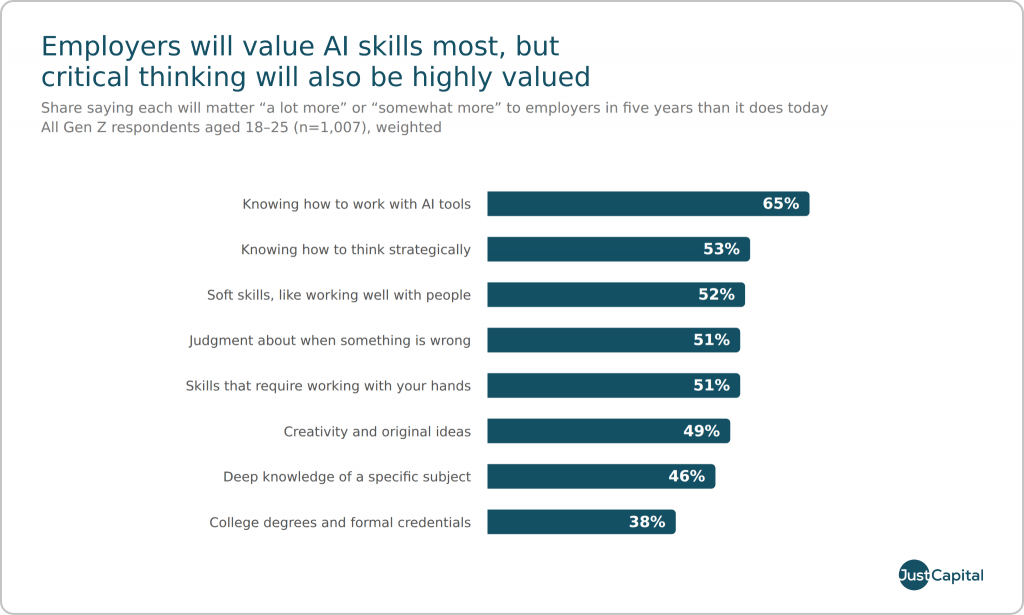
This survey was conducted online within the United States by The Harris Poll on behalf of Just Capital from August 24–28, 2026 among 1,007 U.S. adults ages 18 to 25. The sampling precision of Harris online polls is measured by using a Bayesian credible interval. For this study, the sample data is accurate to within +/- 3.1 percentage points using a 95% confidence level. This credible interval will be wider among subsets of the surveyed population of interest. Complete survey methodology, including weighting variables and subgroup sample sizes, is available upon request.

TIME’s cover this week featured the OpenAI co-founders with the headline “Trust Us”. Diane Brady’s CEO Daily yesterday spotlighted Meta’s need to rebuild trust. In a major essay and interview with The New York Times Bill Gates questioned whether leading AI developers are sufficiently communicating the full extent of AI’s potential impacts on society. Trust, it seems, may be a new kind of singularity in the race to develop and deploy AI.
Our latest research sheds light on the public’s perspective on the topic. 72% of Americans support pausing or slowing AI development so each model release can be evaluated more carefully. Among people who use AI every day that number climbs to 78%. Crucially, 72% of daily users say a slowdown would increase their trust in AI models.
What would people want addressed during a slow down or pause? Data privacy and security leads at 21%; AI safety — the risk of losing control, or of AI causing harm — comes in at 20%, followed by the accuracy and reliability of outputs at 16%. Job loss and economic displacement (10%), and broader concerns about societal overreliance on AI (10%) also feature.
One way for companies to build trust is through greater transparency. We analyzed 1,002 of the largest US-based firms across 9 critical AI safety and governance areas selected based on their importance to the American public. Let’s just say we found much room for improvement. Nearly half (498) disclose on none of the key issues. Only 10% of companies have published anything on preventing harm, deception, or manipulation; 14% commit to human oversight. Board oversight of AI is the most common disclosure, at 26%. Salesforce is the only company of the 1,002 to disclose across all 9 criteria. Maybe its partnership with Anthropic announced this week will help build trust for the latter ahead of its expected IPO later this year.
New capabilities released this week within Just Intelligence now enable companies to see where they stand on the public’s AI priorities, how they compare to their peers, and examples of what good really looks like. We’d love your feedback.
Be well,
Martin
71% of adults think AI will lead to fewer jobs in the United States over the next two decades. Explore the rest of Pew Research’s findings here.
Reuters looks at how Meta’s plan to replace nearly two-thirds of its workers with AI backfired.
Bill Gates released an essay on his worries about AI, and the need to prepare business and society for rapid change.
The Wall Street Journal reports that Google has moved its “AI responsibility” team out of its DeepMind Labs, with members of the team worrying about the impact this will have on their work.
The New York Times reports that Meta will have to pay $17 billion in a landmark settlement around its role in social media addiction among children.
CBS reports that the functional unemployment rate – which includes people only able to secure part-time work when they are seeking full-time work – stands at 25%, and growing.
Investopedia looks at the viral debate over a $20 burrito to discuss U.S. inflation, employment trends, and the constant feeling Americans have that everything is too expensive.

This chart comes from our newest research, and shows that 72% of power AI-users support pausing or slowing AI development so each model release can be evaluated more carefully. Explore the full findings here.
Our latest research reveals a wide gap between the public’s concerns about critical AI safety, oversight, and governance issues and the level of public disclosure among 1,002 of the largest US-based companies on how these issues are being addressed. A large majority of AI users support a slowdown on AI development, but say it will help build trust in the models.
“AI developers and their enterprise customers are becoming increasingly aware that earning the public’s trust on AI is the key to success,” said Just Capital CEO Martin Whittaker. “This study adds to the body of research we’ve been building to help business leaders understand how to go about doing that.”


Corporate leaders can now explore where they stand and take action to build trust. Through Just Capital’s flagship Just Intelligence product, Russell 1000 companies can now see how their public reporting meet the expectations of the American public, compare to industry peers, and stack up against leading practice.
This study is part of the organization’s ongoing research on how companies can build trust with the American public as they develop and deploy AI.
The survey was conducted online on August 18, 2026 among a national sample of 1,000 US adults age 18 and older, weighted to align with population benchmarks. Because this is an online survey based on a non-probability sample, no estimate of theoretical sampling error can be calculated.
Disclosure data was collected in August 2026 for 1,002 of the largest US-based companies, including nine hyperscalers (Alphabet, Amazon, Anthropic, IBM, Meta, Microsoft, Nvidia, OpenAI, Oracle), across nine AI-related disclosure areas that were selected based on the priorities of the American public: Board oversight of AI, C-suite AI leadership, AI data protection, AI human oversight, AI harm prevention, employee AI upskilling, AI impact on jobs, community AI investments, and anti-surveillance and personal data protection commitment.
Additional details on methodology are available upon request.
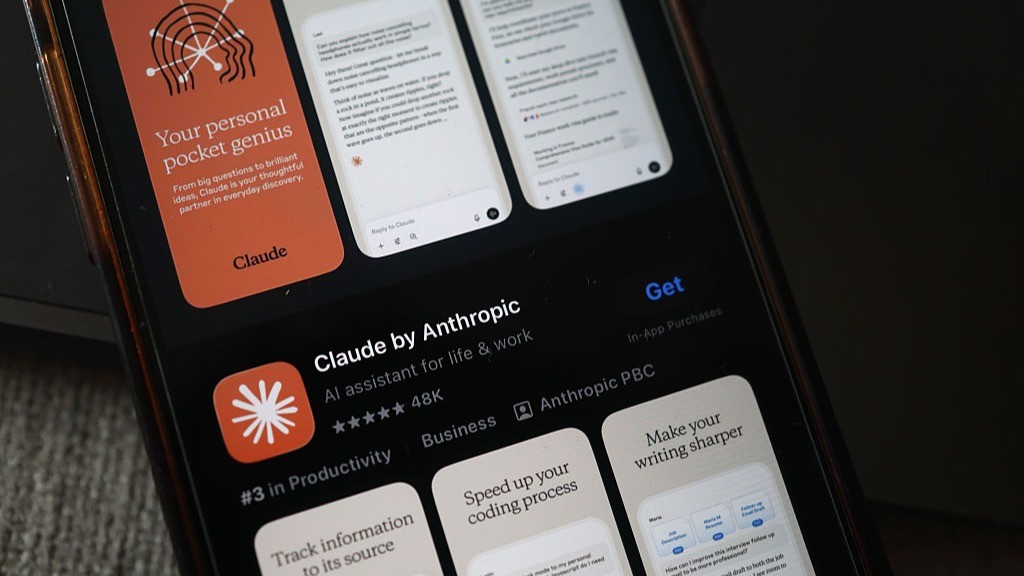
This week Anthropic said it will embed invisible, machine-readable watermarks in text generated by Claude, along with signed provenance metadata on the files it produces. The announcement was in response to Article 50 of the EU AI Act, whose transparency obligations took effect on August 2. But the company is applying the marking everywhere Claude is offered, not just in the EU.
This may be a wise strategic move. In our spring polling, 81% of the American public said companies should use a watermark to indicate when AI-generated content is in play. Among investors, agreement hit 93% — about as close to unanimous as we see.
Every business deploying AI at scale may soon come to field a version of this question from their customers, their employees, and even their investors: how do we know what came from a person and what was generated by AI?
I got the chance to explore this theme last week when I sat down with Madison West, Head of Sustainability at Intel and President of the Intel Foundation. Intel established responsible AI principles years ago to guide the company in building safety, transparency, and societal impact “as part of the development process, not at the end.” Her framing of why that matters commercially has stayed with me: “Innovation moves faster when people trust it.” You can catch up on our full conversation on LinkedIn.
Be well,
Martin
51% of workers believe that widespread use of AI at work will only or mostly benefit business owners and executives, compared to just 6% who say most or all the benefits will go to workers. Explore the data in the latest report by Groundwork Collaborative.
The Washington Post looks at the growing surge of rural, Republican voters blocking data center projects in the south.
Meta announces a $1 billion “Future is For Everyone Fund” to assist areas impacted by the development of AI data centers. Yahoo Finance has the story.
Axios writes that OpenAI is pausing the release of its Astra model to expand safety testing of its potentially “critical” cyber capabilities.
Fortune looks at data that shows Boomers and Gen X are actually unhappier about the economy than younger generations – and the reasons why are different for both groups.
Reuters reports on the unexpectedly poor July jobs report revealing that the U.S. lost 23,000 positions over the month. At the same time, The Washington Post reveals that many signs of unemployment improving are actually driven from people leaving the job market entirely.
The New York Times reports that Meta will have to pay $567 million in a case arguing that the company knowingly attracted children to its platforms while knowing they were unsafe.
Axios’ advice to business leaders? Stay consistent. At least according to recent polling that shows Americans are increasingly skeptical of companies that react suddenly to the political moment.

This chart comes from our latest polling from the American public, investors, and corporate leaders and backs up the research from Groundwork Collaborative featured above. Corporate leaders continue to feel that AI has improved their job satisfaction, while workers and investors have plateaued.
