In the second quarter of 2024, global equity prices continued their robust performance, contributing to an impressive one-year rebound. The S&P 500 Index rose by 4.3% during this period, though many segments of the domestic stock market, including mid and small-cap indices, lagged behind and declined. Among large-cap stocks, the average stock fell by 2.6%, as indicated by the equal-weighted version of the S&P 500. The quarter experienced fluctuations, with April seeing a downturn that reversed some Q1 gains, but a rebound in May led the S&P 500 to set multiple new all-time highs. The quarter concluded with strong stock market gains, fueled by robust company earnings and easing inflation, elevating the S&P 500’s year-to-date performance to 15.3%.
The strong performance of the S&P 500 was primarily driven by the Information Technology and Communication Services sectors, with ongoing enthusiasm around AI boosting related companies amid strong earnings and optimistic outlook statements. The Information Technology sector alone accounted for 95% of the Index’s gain, with NVIDIA leading the charge and contributing nearly half of the S&P 500’s return. Conversely, cyclical sectors such as Financials, Industrials, Health Care, and Materials were the biggest underperformers.
As of June 30, 2024, our flagship index – the JUST U.S. Large Cap Diversified Index (JULCD) has out-performed the Russell 1000 (Cap-Weighted) benchmark by 1.51% year-to-date and by 13.78% since its inception. Additionally, the JUST 100 (equally weighted index) has outperformed the Russell 1000 (Equally-Weighted) index by 6.65% year-to-date and by 44.77% since its inception.
JUST Capital found that all of the five stakeholders we track delivered positive performance in Q2 2024. The Workers stakeholder delivered the strongest performance over this period with a long-short spread of 4.68%. Within the Workers stakeholder, outperformance was driven by both the top and bottom deciles whereas for remaining stakeholders outperformance was driven by top decile.
JUST Capital’s Overall Weighted Score takes into account the 20 core Issues determined through our annual survey research – including paying a living wage, creating a diverse, inclusive workplace, and helping combat climate change – across key business stakeholders: Workers, Communities, Shareholders & Governance, Customers, and Environment. This Overall Weighted Score had a positive long-short spread of 2.89% over the period ending June 28,2024.
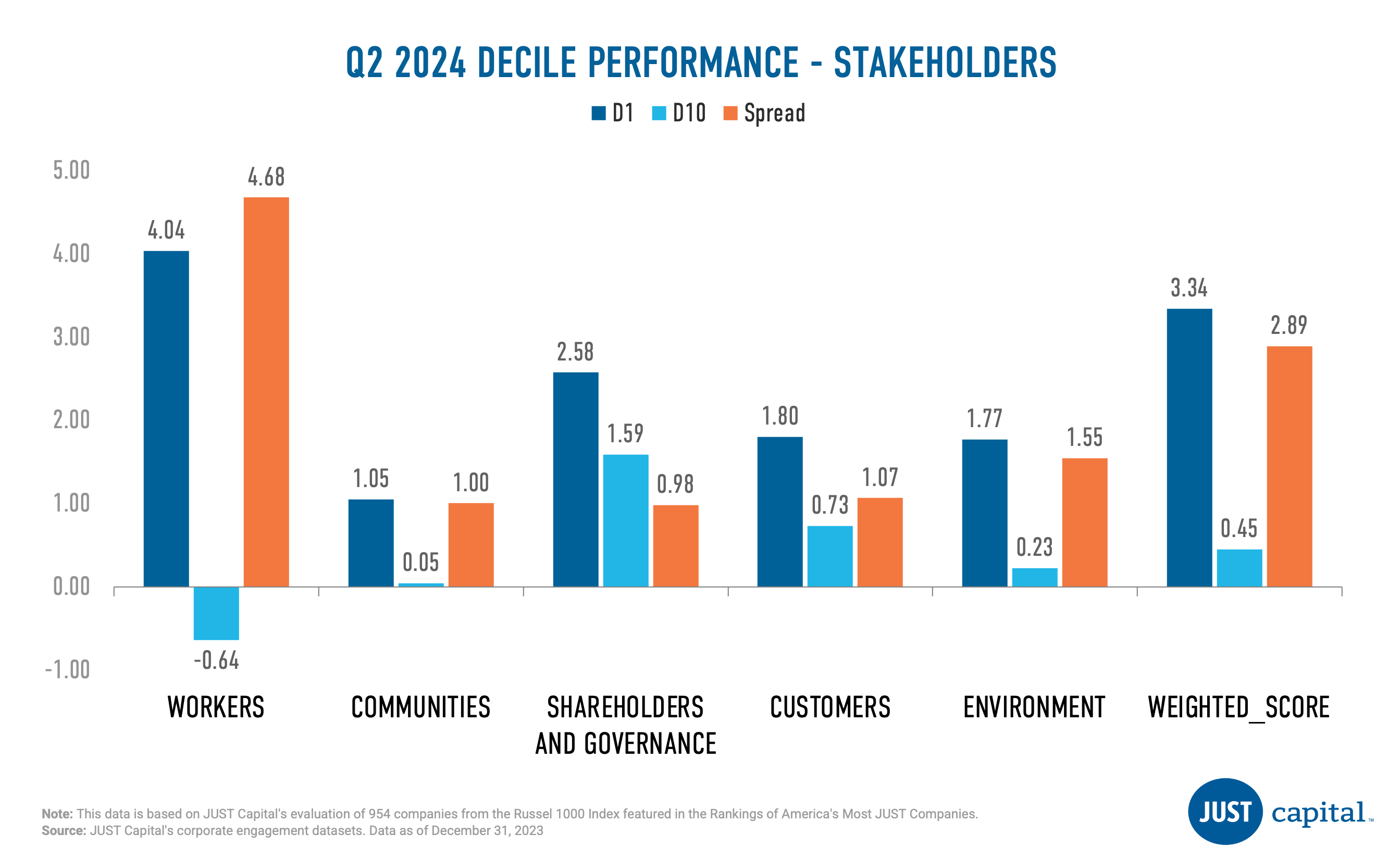
The Workers stakeholder measures a company across five Issues:
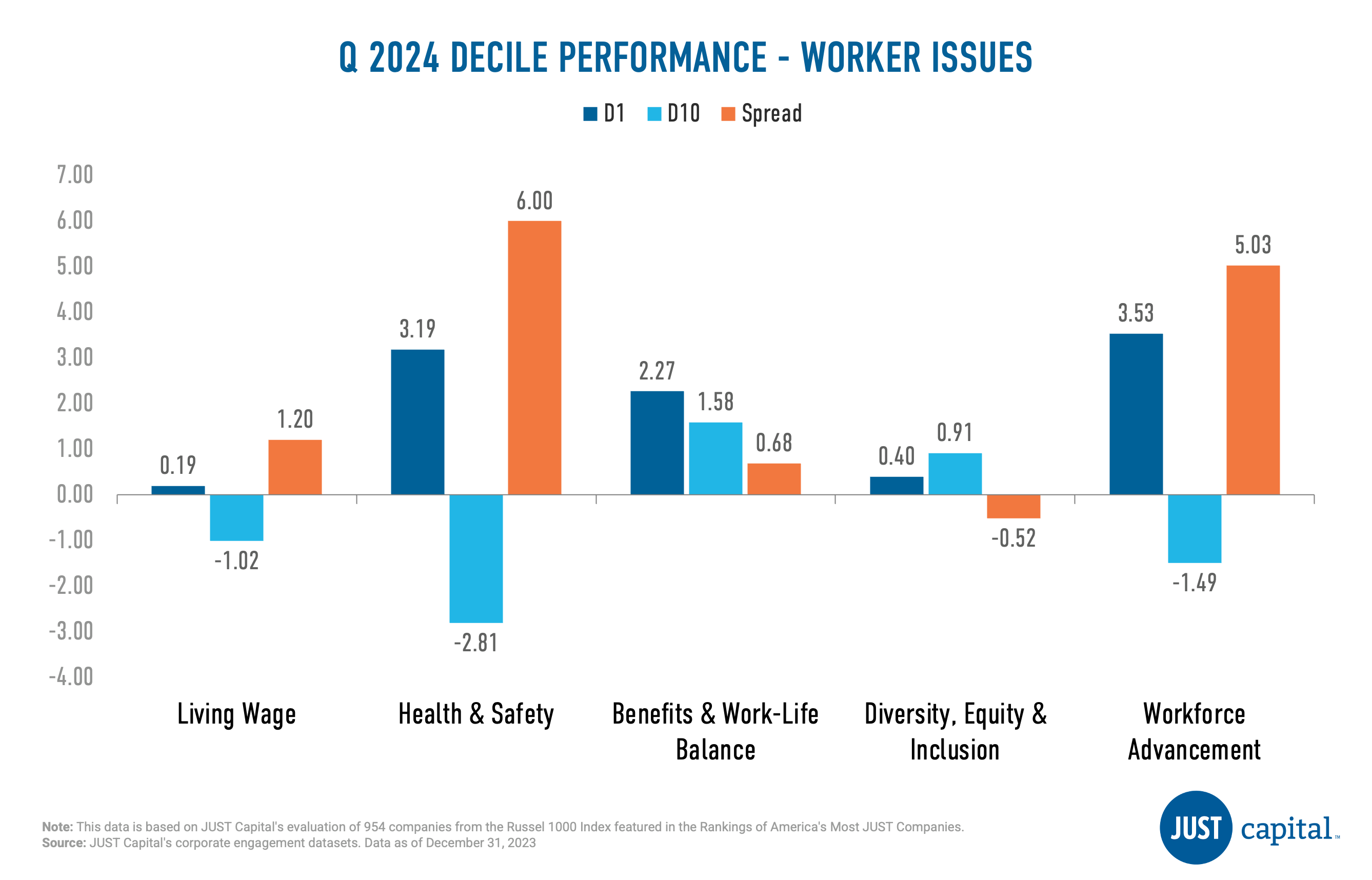
In Q2 2024, we saw four out of five issues deliver positive performance, with the Health & Safety Issue faring the best. Diversity Equity & Inclusion was the weakest performer amongst the Worker issues.
Shown below are the top and bottom five contributors to the top decile (D1), the top-ranked companies as measured by their Workers score, and the bottom decile (D10), the lowest-ranked companies as measured by their Workers score.
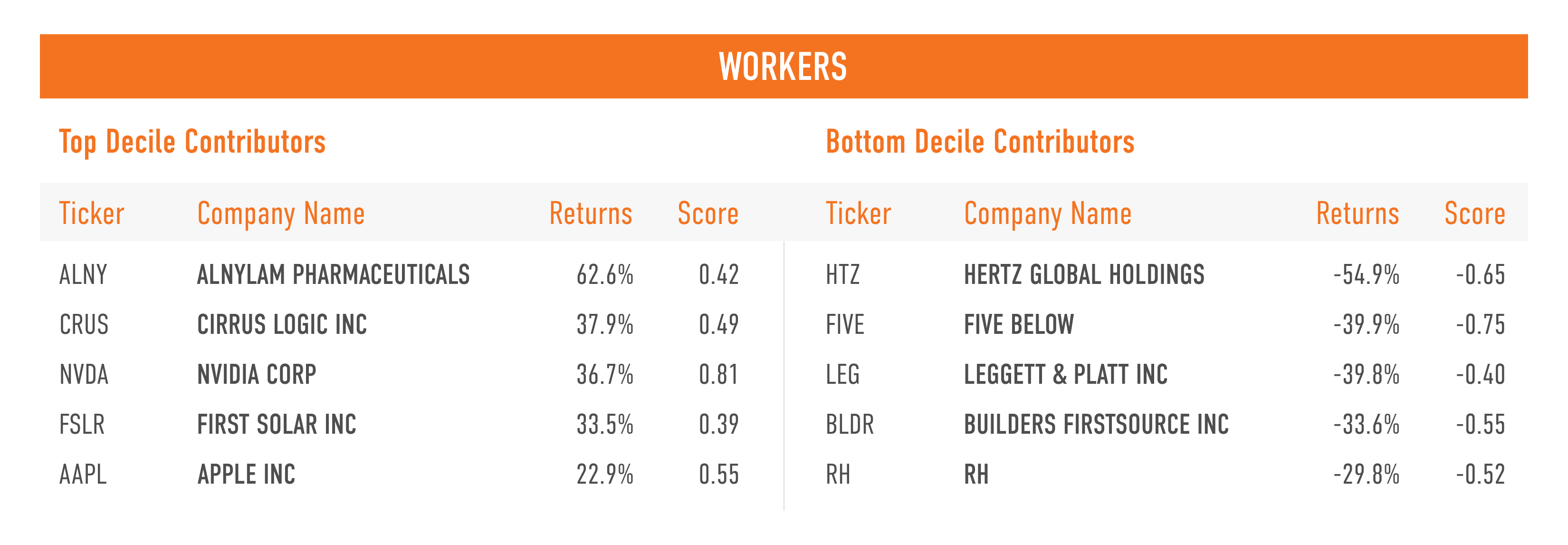
The Communities stakeholder measures a company across four Issues:
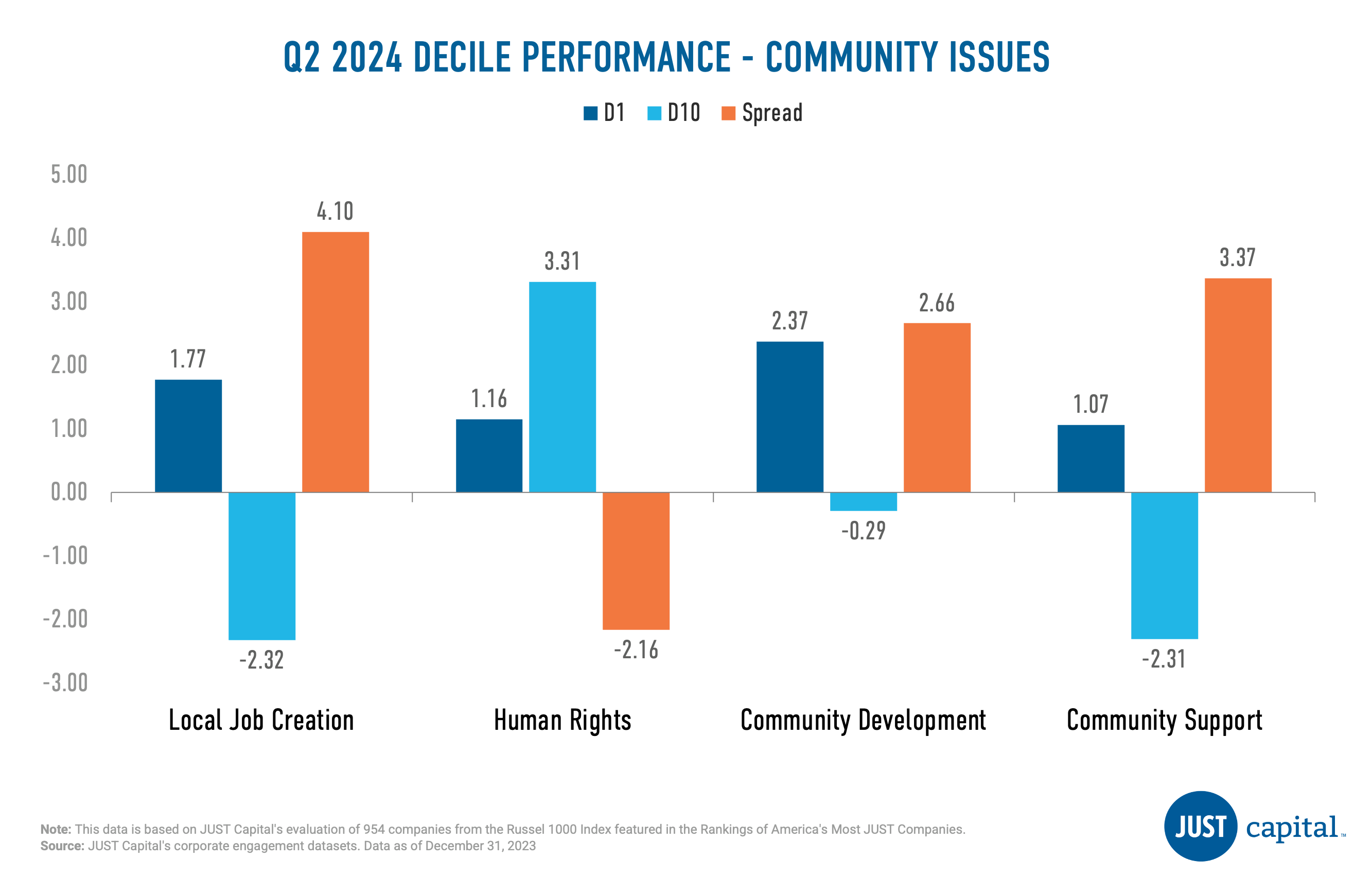
Local Job Creation was the strongest performer followed by Community Support. Human Rights was a negative contributor this quarter.
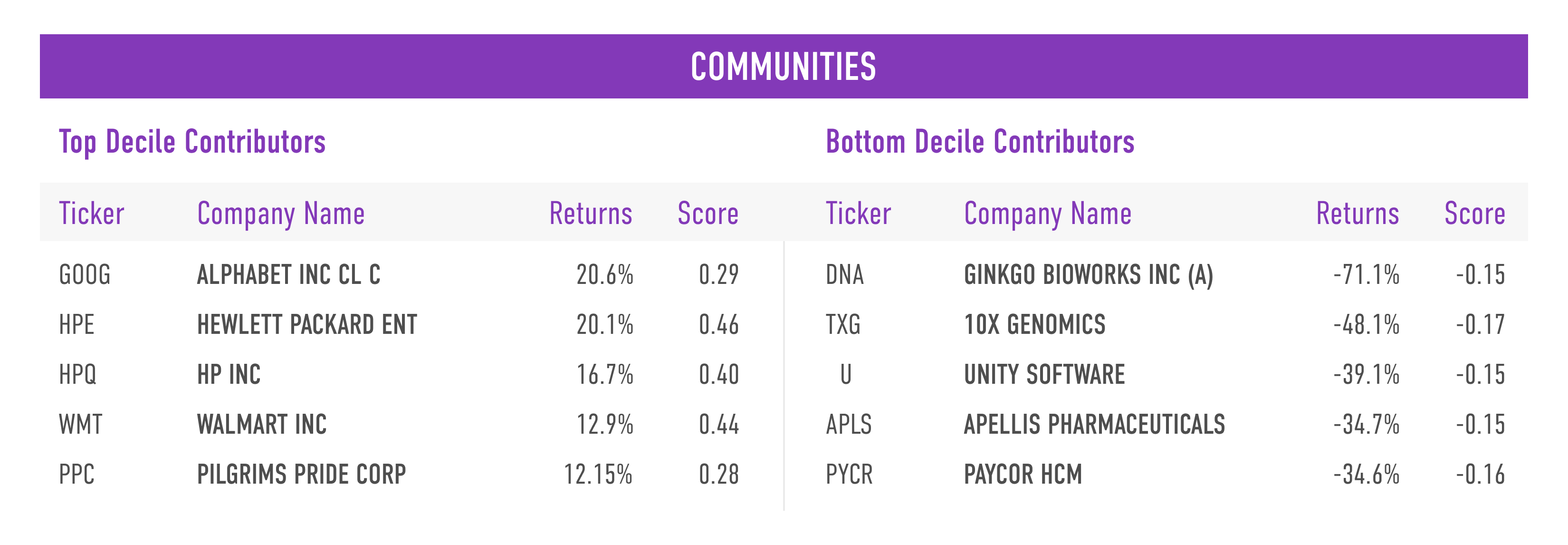
Shown below are the top and bottom five contributors to the top decile (D1), the best-ranked companies as measured by their Communities score, and the bottom decile (D10), the lowest-ranked companies as measured by their Communities score.
The Shareholders and Governance stakeholder measures a company across three Issues:
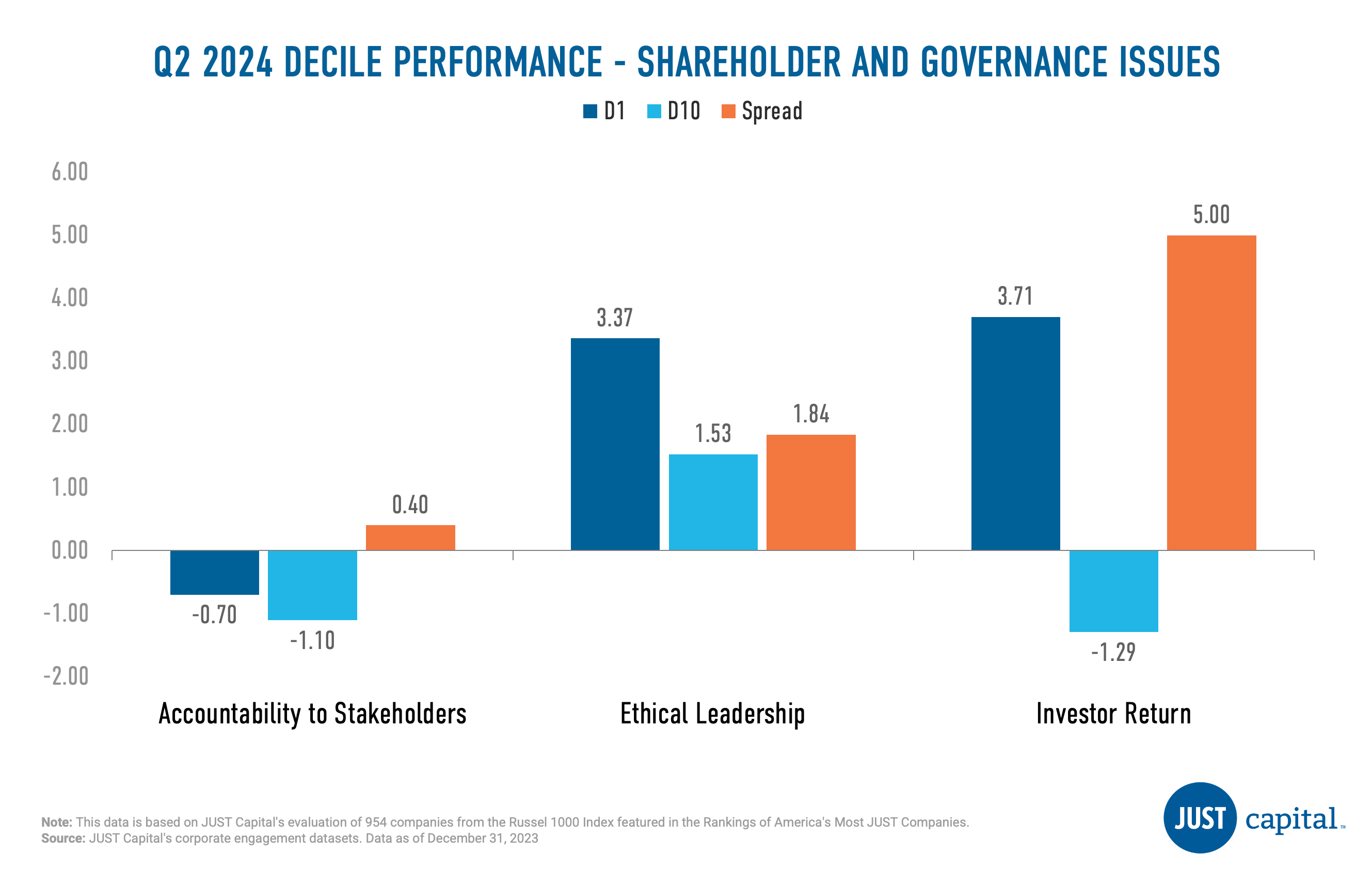
Investor Return Issue was the strongest performer in Q2 with a long-short spread of 5% followed by Ethical Leadership. All issues delivered positive performance in Q2 2024.
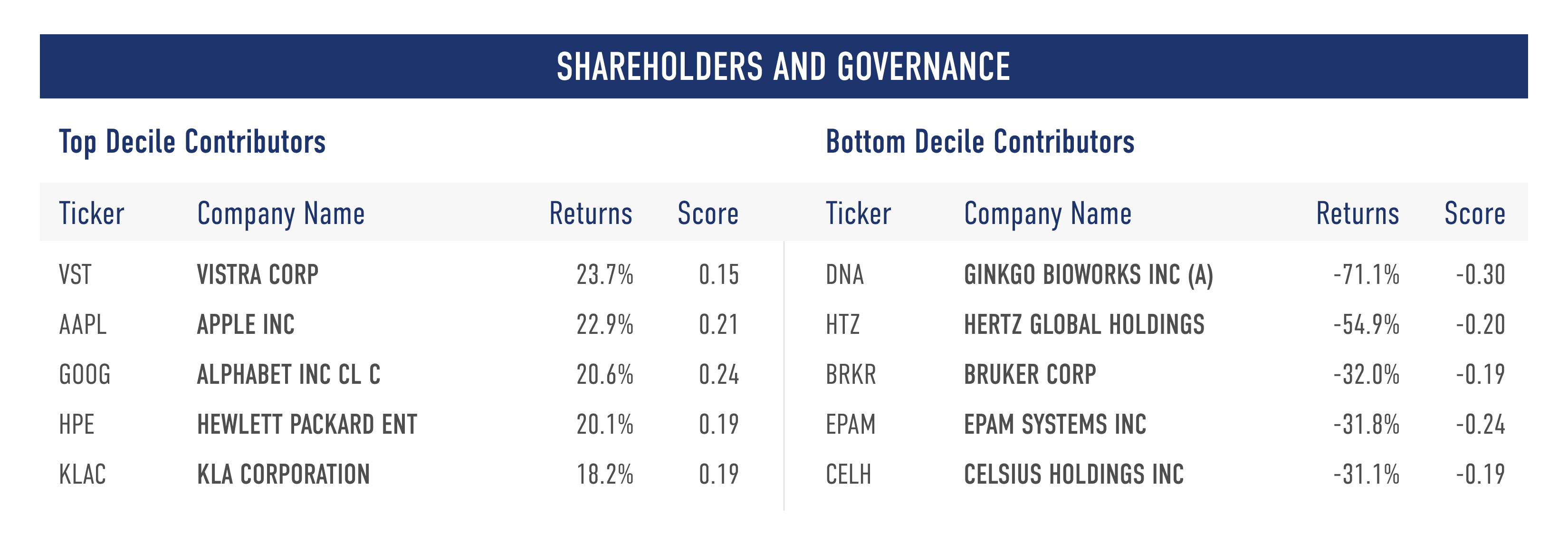
Shown below are the top and bottom five contributors to the top decile (D1), the best-ranked companies as measured by their Shareholders and Governance score, and the bottom decile (D10), the lowest-ranked companies as measured by their Shareholders and Governance score.
The Customers stakeholder measures a company across four Issues:
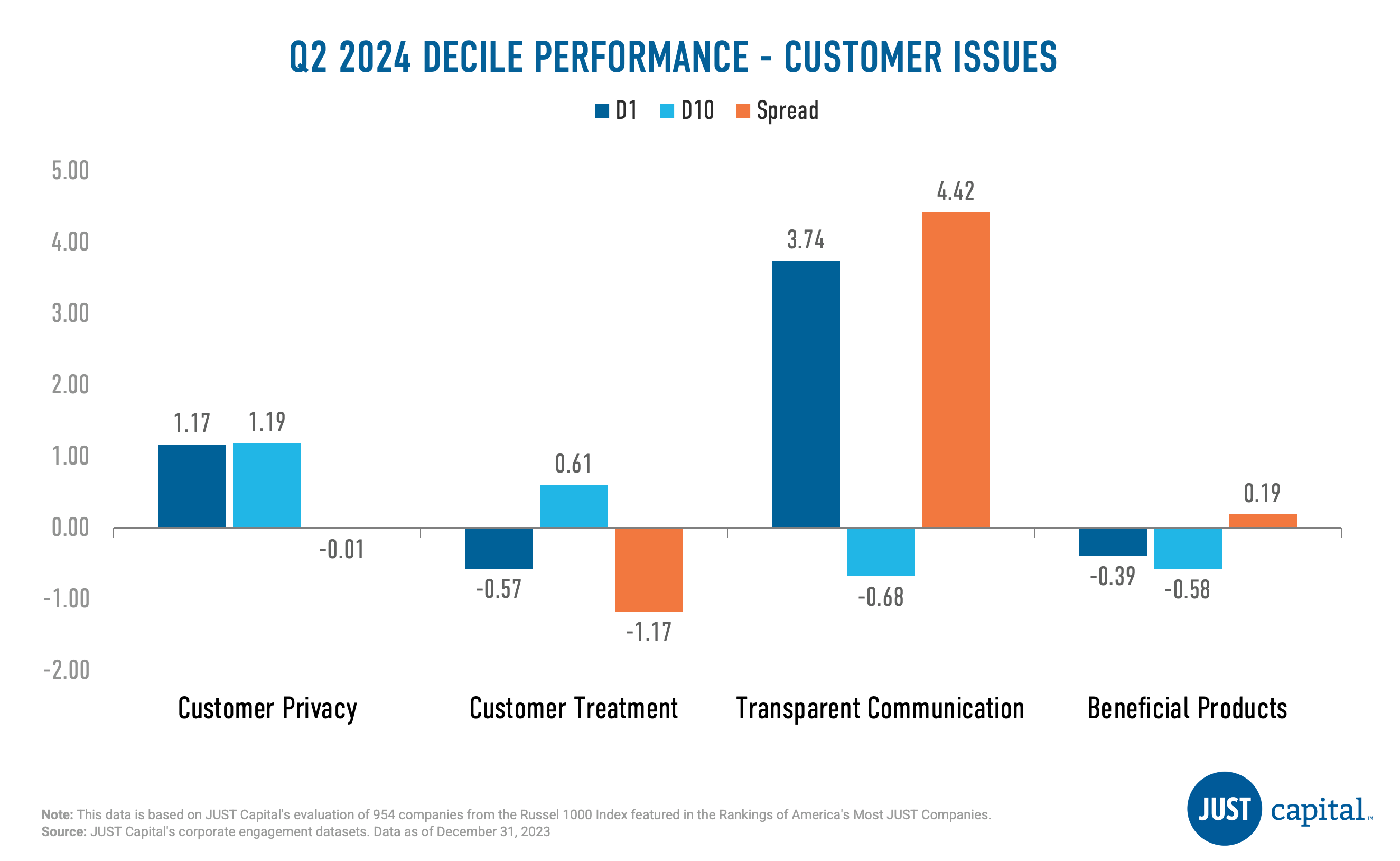
In Q2 2024, two out of 4 Customer Issues delivered negative performance. Transparent Communication was the best performer followed by Beneficial Products.
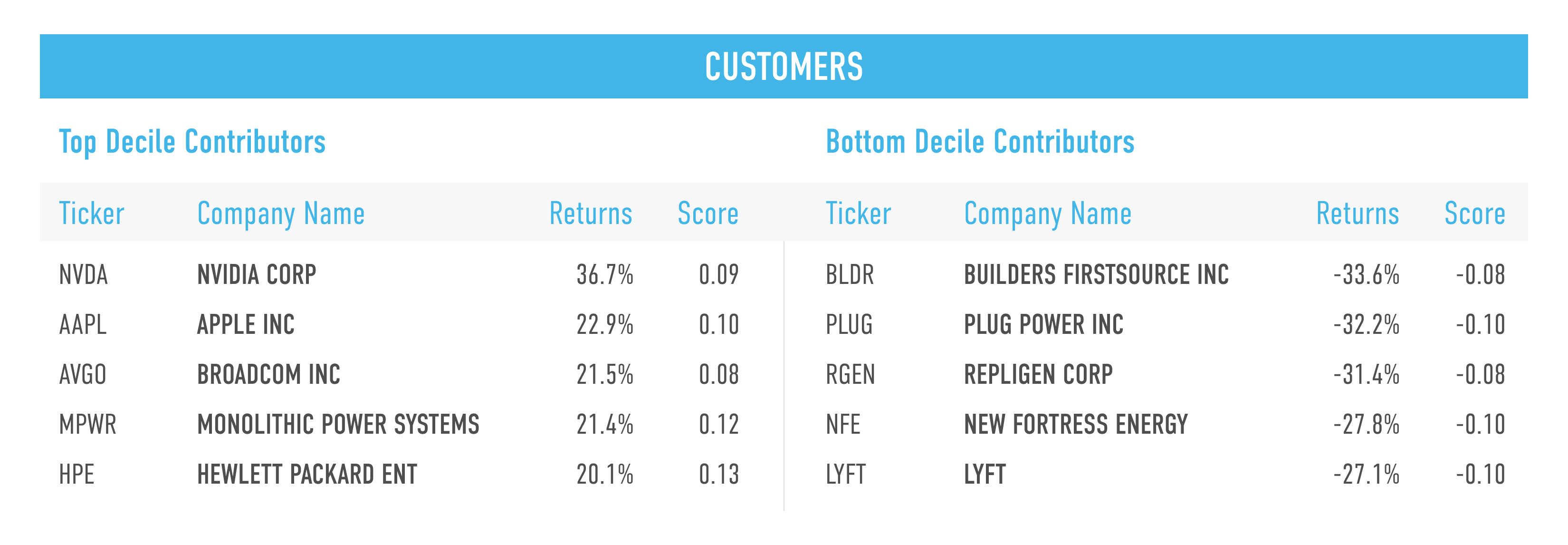
Shown below are the top and bottom five contributors to the top decile (D1), the best-ranked companies as measured by their Customers score, and the bottom decile (D10), the lowest-ranked names as measured by their Customers score.
The Environment stakeholder measures a company across four Issues:
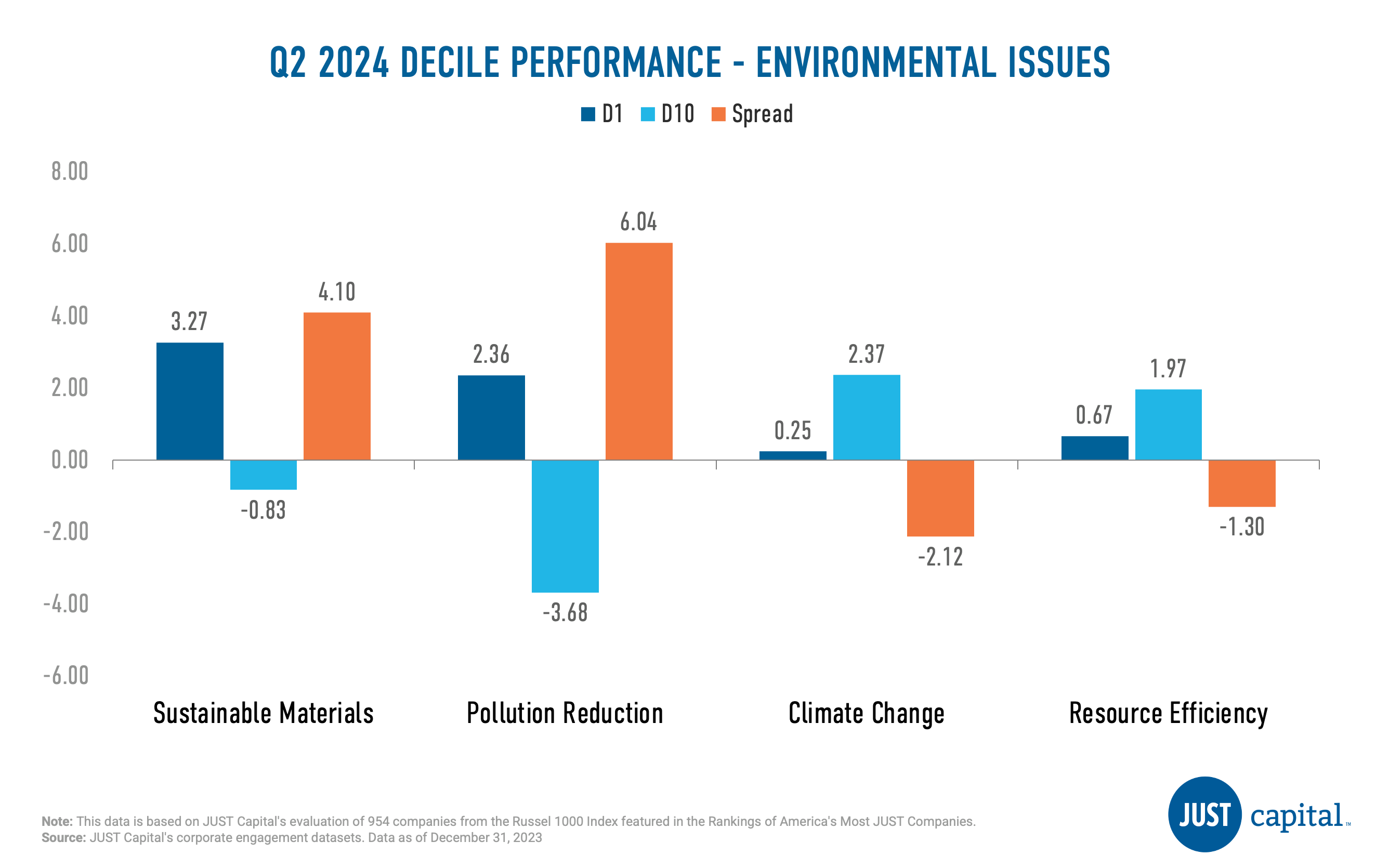
In Q2 2024, we saw two of four Environment Issues deliver positive performance. Pollution Reduction was the top contributor followed by Sustainable Materials in Q2. Climate Change and Resource Efficiency delivered negative performance this quarter.
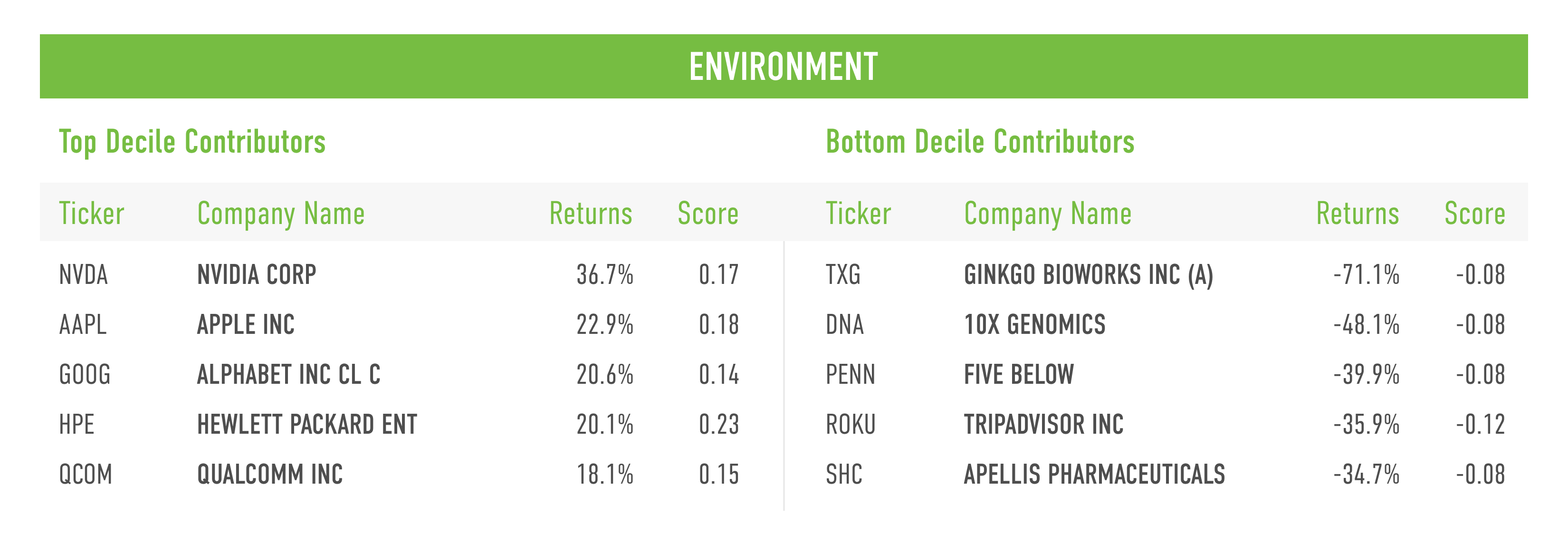
Shown below are the top and bottom five contributors to the top decile (D1), the best-ranked companies as measured by their Environment score, and the bottom decile (D10), the lowest-ranked companies as measured by their Environment score.
Computation Methodology
We monitor the performance of these stakeholders and Issues on a long-short basis. The long and short portfolios are selected based on the factor scores as the top and bottom deciles within the universe of companies we track in the Russell 1000. Top decile (D1) companies are those that rank highest based on the factor score, and bottom decile (D10) companies are those that rank lowest based on the factor score.
D1 Performance is computed as
(Equally weighted average of returns of stocks in D1 bucket) – (Equally weighted average of returns of all stocks within the Universe)
D10 Performance is computed as
(Equally weighted average of returns of stocks in D10 bucket) – (Equally weighted average of returns of all stocks within the Universe)
Spread is computed as
D1 Performance – D10 Performance
“America’s political class was in the final stages of self-righteous detachment from the economic and social conditions of the nation it ruled.” So writes Oren Cass, Chief Economist at American Compass, in a NYT op-ed this week recalling the indifference of political elites to the emerging opioid epidemic in 2011. A searing critique of elected leaders, the fundamental dereliction of duty he describes – to actually listen to what Main Street America has to say about their hopes, fears, and dreams – drives to the heart of our system of capitalism and our mission too.
Would a more just capital market have spotted, and reacted to, Purdue Pharma’s role in the opioid crisis a little earlier? Can socially-destructive corporate behavior or unethical business leadership, even if it’s highly profitable, somehow be curtailed? Conversely, would corporations who seek to create value for all their stakeholders be fully rewarded for their greater alignment with the public interest?
We think so. Certainly our investment research would support that.
Take ethical leadership, integrity, and accountability to stakeholders, for example. They are issues that have often ranked highly in the public’s list of priorities. Had Boeing – which for the last three years has scored very poorly on ethical leadership in our rankings – put more emphasis on this, who knows, maybe they could have avoided many of their recent travails (which deepened this week with their justice department plea deal Justice Department plea deal).
Writing for Fortune’s CEO Daily, Diane Brady notes of Pat Shanahan, the frontrunner to become the next CEO of Boeing, that the keys to his success will be his ability to, “build trust with an unhappy workforce, as well regulators, suppliers, investors and a disgruntled public.”
Stakeholder leadership, in other words.
Be well,
Martin

“Writing and thinking are not separable activities. I think when you lose your writing ability, you actually lose your thinking ability to some extent. And if we outsource judgement, we will lose the ability to think critically.”
Our friends over at the Brookings Institute take a look at how AI is projected to affect income equality in the U.S. While overall optimistic, this line stands out: “Finally, let’s zoom out once again, this time to consider the oft-repeated claim that there will always be new jobs. This has been true since the Industrial Revolution, but whether or not it continues to be true has major implications for inequality in the future.”
CNBC reports that several of the largest fast food chains are testing AI drive-thru ordering as labor costs continue to increase.
Fortune reports that Intuit is laying off 1800 employees from one sector of the business to add 1800 in another sector focused on expanding their AI use.
AI is proving to be a boon for nuclear power companies, with Vistra and Constellation Energy topping the S&P 500 as investors look for companies feeding the artificial intelligence industry’s demand for energy. Reuters has the story.
The Geek Way looks at how AI job loss claims may actually be wildly overexaggerated. Dig into the data here.
JUST Board Member Arianna Huffington teams up with OpenAI’s Sam Altman on ThriveAI Health, a customized, hyper-personalized AI health coach that will be available as a mobile app and also within Thrive Global’s enterprise products. Learn more here.
The Wall Street Journal looks at data from the latest NFIB report which shows wages are rising at small businesses, but employment isn’t. Learn more here.
Axios examines a new report that shows that workers and wages are actually doing the same or better than they have historically in the past 50 years.
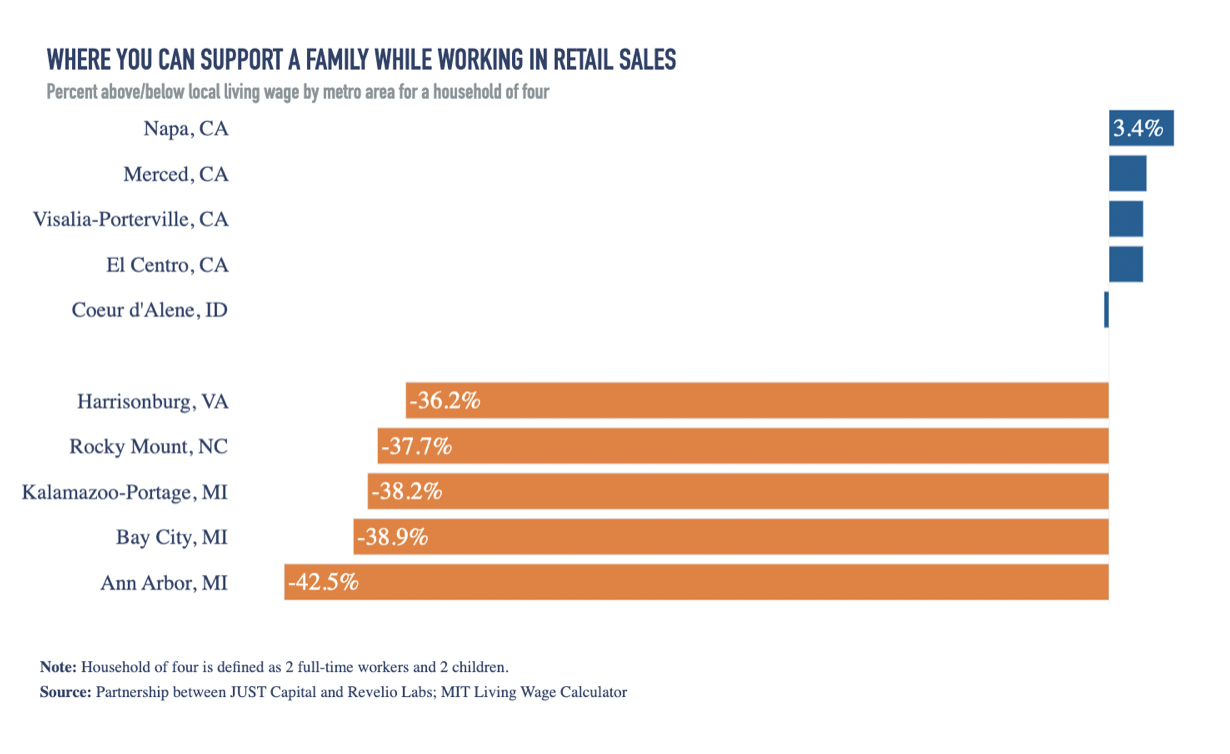
Our latest research partnership with Revelio Labs looks at the financial security of employees across America’s largest publicly traded companies, particularly when it comes to entry level and retail jobs. This chart shows the top 5 and worst 5 areas of the country when it comes to starting retail pay. Read more of our wage analysis here.

We’re halfway through 2024 already, if you can believe it. So as the Independence Day celebrations continue, I thought I’d take a moment to reflect on where things stand in the world of corporate justness.
Overall, I’d say that despite a wider sense of societal instability, the corporate stakeholder space feels relatively steady. Americans’ chief priorities remain firmly centered on pay, jobs, and economic security. The debates and discussions around corporations’ role in society continue, but have become markedly less heated and divisive, and more private, measured and–dare I say–meaningful. Corporations for the most part are focused on gathering data, developing strategy, and generally getting on with the business of understanding what their stakeholders want and working hard to give it to them.
This inevitably means different things to different companies. Some are doubling down on worker-related investments. Some are focused more on branding and communication issues. Others are shifting their priorities entirely. The announcement this week by Tennessee-based rural retailer Tractor Services that it is discontinuing or reorienting certain practices (including its DEI and carbon emission commitments) to focus more on things that “tie directly to business” is an interesting case in point that has attracted a lot of attention. Whichever way you look at it, corporate leaders are very sensitive to the shifting sands of stakeholder expectations and how they align with their core business interests.
I expect things to get more challenging in the second half of the year. The next generation of ChatGPT will undoubtedly shock, amaze and pose some existential questions about morality and business in the modern age. The Presidential election will likely bring varying measures of disharmony and disruption whichever side of the aisle you’re on. According to many commentators, this week’s SCOTUS “Chevron” ruling could up-end the entire regulatory status quo facing businesses in America.
In my view, all of this makes JUST’s role more important. When it’s at its best, American business is an incredibly powerful force for good that is essential to a more just and perfect Union. It helps support the freedoms, liberties and opportunities that define our collective future. Creating the incentives for that is where we will stay focused.
Wishing you and yours a wonderful weekend!
Be well,
Martin
To understand the financial security of employees across America’s largest publicly traded companies, JUST Capital and Revelio Labs analyzed the amount employees’ wages exceed the local living wage necessary to cover basic budgetary needs. Here’s what we found.
CNBC looks at how AI is eating up corporate tech budgets, but not on the customer side–a majority of the investment is going to training and outfitting their employees.
Must Reads
The Wall Street Journal highlights how Tractor Supply Co has walked back their DEI and environmental initiatives after weeks of criticism on social media.
Bloomberg wonders if “social media labels” would wind up being even worse than “cigarette labels”, examining how that industry used those warnings to escape liability and regulation.
The New York Times examines the pros and cons of the growing list of top employers covering egg freezing, which, while immensely helpful for many workers, points to a potentially growing schism in work/life balance and expectations.
Our latest research partnership with Revelio Labs looks at the financial security of employees across America’s largest publicly traded companies, particularly when it comes to entry level and retail jobs. This chart shows the top 5 and worst 5 areas of the country when it comes to starting retail pay. Read more of our wage analysis here.

Extreme temperatures are shattering weather records around the world. Almost 100 million Americans were reportedly under some level of excessive heat warning this week. Extreme weather conditions are being documented across much of the world. Sea surface temperatures in the tropical North Atlantic are at record high levels, fueling the intensification of tropical cyclones and what is expected to be a “above-normal” Hurricane season. Heat-related deaths, sadly, are an all-too-frequent news headline.
Then there’s the economic impact. According to researchers, “under current climate conditions, lost labor productivity due to heat in the U.S. could reach $100 billion a year [and] that loss could reach $200 billion by 2030 and $500 billion by 2050.”
What this also points to is the growing opportunity for market-based solutions to help the world adapt to a more volatile climate. This spans everything from helping businesses deal with the effect of extreme heat on workers – something Bloomberg highlighted this week – to building resilience into supply chains, logistics, food and agriculture production, and physical infrastructure (buildings, roads, electric grids); to risk management and insurance solutions that protect against climate-related financial loss.
It’s an area where AI can play a strong supporting role, too. JUST 100 company IBM’s “Environmental Intelligence Suite,” which leverages AI to help clients improve risk management and decision-making on climate risk, is one example. PG&E’s use of AI to enhance fire and outage risks is another. Beyond AI, construction companies are working to find workforce solutions to enhance safety and productivity, and energy companies, like those in Michigan, are preparing to keep the power grid running. HP and Intel’s leadership on water management in the semiconductor industry and broader technology sector y also springs to mind.
Helping the world address climate risk and extreme weather is becoming an increasingly important facet of just business leadership and overall stakeholder performance.
Be well,
Martin
“You spend a lot of time at work. Just like we would for a consumer on our app, we asked: What’s easy? What’s hard to do? How do you access certain things quickly and seamlessly? We had a lot of work to do, end-to-end, on the experience. Just like we would on a customer journey, we looked at our colleague journeys as well.”
The Biden Administration unveils new rules to curb U.S. investment into Chinese AI and semiconductor technology that could also enhance their military. The New York Times has the story.
The Washington Post looks at the race for tech firms to devise new, potentially improbable energy solutions as AI development eats away at an aging power grid.
PwC reveals a fascinating bit of research on how AI is impacting work. A study of half a billion job ads from 15 countries suggests that AI is making workers much more productive, with sectors that are especially exposed to AI experiencing nearly 5 times higher growth in labor productivity.
Post Father’s Day, Nike increases its paid parental leave to 16 weeks for all U.S. employees, which can be used for birth, adoption, or foster placement.
The New York Times takes a deep look at how Meta continues to fail at protecting the safety of its most vulnerable users–children.
The Atlantic casts a critical eye on federal workforce-training programs, revealing how they accomplished little for the workers NAFTA displaced in the 1990s, largely because they targeted “in-demand” jobs that employers needed to fill, which often meant low-wage, high turnover positions.
The attacks on DEI continue. This week, Fortune covers the move from several high-profile tech CEOs, including Elon Musk, to move to MEI (Merit, Excellence, and Intelligence).
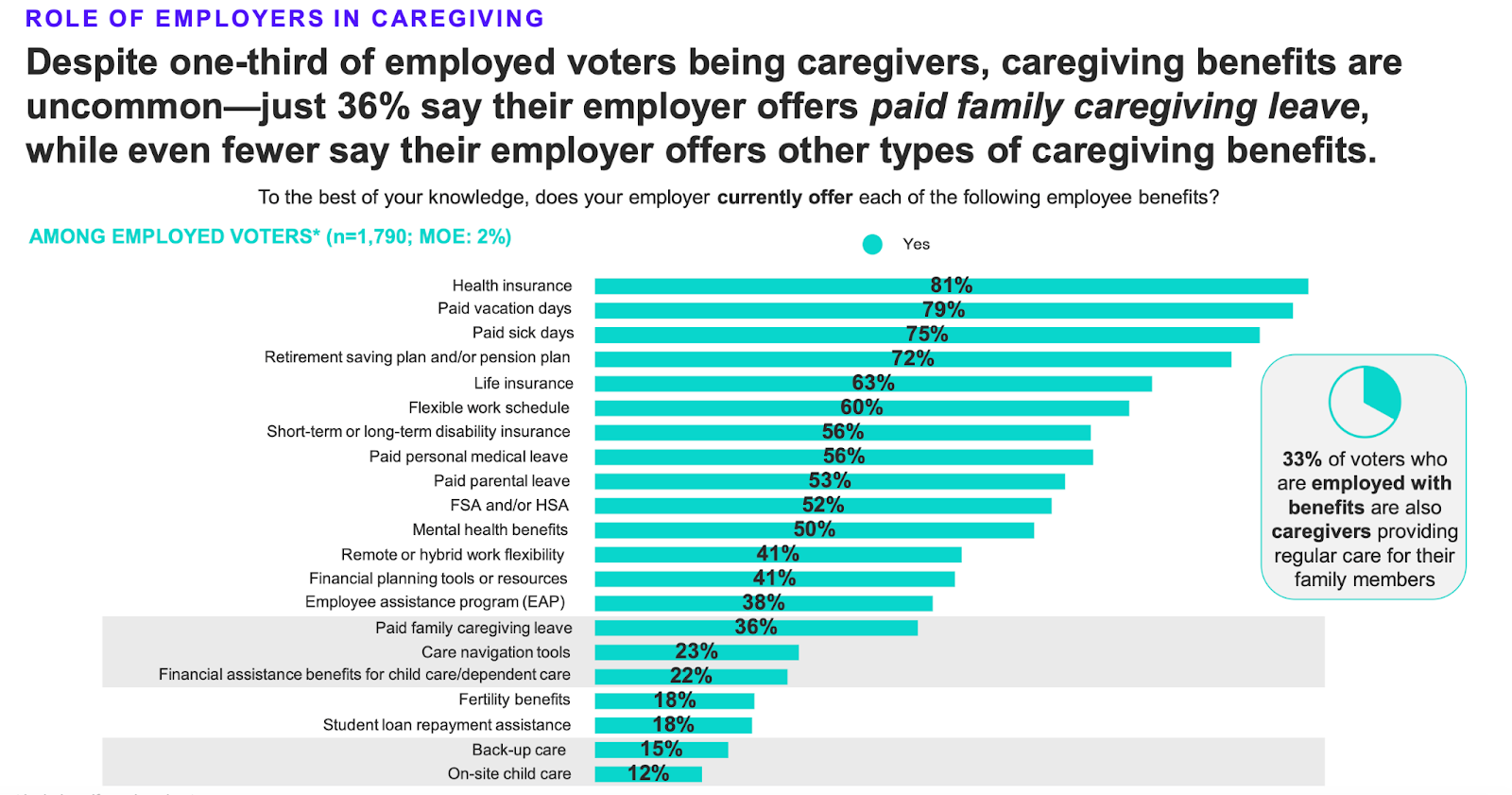
This chart comes from excellent research by Politico’s Morning Consult on Voter Sentiment on Caregiving in the U.S. The chart shows that only 36% of companies offer paid family caregiving leave, despite the fact that 59% of respondents would be more likely to stay at a job that has it. Explore the details here.
This week’s call by the U.S. Surgeon General for tobacco-style warning labels on social media products is the latest chapter in one of the defining corporate justness narratives of our time: the impact of social media on the mental health of children and teens.
It’s something that we at JUST have grappled with over the years. Public polling suggests that 86% of Americans are concerned about the impact of social media on children; that 50% of parents of children younger than 18 feel their child(ren)’s mental health has suffered because of social media use; and 83% of likely voters believe social media platforms should be required to protect their minor users.
In step with the polling, bipartisan political pressure for action is growing. For example, Over 40 states are suing Meta claiming the company designed addictive features which resulted in serious mental health problems for children.
As of writing, Meta has emphasized its position that Congress should pass legislation which would require parental consent to join social media if a child is under the age of 16. Currently most social media sites require the account holder to be at least 13-years-old. At the same time, big tech firms have implemented safety features to support a safe, positive online experience for teens.
The question at the center of this is a just one: how will these firms address a critical stakeholder issue that is central to their business model while balancing their near and long term profits?
Be Well,
Martin

“I want to touch on AI to close. There’s a lot of buzz about AI, we have 1,000 wildfire cameras in the state of California, and of the 1,000, 600 of them exist in our footprint. AI was enabled on all 1,000 cameras last year and the results are tremendous. AI is picking up wildfire hits faster than humans…so that’s a very effective post-ignition layer of protection that we intend to move forward and install more cameras.”
CNBC examines our data and highlights companies that are providing the best paternity leave for Father’s Day.
The BBC takes a look at one of the first sectors to be hit with AI job loss–copywriters–and how, amid massive team cuts, the sole job of many that remain is to make AI articles sound more human. Dystopian, much? And on a broader scale, the Financial Times reports that the IMF has “profound concerns” over AI labor destruction.
In a follow-up from last week’s article over the security concerns surrounding Microsoft’s new “Recall” AI feature, which automatically takes photos of your screen at random intervals, the company will now delay the release until it can tackle the security challenges it poses. Reuters has the full story.
For Father’s Day, GQ interviewed 13 new father’s on how having paternity leave (or not) affected the first weeks with their newborn.
SHRM analyzes the Supreme Court decision siding unanimously with Starbucks against their employees in a lawsuit over the firing of several workers who were attempting to unionize in Memphis.
Business Insider reports that the Surgeon General has called to implement a Surgeon General’s warning on social media due to plummeting mental health among teens, but others think that this “warning label” will prove infective when compared to actual government regulation.
The NY Post looks at the growing trend of companies eliminating middle managers, and how it is effecting new entrants to the workforce.
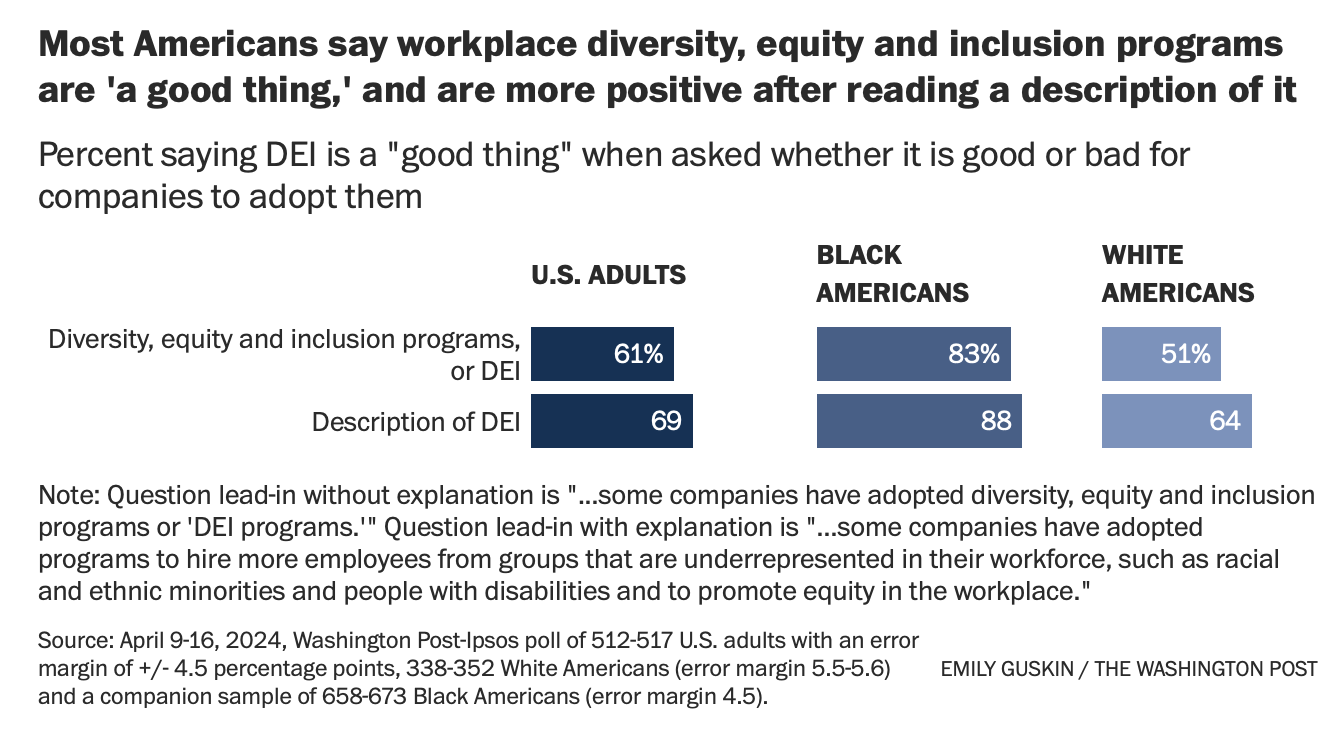
This chart comes from this Washington Post article highlighting the latest Ipsos polling that shows a majority of Americans support DEI initiatives, and even more so when they’re given a description of what those initiatives entail.

Amidst the current caregiving and mental health crises, employees are increasingly seeking paid leave benefits to safeguard their well-being, and that of their families. In response, some companies are strategically crafting policies that cater to diverse employee needs, fostering equity and inclusion within their organizations, and integrating more resiliency into their workforces.
Right now, the vast majority of companies fall short of meeting workers’ expectations on paid leave benefits. JUST Capital’s research suggests only 9% of companies offer 12 or more weeks of parental leave for both caregivers, while their 2022 polling found that 64% of Americans believe it is necessary for companies to provide 12 weeks of paid leave for all parents. Worse, just 23% of private industry workers had access to any paid family leave through their employer in 2021, according to the Bureau of Labor Statistics. While 77% of workers in private industry are able to access paid sick leave as of February 2023, low-wage workers are significantly less likely to have paid sick leave compared to high-wage workers (38% vs. 96%, respectively).
JUST Capital tracks companies’ practices around paid family leave, paid sick leave, and other core caregiving policies, and we have observed the emergence of cutting-edge benefits that support employees across various life stages as businesses discover that supporting their employees’ well-being is not only socially responsible, but a smart investment. Paid leave policies improve worker retention and productivity, while minimally increasing operating costs (sometimes producing cost savings). In studies of California’s paid leave program, about 90% of businesses reported either a positive or neutral effect on productivity and almost all businesses (99%) identified positive or neutral effects on employee morale.
Paid leave initiatives are also pivotal in advancing equity within the workforce. Women – particularly mothers – often bear the brunt of caregiving responsibilities, leading to detrimental career choices and perpetuating the gender earnings gap, sometimes known as the “motherhood penalty.” In an analysis of states with paid leave policies, the rate of women leaving their jobs after welcoming a child dropped by 20% in the first year, and up to 50% after 6 years.
Nine years of polling has shown that paid leave policies are a key way for companies to differentiate themselves as a JUST employer. Below, we examine companies leading on implementing paid leave policies to support their diverse workforces, and the results for their employees and their business.
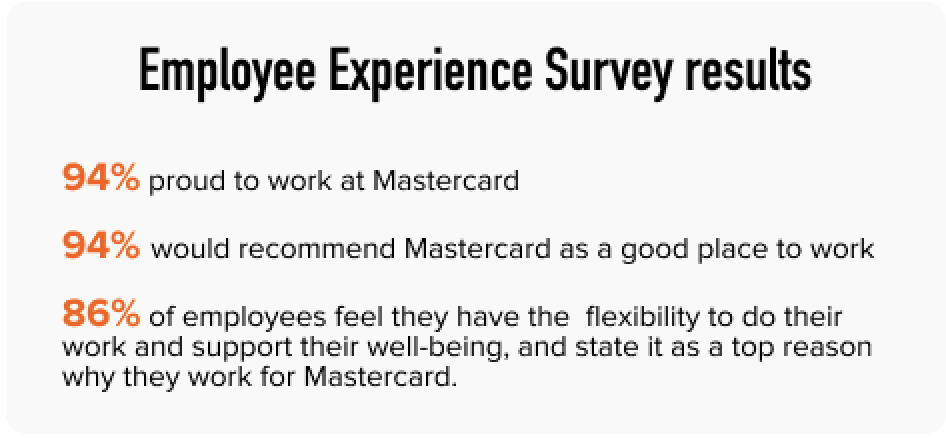
Mastercard offers a bereavement leave policy, acknowledging the need for employees to take the time to grieve and attend to personal matters without the added stress of work responsibilities. Mastercard considers bereavement leave as part of their holistic wellbeing and flexibility offerings, which they continuously revisit to ensure they best support employees and company. Over the years, bereavement leave has expanded and evolved, and in their current policy, employees can take up to 20 days paid time off, which applies to both full- and part-time employees. Recent updates to the policy include expanded time for death of a parent (including in-laws and step-parents) and in the event of a stillbirth or miscarriage.
We have received overwhelmingly positive feedback from employees, who attribute this benefit as a good example of our culture of decency. Feedback has also come in other forms, such as through the employee-led blog on the Mastercard homepage, called “Our Voices.” One employee reflected on their experience using the benefit to grieve the death of their grandparent and support their family, stating that Mastercard is a
Caring and inclusive workplace that values our lives and identities beyond our business hour deliverables.
Mastercard
Cisco has implemented a Critical Time Off policy that goes beyond traditional leave structures. This policy allows employees to take additional time off during significant life events such as the illness of a family member or personal emergencies. Cisco understands that certain situations require extra time and attention, and the Critical Time Off policy is designed to provide the necessary flexibility and support.
Three years ago, Adobe instituted Global Wellbeing Days, enabling their global community to collectively prioritize their wellbeing, disconnect, and recharge without worrying about work. In 2024, Adobe is offering six Global Wellbeing Days. These designated days serve as opportunities for employees to engage in activities and initiatives focused on improving their overall well-being.
At Adobe, we believe that taking time off is essential to the health and wellbeing of every employee. When our employees experience support both in and outside of the workplace, they are better equipped to unleash their creativity and innovate.
With Global Wellbeing Days, we’ve witnessed the profound impact of our community coming together for a collective day of rest. Employees use the time to reconnect with loved ones, focus on their health, or build community with other Adobe colleagues. For instance, the Adobe Golf network arranges golf outings on Global Wellbeing days, while some employees join fellow Adobe colleagues for activities like hikes, local pickleball games, and bike rides. Others choose to spend quality time with their family and pets.
Adobe
Medtronic, a leader in medical technology, understands the commitment of employees serving in the military reserves. To honor and support their dedication to national service, Medtronic provides paid time off for employees to fulfill their military reserve obligations. If reservists get deployed, Medtronic ventures far beyond what’s legally required. Medtronic holds reservists jobs for up to five years and provides differential compensation to cover the difference between their base pay and military pay. Benefits are covered for employees on military leave for up to 24 months. Their Family Care Leave policy includes up to six weeks paid leave for employees who are caregivers in a family where someone (such as a partner) is called to active military duty.
We’ve heard overwhelmingly positive feedback from workers who have utilized our military reserve leave. For them, it’s about more than just time off; it’s about peace of mind knowing that their service is valued and supported. We’ve had employees express deep gratitude for feeling recognized for their military commitments and the flexibility we offer.
Beyond military leave, we’re also proud to offer our employees caregiving support through Wellthy, a care concierge platform that works with families to ease their care burdens. Employees are matched with a dedicated Care Coordinator, who can help manage care in any capacity, big or small. This includes Wellthy’s deep expertise in veterans’ benefits, which can help veterans and their caregivers navigate benefits and coverage offered through the VA and other providers.
Our broader paid leave policies, including our military reserve leave, have significantly impacted our workforce in terms of retention, recruitment, and overall employee satisfaction. By prioritizing paid leave for military reservists, we demonstrate our commitment to supporting our employees’ diverse needs and honoring their service to the country. This approach not only strengthens our workforce by retaining experienced and dedicated individuals but also enhances our reputation as an employer of choice.
Our Family Care Leave, available globally — and expanded leave of up to 24 weeks paid for birthing parents in the U.S. — sets us apart in the marketplace. Combined with our Mission, which provides employees with a profound sense of purpose, our commitment to evolving benefits to meet employee needs is consistently highlighted as a top draw for candidates. …
Overall, our comprehensive approach to paid leave and talent development not only fosters a supportive and inclusive workplace culture but also positions us as a talent destination where diverse, top talent can come, grow, and thrive.
Denise King, Vice President, Global Benefits and Payroll, Medtronic
Pinterest recognizes the physical and emotional challenges that accompany miscarriage or stillbirth and is committed to supporting its employees during these difficult times. The company has a bereavement leave policy in place that covers Miscarriages and Stillbirth, acknowledging the need for employees to take the time they need to heal and cope with such personal losses.
Pinterest also provides a Family Care leave offering up to 12 weeks of full pay should employees need it to care for a seriously ill family member including a child under the care of a Neonatal Intensive Care Unit (NICU) post-birth. This is in addition to Pinterest’s 20 weeks of bonding leave for new parents.
At Pinterest, we’ve seen that people do their best work when they are most inspired, and feel seen and supported. We strive to create benefits that meet the real-world needs of our employees by supporting them through the different stages of family planning and child care, and by putting emotional wellbeing at the forefront. By listening to our employees, we’ve been able to shape our policies to support them when unexpected challenges arise. As our company continues to grow, we will keep working to create benefits that provide choices that are best for our employees’ careers and lives.
Adobe launched its U.S. sabbatical program to celebrate and honor employees’ innovation and contributions, recognizing them as the company’s greatest assets. Once employees reach five years of tenure, their initial sabbatical lasts four weeks. At 10 years, it extends to five weeks, and at 15 years, six weeks, remaining at this duration every five years thereafter. The Sabbatical Program is designed to provide employees with the time and space they need to rest and reflect, fostering creativity and innovation upon their return to work.
Adobe’s industry-leading paid leave policies foster a healthier, happier, and more engaged workforce by enabling employees to reinvigorate their creativity and return to work refreshed, primed to forge innovative ideas, and explore uncharted paths. In our annual employee survey, 87% of respondents expressed a willingness to recommend Adobe as an employer, while 89% stated they feel proud to work here. Upon returning from sabbatical, most employees shared in our sabbatical survey that they felt refreshed and welcomed as they transitioned back into their roles, noting that the time off fueled their motivation to do their best work upon return.
We are evaluating our wellbeing and benefits offerings each year by pulsing employee sentiment and benchmarking against the industry to remain competitive while providing optimal support to our global workforce.
Adobe
Understanding the unique challenges and health considerations that menopause can bring, Sanofi has implemented comprehensive menopause benefits to provide support and resources to its employees. These benefits may include access to menopause education and information, support groups, counseling services, flexible work arrangements, and healthcare coverage for treatments or therapies related to menopausal symptoms.
| “If you feel truly supported throughout your life cycle, whether it is maternity or menopause, you’ll be more engaged. I’m sure the new generation is more demanding on that.” Nathalie Grenache, SVP of People and Culture, Sanofi |
