Earlier this month, JUST Capital released its 2022 Rankings of America’s Most JUST Companies, a comprehensive list of the largest, public U.S. companies ranked according to the public’s priorities. This year’s ranking model consisted of 20 core Issues determined through our survey research – from paying a living wage to creating a diverse, inclusive workplace to helping to combat climate change – across key stakeholders of business: workers, customers, communities, the environment, and shareholders. Broken down to 241 unique data points, these Issues form the basis by which JUST evaluates companies and serve as a scorecard for corporate America, providing unbiased data on how the largest U.S. companies perform on the issues that matter most today.
JUST Capital’s investable indexes and financial products – which enable investors to implement our research and methodology and drive dollars toward just companies – have demonstrated the investor case for just business behavior, showing that the companies prioritizing these core Issues can be more resilient over the long term.
As of December 31, 2021, our flagship JUST U.S. Large Cap Diversified Index (JULCD) – composed of the top 50% of Russell 1000 companies in each industry, based on JUST Capital’s annual Rankings – has outperformed its benchmark by 6.17% since inception.
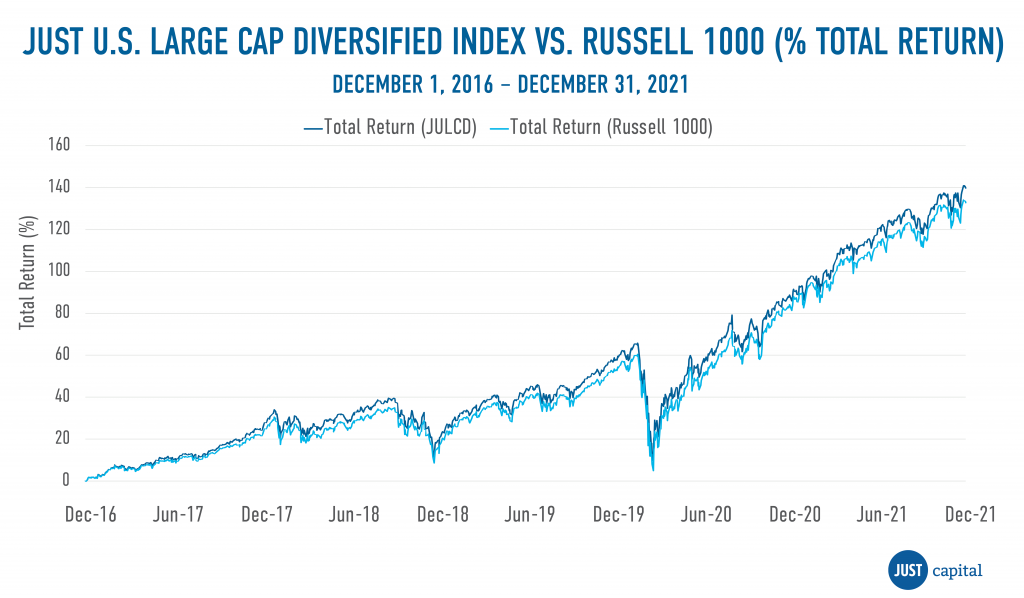
Tracking error of the JULCD Index relative to the Russell 1000 is 1.26, which indicates that the Index closely tracked its benchmark but delivered additional alpha from the top 50% of Russell 1000 companies in each industry, based on JUST Capital’s annual Rankings and methodology over the period on a cumulative basis.
The JULCD Index also provides the basis for the Goldman Sachs JUST U.S. Large Cap ETF (JUST ETF), which seeks to provide investment results that closely correspond, before fees and expenses, to the performance of the JULCD.
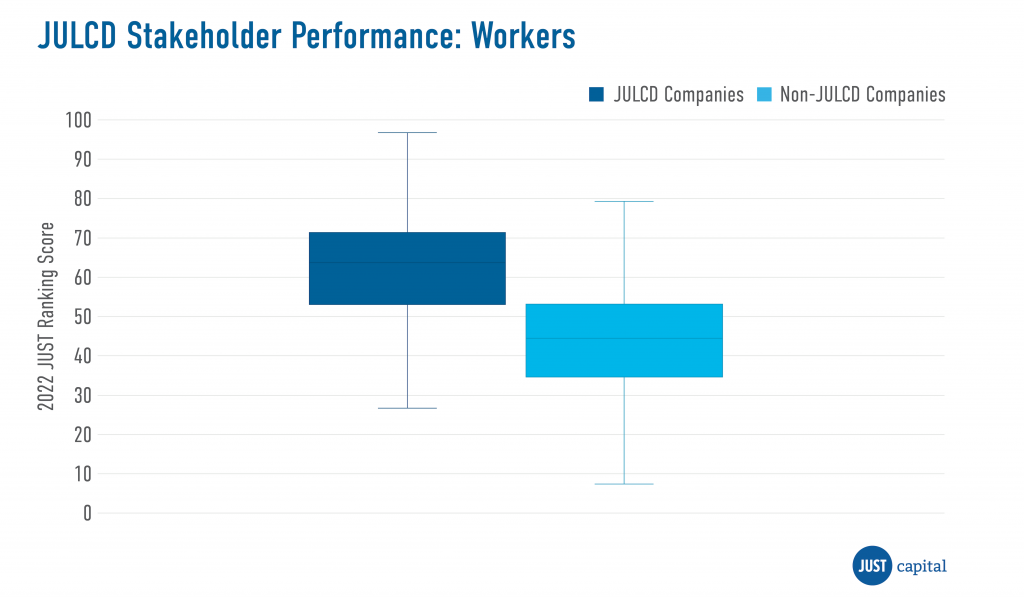
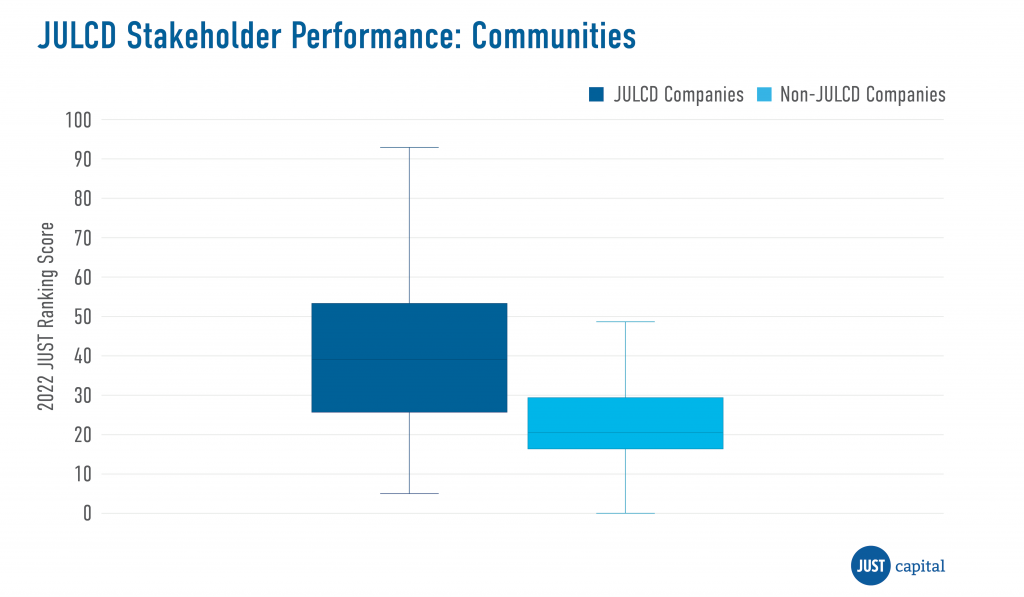
With respect to purpose, the JULCD Index also delivers superior performance across all the stakeholders JUST evaluates, outperforming their Russell 1000 peers excluded from the Index when it comes to their workers, customers, communities, shareholders, and the environment. The charts below unpack this outperformance, each illustrating three components:
As we see below, the median score across each stakeholder is higher for JULCD constituents than it is for their non-JULCD peers, showing that these companies deliver value for their shareholders as well as the other key stakeholders they impact.
Companies in the JULCD consistently outperform their peers in the Russell 1000 when it comes to delivering value to their workers, making up 39% of their overall scores in our Rankings. Their scores – which are determined by their performance on issues from paying a fair and living wage to prioritizing worker health and safety to working to advance diversity, equity, and inclusion – sit consistently higher than those of non-JULCD companies, with a median score of 63.7 vs the non-JULCD score of 44.5.
Compared to their peers, JULCD companies:
In addition to serving their workers, companies in the JULCD also outshine their peers when it comes to delivering value to the communities in which they operate, both at home and abroad. This performance makes up 20% of a company’s overall scores in our Rankings. Their scores – which are determined by their performance on issues from creating U.S. jobs to upholding human rights in the supply chain to contributing to community development – sit consistently higher than those of non-JULCD companies, with a median score of 39.1 vs the non-JULCD score of 20.5.
Compared to their peers, JULCD companies:
Among the key stakeholders of a company is of course its shareholders, and 19% of a company’s scores in our Rankings is determined by how well a company both delivers values for those shareholders and prioritizes good governance. Their scores – which are determined by their performance on issues from acting ethically at the leadership level to delivering value to investors – sit consistently higher than those of non-JULCD companies, with a median score of 61.7 vs the non-JULCD score of 42.7.
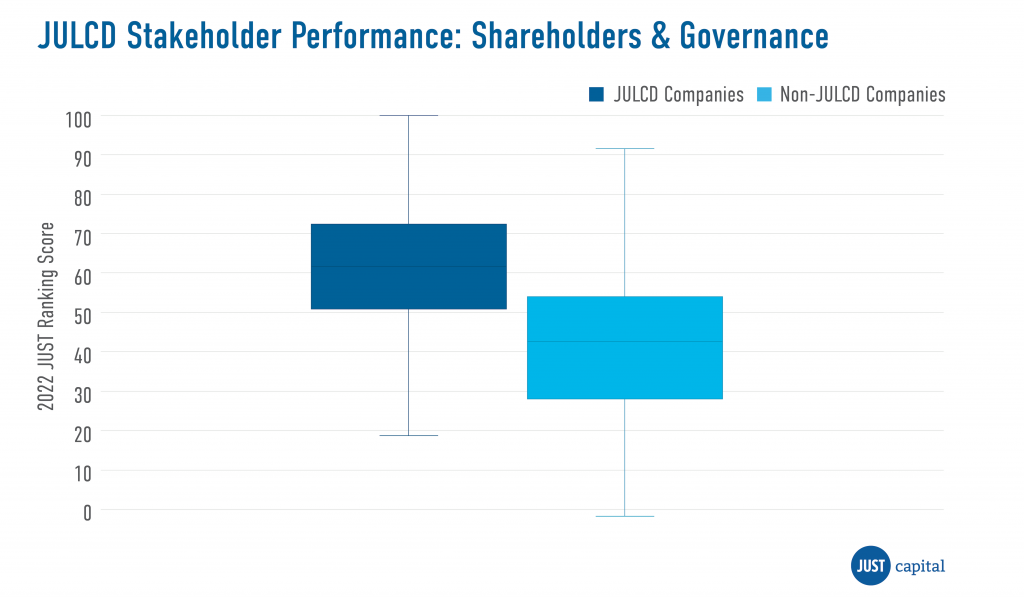
Compared to their peers, JULCD companies:
Rounding out the “S” in ESG is customers – who represent 11% of a company’s score in our Rankings – and the JULCD rises above the rest of the Russell 1000 in serving these key stakeholders as well. Their scores – which are determined by their performance on issues from protecting customer privacy to making products that benefit society – sit consistently higher than those of non-JULCD companies, with a median score of 43.5 vs the non-JULCD score of 32.8.
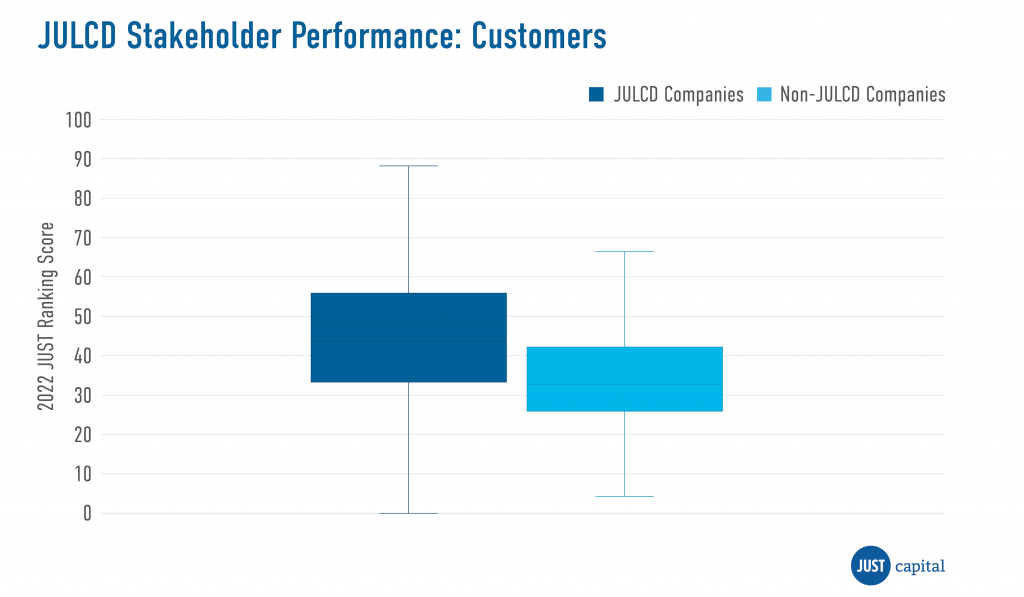
Compared to their peers, JULCD companies:
Also central to the JULCD’s outperformance is the efforts these companies make to reduce their environmental impact, making up 10% of their overall score in our Rankings. Their scores – which are determined by their performance on issues from minimizing pollution to developing sustainable products to helping combat climate change – sit consistently higher than those of non-JULCD companies, with a median score of 53.8 vs the non-JULCD score of 43.4.
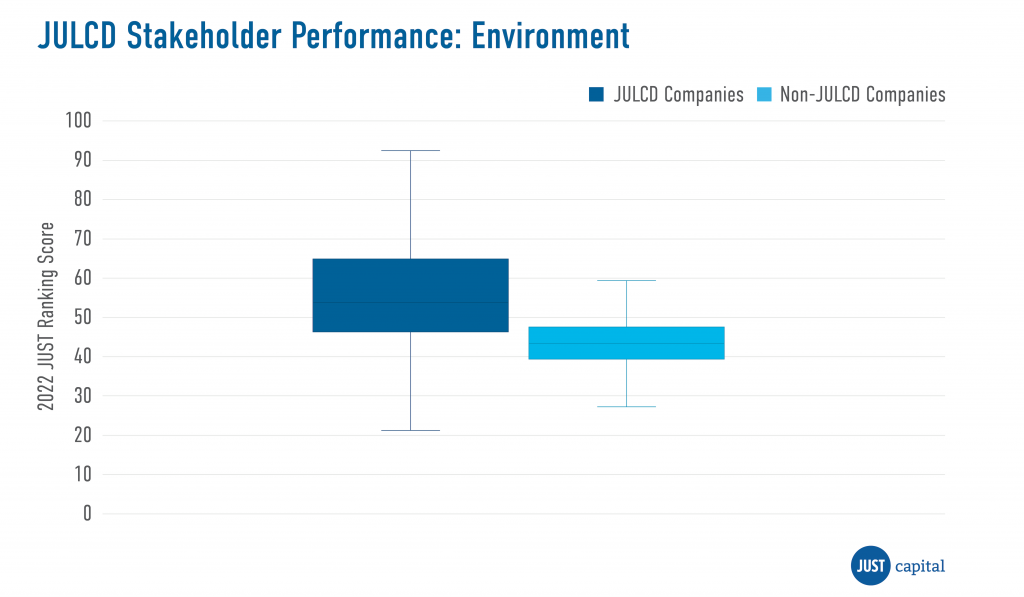
Compared to their peers, JULCD companies:
It’s clear JULCD constituent companies deliver value not only to their shareholders but all their stakeholders – demonstrating that strong performance on ESG issues does not need to come at a cost. Our Rankings represent a scorecard for just business behavior, and those that rise to the top show how just business behavior pays off in the long term.

(Target)
This week marks the third anniversary of the launch of Goldman Sachs’ JUST ETF. The fund tracks our Rankings-based JULCD Index, which we’re happy to report has both outperformed the Russell 1000 cumulatively by 6.17% since inception and showed genuine impact. Of course, much has changed over this time, as MUFG’s excellent recent report, “ESG’s Acceleration,” shows. For anyone seeking a comprehensive breakdown of the critical themes shaping the landscape today, look no further.
Their analysis of the 435 ESG resolutions of this year’s proxy season was especially revealing, in that it showed the range of issues investors were most concerned about and a surprising degree of alignment with our polling results on the priorities of the public.
Corporate political activity (lobbying, etc), climate, human capital issues – notably workplace diversity – and human rights stand out. And whereas the climate campaigns at ExxonMobil and Chevron understandably garnered most of the press, the less heralded shareholder votes in support of releasing EEO-1 diversity data at DuPont, board diversity requirements at Expeditors, arbitration policy transparency at Chipotle, and political spending transparency at McKesson and Omicon Group perhaps signal where investor activism is now headed.
We have oft noted that as shareholder demand for action on human capital and DEI metrics rises, so attention will focus on the need for better data and standards, and greater performance transparency overall. We stressed this in our public comment submitted to the Securities and Exchange Commission this week. Overall, it feels we may be entering a new worker paradigm, where we either listen to, reward, and value people appropriately, or we continue the slide toward division and discord. Humanity at work is a powerful thing (as fans of Undercover Boss will attest), but ultimately, it just makes good business sense.
Speaking of listening to workers, it was corporations like Allstate, Nike, and Target that acknowledged the wishes of their workforces last year and made Juneteenth – a day that celebrates the end of slavery in America – a company holiday. We did the same, and are happy to see with the passing of a law on Thursday that the entire country will be honoring a historic moment with a day of celebration, too.
Be well,
Martin Whittaker
GE announces new partnerships to advance wind turbine recycling technology in order to make it a more viable portion of its business.
General Motors is investing 30% more into electric vehicle production and working on building additional battery plants.
Fifth Third Bancorp is committing $2.8 billion to an equity and inclusion initiative.
Microsoft releases a progress update on its racial equity commitments, showing where the company has invested in Black communities in the U.S.
Morgan Stanley launches a toolkit as part of its Impact Investing Platform to help users invest in companies and products with a racial equity and social justice lens.
PwC aims to increase its employee count by 100,000 over the next five years, with much of the increase involving building out corporate ESG expertise.

June 24th at 1PM ET: Join JUST Capital and the Brookings Metropolitan Policy Program to discuss how private sector leaders can advance racial equity within their companies, communities, and regional economies, featuring speakers from CenterState, Cincinnati U.S. Regional Chamber, and Brookings Institute. Sign up to attend here.

New Yorkers celebrating Juneteenth last year. (Michael Noble Jr./Getty Images)
“This is an opportunity just to sit down and talk. Get it straight from the employees – get their thoughts, their feelings, what it means to them. … That’s the spirit of Juneteenth. It’s about reflection, it’s about getting together and talking about what you’ve been through, what you’re going through, what you want to do. … It’s about celebrating everybody’s history, everybody’s contribution.”
“When businesses act ethically and make a meaningful impact on society, they can create bigger and more sustained outcomes for themselves and their people and broader stakeholders. If the past year has taught us anything, it is that embedding ESG into an organization’s core can be a significant part of reducing the risks and gaining opportunity.”
“It has been a paltry number, even the pipeline is paltry today. So there’s a lot of work that has to be done for African American women or for Black women anywhere in the world.”
The Financial Times reports on one of the biggest stories coming out of the G7 summit – that G7 countries are formulating a “green belt and road” plan to counter China’s influence, with the hopes of investing billions in green energy in developing countries.
Axios discusses the upcoming “great resignation,” with polling showing that 25% to 40% of workers are considering leaving their jobs.
The Wall Street Journal takes a deeper look at the future of workplace benefits as hybrid work becomes the new normal for many companies.
Morgan Stanley takes a hard look at how the pandemic has set the stage for an inflation surgeand hotter, but shorter, economic growth cycles (reposted via Zero Hedge).
The New York Times reveals the results of a months-long investigation into worker issues at an Amazon warehouse in New York. One surprising stat: “Even before the pandemic, previously unreported data shows, Amazon lost about 3 percent of its hourly associates each week, meaning the turnover among its work force was roughly 150 percent a year. That rate, almost double that of the retail and logistics industries, has made some executives worry about running out of workers across America.”

For the three-year anniversary of the JUST ETF, we take a look back at the performance of the JULCD Index that the ETF seeks to track, showing that it has outperformed the Russell 1000 cumulatively by 6.17% since its inception (Dec. 1, 2016 to May 28, 2021). Learn more here.
JUST Capital’s Large Cap Diversified Index (JULCD) Index, which tracks the companies most dedicated to their stakeholders, has continued to outperform the market throughout the coronavirus crisis.
Since the top of the bull market on Feb. 21 this year, we have seen unprecedented levels of volatility, with returns plummeting upwards of -40%. Our JULCD Index has continued to show resilience, outperforming the Russell 1000 by 100 basis points and proving that investing sustainably does not sacrifice financial performance.
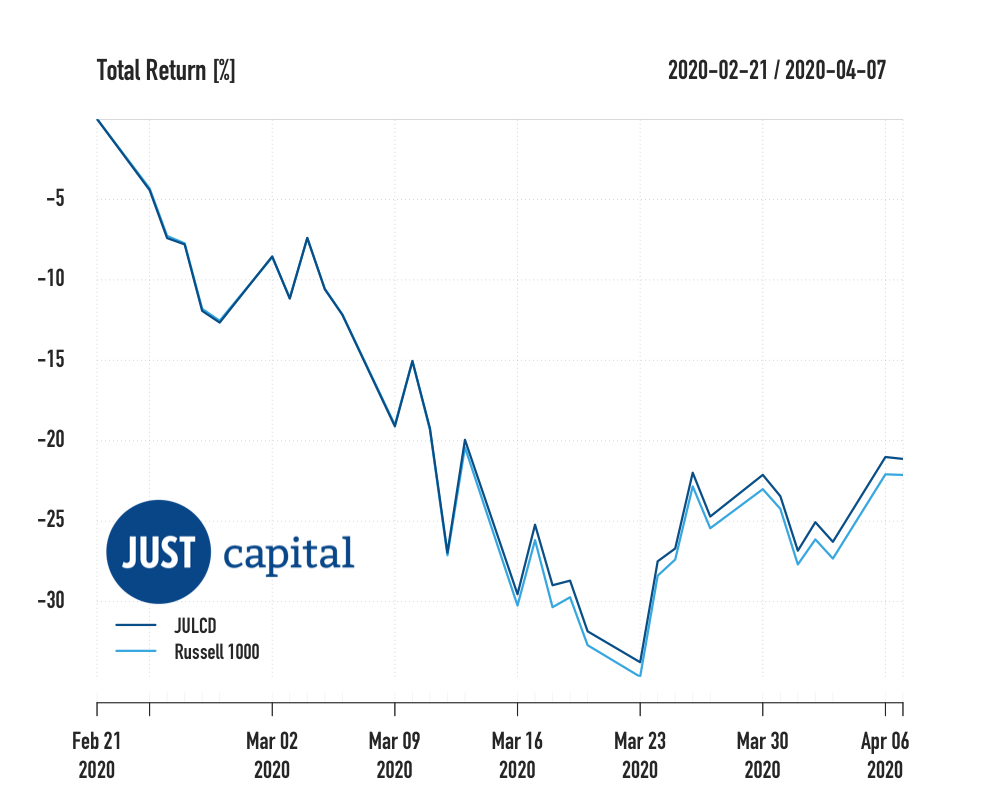
The JULCD Index has outperformed the Russell 1000 during the coronavirus crisis. (Steffen Bixby/JUST Capital)
Research this week from Morningstar showed that throughout the coronavirus crisis, ESG funds have outperformed the market.
And investors are taking notice, as we continue to see assets swell into the space. Per Bank of America, assets increased by 4.50% from Jan. 1 through Mar. 25, while S&P 500 ETFs have seen a -30.50% loss in AUM over the same period.
Investing in high quality companies focused on sustainable governance that carry clean balance sheets better position investors to weather downturns like the one we are in. Unlike 2007-2008, we are not involved in a financial collapse.
In our current crisis, the “S” in ESG stands for “Support.” The companies in the JULCD are prioritizing their focus on supporting the economy – their workers, communities, and consumers – and will see this benefit long term. It’s why we believe the COVID-19 pandemic will be the turning point in which we finally see the stakeholder-first model overturn shareholder primacy.
