For years, the working assumption has been that performing well on so-called “non-financial” stakeholder metrics is detrimental to a company’s profitability and financial performance. New analysis from Just Capital finds that, in fact, the two move positively together in statistically significant ways much more frequently than they diverge.
The research compares Russell 1000 company performance across five stakeholder groups – workers, customers, communities, environment, and shareholders and governance – with four financial metrics: economic profit margin, excess return (alpha), gross margin, and revenue growth. Overall, the results provide insight into the connections between financial and stakeholder leadership, how it varies across industries and issues, and where it appears to be strongest and weakest.
1. All industries have at least one opportunity to improve financial performance through strengthened stakeholder performance. Each company’s unique opportunity is dependent on their industry, and the stakeholder and financial metric in question.
2. The research identified the strength of relationships between each stakeholder and each financial outcome. Among the relationships that reach high statistical confidence, positive links outnumber negative ones by nearly two to one.
3. The strongest relationships between worker performance and returns are in the Consumer Discretionary, Financials, and Real Estate industries; companies that led on worker-related issues subsequently posted the greatest improvements in excess returns, suggesting a potential cause-and-effect relationship.
4. In Technology, companies that made meaningful investments in communities, environment, and governance practices saw the highest subsequent gains in revenue growth.
5. In Telecommunications, the firms with the strongest customer and environment performance delivered the highest improvements in gross margin.
The strongest overall positive relationships across stakeholder metrics and industries were found to be with revenue growth and excess return (alpha), indicating that both the market and customers can reward companies for their stakeholder leadership.
To enable companies to explore how their specific financial and stakeholder performance profile matches up, Just Capital built a new Financial Opportunity module within the organization’s flagship Just Intelligence product.
Although these correlations do not represent a causal relationship with forecasted or guaranteed returns, they provide a valuable input to C-suite decision making and a directional signal for where and how stakeholder and financial performance appear to be linked.
“This is the connection leaders have long sensed but struggled to prove,” said Just Capital CEO Martin Whittaker. “We can now show, industry by industry, where strong stakeholder investment and impact can align with strong financial performance. That moves the conversation from whether the two are related to where a company should focus first.”
The Financial Opportunity module is currently available to subscribers of Just Intelligence.
Just Capital will conduct additional analyses related to financial performance including the mechanisms that underlie these relationships. Future analyses will explore issue-level performance and the relationship to other financial performance measures such as return on invested capital and total shareholder return. The organization will also be building additional modules within Just Intelligence to inform business strategy and responsible AI deployment.
“Our commitment is to keep improving Just Intelligence so leaders always have the sharpest possible view of what drives performance,” said Whittaker. “That work is in service of something bigger, a vision of business where financial success and the wellbeing of workers, customers, and communities move forward together.”
The research builds on Just Capital’s history of exploring how meeting the expectations of the American public drives business results. The organization’s Just 100 Index has outperformed the Russell 1000 equal-weighted benchmark by 79% since inception in 2019.
The research that underpins the Financial Opportunity module was completed in collaboration with New Constructs and used a statistical approach that involved all 767 companies present in the Russell 1000 universe between 2021 and 2025. The analysis was conducted industry-by-industry based on the 11 Industry Classification Benchmark Industries.
For each company, Just Capital compared their annual financial performance measured by economic profit margin, excess return (alpha), gross margin, and revenue growth to their annual performance on key issues that the public has identified as priorities in Just Capital’s polling. The issues are aggregated by stakeholder: workers, customers, communities, environment, and shareholders & governance.
The analysis contained two periods: Period 1 (2021-2023) and Period 2 (2024-2025). The research compared average stakeholder performance in Period 1 with the change in financial performance between Period 1 and Period 2, in order to determine whether strong stakeholder performance results in improved financial performance over time.
For media inquiries, please contact:
Evangeline DiMichele: edimichele@justcapital.com
Organization Unveils Second Generation Platform and New Brand Identity to Help Business Leaders Deliver Value for Shareholders, Economy, and Society
NEW YORK, NY February 17, 2026 – Just Capital, the foremost independent organization advancing responsible business leadership, announced the culmination of its strategic transformation into a stakeholder-focused data and insights platform. Building on more than a decade of impact, the organization released an updated version of its flagship Just Intelligence product, alongside a new brand identity, logo, and website, to serve as an objective partner to companies as they shape outcomes for their business, workers, communities, and the economy and society at large.
“Just Capital’s evolution was driven by the conviction that the decisions leaders make today will define business and societal outcomes for decades to come,” said Martin Whittaker, Chief Executive Officer of Just Capital. “We have enhanced our capabilities to help companies optimize their stakeholder investments through independent and comprehensive insights in service of their ability to compete and win in a changing marketplace. Our vision is an economy where business success and shared prosperity move forward together.”
Just Capital has launched upgraded functionality and performance data within Just Intelligence. Just Intelligence supports strategic planning and decision-making by offering a comprehensive view of public expectations, sector realities, and stakeholder performance, and by connecting those signals to core business outcomes. The platform is built on Just Capital’s decade of public opinion research and corporate performance data, and it surfaces areas of relative over- and under-performance across a company’s stakeholder ecosystem, including workers, customers, communities, environment, and shareholders. New features include:
These capabilities help leaders identify which stakeholder investments have the power to drive long-term business performance, enabling them to create value that compounds beyond their firm to benefit shareholders, the economy, and society at large.
“At a time where looking around corners has never been more important, Just Intelligence offers insights leaders can use in moments of complexity to evaluate real tradeoffs across growth, risk, technology, and societal expectations,” said Whittaker. “Our goal is to help leaders navigate those tradeoffs with clarity and confidence.”
Just Capital’s transformation was informed by a review process including direct engagement with CEOs, C-suite leaders, and board members of some of America’s most influential companies. Five Fortune 500 companies are vanguard users of the paid product, helping to shape the platform’s evolution ahead of broader market rollout and adoption. Just Intelligence and the platform’s ongoing enhancements are grounded in feedback from a beta period with 250+ corporate users and interviews with more than 45 business leaders on the user experience, value proposition, and industry relevance.
Russell 1000 companies have access to the Performance Explorer tool with select stakeholder indicators available. Subscribers can access full metrics, Peer Comparison, and Leading Practice capabilities. The platform and its features will be updated on an ongoing basis.
Just Capital’s refreshed visual identity marks the evolution of the organization from an external evaluator to a performance partner. The new website and tools within Just Intelligence are built to support forward-looking decision-making rather than retrospective assessments of past performance. Just Capital’s annual Rankings will continue to serve as a tool to showcase performance and insights to inform responsible business leadership. The 2026 Rankings will be announced in March 2026.
In Fall 2025, Just Capital launched its inaugural research from surveys of corporate leaders, investors, and the American public on responsible AI deployment. The organization will conduct quarterly pulse surveys through 2026 and beyond, providing ongoing insights for corporate leaders, investors, and policy makers as perspectives continue to evolve. AI-focused insights will feed into Just Intelligence in 2026.
As part of this strategic focus, the Corporate Impact Lab has begun the process of becoming an independent organization. Just Capital has been proud to incubate the Corporate Impact Lab since its inception in 2022. In 2026, the Corporate Impact Lab will be fiscally sponsored by Just Capital and operate independently. Both organizations share the mutual goal of the Corporate Impact Lab becoming a fully independent organization in 2026, subject to the completion of necessary regulatory, legal, and other administrative requirements.
Just Capital is the foremost independent organization advancing responsible business leadership. We translate insights from public polling, performance data, and financial analysis into actionable intelligence leaders can use to drive long-term business success and shared prosperity for people across America. Our flagship product Just Intelligence is designed to offer a comprehensive view of public expectations, stakeholder performance, and sector realities in order to drive responsible decision-making. When companies make better decisions, they can create lasting value for shareholders, contribute to stronger communities, and help drive broader economic and societal progress. For more information, visit justcapital.com.
For media inquiries, please contact:
Tyler Spalding: tspalding@justcapital.com

Amid ongoing macroeconomic uncertainty and emerging AI-driven labor market disruptions, workforce leaders face the dual challenge of investing meaningfully in their workforce and demonstrating their value proposition to meet rising employee expectations.
What do Americans want from their employers? The public tells us year after year that fair wages matter most, but they also clearly indicate that pay alone doesn’t define a good job. Across every demographic group, Americans consistently prioritize benefits, worker well-being, ethical leadership, and transparent communication as hallmarks of just companies.
The Just Jobs Performance Tracker supports Russell 1000 leaders facing tough decisions on their human capital strategy through comprehensive access to benchmarking data and leading workforce practices. This singular destination is built to help enhance job quality, strengthen recruitment and retention, and unlock organizational excellence.
The business case for Just jobs is compelling: As of June 11, 2025 Just Capital’s Workers Index has outperformed its Russell 1000 benchmark by 16.6% since its inception in December 2021. The Workers Index tracks the top 20% of Russell 1000 companies with high performance on Worker issues in the annual Ranking of America’s Most JUST Companies.
This Performance Tracker is the third iteration of a tool formerly known as the JUST Jobs Scorecard, building on earlier versions with updated company data, refreshed benchmarks, and an enhanced peer comparison feature to provide deeper insight. It is accessible within the JUST Intelligence platform.
The JUST Jobs Performance Tracker enables companies to assess disclosure and performance on 27 data points across five key topic areas that are foundational to quality jobs: Wages & Compensation; Benefits; Hiring & Stability; Training & Development; Employee Wellness & Belonging. To develop the JUST Jobs Performance Tracker, JUST Capital assessed corporate disclosure and performance on these data points, scoring companies on a continuum of practice from 0 points for no disclosure through 4 points for leading practice.
Companies earn JUST Jobs Leadership designation by achieving an overall average score at or above 3.00, and can earn Top Performer status through earning a perfect 4.00 on all data points within any one topic area or Top in Industry for achieving the highest average score for their industry on the data points in a given topic area.
Additional methodological details can be found here.
Here are our findings:
The Just Jobs Performance Tracker, based on data collected through November 2024, reveals a continued overall trend of steady employee policy transparency and workforce investment despite early indications of an evolving social and political environment.
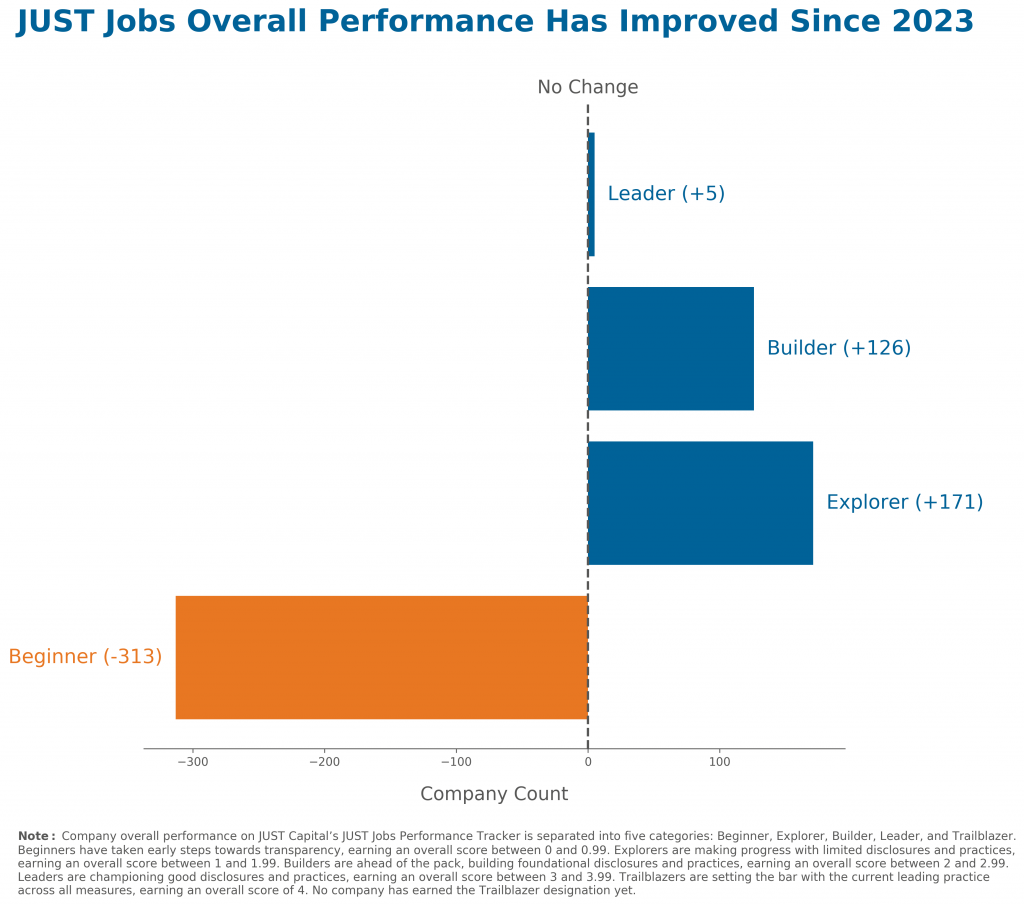
Notably, the proportion of companies earning the lowest possible score (0.00) decreased for every topic, indicating attention to disclosure across key job categories.
And disclosure rates in the tracker increased between 2024 and 2025 for almost all data points. The following saw some of the more notable jumps, indicating an increased focus on building a robust talent pipeline:
Pressure around non-financial reporting has become even more complex between 2024 and 2025. So far, in 2025, our ongoing tracking of key disclosures – including workforce policies – indicates that company impact report releases are down by 27% compared to this time last year. It is too early to say whether this is a delay or a retreat. While company leaders have told us they are being more cautious about how and when they communicate their stakeholder efforts in today’s environment, the work continues internally. Corporate leaders tell us they’re being more strategic about tying every initiative directly to business value and managing legal risks. We expect to have clearer visibility on how this context impacts disclosure trends by Q4.
This business-based caution stands in contrast to our understanding of public demand for transparency. Our survey work finds increased support year over year for disclosure across all categories – including minimum wage and average wage for different worker demographic groups. Meanwhile, the American public ranked “Communicates transparently” as the #4 priority issue for business behavior in 2024, followed by “Provides benefits and work life balance” and “Supports workforce advancement and training”.
Representation of overall Just Jobs leadership across industries demonstrates a continued investment in job quality and disclosure across the U.S. workforce.
Consistent with 2024, the Just Jobs Leaders each represent a different industry with a range in workforce compositions:
Three companies were just shy of reaching the overall average score required to be named an overall JUST Jobs Leader, but still outperformed their peers:
Company disclosure tends to lag across industries on all but a few Wages & Compensation metrics. With wage-related issues as the American public’s top priority, especially amidst rising cost of living, this provides an area in which companies can take advantage of an existing transparency gap and emphasize their employee value proposition.
Additionally, while companies are sharpening their benefits policies and improving offerings for employees, few in the JUST Jobs Performance Tracker are providing what experts and company examples indicate is leading practice. By investing in comprehensive benefits and transparent communication, companies can stand out in meeting the expectations of the American workforce.
A few key policies with wide-ranging public support have relatively low disclosure, and indicate where companies looking to demonstrate leadership can differentiate themselves through disclosure of existing policies:
The transparency gaps and opportunities outlined above reflect a broader shift in the American employment landscape, one that has significant implications for the current administration’s domestic job creation goals. While the administration has prioritized reshoring manufacturing jobs and creating employment opportunities domestically, our polling reveals that Americans aren’t simply seeking any employment — they’re searching for quality positions that offer genuine value and security.
Manufacturing — a focal point in the administration’s job creation strategy — presents a mixed picture of job quality in the JUST Jobs Performance Tracker. Key manufacturing industries such as Aerospace & Defense, Automobile & Parts, Energy Equipment & Services, Semiconductors & Equipment, and Utilities show a wide range in performance across core job quality metrics.
While these industries tend to score well on Training & Development and Employee Wellness & Belonging, they lag on Wages & Compensation and Benefits — two areas workers consistently rank as top priorities. Even within lower-performing topics, variation exists: Energy Equipment & Services’s top Wages and Benefits scores are among the lowest across all industries on both compensation-related topics, whereas Utilities performs relatively well on Wages & Compensation, and Semiconductors & Equipment is strong on Benefits.
Utility companies may offer a positive blueprint for building JUST Jobs among a domestic workforce. Although there is significant room for improvement on key job quality practices and disclosures, Utilities led all 36 industries in the Just Capital universe with the highest average overall score. American Water Works achieved Just Jobs Leadership designation, leading the industry in Training & Development and Employee Wellness & Belonging. Another domestic utility company American Electric Power is top in the Utilities industry on Wages & Compensations and discloses key benefits including paid parental leave, sick leave, and paid time off.
