Americans want paid leave. Just Capital data shows a clear and unmet demand for paid leave and parental support – 86% of Americans agree that it is important for companies to invest in expanded child care benefits, while just 44% agreed that companies are doing well on this issue. Polling shows these policies are a priority for the American public, and this election season, we saw paid leave measures advance in Nebraska, Missouri, and Alaska on the ballot. By implementing comprehensive paid leave programs, corporate leaders not only meet this expectation and support the well-being of their workers, but also deliver measurable returns through improved talent retention, enhanced productivity, and strengthened brand value.
This report makes the business case for maintaining and/or expanding paid leave policies, including:
Click on the image below to read or download the full report.
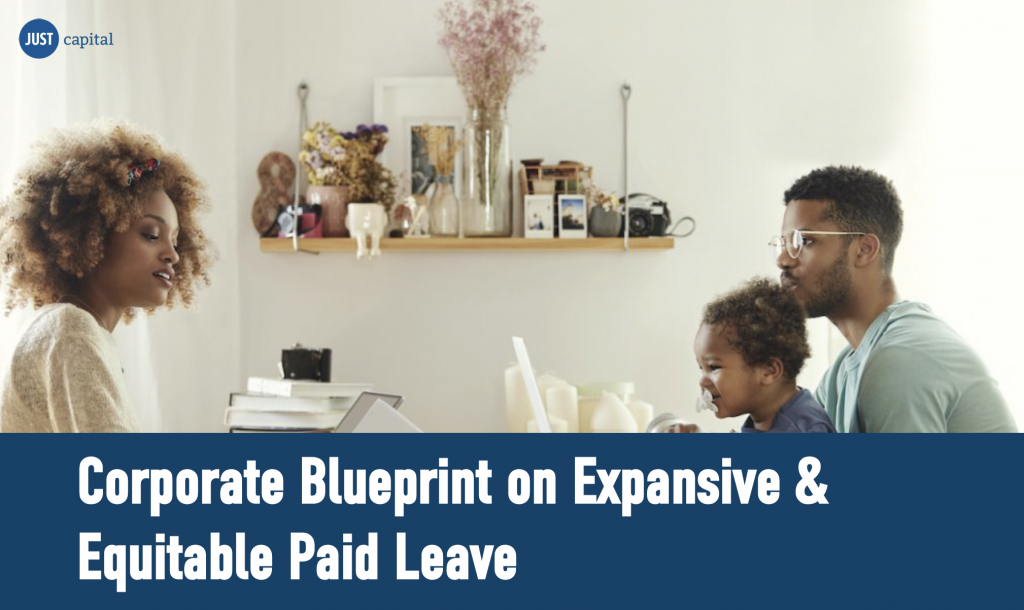

Amidst the current caregiving and mental health crises, employees are increasingly seeking paid leave benefits to safeguard their well-being, and that of their families. In response, some companies are strategically crafting policies that cater to diverse employee needs, fostering equity and inclusion within their organizations, and integrating more resiliency into their workforces.
Right now, the vast majority of companies fall short of meeting workers’ expectations on paid leave benefits. JUST Capital’s research suggests only 9% of companies offer 12 or more weeks of parental leave for both caregivers, while their 2022 polling found that 64% of Americans believe it is necessary for companies to provide 12 weeks of paid leave for all parents. Worse, just 23% of private industry workers had access to any paid family leave through their employer in 2021, according to the Bureau of Labor Statistics. While 77% of workers in private industry are able to access paid sick leave as of February 2023, low-wage workers are significantly less likely to have paid sick leave compared to high-wage workers (38% vs. 96%, respectively).
JUST Capital tracks companies’ practices around paid family leave, paid sick leave, and other core caregiving policies, and we have observed the emergence of cutting-edge benefits that support employees across various life stages as businesses discover that supporting their employees’ well-being is not only socially responsible, but a smart investment. Paid leave policies improve worker retention and productivity, while minimally increasing operating costs (sometimes producing cost savings). In studies of California’s paid leave program, about 90% of businesses reported either a positive or neutral effect on productivity and almost all businesses (99%) identified positive or neutral effects on employee morale.
Paid leave initiatives are also pivotal in advancing equity within the workforce. Women – particularly mothers – often bear the brunt of caregiving responsibilities, leading to detrimental career choices and perpetuating the gender earnings gap, sometimes known as the “motherhood penalty.” In an analysis of states with paid leave policies, the rate of women leaving their jobs after welcoming a child dropped by 20% in the first year, and up to 50% after 6 years.
Nine years of polling has shown that paid leave policies are a key way for companies to differentiate themselves as a JUST employer. Below, we examine companies leading on implementing paid leave policies to support their diverse workforces, and the results for their employees and their business.
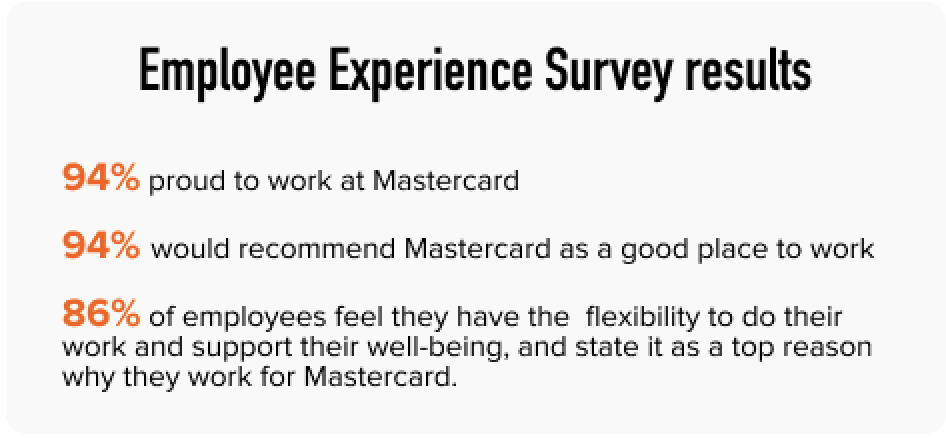
Mastercard offers a bereavement leave policy, acknowledging the need for employees to take the time to grieve and attend to personal matters without the added stress of work responsibilities. Mastercard considers bereavement leave as part of their holistic wellbeing and flexibility offerings, which they continuously revisit to ensure they best support employees and company. Over the years, bereavement leave has expanded and evolved, and in their current policy, employees can take up to 20 days paid time off, which applies to both full- and part-time employees. Recent updates to the policy include expanded time for death of a parent (including in-laws and step-parents) and in the event of a stillbirth or miscarriage.
We have received overwhelmingly positive feedback from employees, who attribute this benefit as a good example of our culture of decency. Feedback has also come in other forms, such as through the employee-led blog on the Mastercard homepage, called “Our Voices.” One employee reflected on their experience using the benefit to grieve the death of their grandparent and support their family, stating that Mastercard is a
Caring and inclusive workplace that values our lives and identities beyond our business hour deliverables.
Mastercard
Cisco has implemented a Critical Time Off policy that goes beyond traditional leave structures. This policy allows employees to take additional time off during significant life events such as the illness of a family member or personal emergencies. Cisco understands that certain situations require extra time and attention, and the Critical Time Off policy is designed to provide the necessary flexibility and support.
Three years ago, Adobe instituted Global Wellbeing Days, enabling their global community to collectively prioritize their wellbeing, disconnect, and recharge without worrying about work. In 2024, Adobe is offering six Global Wellbeing Days. These designated days serve as opportunities for employees to engage in activities and initiatives focused on improving their overall well-being.
At Adobe, we believe that taking time off is essential to the health and wellbeing of every employee. When our employees experience support both in and outside of the workplace, they are better equipped to unleash their creativity and innovate.
With Global Wellbeing Days, we’ve witnessed the profound impact of our community coming together for a collective day of rest. Employees use the time to reconnect with loved ones, focus on their health, or build community with other Adobe colleagues. For instance, the Adobe Golf network arranges golf outings on Global Wellbeing days, while some employees join fellow Adobe colleagues for activities like hikes, local pickleball games, and bike rides. Others choose to spend quality time with their family and pets.
Adobe
Medtronic, a leader in medical technology, understands the commitment of employees serving in the military reserves. To honor and support their dedication to national service, Medtronic provides paid time off for employees to fulfill their military reserve obligations. If reservists get deployed, Medtronic ventures far beyond what’s legally required. Medtronic holds reservists jobs for up to five years and provides differential compensation to cover the difference between their base pay and military pay. Benefits are covered for employees on military leave for up to 24 months. Their Family Care Leave policy includes up to six weeks paid leave for employees who are caregivers in a family where someone (such as a partner) is called to active military duty.
We’ve heard overwhelmingly positive feedback from workers who have utilized our military reserve leave. For them, it’s about more than just time off; it’s about peace of mind knowing that their service is valued and supported. We’ve had employees express deep gratitude for feeling recognized for their military commitments and the flexibility we offer.
Beyond military leave, we’re also proud to offer our employees caregiving support through Wellthy, a care concierge platform that works with families to ease their care burdens. Employees are matched with a dedicated Care Coordinator, who can help manage care in any capacity, big or small. This includes Wellthy’s deep expertise in veterans’ benefits, which can help veterans and their caregivers navigate benefits and coverage offered through the VA and other providers.
Our broader paid leave policies, including our military reserve leave, have significantly impacted our workforce in terms of retention, recruitment, and overall employee satisfaction. By prioritizing paid leave for military reservists, we demonstrate our commitment to supporting our employees’ diverse needs and honoring their service to the country. This approach not only strengthens our workforce by retaining experienced and dedicated individuals but also enhances our reputation as an employer of choice.
Our Family Care Leave, available globally — and expanded leave of up to 24 weeks paid for birthing parents in the U.S. — sets us apart in the marketplace. Combined with our Mission, which provides employees with a profound sense of purpose, our commitment to evolving benefits to meet employee needs is consistently highlighted as a top draw for candidates. …
Overall, our comprehensive approach to paid leave and talent development not only fosters a supportive and inclusive workplace culture but also positions us as a talent destination where diverse, top talent can come, grow, and thrive.
Denise King, Vice President, Global Benefits and Payroll, Medtronic
Pinterest recognizes the physical and emotional challenges that accompany miscarriage or stillbirth and is committed to supporting its employees during these difficult times. The company has a bereavement leave policy in place that covers Miscarriages and Stillbirth, acknowledging the need for employees to take the time they need to heal and cope with such personal losses.
Pinterest also provides a Family Care leave offering up to 12 weeks of full pay should employees need it to care for a seriously ill family member including a child under the care of a Neonatal Intensive Care Unit (NICU) post-birth. This is in addition to Pinterest’s 20 weeks of bonding leave for new parents.
At Pinterest, we’ve seen that people do their best work when they are most inspired, and feel seen and supported. We strive to create benefits that meet the real-world needs of our employees by supporting them through the different stages of family planning and child care, and by putting emotional wellbeing at the forefront. By listening to our employees, we’ve been able to shape our policies to support them when unexpected challenges arise. As our company continues to grow, we will keep working to create benefits that provide choices that are best for our employees’ careers and lives.
Adobe launched its U.S. sabbatical program to celebrate and honor employees’ innovation and contributions, recognizing them as the company’s greatest assets. Once employees reach five years of tenure, their initial sabbatical lasts four weeks. At 10 years, it extends to five weeks, and at 15 years, six weeks, remaining at this duration every five years thereafter. The Sabbatical Program is designed to provide employees with the time and space they need to rest and reflect, fostering creativity and innovation upon their return to work.
Adobe’s industry-leading paid leave policies foster a healthier, happier, and more engaged workforce by enabling employees to reinvigorate their creativity and return to work refreshed, primed to forge innovative ideas, and explore uncharted paths. In our annual employee survey, 87% of respondents expressed a willingness to recommend Adobe as an employer, while 89% stated they feel proud to work here. Upon returning from sabbatical, most employees shared in our sabbatical survey that they felt refreshed and welcomed as they transitioned back into their roles, noting that the time off fueled their motivation to do their best work upon return.
We are evaluating our wellbeing and benefits offerings each year by pulsing employee sentiment and benchmarking against the industry to remain competitive while providing optimal support to our global workforce.
Adobe
Understanding the unique challenges and health considerations that menopause can bring, Sanofi has implemented comprehensive menopause benefits to provide support and resources to its employees. These benefits may include access to menopause education and information, support groups, counseling services, flexible work arrangements, and healthcare coverage for treatments or therapies related to menopausal symptoms.
| “If you feel truly supported throughout your life cycle, whether it is maternity or menopause, you’ll be more engaged. I’m sure the new generation is more demanding on that.” Nathalie Grenache, SVP of People and Culture, Sanofi |
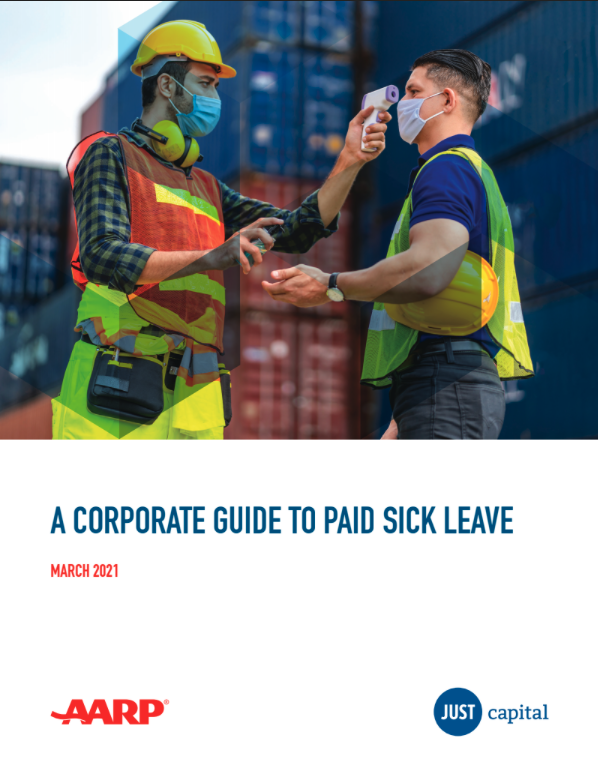
For years, there have been mounting calls from researchers, advocates, policy makers, and workers to increase Americans’ access to a range of paid leave benefits in the absence of government action. The COVID-19 health crisis has put a spotlight on these critical issues. It has never been clearer that all workers need access to a range of paid leave benefits to care for themselves or for an ill family member or young child. Paid leave benefits, whether provided voluntarily by a company or through a government program, are vital to protecting workers’ health and economic security. In the brief below, we focus on one of the most crucial and basic forms of paid leave – paid sick leave – and discuss the state of workers’ access to these benefits, how corporate policies have changed in response to COVID-19, and what actions business leaders can take moving forward.
As companies continue the process of re-opening, paid sick leave has become an important part of the puzzle. These policies serve to minimize continued spread of the virus, protect the financial security of workers, help companies retain employees, and protect against long-term shortages or reliability in the value chain. The consequences of not having a paid sick leave policy in this time of crisis have been serious in some instances. For example, several major meatpacking companies had to shut down plant operations following waves of COVID-19 cases on their factory floors.
The benefits of these policies include, but are not limited to, retention, recruitment, and employee well-being – which all can bolster the overall financial health of a company. In fact, research from JUST Capital shows that stakeholder-focused companies that prioritize their workforces have outperformed their peers by 7.3% so far in 2020. Since the pandemic began, investors have increasingly emphasized paid sick leave as well, with 286 institutional investors representing $8.2 trillion calling for companies to provide paid sick leave, prioritize health and safety measures, retain their workforces, maintain supplier and customer relationships, and remain financially prudent in response to coronavirus. Companies are facing a distinct choice to protect their employees at all levels, keep communities and families caring for dependents financially secure, and to build healthier communities, and can take a significant step in this process by implementing paid sick leave.
JUST Capital was proud to partner with AARP to make this guide available. Download the report below to read the full report detailing the following key findings:
We invite you to read the other two guides in this series offering additional insights on navigating key workplace issues in the wake of the coronavirus pandemic:
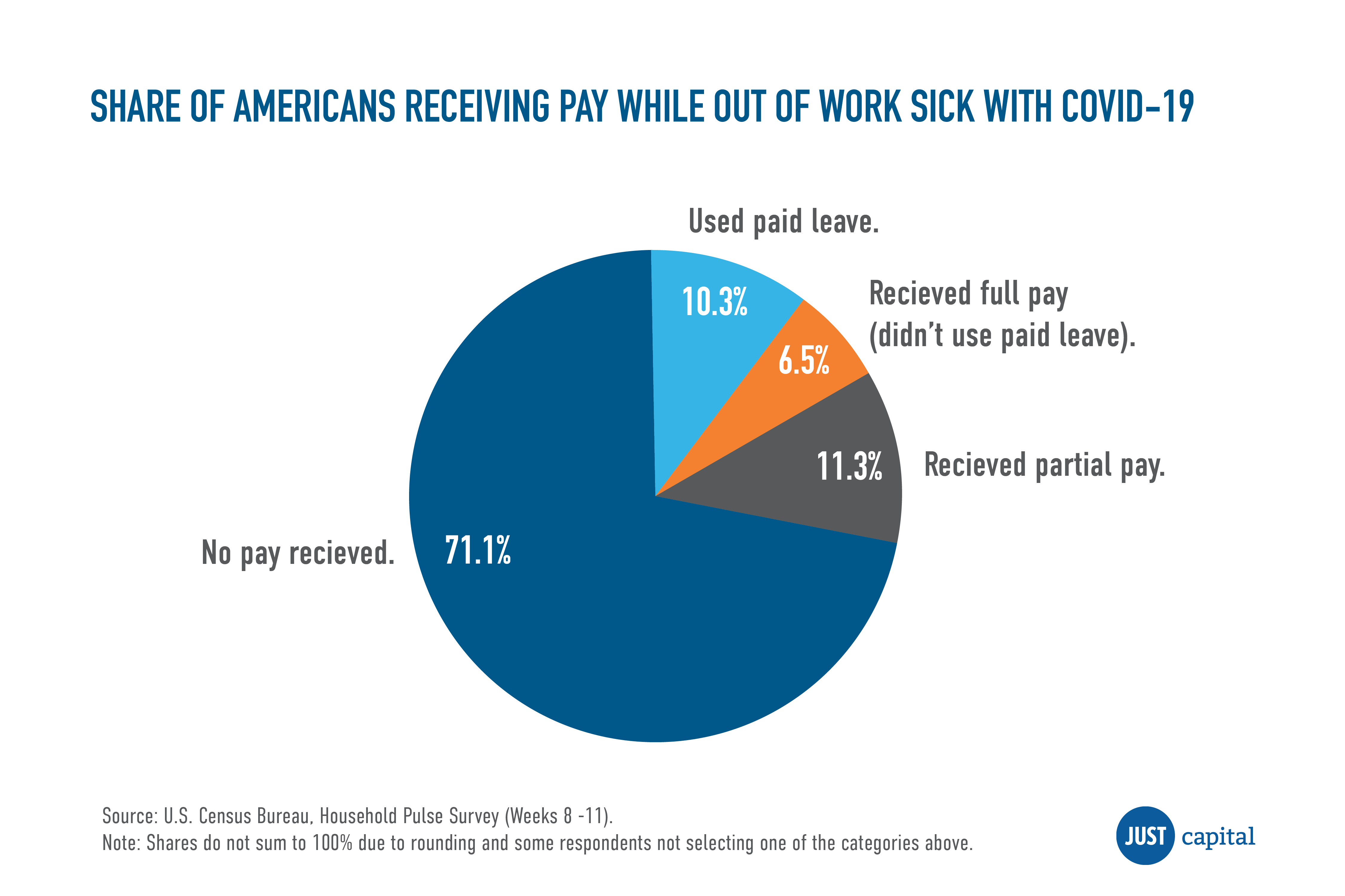
As the number of COVID-19 cases in the U.S. continues to rise, paid sick leave remains crucial to limiting the spread of the virus, protecting workers’ finances, and supporting businesses and the economy. Recent data from the Census Bureau, however, shows that the vast majority of Americans who weren’t at work because they had COVID-19 symptoms did not receive any pay.
Beginning at the end of April, the U.S. Census Bureau deployed a new weekly experimental household survey to identify how the pandemic is impacting people’s social and economic wellbeing. A key section of this survey asks whether a respondent worked in the last week and, if not, what was the main reason why, including whether it was because they were “sick with coronavirus symptoms.” Specifically, respondents are asked if they worked for pay during the prior seven days and if they didn’t, whether they received any pay during this period.
Over a four week period (June 18 to July 14), 71% of adults who didn’t work because they had COVID-19 symptoms reported receiving no pay during that period; only 10% reported using paid leave during their time away from work.
A closer look at the data illustrates that low-wage workers and people of color comprise the majority of people missing working due to COVID-19 illnesses. These workers are also among those least likely to have access to paid sick leave benefits prior to the outbreak. Below is a snapshot of the demographic characteristics of Americans missing work due to their COVID-19 symptoms.
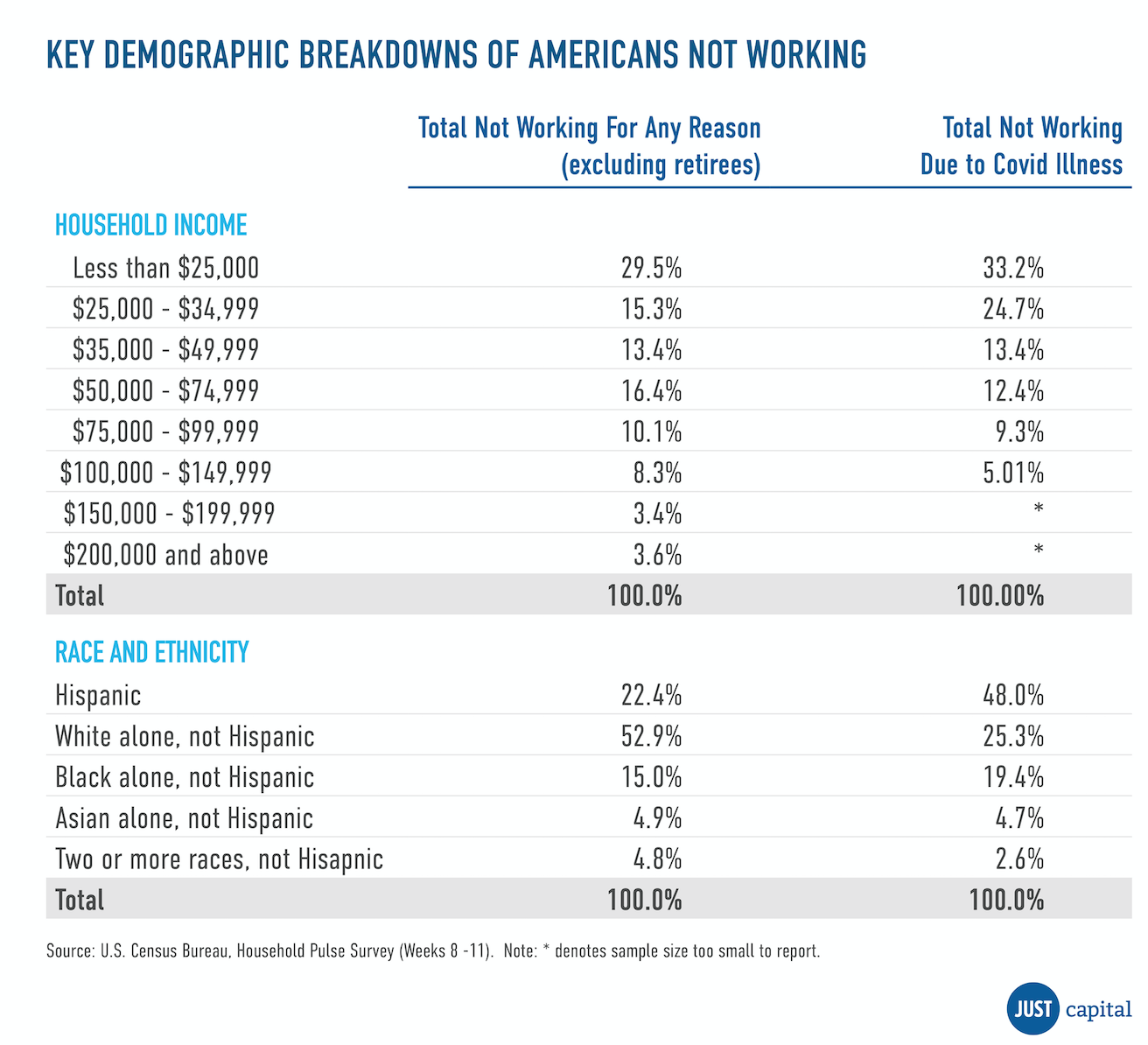
Americans not working due to a COVID-19 illness are disproportionately low-wage workers. More than 70% have a household income of less than $50,000, with nearly 60% making less than $35,000. As a point of comparison, among all adults not working for any reason, 45% earn less than $35,000. People of color also make up a majority of all adults not working because of COVID-19 symptoms, with Hispanic or Latinx workers comprising almost 50% of all adults.
As identified above, nearly three in four (71%) adults not working because they have COVID-19 symptoms are not receiving any pay. Alarmingly, these rates are far higher among low-wage workers. For example, among adults with a household income of less than $25,000, more than 87% didn’t receive any pay while they weren’t working; among people with a household income between $25,000 and $34,999, more than 73% of people didn’t receive any pay.
Nearly six months into the COVID-19 crisis, one may wonder why so many workers still can’t access adequate paid sick leave benefits. The short answer is that paid sick leave in the U.S. remains a patchwork of policies, including a new federal law, city-wide programs, and employer provided benefits. The data highlighted above suggests that this approach has largely failed at a moment when workers need paid sick leave benefits the most.
Prior to the COVID-19 crisis, there were significant disparities in access to paid sick leave across the labor force. Overall, 73% of private-sector workers had access to paid sick leave but rates were far lower in industries with significant frontline workers and among low-wage workers. For example, only 45% of those in the Accommodation and Food Services sector had access to paid sick leave; overall, only 30% of the lowest paid workers have access to leave.
Recognizing the health and economic importance of workers having adequate paid sick leave, Congress passed the Families First Coronavirus Response Act, which included a requirement for employers to provide up to 80 hours (10 days) of paid sick leave to workers. The Act, however, contained a large loophole, exempting employers with 500 or more employees, which represents more than half of the nation’s workforce.
On top of that, the Department of Labor – the agency charged with implementing the law – has done little to ensure covered employers and workers are aware of their rights under the program. In fact, the Department has taken steps to make it easier for small employers to also be exempt from providing workers with paid sick leave in instances when they need to care for children.
In short, legislated exemptions, clawbacks through regulation, and the lack of an implementation strategy reduced the effectiveness of the Families First Coronavirus Response Act. It’s clear that federal legislation that provides paid sick leave to all workers – regardless of employee classification or what size of company they work for – is still needed.
In the absence of additional Congressional action, large companies should step up and provide all workers with paid sick leave. JUST Capital’s polling shows that this issue is among the top priorities of the American public: 74% of Americans believe that companies should provide employees with 14 days of paid sick leave. Importantly, the public recognizes that this shouldn’t be a short-term benefit, with 70% believing extended lengths of leave should be provided to workers for at least the next 12 months.
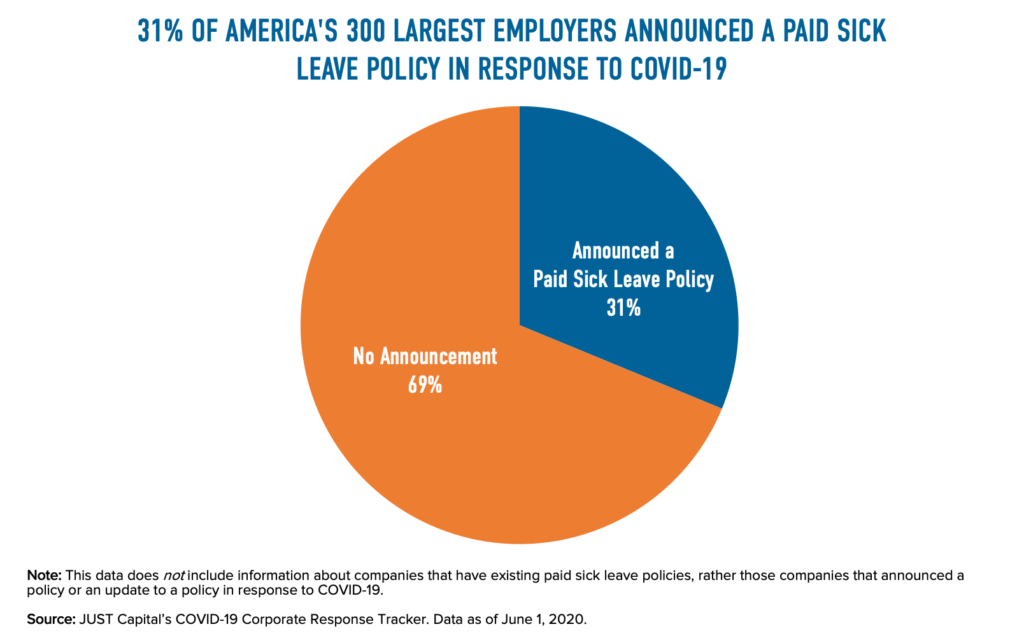
Since the beginning of the COVID-19 crisis, JUST Capital has been tracking corporate behavior and responses. Our research shows that less than a third (31%) of America’s largest companies have announced a new or expanded paid sick leave policy. Within the retail sector, JUST’s research shows that about 40% of the largest companies have made paid sick leave announcements. Across all companies that have made a paid sick leave announcement, the average number of days provided to workers is about 13 days.
In many cases, however, workers still face barriers to use. For example, at some companies workers need to have a positive COVID-19 test or a doctor’s note in order to use their leave. That means that workers who have a fever or other mild symptoms of COVID-19 and would like to stay home can’t do so with pay. In total, 31% of companies that have announced a new or expanded paid sick policy have some barrier to use.
As our country continues to experience a rising number of COVID-19 cases, paid sick leave is vital to containing outbreaks and protecting families’ finances. Corporate actions to date are encouraging, but businesses can and should do much more to ensure all workers – especially low-wage, essential workers – don’t have to choose between their health and earning a paycheck while they wait for Congress to act.
The world is gripped by fear. The market is plunging. Governments are locking down cities. Many of us are refreshing news sites and Twitter to understand the latest update. Of course, I’m talking about the coronavirus, or COVID-19, an international pandemic that’s leaving everyone anxious.
There’s been much (welcome!) talk about stakeholder capitalism, purpose, and a commitment to workers in the last year, from the Business Roundtable’s new statement of purpose to its presence as a main topic in Davos. The reality is that this is the moment for companies to put stakeholder capitalism into practice – to demonstrate their commitment to an American public that is increasingly skeptical about promises (according to our polling, less than half of Americans currently trust large companies). Every company – from the 181 that signed the Business Roundtable’s pledge to those espousing purpose and a commitment to workers and communities – should be acting now.
What should companies be doing?
First, paid sick leave. Every worker, regardless of classification, needs access to paid sick leave. And with too few tests available and concerns about hospital overuse, it can’t only be available when a worker has a proven case of COVID-19. We’re seeing announcements from companies like Walmart and Darden Restaurants on new sick leave policies. Fundamentally in this environment, workers need 14 days of leave. Companies should also press Congress to implement sick leave universally. This will level the playing field for those companies that are committed to doing the right thing for their workers and communities.
Second, we’re seeing many tech and white collar companies encourage or require employees to work from home. Those companies must also be thinking about their contractors, vendors, and suppliers. We’ve seen companies like Microsoft and Alphabet pledge to cover lost wages of hourly workers at their headquarters. Every company should include this as part of their calculation over the coming days and weeks. Stakeholder-run companies connect the interests of their workers to their suppliers and communities, and this is a critical example of that.
And third: Companies need to know the financial security of their workforce and ask if their workers are making ends meet each month. JUST Capital can help with conducting a financial stress test. This is the moment where recommendations like storing up a month’s worth of food is simply not possible for workers in financial distress. We know that 40% of Americans can’t afford a $400 emergency and according to our initial estimates, 10.4 million people (of the 20 million overall) who work at Russell 1000 companies do not make enough to support a family of three, even with a spouse working part time. It goes without saying that a pandemic is one of those emergencies – necessitating that people obtain additional medication, food, and healthcare.
More fundamentally, as a recession feels more likely, companies (and investors) must recognize that the last 10+ years of growth, buybacks, and tax cuts can and must cover the costs of keeping jobs and workers in those jobs. There is some evidence that an investment in workers, rather than layoffs and cost-cutting measures, along with operational efficiencies and agility can support the long-term resilience of companies. Studies have also shown that stakeholder-driven small businesses, post-2008, were more likely to rebound due to their stakeholder approach in a downturn.
This is a once-in-a-generation moment. Business leaders should be acting quickly to be sure they’ve defined their vision for and commitment to their workers, communities, suppliers, and long-term interest of investors. This is the social license to operate; this is stakeholder capitalism.
