Consumer issues comprise some of the biggest conversations on what it means to be a just company right now. Take Meta, Snapchat, and other social media CEOs appearing before the Senate on their impact on child safety. Or consider the effect that stubbornly high prices for groceries and other consumer staples have had on working families. AT&T’s cellular service outage this week also springs to mind.
These issues have a real impact on millions of Americans. And with the rapid growth and deployment of generative AI, the consumer component of our stakeholder model – particularly in areas like data privacy, product benefit and harm, and customer treatment – is only going to grow in importance in the future.
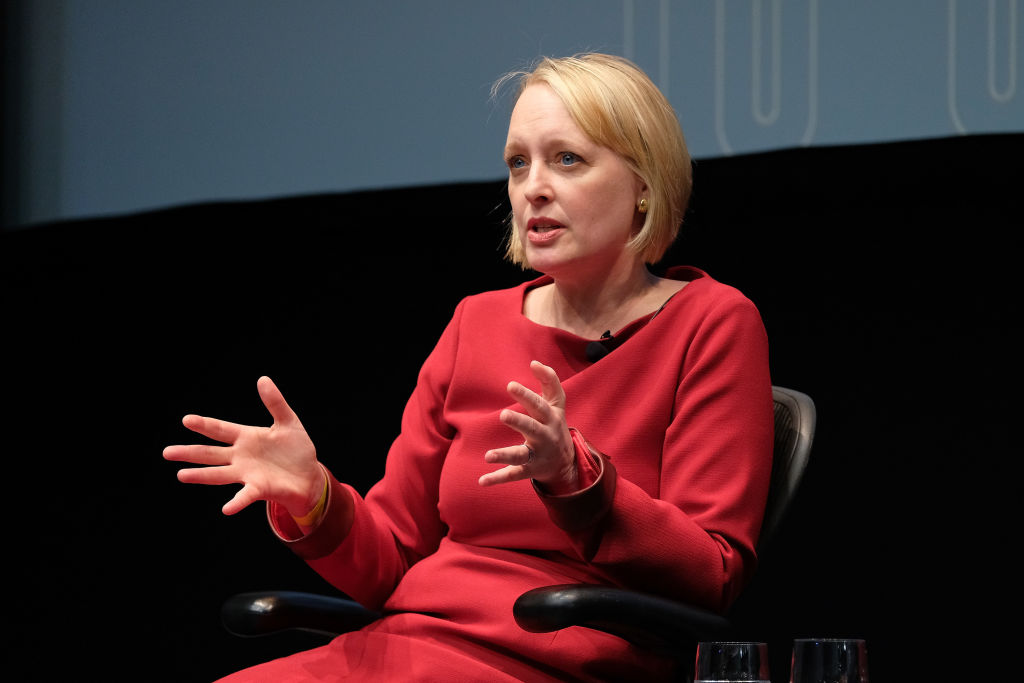
In a recent CNBC interview, Accenture CEO Julie Sweet spoke about ranking No.3 overall on JUST’s 2024 Rankings (and No. 1 in its industry). She underscored her strategy of prioritizing not only worker issues but customer issues as well. Focusing on key consumer issues like data privacy helped propel the company’s recent success, she said.
Accenture’s ISO 27001 certification makes it one of the first global companies to be externally verified against the information security standard and one of only 20% of companies in the Russell 1000 to do so. They are also one of 74% of companies that maintains both board-level oversight on privacy and cybersecurity issues along with an internal team to mitigate and resolve privacy-related issues.
“The fact that we have a responsible AI program, that we have very strong programs around data privacy – these are essential to our business. Over the past four years, we’ve added $120 billion in market cap. It reflects that being just is really good. You create value and you stand for values,” Sweet said.
Be well,
Martin
We’ll be highlighting some of the best policies across the JUST 100 in our next few newsletters, but for this week, we’re picking one policy each from the companies that landed 9 and 10 on the list.
9. Advanced Micro Devices returns to the JUST 100 and enters the top 10 for the first time. One area where they standout is in prioritizing the health and safety of its workforce, with an OSHA total recordable incident rate of 0.04, much lower than the semiconductors industry average of 0.4 and the overall Russell 1000 average of 1.1. In addition, they provide a generous benefits package which includes 12 weeks of paid parental leave for both primary and secondary caregivers, 20 days of designated sick leave, and a minimum of 15 days of paid time off.
10. Micron Technology enters the top 10 for the first time, excelling at career development opportunities and support for individuals re-entering the workforce or at early stages of their careers, offering career development opportunities such as tuition reimbursement and 62 hours, on average, of employee career development training, which contributes to a retention rate of 92%, while also supporting employees’ work-life balance with 17 days of paid vacation, 12 weeks of paid parental leave for all caregivers, and opportunities for flexible scheduling.
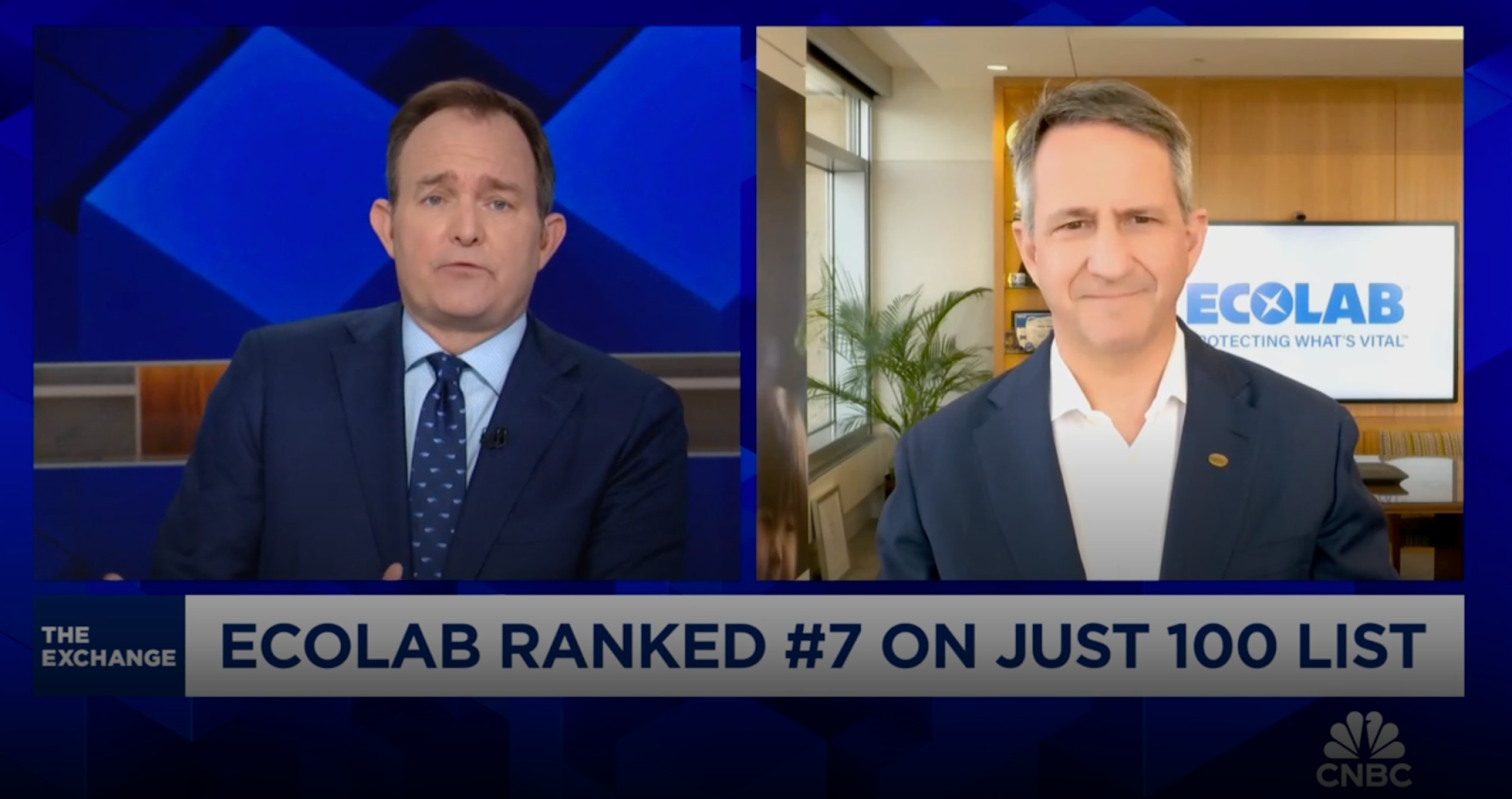
“Our people, our 47,000 people, are in a very good place because they know that what we do, what they do, has a major impact on our customers, on the environment and at the end of the day, on our performance. Doing what’s right the right way is what’s been driving us for the past 100 years and will propel us for the next 100 years.”
– Christophe Beck, CEO and chair of Ecolab, speaking about ranking No. 7 on JUST Capital’s 2024 Annual Rankings of America’s Most Just Companies on CNBC’s “The Exchange”.
A new Axios poll shows that Gen Z is far more excited by the prospect of generative AI than older generations, though most Americans remain wary of the new technology’s power. Meanwhile, Quartz reports that Google had to pull its generative AI tool this week after its inability to replicate historical figures with racial accuracy.
The Guardian dives into a significant report that says major plastic-producing companies knew as far back as the 80’s that recycling would not be a sustainable solution for waste management but promoted it anyway.
The Wall Street Journal takes a look at a problem currently hitting high-shipping industries – while consumers might love next-day delivery, they remain vehemently opposed to living near shipping warehouses, stifling where companies are allowed to build new shipping centers and routes.
Capital One is buying Discover – or trying to. The New York Times weighs in on the legal hurdles the massive 35 billion dollar deal may face. Meanwhile Walmart will buyTV-maker Vizio for 2.3 billion, signaling their plans to move beyond just selling goods.
The Washington Post reports that the head of Boeing’s 737 Max program is exiting the company in a wave of leadership changes due to the ongoing controversy around the aircraft’s safety.
The Wall Street Journal reports that Nike is planning to cut over 1,600 jobs in a bid to cut costs.
The New York Times looks at a common trend squeezing workers wages – more and more companies replacing full-time workers with multiple part-time workers to drive down labor and benefit costs, and how unstable schedules are hurting these workers’ ability to find other jobs.

The Harris Poll’s recently published fifth annual Parent Confidence Index with KinderCare finds that 57% of parents would take a pay cut to work for a company that provided childcare benefits. This chart from the report lays out the types of benefits working parents are looking for from employers, from flexible hours to on-site childcare.

When just business leadership is implemented effectively it can transform local economies and communities. It’s why this article in Hartford Business (“These Connecticut companies were named the most ‘just’ in the nation”) caught my eye this week.
For the record, California is home to the greatest number of JUST 100 companies, taking up 24 spots including the No.1 company, Hewlett Packard Enterprise. New York is next with 16, followed by Ohio (6) and Illinois (5).
Beyond that, there are five states each with four companies (WA, TX, NC, NJ and CT); four with three companies (MI, MN, MA, VA); two with two companies (AZ and MD) and finally nine states each with a single representative (IA, GA, NE, IA, PA, OR, ID, RI and OK). So 24 states represented in total.
Of course, there is more to this kind of analysis than meets the eye. Some states simply have more large publicly-traded companies headquartered there than others. Certain types of companies that tend to do well in the rankings – banks, technology and software firms – may be clustered in certain regions. Perhaps most importantly, the location of a company’s headquarters isn’t necessarily where its workers, facilities, and major operations are located.
Still, the geographic footprint of a corporation is no doubt a crucial factor in its impact on the ground. And it begs a larger question – whether and how corporate justness can align with local and state social, economic, environmental and political goals.
Should state legislatures, city officials and governors be working harder to support just companies that do better at creating good jobs, investing in workers and their families, supporting their local communities, and protecting the environment? Can regional industry groups and chambers of commerce do more to lift up and promote just business behavior to help build the financial, human, and social capital of cities across America?
Earlier this year, JUST hosted a fantastic conversation with business and community leaders in Atlanta on that very question. We aim to build on that this year, so if you’d like to get involved, please reach out.
Be well,
Martin
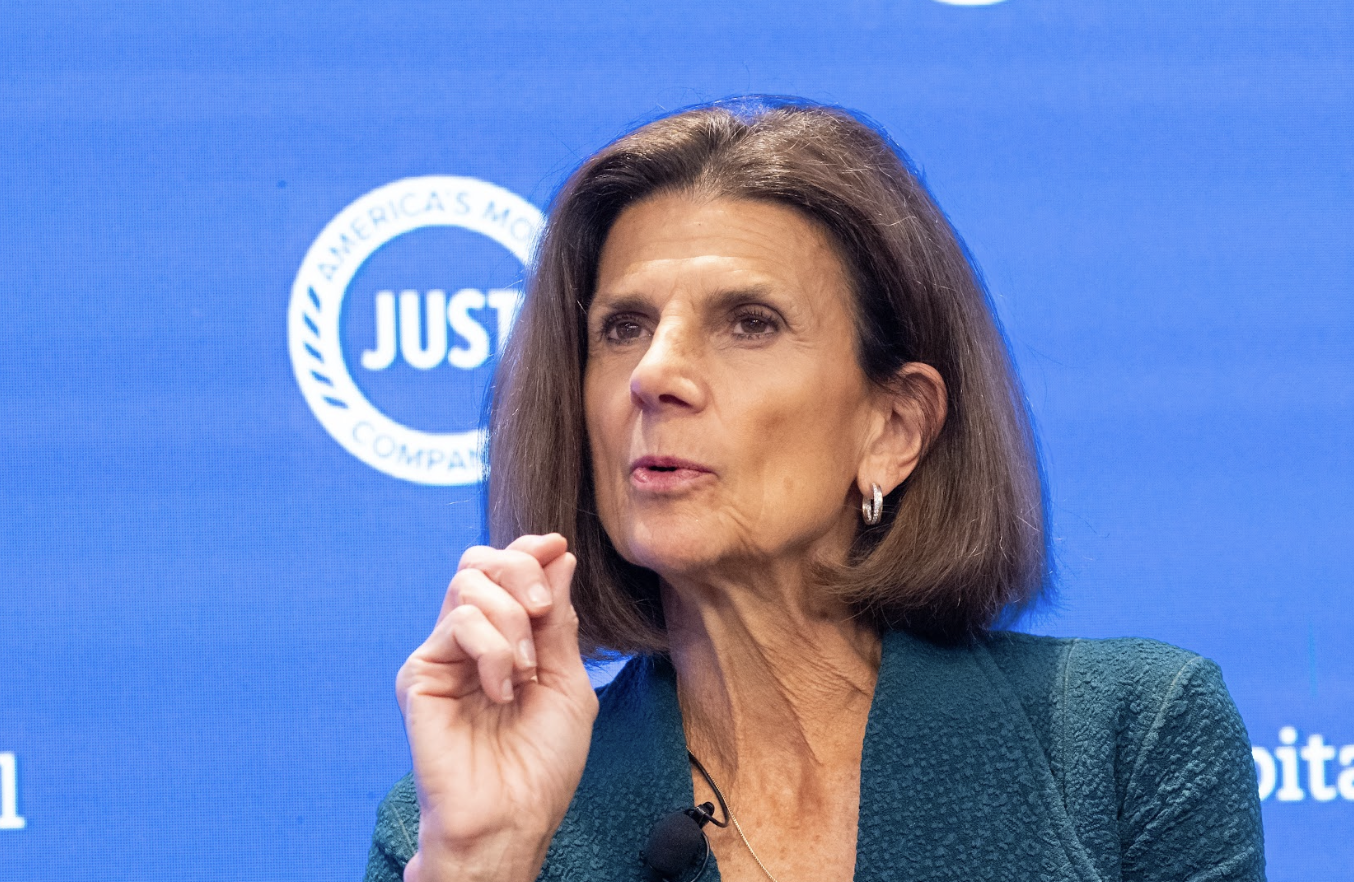
Photo by Elena Oliva / Sight & Sound
“I don’t get into debates about DEI. I think the pushback is based on a myth of what it is. If you have a conversation with someone who is rational and intelligent, and you say, ‘Do you believe that different perspectives lead to better discussions?’ the answer will be yes. ‘Do you believe in a work environment where people feel like they can come to work and they can be their best selves because they are part of a team and valued?’ Absolutely. ‘Do you believe we should pay people fairly and the same for the same work?’ Oh, absolutely. Okay, well that’s DEI.”
We’ll be highlighting some of the best policies across the JUST 100 in our next few newsletters, but for this week, we’re picking one policy each from the companies that landed 6-8 on the list.
6. The Cigna Group came in 1st in its industry and 1st overall when it came to supporting Customers thanks to their strong commitment to customer data protection, not selling users’ data or sharing users’ personal information with advertising or marketing companies, leading the Health Care Providers industry on Privacy Policy Transparency, and disclosing no data security breaches within the last reporting year, in addition to receiving no controversies or fines across the entire Customers stakeholder.
7. Ecolab greatly improved its performance in JUST Capital’s Rankings, moving up from #325 in 2020’s Ranking to breaking into the top 10 for the first time this year, driven by its robust benefits including 12 weeks of paid maternity and 6 weeks of paid paternity leave, emergency backup dependent care, routine subsidized dependent care, a flexible working hours policy, and providing an average 27 hours of career development per employee and a tuition reimbursement policy.
8. Elevance Health excelled at supporting their local communities, offering a rotational information technology apprenticeship for early career professionals, committing $160 million to affordable housing projects in 2022, and investing in the placement of 78 licensed social workers in schools across the state of Indiana in 2022 in support of mental health services and accessibility.
Google reports that it has been working with airline companies and using its AI to reduce the climate impact on contrails, which account for 35% of the aviation industry’s global warming impact.
Seeing lots of large pay raises in your industry? It might be a harbinger of layoffs to come. Fortune reveals that many jobs at risk of being replaced by AI are seeing salary booms as the worker pool shrinks but companies still need humans to work these jobs until AI is able to replace them.
Despite sustained pushback against diversity, equity, and inclusion from political figures, a new national survey finds a majority of senior business executives — across the political spectrum — say diversity initiatives are important for positive business performance, Marketplace reports. In addition Google’s Chief Diversity Officer speaks to the BBC about how the company remains committed to its diversity goals.
The Wall Street Journal reports that the financial industry’s ESG hiring boom is starting to cool amid cost cutting and initiatives to get faster returns on investment.
Fortune highlights the cringe-inducing new trend of companies using euphemisms for “layoffs” in order to avoid social media backlash, especially amidst the trend of workers recording their final meetings with HR.
Cryptocurrency companies must now report their energy use to the government due to a new initiative by the Biden administration, which many are calling a big win due to the heavy energy costs associated with the industry.
Fortune reports that right now, there are 8 Black CEOS of Fortune 500 companies, a near-record high outside of 2022.
Yahoo Finance counts down the 12 highest paid female CEOS in 2024.
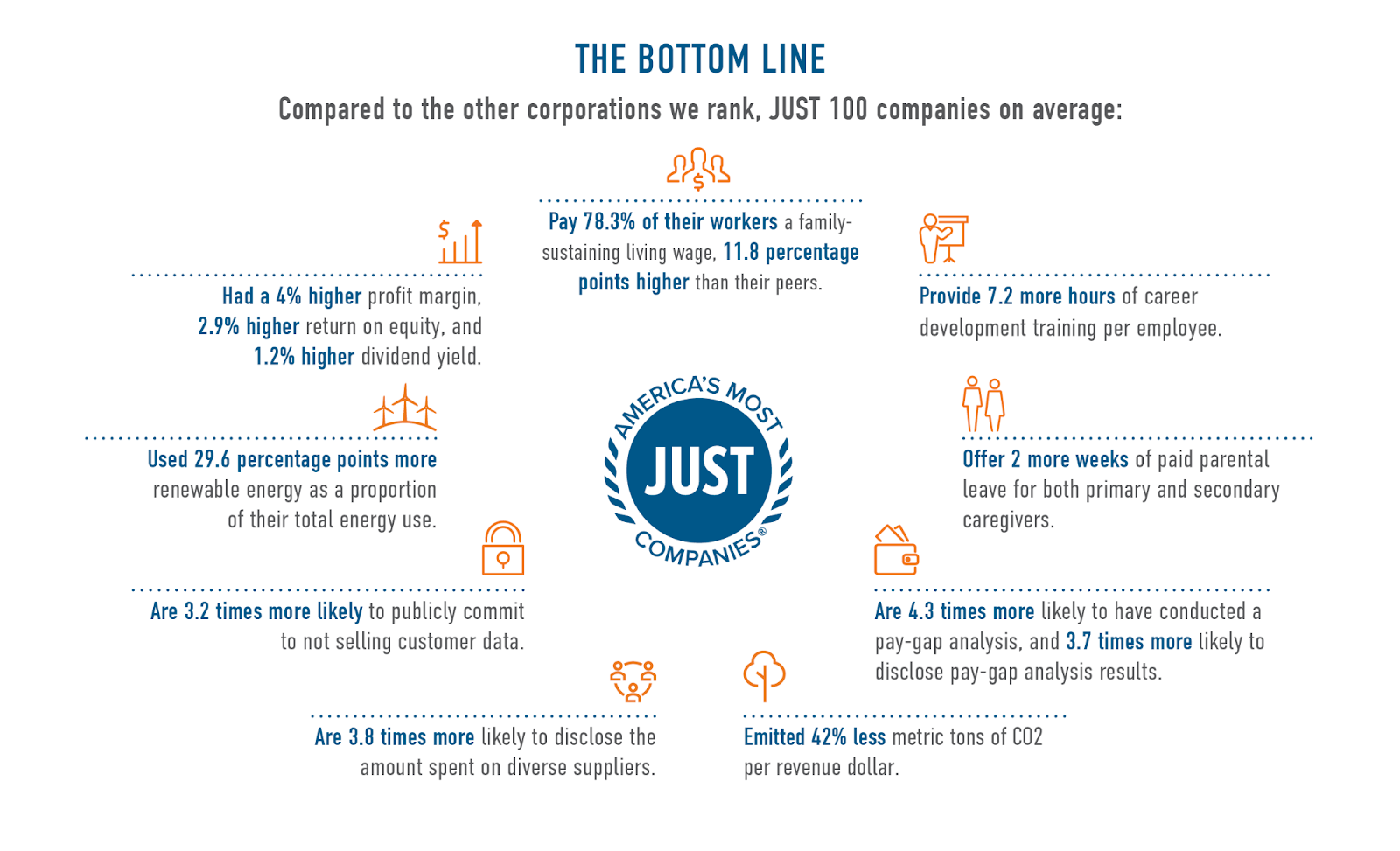
This week’s chart is a high level summary of what separates the JUST 100 from the rest of the Russell 1000 that was featured in our Rankings launch announcement here. On average, companies in the JUST 100 outperform their competitors on a variety of metrics, including offering 2 more weeks on parental leave, having a 4% higher profit margin, paying more of their employees a family sustaining wage, and more. Dig into the details here.
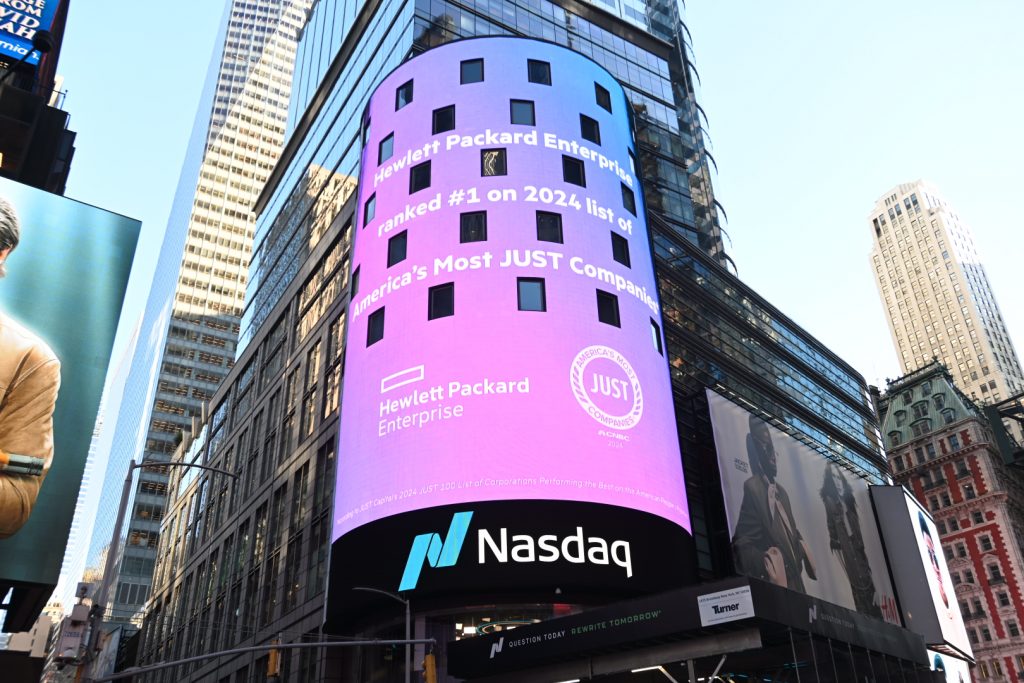
Our annual release of the JUST 100 with CNBC is always a special occasion. It’s a huge deal for JUST Capital to unveil which companies are truly delivering on the issues of greatest importance to the American public. It’s also a moment to recognize and celebrate business leadership, spotlight key issues and spark important debate about the role of business in society.
This year’s event, sponsored by the Stakeholder Impact Foundation and BCG, had a particular electricity running through it.
Maybe it was the magic of the Nasdaq closing bell ceremony with our Chair and co-founder Paul Tudor Jones, and Hewlett Packard Enterprise (HPE) CEO Antonio Neri, whose company took the #1 spot on our list. Maybe it was the power-packed, standing-room-only reception that followed with our fabulous partners Boston Consulting Group, Stakeholder Impact Foundation, and Nasdaq.
From BCG Senior Partner (and JUST Board member) Sushmita Banerjee’s opening remarks, to Andrew Ross Sorkin’s conversation with Paul and Antonio, to JUST Capital President Alison Omens’ panel with HPE Board Chair Patricia Russo (also on the JUST Board), Avangrid CFO Justin Lagasse, and Accenture’s Stuart Henderson, the program struck to the heart of what just business behavior actually looks like, the challenges and tradeoffs that companies face, and what it means to be a corporate leader today. You can read more of their remarks and takeaways here.
It’s a movement we know a large majority of Americans are behind: the idea that business can and must be a force for greater good. Lest anyone think this is antithetical to shareholders’ best interests, I note (as reported last week) that the JUST 100 Index has beaten the Equal Weighted Russell 1000 benchmark by 38.5% since inception (and 3% YTD), and the spread between the top 10% and bottom 10% of companies we rank is 75.5% since January 2018.
I’m going to leave the last word to HPE’s Neri. He is, as Paul noted, the new “gold standard” for business leadership in America. “One of the sayings we have at the company is ‘you have to win the right way.’” Amen to that.
Be well,
Martin
We’ll be highlighting some of the best policies across the JUST 100 in our next few newsletters, but for this week, we’re picking one policy each from the companies that landed 2-5 on the list.
CNBC, our official media partner, led in-depth coverage of our rankings.
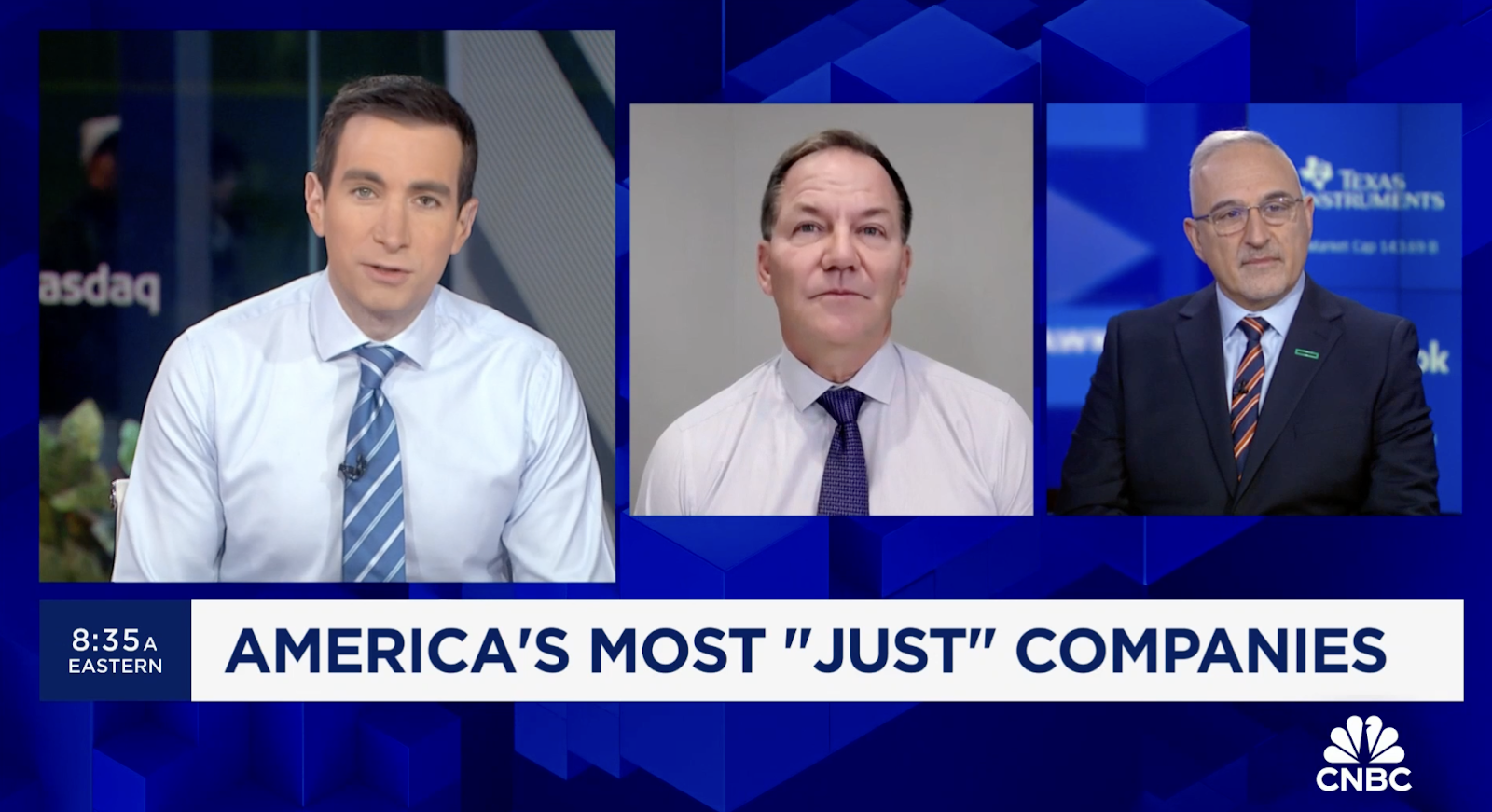
The network’s coverage led off with Andrew Ross Sorkin speaking with Antonio Neri – CEO of HPE, 2024’s Most JUST Company – and our founder and chair Paul Tudor Jones. The three discussed the company’s incredible performance across worker issues, the markets, and more. After you’ve listened to their conversation, you can take a much closer look at HPE’s leading policies and practices in this special deep-dive, and make sure to follow it up with our interview with their VP of Benefits, Culture, and People Experience on how the company implemented its exceptional parental leave policy–offering 26 weeks of paternity and maternity leave to all employees, including a host of other childcare related benefits.
Later that afternoon CNBC spoke with Christophe Beck, Ecolab chair and CEO, to discuss their place on the Just 100 list, the business of water conservation and their environmental leadership and more, and more. CNBC also released a short on-air piece highlighting how these top JUST 100 companies perform on DEI disclosures despite the recent political pushback.
On Wednesday they spoke with Avangrid CEO Pedro Azagra to discuss their ranking, working with the sustainable energy sector, and more. And on Thursday they were joined by Accenture CEO Julie Sweet, our #3 most JUST Company, where they discussed the company’s leading consumer privacy and cybersecurity policies and more.
Additionally, CNBC’s Brandon Gomez discussed overall trends in the JUST 100, and CNBC’s Eric Rosenbaum explored how chip companies fared.
Next week they’ll continue their coverage with interviews featuring the CEOs of Citigroup, Hasbro, and other companies. To keep on top of all of their coverage, go here.
On Monday, February 5, JUST Capital and CNBC unveiled the 2024 JUST 100. The comprehensive list spotlights America’s Most JUST Companies by analyzing how companies comprising the Russell 1000 perform across the 20 Issues the American public believes corporations should prioritize in their business practices.
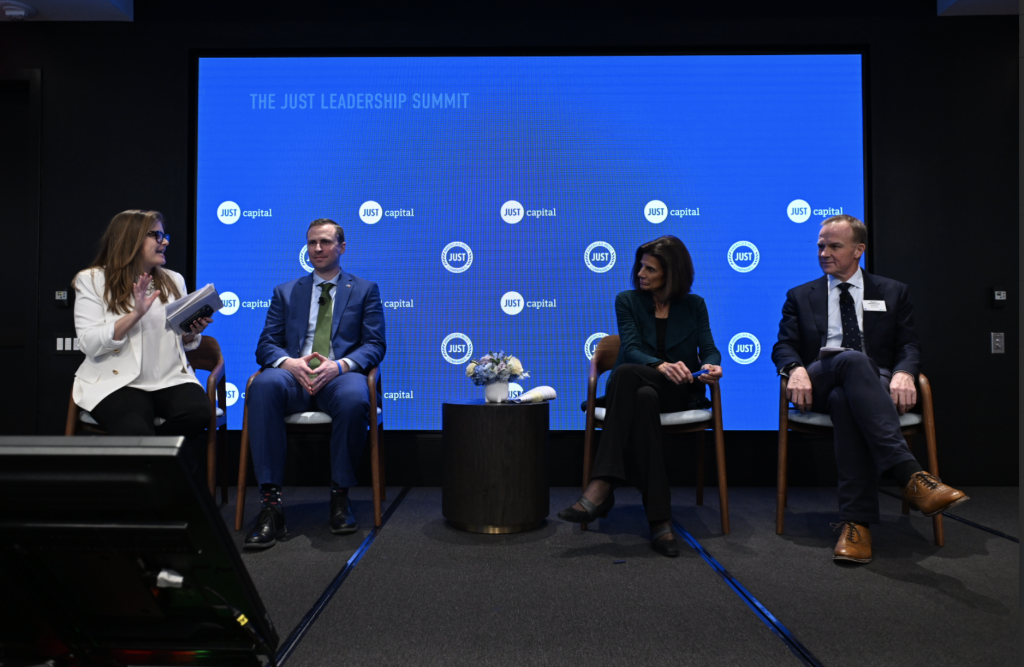
The event, which took place at the NASDAQ MarketSite and was sponsored by the Stakeholder Impact Foundation and BCG, opened with introductory remarks from JUST Capital CEO Martin Whittaker and a speech from Sushmita Banerjee, Senior Partner and Managing Director at Boston Consulting Group (BCG). Two panel discussions followed. The first featured a macro-level conversation between JUST Capital co-founder Paul Tudor Jones II alongside Hewlett Packard Enterprise (HPE) CEO Antonio Neri, moderated by CNBC’s Andrew Ross Sorkin. JUST Capital’s President Alison Omens then moderated the second panel with HPE Board Chairman Patricia Russo, Avangrid CFO Justin Lagasse and Accenture’s Northeast Market Unit Lead Stuart Henderson where they discussed in further detail what just business behavior actually looks like, what are the challenges and tradeoffs that companies face.
Banerjee set the tone for evening speaking about what she has seen working with some of the most successful companies in the world. “Just companies – in my experience – have leaders who exercise their responsible, ethical muscles every day, versus waiting for their grand moment where they could prove to the world they are doing something great,” she said.
Just actions, Banerjee said, lead to something every business needs to thrive: trust. She highlighted BCG’s Trust Index as an example of how companies can measure and decode trust among stakeholders by focusing on four dimensions: competency, fairness, transparency and resilience.
The companies that top JUST’s rankings prioritize building trust across stakeholders and their business performance benefits. ”When we look at the top 100 companies in JUST’s database, what we see is that they generate 2.5x more value than comparable businesses—their valuation multiples are also up to 47% higher,” Bannerjee said.
Sorkin kicked-off the first panel conversation by prompting Jones to reflect on how far the conversation around stakeholders in American business has come over the last decade.
“If you rewind to 2014, no one would even know what stakeholder business meant,” Jones told the panel. “There was nothing but shareholder governance at that point in time. Of course that was why business was very narrowly focused on nothing but profits. That is one of the reasons why we started JUST Capital.”
Turning to Neri, Sorkin gave the HPE CEO an opportunity to speak on why his company was able to secure the number-one spot in JUST’s 2024 rankings. This year is HPE’s first time at the top of the list after being recognized as a JUST 100 leader every year from 2018 through 2024.
“Our job is to create value and my measure of value is not just shareholder value,” Neri said at JUST’s 2024 Leadership Summit on Monday. “It’s about value for the people who participate in the ecosystem where we deliver business results or other types of outcomes for our customers and employees. Ultimately, stock price is a reflection of how you do things and what you deliver. One of the sayings we have at the company is ‘you have to win the right way.’”
The discussion delved into the correlation between this inclusive approach, business success, and positive societal impact. Additionally, Jones emphasized the need for other companies to adopt a similar mindset, underlining the significance of leadership in today’s dynamic economic and social landscape.
The second panel focused on the strategic investments C-suite leaders have undertaken that have led to top-ranking performances. HPE Board Chairman Patricia Russo, Avangrid CFO Justin Lagasse and Accenture’s Northeast Market Unit Lead Stuart Henderson gave practical examples to illustrate how they approach prioritizing stakeholder value to achieve business success.
“It’s really important that boards have clarity around what a reasonable timeframe is and I want to use an example from Merck,” Russo said. “There was a time when Merk’s TCR was not competitive with other pharma companies, because Merck had decided–as a company committed to science–that they were not going to cut back on R&D in order to get their profits up, they were going to continue to invest in medicines. And today, Merck has the largest cancer drugs on the planet as a result of what they invested in and their stock is now trading at $126 a share. So there is a time-horizon around when value creation for shareholders is the natural follow-on to all the other good things you’re doing for people, customers and communities.”
By aligning their strategies with the values prioritized by all of their stakeholders, these leaders exemplify the potential for businesses to thrive while making meaningful contributions to society. The emphasis on stakeholder value creation showcased the alignment between business success and ethical decision-making, reinforcing that a just approach is morally sound and strategically advantageous in the long run.
When asked what their advice would be to other companies, the panelists each provided their own poignant perspective. Henderson encouraged leaders to steer clear of politics and lean into the business case for transparency, diversity and sustainability, which would deliver good outcomes for shareholders and stakeholders. Lagasse rounded out the panel with a reminder to keep it simple—over-complicating how to empower and enable stakeholders to thrive is where the disconnect comes from. Russo emphasized the importance of focusing on managing human capital just as well as financial capital.
“I don’t get into debates about DEI,” Russo said. “I think the pushback is based on a myth of what it is. If you have a conversation with someone who is rational and intelligent, and you say, ‘Do you believe that different perspectives lead to better discussions?’ the answer will be yes. ‘Do you believe in a work environment where people feel like they can come to work and they can be their best selves because they are part of a team and valued?’ Absolutely. ‘Do you believe we should pay people fairly and the same for the same work?’ Oh, absolutely. Okay, well that’s DEI.”
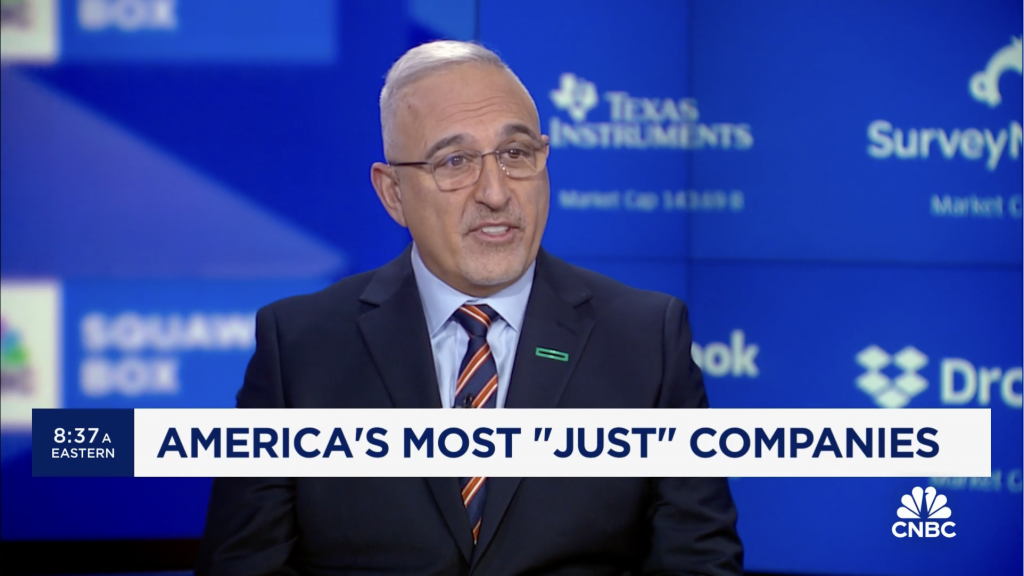
On Monday, JUST Capital and CNBC announced that Hewlett Packard Enterprise (HPE) took the 2024 title for America’s Most Just Company. For HPE CEO Antonio Neri, the recognition is evidence of his team’s meticulous work to deliver positive outcomes on worker, environment, community, and other issues Americans care most about. Neri underscored it’s all about results.
“Our job is to create value and my measure of value is not just shareholder value,” Neri said at JUST’s 2024 Leadership Summit on Monday at the NASDAQ. “It’s value for the people who participate in the ecosystem where we deliver business results or other types of outcomes for our customers and employees. Ultimately, stock price is a reflection of how you do things and what you deliver. One of the sayings we have at the company is ‘you have to win the right way.’”
HPE blazed past its peers and other industry leaders in JUST’s rankings of the Russell 1000 (approximately 937 companies when you account for mergers, acquisitions, and delistings). While HPE has been in the JUST 100 every year from 2018 through 2024, this is HPE’s first time in the top spot.
The company’s standout leadership on issues like fair pay, climate change, and offering apprenticeship programs, such as its Cyber Career Reboot program, helped propel its performance. Other notable data points include the following:
“I take great pride in HPE’s recognition as a leader by JUST Capital on the issues vital to Americans,” Neri said in a previous statement. “Our purpose is to advance the way people live and work, which is evidenced in our commitment to reducing environmental impacts throughout our value chain, supporting our team members with exceptional benefits and talent programs, and investing in our communities and supply chain.”
During a panel discussion on Monday, Neri and JUST Capital co-founder and chairman Paul Tudor Jones responded to questions about the recent pushback against ESG, and underscored that stakeholder issues aren’t about politics, but about promoting better long-term business practices.
“I differentiate between just behavior and ESG, because they do overlap in part, but they are really different,” Jones said. “What we’re doing with our rankings is reflecting what the American public says.”
Neri said he plans to continue investing in areas that JUST Capital ranks, saying it’s good for shareholders, as well as other stakeholders.
That assumption is buoyed by real financial data. The JUST 100 Index has beaten the Russell 1000 Equal Weighted Index by 38.5% since inception and 3.1% YTD. And JUST’s worker-focused index – meaning companies that rank most highly on worker issues – has outperformed the Russell 1000 Equal Weighted Index by 103.75% since 1/1/2018.
“It starts with a purpose,” Neri said on Monday. “What is our purpose? Why do we come to work every day? That purpose is to enhance the way people live and work. And how do we do that? By engineering an experience that will unlock your full potential, whether you are a business, shareholder or employee.”

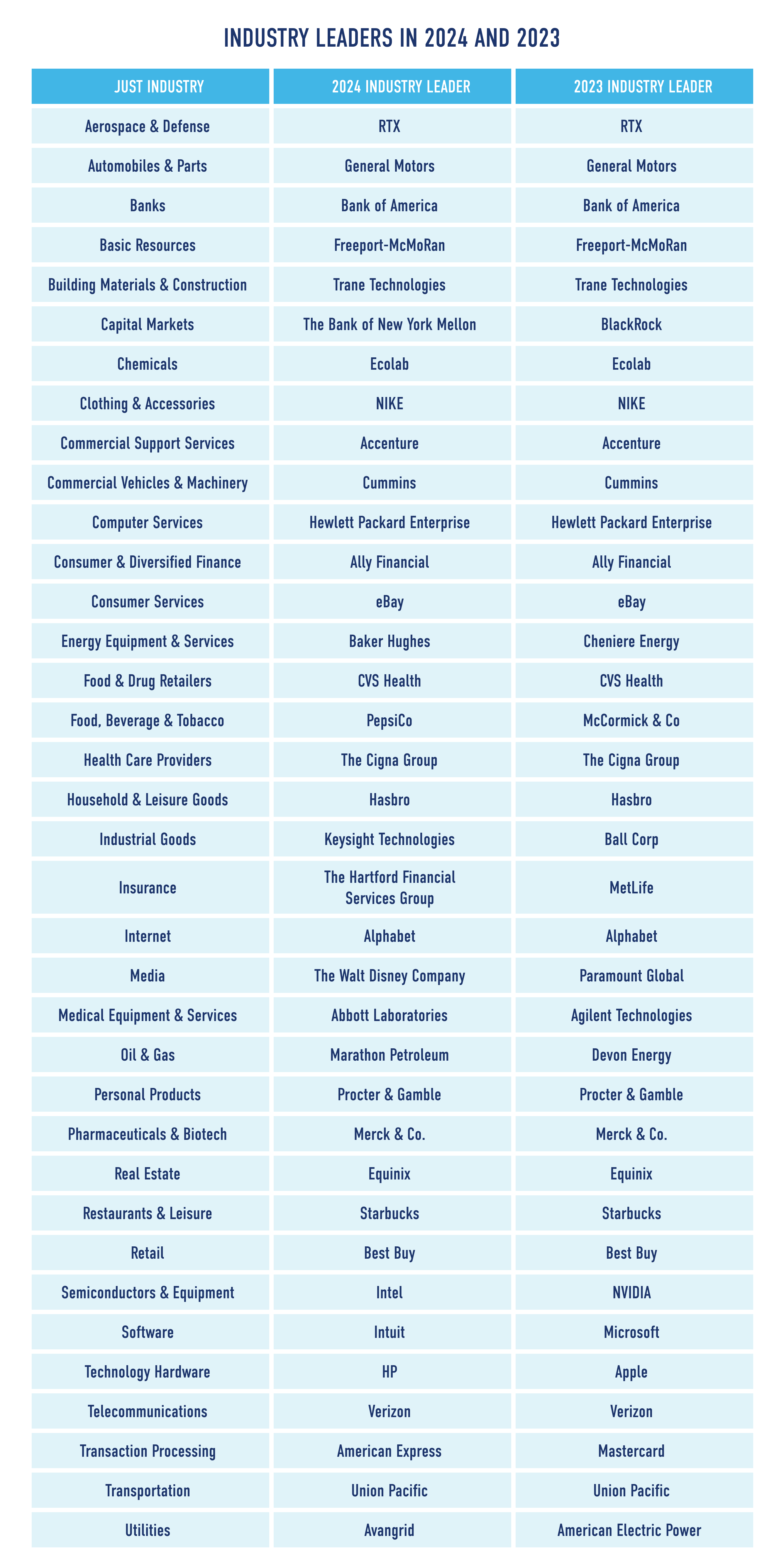
As part of its 2024 Rankings, JUST Capital is proud to present its list of Industry leaders, or companies that receive the highest overall rank within each of our 36 industries.
Of this year’s 36 industry leaders, 23 companies remained the leaders of their industry, while 13 new companies moved in to take the industry leader spot this year. Below is the full list of industry leaders for 2024. Industry leader shifts can be explained by both improved year-over-year performance of individual companies as well as shifting industry compositions.
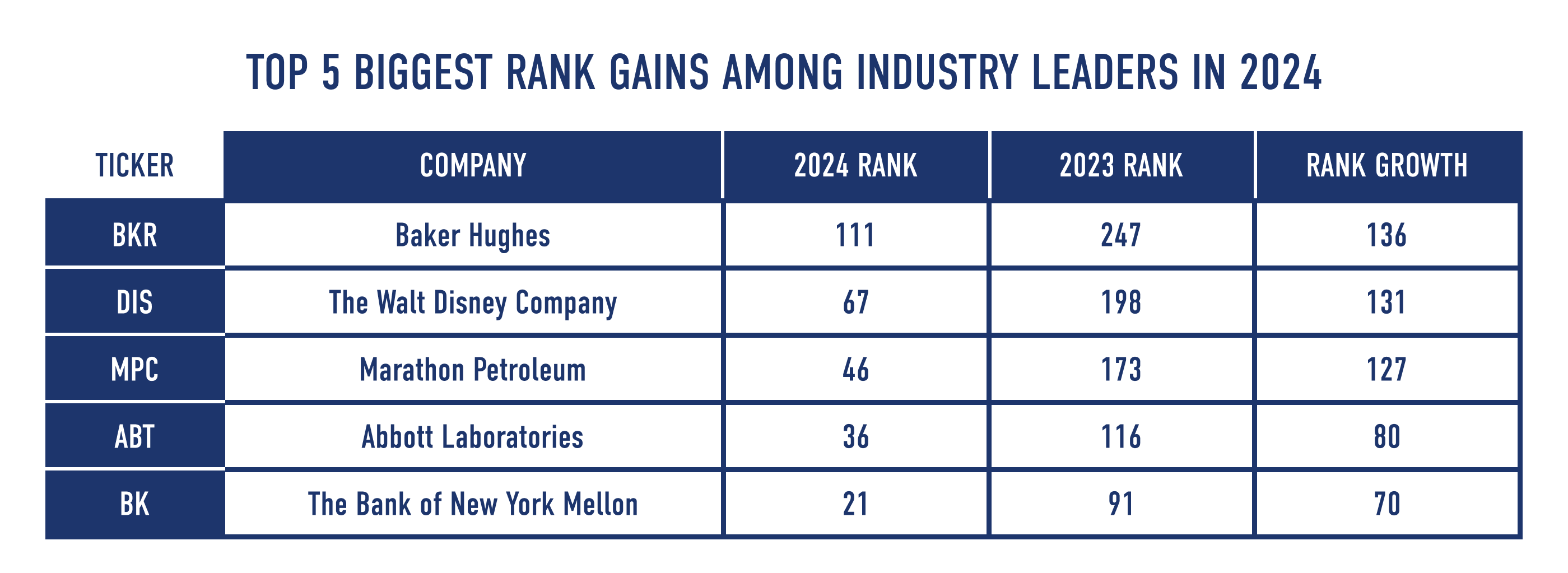
Among the industry leaders, the following saw the biggest increases in their rank.
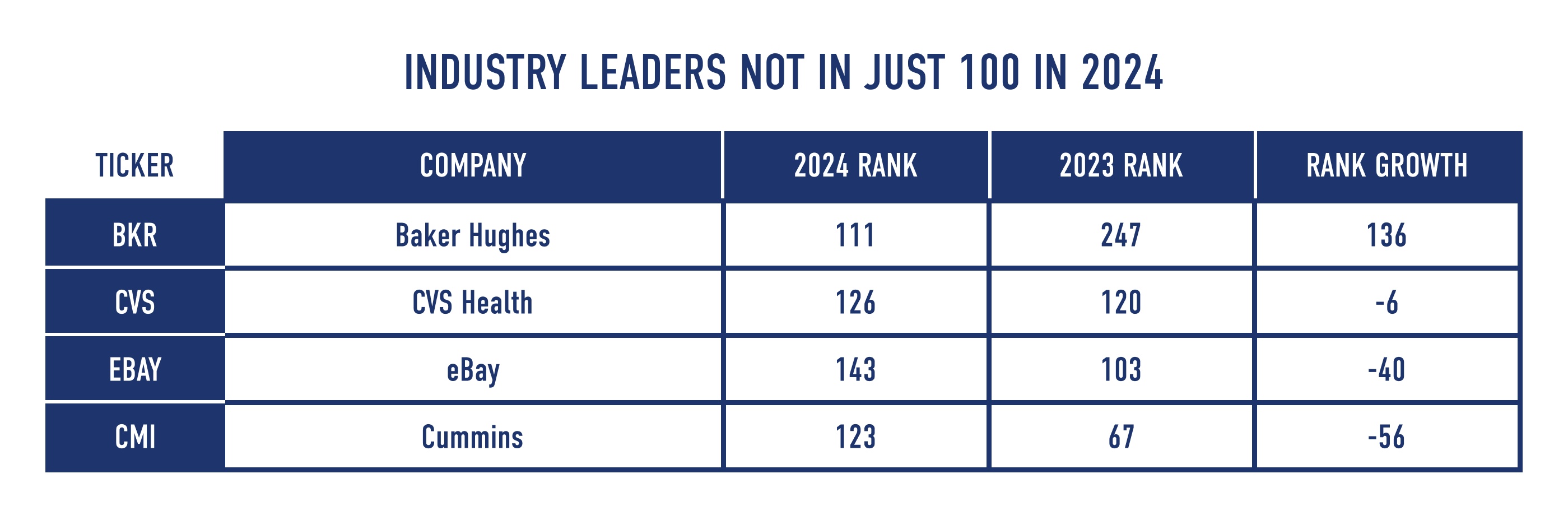
This year, 32 out of the 36 industries were represented in the JUST 100: In other words, four industry leaders are not part of the JUST 100 this year, including Baker Hughes (111), CVS Health (126), eBay (143), and Cummins (123).
Though there are 32 industries represented in the JUST 100, some industries make up a higher share of the JUST 100 than others. There are:
Certain industries tend to perform better than others, on average. Companies in the Utilities and Semiconductors & Equipment industries rank, on average, the highest at 320 and 341, respectively. When breaking industry average rank down by the five Stakeholders, we find that:
Companies in the Restaurants & Leisure and Food, Beverage & Tobacco industries saw some of the largest average gains in rank, rising 115 and 82 ranks, respectively. Companies in the Consumer & Diversified Finance and Banks industries saw the biggest average declines, dropping 118 and 88 ranks, respectively.
For more information on our Rankings, to engage with us on our corporate initiatives, please reach out to us.
