
Third-quarter earnings season kicked off this week, and while it’s still early, it appears corporate America is in a golden age of profits. Goldman Sachs expects just 10 stocks, led by AI companies, to drive more than two-thirds of S&P 500 earnings growth this quarter. And while shareholders reap the rewards, workers’ share of the pie is shrinking to record lows: just 53.7% of business income now goes to wages and benefits.
Capital outpacing wages like this presents both risk and opportunity for business leaders. The risk is that wealth continues to concentrate at the top and more Americans feel disconnected from an AI-driven future. This threatens not only the frontier labs, but also the corporate deployers and social stability overall. Our polling finds the public holds developers and deployers nearly equally responsible for AI across a number of issues.
Meanwhile, there is great opportunity to find new models for distributing AI-driven gains. Our polling finds that 65% agree that all Americans should receive a direct financial benefit from the wealth AI companies generate. Company 401(k) plans are an obvious route. As one respondent put it in the second wave of our National AI Monitor, released this week, “My 401k is doing pretty well and AI is driving the market.”
The good news is that out of the 1,002 companies we track, 71% offer a 401(k) match. The bad news is that according to Gallup only 59% of Americans actually have an active 401(k) account – and that number drops to 28% for workers earning less than $50,000. If you want one example of real leadership, look no further than Costco, which contributes 4% of pay to workers’ 401(k) accounts regardless of employee contributions, rising to 9% for those with 25 or more years of service.
The National AI Monitor will track how Americans are experiencing AI: as workers, customers, community members, and investors. In parallel, we will continue to track how companies are finding innovative ways to grow the pie for everyone. It’s the defining challenge of the era.
Be well, Martin
35% of women expect AI to improve their lives, compared to 54% of men. 36% expect more harm than benefit. Explore the data here.
Gizmodo reports that Anthropic has created a new usage policy that will discontinue a user’s account if they are too “abusive or cruel” towards their models.
The Wall Street Journal looks at a lesser known issue with the data center buildout – utility companies being asked to set aside power for projects that may never be completed, and how that is affecting grid pricing.
Fortune uses the CEO of Hachette as an example of a C-suite leader refusing to let AI write their communications, arguing that it weakens essential leadership skills.
The Wall Street Journal reports that Netflix has cut 1,000 roles, the largest elimination of jobs since 2022.
The BBC looks at how U.S. inflation rose higher than expected month-over-month, and the impact that is having on American industries.
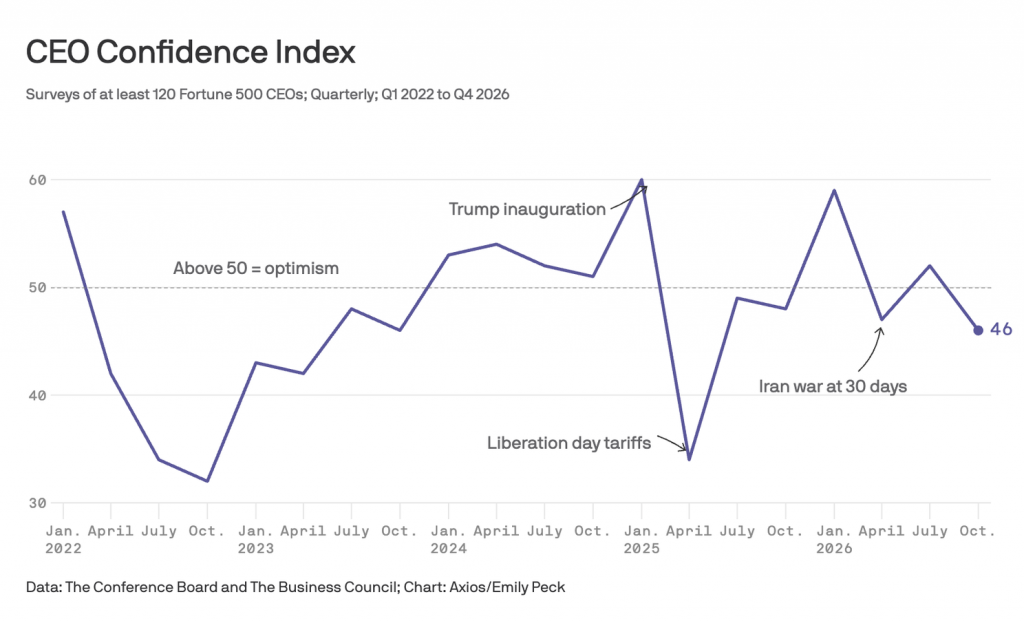
Axios examines the reasons CEO economic confidence is once again on the downturn.
