This year, March 24 marks Equal Pay Day for women in the United States – a date that signifies how far into 2021 women have had to work to earn what men did in 2020 alone. For many women of color, the dates are considerably starker: Black Women’s Equal Pay Day falls on August 3 this year, while Native and Latina women must work until September 8 and October 21, respectively, to earn what their white male counterparts did the year prior.
This is not a new issue, and it’s one that women grapple with worldwide. Over the past several years, JUST Capital has been analyzing what steps corporate America has taken to shrink the pay gap – particularly, whether they disclose that they’ve conducted a pay equity analysis, and further, whether they’ve published the results. Last year, we found that 22% of the 922 largest public U.S. corporations we ranked disclosed conducting such an analysis, a significant 57% increase from 2019.
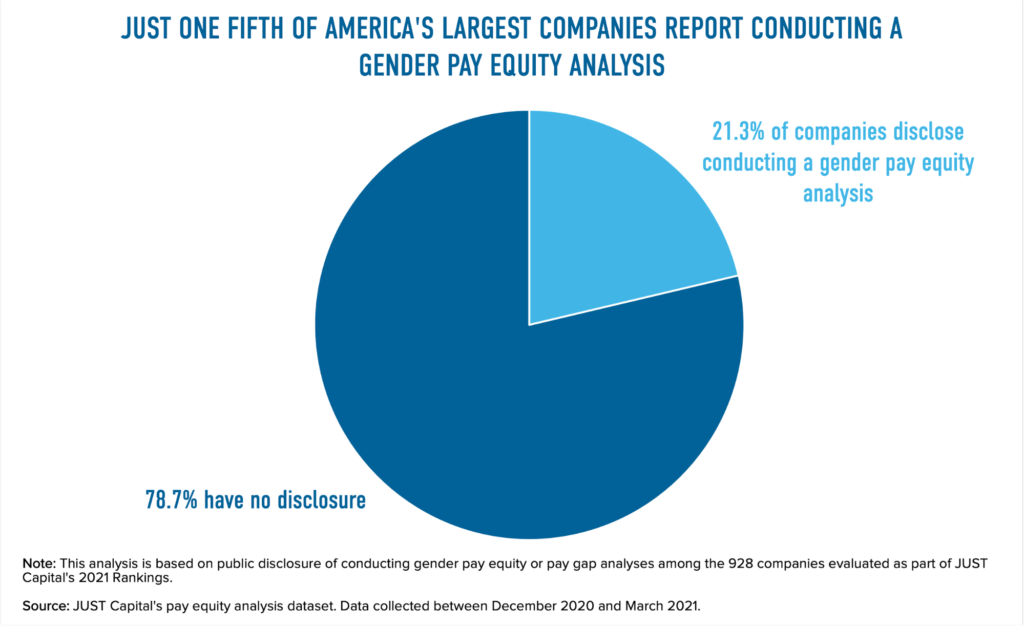
Following a year roiled by the pandemic and economic recession, pay gap statistics have unfortunately not changed (women still earned just 82 cents for every dollar earned by men in 2020, as they did in 2019). We also found that an almost identical percentage of companies – 21% of the 928 we evaluated for our 2021 Rankings (198 companies) – disclosed conducting a gender pay equity analysis. While there were some methodological shifts in how we measured pay equity analysis disclosure – including assessing gender pay equity analyses and race & ethnicity pay equity analyses in separate data points – the near identical disclosure rate suggests that progress on this issue may have stalled over the past year:
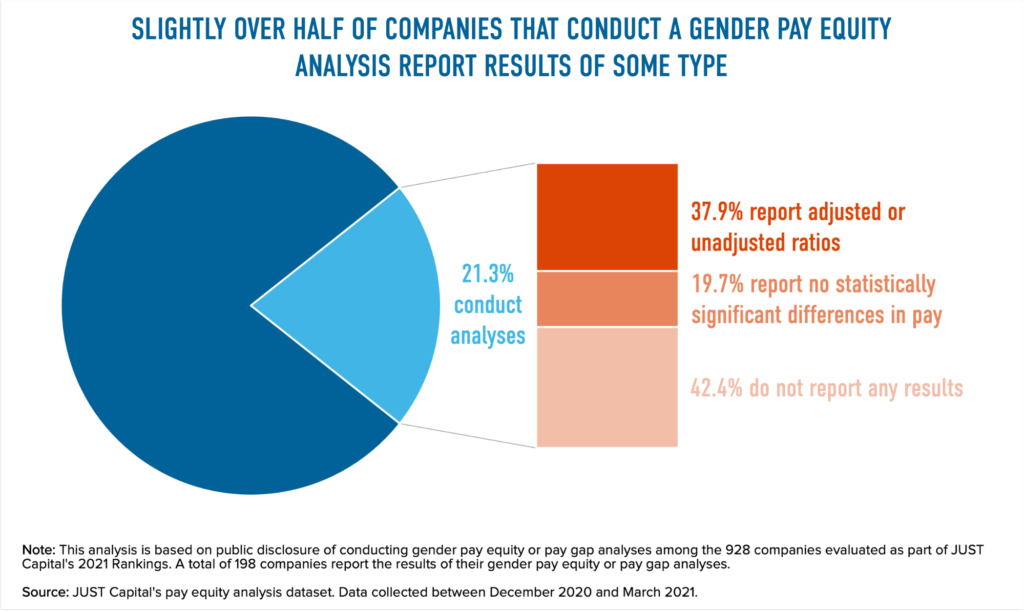
With only one-fifth of America’s largest companies again disclosing that they conducted this kind of analysis – which is a key first step to closing the pay gap in our country – it’s clear that corporate America has more work to do and that this issue must remain in focus as we build back from COVID-19. What is heartening, though, is that more companies are disclosing the results of these analyses. This year, 58% of the 198 companies we analyzed that reported conducting a gender pay equity analysis also disclosed their results, up from 39% last year (of 206 companies conducting either a gender or race/ethnicity analysis).
What companies report, however, varies: Nearly 20% that conduct analyses (39 companies) tend to report that the results of their gender pay equity analyses showed that there were no statistically significant differences in pay between men and women, while roughly 40% (75 companies) share the ratio of average pay between women and men or note that there is 100% parity.
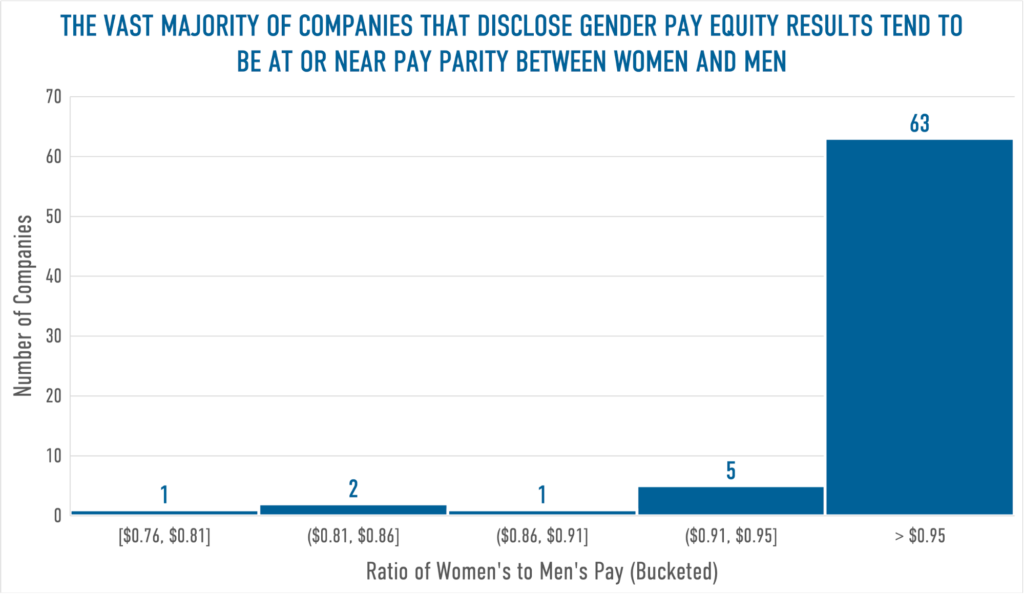
Looking more closely at the 75 companies that disclosed ratios, we find that the vast majority of disclosures indicate that women are paid nearly the same as their male counterparts – on average, 98.26% of their earnings – suggesting, as we’ve also found in past research on gender pay equity, that companies tend to disclose on this issue when they’re able to indicate success in nearing or reaching pay parity:
As we continue to rebuild from the COVID-19 pandemic, issues of equity become more – not less – important. Women are among the most severely impacted by job loss during the economic downturn, losing more than 5 million jobs in 2020. And based on this analysis, progress on addressing gender pay equity (particularly, conducting pay equity analyses) seems to have stalled as well. JUST Capital will continue to track the actions companies are taking to advance equity in the workplace, including how the state of gender pay equity continues to shift in corporate America in the months and years to come.

2020 has been a year of profound change and upheaval – from the COVID-19 pandemic to our national reckoning with racial injustice to last week’s unprecedented election and the continued fight for American democracy. Amidst these monumental and unusual events, the call for stakeholder capitalism has continued to mount, with workers’ needs – health, safety, security, fair treatment, and pay – at the forefront of the conversation.
Earlier this year, JUST Capital and PayPal launched the Worker Financial Wellness Initiative, a new, critical project to make workers’ financial security and health a C-suite and investor priority. And at the Forbes JUST 100 Virtual Summit – where we celebrated the 2021 Rankings of America’s Most JUST Companies on October 14 – we discussed why worker financial wellness must be a priority for corporate leaders, now more than ever, in conversation with PayPal CEO Dan Schulman, JUST Capital Cofounder & Chairman Paul Tudor Jones, and Chief Strategy Officer Alison Omens.
Explore our key takeaways below.
Even before the COVID-19 crisis hit the U.S., far too many Americans were struggling to pay their bills each month, an issue that has only been exacerbated as our economy has contended with the impacts of the pandemic. In 2018, PayPal CEO Dan Schulman decided to find out whether employees were able to make ends meet – and because his company paid employees at or above market, he expected a good news story. But when he surveyed his workers, he learned that more than two-thirds of call center and entry level employees were struggling to pay their bills each month, let alone save for their futures or for emergencies. Dan explained that “our mission as a company is to democratize financial access,” and that while PayPal’s focus had been to achieve this mission for customers, its employees were being left behind. In better understanding the financial health and security of his workers, Schulman was able to evaluate the broader implications of his mission, and make critical changes to ensure that workers were not simply the purveyors of this mission, but also its beneficiaries.
In our six years of polling the American public, we’ve heard every year that workers are the most important stakeholder for corporate America, and that paying a living wage is critical to creating a more just form of capitalism (this year, and last, Americans agree that paying a fair, livable wage should be the top priority for companies). In discussing why this issue is so important, Tudor Jones emphasized that “paying a living wage is the first great step to reducing the inequality gap, taking care of employees, and hopefully building a larger pie for the entire country.” Today, among the 20 million workers who work for the Russell 1000 companies we evaluate, we estimate that 50% currently do not make a living wage. Tudor Jones identified Schulman as “the flag bearer” in driving change on this issue, and believes that boards, shareholders, and employees themselves will increasingly demand a living wage.
There is a pervasive narrative on Wall Street that raising wages destroys value – something we saw play out recently when Costco stocks dropped after the company announced that it was maintaining COVID-19 wage hikes for its frontline workers. Schulman called this narrative “fundamentally wrong” – noting that the single biggest competitive advantage for any company is the talent and passion of its workers, and that the most talented people want to work for companies that both stand for a purpose and ensure their financial security. “I actually think if you don’t have a purpose as a company and don’t treat your workers as your most valuable asset,” Schulman explained, “then you minimize your profitability going forward.” Tudor Jones agreed, suggesting that the market is beginning to understand this, bolstered by growing research to suggest that a company’s “net contribution to society” is key to the formula for raising the company’s net value overall.
Healthier employees not only have the ability to strengthen the financial health of their companies (and in turn, the economy), they create a healthier democracy. Schulman noted that “democracy asks us to rise above our own self interest to support what’s right for the whole,” but when employees are financially insecure, they question the system. A strong economy, a healthier capitalism that really cares about everyone, is essential for a strong democracy – and that begins with treating workers right. Tudor Jones emphasized the critical importance of this work: “We’re not going to change this country, we’re not going to feel embarrassed to be Americans, we’re not going to be proud of what we do every day unless we change where we work first. It’s the only way we’re going to get gender equity, income equity, wealth equity, or racial equity. It’s the only way we’re going to do it.”
You can watch the full JUST 100 Virtual Summit here.
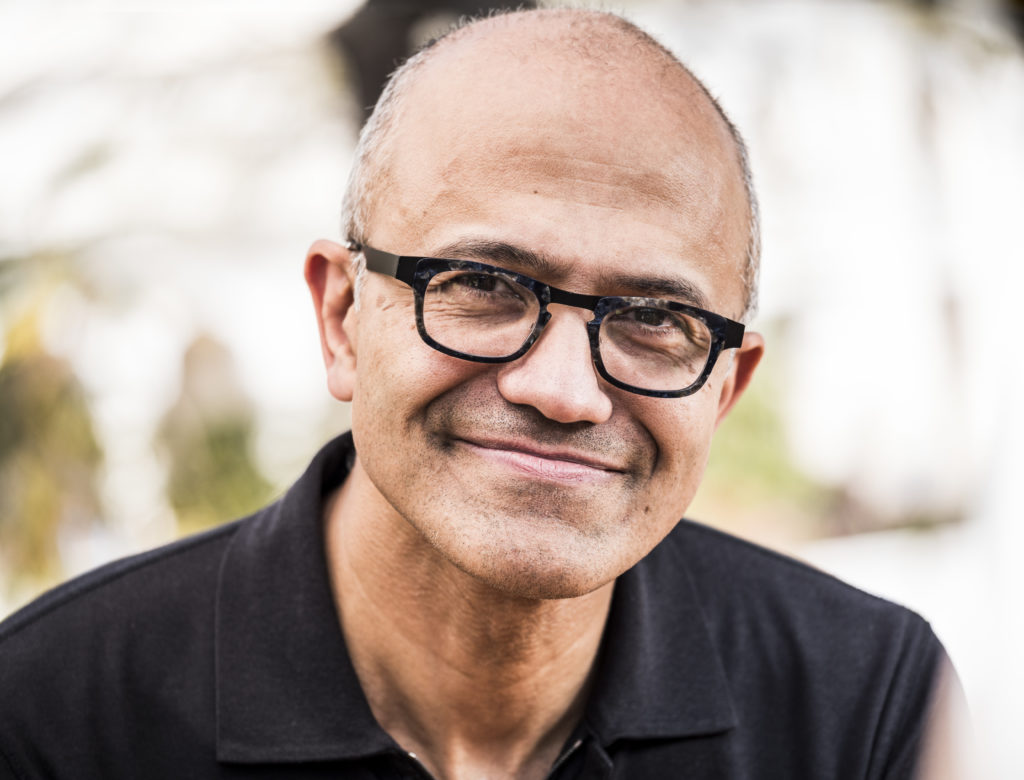
Microsoft CEO Satya Nadella. (Microsoft)
This year, we released the 2021 Rankings of America’s Most JUST Companies on October 14, and for the third year running, Microsoft took the lead. At the Forbes JUST 100 Virtual Summit, JUST Board Member and CEO of Grameen America, Andrea Jung, sat down with Microsoft CEO Satya Nadella to discuss his leadership. Nadella is one of the most prominent proponents of adopting stakeholder capitalism, and he explained how to make that a reality in light of COVID-19, our national reckoning with racial injustice, and recent challenges to American democracy.
On navigating the extraordinary challenges of 2020, Nadella began by saying that Microsoft’s three-time No. 1 rank in the JUST 100 is “really the recognition of all the people I work with, my team members and coworkers, and their hard work every day, living our mission and our culture.” It’s this commitment to mission, culture, and purpose that Nadella credits with Microsoft’s competitive advantage, and it’s something he has been fostering in his seven years as CEO, as well as his 28 years at the company.
Watch the full talk here and explore our key takeaways below.
Stakeholder capitalism has faced criticism for being little more than rhetoric, a buzzword for corporations looking to align themselves with ideals of sustainability and ESG. But in the conversation, Nadella pushed back, emphasizing that “in the midst of this pandemic, [it’s fair to] to essentially have a referendum on capitalism. We all have to recognize: What is the core purpose of a corporation?” Rather than simply generating a profit for shareholders, Nadella believes that this purpose must lie in finding profitable solutions to the issues faced by people and our planet, and that the measure of corporate success lies not in the surplus companies create in their own enterprise, but in the surplus they create around them. Microsoft’s long-time commitment to these ideals, and its ability to execute its social mission, are key to its competitive advantage in our Rankings, and as evidenced by the company’s best quarter ever.
Microsoft has consistently been a leader in the arena of environmental impact and sustainability, pioneering new technologies and initiatives that reduce its footprint. Recently, Microsoft announced that it aimed to be carbon negative by 2030 and that by 2050, the company will essentially “go back in time” to reclaim all the carbon it had emitted since 1975. Nadella recognizes that of course climate change is a global issue that a single company can;t solve, but believes that these ambitious efforts can create a “ripple effect through our ecosystem of suppliers and partners,” driving powerful change across its operations.
In the midst of a contested election, Americans are looking to companies – and particularly those in the tech sector – to play a critical role in protecting democracy. Nadella agrees, emphasizing that “as an American company and as a tech company, our standing in the world and in the U.S. comes because of the vibrancy of American democracy.” With technology both a powerful tool and pervasive challenge of American society today, Nadella sees a “wide gamut” of efforts that Microsoft can make to help ensure that democracy continues to thrive, from making the democratic process itself more secure to protecting the digital discourse around key issues like racial injustice. With the foundations of our democratic system at stake, leaders like Nadella are poised now, perhaps more than ever, to play a key role in their protection.
In the debate around stakeholder capitalism, a pervasive myth holds strong among corporate and investment leaders that doing right by workers, communities, customers, and the environment hurts shareholder returns. Throughout the COVID-19 crisis, Microsoft continued to pay its employees and contractors, despite pandemic constraints like the closure of its corporate campus. Nadella shared that decisions like these, in support of the company’s stakeholders, stem from Microsoft’s long-term mission and principles to create success around itself, something the company’s shareholders have a vested interest in. He shared that “our shareholders want us to do this,” driving home that his company’s competitive advantage – its success in the long term and the value it creates for shareholders – is derived from its commitment to all its stakeholders.
In this unprecedented moment, corporate leaders are faced with urgent questions around how to lead their companies – through the pandemic, social unrest, and political tumult – and what, in turn, that means for society. Jung asked Nadella what he believes his personal responsibility is to lead in this moment. “I always go back to that social contract of our company with the world around us. Because that to me is at the core of the license to operate,” he said. “You can’t exist if all you’re doing is benefiting yourself. … Profit [comes] because of the larger surplus you’re creating around you.”
With our country and our world facing profound new challenges, this sense of purpose must continue to fuel not only what corporate leaders say on the issues that matter most, but how they act. Nadella emphasized that, by holding fast to culture and purpose through this time of upheaval, corporate leaders can help ensure greater resiliency and a better future for Americans, as well as continued success for their companies.
You can watch the full JUST 100 Virtual Summit here.
