
Moving the needle on corporate justness often requires a patient, deliberate, hands-on approach. This was evident recently, when the JUST team – in conjunction with the Gates Foundation and several partners – brought together 14 executives from big companies for a groundbreaking 4-day summit to advance workforce innovation and well-being.
Occasionally, though, external events compel companies to move swiftly to help their stakeholders, whether that means their employees, their customers, the communities they operate in, or society at large. Hurricane Helene is such an event.
It starts with financial support. Many companies we track – including Bank of America, Lockheed Martin, Wells Fargo, Truist, Target, and others – have made sizable donations to local charities, the American Red Cross, and other organizations to help provide essential needs and resources to those most affected.
Others also deploy their corporate capabilities. AirBnB, for example, is providing free temporary housing to displaced families. Amazon’s Disaster Relief and Response Team is leveraging the firm’s logistics, cloud computing and transportation assets to support organizations on the ground and to ensure critical help and supplies get to those in need. Walmart, Kroger, Home Depot, and Lowes, all of which have employees directly in harm’s way, are using their stores and warehouses as distribution centers for food, water, charging stations, generators, chainsaws, portable AC units, and more.
As the saying goes, crisis doesn’t create character, it reveals it. For many business leaders, Hurricane Helene has given them the chance to show what they’re made of.
Be well,
Martin
“I love trying to add purpose to the things I do because it gives me meaning. But I never advocate for people to insert purpose into their own businesses. It can end up as performative. A business can be a great social good on its own, and I don’t like adding gimmicky, fake missions. If you care about an issue, and you find a way to use market forces to channel that impact, it can do good. But often corporate communications departments are like, how do we add these as a feature? And it can be fake and doesn’t help.”
The Corporate Racial Equity Alliance, comprised of JUST Capital, PolicyLink, and FSG, have developed Business Standards for 21st Century Leadership to define business leadership that values people, planet, and the bottom line. Following our May 2024 release of draft standards 1-8, we have now released standards 9-14 for public feedback. The newly released draft standards focus on corporate impact on communities and society.
To lend your perspective on the topics of corporate impact on communities and society at large, please take our online survey by October 31. Stakeholder engagement in the development of these standards is key to our success. We hope you’ll join us and share your feedback.
It’s official: OpenAI is planning to become a for-profit business, causing several other executives to leave, and putting up more legal and logistical roadblocks. Mashable has the story. Meanwhile, Axios looks at some of the underlying causes of this shift.
Fortune reveals that shareholder proposals on diversity, pay equity, and plastic pollution got less support this season, but anti-ESG proposals also got less support. Learn more.
Board Member Peter Georgescu writes how, with a hollowing middle class, stakeholder capitalism is the best hope for a brighter future in his latest Forbes piece.
The Washington Post looks at the longshoreman strike, and the impact it could have on goods moving into the U.S.
The Wall Street Journal takes a look at the slow migration from salary-based pay to incentivized-bonus pay for many jobs, and how now, a majority of Americans work in positions where a chunk of their pay isn’t guaranteed.
Reuters examines the fallout that occurs when a Dollar Store closes in a low-income community.
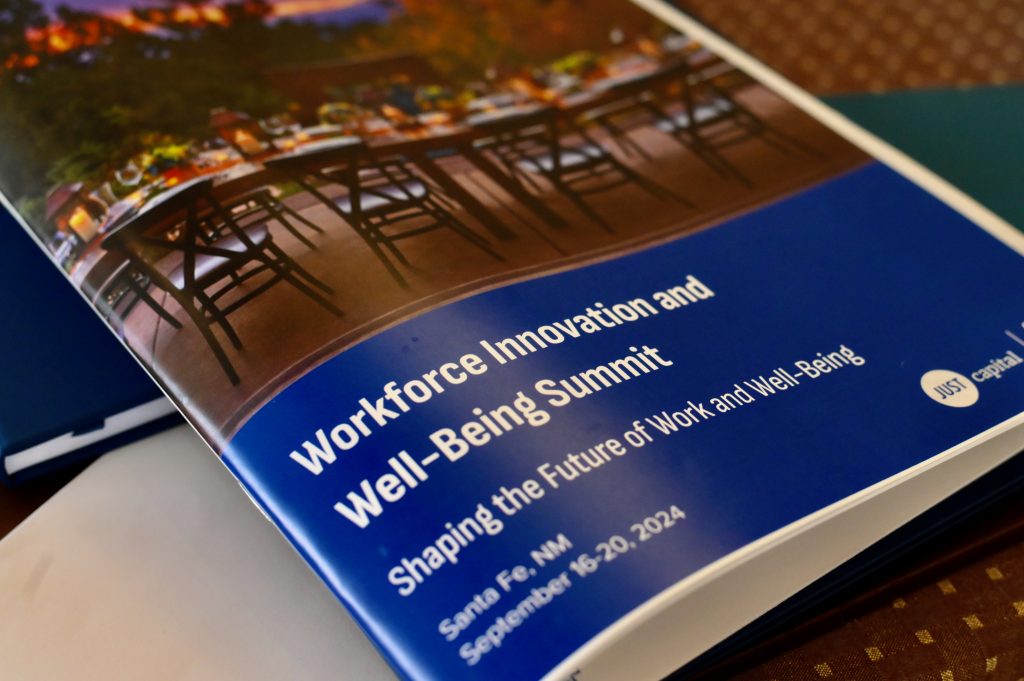
Two weeks ago marked significant milestones for Just Capital: we hosted a week-long Workforce Innovation and Well-being Summit for executives driving vital initiatives at some of America’s largest companies, and we welcomed the trailblazing former PayPal CEO, Dan Schulman, as our new board chair.
With Dan at the helm, Just is proud to continue a close working relationship that began when we partnered with PayPal to launch the Worker Financial Wellness Initiative. This initiative, which aims to make employee financial wellness a C-suite priority, laid the groundwork for our ongoing efforts to advance workforce well-being and innovation.
Building on the foundation of our Worker Financial Wellness Initiative, the Summit brought together committed, visionary corporate leaders from industries that collectively employ almost one million U.S. workers, and represent over $4.2 trillion in market cap. In collaboration with partners like IDEO, Jobs for the Future, Financial Health Network, Good Jobs Institute, Guild, and Syndio, the Summit fostered peer dialogue and leveraged expert insights to develop actionable strategies aligned with each leader’s workforce priorities.
Rooted in a focused, hands-on, interactive approach developed by Just in partnership with IDEO, the goal of this Summit was to help executives bridge the gap between visionary goals and practical, incremental strategies. Rich, provocative discussions, alongside context-specific strategies and tools gave participants the opportunity to strategize, think big, and connect with peers.
Participants found immense, immediately applicable value in their experience. From our attendees:
This was easily the most valuable event I’ve been to in this role and one of the top 3 in my career.
High value for me as timing was right in the midst of strategic planning for my team/company. Felt like I was able to spend some dedicated deep work time on the most important work while being surrounded by credible partners and peers.
I am leading the People and Culture work stream for a massive company transformation and this was helpful to crystallize my approach, KPIs, potential allies, etc.
It was an excellent event from start to finish: Carefully curated attendance list; Everyone was able to build on and add value to each other.

These reflections fuel our commitment to creating spaces and opportunities for impactful collaboration.
Those spaces – and Just’s theory of change – will always recognize the complex landscape corporate leaders must navigate. From addressing Americans’ declining trust in corporations to grappling with economic uncertainty, talent shortages, and regulatory compliance, the challenges are multifaceted. And we know that solutions with staying power must meet workforce priorities and enable the advancement of related business imperatives. That’s precisely why JUST Capital is focused on supporting leaders in pursuit of operational excellence, healthy workplace culture, and workforce sustainability – bridging the gap between data and reality, while enhancing our ability to measure just business practices.
That approach is anchored in the strong, compelling financial performance of companies prioritizing stakeholder value. As of September 30, 2024, Just Capital’s flagship indexes, the Just 100 Index (JUONETR) and Just U.S. Large Cap Diversified Index (JULCD), have outperformed their benchmarks by 51.1% and 11.96%, respectively, since inception. These figures underscore the growing evidence that just business practices are not only ethically sound, but financially prudent.
As we reflect on the success of the Summit and look to the future, I’m confident in the power of bringing together diverse perspectives to tackle shared challenges. One of our participants echoed these sentiments:
We’ve never shied away from challenges. We’ve been built by them.
As the leaders left Santa Fe, they did so with a newfound sense of confidence, urgency, and direction: the roughly half of attendees who entered the Summit likely to implement workforce well-being initiatives in the near-term jumped to 80% by the Summit’s end.
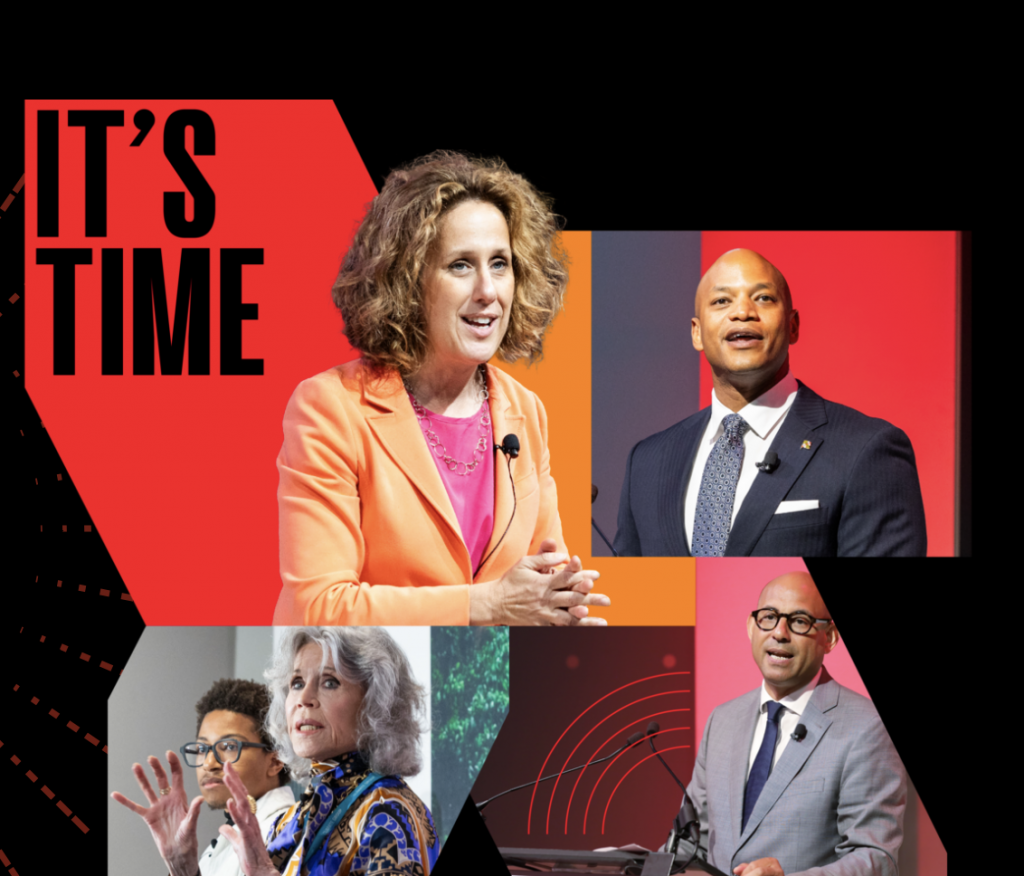
If you can make it around the barricades, past the acronyms, and beyond the countless cocktails and canapes, you realize Climate Week in New York City provides an opportunity to address some serious questions.
Are we actually on track to combat climate change? Who’s moving the needle? Who is holding everyone to account? And who, ultimately, will foot the bill for whatever future we have in store?
There’s certainly a lot of capital flowing into the climate space. According to CREO Syndicate, a nonprofit organization on whose board I serve, “Annual global climate finance flows doubled from 2020 to 2022, reaching $1.4 trillion or 1% of global GDP, but will need to increase sixfold to average $8.6 trillion through 2030, and $10.7 trillion through 2050, to reach net zero.” Whether all of this investment will generate a market rate of return (or mitigate greenhouse gas emissions for that matter) remains to be seen, but compared to, say, a decade ago, these numbers are impressive.
There’s also a lot of business action on the issue. As our list of Top 10 Companies for the Environment shows, companies like Hewlett Packard Enterprise, McCormick and Co, Accenture, and Trane are supplying the world with advanced climate solutions that tie directly back to market performance and profitability. This week’s announcement by Microsoft (another JUST 100 leader) that it will use the Three Mile Island nuclear facility to supply the emissions-free power it needs to grow brings home how seriously companies are taking their climate commitments and how complex the path forward really is.
Where is the public – as consumers, as taxpayers, as voters – on all this? I’d say it’s a mixed bag. Despite what many of the international visitors I talked to this week think, Americans do care about the climate. But as our polling shows, it’s hard to prioritize it when you’re struggling to make ends meet. For millions around the world, a changing climate threatens their livelihoods, their communities, their futures. Yet many feel similarly threatened by some of the policies proposed to address the issue. Getting to grips with these realities is essential. In the meantime, it’s the private sector that will continue to lead.
Be well,
Martin
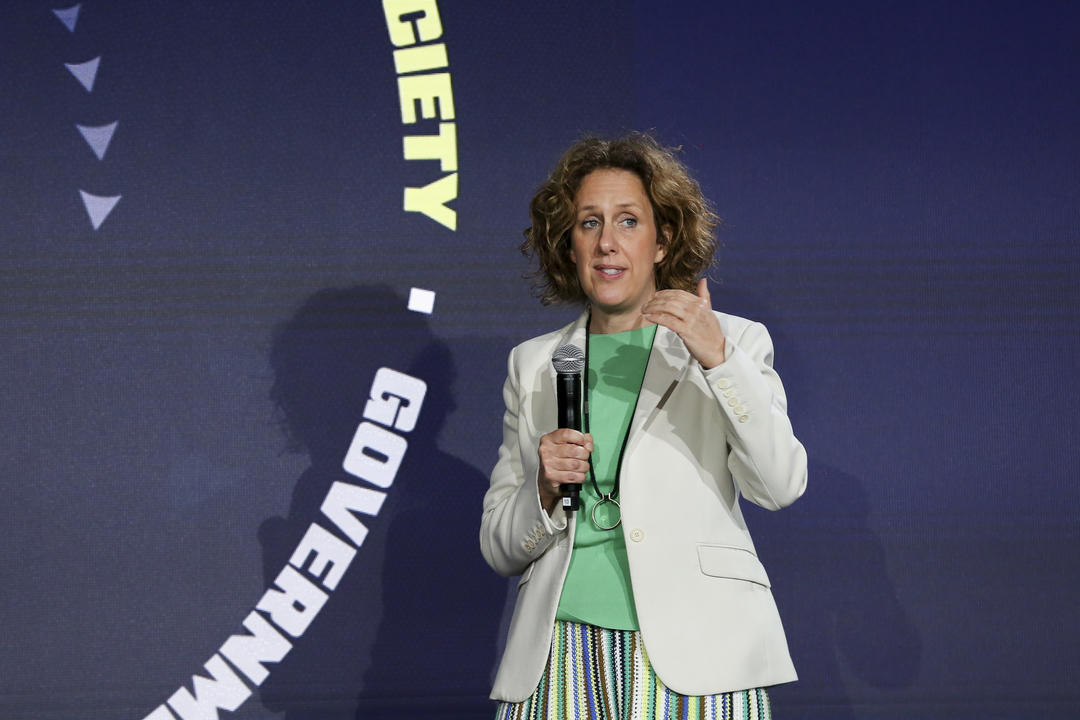
“We only have one environment and we must protect it. The planet will adapt without us – we are not as important as we think we are.”
California kicked-off climate week by launching the first-of-its-kind lawsuit against ExxonMobil for its alleged role in the plastic pollution crisis. The Guardian has the story.
Bloomberg takes a deep-dive into how corporations have lost or regained Americans’ trust, as part of an ongoing series on lack of faith in institutions.
Forbes predicts that average salary increases are going to decline next year. Explore why.
Fast Company explains why corporate America’s retreat from DEI is shortsighted, and Retail Dive highlights the leading DEI programs that serve business goals.
Bloomberg looks at the immense pay package garnered by ousted Nike CEO John Danahoe, and whether it was a just amount for a man who presided over the company losing over $40 billion in market value.
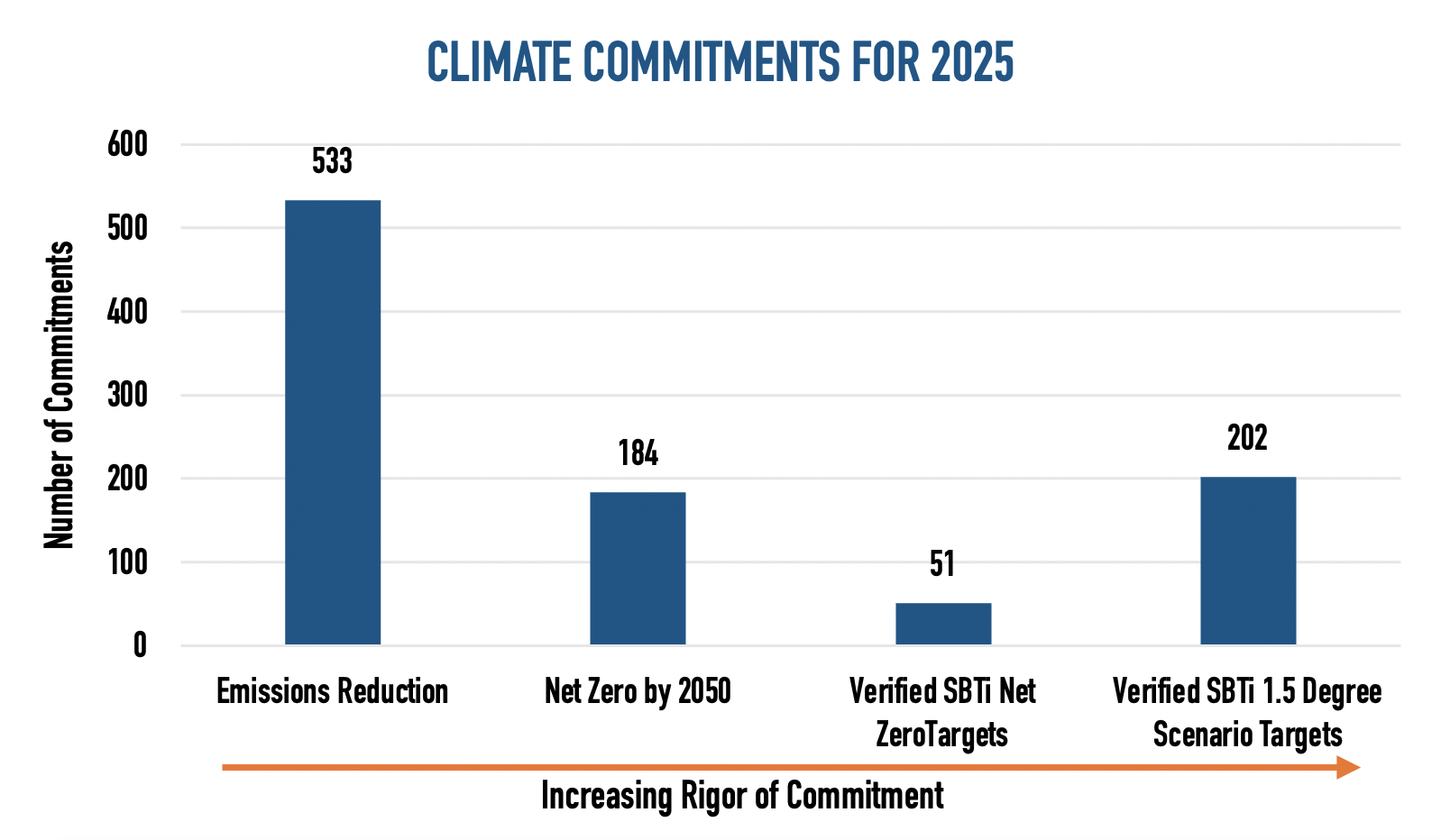
For climate week, we analyzed preliminary 2025 data on climate commitments, showing what level of disclosure and commitment Russell 1000 companies are providing, which will factor into our 2025 Rankings. So far, we are seeing a remarkable increase on SBTi scenario commitments compared to last year’s data.

Big news in the JUST world. After a decade in the seat, our Co-Founder and inspiration Paul Tudor Jones II is stepping down as board chair and handing the baton to one of corporate America’s most respected business leaders, former PayPal CEO Dan Schulman.
Paul, who will remain an active board member, puts it perfectly: “Dan’s track record of leadership at some of the largest U.S. companies makes him the perfect person to carry JUST Capital forward as chair.” Having worked with JUST during his 10-year tenure at PayPal (on our Worker Financial Wellness Initiative), Dan is no stranger to the organization. Indeed, his interview on CNBC’s Squawkbox with Paul in the fall of 2019 stands out to me as one of the most important moments in the organization’s history.
The move comes at an important moment for America and the world. In a period of deep and seemingly endless political division, business has a unique opportunity to lead, to bring people and ideas together, and to champion the things Americans really care about: their hopes, their dreams, their futures. Companies that do this well, as our data shows, will achieve success in many ways, financial and otherwise. CEOs that do this well – as Dan has demonstrated – will cement their legacy for years to come.
I hope the prospect of Dan, Paul, and the rest of our board working together in service of this ideal fills you with as much excitement as it does me.
Read the full announcement of Dan’s appointment.
Be well,
Martin
“Paul Tudor Jones II’s vision when he co-founded JUST Capital ten years ago is an inspiration to us all. Under his leadership, JUST Capital has changed the conversation about how business in America is done. The role of JUST Capital is becoming ever more important in today’s world. I look forward to partnering with Paul and the rest of the board to help guide the kind of corporate leadership that the world so urgently needs.”
The Atlantic expresses skepticism over Microsoft’s claims that AI can enrich fossil fuel companies AND help fight climate changes, in addition to other paradoxes.
ESGDive reveals that the SEC has sunset its climate and ESG enforcement task force. More info on the implications here.
A Forbes piece looks at the problems with “no taxes on tips” and “no taxes on overtime hours” policies put forth by this year’s Presidential campaigns.
USA Today reports that grocery chain Aldi is increasing its minimum wage to $18 and $23 an hour for in-store workers and warehouse workers, respectively, in anticipation of hiring 13,000 additional workers this holiday season. Meanwhile, Amazon is increasing pay for hourly workers to $22 an hour.
Reuters reports on the ongoing Boeing strike – where 30,000 workers voted down their latest contract – and how long the strike could last given existing instability at the company.
Instagram announced changes to help curb inappropriate contact and content to users under 18, as well as features to make the app less addictive to teens. The New York Times has the story.

This chart comes from a piece of analysis from Axios that shows the gender wage gap increased for the first time in 20 years. Explore why.

Just Capital announces today the appointment of former PayPal CEO Dan Schulman as chairman of its board of directors.
Schulman replaces Just Capital Co-Founder Paul Tudor Jones II, who will remain on the board and continue to partner with Just Capital’s advisors and directors to realize its goal of becoming the most trusted and objective authority on ranking, recognizing, and incentivizing corporate stakeholder leadership.
“Paul Tudor Jones II’s vision when he co-founded JUST Capital ten years ago is an inspiration to us all,” said Dan Schulman. “Under his leadership, the organization has changed the conversation about how business in America is done. The role of JUST Capital is becoming ever more important in today’s world. I look forward to partnering with Paul and the rest of the board to help guide the kind of corporate leadership that the world so urgently needs.”
Schulman was the CEO of PayPal for more than nine years and previously held leadership roles at American Express, Sprint Nextel Corporation, Priceline Group, and AT&T. He is a board member of Verizon, Cisco, Lazard, and the Cleveland Clinic. He is vice chair of the Valor Capital Group, a life member of the Council on Foreign Relations, and co-chairs the World Economic Forum’s Steering Committee to promote global financial inclusion.
“Dan Schulman’s track record working at some of the largest U.S. companies makes him the perfect person to carry Just Capital forward as chairman,” said Paul Tudor Jones II. “I couldn’t be prouder of what we’ve achieved and look forward to working alongside Dan and the entire JUST Capital team to drive change at scale and better the lives of all Americans in doing so.”
Over the past 10 years, Just Capital has amplified the voices of more than 180,000 Americans and incentivized hundreds of the largest U.S. companies to take concrete actions that benefit millions of workers, families, and communities. With partners like CNBC and Forbes, the organization has built the Just Capital Rankings into a sought-after designation that improves brand value and has launched investable indices that demonstrate the clear case for stakeholder-driven business. As of August 30, 2024, Just Capital’s flagship indexes, the JUST 100 Index (JUONETR) and Just U.S. Large Cap Diversified Index (JULCD), have outperformed their benchmarks by 51% and 12.9%, respectively, since inception.
“As stakeholder metrics become more relevant in C-suites and boardrooms, Just Capital is delighted to work hand-in-hand with Dan Schulman to hone our strategy to directly support leaders in managing risk, measuring and improving performance, and creating impact at scale,” said CEO Martin Whittaker. “When many are questioning the merits of capitalism and faith in the American Dream is being tested, our vision is clear. We know that just business is better business.”
In a slowing job market and signs of rising unemployment, understanding how companies invest in their workforce has never been more critical. Workers are increasingly asking for meaningful employee benefits and are vocal about their needs for better support, whether it’s for financial wellbeing and the ability to cover their living costs, assistance with caregiving responsibilities, or clear paths for career progression.
JUST Capital’s polling continuously shows how consistent Americans are when it comes to what they want the nation’s largest public companies to prioritize – their workers. Year over year, worker issues including living wage, benefits, career development, worker health and safety, and diversity and inclusion get the highest prioritization and in 2024 comprise 42% of a company’s score in our Rankings of America’s Most JUST Companies.
Investing in workers was a recurring theme in JUST Capital focus groups that will inform the 2025 Rankings. Full findings will be published later this year. Related to how companies can create value for all their stakeholders, one participant shared:
“I feel like a happy employee makes a happy company.” – Male, 40-44, Moderate
And in fact, JUST Capital’s research shows exactly that: investing in workers pays off. Our Workers Leaders Index Concept – which tracks the top 20% of companies in our Rankings that perform best across all five worker-related issues – has outperformed the Russell 1000 Equal Weighted index by 16.46% from December 31, 2021 to July 31, 2024.
As we approach Labor Day, JUST Capital is highlighting the companies leading the way in fostering environments where workers feel valued, supported, and empowered to thrive by actively implementing comprehensive workplace policies that address their workers’ needs head-on. Our analysis found that the top 10 companies for worker issues are outpacing the rest of the Russell 1000 in a number of ways:
JUST Capital is proud to present the list below of Top 10 Companies for Workers with details on how they are leading on the issues that matter most to the American public. The following list is based on performance on Worker Issues from JUST Capital’s 2024 Rankings of America’s Most JUST Companies.
Ranked 2nd in Overall Rankings and 1st for Banks
Bank based in Charlotte, North Carolina
Bank of America invests in its employees’ financial and physical well-being by focusing on competitive wages and comprehensive benefits. The company demonstrates a commitment to paying living wages, with a minimum hourly wage of $23 – one of the highest disclosed among the Top 10 Companies for Workers and well above both the Russell 1000 average of $16.73 and the bank industry average of $18.22. In its commitment to supporting working families, Bank of America offers 16 weeks of paid leave for both primary and secondary caregivers and provides emergency backup care and subsidies for routine day care services. In addition, Bank of America embraces transparency on topics like pay equity and workforce demographics: it’s among the 12.5% of companies that publicly report the results of both their gender and race/ethnicity pay equity analyses and part of the 47% who disclose highly disaggregated workforce demographic data.
Ranked 5th in Overall Rankings and 2nd for Banks
Bank based in New York, New York
Citi demonstrates a strong commitment to fairness and family support through a range of initiatives focused on equity and employee-wellbeing. The company’s dedication to equity is reflected in its pay analysis results, which show that women globally earn over 99% of what men earn. Citi also provides highly disaggregated workforce demographic data by gender, race/ethnicity, and standardized job categories, underscoring its transparency and commitment to an inclusive environment. Supporting its workforce further, Citi offers up to 16 weeks of paid leave to primary caregivers and benefits like preferred access and up to 10% tuition discounts at Bright Horizons child care centers, along with emergency backup dependent care. The company also invests in professional development, providing an average of 38 training hours per employee and offering tuition reimbursement to support employees’ continuous learning.
Ranked 18th in Overall Rankings and 4th for Semiconductors & Equipment
Semiconductors & Equipment company based in Santa Clara, California
NVIDIA’s approach to fostering an equitable and supportive work environment is evident in its commitment to both pay equity and comprehensive employee benefits. Notably, the company offers robust parental leave benefits, including 22 weeks of fully paid leave for birth parents, 12 weeks of paid leave for non-birth parents, including fathers and adoptive parents, and support in offsetting childcare costs by providing a 10% discount on childcare at KinderCare centers. Additionally, NVIDIA stands out for its robust pay equity disclosure, as it is one of only 12.5% of companies overall and 23.5% among industry peers to disclose both their gender and race/ethnicity adjusted pay ratios. The company is also one of very few among the Russell 1000 companies we assess to disclose disaggregated pay equity data by different race/ethnicity categories, showcasing a high level of transparency.
Ranked 16th in Overall Rankings and 4th for Banks
Bank based in New York, New York
JPMorgan Chase invests in its employees’ financial well-being by offering a minimum hourly wage of $20, which exceeds the Russell 1000 average and represents the third highest minimum wage among banks. The company also supports new parents with 16 weeks of paid parental leave for both primary and secondary caregivers and families with various caregiving services. JPMorgan Chase’s equity practices are also reflected in its pay gap analysis results, which show nearly equal compensation across gender and racial lines. Additionally, the company maintains transparency in its diversity efforts by disclosing detailed demographic data by gender, race/ethnicity, and job category.
Ranked 6th in Overall Rankings and 1st for Health Care Providers
Health Care Provider based in Bloomfield, Connecticut
Cigna demonstrates its commitment to workplace equity through pay equity analysis, showing near-parity in compensation for female and underrepresented minority employees. The company also prioritizes transparency by sharing highly detailed workforce demographic data by gender, race/ethnicity, and job category, reinforcing its focus on fostering an inclusive environment. Additionally, Cigna supports its employees’ work-life balance with key benefits including 18 days of paid time off and seven days of paid sick leave annually, paid parental leave, flexible scheduling opportunities, and emergency backup dependent care support.
Ranked 51st in Overall Rankings and 6th for Software
Software company based in Minneapolis, Minnesota
Dayforce sets a high standard in the Software industry with its generous and inclusive parental leave policy, offering 17 weeks of paid leave to all caregivers. This is the highest offering at parity among the Top 10 companies and far surpasses the Russell 1000 average of 11 and 8 weeks of paid parental leave for primary and secondary caregivers, respectively. Additionally, Dayforce invests in its employees by providing unlimited paid time off, 10 days of paid sick leave annually, and both backup and subsidized dependent care benefits. Flexible scheduling opportunities further reflect Dayforce’s dedication to fostering a work environment that truly supports its employees’ diverse needs.
Ranked 90th in Overall Rankings and 1st for Consumer & Diversified Finance
Consumer & Diversified Finance company based in Detroit, Michigan
Ally Financial is among the Top 10 companies with the highest minimum wage of $23 per hour. This wage exceeds the Russell 1000 average of $16.73 and the Consumer & Diversified Finance industry average of $19.00, demonstrating a sustained commitment to competitive compensation for hourly employees. The company also supports working parents by offering equal parental leave to both primary and secondary caregivers and providing discounts on childcare to help ease caregiving costs. This combination of competitive wages and comprehensive family support underscores the company’s ongoing investment in its employees’ well-being and stability.
Ranked 9th in Overall Rankings and 2nd for Semiconductors & Equipment
Semiconductors & Equipment company based in Santa Clara, California
Advanced Micro Devices (AMD) demonstrates a strong commitment to employee well-being through a comprehensive range of benefits, supporting their work-life balance and professional development. AMD offers 12 weeks of fully-paid parental leave for the birth, adoption, or foster placement of a child, ensuring equitable support for all parents and new families alike. Also, the company provides up to 20 days of subsidized backup care annually to help employees with their caregiving expenses. In addition to its family-friendly policies, AMD supports employees’ work-life balance with a minimum of 15 days of paid time off, 20 days of paid sick and family time off, and workplace flexibility, enabling employees to choose what best fits their needs. AMD also supports employees’ professional development and encourages continuous learning through its education assistance program which offsets the cost of education.
Ranked 10th in Overall Rankings and 3rd for Semiconductors & Equipment
Semiconductors & Equipment company based in Boise, Idaho
Micron offers a range of robust benefits to support its employees, including 12 weeks of fully-paid parental leave for all expectant parents and at least 17 days of paid time off annually for rest and recovery. Additionally, the company supports career development and skill enhancement through its academic advancement program which provides financial assistance and resources for employees to pursue higher education and professional certifications. What’s more, Micron provides an average of 62 hours of career training per team member annually, significantly exceeding the industry average of 21 hours. Micron also performs regular pay equity analyses to foster a culture of fairness, ensuring sustained pay equity globally for women and people with disabilities, as well as across race/ethnicity and veteran status in the U.S.
Ranked 26th in Overall Rankings and 2nd for Transaction Processing
Transaction Processing company based in San Jose, California
Paypal demonstrates a strong commitment to employee support through its equitable compensation practices, robust professional development opportunities, and comprehensive benefits package. The company regularly conducts pay equity analyses by gender and race/ethnicity, and its latest assessment reveals that it has maintained 100% global gender and U.S. ethnic pay equity, reflecting its ongoing commitment to fairness and inclusivity. In addition to its focus on equitable compensation, PayPal supports employees’ professional development by offering tuition reimbursement to help cover educational costs and an average of 48 hours of training per employee annually, which is 2.4 times more than the industry average. The company also provides a comprehensive benefits package which includes unlimited paid time off, five days of paid sick leave, equal paid parental leave for all parents, and both subsidized and backup dependent care. To further promote work-life balance, Paypal also offers flexible working arrangements like hybrid work to accommodate diverse needs.
To learn more about our methodology, unpack your company’s performance on worker issues in the 2024 Rankings, and gain insights into how to improve on the issues that matter most to the American public, please reach out to corpengage@justcapital.com.
