In the period between June and October 2020, after our data collection process concluded but before our Rankings were released, Facebook was the subject of several high-profile media controversies related to the spread of misinformation, hate speech, and other discriminatory and incendiary content on its platforms. In some instances, such as in Kenosha, Wisconsin, it is alleged that Facebook’s failure to swiftly and systematically remove such content from its flagship platform may have indirectly contributed to the deaths of protesters.
Compounding our concerns about Facebook are the outcomes of its own Civil Rights Audit, released in July, which details its performance on matters including voter suppression and voter information, building a civil rights accountability infrastructure, content moderation and enforcement (including hate speech and harassment), advertising targeting and practices, diversity and inclusion, fairness in algorithms, and the civil rights implications of privacy practices, among others. While the transparency demonstrated by undertaking and publishing an audit of this type – voluntary in nature – is a positive step, the auditors noted that they had watched the “company make painful decisions over the last nine months with real world consequences that are serious setbacks for civil rights” and that “Facebook’s approach to civil rights remains too reactive and piecemeal.”
From recent polling conducted in collaboration with The Harris Poll, we found that almost two in three Americans (63%) say that companies have a moderate to significant role to play in taking an active stand against the spread of disinformation by identifying and debunking falsehoods and propaganda. Yet Facebook stands accused of repeatedly failing to halt the spread of misinformation and incendiary content, both of which could be categorized as acts of omission or non-action. An act of omission is more overt and measurable, particularly in the context of our research and ranking work. Facebook has not deliberately incited violence from extremist groups on its platform, but there is credible evidence to suggest that the company did not act with the speed and force necessary to stop it.
Recognizing that the spread of misinformation online is a complex problem for which a perfect solution may not exist, we have therefore put Facebook’s 2021 ranking “under review” and withheld the JUST Seal that denotes a company’s inclusion as one of America’s Most JUST Companies. The Seal is a reward for proven excellence. Until Facebook’s performance and alleged shortfalls are better understood, we deem unproven its case for JUST Capital’s highest honor.
Our objectives in ranking companies, and awarding leaders the JUST Seal, is simple: We want to measure company performance as accurately and objectively as possible, and we want to recognize, celebrate, and incentivize true leadership.
In the coming year, we will be taking concrete steps to further explore and quantify how Facebook’s actions (and inactions), and similar business behaviors by other internet companies, can be better reflected in our Rankings, in order to meet these objectives. These efforts start with our Polling Team, which will embark on a survey research program to better understand public opinion on these types of controversies. We will use a combination of qualitative and quantitative research fielded among a random sample of the American public, aged 18+, to understand:
We will further investigate the extent to which our existing metrics are adequately capturing the social consequences of Facebook’s actions and other corporate actions like it. Facebook’s above-average performance on the fourth most important Issue in our Rankings, “Acts ethically and with integrity at the leadership level and takes responsibility for wrongdoings,” may reveal that one or more of its underlying metrics are not calibrated or sufficiently targeted to signals of repeated failures of leadership on matters of enormous social consequence. We will be conducting a detailed analysis of our metrics on this Issue and, as ever, working toward better measurement.
We will be updating this website with our progress in 2021.
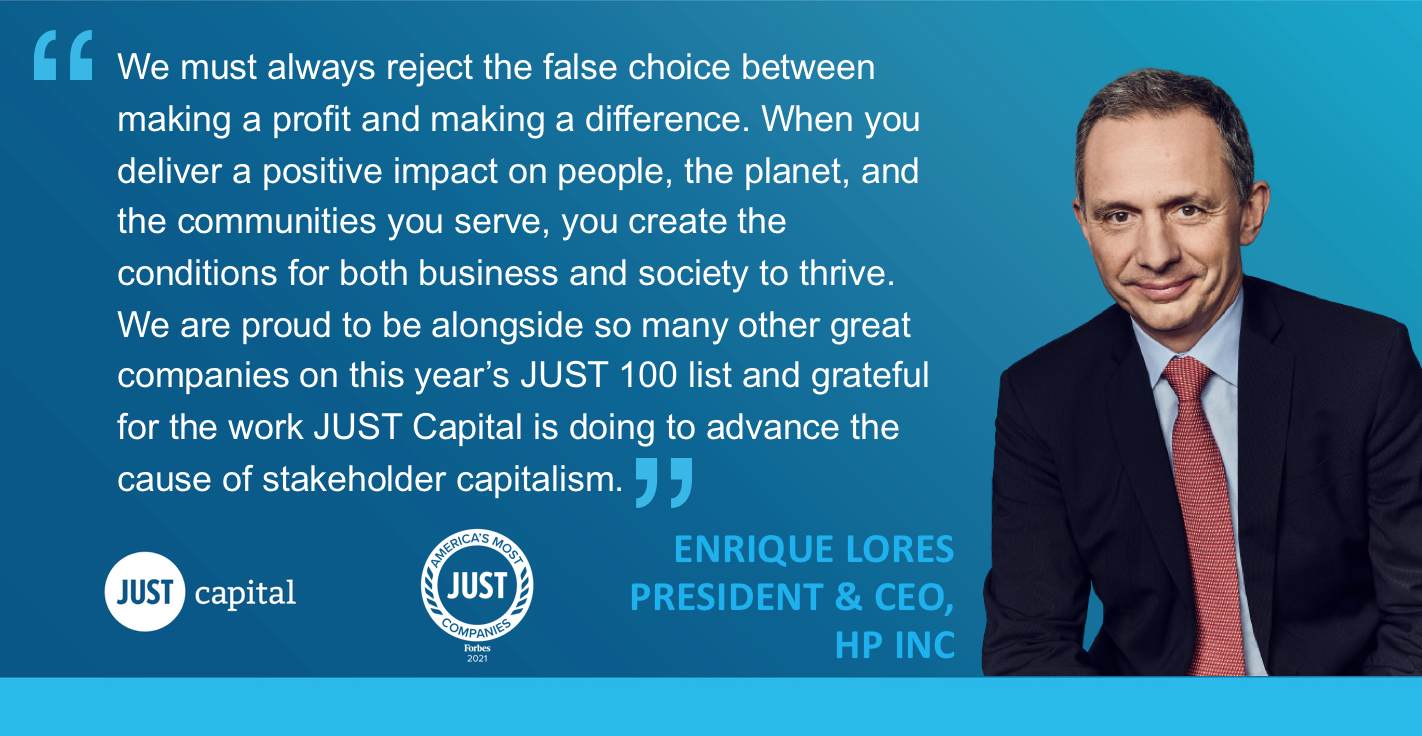
This week saw the release of our new annual rankings of America’s Most JUST Companies and our celebration with Forbes of the new JUST 100 list. It’s a big occasion for the organization, and a chance to spotlight our mission and hear directly from corporate leaders on why all this matters. The event did not disappoint. (And you can watch the replay here.)
Ken Chenault, former CEO of American Express and Chairman & Managing Director of General Catalyst, discussing how to lead through a crisis, explained that “reputations are made or lost in times of crisis.” On racial inequity, he advised, “This is not rocket science. There has to be focus, persistence…This is not something that can be a flavor of the year. It has to be an ongoing effort.”
Satya Nadella, CEO of Microsoft, speaking about stakeholder capitalism more broadly, observed: “I think it’s fair, in 2020, in the midst of this pandemic, to essentially have a referendum on capitalism…We all have to recognize: What is the core social purpose of a corporation?” He also noted businesses’ connection to democracy itself: “There is a wide gamut of things that we should do to ensure democratic institutions continue to thrive, as all of us as citizens and as businesses depend on these institutions on being strong.”
Ken Frazier, CEO of Merck, struck a powerful note in his remarks on equity: “If you’re complacent with the status quo, you’re complicit in the structural racism and inequality that the status quo hides,” and discussed the steps corporate America not only needs to take within, but also in support of addressing deep structural disparities in society – in education, in criminal justice, in health equity, and more. And Risa Lavizzo-Mourey, board member of Intel, Merck and GE, highlighted the importance of worker health and safety from factory floor to hospitals: “It also needs to extend beyond what we do in a corporation, and that requires us to use our influence and make sure that safety extends out beyond into society.”
A major focus for JUST right now is the Worker Financial Wellness Initiative, with PayPal and other partners. Speaking about this, our Chair Paul Tudor Jones emphasized that “having companies understand and measure how many of their employees aren’t making a living wage is the first big step towards reducing that inequality gap.” Dan Schulman, PayPal’s CEO, elaborated: “When we don’t have financially healthy and safe employees, they start to question the system. Our whole democracy relies on rising above your own self-interest. Creating a healthy economy, a healthy capitalism, and a strong democracy…that’s crucial for our future.”
Pharrell Williams had the last word: “I love my country for its progression, but I REALLY love it for its untapped potential.”
The JUST movement is on a roll, and I invite everyone who reads this to reach out, forward the invitation to others and join us.
Be well,
Martin Whittaker
P.S. I’d be personally honored if you would consider making a gift today to support JUST’s work and mission so that we can continue to push forward on building an economy that works for all Americans.
This week, we wanted to highlight some of the standout policies of our JUST 100 leaders. Here are a few:
Microsoft, America’s Most JUST Company, led on financially supporting workers through the COVID-19 crisis by continuing to pay contract workers during facilities and store closures.
JPMorgan set quantitative targets to increase representation of women, veterans, and employees with disabilities, demonstrating a commitment to equity across the organization. In 2019, JPMorgan committed to hiring over 4,000 Black students into entry-level roles over five years, and invested in Black talent retention with its Advancing Black Leaders initiative.
Target prioritized frontline workers during the pandemic by providing hourly wage increases and by offering $250-$1500 bonuses to hourly store managers, the highest amount among retailers. In addition, they were one of the few companies to permanently extend hazard and raise wages $15 an hour.
Mastercard helped individuals and companies weather COVID-19 with financial and in-kind support for small businesses and frontline workers, including $250 million in support for small businesses, and $10 million in emergency grants to frontline workers.
AT&T rewarded frontline workers with hazard pay in the form of a 20% hourly wage increase during the pandemic. They also extended its existing emergency PTO from 80 hours to 160 in order to meet varying employee needs.
Wednesday, October 28th at 2PM to 3PM ET – How to Make Worker Financial Wellness a C-Suite Priority
Participants will hear from JUST, the Financial Health Network, and the Good Jobs Institute on how and why companies should conduct an assessment of wages, benefits, and employees’ overall financial health, and also hear how PayPal increased the net disposable income of workers to 16%, up from as low as 4% in some regions. Join our webinar here.
Thursday, October 22nd at 1PM ET – Business Elects to Lead
Tune into Episode 3 of 3BL Virtual Forum to hear Martin in conversation with Simon Mainwaring on ESG, corporate purpose, and what to expect in the next year. Register here
For this week’s release of America’s Most JUST Companies, our media partner Forbes explored the leading companies in depth – discussing what stakeholder leadership looks like with CEOs of the JUST 100, highlighting the Women Leading America’s Best Corporate Citizens, and unpacking why America’s retail giants – like JUST 100 leader Target – are being hailed as heroes. Business Insider showcased the Top 10 unpacking scores on worker pay, racial justice, and climate change.
If you are curious about how Business Roundtable signatories on the revised Statement on the Purpose of a Corporation stacked up on stakeholder performance, we have the analysis here, featured in yesterday’s Fortune CEO Daily.
Rounding out this week of coverage, CEO Martin Whittaker was featured in Reuters discussing the importance of disclosure in advancing racial equity across corporate America and last week’s release of our Worker Financial Wellness Initiative was highlighted in the Journal Transcript.

As we celebrate the 2021 Rankings of America’s Most JUST Companies, this week’s chart looks closely at what it actually means to be a leader in the stakeholder economy. JUST 100 companies not only pay 18% to their median workers, use 123% more green energy, and give 6 times more to charitable causes, they had a 7.1% higher return-on-equity, as well as 56% higher total shareholder return over the past five years, showing that doing right by all stakeholders is good for shareholders.
This week we’re focusing on companies that excel in their Customers stakeholder. In our evaluation, we measure the degree to which companies produce non-harmful and quality products, emphasize privacy, use fair pricing, offer equal treatment, have transparent communications, and provide an overall excellent customer experience.
When we split our JUST Rankings universe of Russell 1000 companies into five quintiles from highest to lowest Customers score (full list here), we see significant outperformance of the top quintile, returning 20.7% in the trailing one year. Looking at the chart below, it becomes clearer each day that the higher the priority a company places on its customer base, the greater its financial outperformance relative to its peers. Rounding out the other quintiles, we see Q2 returning 16.6%, Q3 at 8.8%, Q4 at 4.7%, and Q5 at -4.6%.
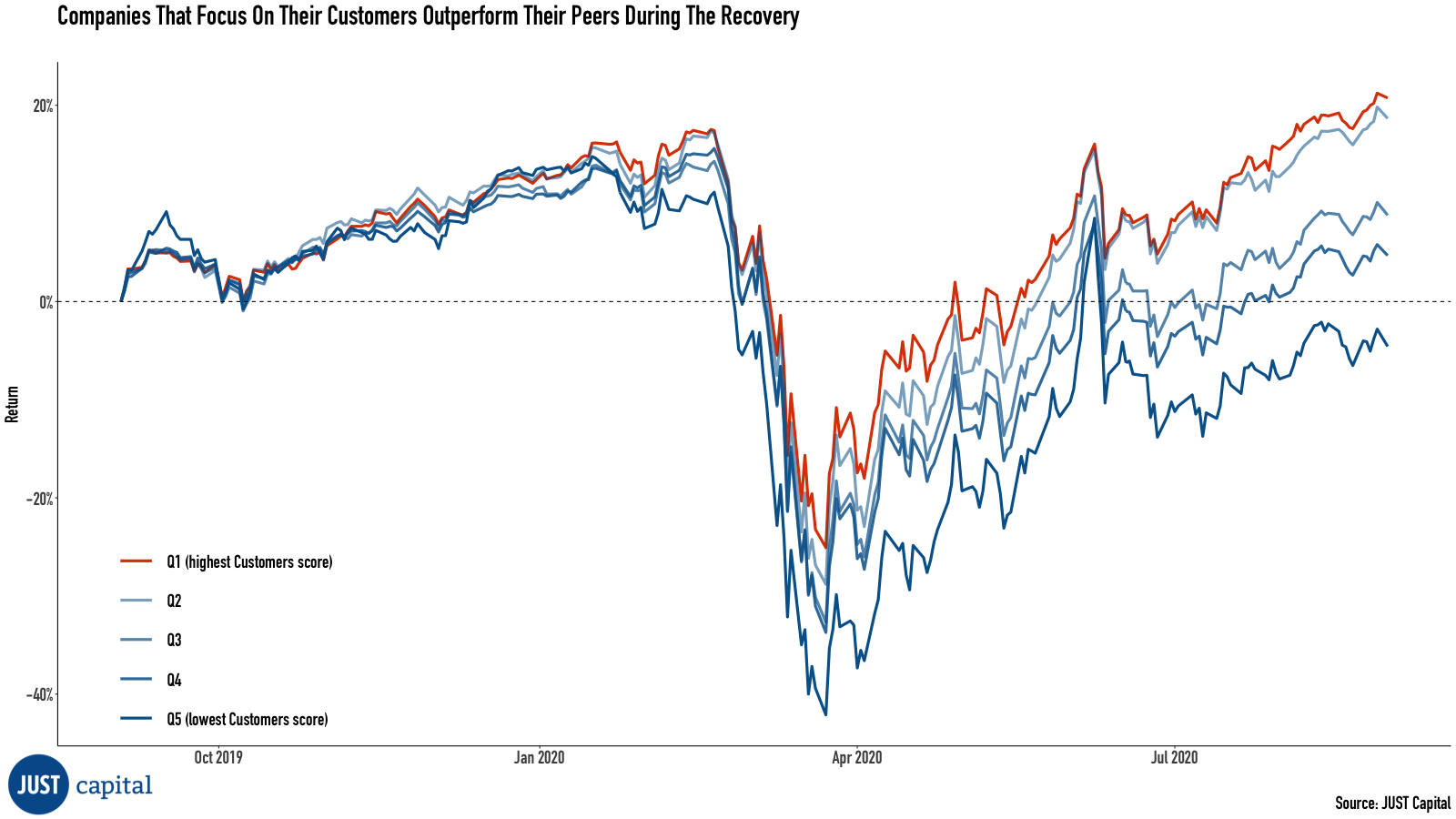
As an example of how a company can do well by its customers, we look at our third highest-weighted issue: whether or not a company protects a customer’s data privacy. With recent headlines around the TikTok US acquisition and how data privacy is becoming a national security issue, the importance of this issue continues to gain prominence. Apple, which ranked No. 1 on data privacy collection among the JUST 100, is continuing to link its brand to the issue, debuting a new set of privacy protections for customers this week in its iOS 14 update for iPhones. Apple is up 53.8% this year, driving a material portion of our first quintile, and its emphasis on customer privacy is an example of why the companies in that top quintile are generating significant alpha.
Protecting your customers’ information, embracing transparency with them, and making products with a social benefit build trust. And it’s ultimately brand loyalty that serves as the bedrock for generating long-term value, through ups and downs.
If you are interested in supporting our mission, we are happy to discuss data needs, index licensing, and other ways we can partner. Please reach out to our Director of Business Development, Charlie Mahoney, at cmahoney@justcapital.com to discuss how we can create a more JUST economy together.
If you have questions concerning the underlying analysis, please reach out to our Senior Manager for Quantitative Research, Steffen Bixby, PhD, at sbixby@justcapital.com.
On June 9th JUST Capital launched an updated version of the COVID-19 Corporate Response Tracker, now featuring data for 300 of America’s largest public employers (up from 100) across 20 dimensions of corporate action. Though the tracker grew by 200 companies, one of the most interesting trends we noticed was that overall rates of disclosure dropped in nearly every dimension.
To further unpack these shifts, we compared disclosure rates across the 20 dimensions between the original 100 largest and the newly added next 200 largest U.S. employers.*
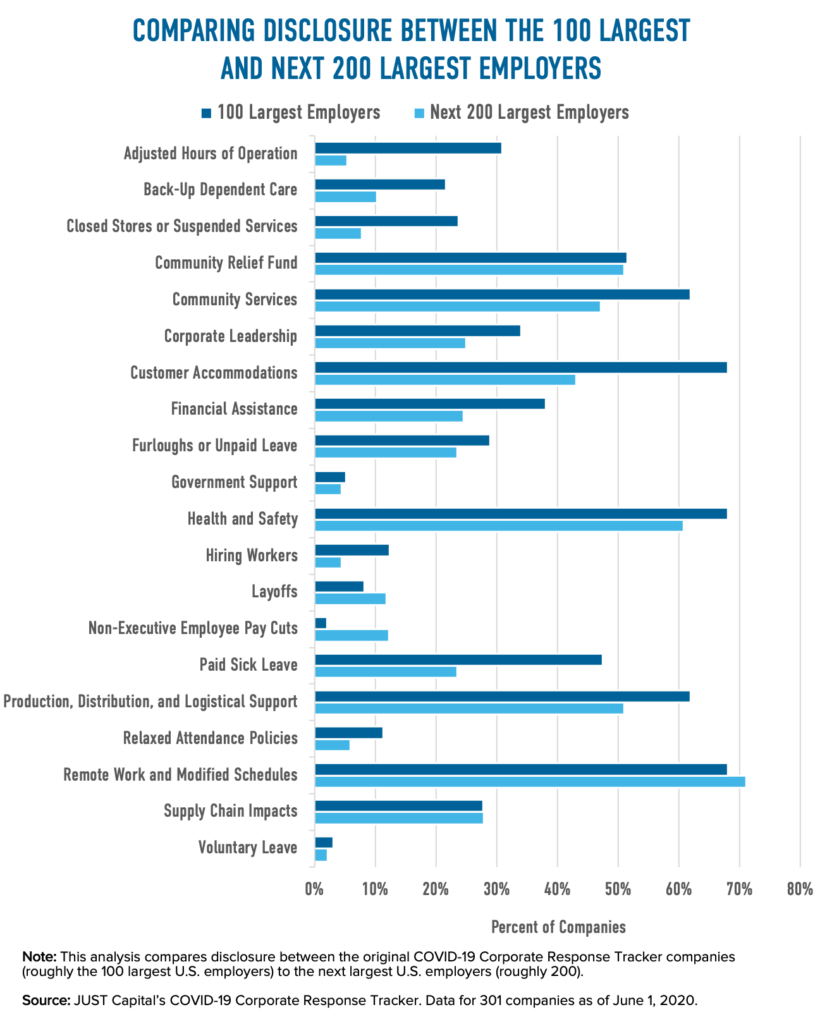
The findings are stark – larger employers appear to have a greater propensity to disclose positive actions in response to the pandemic, much as the top performers in our Rankings tend to be those with the most employees. For instance, the 100 largest employers are:
Conversely, the next 200 largest employers announce engaging in cost-cutting measures that disproportionately impact workers at a higher rate than their counterparts in the largest 100. The next 200 are 1.4 times more likely to lay off employees and 5.9 times more likely to cut pay for non-executive employees.
There are three notable exceptions. When it comes to donating cash to community relief efforts, enhancing health and safety protocols or providing workers with PPE, and permitting employees to work remotely (when possible) or modifying onsite work schedules, rates of disclosure are similar between the 100 largest and the next 200 largest U.S. employers.
So, what explains the differences in disclosure between the 100 largest and next 200 largest companies? One factor to consider is the date of collection. As time has passed since we first collected data in mid-March, some of the critical early measures that companies took to support their workers, customers, and communities – such as adjusted hours of operation, temporary store closures and service suspensions, and relaxed attendance policies – have phased out. It is possible that the newly added companies once took these actions and discontinued them as the pandemic progressed. A company’s national visibility or brand presence may play a role, as well, as less visible companies (oftentimes smaller) may dedicate fewer resources toward disclosing their actions. Yet another explanation for lower disclosure rates among the next 200 largest companies could be related to industry or business operations (e.g. there is a greater proportion of B-to-C companies among the 100 largest), and, relatedly, impacts on financial performance.
Most likely, a combination of these factors drive the discrepancies in disclosure between the 100 largest and next 201 largest companies. And as we enter the reopening phase of the COVID-19 crisis, we are likely to see companies continue to shift how they’re responding. We are continuing to track what businesses are doing – stay tuned for more updates and analysis in our Corporate Response Tracker and the 2021 Rankings this Fall.
*Note: In this piece, we use short-hand language to describe the “100,” “next 200,” and “300” largest U.S. employers. The Corporate Response Tracker, however, includes a total of 301 companies: 97 companies are part of the initial tracker, while 204 have been added during the tracker expansion. The rounded values help simplify discussion of the Tracker.
Over the past month, we have been tracking the market performance of companies that have prioritized their stakeholders throughout the COVID-19 crisis. We’ve generally seen that the stock prices of these companies excel in the market, and recently found that those that have been focusing specifically on their workers and customers during the crisis outperformed their peers over the last quarter.
Customers and workers comprise the “S” of ESG – the “social” impacts of sustainable investing – and it has never been more important than it is today that we see this “S” take center stage. We’ve seen a deepening interest in these issues from corporate and investment leaders alike, suggesting that, throughout and potentially following the coronavirus crisis, we might see greater focus placed on these two key stakeholders.
Over the last four years, JUST Capital has evaluated America’s largest public companies based on their performance across the issues Americans care about most, grouped into five stakeholders – workers, customers, communities, the environment, and shareholders – and published an annual Ranking based on this evaluation. In this uncertain time, stakeholder performance has never been more important, and we have been tracking how companies are supporting their stakeholders – including their workers and customers – throughout the crisis.
This week, we’re taking a look at our 2020 Rankings to see how companies that prioritized their customers and workers – the “S” in ESG – perform with regard to their other stakeholders. We constructed two sets of portfolios based on stakeholder scores: one for workers, and one for customers. For each stakeholder, we contrast the top 20% of each industry with the bottom 20%, and found that the top quintiles generally outperform the bottom quintiles with respect to all stakeholders.
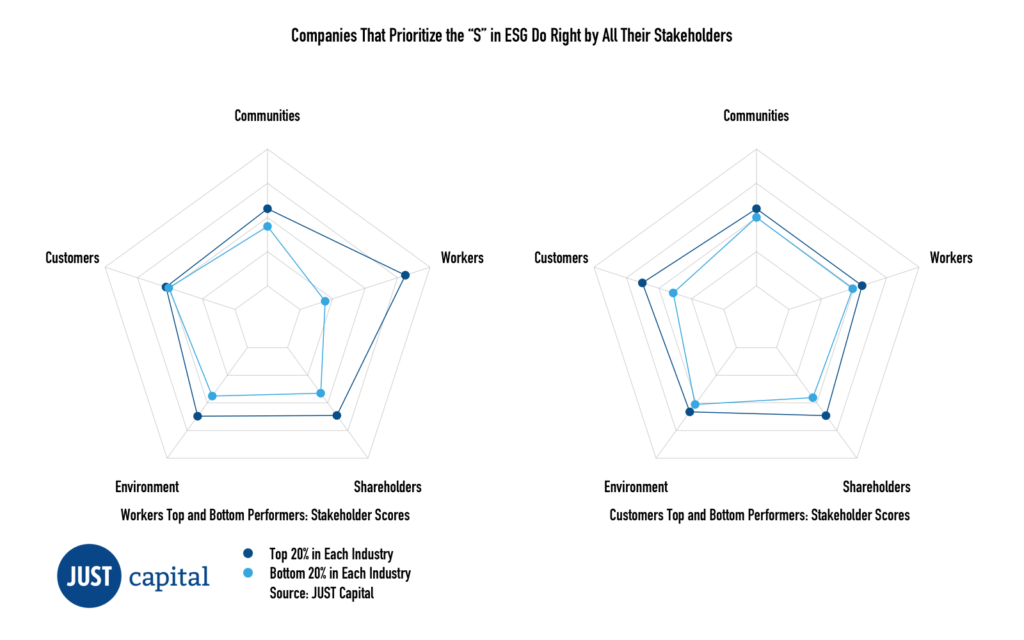
What this means is clear: the companies that prioritize the “S” in ESG also do right by their other stakeholders, their communities, the environment, and their shareholders. Hence, the question is not whether to prioritize one or two stakeholders over others, but whether to jointly maximize stakeholder returns.
As our 2019 survey showed, the American public’s trust in large companies dropped 11% – from 54% in 2018 to 48% in 2019 – leaving less than half the population trusting corporate America. By investing in workers and customers during the current crisis – from prioritizing employee health, safety, and pay to providing aid, relief, and support to customers – companies have the opportunity to win back the trust of the public. As we return to shop at stores, apply for jobs, and/or invest our savings, we can expect to see corporations that choose their people over profits, and customers over cut costs, rise to the top.
We’re continuing to analyze how companies are performing in the market, as well as for their stakeholders, throughout the COVID-19 crisis. Check out all our coverage here, and stay tuned for next week’s chart, which will take a look at the financial performance of the top companies for workers and customers.
If you are interested in supporting our mission, we are happy to discuss data needs, index licensing, and other ways we can partner. Please reach out to our Director of Business Development, Charlie Mahoney, at cmahoney@justcapital.com to discuss how we can create a more JUST economy together.
Last week we looked at whether the top-performing companies for Workers in our Rankings outperformed their peers in the first quarter of 2020 (they do), and this week we’re taking a similar look, but using data from our new COVID-19 Corporate Response Tracker.
The Tracker assesses how America’s 100 largest employers are responding to the COVID-19 pandemic across various dimensions, or “tags,” ranging from whether they provide PPE to employees, accommodate customer needs, and engage in direct community services such as food banks.
Here, we are taking a look at a subset of companies that are outstanding when it comes to how they have prioritized their workers and customers throughout the crisis.
Outstanding companies for workers (17 of 100) typically provide:
Lowe’s, with about 300,000 employees across the U.S., is a prime example from this group of companies. In addition to its engagement for communities and customers – as well as other key initiatives for workers – Lowe’s gave all hourly associates a special bonus, temporarily increased the wages of frontline workers by $2 an hour, and enhanced paid leave policies.
Outstanding companies for customers (18 of 100) make industry-specific concessions, such as:
An example from this group is Verizon, one of America’s largest providers of internet and wireless services. In addition to prioritizing its workers through the crisis, Verizon has waived billing charges for its low-income customers, is not terminating service of customers experiencing economic hardship, and offers more data free of charge to account for higher needs.
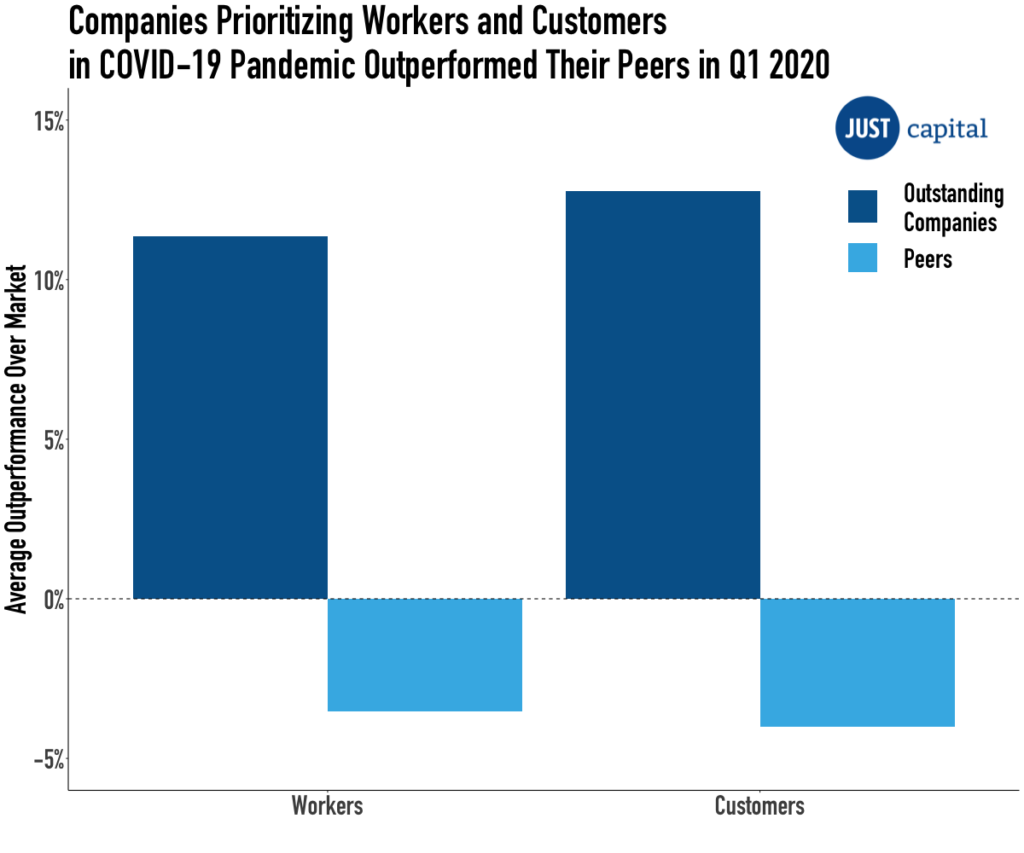
Looking at the market performance of these outstanding companies (above), we find that they outperformed the market in the first quarter of 2020, while the companies that put less emphasis on their workers and customers respectively underperformed. This relationship holds true when controlling for other variables such as industry and number of employees. It is important to note that it is too early to make claims about a causal relationship between market performance and a company’s response to the COVID-19 pandemic, but the relationship shown here is nevertheless encouraging.
We’re continuing to analyze how companies are performing in the market throughout the COVID-19 crisis. Check out all our coverage here, and stay tuned for next week’s chart.
