
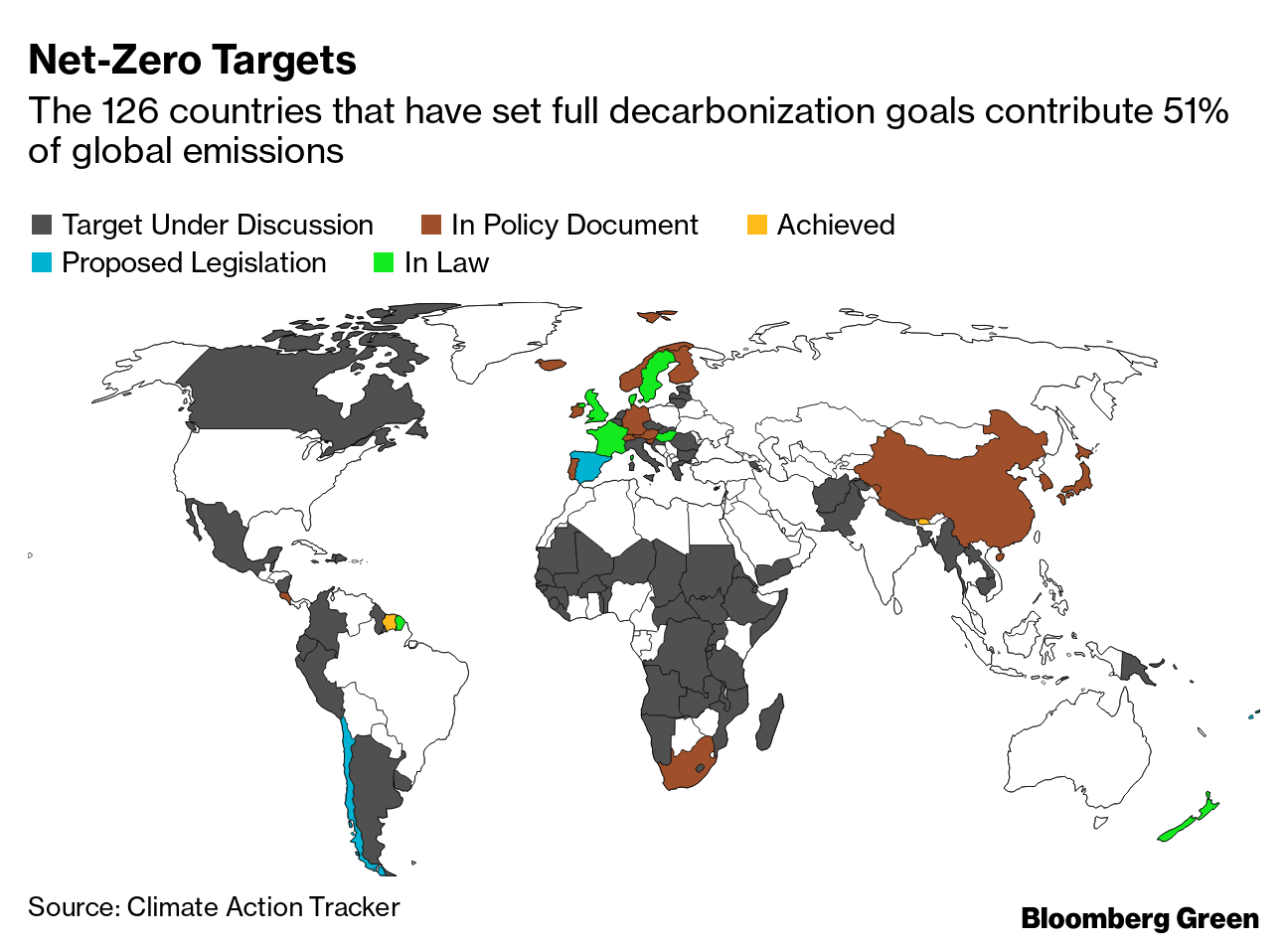
Last week was quite the rollercoaster for stakeholder capitalism (and the U.S. political landscape). First, on Wednesday, the United States officially left the United Nations Framework Convention on Climate Change’s Paris Agreement, further unraveling efforts to mitigate the climate crisis. Then, on Saturday, with Vice President Biden winning the 2020 presidential elections, this outlook changed completely. Biden vowed to rejoin the Paris Agreement and is aiming for net-zero emissions by 2050, joining a large group of countries, as shown in this graphic from Bloomberg Green:
Source: Bloomberg Green
As a result, companies increasingly face the prospect of needing to incorporate carbon emissions and emission reductions when doing internal cost-benefit analysis for new projects. The impact of this varies across industries and companies. Some actors such as Walmart have already pledged to reduce their carbon emissions to net zero by 2040, ahead of the expected plan of president-elect Biden. Others will need to catch up and face an uphill battle against better positioned competitors.
Irrespective of the carbon policies of the new administration and the inherent carbon-related business risks, reducing a company’s carbon emissions is a win-win for both the environment and its shareholders. As we have demonstrated in a previous Chart of the Week, companies with lower carbon emission intensity outperform their peers in the stock market. With the results of the presidential election in mind, we expect this effect to be even stronger in the future. As a result, action against climate change becomes increasingly important for companies.
If you are interested in supporting our mission, we are happy to discuss data needs, index licensing, and other ways we can partner. Please reach out to our Director of Business Development, Charlie Mahoney, at cmahoney@justcapital.com to discuss how we can create a more JUST economy together.
If you have questions concerning the underlying analysis, please reach out to our Senior Manager for Quantitative Research, Steffen Bixby, PhD, at sbixby@justcapital.com.
As the UN Climate Change Conference – COP 25 – comes to a close this week, we’ve taken a look at the companies we rank that have taken the lead on mitigating climate risk in their operations – those that are walking the walk, in addition to talking the talk, around addressing the issues at the forefront of the conference.
In a session on December 2, House Speaker Nancy Pelosi announced that the U.S. is still part of the Paris Agreement, despite President Trump giving the UN formal notice of withdrawal from the pact in November. Despite the conflicting views and lack of executive leadership in Washington, private sectors are stepping up and have pledged to fill the gap, led by 2860 signatories in the We Are Still In coalition.
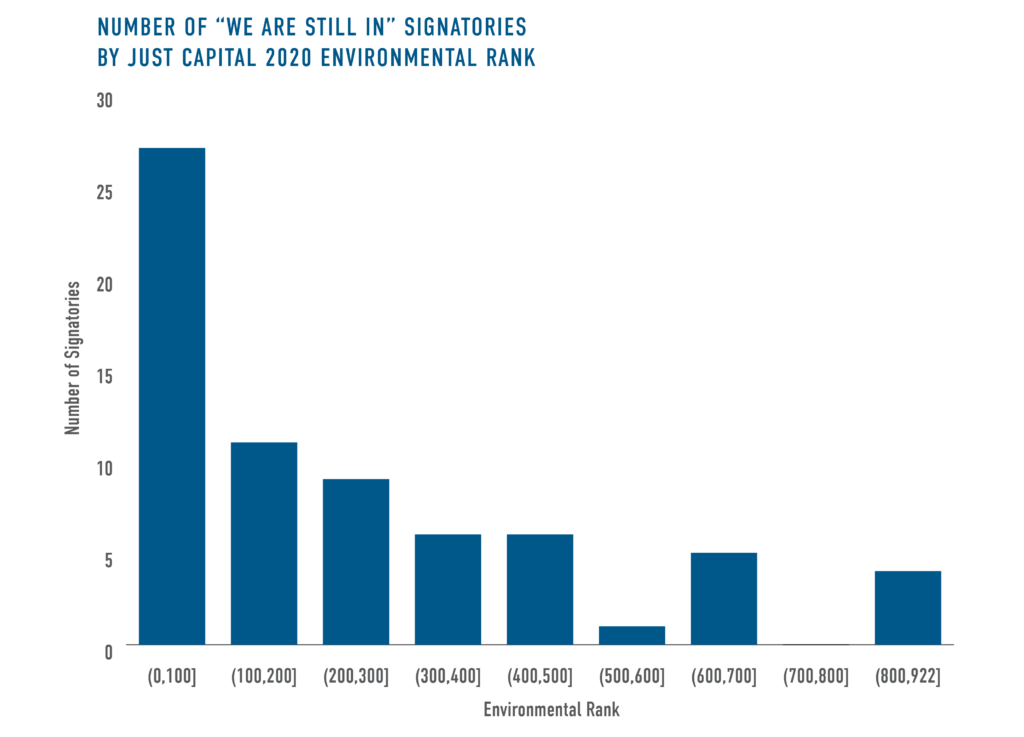
Of the 925 large-cap companies we rank, 69 are part of the coalition. These companies demonstrate mature climate risk management capabilities – including environmental policies, concrete, measurable targets, and disclosure of progress toward their goals.
Close to 40% of these 69 companies ranked in the top 100 for the Environment this year, based on their efforts to protect the environment, minimize pollution, and make efficient use of resources.
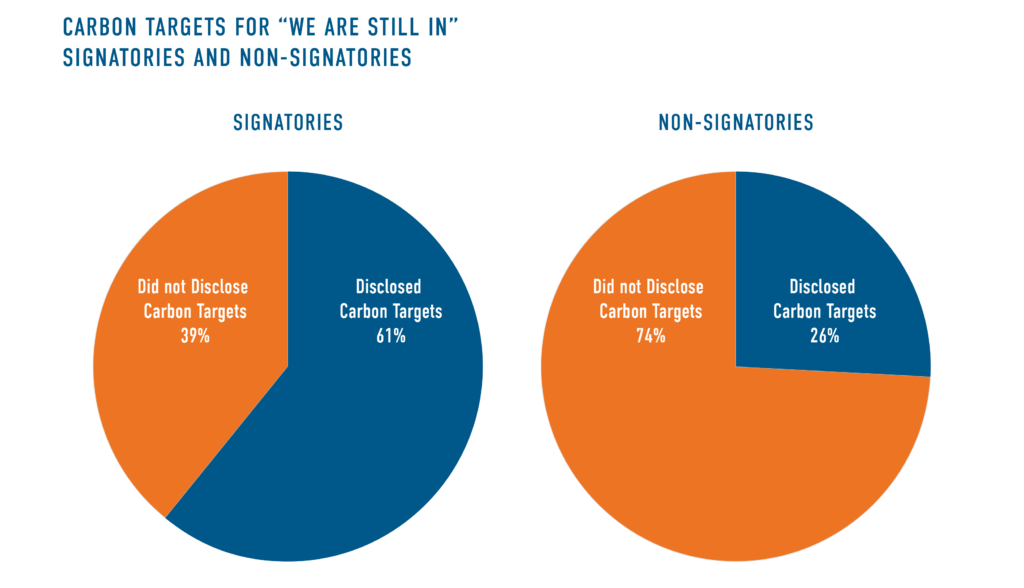
When it comes to carbon targets specifically, we found that 61% of these signatory companies we rank have set quantitative targets with a clear timeline to cut their emissions, while only 26% of other companies we rank have set such targets.
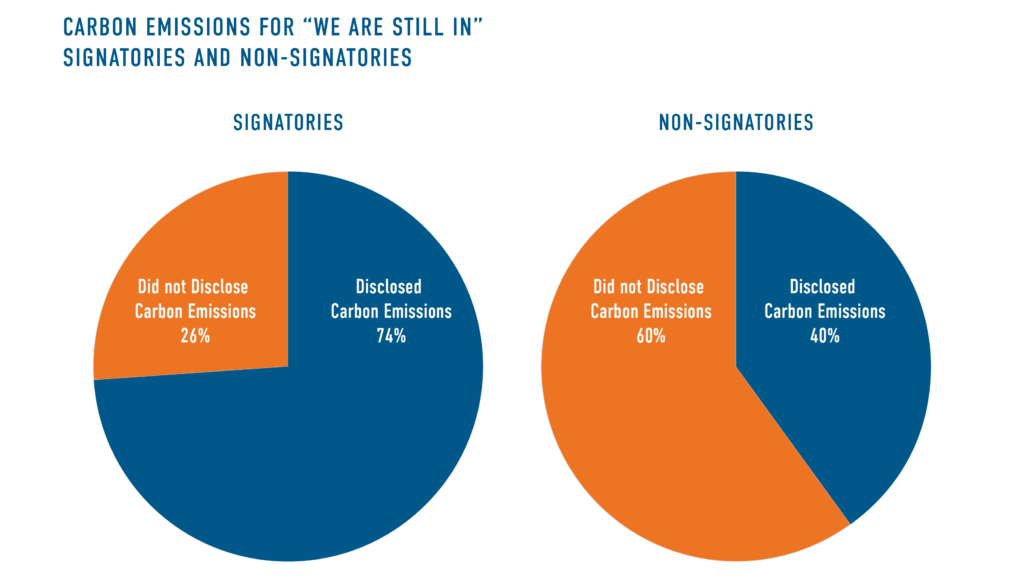
74% of these companies report their carbon emissions publicly, whereas 40% of other companies we rank do so – clearly showing a greater commitment to disclosure, transparency, and improvement in these areas among signatory companies.
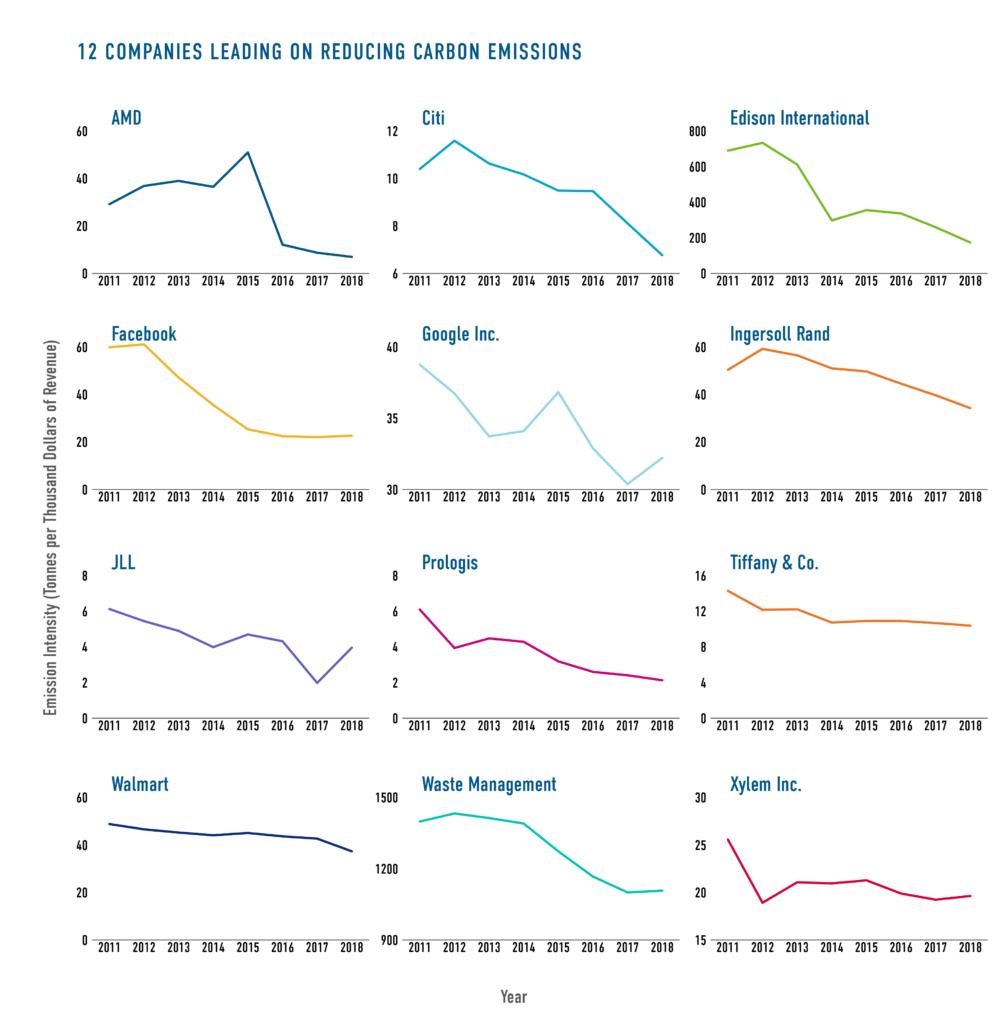
For example, Advanced Micro Devices – one of the signatories that we rank – has committed to a 2020 goal of improving its mobile processors’ performance per watt by 25 times, and requires its suppliers to use 40% less electricity than the industry average. This target has been recognized by the Science Based Targets initiative.
Edison International is also a leader on environmental issues. As a public utility holding company based in California – the parent company to Southern California Edison – Edison International has a relatively high carbon intensity, and pledged to reduce greenhouse gas emissions by 40% from 1990 levels by 2030, and by 80% by 2050 through electrification, turning to low-carbon fuels and modernizing its grid.
Among these 69 companies, we identified 12 that have demonstrated consistent efforts and made progress toward forging a low-carbon future. Facebook, JLL, Citi, Tiffany, Walmart, and others have worked to lower their carbon emissions – investing in clean energy or energy efficiency improvement projects – while also striving to grow their businesses and deliver value for their stakeholders. Over a seven-year time span, these 12 companies across different industries have reduced their emissions intensity between 17% and 76%, a clear effort to transition to a more environmentally just future.
As companies like these shift from a model of shareholder capitalism toward one that addresses the needs of all stakeholders – including the environment – JUST Capital will continue to track the work they are undertaking to improve their practices, policies, and goals.
This post includes analysis conducted by Steffen Bixby, JUST Capital Manager of Data Modeling & Environment.
No matter your political leaning, Rachel Carson’s famous words ring true: “In nature, nothing exists alone.”
This year’s Earth Day tackles how we can keep these words in mind, and protect the rich biodiversity of our planet while contemplating the ways that individuals and institutions can better mitigate their impacts on the environment.
At JUST Capital, we’ve surveyed more than 81,000 Americans over the past four years, to better understand what matters most to them when it comes to just business behavior. And when asked about the state of business today, 57% of respondents said that companies have a negative impact on the environment, while a much smaller proportion – only 38% – believe that companies have a positive impact.
Americans agree that the environment should be a priority for companies, but that corporate behavior is clearly not measuring up. The good news is that, despite this middling perception, our analysis shows that there are a number of companies across sectors working to build a more sustainable future.
These companies – the top environmental performers in the 33 industries we track and analyze in our Rankings – are not only reducing their impact on the environment, but are overall more just companies. They align with many of the public’s priorities – including worker well-being, community support, and customer treatment – and score highly in the JUST Capital Rankings:

Further, environmental leadership is correlated with higher profitability – with Industry Environmental Leaders earning a higher median Return-on-Equity than their peers:

This confirms that, as we’ve shown in the past, leadership on these core issues is not just good for the environment, it’s good for business. While corporate America still has a long way to go in mitigating its environmental impacts, we want to take this opportunity to celebrate the companies that – regardless of their industry – are taking responsibility for their place in nature through actions that protect, rather than harm, the environment.
Here are some of the concrete actions these companies – in order of their overall JUST Capital rank – are taking:
#1 Microsoft – Software
Since 2012, Microsoft’s global operations have been 100% net carbon neutral. The company charges a “carbon fee” to all business groups for their carbon footprint, and invests the fees collected in its carbon reduction initiatives.
#2 Intel – Semiconductors & Equipment
Intel believes that employee engagement is essential to reaching the company’s environmental goals, and since 2008, has tied a portion of each employee’s compensation to corporate sustainability metrics.
#3 Alphabet – Internet
Since 2016, Google has been using AI systems to manage cooling at its 15 data centers, saving up to 40% of energy. Data centers account for 2% of global greenhouse emissions – about the same as air travel.
#5 International Business Machines – Computer Services
In 2017, IBM purchased 22.9% of its electricity from renewable sources, exceeding its 2020 goal of 20% by 2020, and well on its way to the company’s 2025 goal of 55%.
#12 Accenture – Commercial Support Service
In December, Accenture announced that it would aim to reduce its greenhouse gas emissions 11% by 2025, against its 2016 baseline – the largest professional services company to make this type of commitment.
#13 AT&T – Telecommunications
By 2020, AT&T aims to reduce all greenhouse gas emissions by 20% from its 2008 baseline – and as of 2017, the company had already reduced its emissions by 22.6%, ahead of its target.
#14 General Motors – Automobiles & Parts
GM aspires to reduce its carbon footprint – 77% of which is represented by its global vehicle fleet – to zero, and toward that goal plans to introduce 20 new zero-emissions vehicles to global markets by 2023.
#15 General Mills – Food, Beverage, & Tobacco
General Mills tracks the sustainable sourcing of 10 priority ingredients, including palm oil, dairy milk, and sugar beets, aiming to sustainably source 100% of these ingredients by 2020 – and achieving 85% in 2018.
#16 Apple – Technology Hardware
Apple sourced 100% of the electricity used at all its facilities in 2018 from renewable sources, and in 2017, 22 of Apple’s supplier facilities were certified as Zero Waste, including all iPhone final assembly sites.
#18 ResMed – Health Care Equipment & Services
In its manufacturing operations, Resmed reduced its energy intensity by 26.7% in 2017, attributing improvements to new lean process equipments such as robot demoulders and conveying systems that deliver higher productivity.
#19 Biogen – Pharmaceuticals & Biotech
By 2020, Biogen aims to reduce GHG intensity of operations by 80% from its 2006 baseline, and had already at a 72% reduction in 2015.
#20 United Parcel Service – Transportation
In 2017, UPS decreased greenhouse gas emissions of ground operations by 0.6%, and aims to reduce emissions by 12% by 2025 – a significant challenge in light of growing e-commerce. As part of its Global Forestry Initiative, UPS planted 2.8 million trees from 2016 to 2017.
#21 Keysight Technologies – Industrial Goods
In 2017, Keysight recycled 75% – 1,627 metric tons – of its waste in 2017, and offers a take-back a recycling program for electrical and electronic equipment.
#22 S&P Global – Consumer & Diversified Finance
Global employees at S&P work to save energy and water, reduce waste, and benefit communities, and 12 employee-led Green Teams support environmental targets and help lead on-site and community initiatives.
#24 Prudential Financial – Insurance
Prudential has developed opportunities to mitigate climate change in a range of asset classes, including renewable energy, “green” bonds, and “green” real estate. Its renewables portfolio market value increased by almost 13% from 2016 to 2017.
#25 Clorox – Personal Products
Clorox is committed to ensuring that more than 90% of its product packaging is recyclable, making sustainability improvements to half of its global product portfolio, and eliminating PVC in all packaging.
#40 Nielsen Holdings – Media
Nielsen has established several programs around eliminating waste from its operations – including a 2020 goal to ensure that none of its global e-waste is sent to landfills, and a “No Print” initiative in its offices that has saved over 70,000 sheets of paper.
#47 ConocoPhillips – Oil & Gas
In 2013, ConocoPhillips established a 5-year Biodiversity Action Plan to minimize long-term environmental risks – including technological innovations that reduce the equipment, roadways, and pipelines required to complete projects.
#52 Northrop Grumman – Aerospace & Defense
Environmental sustainability is one of the Northrop Grumman’s performance metrics for executive compensation, holding company leaders accountable for achievement of sustainability goals.
#78 Bank of New York Mellon – Capital Markets
In 2017, Bank of New York Mellon diverted nearly 73% of solid waste from landfills, reused or recycled 35,682 technology devices, and recycled 3,088 printers.
#80 Cummins – Commercial Vehicles & Machinery
Cummins works with its customers to improve the efficiency of its products – achieving an annual run-rate reduction of 3.4 million metric tons of CO2, approximately 97% of its 2020 goal to reduce by 3.5 million.
#101 PVH Corp – Household Goods & Apparel
Approximately 70% of PVH Corps on-product packaging – such as stickers, hangtags, and tissue paper – is recyclable, and in 2017, the company recycled 10,000 metric tons, or about 90%, of its solid waste.
#111 JPMorgan Chase & Co – Banks
JPMorgan Chase aims to source 100% of its global power needs from renewable energy by 2020, and is committed to facilitating $200 billion in clean financing by 2025. Having already provided over $100 billion, it is already halfway toward achieving this goal.
#119 Avery Dennison – Chemicals
Avery Dennison has committed to lowering absolute emissions by a minimum of 3% annually (at least 26% in total), based on The 3% Solution developed by World Wildlife Fund, along with the CDP and McKinsey & Company.
#137 Cardinal Health – Food & Drug Retailers
Cardinal Health has invested in waste water recovery, collecting rainwater from site roofs to use for air cooling, bathrooms, and irrigation. In 2017, the company recycled more than 250 million gallons (20% of total water consumption) at its facilities.
#144 Kohls Corp – Retail
Kohl’s is committed to renewable energy use, with Many of its stores deriving up to 50% of their energy from solar power. The company hosts 200,000 solar panels on 161 rooftops, as well as two wind turbines at one of its distribution centers.
#154 Vectren – Utilities
Vectren is working to transition its electric generation portfolio away from nearly total reliance on coal to a diversified portfolio that includes natural gas and renewable energy – drawn in part from solar projects that will serve more than 11,000 households each year.
#226 Domtar Corporation – Basic Resources
At Domtar’s pulp and paper mills, the company has seen an 18% reduction in GHGs since 2010, a 36% reduction in waste to landfill since 2013, and has utilized 74% of its byproducts for beneficial purposes (compared to the industry average of 47%).
#274 Schlumberger – Energy Equipment & Services
Schlumberger employees have initiated and participated in projects worldwide that have helped reduce environmental impact – including safe recycling of lithium batteries, tree planting initiatives, and waste reduction in facilities in Gabon and Libya.
#277 Aptargroup – Building Materials & Packaging
In 2015, Aptargroup launched its Landfill Free Certification Program, which requires its sites to prove, through a third-party audit, reuse or recycle of at least 90% of operational waste. 46% of the company’s sites were certified in 2017.
#361 Quest Diagnostics – Health Care Providers
In 2017, Quest Diagnostics set an ambitious new management goal to improve its environmental data collection efforts at its various sites and facilities, allowing the company to better track its local and broad impacts in the coming years.
#415 Wyndham Destinations – Restaurants & Leisure
Wyndham Destinations has set a 2025 goal to reduce carbon emissions by 40% and water consumption by 25% compared to its 2010 baseline – having already reduced them by 31% and 22%, respectively.
#557 Vornado Realty Trust – Real Estate
Vornado has set a goal to certify all in-service office properties as green buildings, and as of 2018, had done so for 91% of its properties.
This article was originally published at Forbes.com.
