
Prioritizing Work-Life Balance through Flexible Hours, Day Care, and PTO
Work today is changing so quickly it can be dizzying. I have a poster made about 40 years ago that breaks out the 24 hour day – eight hours for work, eight hours for sleep, eight hours for leisure and family. Today, that concept is laughable. We’re always available to our employers – responding to emails when we first wake up, when we’re making dinner, during kids’ bathtimes. In lower-income jobs, many have to work two or more jobs to keep up. And we’re often struggling with childcare and building more time for our family and friends.
And as a result, we’re increasingly experiencing workplace burnout – which the World Health Organization recently named as a syndrome and occupational phenomenon in its 11th International Classification of Diseases.
Caused by long-term, unresolved, workplace stress, occupational burnout can lead to exhaustion, reduced professional efficiency, and serious illness. And with 11% of U.S. employees working 50 hours or more per week – and the psychological and physical problems faced by burned-out employees costing an estimated $125 to $190 billion per year in healthcare spending in the U.S. – the issue poses a serious problem in corporate America today.
The public agrees – and in our 2018 Survey, let us know that good benefits (including paid time off) and work-life balance (including flexible working hours and daycare services) must be top priorities for companies. Fostering worker well-being is essential to being a just company, and happier workers are in fact more productive, better able to support the companies they work for and bring their full selves to work.
With worker issues overall identified as a top priority by the public, we looked at how the largest, publicly traded U.S. companies measure up on nine key workplace policies that support employee well-being – including whether they disclose policies on flexible working hours, daycare services, and paid time off – with the hope of better understanding the state of corporate America today, and creating a playbook for how companies can improve. Here’s what we found:
Flexible Working Hours
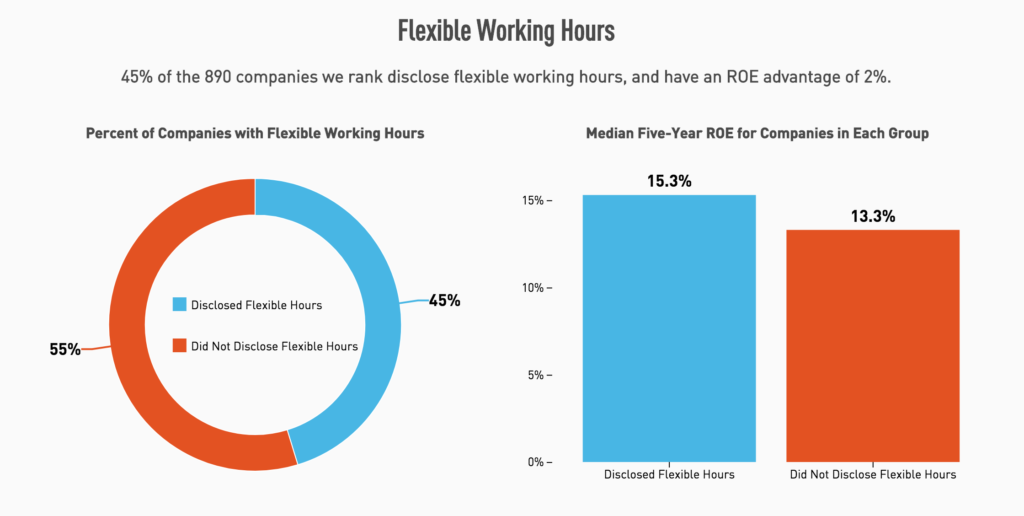
This week, Bill Gates proposed that, in order to attract the best talent, providing flexible work options is a necessity. And with up to 90% of the U.S. workforce saying they want to telework at least part time, it’s clear Americans expect this benefit more and more. Especially valuable for working parents and caregivers, flexible working hours policies are disclosed by 45% of the companies we ranked in 2018. And they provided a win not only for employees, but for the bottom line as well: the companies offering flexible working hours had an ROE advantage 2 percentage points above their peers.
Day Care Services
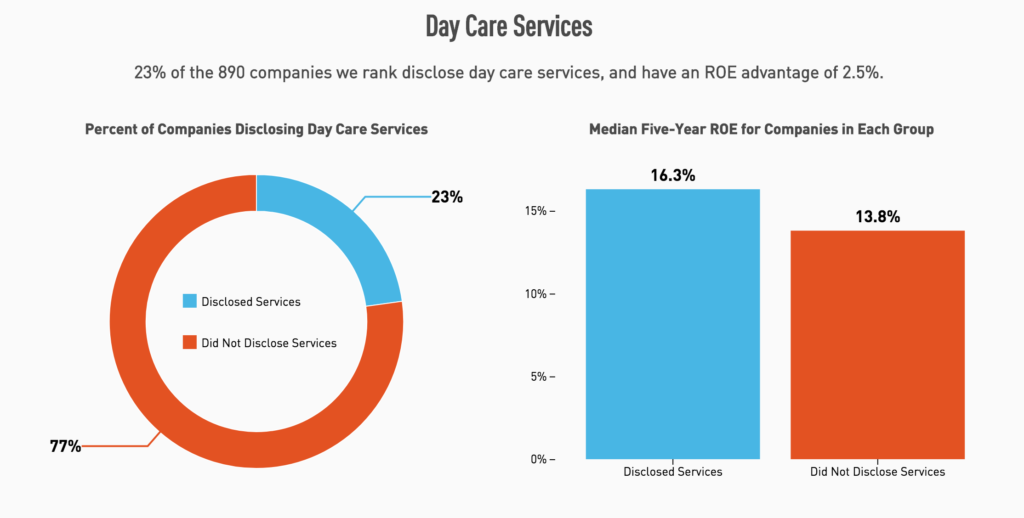
Also of obvious value to working parents is the provision of day care services, which enable employees to balance the demands of their home life with the demands of their career, and more easily return to work after the birth of a child. We found that just 23% of companies disclose that they offer supplementary or backup day care services, but the win-win again can be clear: the companies that offer this benefit to employees had an ROE 2.5 percentage points higher than the companies that did not.
Paid Time Off
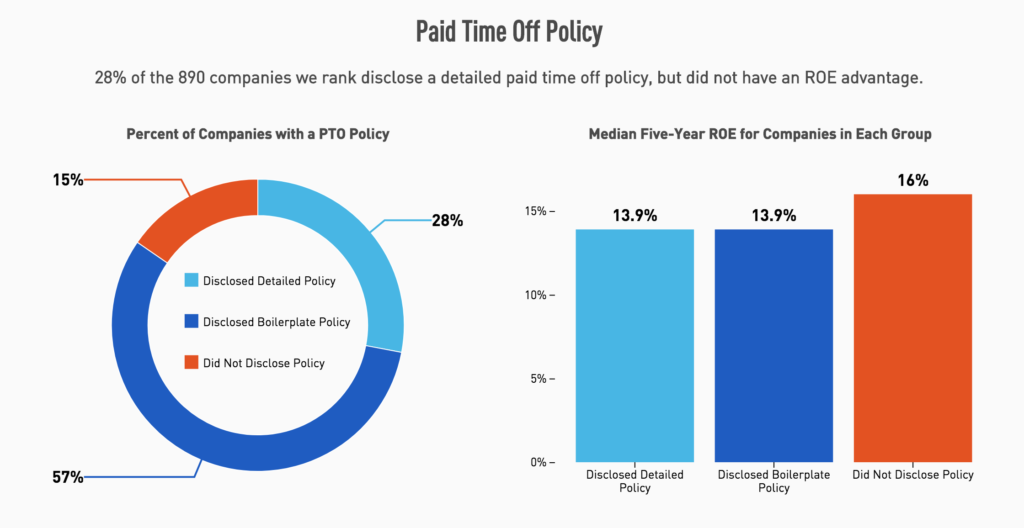
PTO as well provides an essential tool for employees to find balance as prioritize their personal needs, and while 85% of companies disclosed that they offer PTO, only 28% shared detailed information around their policies. This suggests that paid time off is quite standard in corporate America, but there seems to be a reticence to publish the specific benefits offered to employees. Of all the workplace policies we analyzed, this is the only one that did not correlate with an ROE advantage.
We often think of work-life balance as a focus primarily offered in the tech industry, but our research showed that companies across sectors are taking the lead. In Consumer/Diversified Finance, 60% credit card companies – like Capital One and Moody’s – offer day care services, while 88% of Telecommunications companies – like AT&T and Verizon – provide flexible work options. Perhaps surprisingly, 33% of companies in the Restaurants & Leisure sector – including Starbucks and McDonald’s – disclose the details of their paid time off policies, above the average disclosure of 28%.
Workplace burnout is a problem faced by employees across the country – and the impacts are most keenly felt by women and people of color, who typically have lower salaries and less decision-making power, alongside greater caregiving responsibilities and fewer resources. There’s much work to be done in corporate America to create workplace cultures that both prevent and help manage burnout – and in strengthening core work-life balance policies, companies can help curb the impacts affecting Americans today.
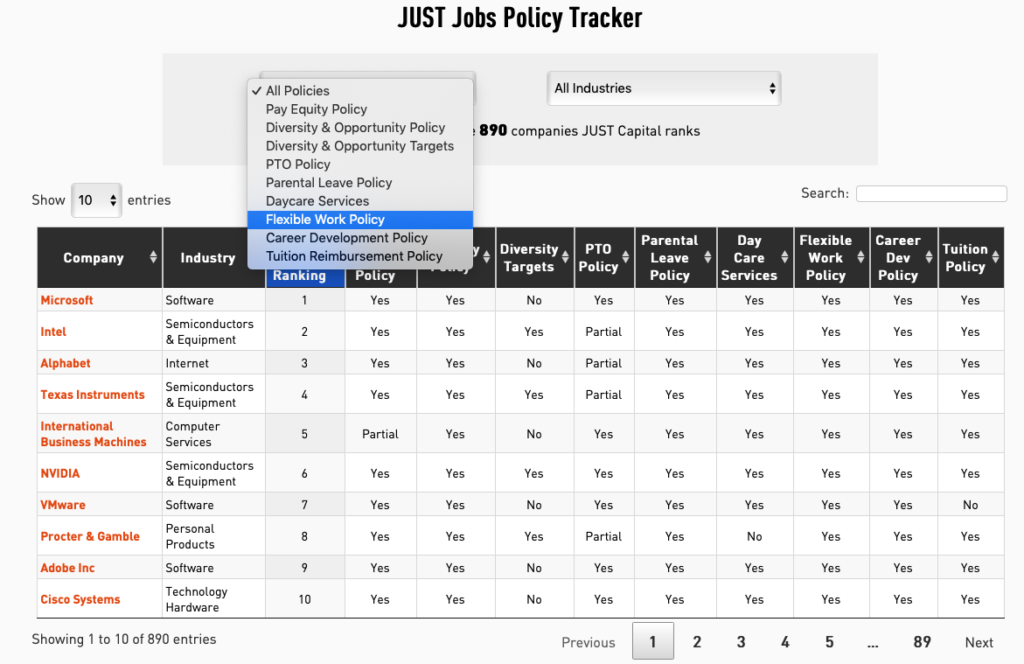
To explore the data and links to all the relevant policies at the 890 companies we analyze, visit the JUST Jobs Policy Tracker, and select any issue and industry from the pull-down menu.
In today’s tight labor market, companies are facing high turnover and fierce competition. Across industries, benefits like paid parental leave and career development are becoming more commonplace as companies work to attract and retain talent, as well as reskill employees for an increasingly automated workplace.
Employers are investing in their workers in new and significant ways, and in recent years, more companies are offering tuition reimbursement and other education assistance programs. And with about 60% of the entire civilian labor force without a Bachelor’s degree as of 2018, this offering has the potential to transform the lives of workers across the U.S.
According to our recent JUST Jobs analysis on company disclosure related to nine key worker issues, about two-thirds of the largest, publicly traded U.S. companies offer tuition reimbursement to their employees. And, good news – those disclosing a tuition reimbursement policy also generate an ROE advantage 1.2 percentage points higher than their peers.
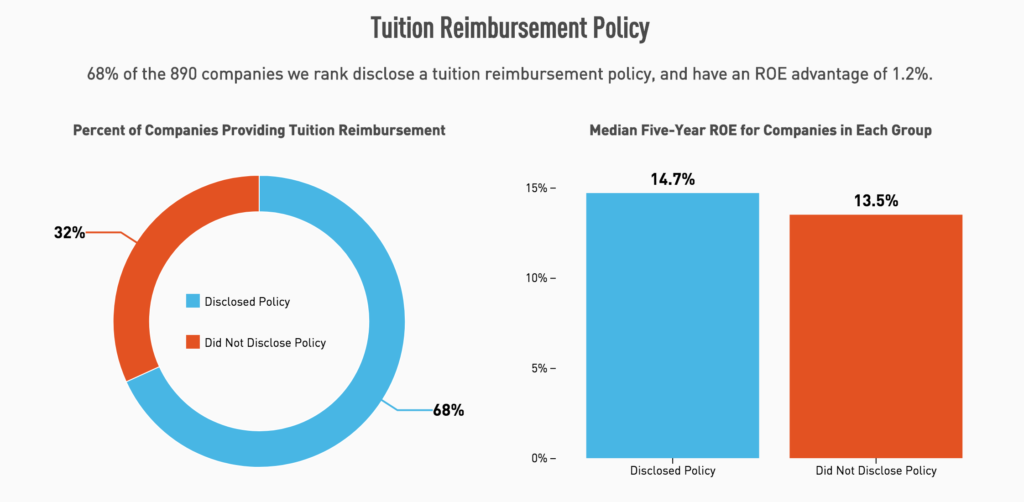
While the majority of companies offer tuition reimbursement to their employees, this benefit might not always reach the workers who really need it – like those on the front lines of traditionally lower wage industries such as retail and restaurants. In 2018, 86% of workers earning at or below the federal minimum wage did not have a Bachelor’s degree – typically an entrance requirement for higher paying jobs.
In these industries, we’ve found that, interestingly, higher proportions of companies offer tuition reimbursement – with 78% of Food & Drug Retailers and 73% of Restaurants & Leisure companies disclosing tuition reimbursement (while Retail lags behind at 59%).
However, tuition reimbursement might not ultimately reach the cashiers, servers, call center workers, and store associates earning lower wages on the front lines. Companies like Macy’s, Domino’s, and Dunkin’ Brands offer education assistance only to their corporate staff, excluding front-line workers and hourly associates. Arguably, front-line workers could benefit significantly from tuition reimbursement, gaining access to higher wages and greater economic mobility.
Still, there is a handful of leaders – including Walmart, Starbucks, and H&R Block – ensuring that tuition reimbursement is available to all workers, extending the benefit beyond its headquarters, salaried, and corporate staff. The restaurant industry, especially – faced with the highest quit rates since 2001 – has stepped up to provide better benefits and career opportunities to its workers. Last year, for example, McDonald’s announced an initiative – following its windfall from the Tax Cut & Jobs Act – that it would allocate $150 million over five years toward providing almost 400,000 U.S. restaurant employees with accessibility to its education program.
Companies that invest in the education of their workforce are likely to see employees stay longer and move into senior positions more frequently. And as corporate America moves toward automation and the future of work, employers are seeking out more skilled employees. By investing in education, companies can foster the skills they need in their own workforce, focusing on retention and alleviating the high costs of replacing or hiring workers.
With our research showing that tuition reimbursement correlates with a return on investment, it’s clear that programs like this can create a win-win for companies and employees alike – both upskilling workers and improving the bottom line. And for companies in low wage industries especially, investments in better benefits and higher wages have the potential to influence not only their workers’ well-being and their company’s performance, but the overall course of income inequality in our country.
In the coming year, we will continue to track what companies offer around this and other core worker benefits – in an effort to better understand both the state of just business behavior and its impact on American workers today.
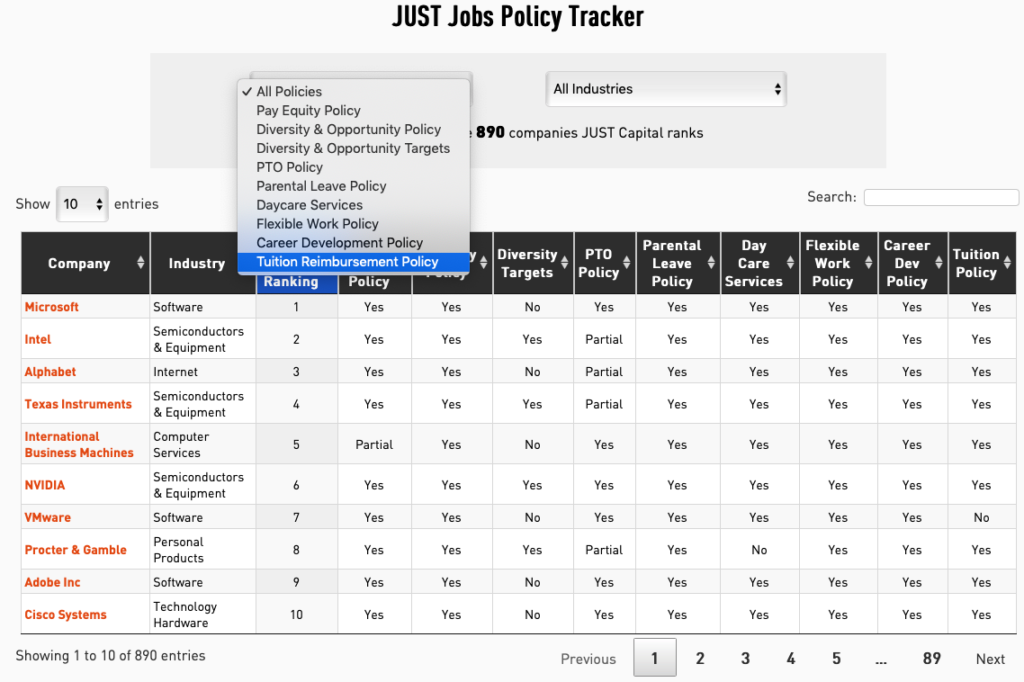
To explore the data and links to all the relevant policies at the 890 companies we analyze, visit the JUST Jobs Policy Tracker, and select “Tuition Reimbursement” from the pull down menu.
Last week, Amazon announced that it would launch a massive new retraining program, committing $700 million over six years toward retraining about a third of its staff – from headquarters staff to warehouse workers – to transition to more high-tech jobs.
Globally, companies spend over $200 billion annually on training programs, with about $141 billion of that coming from U.S. employers. Companies like JP Morgan Chase, AT&T, Walmart, and Accenture have all recently committed significant resources toward training initiatives. And we hope to continue to see more investments on this scale in the months and years to come.
While economists and policy-makers continue to debate the jobs impact of automation and A.I., it is clear that many business leaders are moving forward with plans to retrain their workforces and are encouraging others to do the same. IBM CEO Ginni Rommety, for example, has spoken out in the media and before Congress about the training needs that coincide with the rise of A.I., stating “our challenge as a society isn’t about A.I. replacing jobs—it’s about people and skills.”
For decades employers have utilized training programs to meet their workforce needs. Yet, as structures of work continue to change, and new technologies emerge companies face a renewed responsibility to ensure their workforces have access to training throughout their careers. These changes are fueling businesses’ adoption and expansion of long-standing training strategies, such as apprenticeships, across industries including the tech sector.
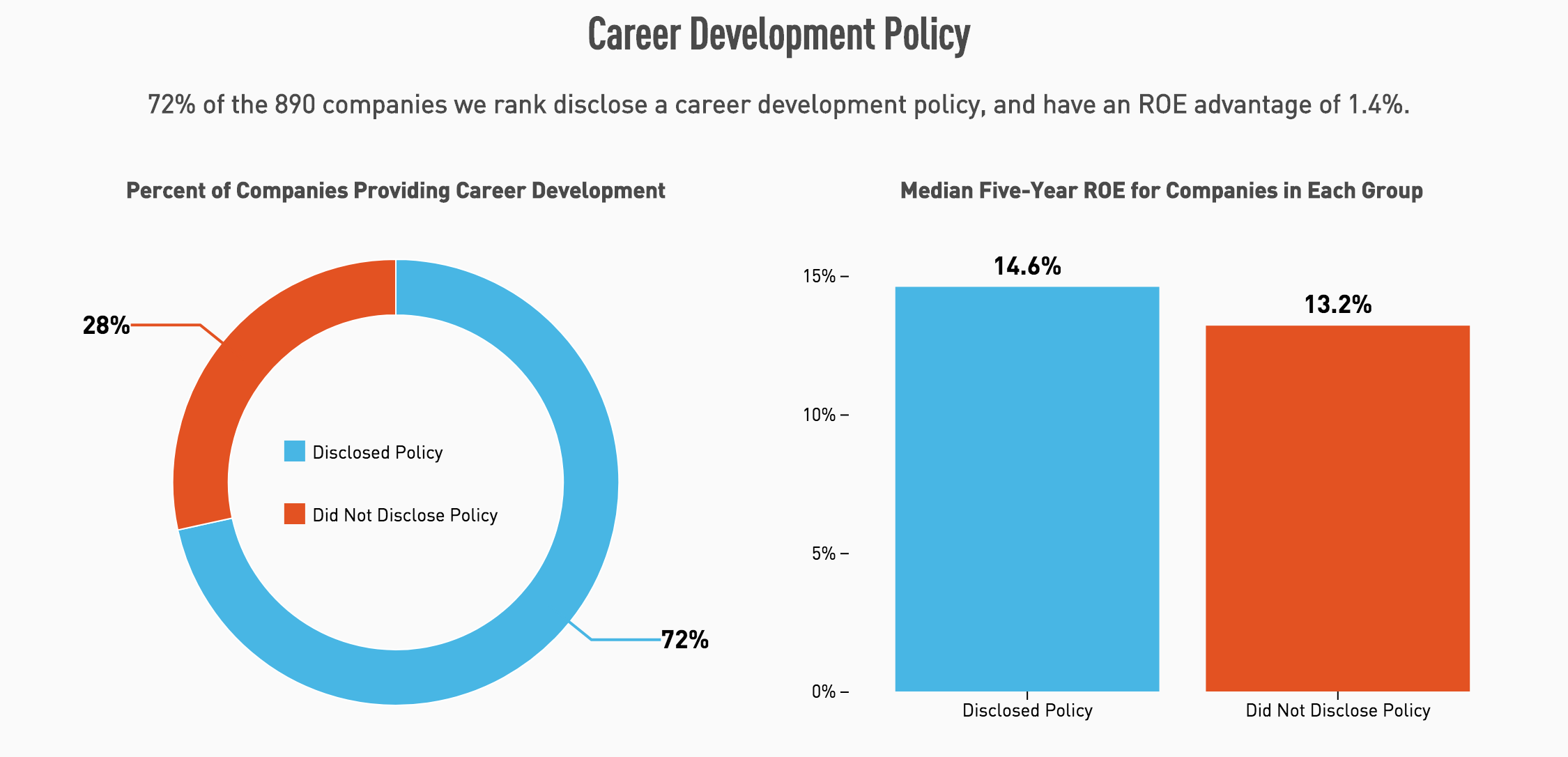
In our recent analysis of human capital disclosure at the largest, publicly traded U.S. companies – the Win-Win of JUST Jobs – we analyzed what companies disclosed on nine core worker policies, including career development and training.
What we found is that 72% of companies disclosed that they offer career development – and what’s more, those companies boast an ROE advantage 1.4 percentage points higher than their peers, showing that skills training is not just a win for workers, but a win for companies.
While the benefits of training programs are clear, companies still face myriad challenges and stumbling blocks when implementing reskilling programs. It’s difficult and costly for employers to map the skills of their current workers and identify what they need, and layoffs remain par for the course as training strategies are often not shared across all levels of a company. Training also can be lengthy and cumbersome for employees, and it’s difficult for employers to measure the impact, not only against employee experience but company productivity and success in the market.
Moreover, these types of training don’t exist in a vacuum and must reinforce other just business practices like paying a living wage, as well as programs that support worker safety and well-being. While Amazon’s retraining initiative signals an important investment for its low-wage workers, the company has continued to come under fire for its working conditions and pay practices. Just this week, Prime Day sparked a wave of demonstrations in Minnesota, New York, Seattle, San Francisco, as well as in Europe.
In all of this, transparency is key. The more companies disclose their career development programs and investments, the better poised we are to help evaluate the impacts of these initiatives on the American workforce. In the coming year, we will continue to push for disclosure on this and other core worker policies, as we track how companies are responding to and preparing for the future of work. No matter what, as Rometty said, we must create “a culture of lifelong learning” – preparing workers for an ever-shifting technological landscape at work.
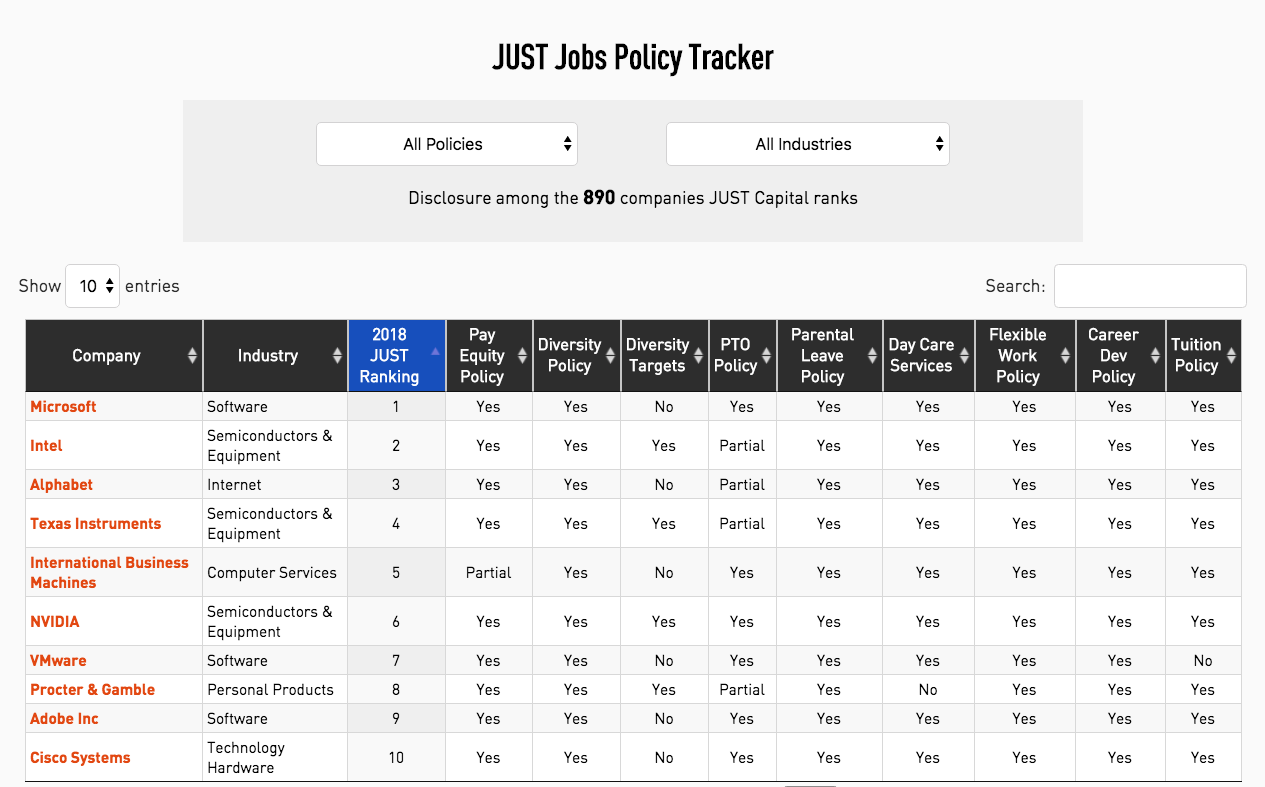
To explore the data and links to all the relevant career development policies at the 890 companies we analyze, track, and rank, visit the JUST Jobs Policy Tracker, and select “Career Development” from the pull down menu.
Late last month, smack dab in between Mother’s and Father’s Days, JP Morgan Chase reached a settlement in its lawsuit around equal access to paid parental leave for parents of any gender – a major step considering that, until recently, it wasn’t a given for both mothers and fathers to receive family leave. Companies like JP Morgan are catching up to this shift in workplace culture, and starting to provide equal leave to all. And with studies published by the Department of Labor and the National Bureau of Economic Research showing that paternity leave can promote improved outcomes for children, minimize postpartum health impacts for mothers, and increase gender equity at home and at work, this is a victory not just for fathers, but working families in general.
The reality is that, even with these improvements, few people have access to quality family leave today, and fathers in particular have little to no leave. Even when they do, many working fathers come up against corporate structures and cultures that discourage them from taking it. With paternity leave either nonexistent, brief, or discouraged, men are tangibly less involved in the day-to-day of their children’s lives, and the BLS’s American Time Use Survey – released earlier this week – showed that, while 92.1% of women with children under six reporting caring for them on an average weekday, just 73.7% of men reported the same.
How can we bridge this gap?
At JUST Capital, we’ve learned that work-life balance and good benefits are top priorities for the American public when we asked what they believe is most important when it comes to just business. While more and more companies are now offering paid family leave to their employees, we’re still falling short, and according to our research, only 28% of the 875 largest, publicly traded U.S. companies disclosed a detailed paid parental leave policy.
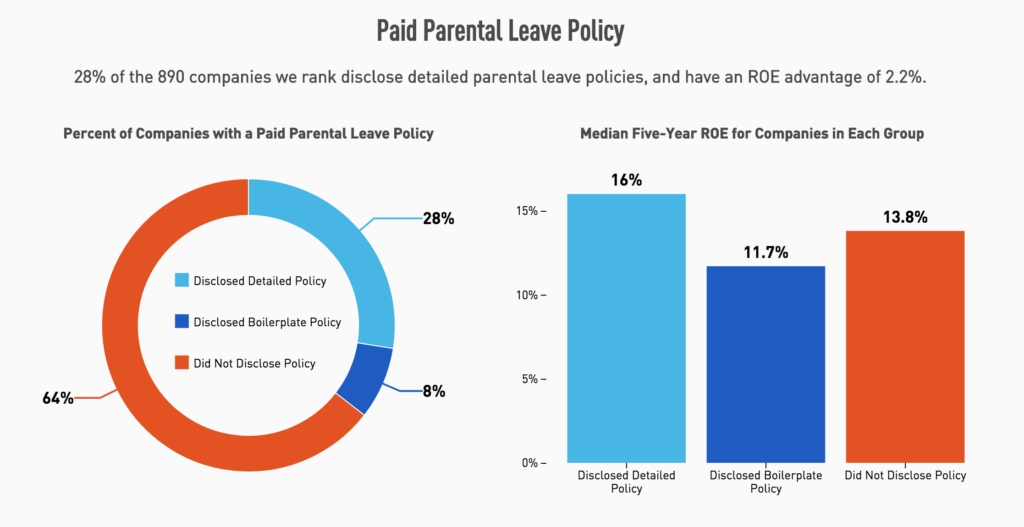
The good news is that these companies outperform their peers on a median five-year ROE analysis, supporting the case that investing in parental leave can and should be a win-win for companies and their workers.
But of those companies disclosing detailed leave, just 21% offer the same amount (which can range from a paltry 1 to exceptional 26 weeks) to both mothers and fathers (or primary and secondary caregivers). While the paid leave landscape may generally be improving, there’s a long way to go toward creating equal access to all parents.
Among the 64 companies already doing so, 14 are going above and beyond, offering 16 weeks or more to both mothers and fathers – these include:
Among this list, three stand out especially: Prudential offers more than six months paid leave to primary and secondary caregivers. Estee Lauder increased its paid leave to 20 weeks after resolving a discrimination lawsuit similar to JP Morgan’s. And when Netflix established its unlimited family leave policy in 2015, the company came under fire for not extending to hourly employees or those working in its DVD division. The company eventually extended its generous policy to all employees – whether salaried, hourly, frontline, or corporate – another critical battleground in the fight for fair, equal paid leave to all working parents.
The significance of paid parental leave cannot be denied – both for the opportunity it provides parents to bond with a child, for its capacity to strengthen working families’ finances, and for the equity it can foster at work and at home. And while improvements are being made, and more and more companies are taking the lead, their policies must today be evaluated on the details: How much leave is given? Does it cover primary and secondary caregivers? Adoptive and foster parents? And at what rate of pay?
JUST Capital is deepening the granularity of its analysis on this and other crucial workplace policies – like pay equity, diversity & inclusion targets, and workplace discrimination – in an effort to better understand how companies are measuring up on the issues that matter most to the public. And perhaps most importantly, to incentivize better business behavior and create new best practices that benefit all Americans – including working parents.
