Labor Day 2021 marks nearly 18 months into the COVID-19 pandemic in the U.S., and this week we highlighted the 32 companies – by industry – that have prioritized their workers during these tumultuous times. The companies – which top our Rankings on worker issues within their industries, from Retail to Software to Transportation – have established practices to keep their workers safe during the pandemic, disclosed demographic details as a first step toward advancing racial equity, offered benefits to help workers climb the job ladder, and more.
For this edition of Chart of the Week, we take a look at how these 32 companies perform compared to the rest of the Russell 1000 companies we rank:
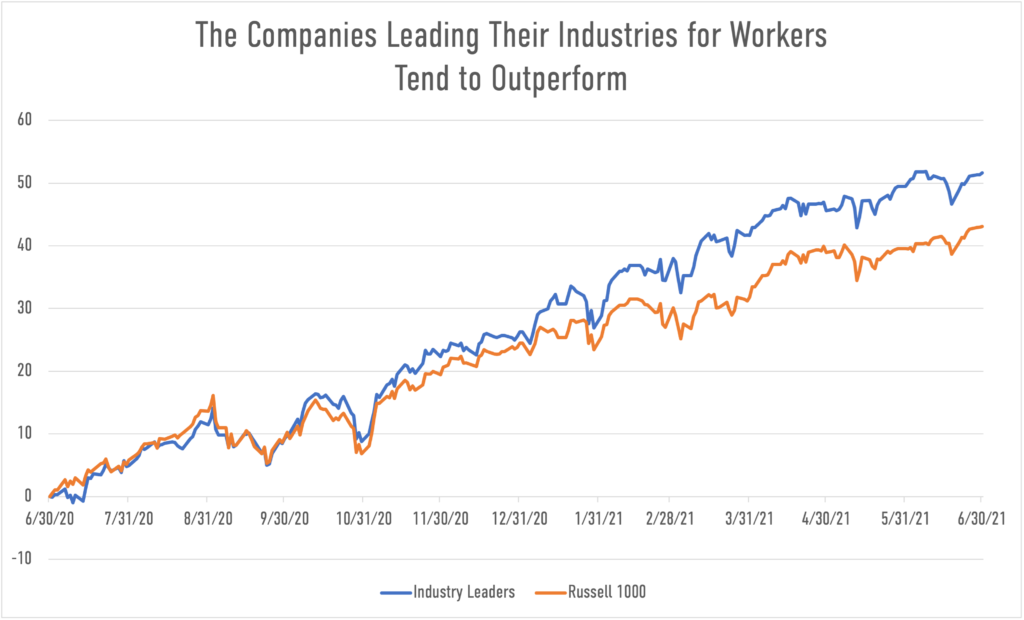
Looking at these industry leaders (excluding the top company for Internet – Facebook – as it is under review for our 2021 Rankings), we see that they have outperformed the Russell 1000 by 8.6% over the trailing one-year period.
These companies are at the forefront of their industries – and many at the vanguard of corporate America overall – when it comes to worker well-being. And their performance shows that, even during one of the most challenging years in recent history, it pays to treat your workers well.
In this week’s chart, we pull from the June 2021 edition of the ESG Acceleration report from MUFG Research (NOTE: member gated) to highlight not only the rise in the number of shareholder resolutions filed but the wide range of ESG issues addressed.
The chart below highlights the broader trend in the rise of shareholder activism related to ESG issues and how investors are increasingly using proxy votes to express their views on company behavior, rather than relying on company disclosure. This past year, climate change, human capital metrics, and diversity, equity, and inclusion (DEI) were especially relevant to shareholders. Increased demand for transparency, targets, reporting metrics, and business impact assessments have all rapidly gained momentum, as we see below.
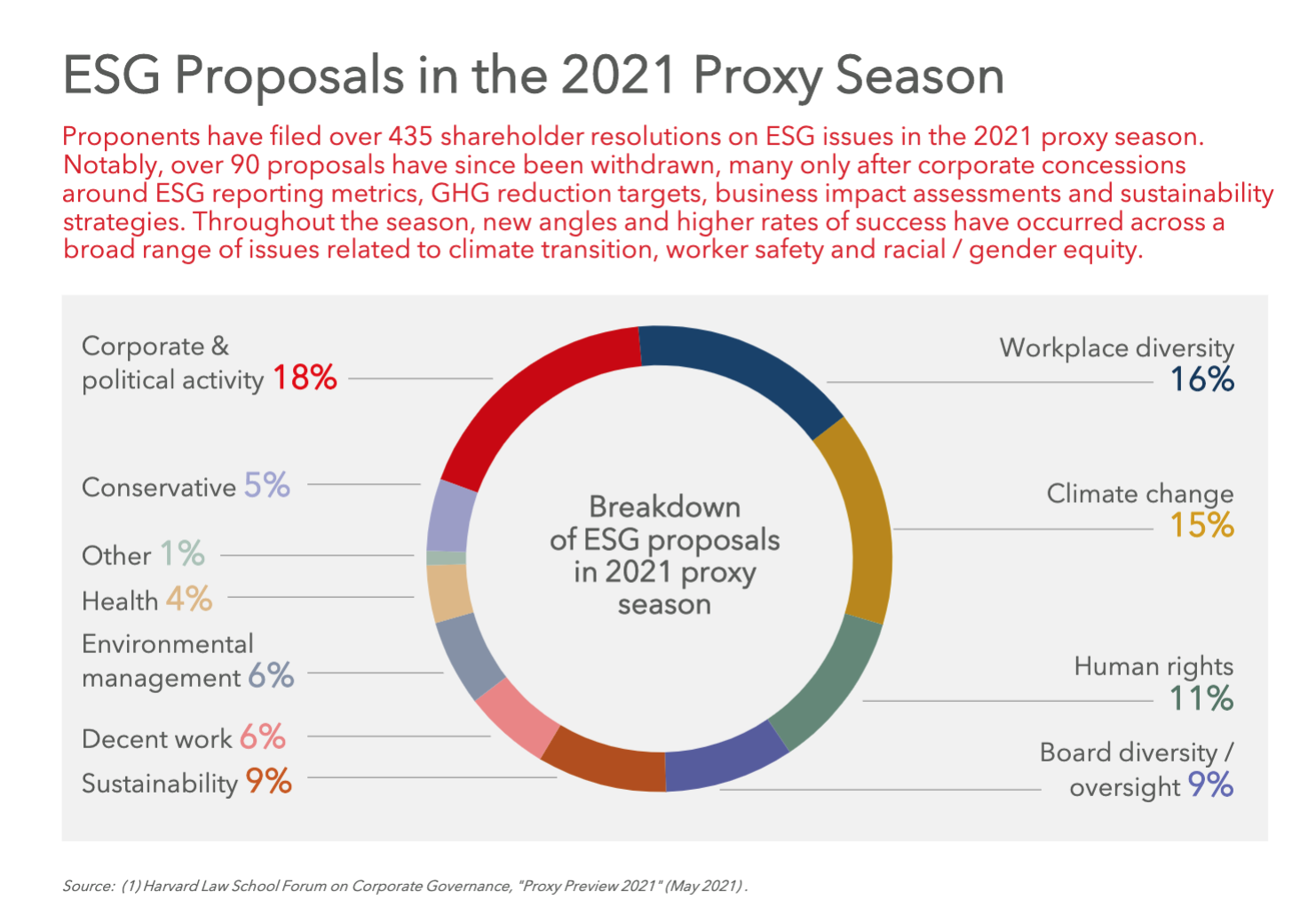
Investors and shareholders continue to demand more, as disclosure is considered a meaningful first step – however, it doesn’t always lead organizations to take meaningful action toward their ESG goals. Bloomberg reports campaigns launched through June 21 at companies with a market value of more than $1 billion reached 116, up from 87 over the same period in 2020. Furthermore, we see the demand for more than disclosure in corporate debt issuance as well, as investors show their willingness to pay a premium or “greenium” for companies to publicly link their debt to ESG goals, with the sustainability-linked-debt market expected to surpass $200 billion this year per S&P, up 54% from the year prior.
Last month, activist investor Engine No. 1 won three of four contested board seats as part of its $30 million Reenergize Exxon campaign, demonstrating that ESG activism can drive actual change and will continue to be a focus as we emerge from the pandemic. Engine No. 1 has continued its activist approach this week with an initiative to empower passive investors through the launch of a new ETF (ticker: VOTE) that aims to encourage better behavior using its shareholder voting rights and will follow voting guidelines aiming to get businesses to invest in employees, communities, customers, and the environment. We’re actually going to be speaking with them and Betterment on June 30th on how they hope to transform retail investing with this offering. Sign up to listen here.
To further highlight the surge in ESG proposals meant to change corporate behavior, we’re showcasing another chart from MUFG. This one is focused on BlackRock, the world’s largest asset manager and an outspoken supporter of sustainability initiatives over the past few years, and how its votes have broken down over the last year.
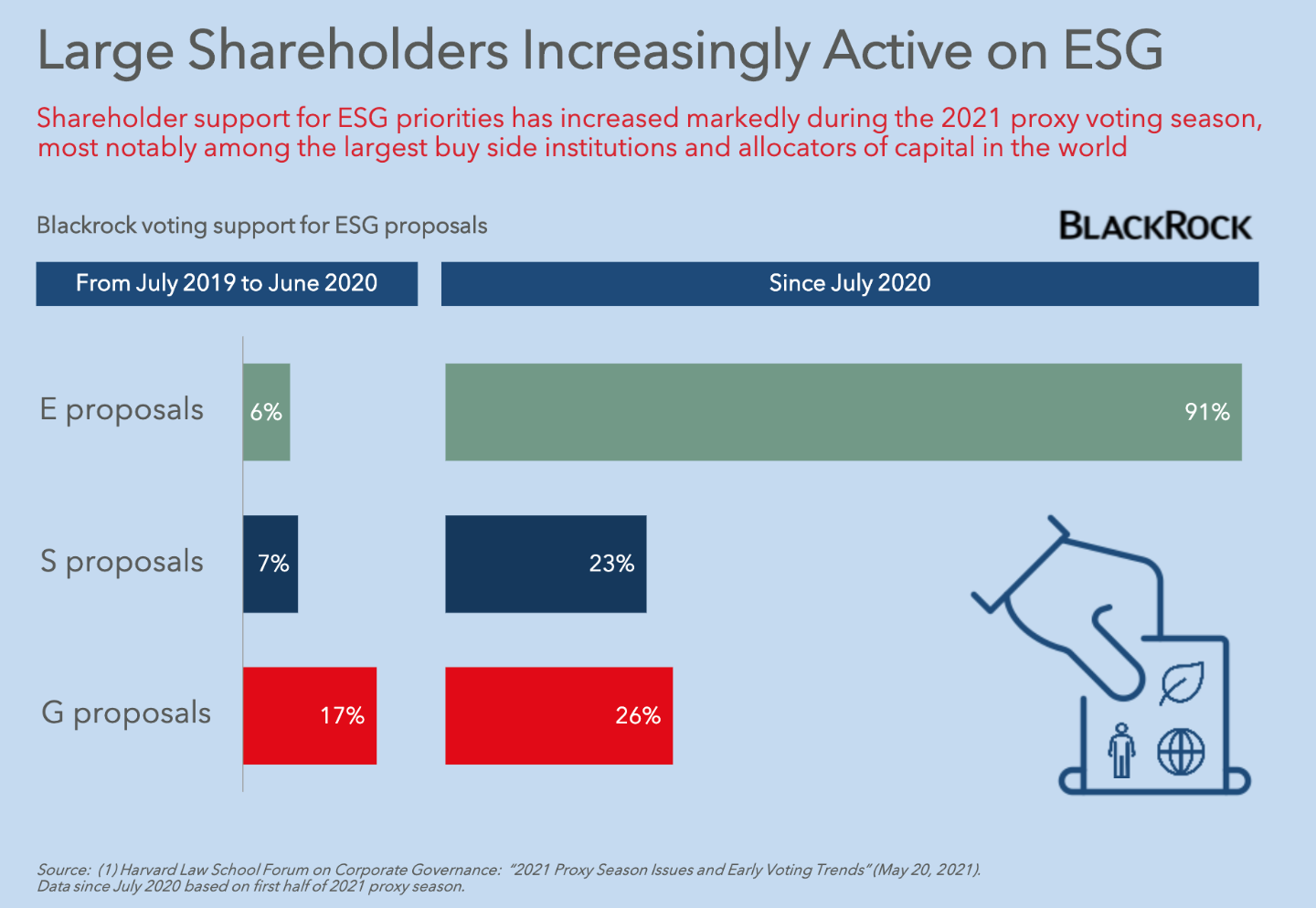
It is clear we are at the forefront of a shift toward broader transparency and accountability. Investors and shareholders not only demand to know what the benchmark looks like for the companies they invest in, but how they are progressing on the broader commitments they have made to address them. As we have seen from Engine No. 1, ESG shareholder activism is now at the forefront as human capital, DEI, and environmental proposals continue to gain traction and importance in 2021’s proxy season.
If you are interested in supporting our mission, we are happy to discuss data needs, index licensing, and other ways we can partner, please fill out our request form to answer a few questions, and someone from our Investor Solutions team will reach out to you within two business days.
As a follow-up to our recent Memorial Day chart, which analyzed companies with veteran hiring policies, we revisit corporate diversity and inclusion practices this week to evaluate if there is additional value in sourcing business from veteran-owned suppliers.
As the global economy begins to emerge from the COVID-19 pandemic, U.S. manufacturers have seen unprecedented product demand with global supply chain shortages continuing to exhaust the manufacturing sector. Given the heightened consumer demand and the supply chain risk of correlated suppliers failing to hit their production targets, there is a need for many companies to have a diverse set of suppliers. As part of a company’s supplier diversity programs, veteran supplier policies, in particular, provide equitable opportunity for direct and indirect suppliers owned by veterans.
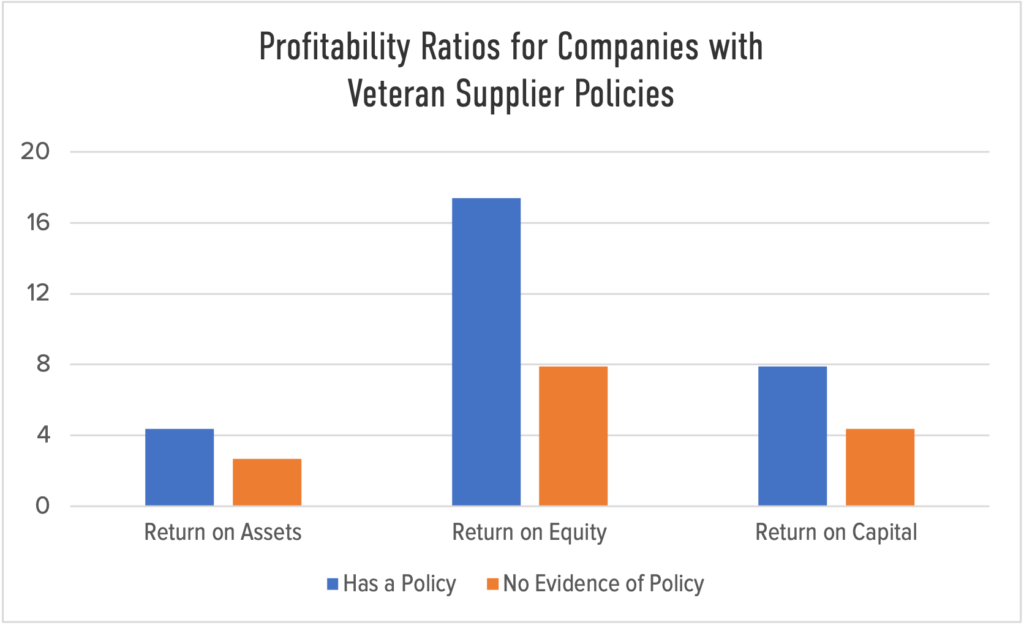
Looking at the 928 companies we ranked in 2021, we find there are 309 that provide veteran supplier policies. Digging into the data around various profitability ratios, we see higher return on assets, return on equity, and return on capital across the board for companies with these policies in place.
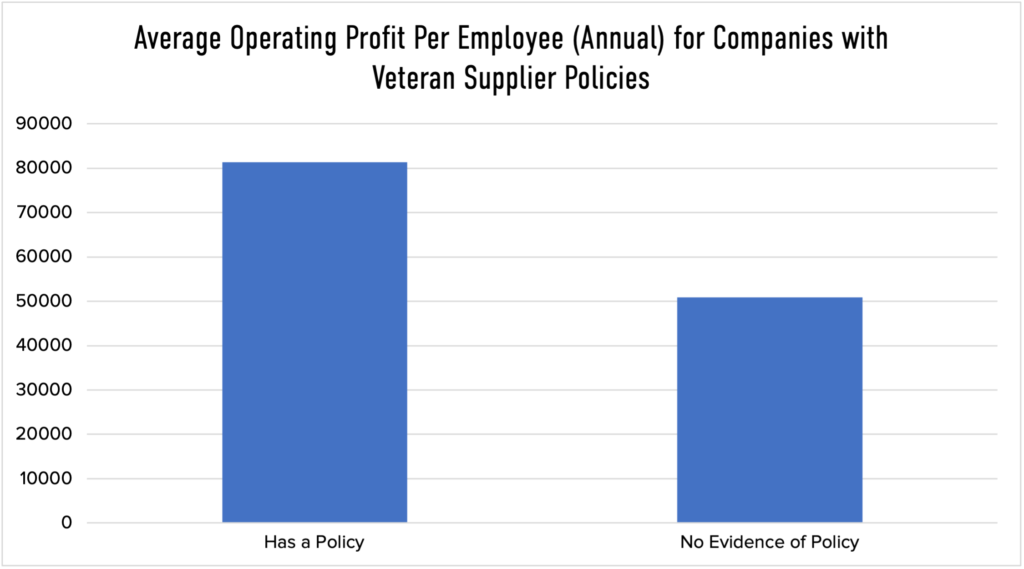
And looking at average operating profit per employee, we see a roughly 60% annual increase across companies with a veteran supplier policy or program in place:
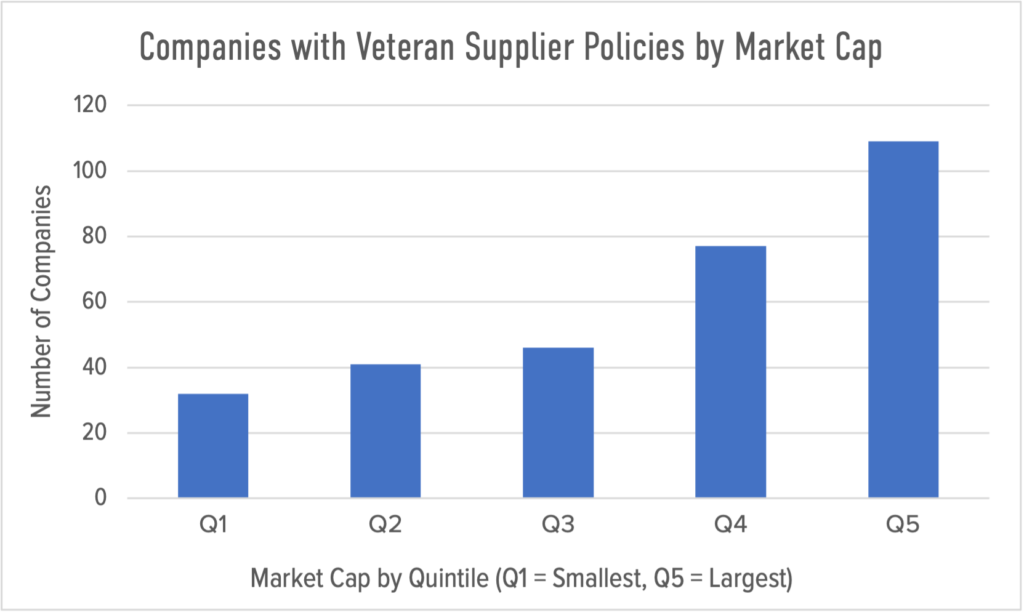
Finally, our analysis breaks out the companies with veteran supplier policies to show that the larger the market-cap of a company, the likelier it is to have a program in place.
Bank of America is our top-rated company for community development – the issue that tracks whether companies institute veteran supplier policies – and it not not only provides such a policy but offers resources to other companies looking to do so. Ranking #12 in the JUST 100, Bank of America spends nearly $2 billion every year with diverse businesses and has a number of resources on its website for smaller companies to get started on building their own diverse supply chain.
Bank of America’s approach to veteran suppliers and community development overall is an example of how taking a stakeholder lens to business can allow for finding opportunities for long-term value creation across every aspect of the company.
If you are interested in supporting our mission, we are happy to discuss data needs, index licensing, and other ways we can partner, please fill out our request form to answer a few questions, and someone from our Investor Solutions team will reach out to you within business days.
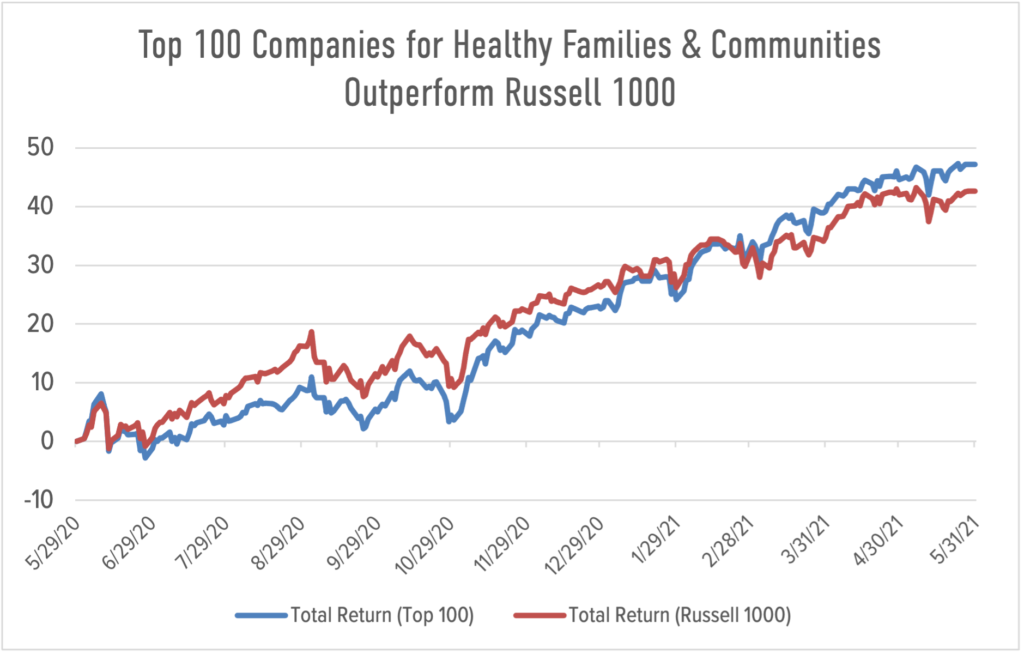
This week’s chart serves as a complement to our list of the Top 100 U.S. Companies Supporting Healthy Families & Communities published this week. Here, we examine the trailing one-year returns of the 100 leading companies from the list, relative the Russell 1000 companies we rank.
JUST Capital’s research team, with support from the Robert Wood Johnson Foundation, identified 10 key issues that determine whether companies are supporting the health and well-being of workers, their families, and the communities in which they operate.
The methodology utilized in the calculation of our 2021 list considers whether a company scores highly on the following 10 issues:
Over the time period of 6/1/2020 through 5/31/2021, the Top 100 Companies Supporting Healthy Families and Communities have outperformed the Russell 1000 Index by 4.6%. Top sector contributors were Financials, Consumer Discretionary, and Real Estate.
Top-ranked companies include NVIDIA, which offers unlimited paid sick leave, back-up dependent care, subsidized child care, and equitable paid parental leave for primary caregivers, secondary caregivers, and adoptive parents. Also included in the list are JPMorgan Chase, which is one of the few Russell 1000 companies to disclose non-white-to-white pay ratios.
Explore the rest of the list here to find out which companies continue to prioritize their stakeholders while outperforming their peers, and learn more about the list from JUST’s Chief Strategy Officer Alison Omens, who spoke on CNBC’s Closing Bell about why it’s so important for companies to focus on the health, safety, and well-being of their workers and communities.
If you are interested in supporting our mission, we are happy to discuss data needs, index licensing, and other ways we can partner, please fill out our request form to answer a few questions, and someone from our Investor Solutions team will reach out to you within two business days.
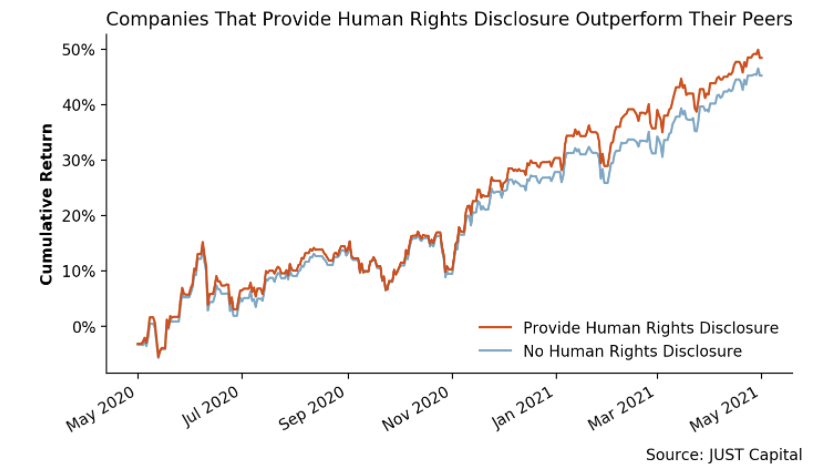
In this week’s chart, we take a closer look at corporate disclosure on human rights policies. In our 2021 Rankings, the second most important priority for corporate America – according to the American public – is to uphold human rights standards across the supply chain, and accounts for 9.2% of a company’s score. Americans want to see companies be transparent about their efforts to address child labor, forced labor, and other abuses of people in their supply chains, and require suppliers to uphold basic human rights standards.
Our analysis looks at one of the data points we use to measure a company’s performance on human rights issues – whether its Supplier Code of Conduct or Human Rights policy, as it pertains to suppliers, explicitly mentions human rights. Of the 928 companies we ranked in 2021, 458 provide this human rights disclosure and outperform those that do not by 3.2% over the trailing year.
Human rights violations within a company’s supply chain were thrust into the spotlight after the 2013 Dhaka garment factory collapse in Bangladesh, prompting organizations and governments to call for a heightened level of supplier due diligence. The World Benchmarking Alliance puts together an annual Corporate Human Rights Benchmark Report, which aims to shine a light on human rights policies by evaluating how 230 public companies across five high-risk sectors track and manage risks related to forced labor, child labor, and freedom of association and collective bargaining within their supply chains. Looking at the automotive sector, they found a “majority of automotive companies failed to demonstrate that they work with suppliers or set core expectations through contractual arrangements to verify the age of workers, prohibit recruitment fees and prevent intimidation or harassment of trade union members and their representatives.” Only one company, General Motors (#28 overall in our 2021 Rankings), provided evidence of mapping its direct and indirect suppliers.
As evidenced in our chart above, it is clear that there is a correlation between financial outperformance and the implementation of human rights supplier policies, further building the case for companies to prioritize supply chain practices. With fewer than 10 years to achieve the 17 sustainable development goals put together by the UN, corporate leaders can start by implementing a human rights supplier policy in order to begin understanding the risks in their supply chains. In turn, this will set the steps in motion to identify, address, prevent, and report publicly on human rights risks, leading to further transparency and more just business practices.
If you are interested in supporting our mission, we are happy to discuss data needs, index licensing, and other ways we can partner, please fill out our request form to answer a few questions and someone from our Investor Solutions team will reach out to you within business days.
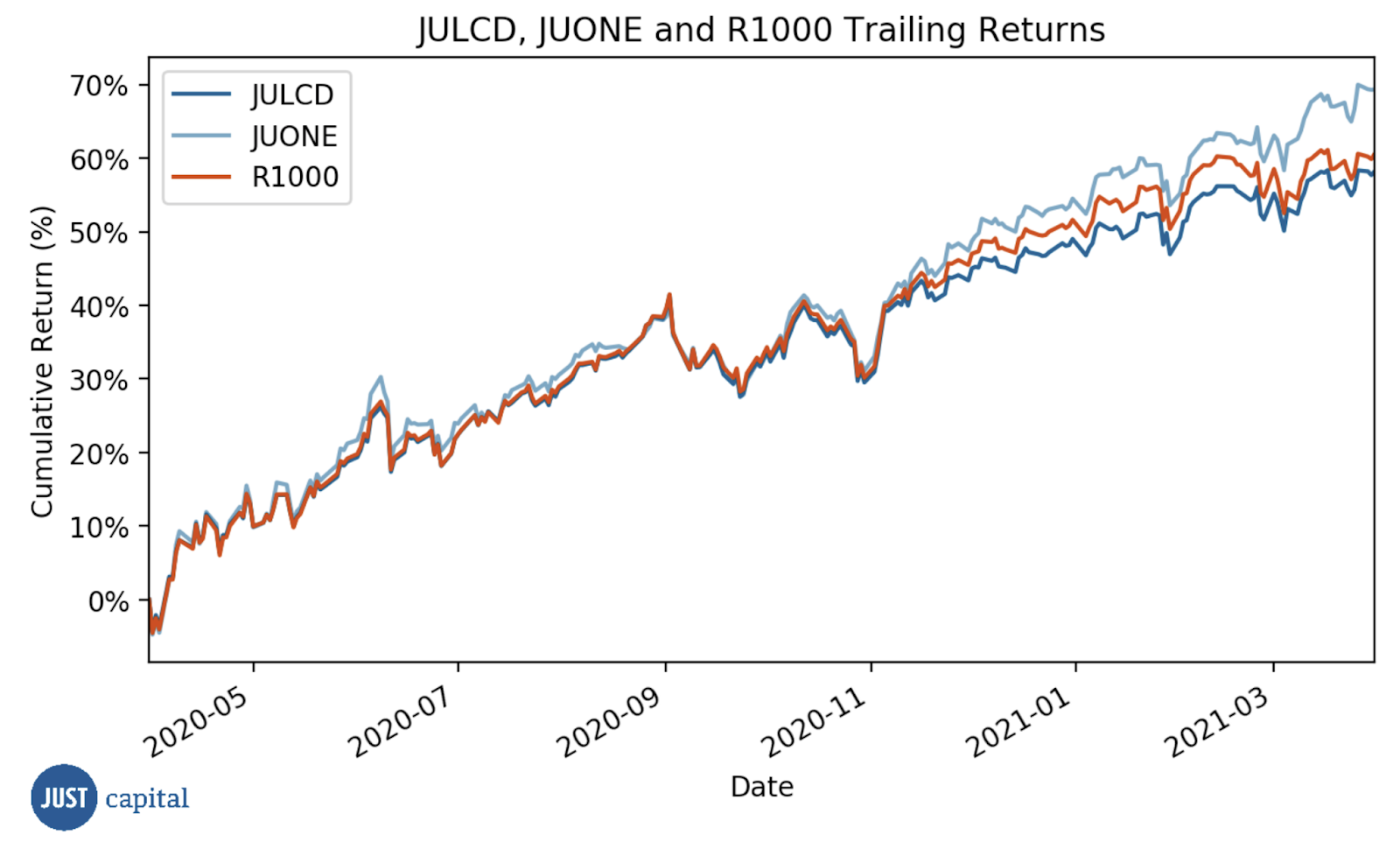
Our chart this week looks at the performance of our two active indexes – the JUST 100 (JUONE) and the JUST U.S. Large Cap Diversified (JULCD) – over the trailing year relative to the Russell 1000 Index.
The JUONE Index, recently hitting its two-year anniversary since inception on March 22, 2019, was constructed to track JUST Capital’s 100 highest-ranked Russell 1000 companies on an equal-weighted basis and includes the best-performing companies in our annual Rankings of America’s Most JUST Companies. Looking at the performance of the JUST 100, we see significant alpha relative to the average Russell 1000 company we rank, with JUST 100 companies returning 69.3% over the trailing -year and the average Russell 1000 company at 60.6% as of 3/31/2021. Our broad-based JULCD Index has slightly underperformed the Russell 1000, returning 58.2% over the trailing year.
Investors continue to see value in the JUST methodology, as the Morningstar bronze-medalist JUST ETF – which tracks the broad-market JULCD Index – continues to scale and recently crossed $225 million in assets under management, a 20% increase in assets since year-end. While we have a strong partnership with Goldman Sachs with the JUST ETF, JUST Capital is actively seeking a dedicated asset management partner interested in launching an investment product around the JUST 100 Index.
Highlighting unique attributes of the JUST 100 further:
The JUST 100, as we see above, is a unique portfolio of companies driving stakeholder capitalism forward, going above and beyond to advocate for the environment, their workforce diversity, and better pay for their workers. Given the leadership, performance, and impact of JUST 100 companies, it is clear that a JUST 100 thematic investment product fits a unique need in the market as our methodology and Rankings reflect the priorities of the American public.
Please don’t hesitate to reach out to our Investor Products team if you are interested in speaking further about the JUST 100 Index.
If you are interested in supporting our mission, we are happy to discuss data needs, index licensing, and other ways we can partner. Please reach out to our Director of Business Development, Charlie Mahoney, at cmahoney@justcapital.com to discuss how we can create a more JUST economy together.
