The U.S. fixed income (bond) market rivals the U.S. equity market in valuation, with total issuance of $49.1 trillion, and $10 trillion, or 20% of that is corporate debt. In this piece, we’ll investigate the corporate debt market, looking both at how opportunities in debt compare to those in equities in this moment, and how companies that prioritize all their stakeholders as represented in the JUST Rankings enjoy better credit ratings.
After the 2008 global financial crisis, the Fed and other central banks engaged in unprecedented quantitative easing, suppressing global interest rates. While low interest rates supported equity and other asset (including bond) prices, they were a challenge for retirees and other savers needing current income. More recently, renewed inflation accompanying the emergence from the economic disruptions of COVID forced the Fed to increase rates in response, leading to declines across both stocks and bonds in 2022.
As investors consider what’s next for interest rates, economic growth, and prospective returns from different asset classes, the natural, evergreen question of “Where should I invest now?” is front of mind. One broad comparison worth looking at is the expected earnings yield on equities versus the available yield on bonds. At a macroeconomic level, investors choose between earning the yield from bonds in coupon payments, or the income yield from stocks. In the chart below, the corporate earnings yields are the actual realized earnings for S&P 500 companies in that year divided by the S&P 500 index value at the prior year’s end. The value for 2023 is based on consensus 2023 earnings estimates.
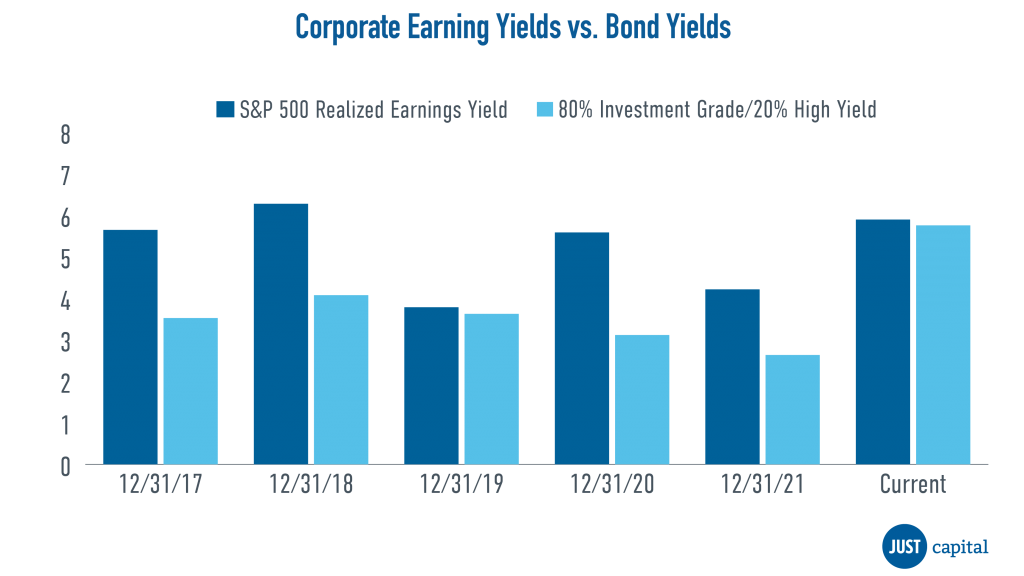
We generally see the S&P 500 earnings yield handily outperforming the available yield from corporate bonds over this period. The exception, of course, came in 2020 when earnings collapsed during COVID. However, a portfolio of corporate investment grade and high yield bonds now offers an attractive prospective yield compared to equities, suggesting that the time to invest in corporate debt may be upon us. While the asset price adjustment of 2022 was painful for both equity and debt holders, an era of more normal interest rate policy in a pro-inflationary economy will offer opportunities for investors to diversify risk across the economic cycle.
JUST Capital tracks companies in the Russell 1000, and we’ve observed a strong relationship between a company’s placement in our Annual Rankings of America’s Most JUST Companies and its long-term credit rating. Companies that succeed in prioritizing their workers, customers, communities, shareholders, and the environment – as reflected in the JUST Rankings – also enjoy the advantage of better credit ratings and lower borrowing costs.
The chart below shows the mean JUST 2023 rank within each S&P long-term credit rating category at December 31, 2022. (Of the Russell 1000, 27 ranked companies with a “Not Rated” credit designation and 251 ranked companies with no credit designation were excluded. The “spikes” on the edges of the chart, at ratings AA and CC, are due to the small numbers of companies in those categories.)
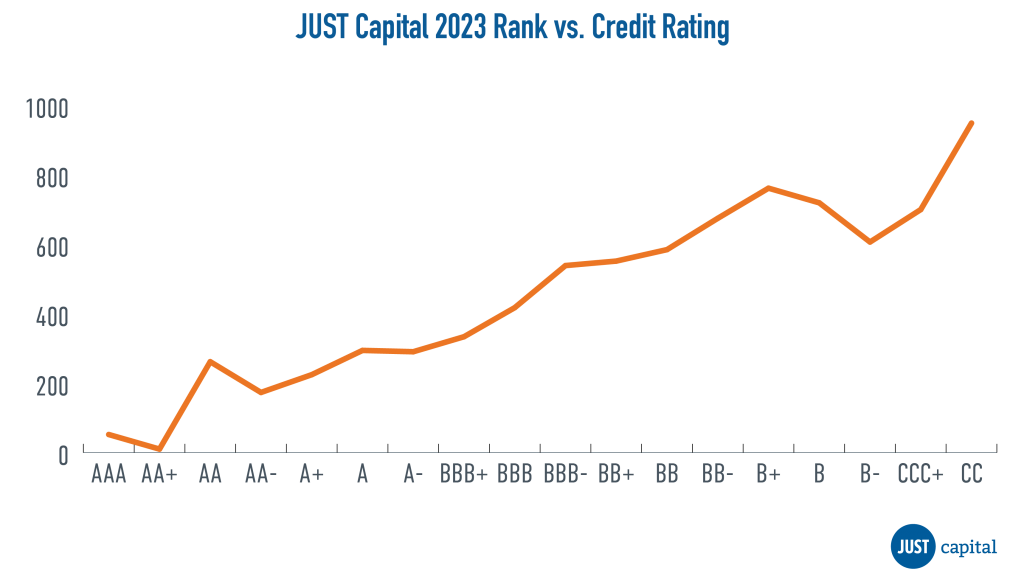
This correlation should not be surprising. Although credit ratings focus on financial measures of strength and JUST Rankings are based largely on non-financial measures of corporate stakeholder performance, they both distinguish companies on management quality and how they manage the balance of risks and opportunities.
Building on this finding, we’ll be further exploring the debt markets and the relationship between JUST Rankings and corporate bonds further throughout this year.

Walmart, a JUST 100 company for the second time, did a just thing this week. It announced it was raising its minimum wage to at least $14 an hour for all its store workers. That will bring its U.S. average hourly wage up to $17.50, and beginning in March that hourly wage range will rise to $14-19.
The move represents a roughly 17% jump in pay for the workers who stock shelves and look after customers, and is part of a wider package of investments the company is making in its workforce. This includes expanding their Associate-to-Driver Program, which helps associates become Walmart truck drivers (who earn up to $110,000 in their first year); creating more high paid roles at their auto care centers; and improving their college education program, where 100% of fees are company paid.
As my colleague Alison Omens points out in her article on the subject, Walmart has become a leader on good jobs. Here’s some additional context.
Out of 40 retail sector companies, Walmart is one of only 11 (28%) that have publicly released a minimum wage paid to its U.S. workforce. The move brings Walmart’s minimum wage to around the average for its industry but still below Costco ($17), Best Buy, Target, and Amazon (all $15). The new $17.50 average hourly wage is slightly more than the nationwide aggregate local living wage of $17.46 for one full-time worker with no children, but well below the aggregate family-sustaining local living wage, which is $24.16 for a family of two full-time workers and two children (according to MIT’s Living Wage Calculator).
Of course, the only way to truly know how many of Walmart’s workers actually fall above or below the local living wage threshold is to conduct a living wage assessment, based on where workers actually live, as we know from our Worker Financial Wellness Initiative.
Walmart’s move is to be applauded. At a time when so many workers are worried about their jobs and struggling to cope with higher costs of living, about 340,000 people (roughly 21% of Walmart’s workforce) will have a little more to help make ends meet.
Be well,
Martin

This week we’re profiling #44 in our 2023 Rankings of Americans Most JUST Companies – Walmart. The retailer is 2nd in its industry thanks in part to its leadership on worker and job creation issues. It has an extensive tuition assistance plan, an impressive 81% internal hire rate, and provides a comprehensive benefits package for its workforce, including 16 weeks of paid maternity leave, paid time off, and sick days.
Walmart demonstrates an ongoing commitment to diversity by publishing its EEO-1 workforce data. It also was an initial signatory of the “ban the box” initiative and launched hiring programs to assist formerly incarcerated individuals reenter the workforce. On environmental and climate issues, it has set a 1.5 Degree Science-Based Target and discloses across many Scope 3 categories of emissions, aligning with Project Gigaton and its commitment to reduce or avoid 1 billion metric tons of greenhouse gasses from the global value chain by 2030.
(Michael Loccisano/Getty Images)
“Increasing a sense of equity and opportunity among all workers decreases the risks to our investments, the economy, and the communities that make up our workforce and consumer base. Inclusionary business practices require intentionality, sustained effort, and collaboration.”
Gallup released its annual employee engagement survey and the news isn’t great. Disengagement hit a 9-year high with 32% of employees engaged in their work in 2022, while 18% percent were actively disengaged. Women and younger workers experienced greater declines in engagement.
Are CEO pay norms shifting? Fortune reported Google CEO Sundar Pichai will take less pay this year, joining Apple’s Tim Cook and JPMorgan Chase’s Jamie Dimon in compensation reductions this year.
In the wake of layoffs across the tech sector, now totalling 120,000 workers, Fortune shared a guide on how to perform them responsibly and compares the compensation packages for companies like Alphabet, Meta, and Microsoft. Bloomberg reported how tech layoffs are adversely impacting diversity and inclusion departments.
Women Business Collaborative published a report on inclusion in the boardroom. In December 2022, public companies appointed 75 women to boards while overall diversity for the year ended on a downward trend.
State Street’s CEO spoke to the Financial Times about ESG attacks and explained incorporating climate into corporate governance is a matter of value, not values, “For us it is not a political issue. It is nothing more than the proposition that climate needs to be incorporated into our investment risk framework.”
Quartz wrote up a new ShareAction report that details and ranks how the largest European and U.S. asset managers voted on ESG shareholder proposals.
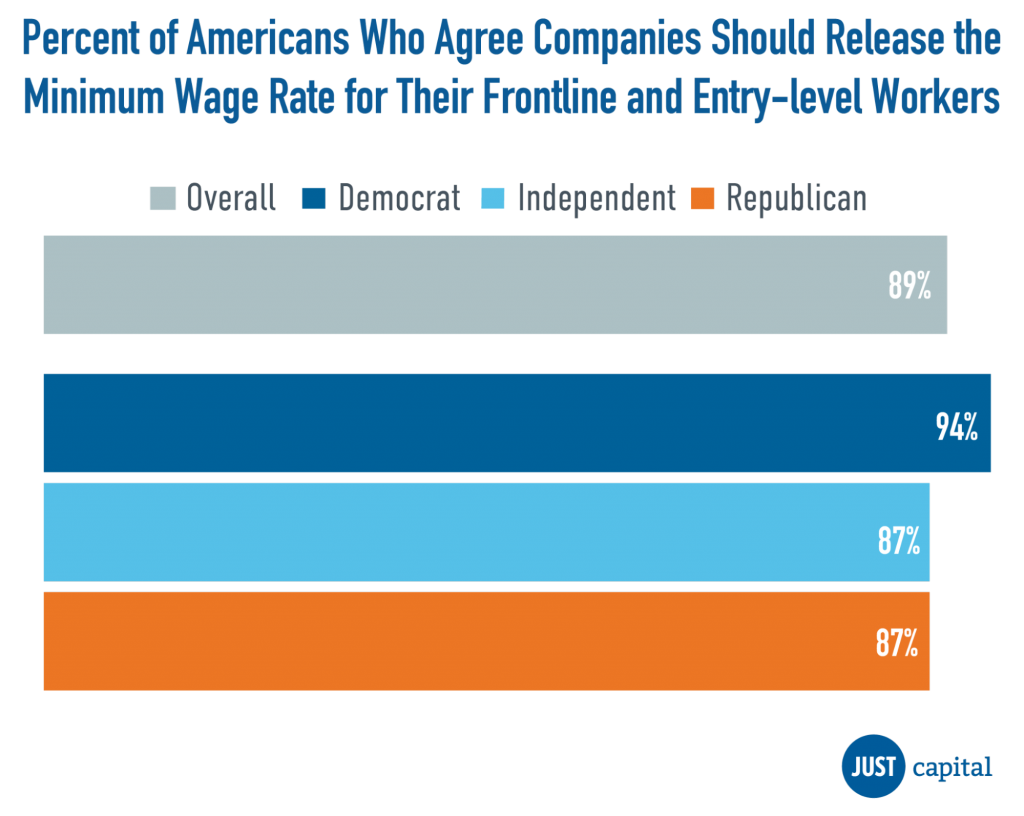
Our chart of the week demonstrates why more companies should follow Walmart’s lead and disclose their minimum wage rates. Across every demographic group we survey, paying a fair, living wage remains the most important business today, and 89% of Americans favor the release of minimum wage rates for frontline and entry-level workers. Disclosures, however, remain low, with only 9% of Russell 1000 companies disclosing the exact value of the minimum wage paid to their U.S. workforce.

January 10, 2023
We are proud to announce the 2023 Rankings of America’s Most JUST Companies, led by the JUST 100, in collaboration with CNBC. Each year, we take our polling of what the American public most prioritizes when it comes to just business behavior and see how the largest public corporations in the United States stack up. It’s a massive undertaking fueled by tens of thousands of hours of work over the last year from each and every staff member at JUST Capital.
This year, out of the 951 companies we ranked based on their performance across stakeholders, Bank of America tops the list for the first time, with NVIDIA, Microsoft, Accenture, Truist, Verizon, Hewlett Packard Enterprise, Apple, Intel, and JPMorgan Chase rounding out the top 10.
You can explore the complete Rankings, with detailed breakdowns for each stakeholder metric, on our site, and find links to CNBC’s multimedia coverage at cnbc.com/just100, also showcased at the bottom of this report.
We believe that business can play a role in creating an economy that works for all Americans, and that the evidence shows the best way to build and run a great business comes through a stakeholder-focused approach. Here are some ways that all stakeholders – workers, communities, customers, the environment, and shareholders and governance – are linked, as shown through outperformance of JUST 100 companies.
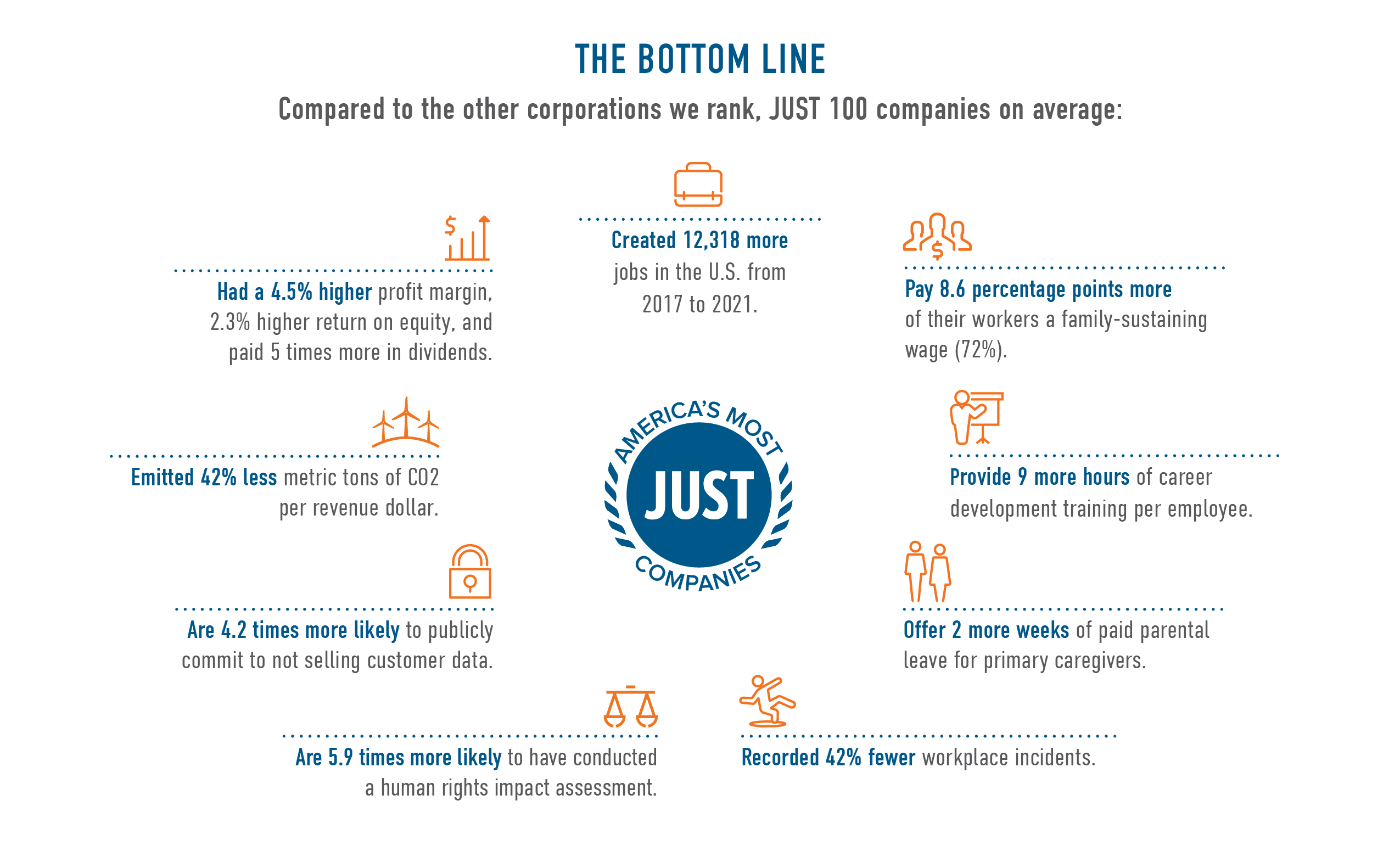
As of December 30, 2022, our JUST 100 Index (JUONE) that tracks the top 100 ranked companies outperformed the Russell 1000 by 13.3% since inception.
For this year’s Rankings, our survey research team asked a representative sample of 3,002 Americans to prioritize which Issues matter most. The following chart, pulled from our 2022 Issues Report, shows the probability that an individual would choose an Issue as most important to defining a just company, and serves as the weighting for this year’s Rankings.
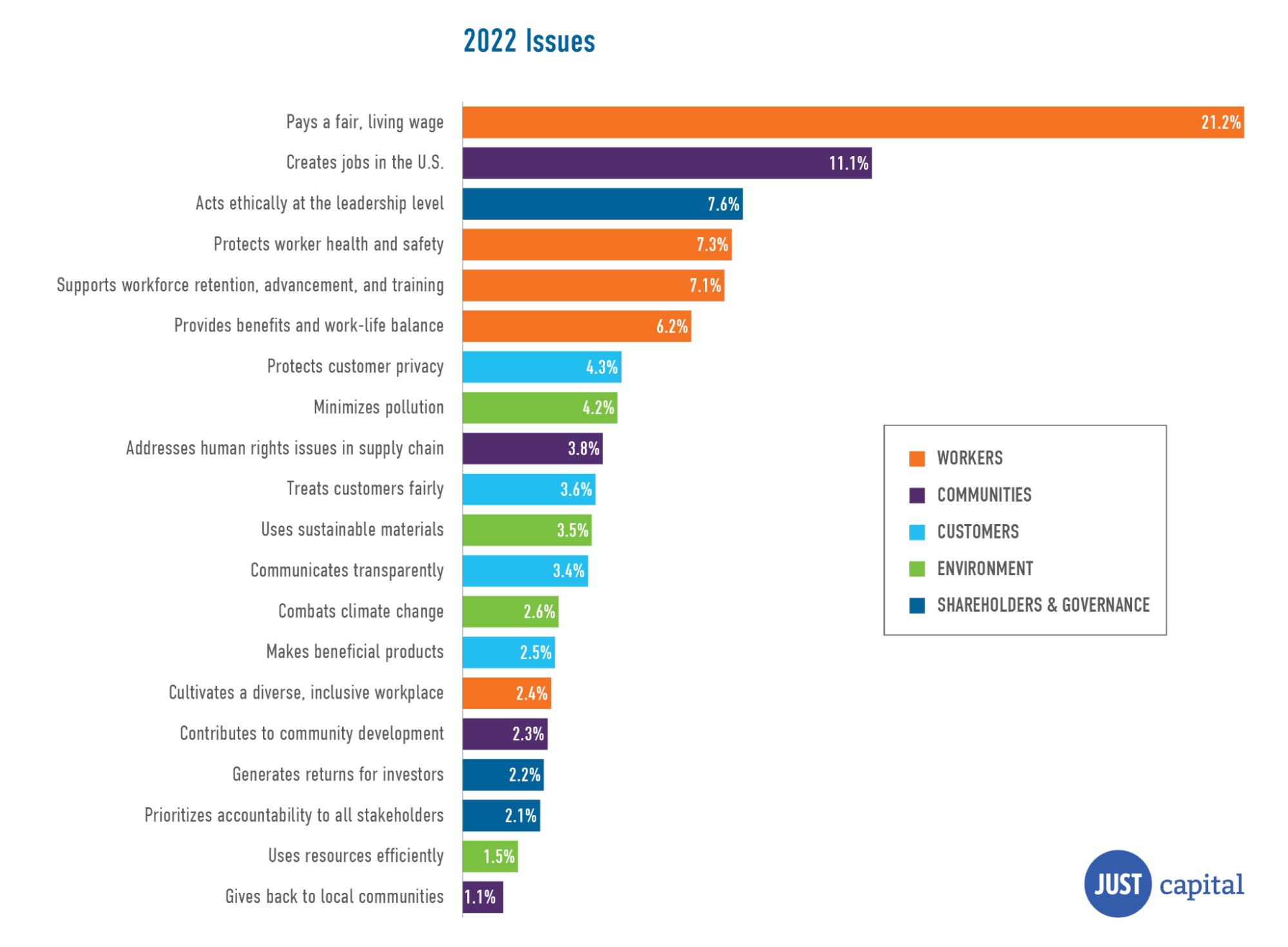
Over the last seven years, Worker Issues have consistently commanded the highest share of priority among the 20 stakeholder-related issues we measure, and this year is no different. As you can see, four of the five Worker Issues – including paying a fair, living wage, supporting workforce training, protecting worker health and safety, and providing benefits and work-life balance – are among the top six priorities of the public, and the collective prioritization of all five worker issues comprise 44% of a company’s score this year.
And despite the ongoing political polarization in the U.S., Americans are united when it comes to just business behavior. Among every demographic group – liberal, conservative, high-income, low-income, men, women, young generations, older generations, and white, Black, and Hispanic Americans – the Workers stakeholder is the top priority. And for each of these demographic groups, the most important Issue is “Pays workers fairly and offers a living wage that covers the cost of basic needs at the local level,” which comprises a significant 21.2% of companies’ scores in this year’s Rankings.
As more industries implement layoffs and fears of a 2023 recession loom, it’s also important to note that the second most important issue that powered significant shifts in the rankings model is “creating jobs in the U.S. and providing employment opportunities for communities that need them.”
We have made enhancements to the way we measure a company’s performance on the top priority of the public – paying a fair, living wage – with the help of our data partner Revelio, that drove significant shifts in the Rankings this year including a new minimum wage disclosure data point and new assessments on living wage, wages compared to industry peers, CEO-to-median worker pay, and more.
This year’s Rankings are led by Bank of America, the first bank to ever top the list, because they’ve been a trailblazer on worker issues (1st in industry and 1st overall). Bank of America raised its minimum wage to $22 an hour and committed to $25 an hour by 2025. It’s invested millions in career development and tuition assistance, offers 16 weeks of paid parental leave for both primary and secondary caregivers, and provides flexible work scheduling and backup dependent care. It is one of 14% of companies to conduct and release the results of its pay equity analysis, and also discloses detailed workforce demographic data by race and gender. The bank is also a strong environmental performer (1st in its industry and 6th overall) and has committed to reaching Net-Zero across its financing activities, operations, and supply chain by 2050, a goal that just 19% of companies in the Banks industry, and 32% of Russell 1000 companies overall, are committed to.
As an industry, Banks made significant gains this year because they categorically outperformed on worker issues, especially in transparency over wage data, pay equity, and commitments to larger national minimum wages than peers. Banks also saw an average Ranking increase of 134 in the “Creates jobs in the U.S.” Issue, the second-highest-weighted of the model (11.1%). Banks are consistently in the top third of our Rankings when it comes to U.S. job numbers and they also have the highest number of companies with second chance/reentry policies, four of which are in the JUST 100.
Overall, transparency continues to improve in key areas. Year over year we saw increases in disclosure of 10 percentage points or more in diversity metrics (e.g. pay analysis by race and gender, and board disclosure race and gender), as well as environmental metrics (e.g., emissions, renewable energy use, total energy use).
This year we also developed a new way of factoring gig workers into a company’s Workers score, and penalized six companies for unique events. Download our Methodology to explore other updates to the model this year.
CNBC will delve into the data, highlighting trends and spotlighting corporate performance stories about this year’s JUST 100 leaders across the network’s broadcast and digital platforms at cnbc.com/just100. Tune into Squawk Box, TechCheck, and Closing Bellover the next month to hear from CEOs of JUST 100 companies including Bank of America, Microsoft, Accenture, Verizon, JPMorgan Chase, Walmart, VMWare, and more. Our co-founder and chairman, Paul Tudor Jones, will be joining Andrew Ross Sorkin and T-Mobile CEO Mike Sievert on Squawk Box to kick off the coverage this morning at 8:15 a.m. EST.
There’s a lot to unpack, and we hope you enjoy exploring the list and all the coverage to come on CNBC.
JUST Capital’s annual Rankings of America’s Most JUST Companies score corporate performance of the Russell 1000 against the priorities of the American public. Throughout the year, we monitor any unique events not captured by our current metrics that should theoretically have an effect on a company’s score and rank. Our analysts identify those events as instances resulting from a company’s actions or inactions that are: (1) considered material to just business behavior as defined by the public, (2) have the potential to affect a company’s standing outside the normal architecture of our ranking process, and (3) are sudden, extreme, or unusual in nature.
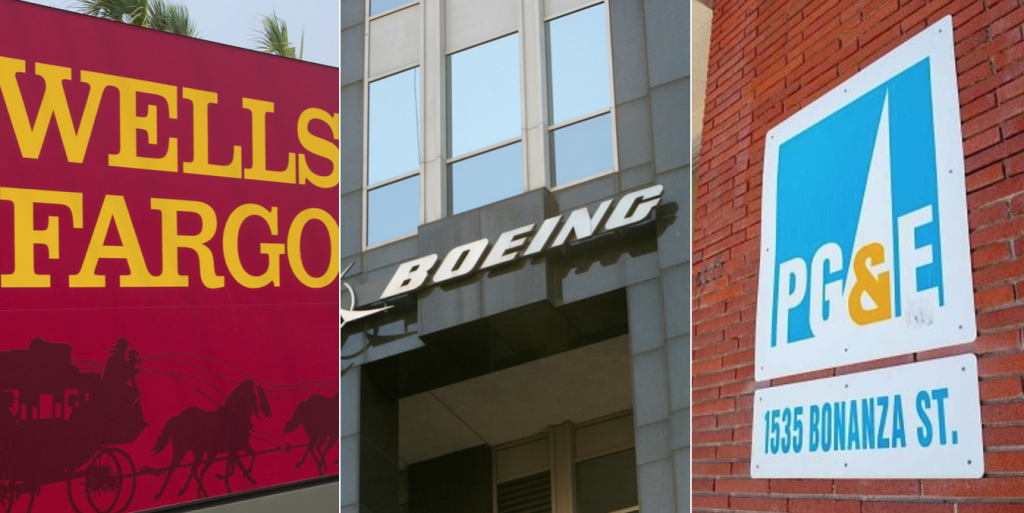
This year, the six companies that received a unique event treatment are Wells Fargo, Uber, Boeing, Altria, Meta, and Pacific Gas and Electric (PG&E).
Our team screens possible events that fit the above criteria. The methodology involves a formal process of monitoring media coverage related to companies under consideration through platforms such as RepRisk, as well as consultation with the public, independent specialists, and other neutral third parties.
The details of each event, and how a company has or hasn’t responded to it, determine the type of treatment given to the company’s Ranking performance. These treatments, in order of increasing severity, are Serious (I), Severe (II), and Most Severe (III). Each step of the process, including the final results, are reviewed by independent specialists and other neutral third parties.
This year, the screening process identified 42 companies, which were cross referenced along geographical and legal considerations among the full Russell 1000. Independent specialists evaluated a total of 18 incidents to identify events that meet JUST Capital’s definition of a unique event. From there, six incidents and their related companies qualified for unique event treatments and assigned one of the three treatments listed above. Further details on the screening process and evaluation criteria can be found in our 2023 Rankings Methodology.
The six cases JUST executed the unique events protocol in the 2023 Rankings are as follows:
The first case applies to Wells Fargo, a financial services company that provides retail, commercial, and corporate banking services through branches, the internet, and other channels to individuals, businesses, and institutions across the U.S. and in other countries. We assigned a Serious (I) treatment to Wells Fargo due to news of the company conducting fake job interviews for women and people of color. Wells Fargo has since suspended the hiring policy that allowed for this behavior. The company will receive the lowest score in the Employee Discrimination Controversies Metric within our Workers stakeholder, resulting in a rank of 42. On December 20, 2022, the Consumer Financial Protection Bureau confirmed Wells Fargo agreed to pay $1.7 billion in penalties and another $2 billion in damages to settle claims that it engaged in an array of banking violations that harmed millions of consumers. While there are several customer-related controversies captured in our Ranking model this year – including discriminatory lending practices against minorities, illegal account openings without knowledge or consent of customers, irresponsible sale of inverse and leveraged ETFs, and a rate-fixing scheme linked to variable-rate demand obligations – Wells Fargo does not receive an additional unique event treatment for the most recent customer-related fines and penalties because the case was settled outside of our tracking window.
Second, Uber, a company offering ride sharing, meal delivery, and logistics services for customers across the world, will receive a Severe (II) treatment. This is due to business practices that included efforts to specifically undermine taxi driver’s rights in the process of expanding its business. Uber receives the lowest score in the Community Development Issue in our Communities stakeholder, and sits at a rank of 505.
The third instance applies to Boeing, one of the world’s major aerospace companies that develops and produces commercial airplanes, military aircraft, space and satellite systems, and intelligence and security systems. One of Boeing’s airplanes, the 737 Max, experienced two fatal crashes within six months of each other in 2018-2019 – one of which occurred after the company assured the plane was safe despite knowing the plane’s flight control system posed an ongoing safety concern. Boeing has since replaced its CEO and settled charges with the SEC for misleading the public regarding the safety of its product. Boeing receives a Severe (II) treatment and the lowest score in the Customer Experience Issue, with a rank of 245.
The final three cases are carried over from the unique rankings treatment in our 2022 Rankings. Altria, Meta, and PG&E all received a Most Severe (III) treatment last year in our Rankings. We have placed all three of these companies at the same rank of 710th.
Altria is a manufacturer and seller of cigarettes, machine-made large cigars and pipe tobacco, smokeless tobacco products, and wine in the U.S. We assigned a substantial penalty to companies in the Industry Classification Benchmark (ICB) Tobacco Subsector, following results from our 2016-2019 survey research. Our survey research has consistently revealed that most Americans believe that companies that make and market tobacco products are extremely harmful, less just, and should be in the bottom quartile of JUST Capital’s Rankings. Altria receives the lowest score in the Customers stakeholder.
Meta is a social media conglomerate with billions of active users worldwide and owns Facebook, Instagram, WhatsApp, and Oculus, among other products. The company has faced growing reports of its involvement in the spread of misinformation, hate speech, and other discriminatory and incendiary content on its platforms – and that it was aware of these issues and has failed to address them. This event is reflected in the Customers stakeholder. Meta receives the lowest score in the Customers stakeholder.
PG&E is a utility company that became notorious nationwide in 2019 for the bankruptcy connected to its wildfire liabilities in California. In 2021, the state determined that PG&E’s continued negligence sparked or contributed to extreme regional wildfires that resulted in human deaths, widespread destruction of property, and endangerment of local communities. PG&E receives the lowest score in the Environment stakeholder.
Since our initial unique event treatment, there have been no substantial changes in business practices by any of the above companies that would result in the removal of this treatment. Barring any significant changes in business practices specifically related to these events, this treatment will remain in effect for a maximum of three years. If another event or development occurs after the three-year period, the event can be evaluated and, in appropriate cases, treatment can be reinstated.
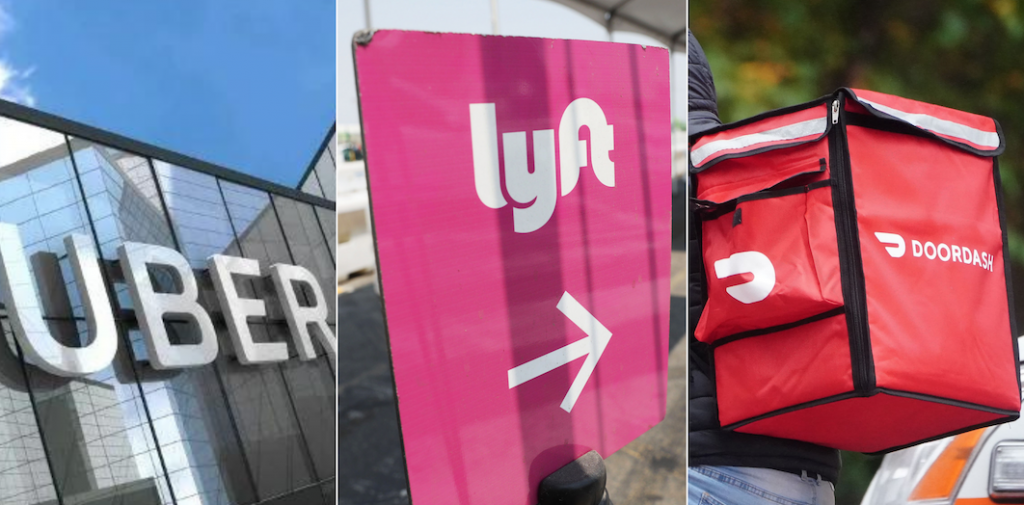
For our 2023 Rankings of America’s Most JUST Companies, we have removed the “Under Review” designation for Uber, Lyft, and DoorDash implemented during our 2022 Rankings.
We used this label last year to acknowledge and flag challenges in assessing how companies treat their entire workforce based on publicly available data. We selected these three companies specifically due to the centrality of gig workers to their business model and their self-identification as members of the Flex Association.
This year, to more accurately capture the experience for gig workers at Uber, Lyft, and DoorDash and to ensure that these companies’ scores are more reflective of their entire workforce, we reached out to the companies and requested public company sources with information about the share of gig workers and the benefits/policies that are accessible to them. Using the information provided, we proportionately discounted the scores of these companies across our Workers stakeholder data points when there was no evidence that gig workers are covered by the benefits or workplace policies that are tracked in our model.
We recognize that our work in capturing the workplace experience of the many Americans who work in the gig economy, or more broadly as contractors, is not yet done, but we believe this new approach is a step in the right direction. Our team will continue working on refining our methodology to ensure that we best capture companies’ commitment to all their workers.

(Mario Tama/Getty Images)
I’ve spent much of the week talking to business leaders about what Tuesday’s election results could mean for corporate stakeholder leadership. The answer – like the outcome of a few key races – is not yet clear, although with the balance of power in the House and the Senate certain to be evenly distributed it’s unlikely there’ll be any fundamental shifts in company strategy required.
The general sense is that if a thin Republican political majority does materialize as expected in the House, hearings on the anti-ESG agenda are likely and CEOs would be summoned to testify. The business case for stakeholder leadership will therefore come under the spotlight – and perhaps that’s not a bad thing. Our research shows the case is pretty clear. A divided Congress also means CEOs will continue to be more cautious of making public statements on divisive issues, and may even embolden some to oppose ESG regulation. On climate, support for domestic fossil fuel production will increase, although a lack of governing majority means that “the policy status quo (on clean energy) remains fundamentally intact for the next two years,” as Goldman Sachs notes. Efforts to regulate ESG disclosure may come under closer scrutiny.
Perhaps the biggest takeaway, however, is that voters on both sides are concerned mostly about core inflation and economic issues. This year’s Americans’ Views on Business Survey, out this week, supports this view, along with our 2022 Issues Survey that focused on kitchen table issues like fair wages and good jobs. It is the most powerful bridge there is, and one where business can really lead by example. Suzanne P. Clark, President and CEO of the U.S. Chamber of Commerce, put it this way in a statement on the election results: “It has never been more important for elected officials to address our nation’s challenges by bridging divides and forging durable solutions – just like business leaders across this country do every day.”
For companies the best approach for now would therefore seem to stay focused on the thing that we know really matters: supporting their workers’ economic well-being.
Be well,
Martin Whittaker

Home Depot workers voted against forming its first store-wide labor union in Philadelphia.
Macy’s plans to invest $30 million into minority-owned businesses over the next five years.
Meta lays off 11,000 workers, or nearly 13% of its staff, and will extend its hiring freeze into Q1 2023.
Salesforce lays off hundreds of employees on Monday after demand lightens in some countries and industries.
Stripe lets go of 14% of its staff, but is praised by HR professionals for its humane approach, especially compared to other companies like Twitter.
This week we released our in-depth 2022 Americans’ Views on Business Survey Report, which provides unique and critically important insights into how everyday Americans think about business today, and when viewed in the context of our previous seven years of polling – how it has shifted over time. For instance, perceptions on whether capitalism is working for the average American plummeted 10 percentage points this year, with a stark difference in demographics. Peter Vanham at Fortune covered the report this week in the new Impact Report newsletter.
Martin joined Leslie Norton and John Hale from Morningstar on Twitter Spaces to discuss the election results and what they mean for ESG, as well as his thoughts on COP27. (The conversation starts at 4:40 in the recording.)
The data on the impact of human capital management is paltry. That’s why we’ve teamed up with the Ford Foundation and have opened up a request for grant proposals focused on advancing human capital management research and accessibility. Help us improve our collective understanding of how companies manage and support their workforces, and how it impacts their bottom line. Submit your proposal now through December 9!

(Fortune)
“This is about driving those four constituents [customers, employees, shareholders, and the larger community] in a way that aligns capitalism to what society needs from us. So that people see the value of capitalism.”
“With the talent wars so strong, we’ve needed to find other good avenues for recruiting folks. And guess what? We already have that with our veterans pipeline. They have great transferable skills, plus they bring additional skills of leadership, flexibility, dedication and all the other intangibles that veterans bring. So in 2021 and 2022, we’re up almost 400% in veteran hiring, versus 2020 and earlier years.
“Government targets, supporting policies and transition plans can provide clarity, predictability and the competitive landscape to encourage more businesses to take action and to make transition-aligned investments.”
Joe Nocera explores in NYT DealBook what the midterms results could mean for business, and the Financial Times describes how U.S. companies are preparing for a potential wave of congressional hearings to investigate businesses’ environmental and social positions.
Al Gore and David Blood of Generation Investment Management pen an editorial in the Wall Street Journal explaining why ESG investing is consistent with fiduciary duty, and Leslie Nortonat Morningstar builds a strong case for why ESG and sustainable investing won’t be stopped and will survive the current demonization and backlash.
Axios reports that to the extent that layoffs are underway, it’s currently largely contained to one sector – tech. Fortune and leadership consultant Scott Monty take a closer look at what Twitter(and others) could learn from how Stripe handled their layoffs.
Gizmondo reports on Microsoft’s push to create more climate-smart workers, finding that at most companies, “60% of sustainability team members joined without expertise in the field.”
The Wall Street Journal creates a compendium of all of its ESG coverage over the last several years.
Forbes counts down the Best Employers for Veterans.

With U.S. midterm elections dominating the news cycle, we’re showcasing one of the many charts from our 2022 Americans’ Views on Business Survey Report, which shows that even across political affiliation, Americans are more aligned than we may think when it comes to how they want companies to be supporting their workers. Explore the insights here.


Team JUST Capital had a blast running the New York City Marathon and raising $35k ($10k over our goal!) to create a more JUST economy. Here are some pictures from the day – and feel free to check out our Team JUST Capital fundraising page if you still want to donate.
