
The “ROI” of being just is critical to our overall strategy. Understanding if and how just leaders perform better financially than their peers supports the investor case for stakeholder capitalism and helps guide corporate executives and boards on where and how they can allocate capital to generate the biggest impact. That’s why JUST’s investment analysis – expertly led by former portfolio manager Mona Patni – is so important.
Some key takeaways from our Q1 2024 analysis:
There’s a lot to unpack here, but the headline is clear: just business is better business.
Be well,
Martin

“While we don’t run the company worrying about the stock price in the short run, in the long run we consider our stock price a measure of our progress over time. This progress is a function of continual investments in our people, systems and products, in good and bad times, to build our capabilities. These important investments will also drive our company’s future prospects and position it to grow and prosper for decades.”
Microsoft continues to expand aggressively into AI, investing 1.5 billion into an AI holding company in the United Arab Emirates. The Motley Fool takes a closer look at this move.
The Wall Street Journal explores how corporate diversity goals are disappearing from company annual reports thanks to increased pushback on DEI. Despite this, the one CEO who hasn’t been scared off is Jamie Dimon, who continues to defend DEI when so many of his contemporaries have gone silent. Axios explores why.
CNBC runs down what salary a family of four needs to live comfortably in every state.
Volkswagen workers in Chattanooga passed a historic vote to join the United Auto Workers on Friday, making the auto factory the first in the South to vote to unionize since the 1940s. The Washington Post has the story.
Delta Airlines is giving a 5% pay raise to all employees and is increasing starting salaries for several positions in order to improve hiring and retention during the upcoming summer travel season.
The Washington Post reports that President Biden has officially signed the “TikTok ban” legislation, giving the company 9 months to sell the app or face a national ban.
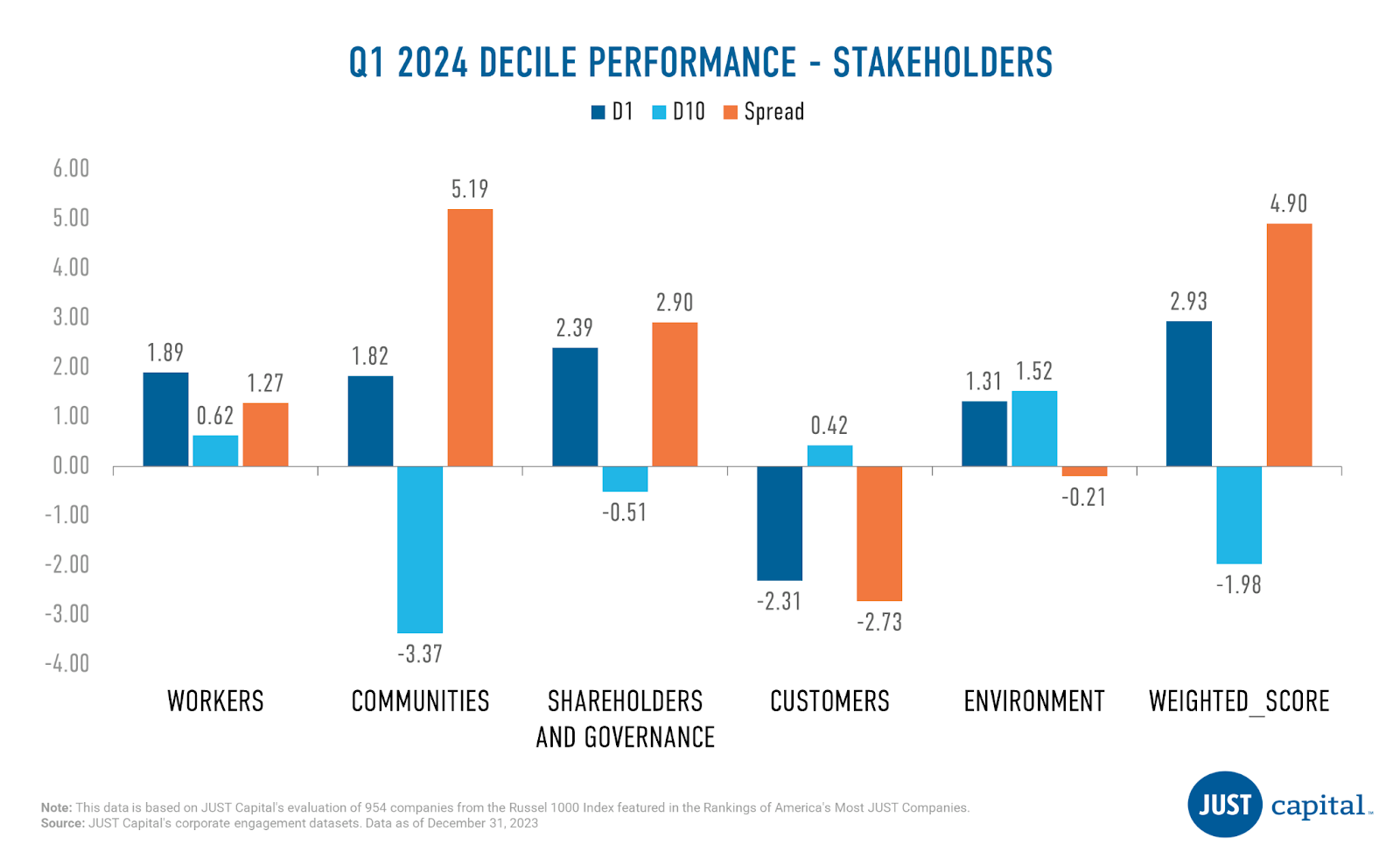
This chart comes from our Q1 Investment Analysis, and shows a quick-view of the stakeholders in our JUST ETF that showed high outperformance. Click here to explore the full analysis.

Monday is the 54th annual Earth Day, so in honor of that I thought we’d highlight a few companies that are showing extraordinary leadership on environmental matters.
First, though, a bit of context. Environmental protection in the U.S. has for the most part been a unifying issue over the years, even politically. It may surprise some that it was Ronald Reagan’s EPA Administrator William Ruckleshaus who sat on the U.N.’s Brundtland Commission that coined the term ‘sustainable development’ (he also served on Clinton’s Council for Sustainable Development), and George H. W. Bush who signed the first Rio Earth Summit declaration that established the U.N. Framework Convention on Climate Change (UNFCCC) in 1992. Protecting our air, soil, and water; our fragile ecosystems; our climate, wildlife, fisheries and oceans; these are ties that bind.
Today, we see this reflected in our polling. Almost 9 in 10 say that large companies have a responsibility to reduce their environmental impact by using sustainable materials and renewable energy. 73% favor increased disclosure from corporate America on environmental impact data. The environment is an essential corporate stakeholder, in other words.
American business leadership on environmental matters comes in many different forms. On greenhouse gases, for example, it’s interesting – and perhaps intuitive – that on an absolute basis the companies that have cut direct emissions the most in recent years are from the most emissions-intensive industries: American Electric Power, Chevron Corporation, Phillips 66. From HPE’s pioneering low-carbon tech infrastructure and Microsoft’s Climate Research Initiative, to Accenture’s nature-based carbon removal solutions, we see innovation everywhere. Explore more of it in our list of the Top 10 Companies for Environmental Performance in 2024.
Be well,
Martin

“Supply chains are extraordinarily complex. My view is you’re never done, you just keep working through it. You take the next supplier. You take the next question. You continue to push on all three dimensions. Do you have resilience for the part of your supply chain? Can you trust that supply chain? And do you have sustainability? And when you have that answer, you go to your next supplier, and you just keep asking those same questions. You keep pushing down the supply chain. Our belief though is that the harder you work it – you’re pushing a boulder up the hill, and then there’s a cascading effect through the supply chain and through the customer base as well. The boulder all of a sudden starts rolling down the hill. I don’t think we’re there yet, but I think that time is in our future.”
We release our Top 10 Companies for Environmental Performance in 2024.
JUST data partner Karma Wallet acquires DoneGood, an e-commerce marketplace where every purchase you make does good for people and the planet, to expand their platform and consumer sustainable buying choices.
According to Fast Company, “Big Tech is on a generative AI hiring spree”. While the sector is experiencing tremendous growth, there are problems on the horizon. One of them? “ChatGPT requires 15 times more energy than a traditional web search.” That quote comes from Fortune’s interview with Ami Badani, CMO of chip design firm Arm Holdings, on the energy consumption AI requires, and how it must be addressed for the technology to grow, otherwise it will eat up a quarter of the electricity in the U.S. by 20230.
The Brookings Institute chronicles the Hollywood writer’s strike and the ways its union pushed back against the use of generative AI, and what lessons can be learned for other industries that will soon be threatened by it.
ESG Today looks at the new EU rules that require all new buildings to be zero emissions by 2023.
With EV purchases slowing down, Tesla will cut 10% of its workforce–nearly 14,000 employees–in an effort to deal with thinning demand. More via The Washington Post.
CNBC releases an informative map showing the median annual income in every U.S. state in 2024, and Business Insider runs down the best paying retail jobs.
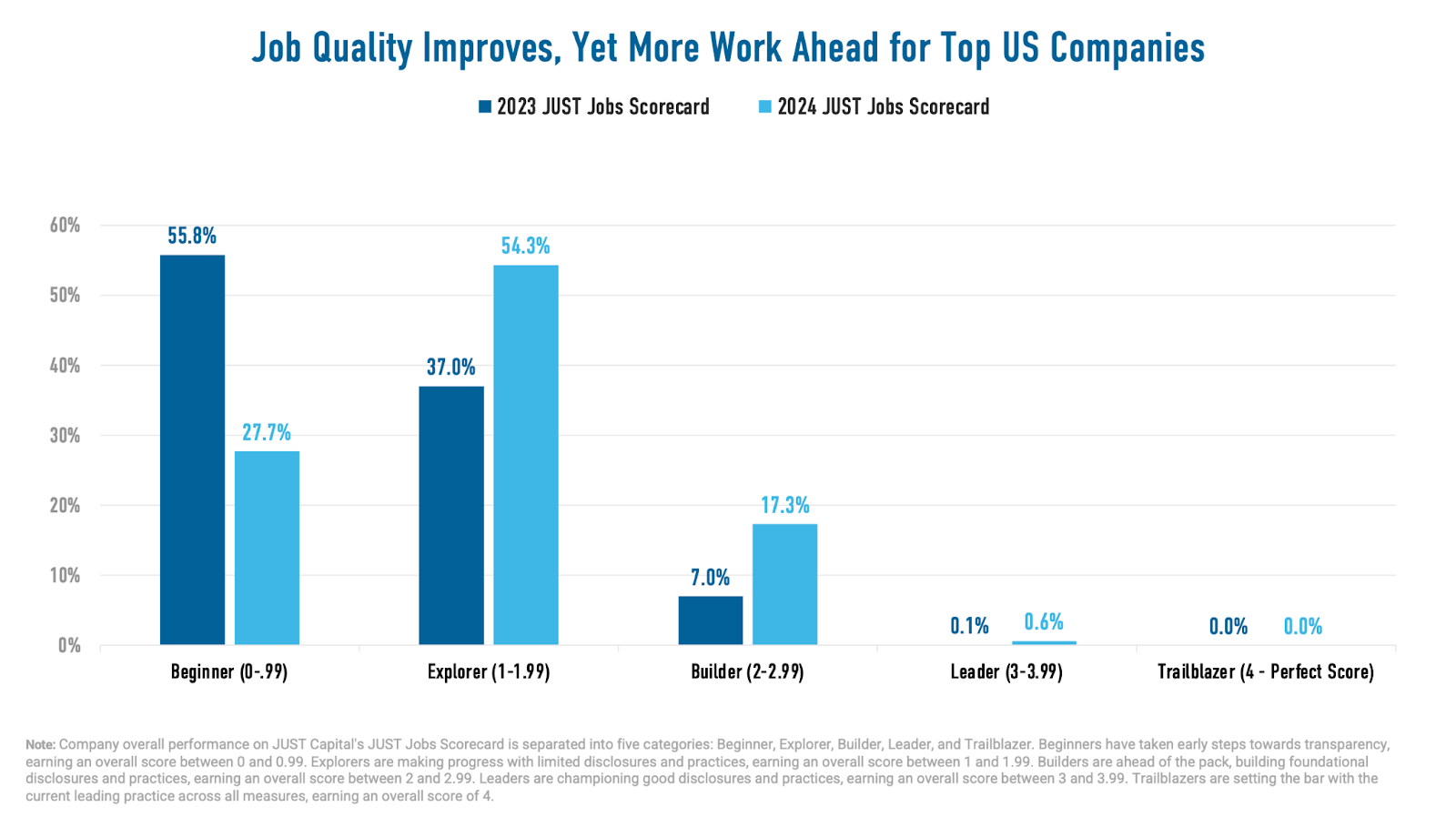
This chart comes from the data in our recently released JUST Jobs Scorecard. While America’s largest companies have more work to do to improve transparency around some key job quality data points, overall performance on the 2024 JUST Jobs Scorecard speaks to noticeable improvement since the 2023 pilot version of this tool. More than one-fourth of companies (256 companies, or 27.3% of all scored companies) have moved from the Beginner category (taking early steps towards transparency, overall scores between 0 and 0.99) into the Explorer category (making progress with limited disclosure and practice, an overall score between 1 and 1.99). Explore these trends, as well as your own company’s in-depth performance, here.

2024 has already been a big year for environmental and climate action in the private sector. Governments of all sizes have implemented new measures that will require certain companies to disclose their greenhouse gas emissions and climate risks.
Following last year’s adoption of the EU’s Corporate Sustainability Reporting Directive and California’s two climate disclosure laws (the Climate Corporate Data Accountability Act and the Climate-Related Financial Risk Act), the Securities and Exchange Commission (SEC) approved a rule that requires some companies to disclose both greenhouse gas emissions and climate risks to their business, the specifics of which are still being challenged in court.
A majority of Americans favor more disclosure from companies on these issues. Our Polling of the American Public found that 73% of Americans strongly or somewhat favor federal requirements for disclosure on environmental data like greenhouse gas emissions. Other research indicates that 90% of investors say that the CSRD and SEC rules will drive better investment decisions.
We evaluated the 10 companies with the best environmental performance in our 2024 Rankings of America’s Most JUST Companies. All 10 of these companies have set an emissions reduction target and we also found that these leaders are outperforming the remainder of the Russell 1000:
Read more about how these companies are taking action. The top 10 are listed below in ranked order on environmental performance based on the 2023 Rankings:
Hewlett Packard Enterprise is a top-performing company on the Environment Stakeholder, in addition to leading the Russell 1000 on overall performance, ranking first overall in our 2024 Rankings. HPE has committed to multiple ambitious climate goals, including achieving Net Zero across its entire value chain by 2040, a 70% reduction in Scope 1 & 2 emissions from 2020-2030, and a 42% reduction in Scope 3 emissions from 2020-230. HPE was the first company within its industry to set a verified 1.5-degree Science Based Net Zero Target, and in 2022 even moved up their commitment date for achieving Net Zero from 2050 to 2040. HPE is focused on finding low-impact suppliers and partnering with suppliers who have their own science-based targets, while also pushing out more sustainable options for their customers to reduce the company’s scope 3 emissions.
Johnson & Johnson has been a continued leader in the environmental space, being the 2nd top-performing company in the Russell 1000, moving up from the 8th spot on last year’s rankings. Johnson & Johnson’s climate action plan revolves around improving operational performance and optimizing their value chain. This plan includes sourcing 100% of their electrical needs from renewable resources by 2025, with 100% of their European operations already achieving this, and launching the Johnson & Johnson Supplier Sustainability Program. The company’s long-term goal is to achieve Net-Zero across all of its value chain by 2045, recognizing that to achieve environmental health equity, there needs to be a focus on tackling climate issues.
Microsoft Corporation has committed to the most robust climate commitments, pledging to be carbon-negative and zero waste by 2030. The pledge goes beyond this, as the company has pledged to remove the amount of carbon equivalent from the atmosphere of all of its historical emissions by 2050. Microsoft has disclosed detailed plans of how they going to achieve these goals and is partnering with global industry-leading organizations to move forward in the field of carbon removal. Microsoft has also pledged to be water-positive by 2030. Since initiating this program, they have secured contracts for projects expected to deliver over 35 million cubic meters of volumetric water benefits throughout the lifespan of these initiatives.
McCormick & Co. Inc. is focused on creating sustainability within the Food, Beverage, and Tobacco industry, honing in on the increased use and branding of sustainable herbs and spices. McCormick has identified the environmental impact of their most iconic branded ingredients and is leading research on how to minimize the environmental impact of their product with the largest carbon footprint, black pepper. The company is also partnering with vanilla farmers in Madagascar to help protect biodiversity in the region through providing the local farmers training on agricultural practices that meet third-party sustainability certifications. All of these efforts are being pursued to ensure the company meets its 2050 goal of Net Zero.
Accenture has met its 2025 Science Based Targets Initiative (SBTi) goal, achieving a 57% reduction in total emissions based on a 2016 baseline and reduced scope 1 and scope 2 emissions by 91%, significantly surpassing their goal of a 65% absolute reduction target. The company has since committed to even more reductions, and has gotten approval from SBTi for another near-term target to be achieved by 2030. Accenture has also invested in nature-based carbon removal solutions, that are predicted to remove millions of metric tons of carbon over the next 20 years. In addition, in 2023 Accenture did achieve its goal of 100% renewable electricity in all of its offices.
Adobe Inc. has adopted a three-tiered approach to sustainability, focusing on product sustainability, operational sustainability, and policy advocacy/thought leadership. Through these efforts, Adobe has a verified 1.5-degree Science Based Net Zero Target. The company’s products help reduce environmental impacts associated with physical software manufacturing, packaging, and distribution, which contributes to their goal of reducing scope 3 emissions associated with product use. Operationally, 80% of their offices globally are LEED or green building certified, and they are committed to sourcing 100% of their electricity from renewable sources by 2025. Adobe has also supported legislation advocating for the deployment of clean renewable energy in areas where they have digital supply chain operations
Bank of America Corporation is leveraging its position as a leading financial organization to invest in sustainable finance. The company collaborates with enterprises in agriculture, transportation, and aviation fuel sectors, offering education and services to help them integrate sustainability into their investments and develop resilient infrastructure. Bank of America has also pledged to reach Net Zero by 2050 within their finance activities, operations, and supply chain. In addition, the company’s Environmental Business Initiative will deploy and mobilize $1 trillion by 2030 to accelerate the transition to a low-carbon, sustainable economy, as part of a broader $1.5 trillion sustainable finance goal aligned to addressing the United Nation’s Sustainable Development Goals (SDGs).
The Procter & Gamble Company climate action plan includes achieving Net Zero by 2040, with additional science-based targets to be achieved by 2030. The company aims to reduce operational emissions by 50% and supply chain emissions by 40% by 2030. In order to tackle waste, Procter & Gamble is aiming to have 100% recyclable or reusable packaging in all consumer products by the same deadline. The company is also focused on reducing water use operationally, specifically in areas where there is a high level of water stress. Through partnerships, Procter & Gamble has embarked on a data-based water risk assessment to identify which water basins are most at risk and has started restoration projects to help restore these essential water sources.
Edwards Lifesciences Corp is aiming to achieve carbon neutrality by 2030 and has made verified commitments to the Science Based Targets Initiative (SBTi) for emission reductions aligned with the 1.5 Degree Warming Scenario. The company prioritizes efforts to diminish its waste and water footprints, striving to innovate new technologies to minimize production waste and regularly evaluating water risks across its operations. Additionally, Edwards Lifesciences is enhancing the sustainability of its operations by implementing renewable energy projects at its facilities and attaining LEED Gold certification for its Irvine campus.
Biogen Inc. has rolled out its initiative, Healthy Climate, Healthy Lives to increase sustainability within their organization and have a positive impact on overall public health. As part of their initiative, they have committed to reaching Net Zero by 2045 as verified by the Science Based Targets Initiative (SBTi). In year two of the initiative they have made reductions in direct emissions and sustained 100% renewable electricity within their operations. Biogen is participating in strategic collaborations with the Harvard T.H Chan School of Public Health, MIT Joint Program on the Science and Policy of Global Change the Technology and Policy Program, and The World Business Council for Sustainable Development’s (WBCSD) Healthy People, Healthy Business project – which Biogen co-chairs, all to assess and understand the impacts of climate issues on public health.
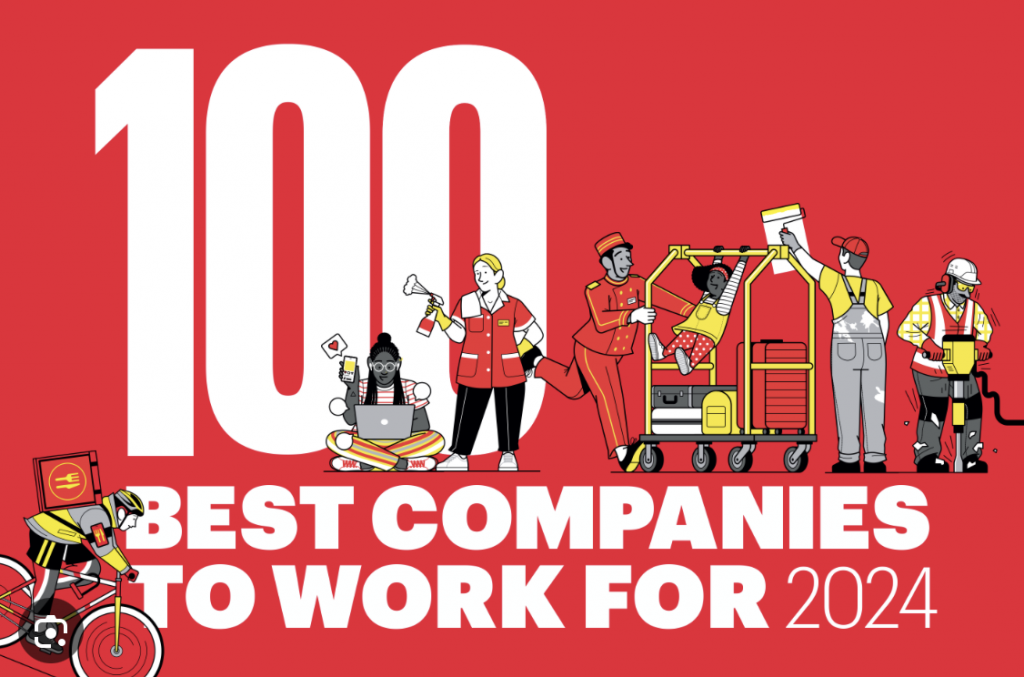
Fortune published their 2024 100 Best Places to Work list recently. It’s highly regarded by major employers and obviously reflects a theme we know to be a top priority for the public, so we thought it’d be fun to compare and contrast against our own JUST Jobs Scorecard, which we released last week.
Although the methodologies and purpose of the two products are very different – JUST’s scorecard is an interactive toolkit designed to help companies track and improve performance and transparency, not a list per se – the results are interesting.
In total, JUST covers 43 of the companies on the Fortune BPW list (the remainder are private or outside our Russell 1000 universe). Of these, 22 are topic or industry leaders in at least one of the six topic areas on the JUST Jobs Scorecard. And yet, only one company earned top marks for its industry on the Wages & Compensation topic, a key priority for the American public. Top companies in the Employee Wellness category in the scorecard tend to be more represented in the Fortune list compared to leaders on other topics. Half of the Top 10 on the Fortune list are represented among the companies that earned the 100 highest overall performance scores in the JUST Scorecard.
This list also marks the last time Alan Murray – their much-admired CEO who is stepping down at the end of the month – will be at the helm. Always a good friend to JUST, Alan’s thoughtful, fearless and often provocative leadership on values-led business and stakeholder capitalism is but one facet of his lengthy career. The success Fortune enjoyed under his tenure is a testament to his business acumen, too. We wish him all the best! His successor, Anastasia Nyrkovskaya, is the first woman to lead the iconic 95-year-old publication.
Be well,
Martin

“I am intimately familiar with what we offer, what’s available to employees. The extra dimension that the JUST Jobs Scorecard gave, in addition to comparability across other companies, was really looking at those programs through an external lens, because you didn’t score things based on what I told you, you scored things based on what you were able to cull out of public information. One use case for the JUST Jobs Scorecard is identifying areas of opportunity where we are doing something but not talking about it outside of our organization.”
JUST Advisor Ursula Burns joins Board Member Dan Hesse’s podcast to discuss her career, her time as the first black woman CEO of a Fortune 500 company, and life lessons–most importantly, “where you are is not who you are.” Listen here.
Fortune reveals that startling stat that nearly nearly 3 out of 4 insurers, representing $13 trillion in assets, say they’re turning to AI to help reduce operating costs.
Must Reads
Fortune releases its 2024 “Best Places to Work” list, and highlights how the nature of the list has changed thanks to changing expectations from Gen Z workers. In their words, “Gen Z doesn’t live to work. They work to live.”
MIT releases a fascinating study showing that the majority of work today occurs in jobs and categories that were all created post-1940, and explores how professions are really created and lost over time.
The New York Times explores new data that shows that, despite the promises made by big Banks, voluntary commitment to reduce climate emissions have been ineffective so far. More inside.
The Wall Street Journal reports that Norfolk Southern has agreed to pay $600 million to settle lawsuits in connection with a toxic train derailment in Ohio early last year.
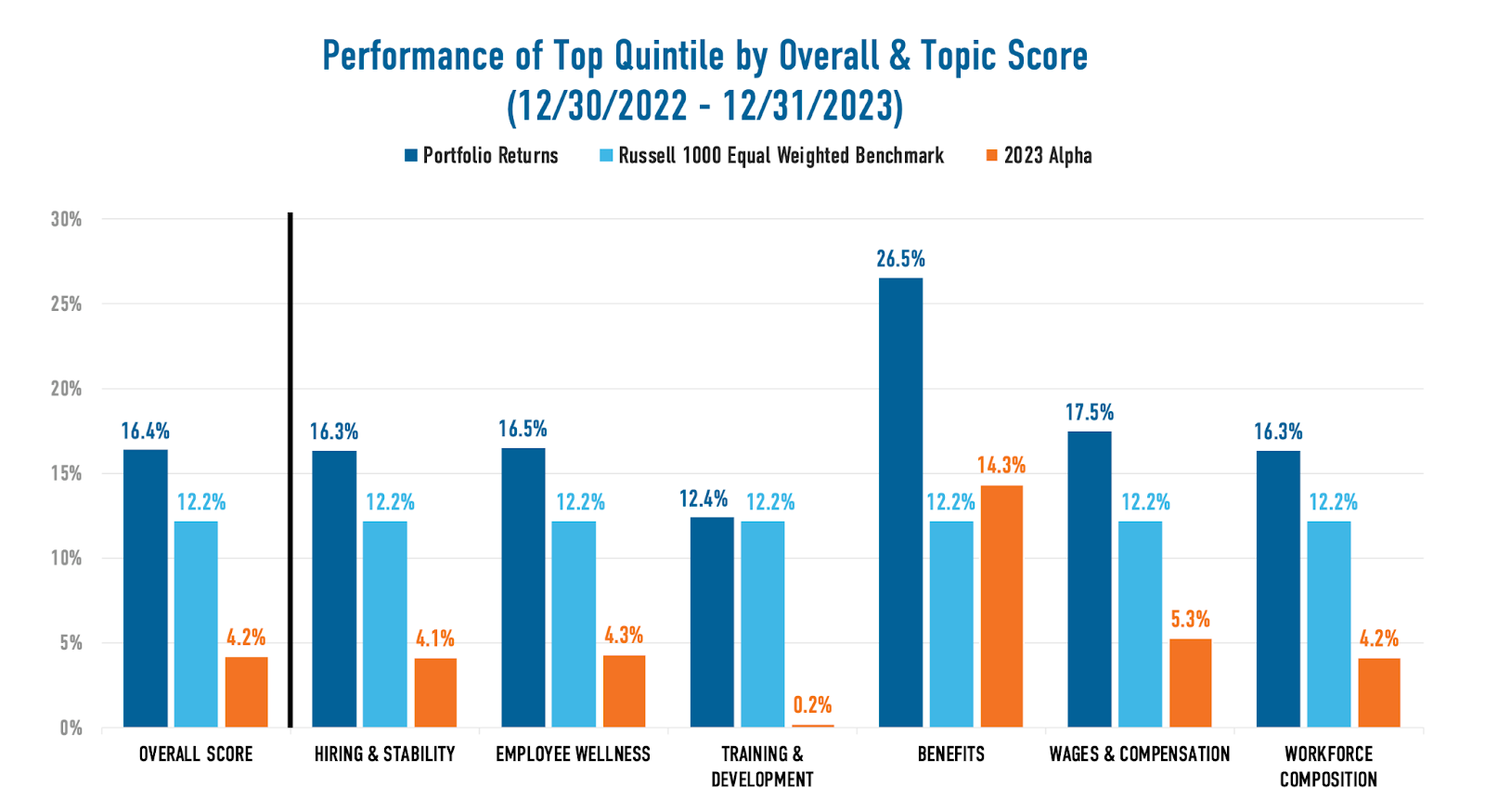
The chart comes from our deep-dive into the insights from our JUST Jobs Scorecard, particularly around stock performance. We examined the market performance of the highest-scoring companies within the top quintile, and discovered that, compared to the benchmark, we found that Scorecard leaders demonstrated substantially superior performance across nearly every Scorecard category, with the difference especially striking for companies that excelled in the Benefits and Wages & Compensation categories. Explore all the insights here.

Investing in human capital is one of the essential elements of business leadership today.
Business Insider’s look at how childcare benefits boost retention – some companies saw positive returns on investment of up to 425% – and a report by Investment News on how companies like DoorDash are experimenting with new financial wellness benefits for gig workers are two recent examples of this in action.
However, without a comprehensive set of metrics and a clear definition of what good actually looks like, it’s very difficult to measure performance on a consistent basis let alone know where to invest in order to improve. Enter JUST Capital’s newest offering – the JUST Jobs Scorecard.
The new tool, funded by the Bill & Melinda Gates Foundation, provides a unique view into how companies are performing and what they can do to improve on 31 distinct data points across six job quality topics, scoring companies on a scale of 0-4, with 4 being the highest. The final score is determined against research-backed thresholds, which range from “no disclosure” to “leading practice” on the issues that JUST tracks. Topics cover the key worker priorities as identified by the public:
Top performers include JPMorgan Chase & Co, Hewlett Packard Enterprise, Dayforce, Starbucks, Union Pacific, and American Electric Power Company.
We offer these scorecards as a resource to anyone interested in improving human capital performance in business. To use the Scorecard visit the tool or get involved by contacting corpengage@justcapital.com.
Be well,
Martin

(Photo courtesy of Dayforce)
“We are collectively redefining how we work – including virtual, hybrid, and the gig economy – resulting in a boundless workforce that is fluid, always-on, and borderless. To keep pace with this rate of change, organizations need to prioritize investments in their people to create an agile and skills-based culture that fosters an engaged and thriving workforce.”
Rob Marsh, our AI Advisor, took to LinkedIn to discuss the future impact of “virtual robots”, AI-powered entities capable of performing a wide range of tasks and even operating autonomously in certain contexts. Read the whole post here.
An artificial intelligence-powered chatbot created by New York City to help small business owners is under scrutiny for sharing bizarre advice that misstates local policies and advises companies to violate the law, the AP reports.
A New York Times article dives into the debate economists are having around how much more efficient AI will make companies in the short term.
A new report by The Financial Times explores new financial products that could incentivize countries to preserve biodiversity and natural resources.
Axios reports on a new study that shows for most employers, childcare benefits pay for themselves through reduced absenteeism and lower rates of attrition. Check out the study here, and then learn more about our own Corporate Care Network initiative.
The EPA releases new, strict emissions standards for heavy-duty trucks in a bid to curb carbon emissions. The Associated Press has the story.
The Wall Street Journal takes a look at how Gen-Z is eschewing colleges and white collar jobs for trade schools and working with their hands, seeing it as a safer, more fulfilling path in a world where the value of a degree is plummeting and AI seems poised to make sweeping job changes across many industries.
Google will delete billions of Chrome browser records in the wake of a lawsuit saying the company was being deceiving by still tracking user activity while in Incognito mode. The New York Times explains.
A new study by Deloitte and Tufts University finds that the large majority of professional investors globally have put in place ESG investment policies over the past several years. These firms cite factors including regulatory requirements, improved performance and talent attraction. ESG Today has the story.
A Wall Street Journal article takes a close look at just how far $100 goes at your local grocery store today after five years of persistent food inflation, a top concern for consumers. Take a look here.
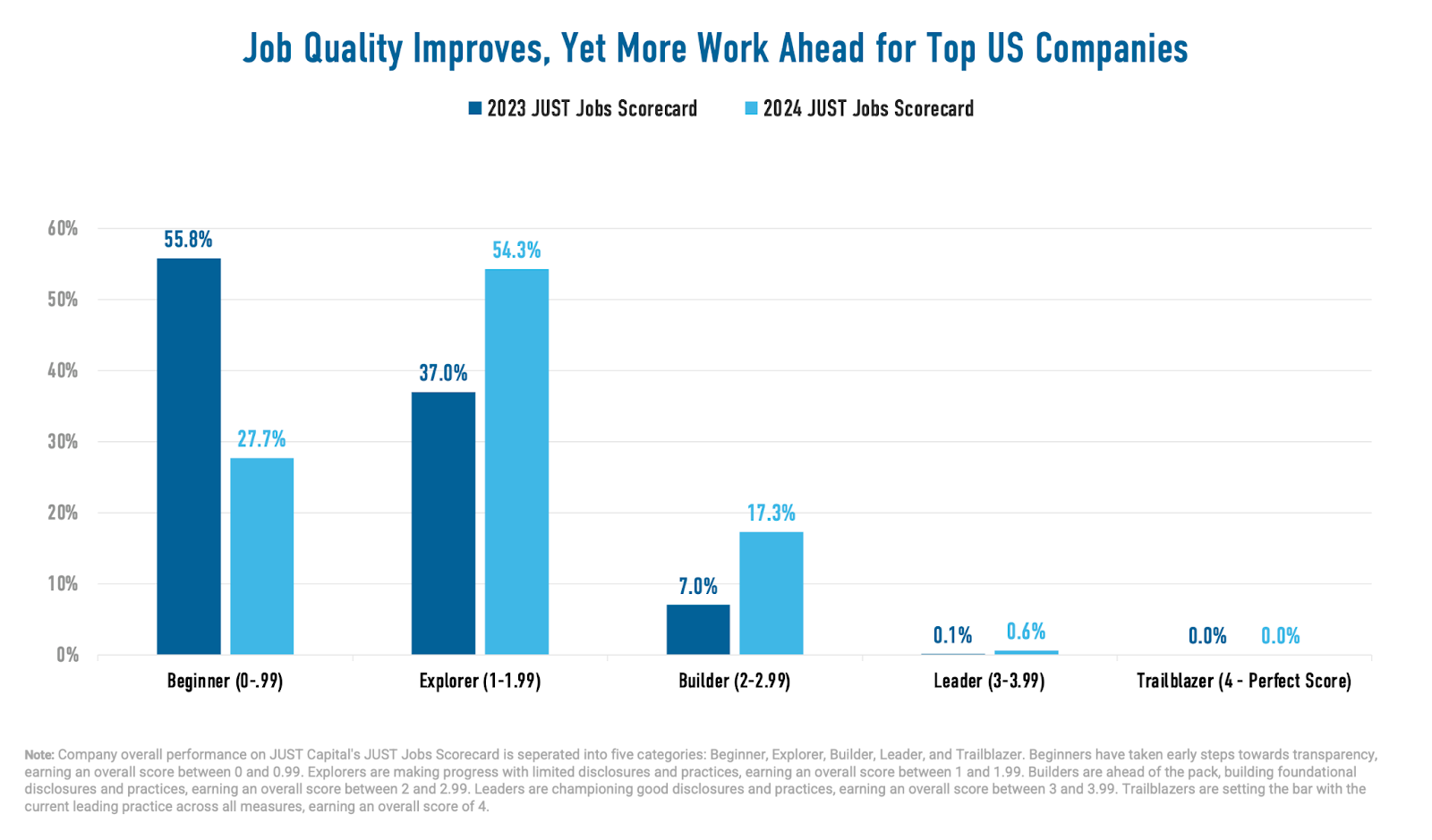
This week’s chart comes from our newly released JUST Jobs Scorecard. While America’s largest companies have more work to do to improve transparency around some key job quality data points, overall performance on the 2024 JUST Jobs Scorecard speaks to noticeable improvement since the 2023 pilot version of this tool. More than one fourth of companies (256 companies, or 27.3% of all scored companies) have moved from the Beginner category (taking early steps towards transparency, overall scores between 0 and 0.99) into the Explorer category. Explore deeper insights here.
NEW YORK – Today, JUST Capital released the second edition of the JUST Jobs Scorecard, a data-driven interactive tool for companies to measure performance and gauge transparency on key job quality practices and worker policies.

The new tool, funded by the Bill & Melinda Gates Foundation, provides a unique view into how companies are approaching one of their most critical stakeholders – their workers – and helps demonstrate how investing in their people can benefit both companies and workers alike. Overall, the Scorecard suggests that actual performance, as well as disclosure and transparency, are all on the rise, and that there is much room for future improvement.
Top performing companies include JPMorgan Chase & Co, Hewlett Packard Enterprise, Dayforce, Starbucks, Union Pacific, and American Electric Power Company. To use the interactive tool and dive into these leading companies’ scorecards, visit https://justcapital.com/the-just-jobs-scorecard/.
“The JUST Jobs Scorecard shows that companies are making steady progress on investing in the American worker,” said JUST Capital CEO Martin Whittaker. “We know from our polling that across demographics and political affiliations, this is what the public wants. And we look forward to continuing our work with companies to help them do this as effectively as possible.”
The Scorecard assesses 31 distinct data points across six job quality topics, scoring companies on a scale of 0-4, with 4 being the highest. The final score is determined against research-backed thresholds, which range from “no disclosure” to “leading practice” on the issues that JUST tracks. Topics include:
After assessing performance and disclosure across all data points, JUST calculates each company’s overall average score in order to categorize their overall performance. Overall performance categories provide a quick snapshot of how far along a given company is on the journey toward transparency on job quality metrics. The following table outlines how companies are increasingly disclosing information related to job quality, but also have room to improve across the board.
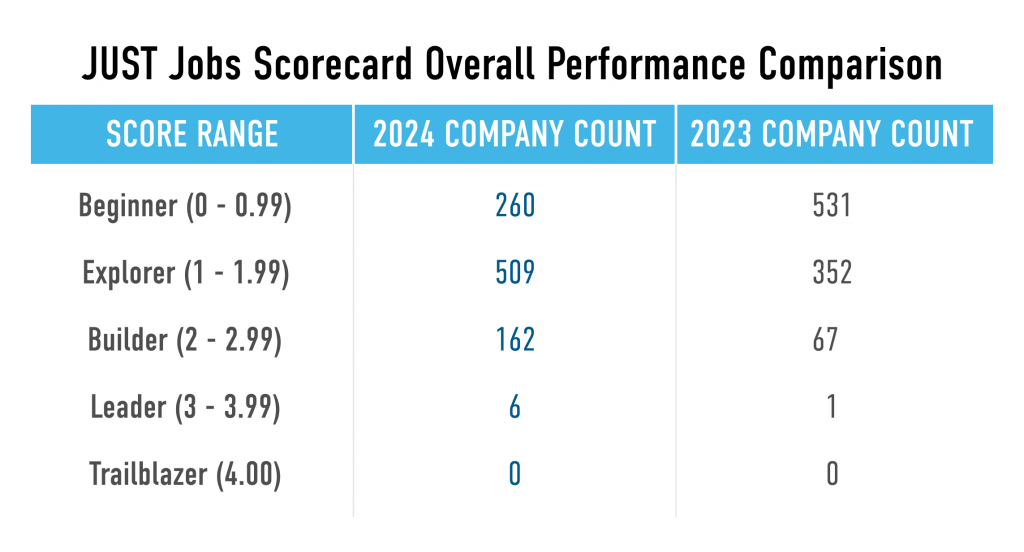
The JUST Jobs Scorecard follows the release of the JUST 100. It is important to note the key ways in which this resource differs from the annual JUST Rankings, both in approach and intended use case. Unlike our annual Rankings, which assess a company’s performance relative to other companies, the Scorecard provides an individual measure of a company’s current standing on job quality disclosure and performance relative to minimum, common, and leading practice standards.
JUST Capital’s 2024 Rankings spotlight the corporations who are performing best on the business issues most valued by the American people. These rankings are determined by scoring performance across the full range of criteria and comparing companies head to head. For the annual Rankings, JUST Capital collects and analyzes corporate data to objectively evaluate the 1,000 largest public U.S. companies across 20 Issues identified through comprehensive, ongoing public opinion research on Americans’ attitudes toward responsible corporate behavior. JUST Capital has engaged more than 170,000 participants, on a fully representative basis, since 2015.
JUST Capital is an independent nonprofit that demonstrates how just business – defined by the priorities of the public – is better business. JUST’s process is objective, data driven and non-political. Its rankings consistently demonstrate that the companies that score best on the Issues Americans care about most also outperform their peers financially.
For more information, please reach out to marketing@justcapital.com
