

Americans overwhelmingly agree that this is a moment for a “Great Reset.” What does that mean? It means people believe the pandemic has landed our society at a critical crossroads. It means people want to seize the opportunity to build a more just, inclusive economy that works for all Americans. It means widespread popular support for the “stakeholder-based” approach to corporate value creation, accountability, and purpose that the Business Roundtable embraced last August (more to come soon on how the signatory companies have actually done this year).
A few short months ago, it seemed that genuine change might indeed be upon us. Our COVID-19 Corporate Response Tracker highlighted corporate leadership across multiple worker criteria, and our polling with The Harris Poll found that the vast majority of Americans agreed with actions companies were taking. Record capital flows into ESG investing strategies suggested investors also approved.
Fast forward to today, and there are real grounds for concern. Axios’ Dion Rabouin highlights the “two coronavirus realities” in America right now that threaten to further entrench the inequalities that plague us. Our Research team shows in a new analysis that nearly three-quarters of Americans who missed work due to the coronavirus received no pay whatsoever. And as we pointed out last week, corporate actions to protect worker health, extend hazard pay and protect jobs are faltering. Even efforts to portray ESG as feel-good social activism are proliferating (you can read our take on a Department of Labor proposal in this vein.)
In last week’s JUST Quarterly Call, Humana CEO Bruce Broussard demonstrated what leadership really looks like. He acknowledged the challenge of delivering short-term returns to shareholders while also creating long-term value through investments in one’s workforce and communities. But he noted that managing such balance is what it takes to be a leader. “If you tilt from one side to the other, and you’re not making that balance, the organization is harmed and the constituencies are harmed for some period of time,” Broussard said.
The market is telling us, via our polling, what it wants, and why it matters to companies. Leadership, as defined by Broussard, will confer competitive and business advantage, and serve shareholders better over the long term. Yet the Great Reset continues to hang very much in the balance.
Be well.
– Martin Whittaker
Google plans on keeping employees at home until the summer of 2021.
McDonald’s requires face masks in all U.S. restaurants, including franchises. Marriott also announces that all of its hotel guests in the U.S. must wear a face covering starting this week.
Morgan Stanley becomes the first U.S.-based global bank to join PCAF and its Steering Committee as part of its commitment to measuring and disclosing its approach to climate change risk and opportunity.
Target joins Walmart in ending Thanksgiving store shopping in 2020.
How do you keep a prolonged WFH workforce engaged? Balance short-term customer needs in the midst of a pandemic while delivering long-term shareholder value? Check out key insights from our latest Quarterly JUST Call featuring Humana CEO Bruce Broussard.
How is corporate transparency on racial equity driving investment decisions? Watch the video replay of our discussion with representatives from two of America’s largest pension funds and Bloomberg’s chief diversity reporter. Bloomberg reported on the conversation, highlighting our latest EEO-1 analysis, and how few companies are actually disclosing diversity data despite heightened commitments for racial equity in the workplace.
We took a look at the proposed Department of Labor rule that would cut ESG out of 401(k) plan’s, and show why it would be bad for investors and retirees. You can also read our official comment to the DOL.
The Wall Street Journal highlights the many difficulties companies are discovering with having near entire workforces working-from-home. And with WFH policies being extended, it looks at the growing conflicts between parents’ child care needs and their ability to get work done.
With the debate raging around unemployment benefits, NPR takes a look at whether or not the expiring $600 per week additional payment is a “poverty remedy or job slayer.”
Bloomberg highlights how disability rights are gaining traction with ESG investors.

This week, we expand on our worker investment research and analyze company performance on our “Pays a Fair Wage” metric. Companies that score in the top quintile for this metric have returned 6.5% relative to their industry peers compared to companies in the bottom quintile, which have seen a -3.0% return relative to their industry peers.
In last week’s Chart of the Week, we evaluated company performance against the estimated percentage of employees making a living wage. This week, we’re again considering the relationship between workers’ financial stability and their company’s performance, this time based on our “Pays a Fair Wage” metric. This offers some insight into how companies’ wages differ across various job titles when compared to industry peers.
Whether or not a corporation pays a fair wage to their employees based on job level, qualifications, and experience is the most important issue to the American public according to JUST Capital’s polling on just business behaviors – and that makes it the highest weighted issue when compiling our Rankings.
When we consider the fair pay scores for the companies in our Rankings during the current economic downturn, those that scored in the top quintile on this metric returned 6.5% relative to their industry peers. Those that scored in the bottom quintile saw a -3.0% return relative to their industry peers.
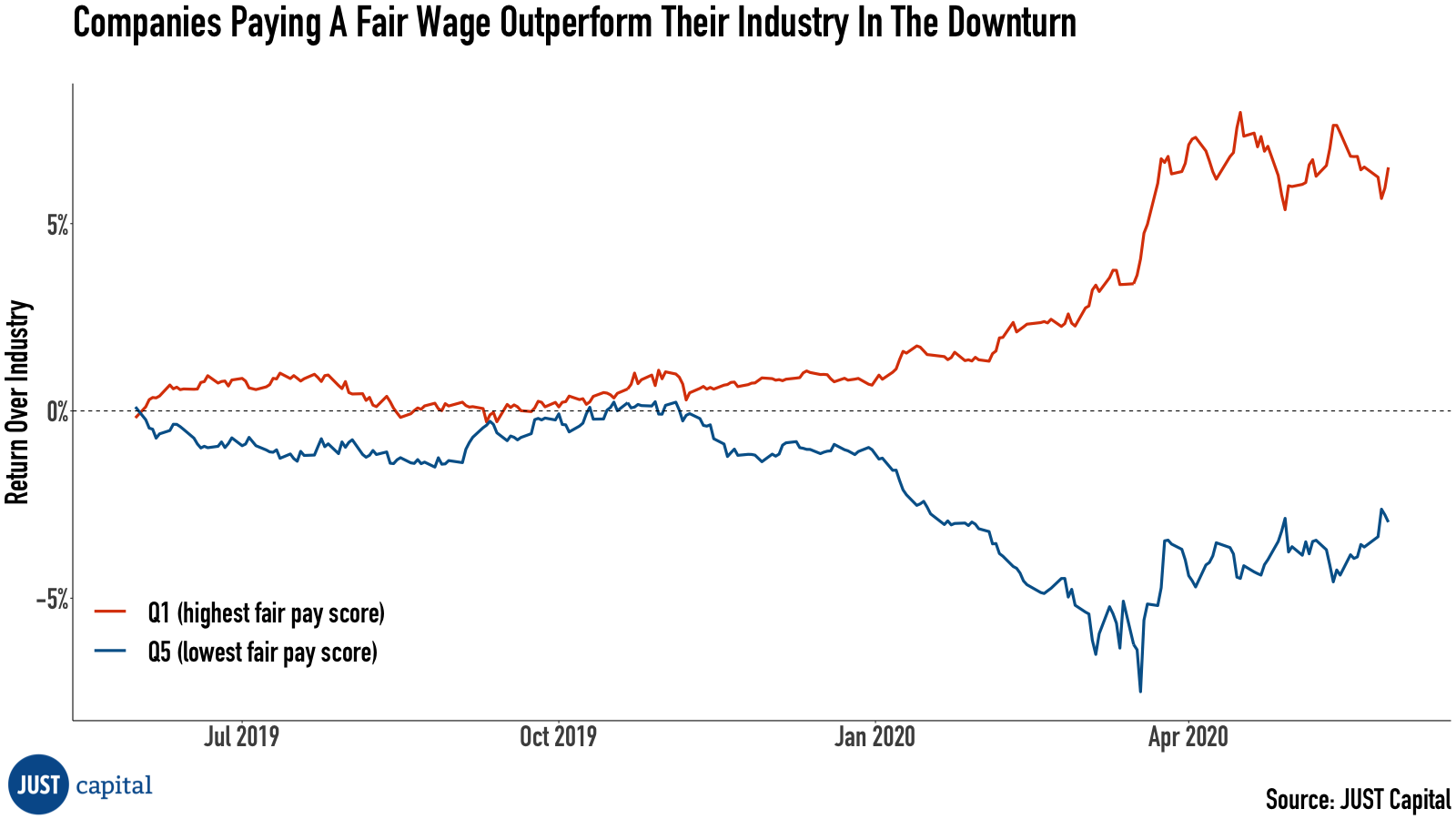
The Fair Pay Score metric that we used in the chart above is a comparison of a company’s wages to industry peers’ wages by job title. This means that companies that pay a high wage to all their workers relative to their industry receive a higher score than those that don’t. Unlike the concept of a living wage, this metric is relative.
As the Financial Times reported this month, raising pay for your employees during a crisis can provide long-term benefits, further substantiating our results above. While firms continue to cut costs on office space, travel, sponsorship, and advertising, they are presented with a unique opportunity to reset the way their employees are incentivized and strengthen the relationship with their workforce. As we show above, there’s evidence this is yet another case of a win-win for both employers and employees.
If you are interested in supporting our mission, we are happy to discuss data needs, index licensing, and other ways we can partner. Please reach out to our Director of Business Development, Charlie Mahoney, at cmahoney@justcapital.com to discuss how we can create a more JUST economy together.
If you have questions concerning the underlying analysis, please reach out to our Senior Manager for Quantitative Research, Steffen Bixby, PhD, at sbixby@justcapital.com.
Last week, Amazon opened its first automated grocery store in Seattle – Amazon Go – allowing customers to stroll in, grab the items they need, and leave without having to stop at check out. This is all thanks to cameras and AI algorithms that track what shoppers pick up along the way, eliminating the need for cashiers entirely.
Known for its ever-changing, groundbreaking technological innovation, Amazon has been shifting the retail landscape since day one – not only for consumers but for employees. So what could this latest change mean for American retail workers?
JUST Capital’s wage model includes estimates for employment by title, wage, and location for over 14 million American workers at the 140 largest retail and service sector companies. Using this data, we looked at what would happen if cashier duties at all these companies becomes completely automated, as they are at Amazon Go. We found that nearly 1.8% of the U.S. private sector workforce – that’s 2.3 million Americans working for companies like Walmart, Target and The Gap – could be affected, representing roughly two-thirds of the 3.4 million cashiers throughout the U.S.
The potential impact at the local level could be profound. In Los Angeles for example, the total automation of cashier duties would reduce the number of retail workers within the greater Los Angeles County by an estimated 49,000. In Dallas County, 19,381 workers would be affected.
In terms of the impact on payroll, we estimate the 2.3 million jobs affected translate into nearly $37 billion in potentially lost income nationwide. While this is a mere 0.6% of the country’s $5.643 trillion private sector income, in some regions the impacts could be material, not only in terms of lost income, but also the additional participation in public support programs (such as food stamps and Medicaid) if these workers are unable to find new jobs.
Of course, this scenario is a hypothetical – not predictive – consideration of the shifting brick and mortar landscape, but the future of work no doubt stands as a growing question in America, particularly for workers in the retail industry. Technological progress is inevitable, but its potential implications are wide-ranging – Will automation destroy or create new jobs? Who will take the lead in the critical task of new skill development and job retraining? Will we generate more or less income with the advent of new technology? How might changes affect the government subsidies many Americans rely on to make ends meet? And where will these shifts be most felt?
As the top company in JUST Capital’s rankings when it comes to job creation, Amazon is expected to grow its business considerably throughout the next year – with 50,000 new jobs planned for its anticipated second headquarters. With U.S. jobs among the top priorities for the American people, JUST Capital will continue to track Amazon’s impact on both job creation and elimination in the company’s own stores, distribution centers, and corporate headquarters, as well as throughout the American retail landscape.
This article was originally published on Forbes.com.
After three years of polling, one of the things we know to be true is that Americans view worker pay-related issues as being at or close to the top of the list when it comes to just corporate behavior. Living wage (am I paid enough to support basic living costs?) and fair pay (am I paid fairly for the job I do relative to others doing the same job?) are the most important, but the ratio of CEO pay to “average worker” is also often mentioned as an additional measure of justness.
Last week, in another effort to reverse Obama-era legislation, the Treasury Department recommended the reversal of a Dodd-Frank rule, due to go into effect next year, that requires companies to disclose the pay ratio between CEOs and average workers. Republicans argued that the rule undercuts the market, aims to shame chief executives, and by extension, discourages companies from going public.
The rule, however, would also serve to shed a clearer light on a core issue that Americans care about, and based on research from the Economic Policy Institute, we already know that the CEOs of America’s largest firms earn far more today than they did in previous decades, with CEO compensation having risen a whopping 807 or 937% (depending on how it is measured) from 1978 to 2016. A recent study from The Conference Board showed that the median pay for CEOs of S&P 500 firms was $11.5 million in 2016, up 6.3% from the prior year. Compare this with the decades-long stagnation in real wages for average workers and the 2.9% increase in average hourly earnings for all employees in the private sector last year.
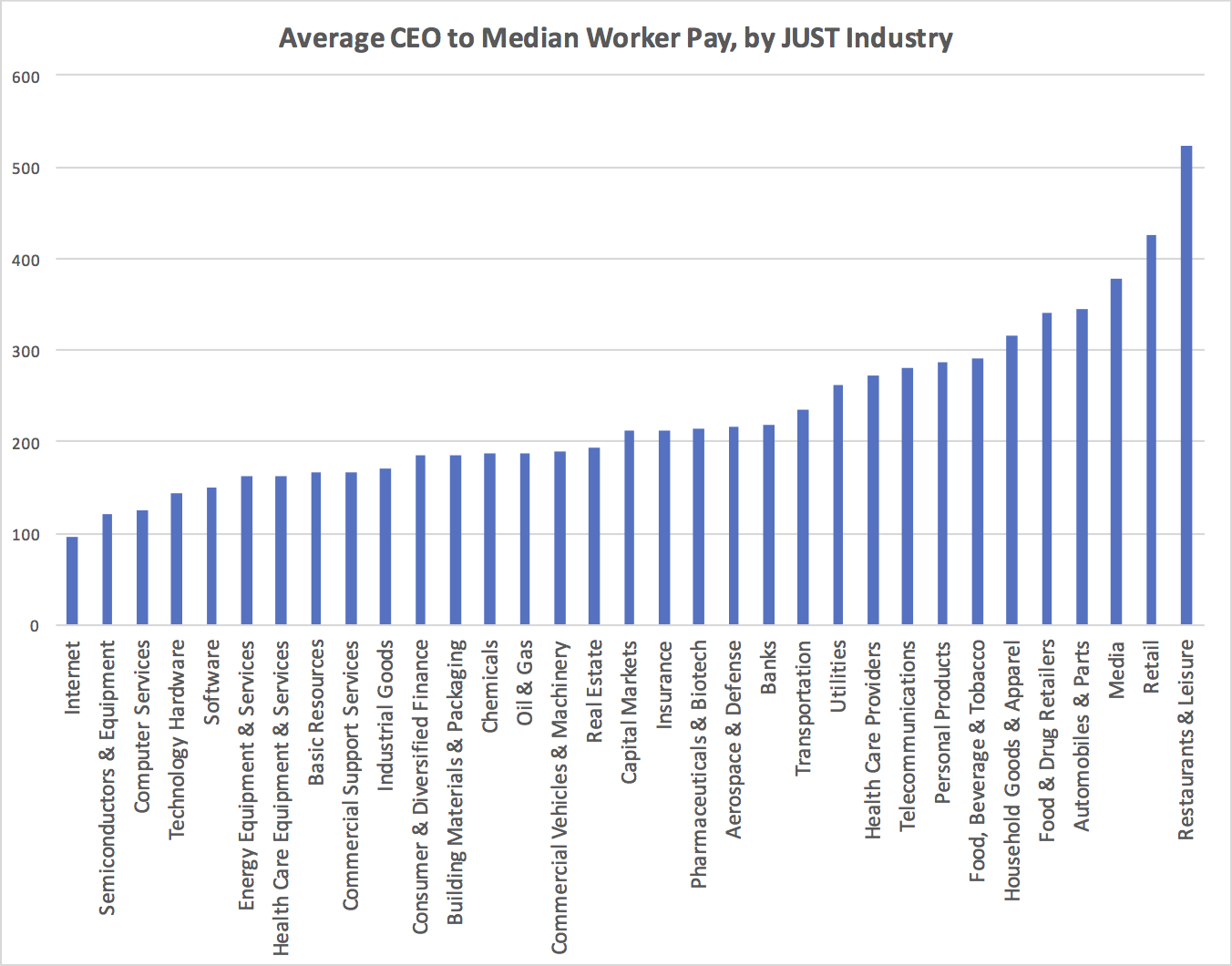
JUST Capital’s breakdown of CEO-to-Median Worker Pay ratios for the top 1,000 publicly traded companies in America provides some fascinating context on the issue. Take the industry comparisons, for example. Ratios tend to be much “lower” (between 100 and 150:1) in technology fields, where workers are paid more on a relative basis and many tech CEOs are company founders with high ownership interest, tending to pay themselves less in salary. At the other end of the spectrum, in Retail and Automobile industries for example, a proliferation of lower skilled workers with lower pay results in very high discrepancies between the earnings of CEOs and workers, in some cases above 400:1.
Based on our own studies, the increasing gap between CEO and employee pay in 2016 may actually be even greater than The Conference Board reports. SEC reporting rules for executive compensation require companies to report stock-based compensation in the year in which it’s granted, not necessarily as its earned. For example, Apple CEO Tim Cook has earned an average of just over $7 million annually over the past five years, but he also received a $376 million bonus in 2011 that does not fully vest for 10 years. Under JUST Capital’s methodology, that bonus would then be spread evenly over 10 years and added to other annual compensation received during that span. Our numbers also include all executives who have held the title of CEO and/or Executive Chairman in a given year, while excluding all one-off cash payments (severance for departing executives and so-called “make whole” payments to new CEOs).
Using this methodology across the 728 companies in the Russell 1000 for which we have compensation data for both 2015 and 2016, median CEO compensation actually increased 9%, more than triple the average hourly earnings for employees in the private sector.
Looking at CEO compensation in proportion to JUST Capital’s estimates for average U.S. worker pay at these companies, the gap continued to widen. In 2016, the median CEO compensation was 204 times that of the average worker, a 7.3% increase from the prior year’s figures.
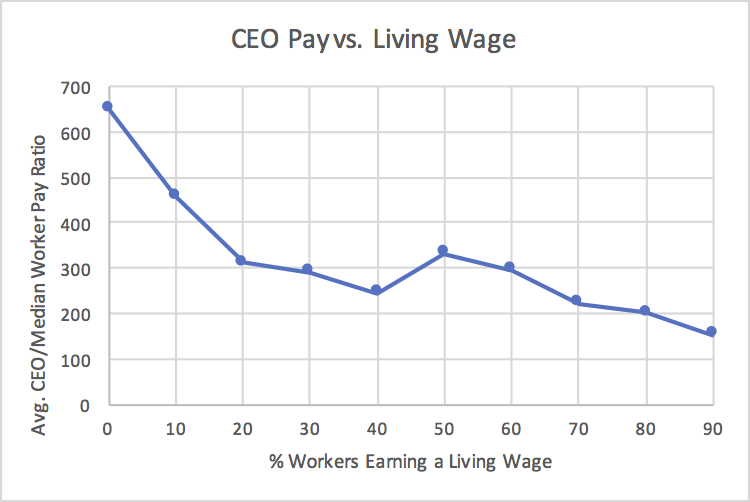
We also took a look at how this ratio compares to other measures of worker pay. For example, we found that the companies that pay the majority of their workers a living wage tend to have a narrower gap between CEO and employee pay. Conversely, the gap is typically wider for companies that pay only a low percentage of workers a living wage. This stands to reason, as low-gap companies are in higher earning industries where more employees make a living wage.
Coming back to the polling results, it is not clear what a fair or just CEO:Median Worker Pay ratio actually is, or what people think it should be. Ordinary workers are more concerned with putting food on the table for their families and being treated fairly relative to their coworkers. When it comes to CEO pay, however, we think the real moral of the story is not only that the numbers be disclosed, but that we consider them in the context of fair treatment and shared value. High CEO pay may be perfectly fine in situations where companies are doing well financially and all workers are sharing in that. Or where workers themselves feel fairly compensated and make more than a living wage. Where the red flags exist are where too many people do not make a living wage, where CEOs are taking too much of the pie at the expense of workers, or where there is some other obvious injustice or imbalance. Boards of Directors setting executive compensation packages would do well to keep this in mind. Going forward, we’ll continue to track CEO pay ratios, and hope that companies will disclose these numbers, providing transparency on the issues Americans care most about, whether they’re required to or not.
