
(Target)
This week marks the third anniversary of the launch of Goldman Sachs’ JUST ETF. The fund tracks our Rankings-based JULCD Index, which we’re happy to report has both outperformed the Russell 1000 cumulatively by 6.17% since inception and showed genuine impact. Of course, much has changed over this time, as MUFG’s excellent recent report, “ESG’s Acceleration,” shows. For anyone seeking a comprehensive breakdown of the critical themes shaping the landscape today, look no further.
Their analysis of the 435 ESG resolutions of this year’s proxy season was especially revealing, in that it showed the range of issues investors were most concerned about and a surprising degree of alignment with our polling results on the priorities of the public.
Corporate political activity (lobbying, etc), climate, human capital issues – notably workplace diversity – and human rights stand out. And whereas the climate campaigns at ExxonMobil and Chevron understandably garnered most of the press, the less heralded shareholder votes in support of releasing EEO-1 diversity data at DuPont, board diversity requirements at Expeditors, arbitration policy transparency at Chipotle, and political spending transparency at McKesson and Omicon Group perhaps signal where investor activism is now headed.
We have oft noted that as shareholder demand for action on human capital and DEI metrics rises, so attention will focus on the need for better data and standards, and greater performance transparency overall. We stressed this in our public comment submitted to the Securities and Exchange Commission this week. Overall, it feels we may be entering a new worker paradigm, where we either listen to, reward, and value people appropriately, or we continue the slide toward division and discord. Humanity at work is a powerful thing (as fans of Undercover Boss will attest), but ultimately, it just makes good business sense.
Speaking of listening to workers, it was corporations like Allstate, Nike, and Target that acknowledged the wishes of their workforces last year and made Juneteenth – a day that celebrates the end of slavery in America – a company holiday. We did the same, and are happy to see with the passing of a law on Thursday that the entire country will be honoring a historic moment with a day of celebration, too.
Be well,
Martin Whittaker
GE announces new partnerships to advance wind turbine recycling technology in order to make it a more viable portion of its business.
General Motors is investing 30% more into electric vehicle production and working on building additional battery plants.
Fifth Third Bancorp is committing $2.8 billion to an equity and inclusion initiative.
Microsoft releases a progress update on its racial equity commitments, showing where the company has invested in Black communities in the U.S.
Morgan Stanley launches a toolkit as part of its Impact Investing Platform to help users invest in companies and products with a racial equity and social justice lens.
PwC aims to increase its employee count by 100,000 over the next five years, with much of the increase involving building out corporate ESG expertise.

June 24th at 1PM ET: Join JUST Capital and the Brookings Metropolitan Policy Program to discuss how private sector leaders can advance racial equity within their companies, communities, and regional economies, featuring speakers from CenterState, Cincinnati U.S. Regional Chamber, and Brookings Institute. Sign up to attend here.

New Yorkers celebrating Juneteenth last year. (Michael Noble Jr./Getty Images)
“This is an opportunity just to sit down and talk. Get it straight from the employees – get their thoughts, their feelings, what it means to them. … That’s the spirit of Juneteenth. It’s about reflection, it’s about getting together and talking about what you’ve been through, what you’re going through, what you want to do. … It’s about celebrating everybody’s history, everybody’s contribution.”
“When businesses act ethically and make a meaningful impact on society, they can create bigger and more sustained outcomes for themselves and their people and broader stakeholders. If the past year has taught us anything, it is that embedding ESG into an organization’s core can be a significant part of reducing the risks and gaining opportunity.”
“It has been a paltry number, even the pipeline is paltry today. So there’s a lot of work that has to be done for African American women or for Black women anywhere in the world.”
The Financial Times reports on one of the biggest stories coming out of the G7 summit – that G7 countries are formulating a “green belt and road” plan to counter China’s influence, with the hopes of investing billions in green energy in developing countries.
Axios discusses the upcoming “great resignation,” with polling showing that 25% to 40% of workers are considering leaving their jobs.
The Wall Street Journal takes a deeper look at the future of workplace benefits as hybrid work becomes the new normal for many companies.
Morgan Stanley takes a hard look at how the pandemic has set the stage for an inflation surgeand hotter, but shorter, economic growth cycles (reposted via Zero Hedge).
The New York Times reveals the results of a months-long investigation into worker issues at an Amazon warehouse in New York. One surprising stat: “Even before the pandemic, previously unreported data shows, Amazon lost about 3 percent of its hourly associates each week, meaning the turnover among its work force was roughly 150 percent a year. That rate, almost double that of the retail and logistics industries, has made some executives worry about running out of workers across America.”

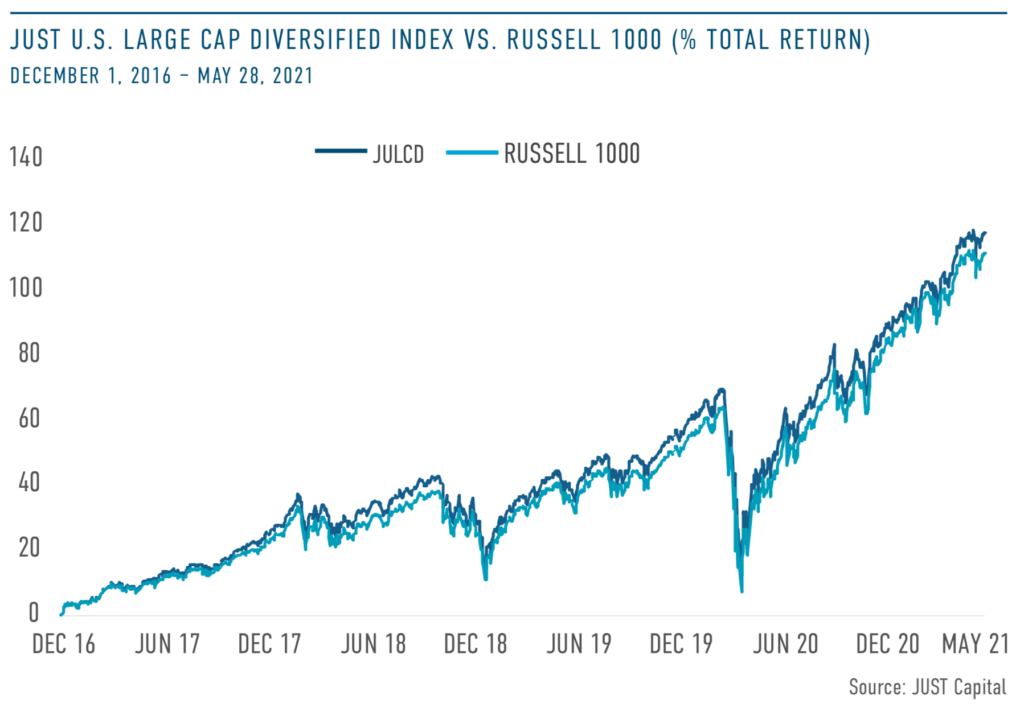
For the three-year anniversary of the JUST ETF, we take a look back at the performance of the JULCD Index that the ETF seeks to track, showing that it has outperformed the Russell 1000 cumulatively by 6.17% since its inception (Dec. 1, 2016 to May 28, 2021). Learn more here.
This week’s chart is timely as the Goldman Sachs JUST U.S. Large Cap Equity ETF (JUST ETF) recently hit its three-year anniversary on June 13, 2021. The fund, which began trading on the NYSE Arca in 2018, seeks to track the JUST U.S. Large Cap Diversified Index (JULCD), constructed and managed by JUST Capital and composed of the top 50% of Russell 1000 companies in each industry, based on JUST Capital’s annual Rankings.
Looking at the JULCD Index that the ETF seeks to track, we see it has outperformed the Russell 1000 cumulatively by 6.17% since inception in the 4.5 year period ending in May (Dec. 1, 2016 to May 28, 2021). Additionally, over the past year, the tracking error of the JULCD index relative to the Russell 1000 is 1.54. This indicates the benchmark is closely tracking the returns of the Russell 1000 to provide market beta, but sees additional alpha on a cumulative basis from JUST Capital’s Annual Rankings and methodology.
Given the JUST ETF anniversary and the past year’s surge of flows to ESG funds, we wanted to resurface a speech that JUST Capital’s Co-Founder and Chairman, Paul Tudor Jones, gave at the 2019 Inside ETFs conference. In his keynote, Jones highlights that the companies working to build a more just and equitable economy are also those that continue to deliver lasting value to shareholders. You can watch the full talk below:
Furthermore, companies in the JULCD are driving positive change on the issues our polling shows the American public expects a response to,including worker pay and well-being, customer treatment and privacy, environmental impact, job creation, and investing in communities.Compared to Russell 1000 companies excluded from the Index, 2021 JULCD constituent companies on average:
As the JUST ETF continues into its fourth year, we have seen the fund reach $238 million in assets under management (AUM), be named the Best New ESG ETF and a finalist for ETF of the year from ETF.com, and receive a Morningstar Analyst Rating of Bronze in December 2020.
The Investor Solutions team at JUST Capital continues to expand the suite of products tracking our in-depth company research and polling of the American public. We firmly believe that together we can create a more just and equitable marketplace that works for all Americans. Please reach out using the link below if you have an interest in partnering with us to launch the next stakeholder-driven strategy.
If you are interested in supporting our mission, we are happy to discuss data needs, index licensing, and other ways we can partner, please fill out our request form to answer a few questions, and someone from our Investor Solutions team will reach out to you within two business days.
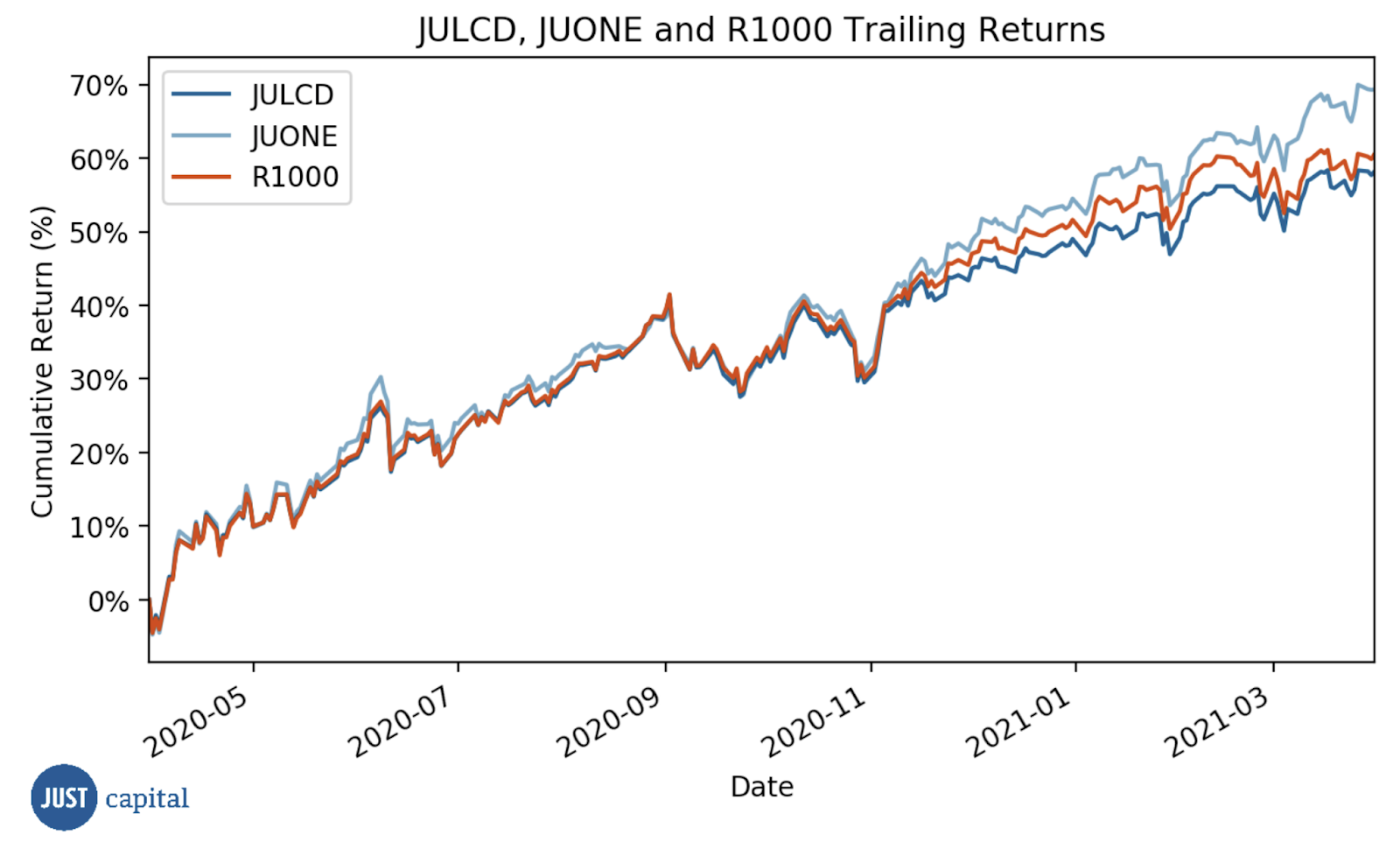
Our chart this week looks at the performance of our two active indexes – the JUST 100 (JUONE) and the JUST U.S. Large Cap Diversified (JULCD) – over the trailing year relative to the Russell 1000 Index.
The JUONE Index, recently hitting its two-year anniversary since inception on March 22, 2019, was constructed to track JUST Capital’s 100 highest-ranked Russell 1000 companies on an equal-weighted basis and includes the best-performing companies in our annual Rankings of America’s Most JUST Companies. Looking at the performance of the JUST 100, we see significant alpha relative to the average Russell 1000 company we rank, with JUST 100 companies returning 69.3% over the trailing -year and the average Russell 1000 company at 60.6% as of 3/31/2021. Our broad-based JULCD Index has slightly underperformed the Russell 1000, returning 58.2% over the trailing year.
Investors continue to see value in the JUST methodology, as the Morningstar bronze-medalist JUST ETF – which tracks the broad-market JULCD Index – continues to scale and recently crossed $225 million in assets under management, a 20% increase in assets since year-end. While we have a strong partnership with Goldman Sachs with the JUST ETF, JUST Capital is actively seeking a dedicated asset management partner interested in launching an investment product around the JUST 100 Index.
Highlighting unique attributes of the JUST 100 further:
The JUST 100, as we see above, is a unique portfolio of companies driving stakeholder capitalism forward, going above and beyond to advocate for the environment, their workforce diversity, and better pay for their workers. Given the leadership, performance, and impact of JUST 100 companies, it is clear that a JUST 100 thematic investment product fits a unique need in the market as our methodology and Rankings reflect the priorities of the American public.
Please don’t hesitate to reach out to our Investor Products team if you are interested in speaking further about the JUST 100 Index.
If you are interested in supporting our mission, we are happy to discuss data needs, index licensing, and other ways we can partner. Please reach out to our Director of Business Development, Charlie Mahoney, at cmahoney@justcapital.com to discuss how we can create a more JUST economy together.
This week’s chart looks specifically at our Workers stakeholder once again, homing in on corporate Workforce Investment and Training – the second most important worker-related issue per the American public’s opinion. We considered the trailing one year, as of Feb. 28, for the Russell 1000 companies we track, and split them into five quintiles based on how they scored on this issue in our current ranking of most just companies. Looking at the data, the top quintile of just companies with the best Workforce Investment and Training score outperformed the bottom quintile by 5.01% over the past year.

The companies that score high on this issue are companies that provide opportunities for advancement, skills development, and educational attainment to employees. This encapsulates job quality, job stability during COVID-19, and whether or not companies prioritize career development within their workforce.
JUST Capital continues to build the case for investing in your workforce through launching corporate programs like the Worker Financial Wellness Initiative, formed in partnership with PayPal, the Financial Health Network, and the Good Jobs Institute. The initiative was established to make workers’ financial security and health a C-suite and investor priority. The initiative calls on the CEOs of America’s largest companies to conduct a Worker Financial Wellness Assessment as a vital first step toward understanding the financial vulnerability of their workforce. Research from the Good Jobs Institute shows that when workers are more financially secure, key business outcomes such as productivity, customer satisfaction, and employee turnover and engagement also improve.
Looking to our chart above, the companies that have invested in their workforce have outperformed those who haven’t for the duration of the pandemic.
If you are interested in supporting our mission, we are happy to discuss data needs, index licensing, and other ways we can partner. Please reach out to our Director of Business Development, Charlie Mahoney, at cmahoney@justcapital.com to discuss how we can create a more JUST economy together.
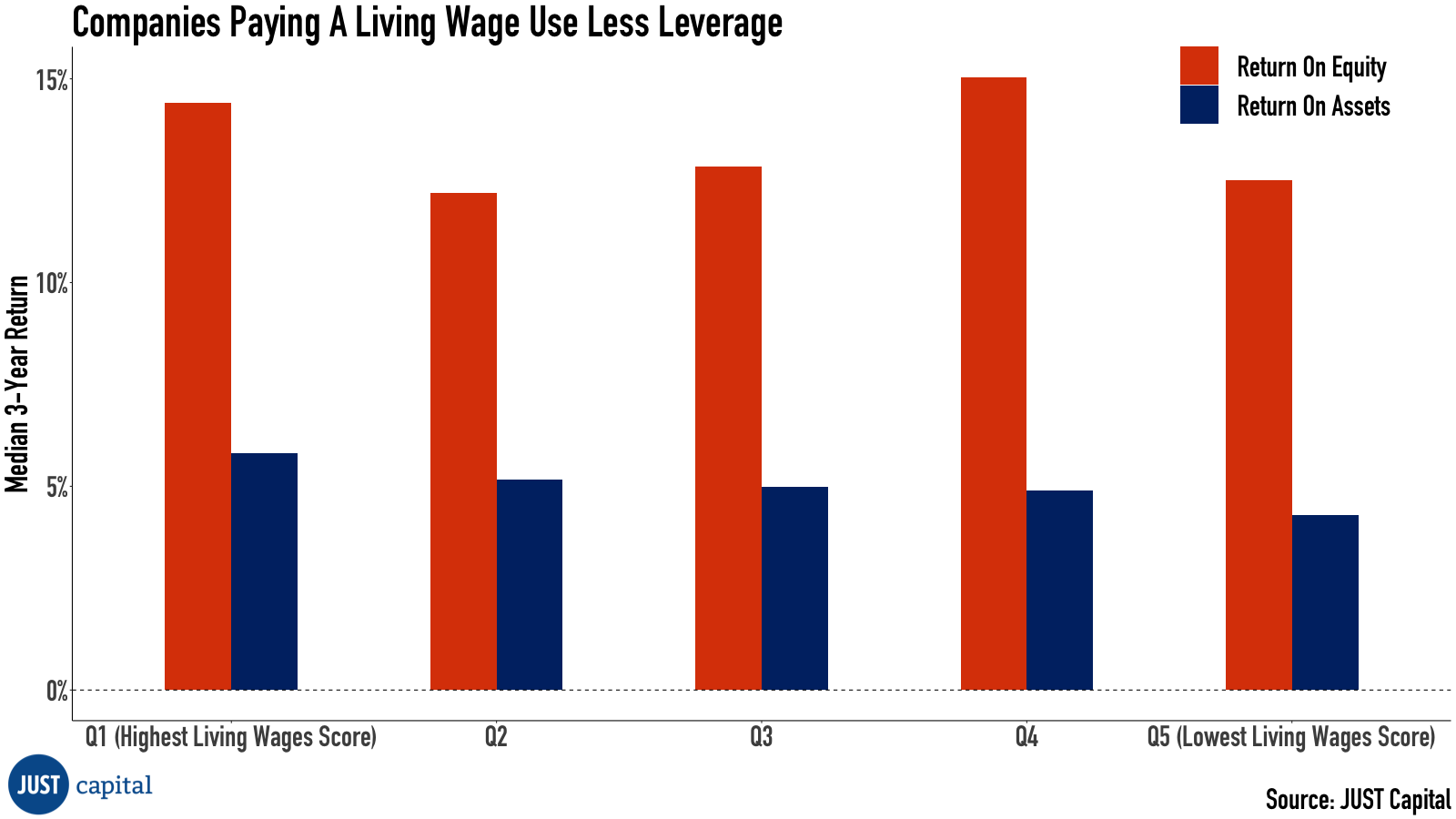
In this week’s Chart of the Week we take a look at the Living Wage Score* across all companies we rank within the Russell 1000 universe, splitting the companies into five quintiles from the highest score to the lowest on an industry-neutral basis.
Our Living Wage Score is based on an estimated percentage of on-site workers making a living wage, which is the level of income needed to meet basic needs, adjusted for location and family size, and not accounting for short- and long-term savings or burdensome expenses like debt.
Looking at the data for the Return on Equity (ROE) across the five quintiles, we see no meaningful trend using the trailing 3-year median. However, there is a trend in Return on Assets (ROA) with companies that we estimate pay more of their workers a living wage outperforming those that don’t.
(JUST Capital)
ROE is an important measure of a company’s financial performance and profitability. It represents how many dollars of net income a company generates in any given year per dollar of equity, and is driven by three main components: operating efficiency, asset efficiency, and financial leverage. The product of the first two is also known as ROA, or the net income per average assets.
Looking at the trend in ROA but not in ROE in the chart above, there is the implication that companies we estimate pay relatively fewer workers a living wage are also companies that take on more financial leverage – and thus more risk – than those that pay more workers a living wage in order to deliver the same level of profitability.
The Good Jobs Institute is one of our partners in the Worker Financial Wellness Initiative we cofounded with PayPal, and it has done extensive research on the benefits of what it calls “The Good Jobs Strategy,” which includes raising wages to avoid any worker struggling to make ends meet. From the WFWI’s guide on how what “worker financial wellness” means and how it can be measured, here’s an overview of a case study on Quest Diagnostics:
“After consolidating 20 call centers into two, Quest Diagnostics experienced 60% turnover, which cost the company $10.5 million each year in direct replacement costs alone. Quest implemented the Good Jobs Strategy by raising wages, creating a more clear career path with incremental pay raises, and improving training. It simultaneously raised expectations of employees, with a more stringent attendance policy and better performance metrics. It improved operations as well, reducing non-value-add call volume and creating ‘model pods’ to drive employee engagement and identify high-leverage improvement opportunities. Within 18 months, turnover rates were cut in half and unplanned absenteeism dropped from 12.4% to 4.2%. Quest’s service improved too: Its 60 second answer rate went from 50% to 70% and call transfer rate from 12% to 9.5%. And they realized $1.3 million in run-rate cost savings from process improvements, many driven by their call center reps.”
Put simply, GJI’s research has found that companies’ investments in living wages and complementary operations improvements drive worker engagement, which in turn drives productivity, and that ultimately creates value for shareholders. It has found that this has worked across different sizes of companies, and across all industries, including ones with notoriously low profit margins, like certain sectors of retail.
If you are interested in supporting our mission, we are happy to discuss data needs, index licensing, and other ways we can partner. Please reach out to our Director of Business Development, Charlie Mahoney, at cmahoney@justcapital.com to discuss how we can create a more JUST economy together.
*Note on the Living Wage Score: Our proprietary living wage model uses geocoded data on a company’s locations across the United States and the number of employees in each of these locations, to which we assign industry classifications (NAICS codes). Using data from the Bureau of Labor Statistics (BLS) on the distribution of occupations (Standard Occupational Classification code) within each industry, we estimate the number of workers in each occupation per location. We then match crowd- sourced wage data to each of these occupations and estimate a wage distribution for each company. Missing wage data for occupations are filled in with national averages from BLS. Finally, using data from our cooperation with MIT’s Living Wage Calculator to determine the national living wage for a family of one full- time worker, one part-time worker, and one child, we determine the share of workers per location who make at least the national living wage.

(Dean Mouhtaropoulos/Getty Images)
The campaign by activist investors Engine No. 1 and CalSTRs to push ExxonMobil to embrace a clean energy future is one we have been tracking closely. The oil major is coming off one of its worst years ever, and announced during its Monday earnings call that it would be building a $3 billion low carbon solutions business over the next five years.
Yet CalSTRs called the announcement “minor” and “inadequate,” rejected a new director proposal, and said the energy giant’s $22 billion loss “demonstrates the continued erosion of shareholder value and that incremental changes are not enough to restore investor confidenceand position the company for the global energy transition.”
Why is this so important? Because it illustrates perfectly what our friend George Serafeim of Harvard Business School recently wrote about, namely, that “investors are becoming sophisticated enough to tell the difference between greenwashing and value creation.”
With ESG investing growing at such a breathtaking pace, this issue is only going to get bigger. Morningstar reported that global sustainable fund assets climbed 29% in Q4 to $1.65 trillion, with net flows to U.S. ESG funds setting a new record of $51 billion in 2020, more than double the total for 2019 and nearly 10 times more than in 2018. (Most of these funds outperformed their benchmarks during the pandemic.)
Just yesterday, Moody’s forecasted that global issuance of sustainable bonds would also hit a new record of $650 billion this year, up more than three-fold from last year and representing 8-10% of total global bonds issued in 2021.
Even the SPAC (special-purpose acquisition company) market is getting in on the act. We found that roughly 45 sustainability-oriented SPACs launched over the past year, ranging in size from $100-400 million, with several now having a market cap above $1 billion.
All of this money, and all the money that flows after it, is eventually going to ask the question, what impact did we have? Are we actually moving the needle on underlying societal challenges, and how do we know whether ESG performance is actually being delivered?
Demonstrating real authenticity of social and environmental impact is finally becoming the basis on which ESG investment products compete.
Be well,
Martin Whittaker
Amazon warehouse workers in Alabama will decide next week if they want to be the company’s first U.S. employees to unionize. Amazon goes on the offensive in response.
Darden Restaurants announced it will offer paid sick leave for employees to receive the COVID-19 vaccine.
Google will pay $2.6 million over claims that the firm’s hiring processes have been biased against women and Asians.
Mastercard pledges to reach a goal of net-zero emissions by 2050 – in its own operations and in its suppliers’.
Martin Whittaker joined JUST board member Alan Fleischmann on SiriusXM to talk Leadership Matters – everything from how companies have supported their workers through COVID-19, to the growing expectations Americans have for corporate America, and more. Listen here.
Martin joined JUST Board Member Dan Ariely to discuss BeWorks’ 2021 Choice Architecture Report – exploring the ways companies can use behavioral science to improve their culture.
Yusuf George joined Judy Samuelson, Founder and Executive Director of the Aspen Institute Business and Society Program, for a conversation on how intangibles, such as reputation and trust, are beginning to have a greater impact on business value – particularly in these tumultuous times.

(Paul Morigi/Getty Images)
“A level playing field will help us all. What do I mean by that? If all businesses have to abide by the moral and capitalist backbone of fairness, of employer and employee strength, of commercial strength – then we would not be faced with making these short-term choices of increasing our earnings on the backs of our employees…on the backs of our sustainability efforts.”
Ursula Burns, Former Xerox Corporation Chair & CEO, in the Rockefeller Foundation’s event “A Framework for Inclusive Capitalism”
“I think more of us are saying it’s now time to cut the bullshit and get serious about attacking these difficult and interrelated problems before it’s too late. …And that’s the context in which I see an increasing resolve in the world of sustainable finance to invest in solutions and to very strongly encourage companies to take the long view, valuing stakeholders and positioning for a just transition to a net zero economy by mid-century. It’s what we all want, and perhaps to the surprise of those not well-versed in the world of finance, this sector is clearly going to play a major role.”
Jon Hale, Global Head of Sustainability Research at Morningstar, to JUST
“The growth has been phenomenal. …. [F]rom the $110 trillion assets that are being professionally managed, we are seeing 40 percent of global financial assets with an ESG consideration. And that will only increase.”
Anne Finucane, Vice Chair of Bank of America, to the Financial Times
In the history of the Fortune 500 there have been only 19 Black CEOs out of 1,800. Fortune profiles them all here. Walgreens names Starbucks executive Rosalind Brewer as the company’s next CEO, increasing the list to 19. But Ken Frazier of Merck and Roger Ferguson Jr. have both announced retirements, leaving Brewer, Marvin Ellison at Lowe’s, and René Jones at M&T Bank as the only three Black CEOs currently leading Fortune 500 companies.
In honor of Black History Month, Business Insider shares a collection of essays and articles from Black writers for readers looking to further educate themselves about Black history and America’s history of racism.
EPI releases a new fact sheet showing how the Raise the Wage Act would benefit U.S. workers and their families. Of the 32 million beneficiaries: 31% would be African American, 26% Latino, and 59% women – many of whom have attended college (43%) and have children (28%).
Despite raising the threshold for inclusion in the 2021 Gender Equality Index, Bloombergannounced that a record number of companies disclosed data on gender equity and inclusion in their workforces, as well as improvements in the quality of disclosure.
Forbes’ Senior Contributor Jack Kelly predicts that the future of work is being able to work anywhere you want while receiving the same pay, rather than the pay cuts many firms are imposing now.

Our latest ESG Chart of the Week takes a look at how industry leaders are at the forefront of the movement to disclose EEO-1 diversity data.
