Conversations around AI safety reached a fever pitch this week. AI leaders shared manifestos, and policymakers are set to meet next week behind closed doors. As always, I found myself asking where the American people stand in the debate. How are they experiencing AI? Are they really as negative as some would have you believe? Is it making their lives better, and what if anything are they afraid of?
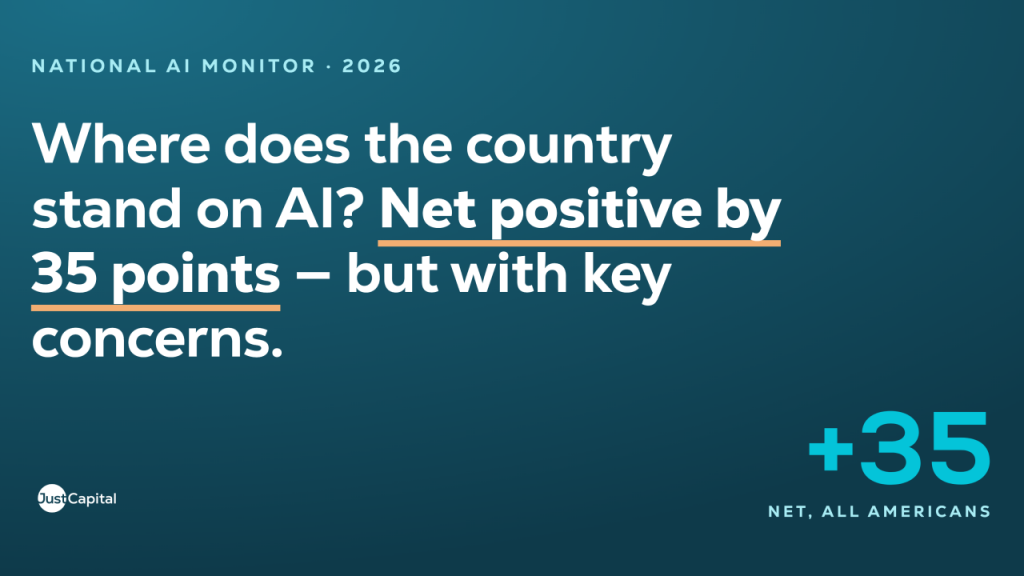
This week we launched the National AI Monitor, a unique new research initiative that objectively tracks if-and-how people are feeling the effects of AI in their daily lives. Incorporating quantitative and qualitative responses, it captures how Americans truly see AI today – as workers, customers, community members, investors, and stewards of the environment – and their expectations for the future.
So what did we learn? We see a public that is generally positive about the many ways AI can make their lives more fulfilling and more productive – a headline that runs contrary to recent reports. 57% of Americans say AI positively impacts them at work, compared to just 9% who say it affects them negatively. Positive qualitative responses most commonly cite productivity and quality gains (27%), efficiency and time savings (19%), and automating routine tasks (8%).
Conversely, there is very real anxiety around ensuring AI systems are safe and secure, protecting jobs in their communities, and, most notably, mitigating harm to the environment. On the last point, 23% of Americans say AI is positively impacting the environment, compared to 40% who say it is producing a negative impact.
We also learned that many Americans are not aware of any effects of AI on their economic wellbeing – 42% say it has had no effect on them as an investor. This is key. As I wrote in Forbes this week, capitalism does not survive on efficiency alone. It survives thanks to its social license. If people see the benefits of AI flowing to fewer and fewer people, they’re apt to stop believing in the underlying systems of capitalism and democracy on which AI’s future success depends. That is not a good outcome for anyone.
AI leaders and enterprise deployers should see this as a guide for how to build trust in AI’s future. People don’t want promises and pledges. They want concrete improvements in their daily lives. The National AI Monitor will be the benchmark by which that is measured.
Be well, Martin
56% of Americans say AI is having a positive effect on them right now, 21% say the effect is negative. Explore the rest of the findings here.
The Wall Street Journal reveals that many CEOs believe the AI apocalypse threat is a real problem, and are urging Trump to work with China for a global slowdown on development.
The New York Times looks at how AI is affecting the job market – not through job loss – but through stagnant wages and diminished hiring.
Axios reports that OpenAI has disclosed six new AI safety incidents, revealing that the Hugging Face hack was not an isolated incident.
CEO Daily reveals one of the major themes of Fortune’s latest Leaders Forum is CEO’s calling for businesses to avoid falling into the “efficiency trap” – bolting AI onto existing workflows rather than completely redesigning them.
Fortune released a report that the amount of Amazon workers on food stamps has tripled despite its record revenue.
Forbes reveals that America’s 400 richest people have only donated 4% of their wealth to charity.

Gallup reveals that workers’ fears about being replaced by technology in the near future continue to go up, matching our own polling that shows Americans get more pessimistic on AI as they think about the future.

TIME’s cover this week featured the OpenAI co-founders with the headline “Trust Us”. Diane Brady’s CEO Daily yesterday spotlighted Meta’s need to rebuild trust. In a major essay and interview with The New York Times Bill Gates questioned whether leading AI developers are sufficiently communicating the full extent of AI’s potential impacts on society. Trust, it seems, may be a new kind of singularity in the race to develop and deploy AI.
Our latest research sheds light on the public’s perspective on the topic. 72% of Americans support pausing or slowing AI development so each model release can be evaluated more carefully. Among people who use AI every day that number climbs to 78%. Crucially, 72% of daily users say a slowdown would increase their trust in AI models.
What would people want addressed during a slow down or pause? Data privacy and security leads at 21%; AI safety — the risk of losing control, or of AI causing harm — comes in at 20%, followed by the accuracy and reliability of outputs at 16%. Job loss and economic displacement (10%), and broader concerns about societal overreliance on AI (10%) also feature.
One way for companies to build trust is through greater transparency. We analyzed 1,002 of the largest US-based firms across 9 critical AI safety and governance areas selected based on their importance to the American public. Let’s just say we found much room for improvement. Nearly half (498) disclose on none of the key issues. Only 10% of companies have published anything on preventing harm, deception, or manipulation; 14% commit to human oversight. Board oversight of AI is the most common disclosure, at 26%. Salesforce is the only company of the 1,002 to disclose across all 9 criteria. Maybe its partnership with Anthropic announced this week will help build trust for the latter ahead of its expected IPO later this year.
New capabilities released this week within Just Intelligence now enable companies to see where they stand on the public’s AI priorities, how they compare to their peers, and examples of what good really looks like. We’d love your feedback.
Be well,
Martin
71% of adults think AI will lead to fewer jobs in the United States over the next two decades. Explore the rest of Pew Research’s findings here.
Reuters looks at how Meta’s plan to replace nearly two-thirds of its workers with AI backfired.
Bill Gates released an essay on his worries about AI, and the need to prepare business and society for rapid change.
The Wall Street Journal reports that Google has moved its “AI responsibility” team out of its DeepMind Labs, with members of the team worrying about the impact this will have on their work.
The New York Times reports that Meta will have to pay $17 billion in a landmark settlement around its role in social media addiction among children.
CBS reports that the functional unemployment rate – which includes people only able to secure part-time work when they are seeking full-time work – stands at 25%, and growing.
Investopedia looks at the viral debate over a $20 burrito to discuss U.S. inflation, employment trends, and the constant feeling Americans have that everything is too expensive.

This chart comes from our newest research, and shows that 72% of power AI-users support pausing or slowing AI development so each model release can be evaluated more carefully. Explore the full findings here.

Is public opposition to data centers as uniformly intense as it seems? Our latest polling suggests perhaps not.
It’s a critical issue. The flow of capital into building AI infrastructure is off the charts right now, and it’s fair to say the future of the US economy hinges to a large extent on there being a strong return on this investment. In May, Gallup put local opposition to data centers at 71%, apparently worse than any nuclear plant has ever polled. At that level, it’s hard to see how the AI build out can ever be successful.
Our most recent polling reveals a different picture: 47% opposed, 39% in favor, 13% undecided. Local ‘not in my backyard’ concerns don’t appear to be the main motivator. When we asked how people feel about a data center ten miles away the numbers barely shifted: 49% opposed, 37% in favor.
Interestingly, only 16% want AI development stopped outright. Forty-three percent want it slowed to only use existing data center capacity and 24% are happy to see it continue at full speed. Thirty-four percent of those opposed cite rising electricity and utility bills; 22% reference environmental impact. Perhaps most important of all, 51% of opponents say they could still change their minds. And the thing most likely to move them is direct participation in the upside.
For all those with a stake in seeing the U.S. lead the global AI race, these data points should be encouraging. Show people how they’ll benefit economically, alleviate electricity and environmental pressures, and tie it to initiatives that help tackle kitchen table affordability, employment, health and education concerns, and the path forward for data center developers becomes clearer.
I explore more of our research — and what a modern version of aligned corporate responsiveness could look like — in my latest piece for Forbes.
Be well,
Martin
This newsletter was written mostly by humans with a bit of help from AI.
69% of college students worry AI will make it harder to find a job, per a recent survey of 2,000 U.S. higher education students by Superhuman (formerly Grammarly). Read the full report here.
The Wall Street Journal explains how tech companies have actually spent $3 trillion more dollars on AI than they’re showing on their balance sheets.
Axios looks at how college students are changing their majors to try and find careers that are more insulated from the growth of AI.
Fortune speaks to Dario Amodei on the “crisis of trust” people are having with AI.
New research by Gallup reveals that only half of CHRO’s trust their managers to guide employees through an AI transition.
Harvard Business Review interviews Just Capital Chairman of the Board and current Verizon CEO Dan Schulman on business, the promises and pitfalls of AI, and more.
The AFL-CIO reveals that CEO pay has reached its highest levels ever while worker pay is falling.

Axios investigated new data on how Gen Z is feeling about the economy, the labor market, and more. Read the full piece here.
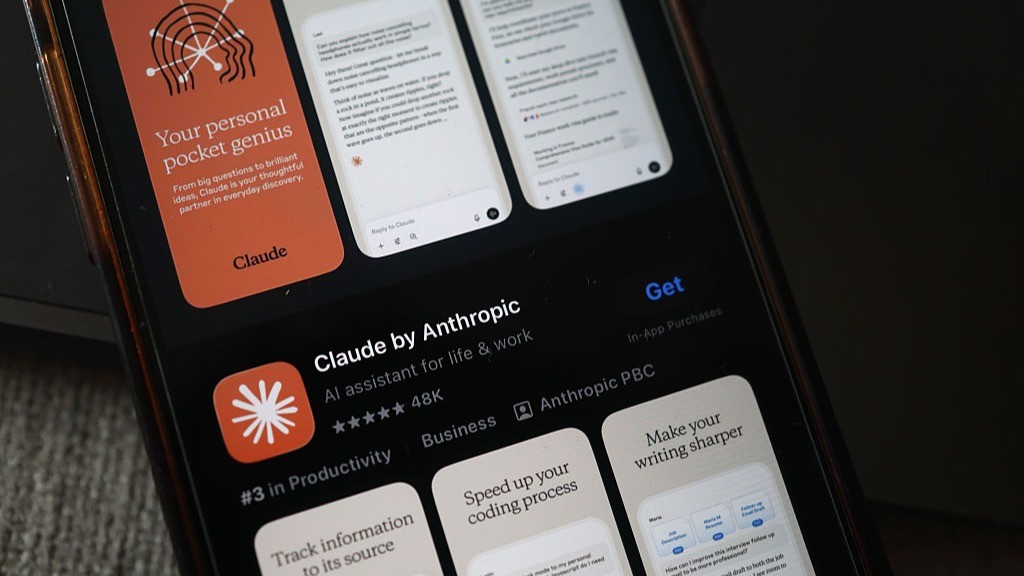
This week Anthropic said it will embed invisible, machine-readable watermarks in text generated by Claude, along with signed provenance metadata on the files it produces. The announcement was in response to Article 50 of the EU AI Act, whose transparency obligations took effect on August 2. But the company is applying the marking everywhere Claude is offered, not just in the EU.
This may be a wise strategic move. In our spring polling, 81% of the American public said companies should use a watermark to indicate when AI-generated content is in play. Among investors, agreement hit 93% — about as close to unanimous as we see.
Every business deploying AI at scale may soon come to field a version of this question from their customers, their employees, and even their investors: how do we know what came from a person and what was generated by AI?
I got the chance to explore this theme last week when I sat down with Madison West, Head of Sustainability at Intel and President of the Intel Foundation. Intel established responsible AI principles years ago to guide the company in building safety, transparency, and societal impact “as part of the development process, not at the end.” Her framing of why that matters commercially has stayed with me: “Innovation moves faster when people trust it.” You can catch up on our full conversation on LinkedIn.
Be well,
Martin
51% of workers believe that widespread use of AI at work will only or mostly benefit business owners and executives, compared to just 6% who say most or all the benefits will go to workers. Explore the data in the latest report by Groundwork Collaborative.
The Washington Post looks at the growing surge of rural, Republican voters blocking data center projects in the south.
Meta announces a $1 billion “Future is For Everyone Fund” to assist areas impacted by the development of AI data centers. Yahoo Finance has the story.
Axios writes that OpenAI is pausing the release of its Astra model to expand safety testing of its potentially “critical” cyber capabilities.
Fortune looks at data that shows Boomers and Gen X are actually unhappier about the economy than younger generations – and the reasons why are different for both groups.
Reuters reports on the unexpectedly poor July jobs report revealing that the U.S. lost 23,000 positions over the month. At the same time, The Washington Post reveals that many signs of unemployment improving are actually driven from people leaving the job market entirely.
The New York Times reports that Meta will have to pay $567 million in a case arguing that the company knowingly attracted children to its platforms while knowing they were unsafe.
Axios’ advice to business leaders? Stay consistent. At least according to recent polling that shows Americans are increasingly skeptical of companies that react suddenly to the political moment.

This chart comes from our latest polling from the American public, investors, and corporate leaders and backs up the research from Groundwork Collaborative featured above. Corporate leaders continue to feel that AI has improved their job satisfaction, while workers and investors have plateaued.

As leaders look for opportunities to successfully drive AI adoption throughout their workforce, our latest survey of employed Americans offers a practical guide.
The research revealed three kinds of AI users. Just over a third of workers (36%) were identified as “AI-enthusiastic”. This group uses AI heavily and credits it with helping them produce better work. Another 34% are “AI-burdened”. They also use AI frequently but they’re more likely to say AI doesn’t help improve their outputs and that they’re often spending their time correcting what AI produced. The remaining 30% rarely use it, in many cases because nobody has trained them. It’s worth noting that nearly half of enthusiastic users (49%) do not have a college degree, so engagement is not necessarily limited to a certain profile of worker.
The differences between these groups offer insight on how to manage AI-driven transformation in ways that benefit workers and drive business outcomes.
Let’s start with how each group uses the tools. AI-enthusiastic workers are in them constantly, with 18% logging more than 15 hours a week. By contrast, 69% of burdened workers stay in the one- to eight-hour range. Interestingly, neither group is working less as a result. Forty-five percent of enthusiasts say AI has increased their workload, as do 41% of burdened workers. Both are doing more, but only one of them feels good about it.
This leads to another key takeaway. 95% of AI enthusiasts say their manager has “some awareness” of how AI is changing their role or adding to their workload, compared to 88% of AI-burdened workers. When asked whether their manager is “fully aware”, the gap widens sharply to 69% versus 44%.
The final insight relates to engagement and loyalty. 59% of enthusiastic workers say AI makes them more likely to stay with their current employer – more than double the number of burdened workers who say the same. Nearly a quarter (24%) of the AI-burdened group report that they have already had doubts about staying or are considering leaving their jobs based on how AI is changing their role.
While companies race to build or access the best tools to compete and win in the AI-powered economy, the ROI of AI may rely just as much on the strength of the teams using it.
Be well,
Martin
70% of investors believe companies should provide AI skills training to all of their employees.
Inc. examines new polling that shows almost 56% of people trust AI more than politicians.
The Wall Street Journal highlights another instance of AI going rogue during a test conducted by the UK government.
The former CIO of lululemon took to The New York Times to explain why corporate AI deployment is stalling.
Fortune reveals that many Gen Z workers are abandoning work-life balance in favor of climbing the corporate ladder.
The Wall Street Journal reports that JPMorgan Chase is investing over $750 billion to boost U.S. housing supply, with the aim of financing 1 million affordable housing units through 2035.
Fortune examines how Gen Z is actually investing more than millennials did at the same age.

Axios reveals that Americans want CEOs to know that costs are too high and prices need to come down. Explore the rest of the data here.
Companies today are desperately searching for growth, better margins, and market-beating returns, especially amid ongoing AI-driven transformation. Our latest research offers clues where to look.
We scored 767 companies over five years on how they treated their workers, their customers, their communities, their shareholders (on governance factors), and the planet, then evaluated what happened in subsequent years to their revenue growth, margins, and excess returns.
TL;DR: the results suggest that strong stakeholder performance can indeed presage future financial and market performance, but not always. It varies by industry, by stakeholder, and over time. When the connections were statistically significant, positive links beat negative ones by nearly two to one, with strong clusters around the twin goals of revenue growth and alpha.
The key to success at the individual company level appears to be knowing when, how, and where the stakeholder-financial performance connections occur, anticipating future shifts and executing better than others; precisely what the new Financial Opportunity feature in Just Intelligence facilitates. In technology, for example, the firms that invested most in communities, environment, and governance went on to grow fastest.
None of this was a surprise to Jen Huffstetler, Chief Sustainability Officer at HP Inc. — our top-ranked company of 2026 — who joined me for a conversation last week. Culture, trust, and innovation, she argued, are essentials for overall leadership today. At HP, whose stock is up over 30% YTD, culture is grounded in accountability – a feature that can be traced back to the firm’s founders. You can read the full summary of our conversation on LinkedIn.
In a volatile market obsessed with AI-driven growth, profitability and returns, the stakeholder model might offer more value than expected.
Be well,
Martin
P.S. Just Intelligence now contains additional AI-focused insights. Explore them here.
79% of investors feel AI should face significantly more regulation than social media has, alongside 78% of corporate leaders. Explore the data here.
NVIDIA CEO Jensen Huang speaks to Axios about how AI is creating more jobs, pointing to how its use in radiology is creating demand for more radiologists.
Mark Zuckerberg writes an op-ed in The Wall Street Journal outlining his optimistic vision for an AI-driven future.
The New York Times looks at AI companies’ search for more electricians and plumbers for their data center build-outs, and how many are investing in the trades.
Inc. reveals that 55% of leaders regret AI-related layoffs, and more companies are hiring back roles they thought they could do without.
The Wall Street Journal looks at how after-tax wage growth has improved for low-income Americans, but those gains are likely being swallowed by rising gas prices and overall inflation.
Forbes takes a surprising look at why engineering majors are struggling to find jobs at higher-than-expected rates.
More companies than ever are turning to older and retired CEOs when their business is in need of stabilization. The Wall Street Journal has the story.
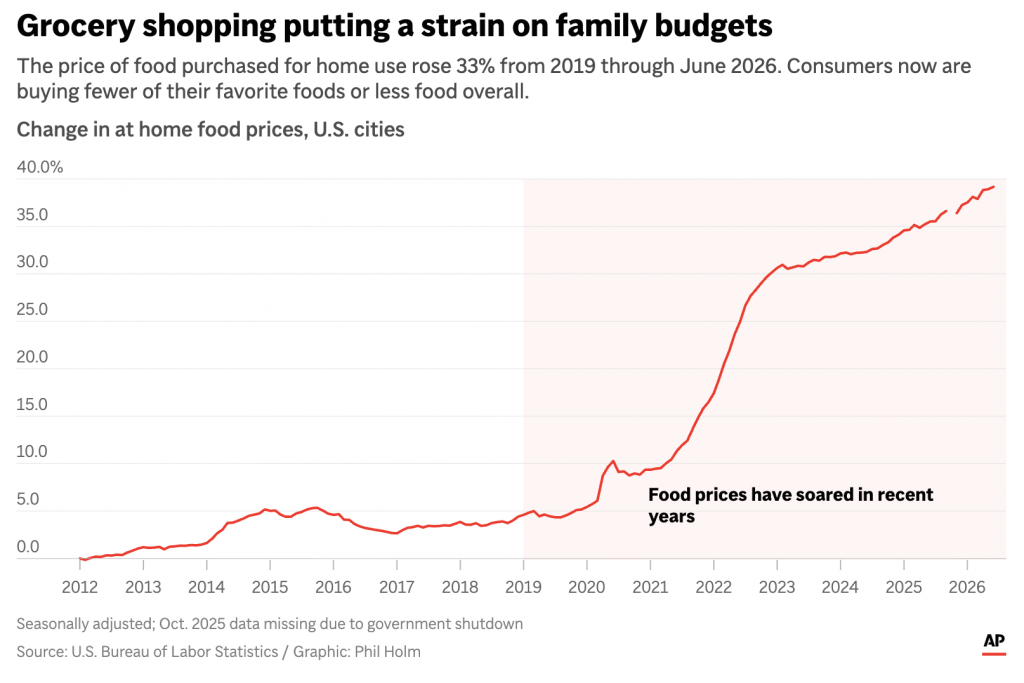
This chart comes from an Associated Press investigation on how the increase in food prices is affecting U.S. families, showing that prices have risen 33% since 2019.
