
Climate news has grown more direct and more dire. The 2021 Intergovernmental Panel on Climate Change (IPCC) report’s harrowing language makes clear that humanity needs to take sweeping action now or risk the severe impacts of climate change. The United Nations Climate Change Conference (otherwise known as COP26) in Glasgow this November is expected to usher in much needed developments in the environmental space from the international community, but where does business fit into this need for immediate action?
The American public has also become increasingly invested in climate action. According to our recent survey conducted in partnership with the Harris Poll, 71% of respondents are concerned about climate change and 74% believe that companies committing to lowering their emissions will have a high/moderate impact on addressing global climate change.
In order to evaluate a company’s environmental efforts for our Rankings of America’s Most JUST Companies, JUST looks at four categories of climate commitments, listed by increasing rigor:
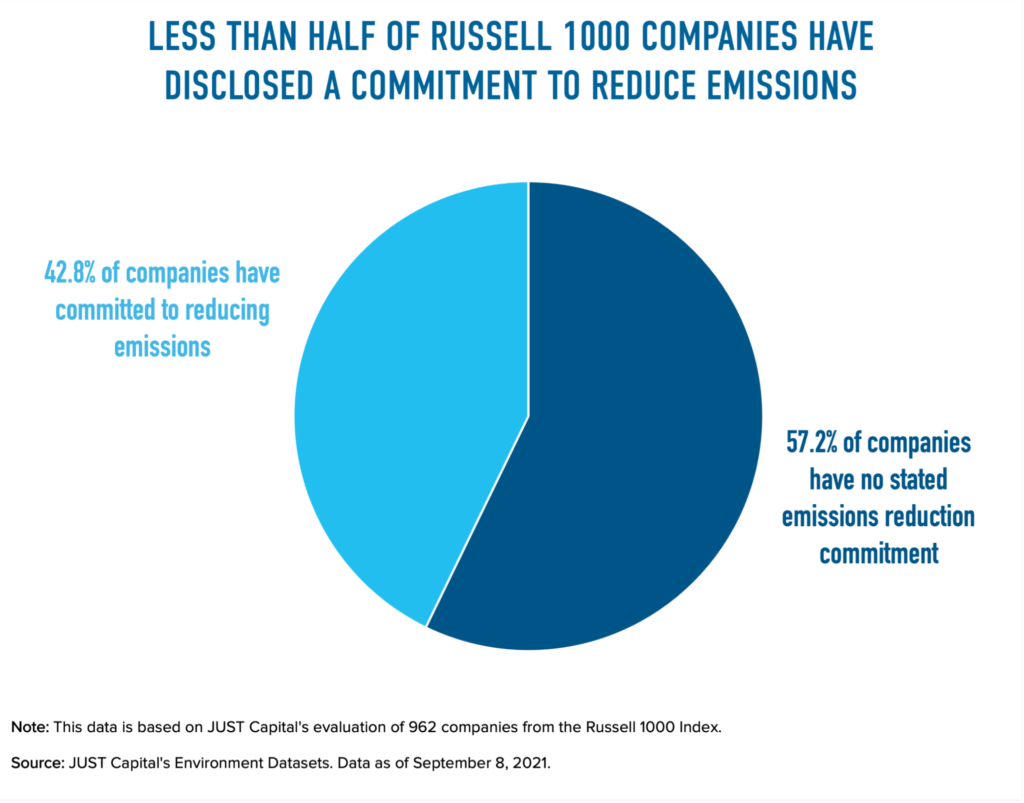
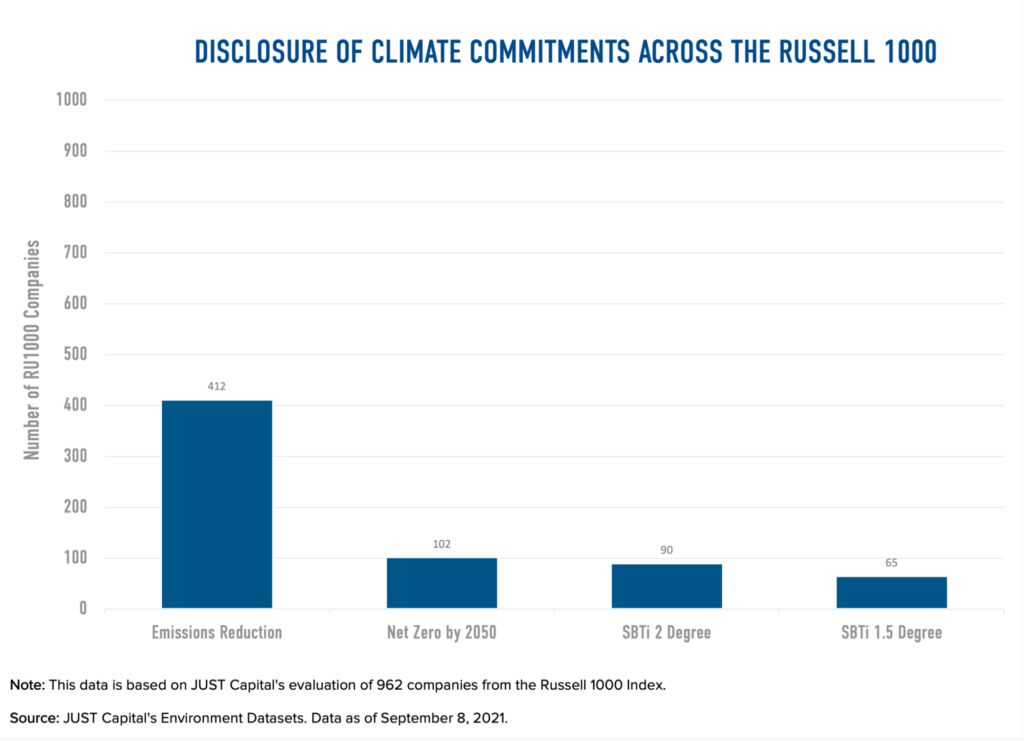
Looking closely at our data, we found that only 42.8% of Russell 1000 companies have disclosed a commitment to reducing emissions. In addition, only 10.6% of companies disclosed a Net Zero commitment by 2050, 9.3% set a commitment that met SBTi’s 2 Degree Scenario, and only 6.7% of company commitments met SBTi’s 1.5 Degree Scenario.
Looking at companies that disclose Net Zero commitments by industry, we found that the Utilities sector led with 16 out of 38 companies committing to Net Zero by 2050, while Health Care Providers lagged behind with zero commitments, the fewest out of all the industries we track and analyze.
However, all industries vary in regards to their emissions intensity, or the amount of emissions scaled by revenue. This calculation is done to control for the size of the company to increase comparability. By calculating overall emissions intensity, it becomes evident that the emissions intensity of the Utilities industry is over 200 times greater than that of the healthcare industry.
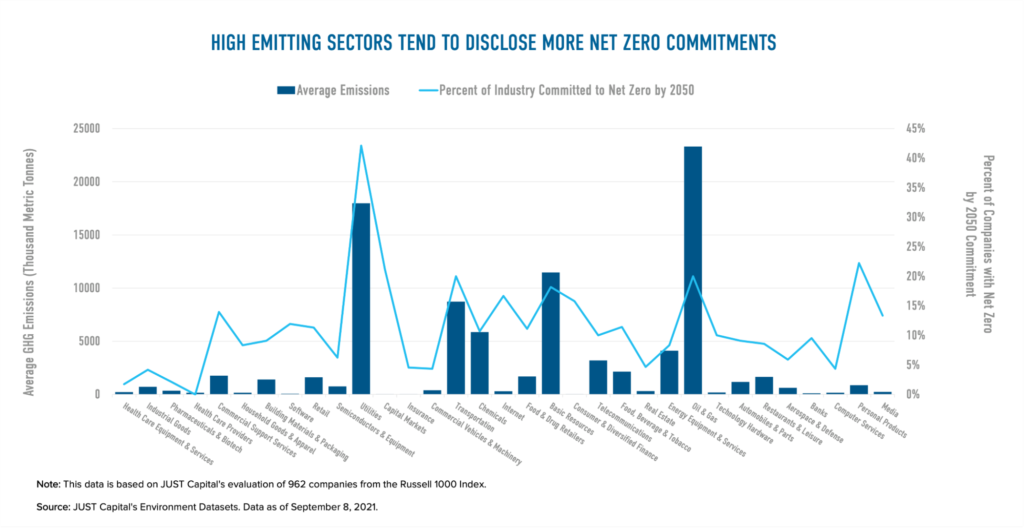
This trend can be seen throughout our dataset: industries with higher emission intensities had higher rates of Net Zero commitments. The top 100 polluters have a disclosure rate of 83%, compared to the 38% disclosure rate of the rest of the Russell 1000, indicating that top polluters are 2.17 times more likely to have an emissions reduction commitment. Looking at Net Zero commitments, the disclosure rate for the same 100 top polluters is 32%, which compared to 8% rate for the rest of the Russell 1000, makes them a little more than five times more likely to have a Net Zero commitment. There are exceptions to this, such as the Personal Products industry with 22% of its companies committing to Net Zero, despite having overall a very low emissions intensity. Of particular concern is the Oil and Gas industry, which has the highest emissions rate of any industry, but only 20% of companies making a Net Zero Commitment.
The fact that top-polluting companies are more likely to commit to Net Zero emissions is encouraging, as we will need major action from the private sector to limit warming. However, we also see a correlation between the size of a company and how likely it is to disclose environmental commitments. The top 100 largest companies we rank have a Net Zero disclosure rate of 37%, which is about five times larger than the rest of the Russell 1000 (7.5%). Bigger companies inherently have more resources and avenues to set these commitments, a trend we see with ESG disclosure. But these large companies are the ones under greater pressure from stakeholders to prioritize the environment – a great example is Engine No. 1’s proxy battle with Exxon.
While we can hope these companies are setting meaningful goals and will stick to their commitments, reassurance is hard to come by. The leadership in companies will likely experience turnover by the year 2050, the finish line of a lot of climate commitments and the last-possible year to meaningfully reduce emissions to reduce warming. That’s why intermittent targets (5, 10, 15 years out) are necessary for stakeholders to adequately assess the progress of these commitments and to ensure that companies achieve these goals. This increased transparency, accompanied by standardized language, will be key to ensuring the private sector is held accountable for in the fight against climate change.
Note: This data is based on JUST Capital’s evaluation of 962 companies from the Russell 1000 Index. We collected emissions and climate commitment data from public company filings, and the data is updated as of September 8, 2021.
The relationship between corporate America and Washington D.C. has always been a topic of debate in the U.S. – and in recent years, we’ve seen the conversation center around issues from adjusting tax rates to working together in the fight against COVID-19. A recent Forbes piece on corporate lobbying points to the old adage – “If you are not at the table, you’re on the menu” – impressing the important role companies can play in influencing legislation on economic and social issues, something the American public also confirmed in our latest survey. Survey research continues to confirm that Americans are increasingly looking to CEOs to be societal leaders, and they trust business more and more to address the big issues, from inequality to climate change.
Yet the question between companies’ leadership overall, and their engagement with government and government-adjacent organizations, remains blurry. Trade associations, also known as industry associations, are an integral part of the corporate lobbying conversation. A trade association is an organization founded and funded by businesses, typically grouped by industry, for the purpose of collaboration, lobbying, education, and advertising, as well as to promote the group’s views to government entities. Trade associations are uniquely positioned to exert political influence with in-depth policy knowledge, political connections, and the influence of a large corporate membership. We know that companies rely heavily on trade associations to advance their priorities, and yet trade associations can advance issues that may be antithetical to their stated stakeholder-capitalism priorities.
Funded mostly by corporate membership fees and non-deductible contributions from their members, trade associations can use this funding for general lobbying-related expenses. Companies also have the ability to pay the trade association in the form of a non-deductible contribution to direct a lobby campaign in their interest. The strength of trade associations should not be underestimated, as their support for or opposition to policy issues is closely followed.
Currently, there is no mandate for companies to disclose their trade association memberships, or for the trade associations to disclose their members, so JUST Capital decided to look at the state of disclosure, as transparency on this issue provides stakeholders with another tool to understand if companies are following through on or possibly undermining their ESG commitments through the trade associations’ approach.
When looking at the 928 publicly traded companies from our 2021 Rankings, we find that 58.3% do not disclose any of their trade association memberships. Of the 41.7% of companies that do disclose trade association memberships, the vast majority provide general disclosures – an acknowledgement of their memberships – but not necessarily an exhaustive list with specific details. Only 46.7% of the companies that disclose these general memberships also make mention of their monetary contributions and just 4.9% explicitly state that they’ve disclosed a full – rather than selected – list of trade association affiliations, in addition to their monetary disclosure.
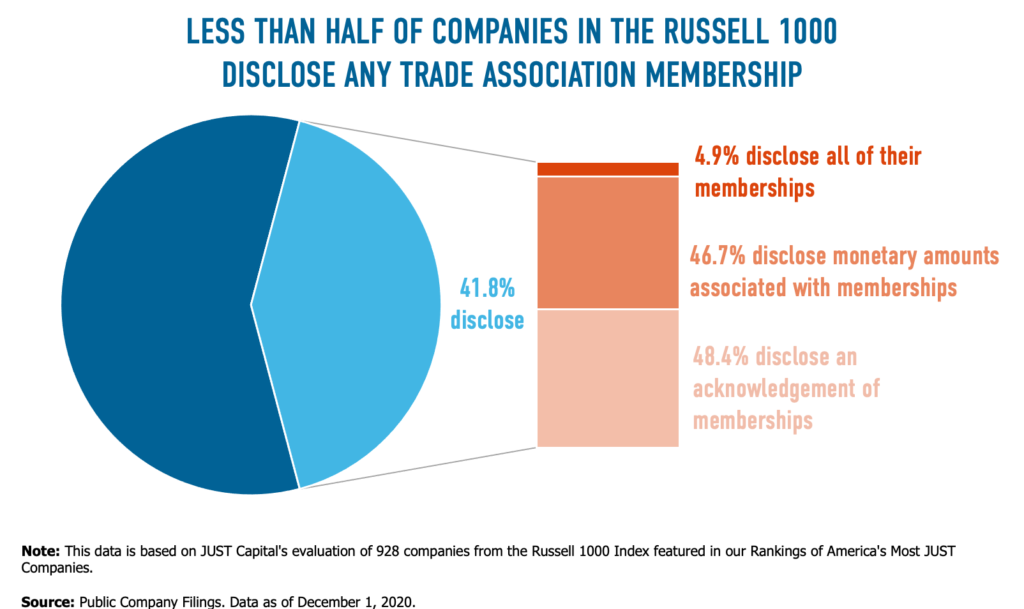
Controlling for industry and revenue, we find that all three levels of disclosure mentioned above correlate strongly with a higher level of performance in JUST Capital’s annual Rankings across each of the five stakeholder groups – workers, customers, communities, shareholders, and the environment. Accordingly, companies that score higher in JUST Capital’s overall Rankings tend to disclose more than their peers.
When collecting this data, we found that these disclosures are often tucked inside governance documents on investor sites or on a hard-to-find public policy/engagement webpage, making the disclosures generally less accessible. The ways that these disclosures are ultimately displayed also varied greatly. For example, Intel has a separate section in their Corporate Responsibility Report Builder with the option to download a list of the company’s political contributions, trade association memberships, and associated membership dues. Aggregating this disclosure along with Intel’s other ESG disclosures shows its commitment to transparency on this as an ESG-related issue. BlackRock’s disclosure specifically notes that these memberships are periodically reviewed to ensure they align with BlackRock’s views on material public policy issues. A robust monetary disclosure from Tractor Supply breaks out what portion of monetary contributions went to lobbying.
As stakeholders continue to expect greater transparency, this is an area that companies may want to review to better understand their approach to government relations alongside their overall approach to supporting their stakeholders. Companies can ensure alignment with their membership to these organizations and all of their viewpoints before contributing to them. In addition, the American public and investors will want to know whether companies are taking one step forward or two steps back through their trade association memberships, or if they are walking the walk in every aspect possible.
The data and analysis in this piece were collected and run in December 2020.

A Microsoft wind farm project. The company’s committed to becoming carbon neutral by 2030 and carbon negative by 2050. (Microsoft)
As the world marks the 51st annual Earth Day, the United States is stepping up its climate action. Today, at a summit of 40 world leaders on climate change, President Joe Biden announced a new emissions reduction target for the country. The goal aims to curb emissions by 50-52% below 2005 levels by 2030.
This announcement comes after a coalition of over 400 businesses (employing more than 7 million Americans), and investors (managing more than $1 trillion in assets) asked Biden to set, “the ambitious and attainable target of cutting greenhouse gas emissions by at least 50% below 2005 levels by 2030.” It also comes at a moment of urgency for the planet. Carbon dioxide levels reached a record high earlier this year – a harrowing milestone scientists say shows the magnitude of the climate crisis.
The new U.S. target will help determine the direction of climate policy around the world over the next decade. And it could mark the beginning of further policy moves to address environmental impacts over the course of President Biden’s term. Earlier this year, the SEC set out an enhanced agency focus on climate-related disclosures in public company filings and asked for public input to shape these disclosures.
If they haven’t yet, companies will need to adapt to new frameworks. Our analysis has shown that companies that are leading on environmental issues are outperforming their peers. As political and regulatory pressure on environmental impact intensifies, first-mover companies will set themselves up for success in a low-carbon economy.
That’s why we wanted to look at the policies and practices of the companies with the top environment scores in our most recent Rankings of America’s Most JUST Companies. We measure environmental performance through a host of different metrics, namely carbon emissions, pollution reduction, and some industry-specific metrics on sustainable products and services. While this performance data is widespread, we also recognize that each industry has its own unique challenges in reducing its environmental impact.
CNBC’s The News with Shepard Smith produced a segment that showcases what we found.
Below we’ve highlighted how the top 10 companies are taking the lead on managing environmental impact.
A Dell corporate office location. (Dell)
Dell is dedicated to sustainable packaging and services. The company is one of two in the software industry to disclose using recyclable packaging, noting that its packaging is made from bamboo. It’s also one of two software companies that offers product take-back programs. Among companies we rank in the software sector, Dell has the highest recycling rate – a key action our polling has shown Americans are looking for from companies. While not captured in our 2021 Rankings, Dell also announced a goal of reaching net zero emissions by 2050 this week.

An Aptar employee manages production of the company’s essential products during the COVID-19 pandemic. (Aptar)
AptarGroup’s core business model is in packaging – and it conducts periodic life cycle assessments to ensure it’s doing so sustainably. The company’s committed to evaluating and improving its circularity efforts through the New Plastics Economy initiative and the CE100 network. As of our latest Rankings release, Aptar reported sourcing nearly half of its global energy use from renewables. At the end of 2020, Aptar released updated numbers showing that 85% of its global electricity use came from renewable sources.

An IBM logo outside the company’s booth at the 2019 Mobile World Congress. (David Ramos/Getty Images)
IBM has set an ambitious target of reaching net zero emissions by 2030 – a notable goal given many companies are aiming for a 2050 timeline. The company’s roadmap to net zero includes existing technologies like carbon capture. IBM also discloses indirect emissions, known as Scope 3 emissions, from its value chain tied to business travel. The company powers 50% of its data centers with renewable energy and sources 40% of its global electricity use from renewables. IBM also uses recyclable packaging and offers take-back services for its products.

A Mastercard customer uses the credit card’s contactless payment feature at a public transit stop. (Mastercard)
Mastercard is committed to tackling climate change through setting a net zero by 2050 target. The company reported reaching a milestone of powering global operations with 100% renewable electricity in service of its net zero goal. Mastercard also recently announced that it’s issuing a $600 million sustainability bond and tying executive bonuses to ESG goals – with an emphasis on progress toward its net zero target. Last year, Mastercard launched the Sustainable Card Materials Directory, a supplier directory that’s allowed 88 financial institutions to issue 10 million cards made from sustainable materials.

The Microsoft flagship store in New York. (Microsoft)
Last year, Microsoft made a commitment to becoming carbon neutral by 2030 and carbon negative by 2050. The company’s since issued a progress report on lessons learned in putting these goals into action. In 2020, Microsoft also set a target to achieve zero waste by 2030. To reach that goal, the company’s building centers to repurpose servers and hardware from data centers, implementing 100% recyclable packaging, and investing in a system to digitize waste data.

The Goldman Sachs logo. (Goldman Sachs)
Goldman Sachs is leveraging its core business model to address climate change. The firm has allocated $750 billion in financing, investing, and advisory services through 2030 to this priority. One year after setting this target, it reported having put $156 billion toward sustainable finance. Goldman Sachs also recently committed to aligning its financing activities with a net zero by 2050 pathway and targeting net zero emissions in its supply chain by 2030.

A Google employee rides a bike on the company’s Mountain View, California campus. (Google)
In 2020, Alphabet became the first company to erase its carbon legacy – leading to a lifetime net carbon footprint of zero. Alphabet also earned the number-one spot among companies we rank for its usage of renewable energy. The company is committed to powering its data centers and campuses with 100% carbon-free energy by 2030.
Cisco Systems headquarters in San Jose, California. (Justin Sullivan/Getty Images)
Cisco Systems tied for the number-one spot for its dedication to sustainable products and services among the companies we rank. The company’s commitment to circularity shows up in its product take-back program, use of recyclable packaging, and incorporation of recycled materials in its products. This week, Cisco also announced a $100 million investment from its foundation in climate solutions and community climate education programs not captured in our 2021 rankings.

NVIDIA corporate headquarters in Santa Clara, California. (NVIDIA)
NVIDIA is focused on product sustainability and pollution reduction. The company reported improving energy efficiency for its graphic processing units by 30% and reducing its packaging materials by 15%. In addition, NVIDIA has stopped use of foam for packaging, relying on recyclable materials. While not captured in our most recent Rankings, last year the company announced a goal of sourcing 65% of global electricity use from renewables by the end of 2024.

A Best Buy customer has a purchase delivered to their vehicle early in the COVID-19 pandemic. (Scott Olson/Getty Images)
Best Buy came in at number-one among retail companies we rank for its performance on the environment. The company leverages its sweeping value chain and customer base to collect and recycle electronic waste. In 2020, it collected 204 million pounds of electronic waste, bringing its total collected over the last decade to more than two billion pounds.
Data used in the analysis for this article were collected as of June 2020 and used to produce our 2021 Rankings of America’s Most JUST Companies.
Sam Schrager contributed to this article.
