In light of last week’s analysis of the 2021 JUST Universe specific to return on equity, this week we dive into the new list of companies constituting the JUST 100, our annual list of America’s most just companies. The latest list showcases companies that are not only prioritizing stakeholder capitalism but have gone above and beyond to support their workforces over the past year, as the workers stakeholder holds a 41% weight in our model this year (compared to 35% last year).
Looking at the average JUST 100 company, we see significant alpha relative to the average company in the Russell 1000 universe we cover with the JUST 100 companies returning 13.12% over the trailing 1 year and the average company we rank at 10.70% as of 10/31/2020.
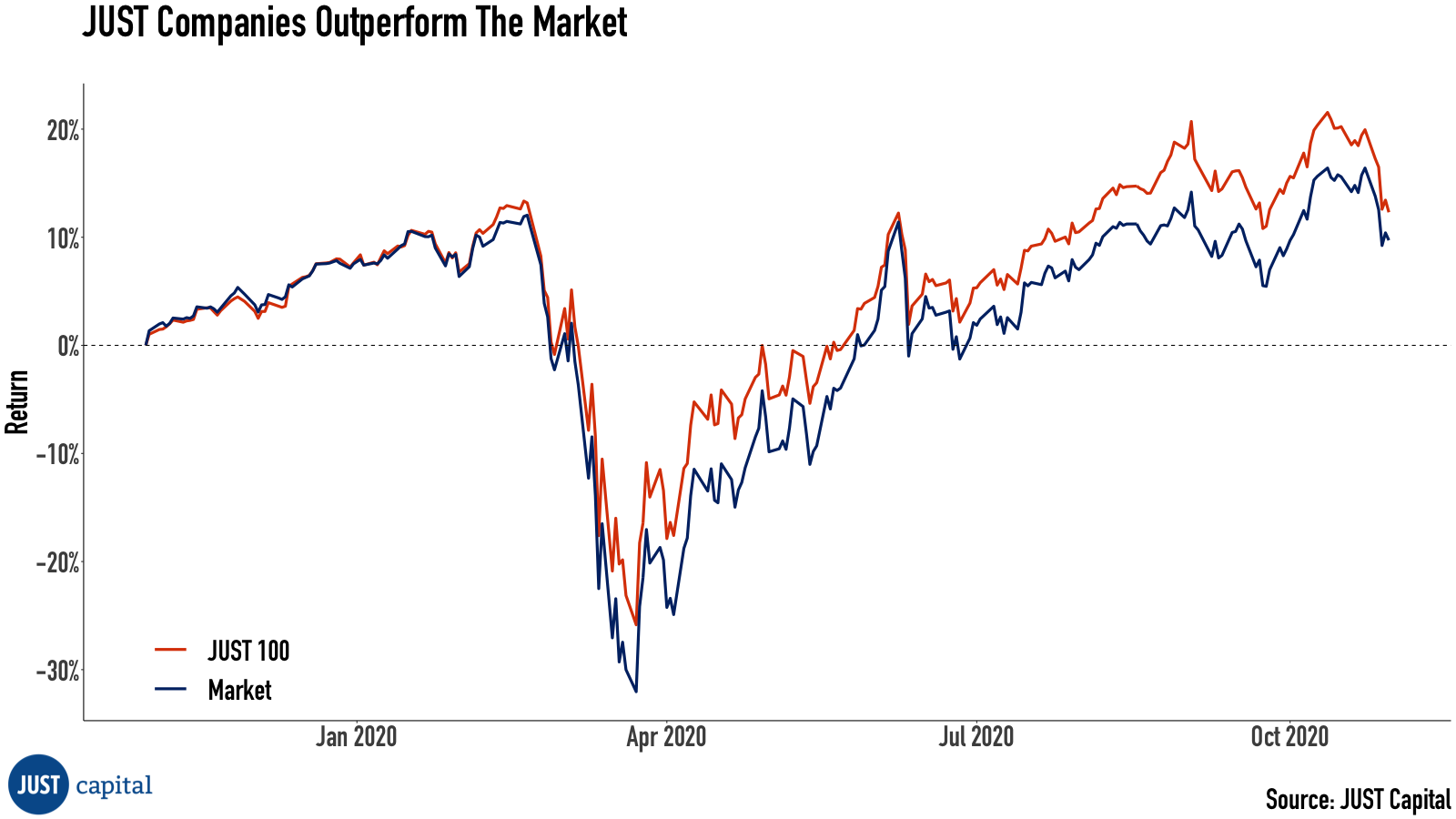
JUST 100 companies have acted ethically, paid their workers a fair, living wage, and protected worker health and safety throughout 2020. This year demanded leadership from our corporations to step when our government couldn’t, with the Harris Poll recently finding that 72% of Americans “trust companies more than the Federal government to help find solutions to issues related to the COVID-19 pandemic and racial equality movement.”
One company that stepped up to lead this year and back into the JUST 100 is Target. Jumping from 101st overall in our rankings to number 15 this year, Target prioritized frontline workers during the pandemic by providing hourly wage increases and by offering $250-$1,500 bonuses to hourly store managers, the highest maximum amount among retailers we track. In addition, Target was one of just a few companies to permanently extend hazard pay increases, raising its minimum wage to $15 an hour. And as Target continues to prioritize its many stakeholders, it continues to see financial results, returning 44.87% in the trailing year as of the end of October.
If you are interested in supporting our mission, we are happy to discuss data needs, index licensing, and other ways we can partner. Please reach out to our Director of Business Development, Charlie Mahoney, at cmahoney@justcapital.com to discuss how we can create a more JUST economy together.
If you have questions concerning the underlying analysis, please reach out to our Senior Manager for Quantitative Research, Steffen Bixby, PhD, at sbixby@justcapital.com.

Last year, before COVID-19 rocked our world, we looked at three myths of sustainable – or “just” – investing. Myth #3 was that raising wages will kill share price and destroy value for investors (spoiler alert: this is not true).
I come back to this today because it’s more relevant now than ever before. “Paying a fair and livable wage” is the single most important issue identified in our 2020 polling work. Our 2021 Rankings of America’s Most JUST Companies, released last week, are heavily influenced by how companies fare on this and other critical worker themes. And we know from our own research that millions of workers at large, profitable, publicly traded corporations still fall below local living wage thresholds, and rely on government support to make ends meet. That’s one reason we launched The Worker Financial Wellness Initiative – to help companies take the first crucial step toward addressing employee financial hardship and simply ask the question: how many of our workers fall into this category? Often, just knowing the answer to this question is all that’s needed to spark action. And if you don’t believe me, ask Mark Bertolini or Dan Schulman.
This year we’ve seen dozens of companies step up to provide hazard pay to their workers during the coronavirus crisis, and some even raising wages permanently (see: Target, Charter Communications). It is clear that employees on the frontlines – many of whom are among the lowest-paid workers in our country – need these pay increases to survive, pandemic or no. But it’s also clear that investing in workers, addressing employee financial hardship, and lifting wages more broadly can have direct and material benefits to corporations, their investors, and society as a whole. Our own analysis supports this. Dozens of CEOs, investors, and business leaders know this. Henry Ford definitely knew it. Yet still we see the myth perpetuated. Just last month, historically pro-worker Costco’s stock took a hit, despite a record-breaking sales quarter, because it is continuing to uphold its $2/hour pandemic pay increase months into the crisis.
Read my take on the subject here, and if you work at a big company and want to learn more about the financial wellness initiative, please reach out.
Stay safe, and stay tuned.
Martin Whittaker,
JUST Capital CEO
This week, we continue to highlight some of the standout policies of our JUST 100 leaders. Here are a few:
PepsiCo distributed more than 50 million meals to low-income populations during the pandemic, and shared its distribution knowledge with partners to ensure that food could reach students who were no longer receiving meals at school.
Cigna launched the Brave of Heart Fund, in partnership with the New York Life Foundation, to provide monetary grants to family members of U.S. healthcare workers who lost their lives fighting COVID-19, in addition to waiving out-of-pocket fees for tests, screenings, and appointments related to COVID-19.
Workday supported employees’ financial well-being throughout COVID-19, offering one-time bonuses and need-based grants through a pandemic-specific employee relief fund, which recently saw an increased investment of $1 million.
Synchrony Financial offers a gender-neutral paid parental leave policy, expanding its scope in 2020 to provide 12 weeks for all caregivers, while also providing back-up dependent care, fertility benefits, and flexible work arrangements.
Apple has achieved 100% renewable energy for all offices, retail stores, and data centers across 43 countries, and 44 of its suppliers have committed to using 100% renewable energy, supporting Apple’s goal of becoming carbon neutral across its entire business by 2040.
Tuesday, October 27th, 8AM to 9:30AM ET
MasterClass Series Course 1: Framing Today’s Challenges as a Stakeholder-Led Company
Martin joins Nasdaq for a three-part masterclass series on Board Leadership in the Stakeholder Era. For this first session, he’ll be talking about how Just corporations are framing the challenges of COVID-19, Racial Inequality, and more to tackle them within their business. Sign up to join here.
Wednesday, October 28th, 2PM to 3PM ET
How to Make Worker Financial Wellness a C-Suite Priority
Participants will hear from leaders at JUST, the Financial Health Network, and the Good Jobs Institute on how and why companies should conduct an assessment of wages, benefits, and employees’ overall financial health – including a look at how PayPal addressed the financial insecurities in its workforce in 2018. Join our webinar here.
Thursday, October 29th, 12PM to 1:30PM ET
HCM and DEI Reporting: What Investors, Managers, and Employers Should Know
Alison Omens joins World at Work to discuss how to balance consistency and simplicity with the complexity of reporting human capital management and diversity, equity & inclusion numbers. Register today.
Thursday, November 5th, 4PM to 5:30PM ET
Business and Markets as a Force For Good: Building Stakeholder Capitalism in America
Join JUST Capital and the New York Stock Exchange for a discussion on how business and markets can take the lead in building a more just and inclusive marketplace in America. Featuring speakers from APG Asset Management US, Two Sigma Impact, AT&T, and more. Sign up to watch here.
The Financial Times reports that nine out of 10 of the largest ESG ETFs outperformed the S&P 500 in the first half of the year.
Axios take a look at how corporate redlining – the practice of denying small-business loans in Black neighborhoods – has cost Black communities millions in potential business revenue.
S&P Global examines how the COVID-19 pandemic has affected women in the workplace, showing that while it seems to be helping to rapidly expand family leave policies, it’s also putting immense strain on working womens’ opportunity to advance.
The Financial Health Network released a report on how HR executives view the financial needs of their employees. The takeaway? Employer awareness of employee financial health challenges is largely based on limited metrics, contributing to a gap between employee needs and solutions.

For our Chart of the Week, we’re highlighting our recent analysis of where Business Roundtable signatories stand in our 2021 Rankings. Between our 2020 and 2021 Rankings, BRT signatories’ overall rank improved by an average of 42 places, while the rank of other non-signatory companies in the Russell 1000 decreased by an average of 8.5 places.
For too long the conventional wisdom in corporate America has been that keeping wages low and reducing labor costs was the key to profitability. But the reality is that divesting in workers was bad business during good times, and is equally short-sighted during an economic downturn. Leading research shows that investing in workers – raising wages and providing strong benefits – improves business outcomes. As companies are developing strategies to weather the current recession, they should start by considering how to improve the financial security of their workforce.
One way to do this is by paying a living wage, which is the amount of money needed for a given family to cover the cost of their minimum needs where they live – including food, childcare, health insurance, housing, transportation, and other basic necessities like clothing and personal care items.
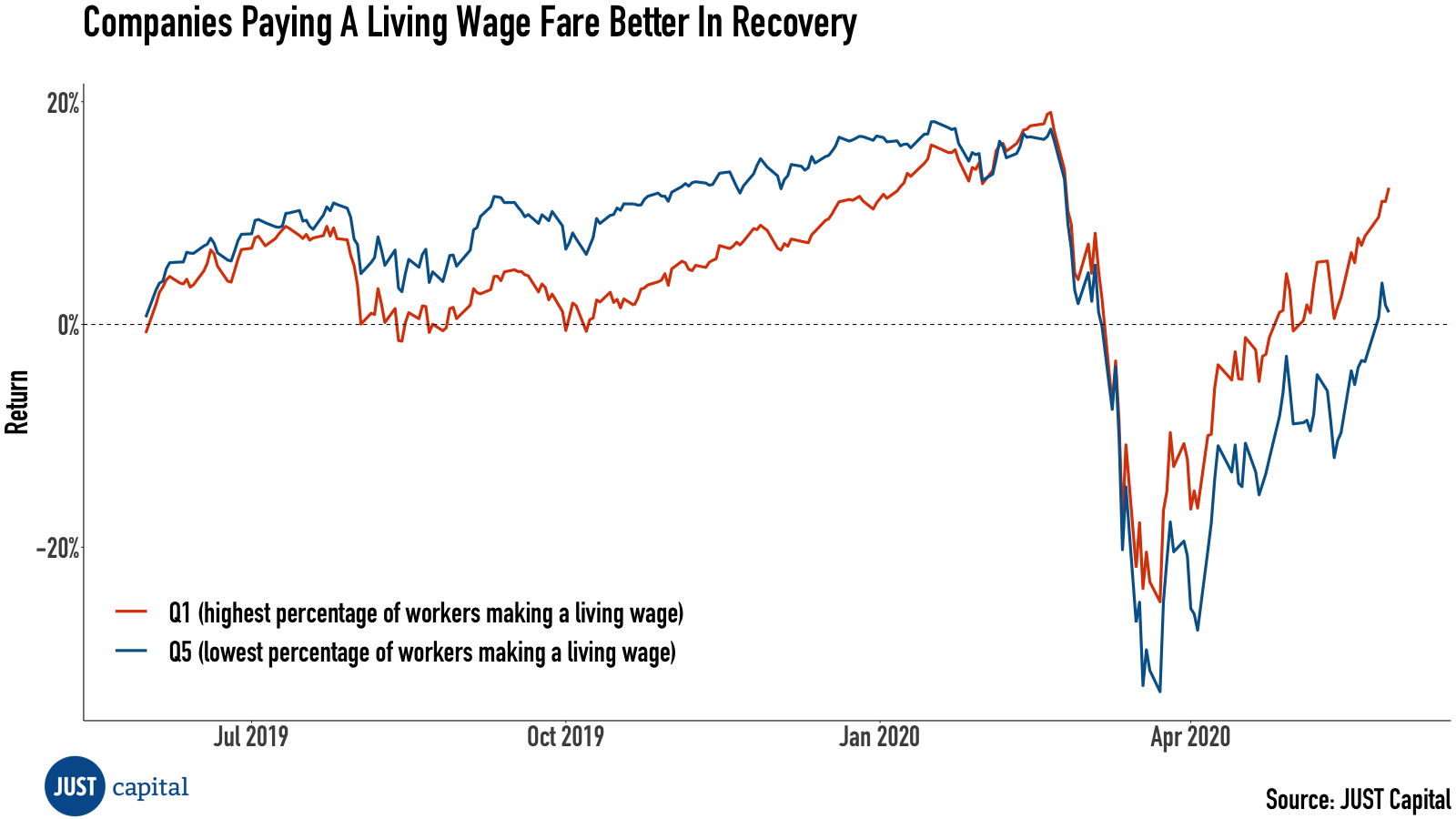
In this edition of our Chart of the Week series, we look at our “pays a living wage” metric to analyze how companies with a high percentage of employees who are estimated to be making above a threshold for a national living wage have performed over the trailing one year, including the market downturn in the first six months of 2020.
As it turns out, the top quintile of companies in our living wage ranking have returned 12.3% compared to the bottom quintile companies who have seen a 1.1% return relative to their industry peers.
Years of research has found that workers who do not have to stress about things like whether they can afford a doctor’s visit or medication, stay with their companies longer, and are more engaged. It’s expensive to replace an employee, and a more engaged workforce is more productive.
Whether or not a company pays its employees a living wage is the third highest prioritized issue that Americans care about with JUST Capital’s Ranking model. Our living wage estimates are created in collaboration with MIT, which provides us with county-level estimates on the income that a representative family needs to meet just their basic needs, which do not account for short- and long-term savings or other burdensome expenses like debt.
Historically, many frontline workers, i.e. those with what is now known as essential jobs, did not generally receive a living wage. With many workers now facing increased economic insecurity in face of the COVID pandemic, responsible companies should consider paying their workers more. This would allow them to focus on their jobs, which in turn can have a positive impact on the company’s bottom line. In fact, we found that companies who have prioritized their workers’ financial needs throughout the pandemic in the first six months of 2020, have shown significant outperformance we have highlighted in past Charts of the Week.
If you are interested in supporting our mission, we are happy to discuss data needs, index licensing, and other ways we can partner. Please reach out to our Director of Business Development, Charlie Mahoney, at cmahoney@justcapital.com to discuss how we can create a more JUST economy together.
If you have questions concerning the underlying analysis, please reach out to our Senior Manager for Quantitative Research, Steffen Bixby, PhD, at sbixby@justcapital.com.
Last week, Amazon opened its first automated grocery store in Seattle – Amazon Go – allowing customers to stroll in, grab the items they need, and leave without having to stop at check out. This is all thanks to cameras and AI algorithms that track what shoppers pick up along the way, eliminating the need for cashiers entirely.
Known for its ever-changing, groundbreaking technological innovation, Amazon has been shifting the retail landscape since day one – not only for consumers but for employees. So what could this latest change mean for American retail workers?
JUST Capital’s wage model includes estimates for employment by title, wage, and location for over 14 million American workers at the 140 largest retail and service sector companies. Using this data, we looked at what would happen if cashier duties at all these companies becomes completely automated, as they are at Amazon Go. We found that nearly 1.8% of the U.S. private sector workforce – that’s 2.3 million Americans working for companies like Walmart, Target and The Gap – could be affected, representing roughly two-thirds of the 3.4 million cashiers throughout the U.S.
The potential impact at the local level could be profound. In Los Angeles for example, the total automation of cashier duties would reduce the number of retail workers within the greater Los Angeles County by an estimated 49,000. In Dallas County, 19,381 workers would be affected.
In terms of the impact on payroll, we estimate the 2.3 million jobs affected translate into nearly $37 billion in potentially lost income nationwide. While this is a mere 0.6% of the country’s $5.643 trillion private sector income, in some regions the impacts could be material, not only in terms of lost income, but also the additional participation in public support programs (such as food stamps and Medicaid) if these workers are unable to find new jobs.
Of course, this scenario is a hypothetical – not predictive – consideration of the shifting brick and mortar landscape, but the future of work no doubt stands as a growing question in America, particularly for workers in the retail industry. Technological progress is inevitable, but its potential implications are wide-ranging – Will automation destroy or create new jobs? Who will take the lead in the critical task of new skill development and job retraining? Will we generate more or less income with the advent of new technology? How might changes affect the government subsidies many Americans rely on to make ends meet? And where will these shifts be most felt?
As the top company in JUST Capital’s rankings when it comes to job creation, Amazon is expected to grow its business considerably throughout the next year – with 50,000 new jobs planned for its anticipated second headquarters. With U.S. jobs among the top priorities for the American people, JUST Capital will continue to track Amazon’s impact on both job creation and elimination in the company’s own stores, distribution centers, and corporate headquarters, as well as throughout the American retail landscape.
This article was originally published on Forbes.com.
After three years of polling, one of the things we know to be true is that Americans view worker pay-related issues as being at or close to the top of the list when it comes to just corporate behavior. Living wage (am I paid enough to support basic living costs?) and fair pay (am I paid fairly for the job I do relative to others doing the same job?) are the most important, but the ratio of CEO pay to “average worker” is also often mentioned as an additional measure of justness.
Last week, in another effort to reverse Obama-era legislation, the Treasury Department recommended the reversal of a Dodd-Frank rule, due to go into effect next year, that requires companies to disclose the pay ratio between CEOs and average workers. Republicans argued that the rule undercuts the market, aims to shame chief executives, and by extension, discourages companies from going public.
The rule, however, would also serve to shed a clearer light on a core issue that Americans care about, and based on research from the Economic Policy Institute, we already know that the CEOs of America’s largest firms earn far more today than they did in previous decades, with CEO compensation having risen a whopping 807 or 937% (depending on how it is measured) from 1978 to 2016. A recent study from The Conference Board showed that the median pay for CEOs of S&P 500 firms was $11.5 million in 2016, up 6.3% from the prior year. Compare this with the decades-long stagnation in real wages for average workers and the 2.9% increase in average hourly earnings for all employees in the private sector last year.
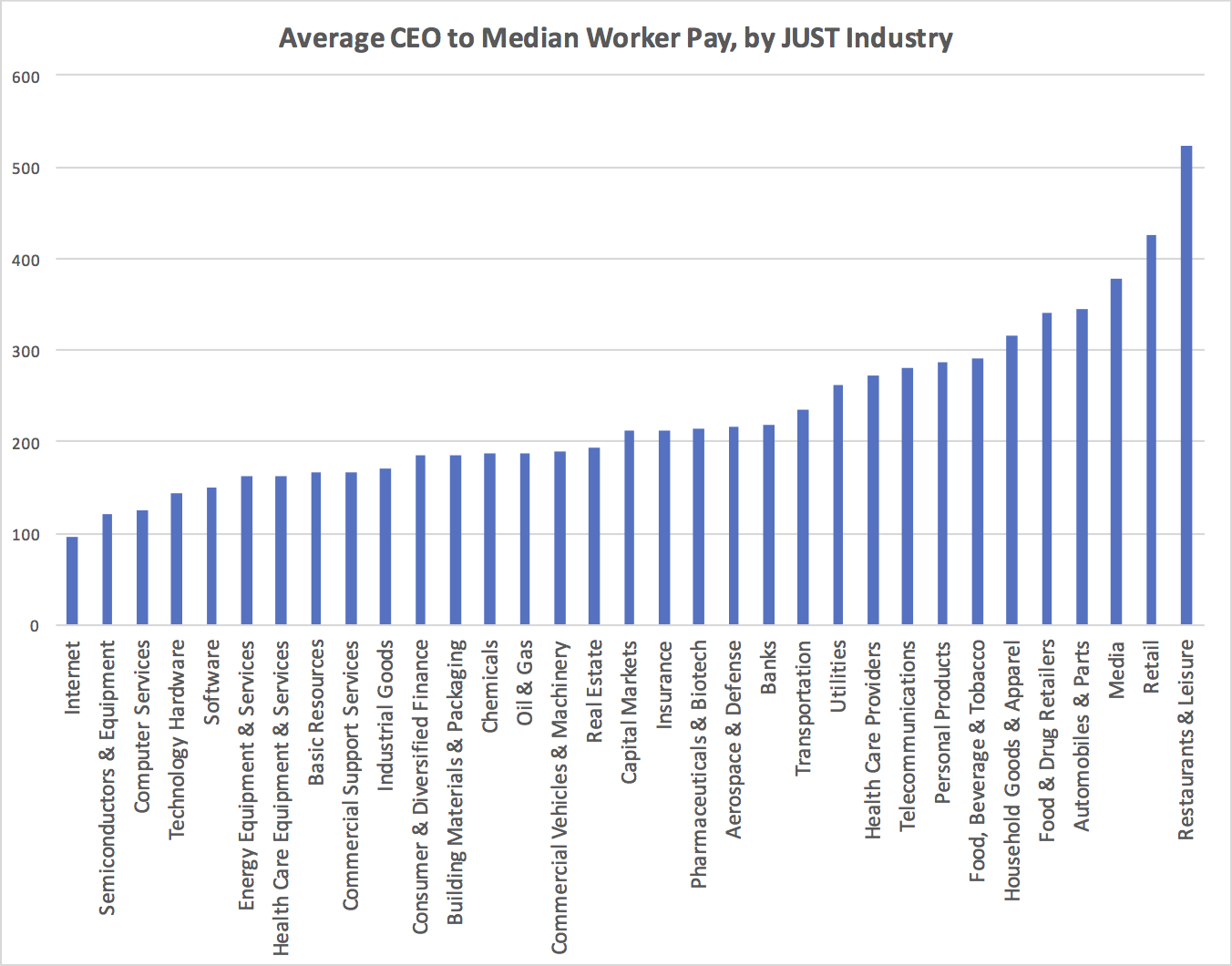
JUST Capital’s breakdown of CEO-to-Median Worker Pay ratios for the top 1,000 publicly traded companies in America provides some fascinating context on the issue. Take the industry comparisons, for example. Ratios tend to be much “lower” (between 100 and 150:1) in technology fields, where workers are paid more on a relative basis and many tech CEOs are company founders with high ownership interest, tending to pay themselves less in salary. At the other end of the spectrum, in Retail and Automobile industries for example, a proliferation of lower skilled workers with lower pay results in very high discrepancies between the earnings of CEOs and workers, in some cases above 400:1.
Based on our own studies, the increasing gap between CEO and employee pay in 2016 may actually be even greater than The Conference Board reports. SEC reporting rules for executive compensation require companies to report stock-based compensation in the year in which it’s granted, not necessarily as its earned. For example, Apple CEO Tim Cook has earned an average of just over $7 million annually over the past five years, but he also received a $376 million bonus in 2011 that does not fully vest for 10 years. Under JUST Capital’s methodology, that bonus would then be spread evenly over 10 years and added to other annual compensation received during that span. Our numbers also include all executives who have held the title of CEO and/or Executive Chairman in a given year, while excluding all one-off cash payments (severance for departing executives and so-called “make whole” payments to new CEOs).
Using this methodology across the 728 companies in the Russell 1000 for which we have compensation data for both 2015 and 2016, median CEO compensation actually increased 9%, more than triple the average hourly earnings for employees in the private sector.
Looking at CEO compensation in proportion to JUST Capital’s estimates for average U.S. worker pay at these companies, the gap continued to widen. In 2016, the median CEO compensation was 204 times that of the average worker, a 7.3% increase from the prior year’s figures.
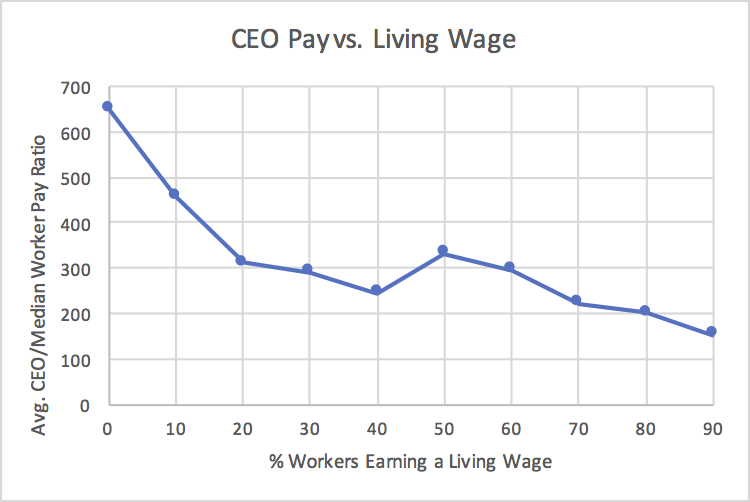
We also took a look at how this ratio compares to other measures of worker pay. For example, we found that the companies that pay the majority of their workers a living wage tend to have a narrower gap between CEO and employee pay. Conversely, the gap is typically wider for companies that pay only a low percentage of workers a living wage. This stands to reason, as low-gap companies are in higher earning industries where more employees make a living wage.
Coming back to the polling results, it is not clear what a fair or just CEO:Median Worker Pay ratio actually is, or what people think it should be. Ordinary workers are more concerned with putting food on the table for their families and being treated fairly relative to their coworkers. When it comes to CEO pay, however, we think the real moral of the story is not only that the numbers be disclosed, but that we consider them in the context of fair treatment and shared value. High CEO pay may be perfectly fine in situations where companies are doing well financially and all workers are sharing in that. Or where workers themselves feel fairly compensated and make more than a living wage. Where the red flags exist are where too many people do not make a living wage, where CEOs are taking too much of the pie at the expense of workers, or where there is some other obvious injustice or imbalance. Boards of Directors setting executive compensation packages would do well to keep this in mind. Going forward, we’ll continue to track CEO pay ratios, and hope that companies will disclose these numbers, providing transparency on the issues Americans care most about, whether they’re required to or not.
