New York, NY, March 17, 2026 – Today, in partnership with CNBC, we are announcing our 2026 Rankings of America’s largest public companies. Now in their 10th year, the Rankings celebrate companies for their performance on the issues that matter most to the American people, such as paying a fair, living wage; supporting worker well-being, advancement, and training; communicating transparently; and acting ethically at the leadership level.
The 2026 Rankings showcase responsible business leadership across 20 industries. As AI and other transformative technologies reshape the economy, business leaders require precise, decision-grade data to weigh tradeoffs, manage risk, and plan for the future. In service of this, ranked companies can now explore their performance in-depth through Just Capital’s flagship Just Intelligence product. The platform has been updated to include an AI-enabled chatbot, currently in beta, which allows users to pose queries that draw on Just Capital’s robust corporate performance database and business case library.
This year, Just Capital is proud to celebrate 21 companies with Industry Leader designations. View them below, and explore the Rankings here.
Automobiles & Parts: Lear Corporation
Banks: M&T Bank Corp
Basic Resources: Freeport-McMoRan Inc
Chemicals: Ecolab Inc
Construction & Materials: Trane Technologies
Consumer Products & Services: Nike Inc
Energy: Marathon Petroleum Corp
Financial Services: S&P Global Inc
Food, Beverage & Tobacco: The Hershey Company
Health Care: The Cigna Group
Industrial Goods & Services: Union Pacific Corp
Insurance: The Hartford Insurance Group
Media: The Walt Disney Company
Personal Care, Drug & Grocery Stores: CVS Health Corporation
Real Estate: Zillow Group Inc
Retail: Lowe’s Companies, Inc.
Technology: HP Inc
Telecommunications: Ciena Corporation
Travel & Leisure: Starbucks Corporation
Utilities: Constellation Energy Corporation & Public Service Enterprise Group Inc
The 2026 Industry Leaders demonstrate common areas of strength across sectors including workforce investment, governance discipline, and environmental transparency. All Industry Leaders are ranked in the top 100 overall, and 16 of 21 improved their overall rank year-over-year
“At a time of great uncertainty, and with questions being asked about the future of capitalism, our Rankings are designed to celebrate American business at its best,” says Just Capital CEO Martin Whittaker. “This year’s Industry Leaders demonstrate that delivering value for shareholders, the economy, and society at large is not a trade-off, it’s a blueprint for success.”
Just Capital tracks the financial performance of the top performing companies in their analysis. The organization’s flagship index (JULCD) tracks the top 50% of performers across each industry and, as of March 10, 2026, has outperformed the Russell 1000 benchmark by 12.7% since inception in 2016. The Just 100 Index which tracks the top 100 overall performers has outperformed the Russell 1000 equal-weighted index by 55.6% since inception in 2019.
In February 2026, the organization released enhanced capabilities within its flagship Just Intelligence product. Just Intelligence supports strategic planning and decision-making by offering a comprehensive view of public expectations and sector realities, and by connecting those signals to core business outcomes. The platform is built on more than a decade of Just Capital’s public opinion research and corporate performance data, and surfaces areas of relative over- and under-performance across a company’s stakeholder ecosystem, including workers, customers, communities, environment, and shareholders.
Just Intelligence now includes a new AI-powered chatbot for users to understand and improve their company’s stakeholder performance in a more accessible and engaging manner. Users can pose queries in natural language to quickly surface actionable insights from Just Capital’s database of performance analysis and business case library. The chatbot is currently in beta and available to paid subscribers of Just Intelligence.
Since 2015, Just Capital has surveyed nearly 200,000 Americans on their priorities for just business behavior. The annual Rankings assess 933 of the largest publicly traded U.S. companies using a model grounded in the priorities of the American public. Companies are evaluated across 17 issues spanning workforce investment, customer trust, governance accountability, environmental performance, and community impact.
For the 2026 Rankings, Just Capital updated its industry classification to align with Industry Classification Benchmark (ICB) supersectors. This year the organization introduced new industry-specific data points and removed data points that were less relevant based on industry context. Many metrics continue to be evaluated across the full universe, ensuring comparability on cross-industry topics including broadly applicable governance and workforce practices.
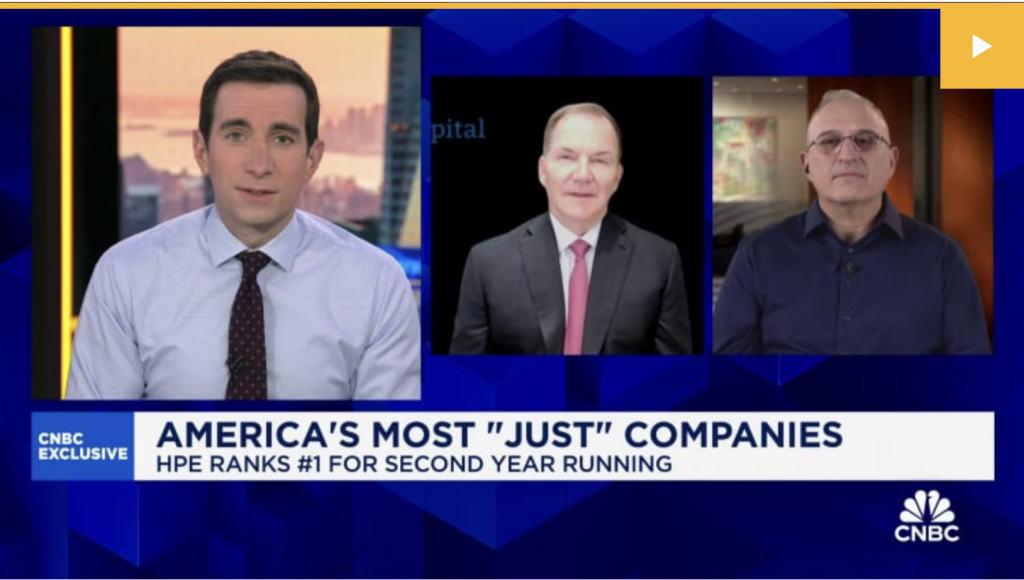
Paul Tudor Jones, Just Capital co-founder and chairman and Tudor Investments founder and CIO, and Hewlett Packard Enterprise CEO Antonio Neri join ‘Squawk Box’ to discuss Just Capital’s 2025 list of America’s most ‘Just’ companies, Americans’ top priorities for companies, President Trump’s tariff proposals, impact on the economy and markets, and more. Watch the full video here:
Today, Just Capital, in partnership with CNBC, is proud to announce the Just 100 list as part of the 2025 Rankings of America’s Most JUST Companies. Each year, JUST Capital begins by polling the American public on a fully representative basis on their priorities for business behavior. It then evaluates how the largest corporations in the country perform against those criteria. Leading companies are recognized for their performance on top priority issues such as: paying fair, living wages; supporting worker well-being; career advancement, training, and work-life balance; treating customers fairly; creating value for shareholders; communicating transparently; strengthening communities; and ethical leadership.
“Hewlett Packard Enterprise is honored to be recognized as #1 by Just Capital in their 2025 Rankings for the second year in a row,” says HPE President & CEO Antonio Neri. “This recognition validates the work we have been doing to understand and serve all our stakeholders in order to drive marketing-leading performance.”
In a year marked by significant geopolitical, cultural, and economic change, business leaders are under pressure with high performance expectations and intense scrutiny. The central message from the public, as detailed in Just Capital’s Americans Views on Business Report and Polling released in 2024, is clear: focus on the basics, do right by your customers, look after your workers, create value for your shareholders, and lead with integrity.
Despite being highly polarized on political issues, Americans are generally united in their expectations for corporations – particularly in areas where positive corporate conduct dovetails with positive business performance – and concerned about kitchen table issues like their economic well-being, how they are treated as consumers, and being able to support their families. Many appear to be distrustful of institutions as they call for increased transparency, corporate accountability, and ethical leadership.
The Just Capital 2025 Rankings of America’s Most Just Companies and Just 100 list celebrate top-performing Russell 1000 companies that are demonstrating leadership in meeting these concerns and responding to the needs of the American people. By tapping into public sentiment, these Rankings offer corporate leaders an objective, empirical roadmap across stakeholder issues that helps businesses navigate a changing socio-political and economic landscape in order to unlock enduring business value.
This promise of value creation is not mere conjecture. As of December 31, 2024 the JULCD (212.2%) – which tracks the top 50% of Russell 1000 companies ranked by Just Capital by industry, and is constructed to match its industry weights – has out-performed Russell 1000 Cap-Weighted Benchmark ( 202.04%) by 10.11% since inception. The Just 100 (116.7%) – which includes the top 100 Russell 1000 companies ranked by Just Capital – has out-performed Russell 1000 Equally Weighted Benchmark (70.8%) by 45.8% since inception.
“Just Capital Rankings stand apart because they measure companies against what matters most: the priorities set by the American public,” says Just Capital CEO Martin Whittaker. “When companies – like those featured in this year’s Rankings – actively deliver on stakeholder expectations, namely those of American workers, consumers, and shareholders, they create enduring business value while advancing solutions to our nation’s most pressing economic challenges. It’s a powerful win-win.”
Today’s corporate leadership demands data-driven insights that align with stakeholder interests and drive lasting value. Just Capital is excited to introduce Just Intelligence – a cutting-edge analytics tool that empowers companies to navigate complex stakeholder issues and fuels their competitive advantage.
This year, all ranked companies will have access to standard Just Intelligence features including an interactive explorer of their performance in the 2025 Rankings and highlights of their highest and lowest performing data points. Just Intelligence subscribers can dive deeper on critical data points, benchmark against peers, and identify best practices of top-performing companies.
“In a rapidly evolving and high-pressure landscape, today’s corporate leaders need a strategic insider to support their competitive edge. Just Intelligence is that strategic insider,” says Whittaker. “We are extremely proud to bring empirical evidence to corporate leaders that allows them to cut through the noise, benchmark their performance, make smarter decisions, and ultimately be more successful in the marketplace.”
As part of its 2025 Rankings, Just Capital is proud to present its list of Industry leaders, or companies that receive the highest overall rank within each of our 36 industries.
Of this year’s 36 industry leaders, 21 companies remained the leaders of their industry while 15 companies dropped out of the industry leader spot this year. Below is the full list of industry leaders for 2025. Industry leader shifts can be explained by both improved year-over-year performance of individual companies as well as shifting industry compositions.

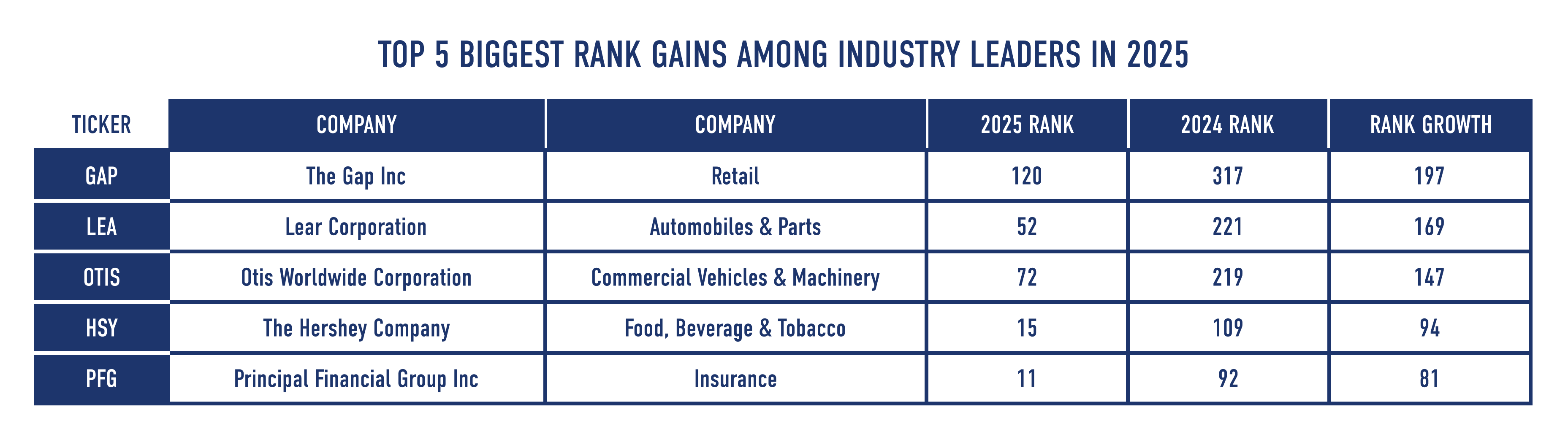
Among the industry leaders, the following saw the biggest increases in their rank (and are not influenced by treatments, such as Unique Event Treatment, applied to the model). Three of these five companies (The Hershey Company, Lear Corporation, and Otis Worldwide Corporation) also moved into the Just 100.
This year, 30 out of the 36 industries were represented in the JUST 100: In other words, six industry leaders are not part of the JUST 100 this year. These industry leaders are listed below.
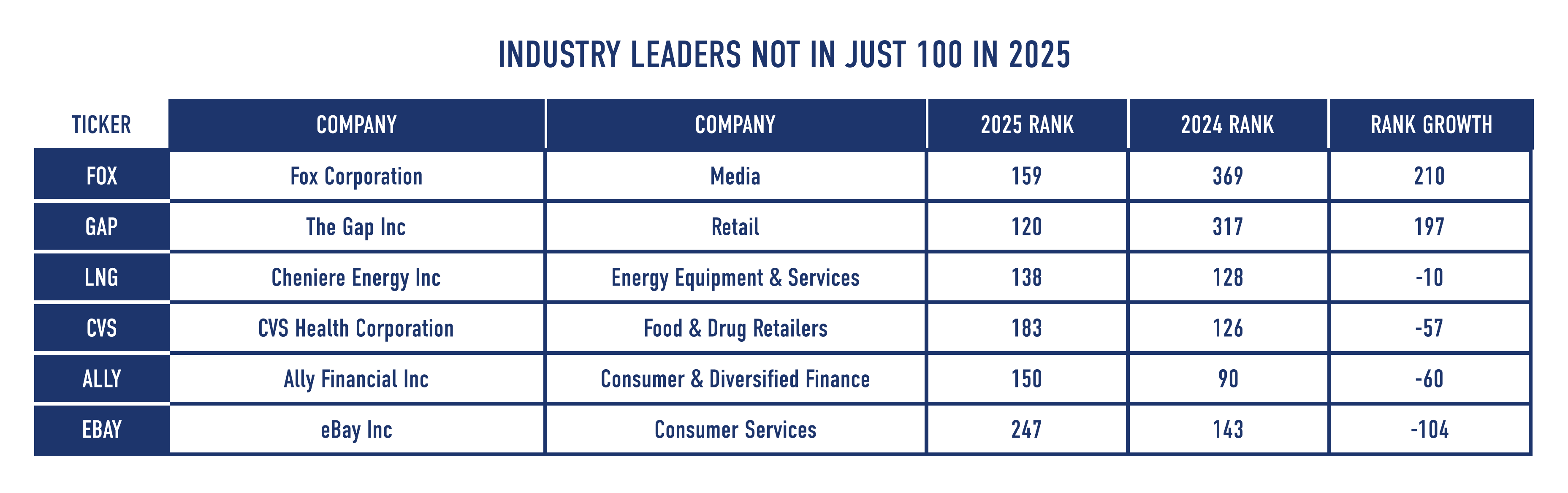
Industry Trends in 2025
Though there are 30 industries represented in the JUST 100, some industries make up a higher share of the JUST 100 than others. There are:
Certain industries tend to perform better than others, on average. Companies in the Utilities and Chemicals industries rank, on average, the highest at 275 and 317, respectively. When breaking industry average rank down by the five Stakeholders, we find that:
Companies in the Internet and Commercial Vehicles & Machinery industries saw some of the largest average gains in rank, rising 118 and 103 ranks, respectively. Companies in the Telecommunications and Clothing & Accessories industries saw the biggest average declines, dropping 91 and 75 ranks, respectively.
For more information on our Rankings, to engage with us on our corporate initiatives, please reach out to us.

In our 2025 Rankings of America’s Most Just Companies, we remain dedicated to capturing companies’ commitment to all of their stakeholders. We also recognize the importance of addressing the whole of each stakeholder, which in a practical application can mean the entirety of a company’s workforce – including workers who aren’t legally or technically considered employees.
To that end, prior to the 2023 Rankings, we employed an “Under Review” designation for companies that meet two criteria: business models that center gig workers and self-identification as members of the Flex Association. This applied to three companies in our Russell 1000 universe at the time: Uber, Lyft, and DoorDash.
Beginning with the 2023 Rankings, we have been reaching out to these companies requesting additional data to help us more accurately capture the experience of gig workers and to ensure that these companies’ scores reflect the entirety of their workforce. In our outreach to Uber, Lyft, and DoorDash, we request public company sources with information about the share of gig workers in their workforce, as well as the offerings and policies accessible to them. Using the information provided, we proportionately discount the scores of these companies across our Workers stakeholder data points when there is no evidence that gig workers are covered by the offerings or workplace policies tracked in our model.
This year, in our review of companies meeting these criteria, we determined that Maplebear (Instacart), which joined our Russell 1000 universe, should also receive a similar treatment.
We recognize that our work in capturing the workplace experience of the many Americans who work in the gig economy, or more broadly as contractors, remains in progress, but we believe that continuing this approach is a step in the right direction. Our team will work to further refine our methodology to ensure that we best capture companies’ commitment to all their workers.
Just Capital’s annual Rankings of America’s Most Just Companies assess corporate performance of the Russell 1000 against the priorities that matter most to the American public. Throughout the year, we monitor any unique events that are not captured by our current metrics and should theoretically impact a company’s overall score and rank. We identify those events as instances which result from a company’s actions or inactions and satisfy the following criteria: (1) considered material to just business behavior as defined by the American public, (2) have the potential to affect a company’s standing outside the normal architecture of our ranking process, and (3) are sudden, extreme, or unusual in nature.
This year, the four companies which received a unique event treatment are: Wells Fargo, Tesla, Johnson & Johnson, and Boeing.
The process of determining a unique event involves monitoring media coverage of companies through an independent feed with minimized bias, as well as consultation with the public, independent specialists, and other neutral third parties.
The details of each event, and how a company has or hasn’t responded to it, will determine the type of treatment given to the company’s overall Ranking performance. These treatments, in order of increasing severity, are Serious (I), Severe (II), and Most Severe (III). Each step of the process, including the final results, are reviewed by independent specialists and other neutral third parties.
This year, Just Capital is applying the unique event treatments only to the Most Severe (III) category. Each event should fall into one of five stakeholders, with each company receiving the lowest score corresponding to that stakeholder that the event pertains to.
We identified 41 companies throughout the monitoring process, which were cross referenced along geographical and legal considerations amongst the full Russell 1000. From that, we evaluated 18 events which satisfied Just’s criteria for a unique event. We narrowed down to a further four incidents and the related companies which received the Most Severe (III) category qualified for a unique event treatment. Further details on the monitoring process and evaluation criteria can be found in our 2025 Rankings Methodology.
The four cases which Just evaluated as Most Severe (III) are as follows:
The first recurring unique event case applies to Wells Fargo, a financial services company that provides retail, commercial, and corporate banking services through branches, the internet, and other channels to individuals, businesses, and institutions across the U.S. and in other countries. Given the evidence of its history of labor and banking violations, such as creating fake accounts and retaliation against its employees who speak up about labor conditions, continued lack of meaningful remediation efforts, and more recently the controversies regarding unionization efforts, Just Capital has given Wells Fargo the lowest score for the Shareholder Stakeholder.
The second recurring unique event case applies to Tesla. Tesla designs, develops, manufactures, and sells electric vehicles and energy storage systems and also installs, operates, and maintains solar and energy storage products. One of its products, the autopilot vehicles, has resulted in hundreds of crashes and several fatalities. Since last year, there has been at least one additional fatality attributed to Tesla’s Full Self-Driving technology. In response to these events, Tesla’s communication regarding the safety of its products has also been misleading to its customers, and has doubled down on this technology with the unveiling of its new robotaxi, Cybercab, despite significant safety concerns from experts and regulators. For these events, we have given Tesla the lowest score for the Customers Stakeholder.
The third recurring unique event case applies to Johnson & Johnson, which makes a range of health and well-being products in three business segments: consumer, pharmaceutical, and medical devices. Johnson & Johnson continues to attempt to use bankruptcy filings to avoid paying the estimated $9 billion settlement to tens of thousands of people affected by the contamination of its talc products. Due to the continuation of these financial maneuvers, Johnson & Johnson has received the lowest score for the Customers Stakeholder.
Since our initial unique event treatment, there have been no substantial changes in business practices by any of the above companies that would result in the removal of this treatment. Barring any significant changes in business practices specifically related to these events, this treatment will remain in effect for a maximum of three years. If another event or development occurs after the three-year period, the event can be evaluated and, in appropriate cases, treatment can be reinstated.
The fourth and final unique event treatment was applied to Boeing, which is an aerospace and defense corporation that designs, manufactures, and sells commercial airplanes, defense systems, and space technology to customers worldwide. On January 5, 2024, a fuselage plug door blew off mid-flight, the latest in several safety-related incidents that have plagued the manufacturer in recent years. Several whistleblowers have come forward alleging a culture that promotes production speed and efficiency over product safety. As a result of these events, Boeing has received the lowest score for the Customer Stakeholder.
