
(Brandon Bell – Getty Images)
We’re closely tracking how inflation is affecting company performance on key stakeholder categories, and I want to highlight two specific areas this week.
The first relates to workers. A soon to be published JUST Capital survey shows that 87% of Americans say large U.S. companies have a responsibility to regularly increase wages to keep up with the rapidly rising cost of living.
While this may be hard to do in the current economic environment, it is happening. And as we note in an article with more inflation-related polling this week, it can be smart business. As CBS News reported, over the past few months several companies have lifted wages and provided other financial incentives to alleviate employees’ angst.
ExxonMobil (a JUST 100 company), for example, has used windfall profits to expand a program that gives stock to high-performing employees and handed U.S. workers a one-time cash payment equal to 3% of their salaries; T. Rowe Price offered most of its global staff 4% salary increases by July 1 “to reward their commitment and ensure that we remain an employer of choice.” And in mid-June, Walmart announced a raise in average hourly wages for more than 36,000 pharmacy technicians to more than $20 an hour.
Even where layoffs are necessary – as has happened recently with Meta, Shopify, Uber, Oracle, and others – they can be handled in a just way. Airbnb showed how best to do that in 2020. In some cases, companies are both downsizing and investing in workers. Microsoft, for example, has taken down job listings but also raised its budget for merit-based salary increases.
The other stakeholder deeply affected by inflation is obviously the consumer. Here, we see large retailers, including Walmart, Best Buy, Gap, and Target, announce promotions and lower product pricing on high-inventory goods. This should help strapped shoppers somewhat. But some interesting shifts in consumer attitudes towards buying U.S. made goods also caught our eye.
This week, our survey partner The Harris Poll partnered with Retail Brew and reported that while 64% of Americans who shop for U.S.-made goods say that inflation has a negative impact on them doing so, 72% of respondents say they seek out American-made products very often or somewhat often even in the face of inflation challenges. This should provide some comfort for companies who source products locally, which is a facet of our stakeholder model.
The pressures inflation heaps on business does not mean stakeholder value creation needs to take a back seat. On the contrary, it can be a time for just companies to shine.
Be well,
Martin Whittaker

Amazon reveals that its carbon emissions increased 18% last year thanks to a COVID-related surge in online shopping.
Amgen is fighting the IRS over a potential $10.8 billion owed in back taxes.
Ford CEO signals it will reduce headcount in its legacy combustion engine business to fund the transition to EVs, and is preparing to cut up to 8,000 workers.
Nike – responding to pressure from activist investors – will release data on the hiring and promotion rates for women and minorities in its workforce.
Oracle begins thousands of planned layoffs across its global workforce, after discussing cutting $1 billion in expenses.
Robinhood lays off 23% of its workforce after a downturn in crypto trading, its second round of layoffs this year.
We broke down the Q2 performance of the companies in our Rankings, discovering that those at the top outperformed the rest across four of the five stakeholders we measure.
If you haven’t taken our Annual JUST Report Reader survey, please do! It helps us in shaping our coverage to include the content that’s most important to you.
Board Member Peter Georgescu speaks with Krista Bourne, COO of Verizon, on how her company is investing in its workers and succeeding in making all of its stakeholders happy.

(CNBC)
“This is good for the markets, it’s good for the country, it’s good for investors. It is possible to do an investment that provides a financial AND a social return. I fear…this backlash [against ESG] is ideological and not based on facts. This is market driven: every firm on Wall Street is creating ESG funds because consumers, investors are asking for these products to invest in, not because they are being browbeaten by activists.”
“It’s part of the cycle. When we think about what’s happened in the last 60 days, in terms of the uber aggressive hiring that has gone on, what you’re seeing is a natural reaction. The math is pretty straightforward: inflation + a retreat from hiring + a heightened focus on retention = more perks à la raises.”
“Our employees are the face of the brand. They are the factor that helps differentiate what we offer over what competitors offer…we get hundreds of job applications daily, but we compete in a tough job market. We just recently raised the minimum wage for starting positions. And we have a rich set of benefits. Incentive bonuses and profit-sharing. Employee stock ownership.”
In the midst of the debate around ESG, Barron’s invites commentary from Environmental Defense Fund’s Fred Krupp who urges readers to tune out partisan point-scoring and work through legitimate critiques and Ford Foundation’s Roy Swan who invites readers to consider pivoting toward more impact investment strategies. The Ford Foundation President Darren Walker went on CNBC to report the success of the foundation’s impact investing program, which has provided greater financial and social returns. On the other side of the conversation, Harvard Business Review publishes a new editorial on how ESG “won’t save the planet,” because it’s not actually designed to do that – it’s designed to drive returns.
The Wall Street Journal features a new comprehensive McKinsey study on the frontline experience for workers of color that suggests companies’ diversity efforts have largely missed the employees that stand to reap the biggest socioeconomic gains from them.
Fortune CHRO Daily unpacks the perplexing dynamics of the current labor market. WSJ reports U.S. job openings fell in June. Quartz reports that wages are holding strong, signaling that many sectors are still struggling to hire at capacity, but Yahoo Finance focuses on the fact that, though wages are up, inflation is eating at those gains. Despite the tight labor market and high attrition risk, a Gartner study shows CEOs and CFOs are attempting to limit expectations for across-the-board pay hikes and that employees expecting pay adjustments that fully compensate for cost-of-living increase may be disappointed.
The New York Times investigates how companies are reassessing and reimagining workplace flexibility to attract Gen Z employees.
NBC looks at the record-high profits shared by energy companies as gas prices at the pump remain steep.

This graph comes from our Q2 2022 Stakeholder Performance Analysis, which shows that companies in the top of JUST’s Rankings outperformed those at the bottom across four out of five stakeholders. The Environment delivered the best performance with a long-short spread of 10.5%. Explore additional insights here.
Events over the last year have tested the country’s frayed social fabric like no other year in recent memory. Growing partisan polarization has been well-documented, and partisan antipathy has intensified to a point where 91% of Americans say that they see strong conflicts between Democrats and Republicans. Everything, from the COVID-19 pandemic to presidential approval ratings, shows widening gaps in attitudes between Americans of different political views. It seems that the only thing that the American public – across all ideological factions – can agree on is that Democrats and Republicans disagree on even basic facts.
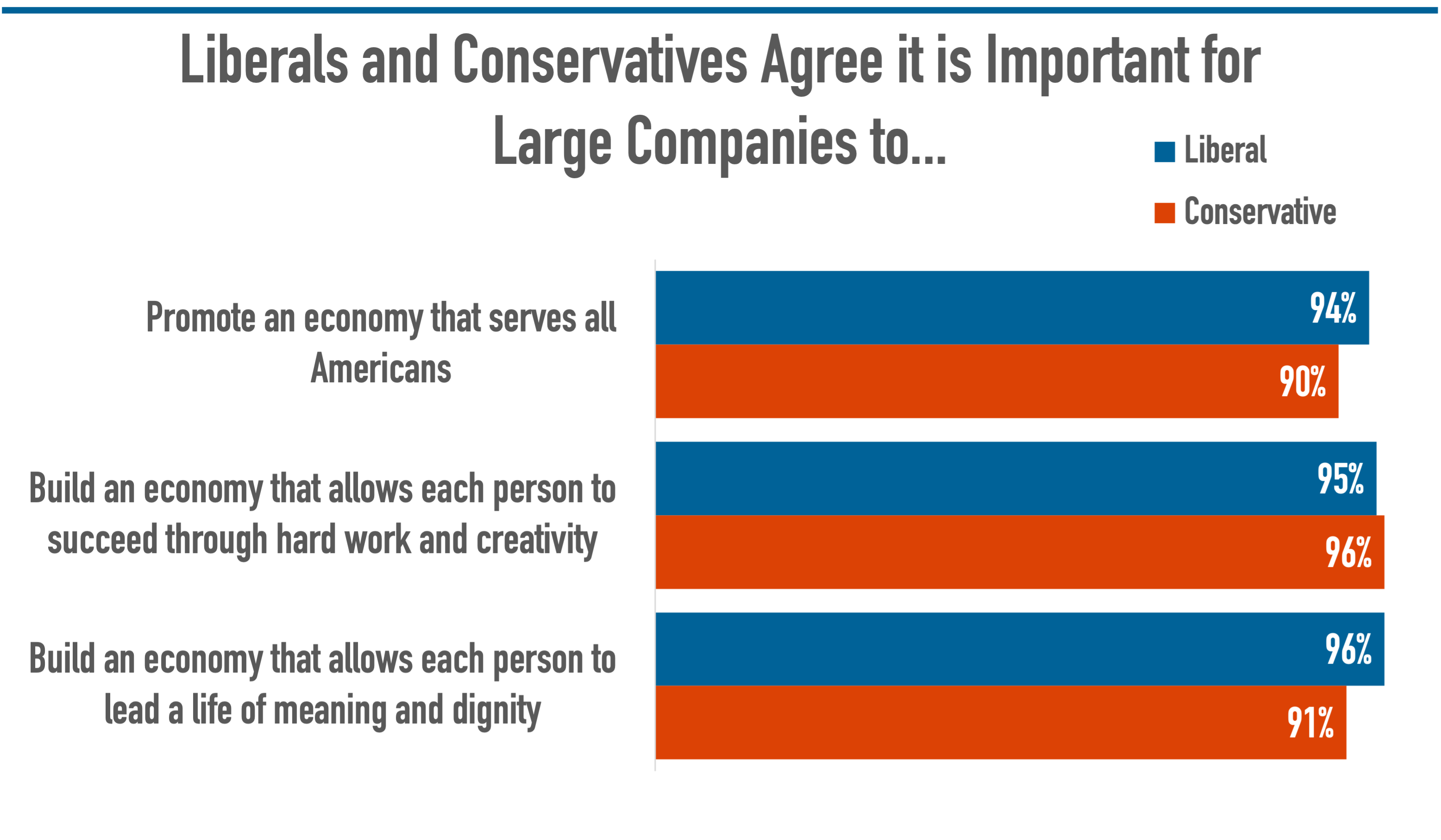
Our annual survey, however, has captured a common ground among liberal and conservative respondents when it comes to their views on stakeholder capitalism, with large majorities of each group agreeing that it’s important for companies to promote an economy that serves all Americans, as well as one that builds an economy that allows each person to succeed through hard work and creativity and to lead a life of meaning and dignity. And both groups largely agree that business can be a force for positive societal change (88% of liberals and 74% of conservatives).
Across ideological divides, Americans also agree on what the top eight priorities for creating this vision of stakeholder capitalism should be – among them, paying a living wage, cultivating an inclusive workplace, and protecting workplace health and safety. This alignment signals that stakeholder capitalism may represent a broad-based solution for achieving a more equitable economy that all Americans, regardless of their ideological perspectives, can get behind – in particular, when it comes to how companies treat their workers.
Overall, Americans want to see companies pay a fair, livable wage to their workers – it is the top priority for conservatives and #2 for liberals (securing human rights across the supply chain is the top priority for liberals). Ethical leadership ranks #4 for both groups on the list of priorities. And among the top eight priorities overall, liberals put slightly more emphasis on issues of human rights and workplace diversity compared to conservatives, while conservatives put slightly more emphasis on job creation and workforce investment compared to liberals.
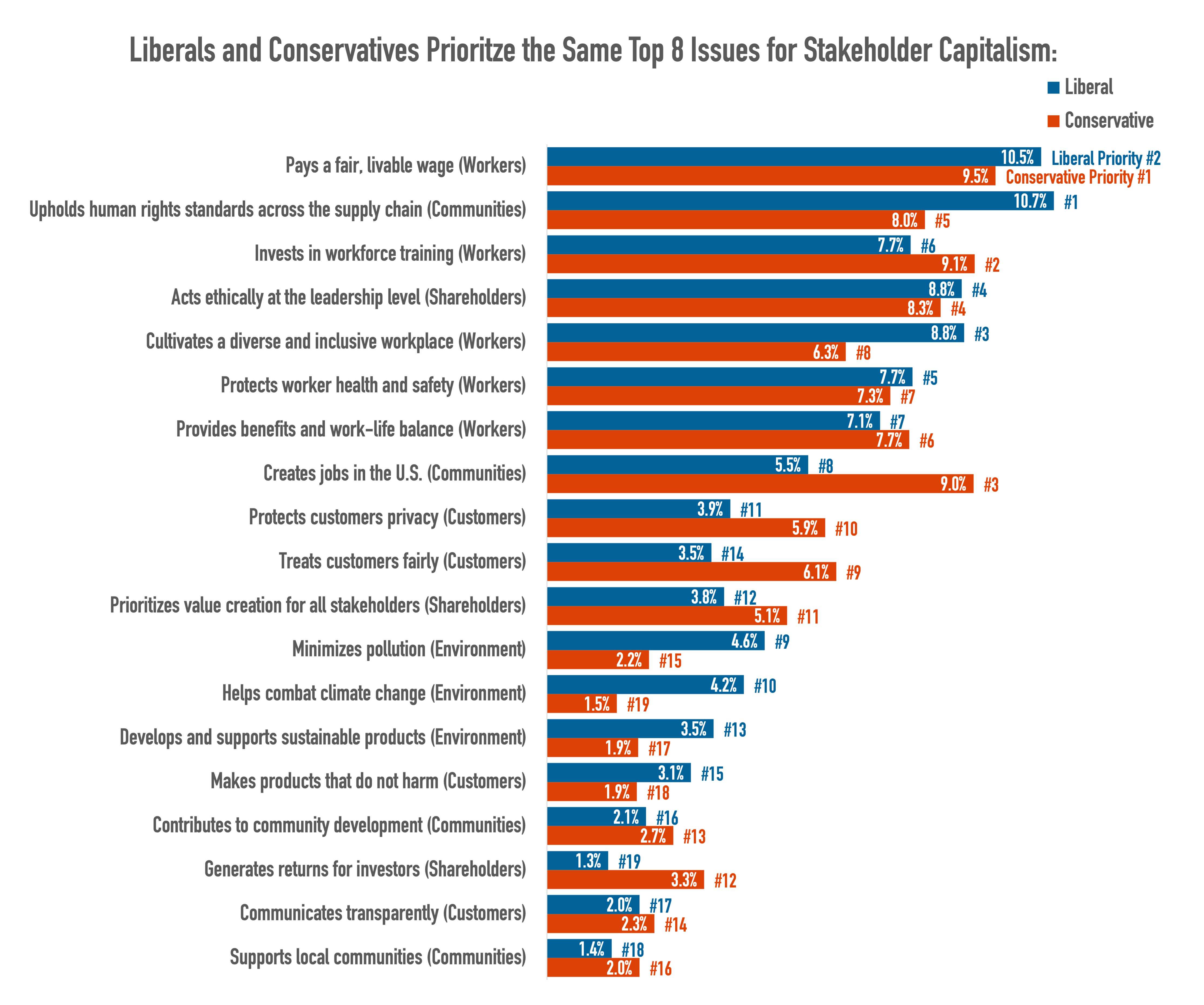
Further down the list of priorities, some predictable differences emerge. Liberals are more concerned about environmental issues compared to conservatives, such as limiting pollution (#9 for liberals and #15 for conservatives) and reducing carbon emissions (#10 for liberals and #19 for conservatives). Conservatives put a higher priority on generating profits (#12 for conservatives and #19 for liberals).
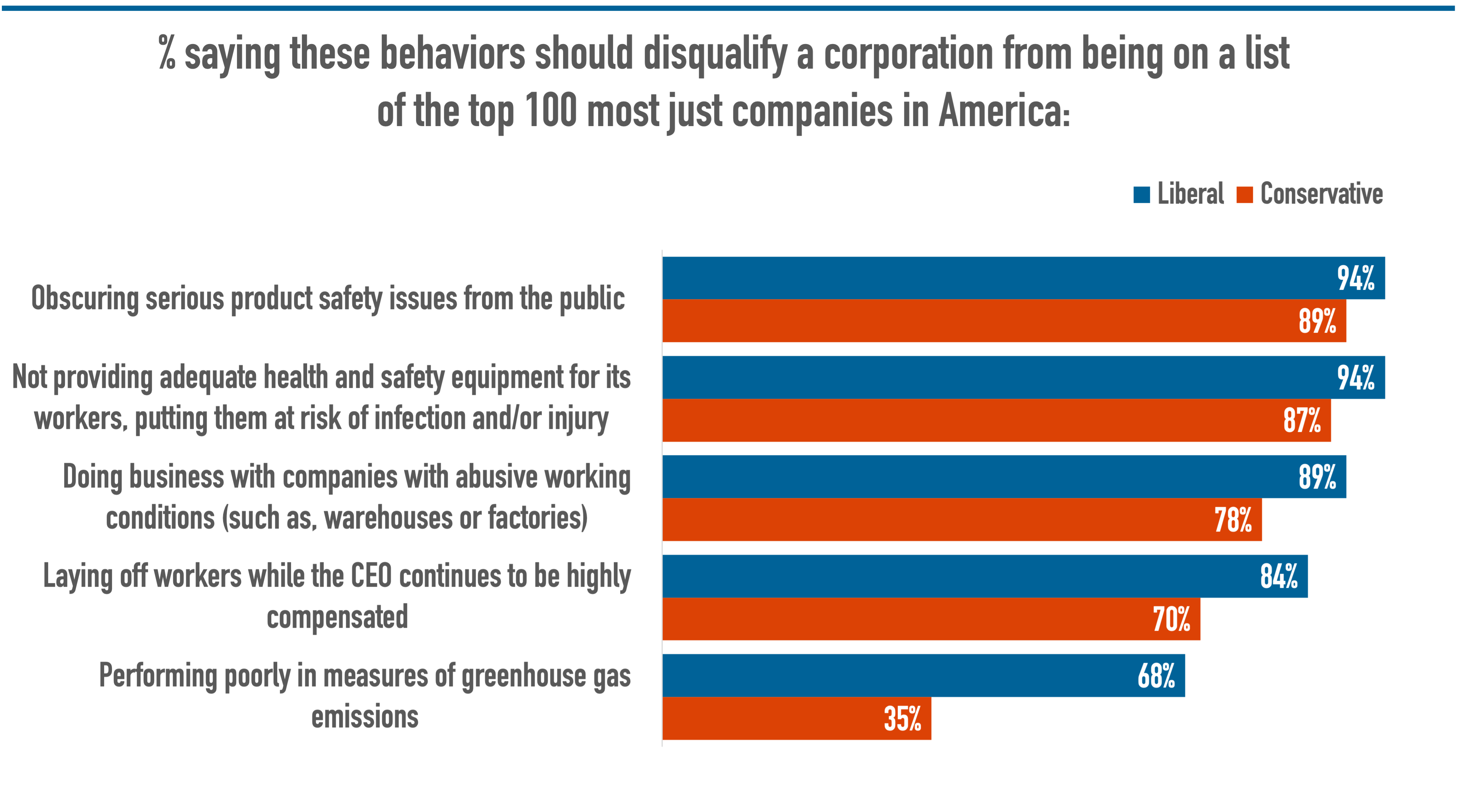
Liberals and conservatives also largely align on the business behaviors that they view as unjust. Large majorities of both groups believe it is unjust for corporations to hide product safety issues from the public, put workers at risk by not providing adequate health and safety measures, do business with companies that have abusive working conditions, and continue providing high pay to CEOs while laying off workers. The only issue that presented a split in opinion about unjust corporate behavior is greenhouse gas emissions – 68% of liberals believe corporations that produce more greenhouse gas emissions are unjust, compared to 35% of conservatives.
Despite the intense polarization that undeniably exists in our country today, a path toward unity seems to exist in how we approach stakeholder capitalism. Business leaders can do their part by putting forward a broader, more inclusive economic vision that allows all people to contribute and achieve their potential. And companies can take action by making the security and well-being of their workers their top priority – a move that truly bridges the ideological divide.

The debate raging this week in Congress around the $15 minimum wage – a Biden Administration “first 100 Day priority” – has put worker economic security back in the spotlight.
It’s a huge issue. Our own research shows that, incredibly, up to 50% of workers at Russell 1000 companies weren’t making enough to support a family of three, even with a partner working part-time. And that was before the coronavirus pandemic hit.
Amazon’s vocal support of a federal $15 min wage floor is, as Michelle puts it in a new piece, admirable. But if we’re looking at what Americans want, and what our biggest corporations can provide them, the bar has to be set higher.
“Paying a fair and livable wage” is the top issue Americans care about most when it comes to just business behavior, and that means paying more than minimum wage. It also means taking a wider view of worker financial health. The quality and availability of benefits; the capacity of workers to save for retirement or pay down student debt; worker financial education and literacy; upskilling and training; stock ownership and profit sharing; all of these things matter too.
More and more companies are starting to get it. This week saw GM announce that up to 44,000 eligible hourly UAW-represented employees could receive up to $9,000 in profit-sharing checks this year. The new CEO of Harley Davidson, Jochen Zeitz, a champion of corporate stakeholder performance (and former JUST Board member) announced the company would issue stock to 4,500 workers, including all of its hourly factory laborers, because when employees are engaged, respected, and have a stake in their work, the company benefits. Mastercard is building a major global initiative around financial inclusion.
The broader theme of investing in, listening to, and supporting workers is a bedrock of stakeholder capitalism. It’s good for business, and as our current Chart of the Week shows, it’s good for investors. It’s also why we’re so proud of the program we co-founded with PayPal, the Worker Financial Wellness Initiative, to guide companies on first evaluating, and then taking concrete steps to address, overall financial hardship among their employees. If you run a big company, and you want to get involved, I invite you to reach out.
Be well,
Martin
Citigroup is working with Black-owned investment firms for a $2.5 billion bond issuance.
As reported above, GM’s hourly workers are expected to receive $9,000 thanks to the company’s profit-sharing program.
Here are more details on Harley-Davidson issuing company stock to 4,500 employees, including all of its hourly factory workers.
Salesforce announced a new “Work From Anywhere” policy, offering employees three options for how they can work going forward: flex, fully remote, and office-based.
Tesla skips contributing to its 401(k) match for the 3rd year in a row, despite record stock price increases in 2020.
Wells Fargo makes equity investments in six Black-owned banks as part of a broader $50 million pledge to support minority-focused lenders.
12PM ET Today: Martin joins the NeuroLeadership Institute to discuss the companies that supported their workers, customers, and communities through the pandemic, and how increased scrutiny on diversity, equity, and inclusion disclosures is changing corporate America for the better. Sign up to listen here.
How can corporate America and the government work together to help all Americans? Martin spoke at a Bipartisan Policy Center event: “What’s Next for Stakeholder Capitalism in 2021.” Watch the replay here.
Our researchers Aleksandra Radeva and Molly Stutzman examine why corporate America needs a common standard for demographic disclosure.

The last couple of years have been scary for a lot of people. A good chunk of the population believes that capitalism is not working for them, that the system is rigged against them. There’s so much inequality that people are now in the streets. Business leaders are coming to a realization that this form of just staying with the status quo may not be sustainable for us as businesses. And I think that realization is creating this awareness that we have to lift up the bottom, we have to lift up the wages and working conditions of people for a better functioning society and economy.
– Zeynep Ton, President of the Good Jobs Institute, to JUST
“Predicting the future is hard. Nobody’s very good at it. For example, the Congressional Budget Office’s track record in its area of expertise – forecasting long term budget deficits – has been described in Forbes as “no better than throwing darts.” So when in its report on the Raise the Wage Act, the CBO chooses to model the employment effect of a $15 minimum wage by plugging in an elasticity value 10 times the consensus of experts in the field, it’s a safe bet that the CBO will once again be proven wrong. That said, regardless of its predictably implausible employment forecast, the CBO report actually makes a strong case for a $15 minimum wage. According to the CBO, 27 million workers would see their incomes rise. Nearly a million Americans would be lifted out of poverty. Even accounting for its predicted job losses, the aggregate pay of affected workers would increase by $333 billion. That’s a net gain for American workers and the American economy.”
– Nick Hanauer, Founder of Civic Ventures and Host of “Pitchfork Economics”
“The myth that sustainable investing results in lower returns is clearly just that. The Center for Sustainable Business’ new analysis of more than 1000 academic studies since 2015 finds that a very small percentage found a negative correlation – and in fact, 58% of corporate studies and 33% of investor-based studies found that ESG delivers superior returns. Managing for a low carbon transition appears to drive better performance for both corporates and investors, and sustainability appears to drive more innovation and better risk management, resulting in better financial performance, as well.”
– Tensie Whelan, Director of the NYU Stern Center for Sustainable Business, to JUST
Must-Reads of the Week
The New York Fed releases new research showing that lower-wage workers have borne much more of the brunt of job losses during the pandemic than higher-wage earners.
The Wall Street Journal highlights the latest CBO study saying that a $15 minimum wage would cut unemployment and reduce poverty. Goldman Sachs analysts estimate that about 30% of U.S. workers would benefit, and in some states like Mississippi, it might be as high as 40% of the state workforce.
The New York Times lifts up the plight of grocery store workers in a story focused on how many feel forgotten as the pandemic rages on, and Forbes reports on the food union’s push for hazard pay and more health and safety protections.
NBC reports that President Biden met with CEOs of JPMorgan Chase, Walmart, Gap, and Lowe’s to discuss equalizing the economic recovery and improving the wage gap.
Business Insider speaks with Ray Dalio on the fundamental changes capitalism needs to maketo address the inequities exposed through the crises of 2020.
CNBC shares a new analysis from the National Women’s Law Center, detailing how women’s labor force participation hit a 33-year low this January.
GreenBiz talks about how the “S” in ESG is finally having its moment, particularly around diversity and inclusion metrics, and Fortune adds more reasons why this sudden focus on social goals is not a passing fad for U.S. business. Meanwhile, Fast Company takes a deeper look into why so many corporate diversity reports are misleading.

Our latest Chart of the Week shows companies that don’t pay their workers well need to take up more debt (i.e. more risk) to have the same returns on equity as those that pay their workers well.
In light of Labor Day this past Monday, we at JUST Capital wanted to revisit a chart from early June to evaluate how companies’ treatment of their workers continues to affect financial performance throughout 2020. We considered the trailing one year, as of Aug. 31, for the Russell 1000 companies we track, and split them into five quintiles based on how they scored on the Workers stakeholder in our current ranking of most just companies. Once again, we saw significant alpha correlated to superior workforce treatment. The top quintile of just companies with the highest workers score has outperformed the Russell 1000 by 4.7% while the bottom quintile underperformed by 4.3%.
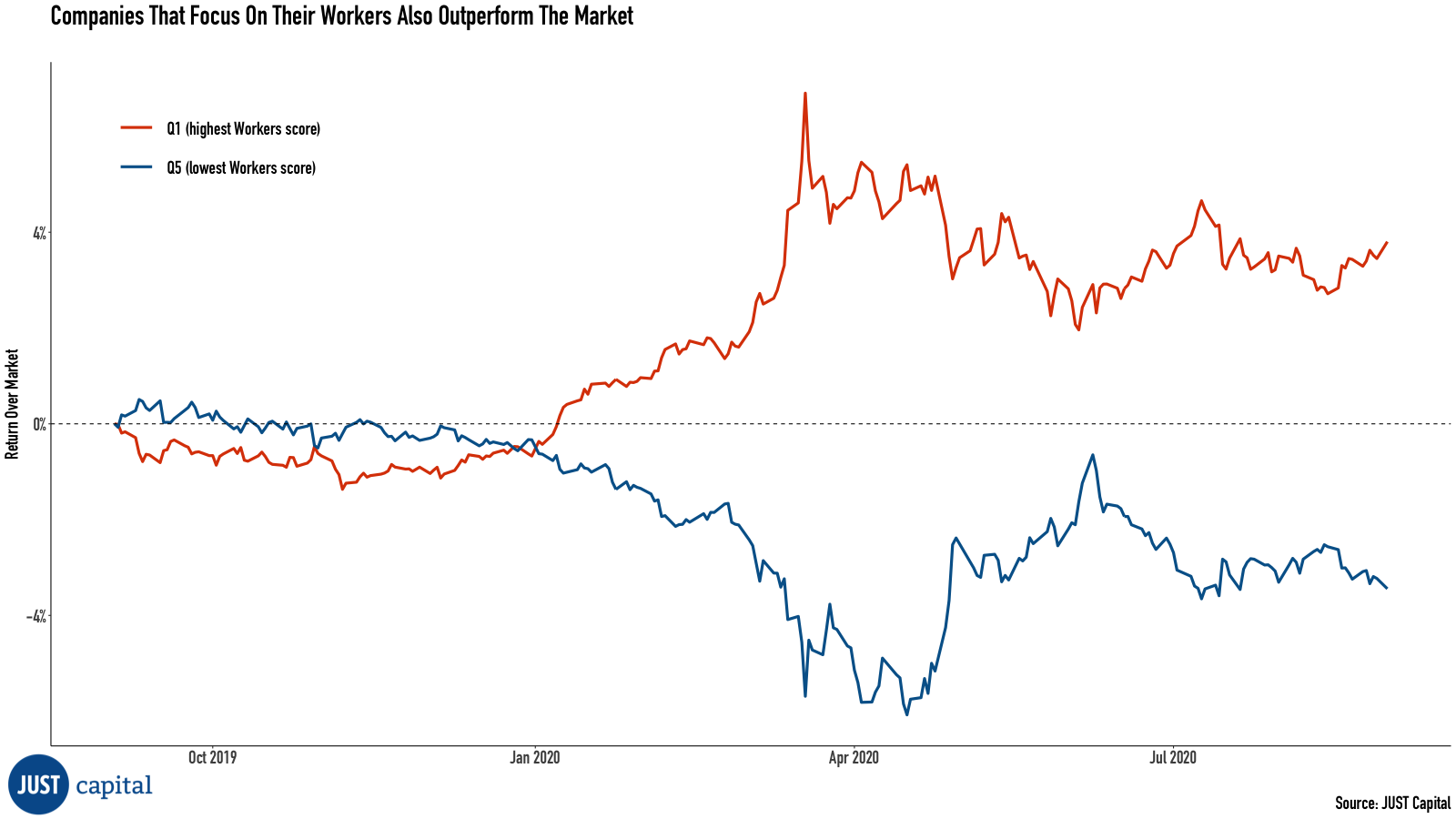
Labor Day provided us a unique opportunity to take a closer look at the how companies treat their workers, which our polling has consistently found to be the stakeholder Americans prioritize most. Your business is only as good as your workforce, and as the U.S. unemployment rate fell to 8.4% in August from 10.2% in July, America’s biggest corporations in a rebuild have the chance to set a new standard. The pandemic has prompted long overdue conversations about how companies value their workers, and we’ve seen corporations step up to provide permanent minimum wage hikes, paid sick leave policies, and long-term commitments to advancing racial equity from within.
Our surveys, done in partnership with The Harris Poll, have shown that the American public overwhelmingly believes that the pandemic has prompted the need for a “reset,” where we move to stakeholder-driven capitalism, and that CEOs have a role to play in advancing racial equity within their companies.have accelerated the need for stakeholder driven capitalism. Americans are demanding more from the companies they work for, purchase from, and invest in. Our analysis has shown that the corporations that take this seriously can do so while continuing to grow and yield returns to shareholders. As the debate between stakeholder capitalism and shareholder primacy carries on, we are seeing clear evidence that maximizing profits in a way that hurts employees is not the best way to do business.
If you are interested in supporting our mission, we are happy to discuss data needs, index licensing, and other ways we can partner. Please reach out to our Director of Business Development, Charlie Mahoney, at cmahoney@justcapital.com to discuss how we can create a more JUST economy together.
If you have questions concerning the underlying analysis, please reach out to our Senior Manager for Quantitative Research, Steffen Bixby, PhD, at sbixby@justcapital.com.
|
|
|
|
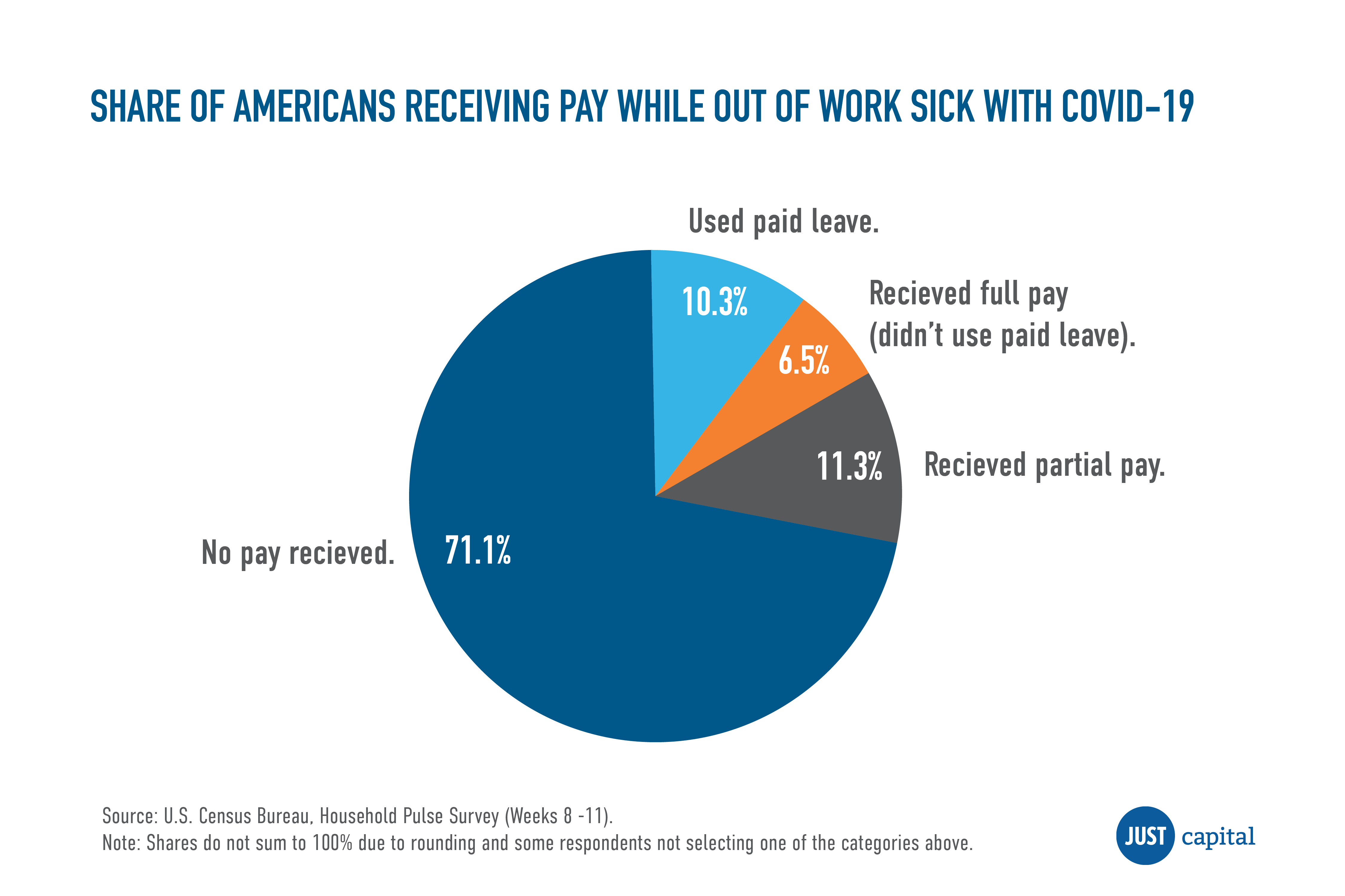
As the number of COVID-19 cases in the U.S. continues to rise, paid sick leave remains crucial to limiting the spread of the virus, protecting workers’ finances, and supporting businesses and the economy. Recent data from the Census Bureau, however, shows that the vast majority of Americans who weren’t at work because they had COVID-19 symptoms did not receive any pay.
Beginning at the end of April, the U.S. Census Bureau deployed a new weekly experimental household survey to identify how the pandemic is impacting people’s social and economic wellbeing. A key section of this survey asks whether a respondent worked in the last week and, if not, what was the main reason why, including whether it was because they were “sick with coronavirus symptoms.” Specifically, respondents are asked if they worked for pay during the prior seven days and if they didn’t, whether they received any pay during this period.
Over a four week period (June 18 to July 14), 71% of adults who didn’t work because they had COVID-19 symptoms reported receiving no pay during that period; only 10% reported using paid leave during their time away from work.
A closer look at the data illustrates that low-wage workers and people of color comprise the majority of people missing working due to COVID-19 illnesses. These workers are also among those least likely to have access to paid sick leave benefits prior to the outbreak. Below is a snapshot of the demographic characteristics of Americans missing work due to their COVID-19 symptoms.
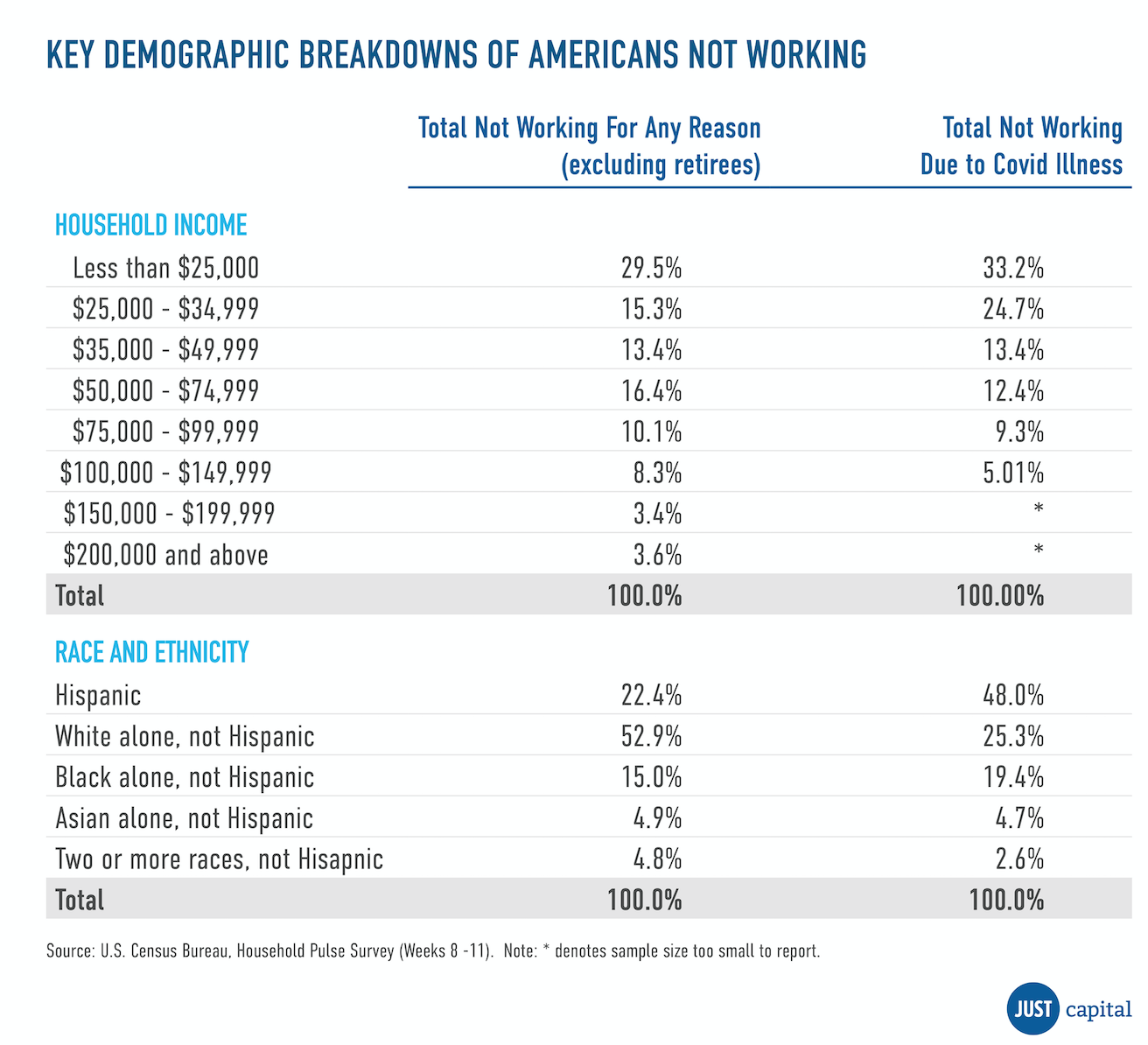
Americans not working due to a COVID-19 illness are disproportionately low-wage workers. More than 70% have a household income of less than $50,000, with nearly 60% making less than $35,000. As a point of comparison, among all adults not working for any reason, 45% earn less than $35,000. People of color also make up a majority of all adults not working because of COVID-19 symptoms, with Hispanic or Latinx workers comprising almost 50% of all adults.
As identified above, nearly three in four (71%) adults not working because they have COVID-19 symptoms are not receiving any pay. Alarmingly, these rates are far higher among low-wage workers. For example, among adults with a household income of less than $25,000, more than 87% didn’t receive any pay while they weren’t working; among people with a household income between $25,000 and $34,999, more than 73% of people didn’t receive any pay.
Nearly six months into the COVID-19 crisis, one may wonder why so many workers still can’t access adequate paid sick leave benefits. The short answer is that paid sick leave in the U.S. remains a patchwork of policies, including a new federal law, city-wide programs, and employer provided benefits. The data highlighted above suggests that this approach has largely failed at a moment when workers need paid sick leave benefits the most.
Prior to the COVID-19 crisis, there were significant disparities in access to paid sick leave across the labor force. Overall, 73% of private-sector workers had access to paid sick leave but rates were far lower in industries with significant frontline workers and among low-wage workers. For example, only 45% of those in the Accommodation and Food Services sector had access to paid sick leave; overall, only 30% of the lowest paid workers have access to leave.
Recognizing the health and economic importance of workers having adequate paid sick leave, Congress passed the Families First Coronavirus Response Act, which included a requirement for employers to provide up to 80 hours (10 days) of paid sick leave to workers. The Act, however, contained a large loophole, exempting employers with 500 or more employees, which represents more than half of the nation’s workforce.
On top of that, the Department of Labor – the agency charged with implementing the law – has done little to ensure covered employers and workers are aware of their rights under the program. In fact, the Department has taken steps to make it easier for small employers to also be exempt from providing workers with paid sick leave in instances when they need to care for children.
In short, legislated exemptions, clawbacks through regulation, and the lack of an implementation strategy reduced the effectiveness of the Families First Coronavirus Response Act. It’s clear that federal legislation that provides paid sick leave to all workers – regardless of employee classification or what size of company they work for – is still needed.
In the absence of additional Congressional action, large companies should step up and provide all workers with paid sick leave. JUST Capital’s polling shows that this issue is among the top priorities of the American public: 74% of Americans believe that companies should provide employees with 14 days of paid sick leave. Importantly, the public recognizes that this shouldn’t be a short-term benefit, with 70% believing extended lengths of leave should be provided to workers for at least the next 12 months.
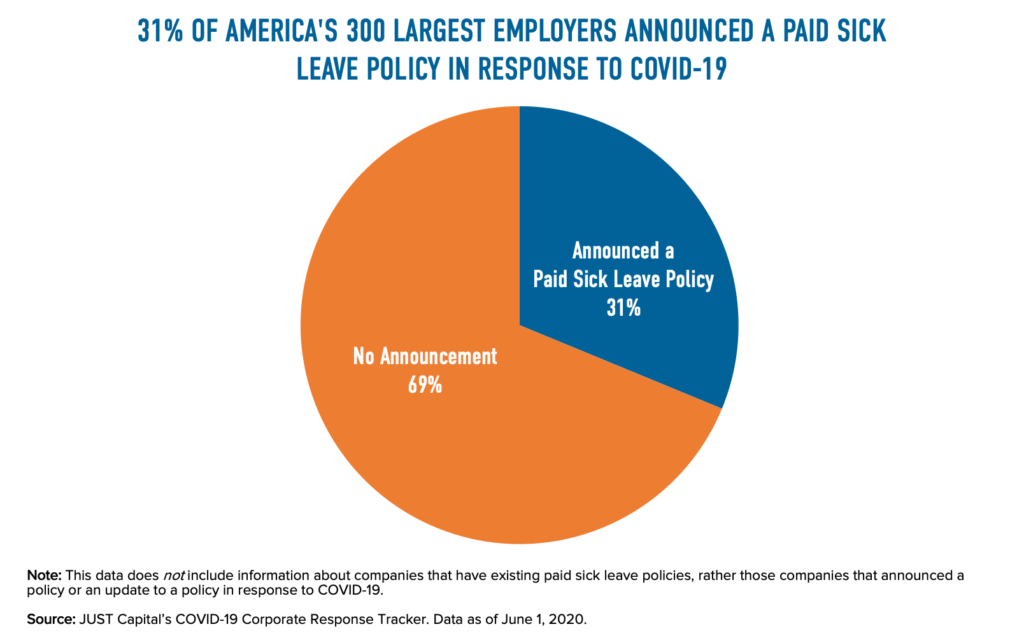
Since the beginning of the COVID-19 crisis, JUST Capital has been tracking corporate behavior and responses. Our research shows that less than a third (31%) of America’s largest companies have announced a new or expanded paid sick leave policy. Within the retail sector, JUST’s research shows that about 40% of the largest companies have made paid sick leave announcements. Across all companies that have made a paid sick leave announcement, the average number of days provided to workers is about 13 days.
In many cases, however, workers still face barriers to use. For example, at some companies workers need to have a positive COVID-19 test or a doctor’s note in order to use their leave. That means that workers who have a fever or other mild symptoms of COVID-19 and would like to stay home can’t do so with pay. In total, 31% of companies that have announced a new or expanded paid sick policy have some barrier to use.
As our country continues to experience a rising number of COVID-19 cases, paid sick leave is vital to containing outbreaks and protecting families’ finances. Corporate actions to date are encouraging, but businesses can and should do much more to ensure all workers – especially low-wage, essential workers – don’t have to choose between their health and earning a paycheck while they wait for Congress to act.