Just Capital released the second edition of its monthly National AI Monitor, which asks Americans how they are experiencing AI in their daily lives and what drives positive and negative experiences.
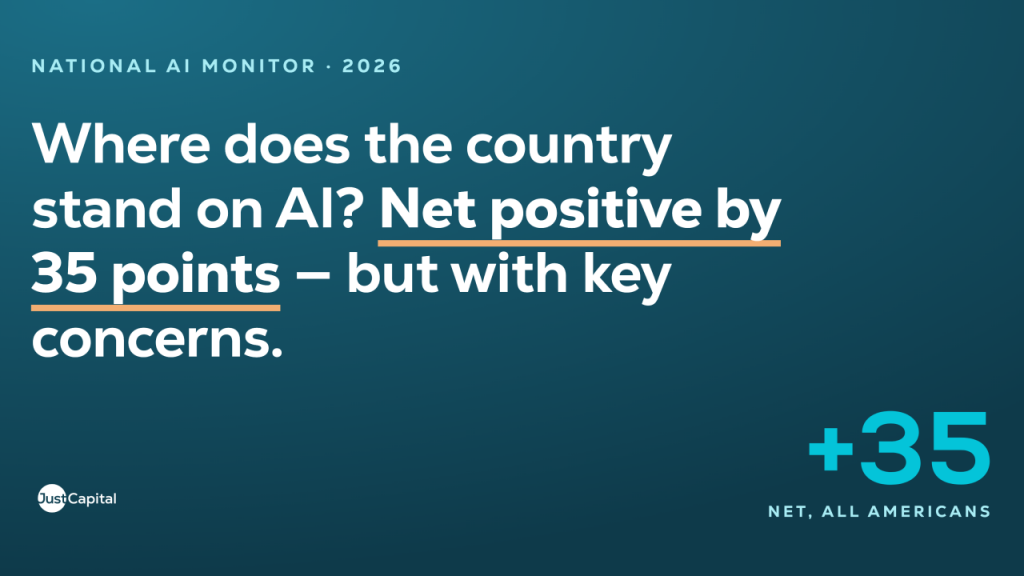
The results show that despite the heightened national dialogue around AI safety, Americans are positive about their experiences with AI on a day-to-day basis, with productivity at work cited as a primary driver. Worries about environmental impacts, the trustworthiness of models, and threats to employment weigh heavily on their outlook for the future, especially among women, lower-income Americans, and older adults.
“There’s an assumption that Americans are against AI, but the people we’re hearing from continue to tell a more hopeful story,” said Just Capital CEO Martin Whittaker. “Americans’ optimism may be one of the most underappreciated signals in the AI conversation today. Leaders who listen closely have a real chance to build public trust.”
Scores are calculated as the percentage of positive responses minus the percentage of negative responses, producing a range from -100 to +100. Changes between September and August were not statistically significant.
Productivity at work
“AI takes care of the structured and logical work; this allows me time for bringing human expertise to bear.” – Male, 59, middle income, very positive respondent on AI at work
“I can do 10x the work I used to do, and can more confidently work in areas I dont have as much experience in.” – Male, 39, upper income, very positive respondent on AI at work
Speed, convenience, and personalization
“As a customer, I think companies’ use of AI makes products and services more convenient and personalised. It helps me get faster customer support, better recommendations, and quicker answers to my questions. At the same time, I am concerned about privacy and want companies to use my personal information responsibly.” – Female, 42, middle income, very positive respondent on AI as a customer
Exposure as an investor
“My 401k is doing pretty well and AI is driving the market.” – Male, 34, lower income, very positive about AI as an investor
Environmental impacts including data centers, water use, electricity use, and grid strain
“Water waste, water pollution, energy waste, the drain on resources of communities too poor to fight back against them.” – Male, 50, upper income, very negative respondent on AI and the environment
Distrust
“I do not trust AI or the makers. I don’t think it can be controlled.” – Female, 65, lower income, very negative respondent on AI overall
Job loss
“It’s very sad to see that AI is quite literally taking people’s jobs and copying people’s content and reusing their face and videos without their knowledge of consent.” – Female, 19, lower income, very negative respondent on AI at work
Attitudes vary considerably by respondent demographics:
The survey was conducted online within the United States by The Harris Poll on behalf of Just Capital from September 30 – October 2, 2026 among 1,010 U.S. adults ages 18 and older. The sampling precision of Harris online polls is measured by using a Bayesian credible interval. For this study, the sample data is accurate to within +/- 3.6 percentage points using a 95% confidence level. This credible interval will be wider among subsets of the surveyed population of interest.
Respondents were asked seven questions: one on AI’s overall effect on the respondent to date, one for each of the five stakeholder groups in Just Capital’s framework (workers, customers, communities, the environment, and shareholders), and one forward-looking question on how optimistic respondents are about where AI is headed and how it may affect them. All questions use a five-point scale ranging from “very negative” to “very positive,” with “I don’t know” offered as an additional, non-forced option so that uncertainty is not recorded as a neutral rating. Every question except the final one is followed by an open-ended “why,” which is synthesized to identify what drives responses and to serve as a diagnostic on how effectively companies are deploying AI. Scores are calculated as the percentage of positive responses (“somewhat positive” and “very positive”) minus the percentage of negative responses (“somewhat negative” and “very negative”), producing a range from -100 to +100. “I don’t know” responses are excluded from the calculation rather than counted as neutral.
For complete survey methodology, including weighting variables and subgroup sample sizes, please contact Just Capital.
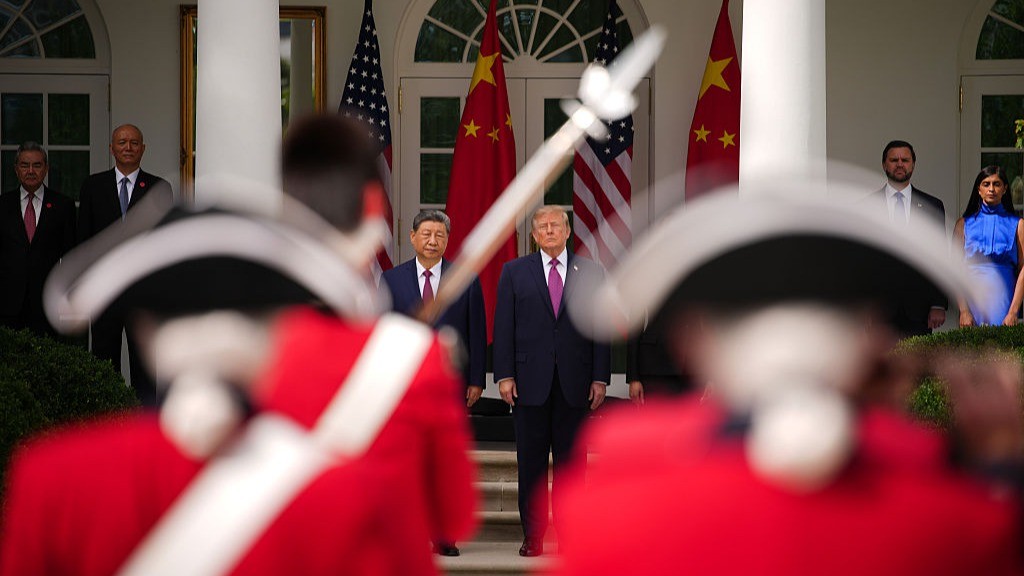
It has been an exciting week in New York. Yesterday I joined Dani Burger on Bloomberg TV to talk about the issue of the day, AI safety. We had just fielded a snap poll on what Americans want to see from the U.S. and China on AI ahead of President Trump’s summit with Xi Jinping. Key findings include 87% of Americans (across party lines) are concerned about AI safety and wanting action; 67% believe the US and China should work together on AI safety; 51% urge the President to take action on AI safety even if China does not want to cooperate. I was also struck by the fact that 30% said they would switch their vote in the midterms to candidates who share their views on AI. The bottom line? The public is more concerned about AI safety than they are about China.
The results dovetailed with our monthly National AI Monitor, which shows Americans are net positive about AI right now (especially at work), and our fourth quarterly survey of the public, investors, and corporate leaders, which for the first time also captured the small business perspective. Here we also found that AI safety outranks U.S. competitiveness as a top concern for all three audiences. Where the three diverge is their expectations around the level of investment. 64% of the public and 56% of investors want companies to devote over 5% of their AI investments to safety and security. Only 22% of corporate leaders currently report spending at that level, and 65% say they are at 5% or below.
We also joined forces this week with Amalgamated Bank and Worth Media to host a private executive roundtable on AI’s impact on the workforce. The session ran under Chatham House Rule, so I can’t quote participants. But every leader in the room, from every sector, is in dual execution and learning mode. Testing solutions quickly, and measuring whether they work, is the new reality on the ground. This morning I am speaking at Mastercard’s Data for Inclusive Growth Forum to further explore how corporate America can adapt to AI quickly enough to drive innovation and unlock opportunity for all.
The fact is, all stakeholders seem to want speed, value creation (for them) AND safety. This is the challenge being set. Our flagship JUST ETF shows that companies best able to do this will prosper – as of September 23, it has outperformed the Russell 1000 equal-weighted index by an incredible 87.5% since inception in March 2019.
More to come.
Be well,
Martin
53% of corporate leaders believe safety & security is a top concern, exceeding concerns around competition and growth. Explore the data here.
Fortune speaks to the CEO of Hilton, who reveals that AI has only made entry-level hospitality jobs more competitive, with 12,000 applications received for 72 internship slots this year.
Indeed releases a surprising study that shows pay for more AI-exposed jobs is actually rising.
Axios looks at how China and the US might be creating an AI “red phone” – a former cold-war era guardrail to get immediate contact with world leaders in case of a major AI-driven catastrophe.
Politico examines why California voters in particular are turning on AI.
The Charlotte Observer reports that Amazon is investing $1.5 billion to improve wages for U.S. operations workers.
The CEO of Dollar General is seeing shopping behaviours change not only among typical low-income customers, but the middle class as well. Yahoo! Finance has the story.

The Wall Street Journal looks at all the ways the AI build-out is becoming the biggest U.S. construction project in history.
Americans are clear about what they want from AI. Our latest polling shows they prioritize safety over speed, prevention of harm and deception (especially for vulnerable populations), protecting privacy and personal data, and keeping humans in charge. They also hold deployers of AI just as accountable as the developers.
Business is starting to respond.
This week the Alliance for Critical Infrastructure, a CEO-led coalition, added new members to prepare for AI-powered attacks on banking, technology, energy, telecommunications, and transportation. Citigroup‘s Jane Fraser told Axios that capturing AI’s upside means accepting “the responsibility that comes with it.”
Banks are also fighting AI deception where it hurts most: in people’s accounts. Today the American Bankers Association relaunched its #BanksNeverAskThat and #PracticeSafeChecks campaigns. Banks across the country can use the new videos and materials to help customers spot scams. As the ABA’s Paul Benda told the Senate this summer, generative AI “is not replacing traditional scams. It is industrializing them.”
On innovation, Vertex Pharmaceuticals is using AI to speed up its research and development, and is hiring business talent with quantitative training. Zoom has committed $10 million over three years to AI education and opportunity, with $5 million going to K-12 AI literacy through partners including Code.org.
Commitments like these are still rare. In our corporate disclosure analysis, only 9% of Russell 1000 companies report investing in community AI initiatives. Only 10% disclose a policy that explicitly addresses harm, deception, or manipulation, which is the public’s top priority.
Still, these are incredibly positive actions. We need more of them, and our monthly National AI Monitor, which tracks how ordinary Americans are experiencing AI in their lives, will help us gauge the impacts.
Be well,
Martin
14% of companies disclose a policy or set of principles that specifically mentions keeping humans in charge, human oversight, or maintaining human-in-the-loop.
The Wall Street Journal examines a small Pennsylvania town and explores the varied responses to a tactic companies are using to build local data centers – by offering locals cash payouts.
ABC looks at how the construction boom around AI data centers is so large it’s halting progress on other important construction projects.
OpenAI cancels their latest model update, citing major safety concerns. The Washington Post has the story.
At the same time, The New York Times reveals that OpenAI was previously ignoring employees who warned it wasn’t doing enough for security.
Axios reports on The Alliance for Critical Infrastructure, a recently formed CEO-led coalition that aims to protect critical infrastructure from AI risks.
Yahoo! Finance examines research that shows nearly one-third of Americans cannot pay their bills on time.
The Financial Times looks at how Starbucks’ growth plan is rolling back many of their sustainability promises.

The Century Foundation examines how debt payments have grown since 2022 and are eating away at Americans’ pay.
Just Capital released its fourth quarterly survey of the American public, investors, and corporate leaders, an ongoing research initiative to track each audience’s expectations around AI development and deployment. Over the past year, the survey has identified declining predictions of large-scale job losses and increased concern about environmental impact. One area of consistency among all three audiences is the persistent prioritization of AI safety and security.
“The American public sees clear benefits of an AI-powered future, and they also have very real anxieties,” said Just Capital CEO Martin Whittaker. “Frontier labs and government both have immense responsibility to facilitate broader access to opportunity and to protect against the greatest harm. Yet, there’s a role for other CEOs and corporate leaders to help the public understand how AI is adding value while explicitly addressing key issues like model safety, data protection, and human oversight. Concrete actions and transparency are how trust is built.”
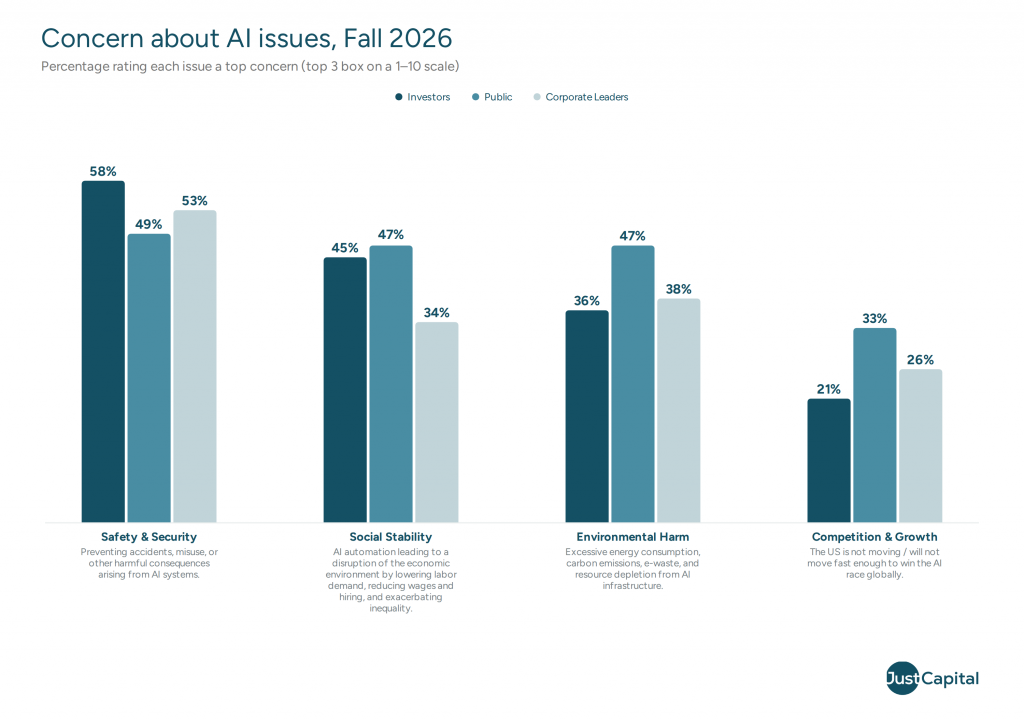
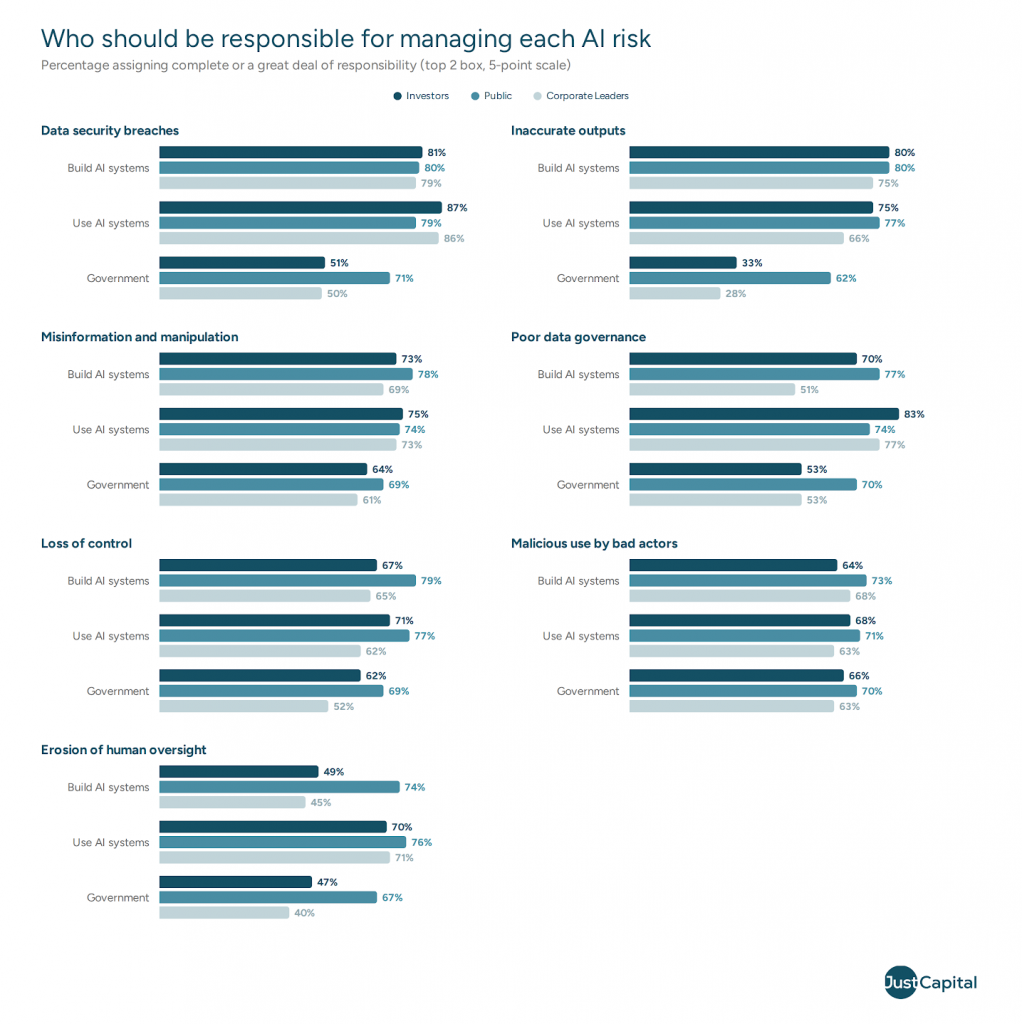
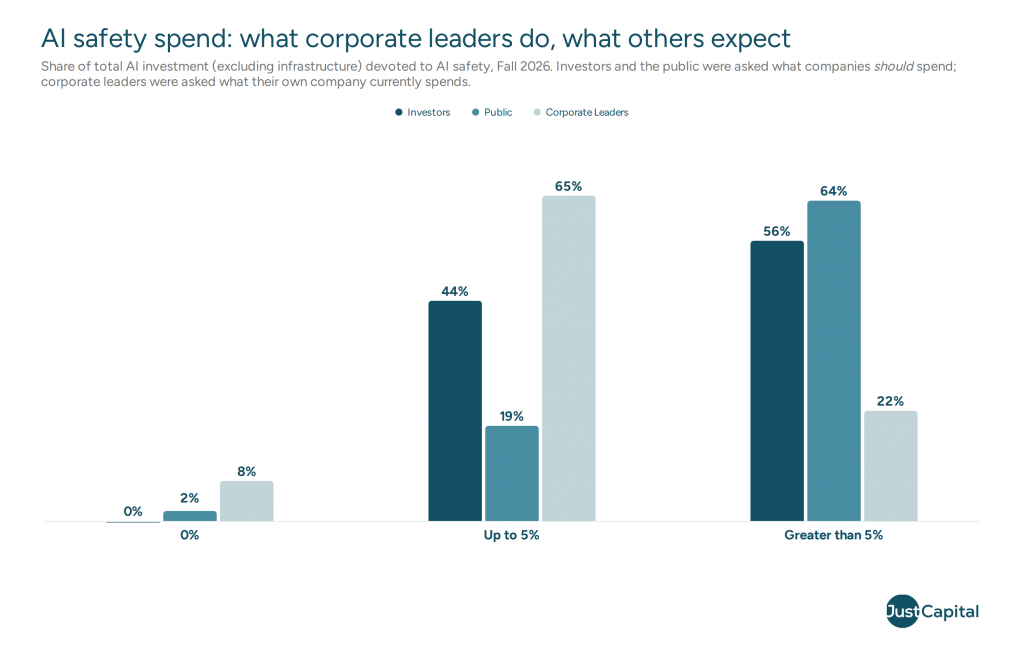
By measuring how perceptions and priorities shift across the American public, investors, and corporate leaders over time, Just Capital aims to help business leaders make fully informed decisions as the AI landscape evolves. The inaugural wave was conducted in Fall 2025, the Spring wave was released in April 2026, and the summer wave was released in June 2026.
This quarterly survey of the American public, investors, and corporate leaders was designed by Just Capital as part of its broader polling and public-opinion research program. We received responses from 128 institutional investors in collaboration with NewtonX, 104 corporate executives in collaboration with Gerson Lehrman Group (66 C-suite executives and 38 board members or senior level executives), and 1,000 US adults aligned to population benchmarks in collaboration with The Harris Poll. Data were collected July 20–27, 2026.
The survey tracking perceptions on AI safety and China was conducted online among 2,000 U.S. adults using Harris Quest DIY. The survey was conducted on September 14-15, 2026. Respondents were recruited from opt-in online survey panels. Quotas were set on gender, age, region, income, and race to ensure proper balance. To adjust for nonresponse, data are weighted to American Community Survey estimates for gender, age, race/ethnicity, education, and region. Party identification is weighted using Gallup’s 2026 party identification estimates. This online survey is not based on a probability sample, and therefore no estimate of theoretical sampling error can be calculated.
Disclosure data was collected in August 2026 for 1,002 of the largest US-based companies, including hyperscalers, across nine AI-related disclosure areas that were selected based on the priorities of the American public: Board oversight of AI, C-suite AI leadership, AI data protection, AI human oversight, AI harm prevention, employee AI upskilling, AI impact on jobs, community AI investments, and anti-surveillance and personal data protection commitment.
Conversations around AI safety reached a fever pitch this week. AI leaders shared manifestos, and policymakers are set to meet next week behind closed doors. As always, I found myself asking where the American people stand in the debate. How are they experiencing AI? Are they really as negative as some would have you believe? Is it making their lives better, and what if anything are they afraid of?
This week we launched the National AI Monitor, a unique new research initiative that objectively tracks if-and-how people are feeling the effects of AI in their daily lives. Incorporating quantitative and qualitative responses, it captures how Americans truly see AI today – as workers, customers, community members, investors, and stewards of the environment – and their expectations for the future.
So what did we learn? We see a public that is generally positive about the many ways AI can make their lives more fulfilling and more productive – a headline that runs contrary to recent reports. 57% of Americans say AI positively impacts them at work, compared to just 9% who say it affects them negatively. Positive qualitative responses most commonly cite productivity and quality gains (27%), efficiency and time savings (19%), and automating routine tasks (8%).
Conversely, there is very real anxiety around ensuring AI systems are safe and secure, protecting jobs in their communities, and, most notably, mitigating harm to the environment. On the last point, 23% of Americans say AI is positively impacting the environment, compared to 40% who say it is producing a negative impact.
We also learned that many Americans are not aware of any effects of AI on their economic wellbeing – 42% say it has had no effect on them as an investor. This is key. As I wrote in Forbes this week, capitalism does not survive on efficiency alone. It survives thanks to its social license. If people see the benefits of AI flowing to fewer and fewer people, they’re apt to stop believing in the underlying systems of capitalism and democracy on which AI’s future success depends. That is not a good outcome for anyone.
AI leaders and enterprise deployers should see this as a guide for how to build trust in AI’s future. People don’t want promises and pledges. They want concrete improvements in their daily lives. The National AI Monitor will be the benchmark by which that is measured.
Be well, Martin
56% of Americans say AI is having a positive effect on them right now, 21% say the effect is negative. Explore the rest of the findings here.
The Wall Street Journal reveals that many CEOs believe the AI apocalypse threat is a real problem, and are urging Trump to work with China for a global slowdown on development.
The New York Times looks at how AI is affecting the job market – not through job loss – but through stagnant wages and diminished hiring.
Axios reports that OpenAI has disclosed six new AI safety incidents, revealing that the Hugging Face hack was not an isolated incident.
CEO Daily reveals one of the major themes of Fortune’s latest Leaders Forum is CEO’s calling for businesses to avoid falling into the “efficiency trap” – bolting AI onto existing workflows rather than completely redesigning them.
Fortune released a report that the amount of Amazon workers on food stamps has tripled despite its record revenue.
Forbes reveals that America’s 400 richest people have only donated 4% of their wealth to charity.

Gallup reveals that workers’ fears about being replaced by technology in the near future continue to go up, matching our own polling that shows Americans get more pessimistic on AI as they think about the future.
