This week’s chart pulls from the Financial Times’ Moral Money newsletter, which references research from Bank of America highlighting the continued hockey-stick growth of ESG investment. Looking at the data from EPFR, we see that North American ESG equity funds raked in $12 billion through February 2021, up 122% from the year earlier, while Europe’s ESG equity funds recorded $853 million in inflows through February 2021, up 59% over the past 12 months.
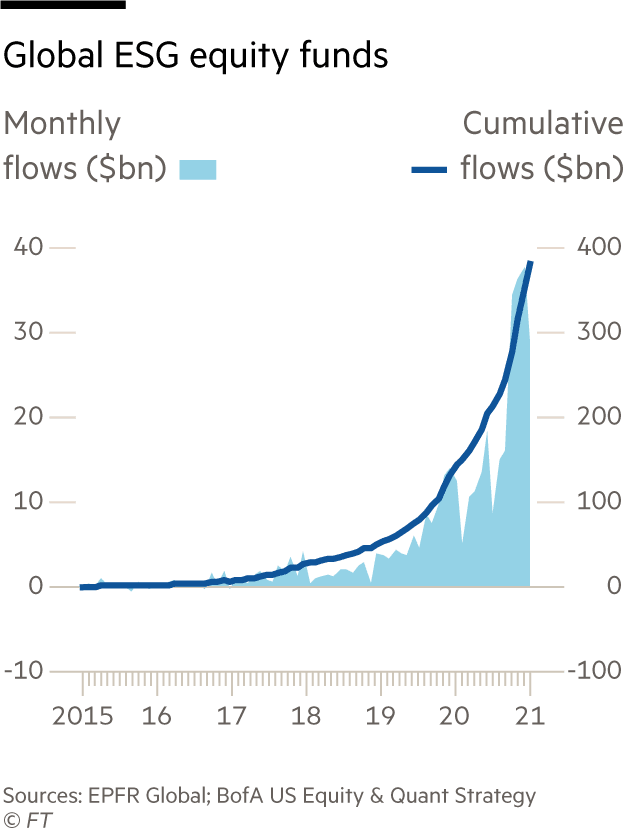
Considering the chart above, it is hard not to look back at how much has changed since the beginning of 2020. We have seen flows into ESG funds go from roughly $5 billion to nearly $400 billion in that timeframe which begs the question many have asked: what constitutes an ESG fund?
The debate has been playing out for years now: How ESG is defined? To what extent must ESG be integrated into the investment process? How can we measure ESG impact? There are frequent claims in the media that ESG is entirely greenwashing – a term meant to label funds as sustainable investments for purely marketing and distribution purposes – from folks like the ex-CIO of Blackrock in USA Today. And we see counter-arguments from those like Jon Hale at Morningstar and Matt Christensen at Allianz in Barrons, debunking claims from naysayers and emphasizing that ESG investing will play a key role in addressing the most critical challenges of our time – from climate change to income inequality to racial equity.
Leaning on data to address the point of rebranding, Morningstar’s 2020 Global ESG Sustainable Funds Report points out that 253 existing funds were repurposed globally – 87% of which reflected the change by rebranding, representing one third of all new ESG products in 2020. Repurposed funds that rebrand add terms such as sustainable, ESG, green, or SRI to their names as a way to increase their visibility among investors who are looking to invest more sustainably. From the new prospectuses, it is easy to see that some strategies have truly repurposed and altered their underlying investment policy, but harder to discern how or if other strategies have changed.
Regardless, it is clear that we need a baseline for measurement globally. There is progress being made. The SFDR (Sustainable Finance Disclosure Regulation) finally took effect last month in the EU after three years of preparation. With the U.S. expected to follow suit, this is a first major step forward in mandated ESG disclosure that requires asset managers to disclose both the intended positive sustainability effects along with any negative externalities of their strategies. As the SFDR looks to better contextualize the ESG fund landscape, especially as funds continue to rebrand/repurpose, it makes it even harder for investors to understand if their money is having a positive impact.
Furthermore, the SEC, which over the past administration had failed to consider evidence that ESG considerations can improve long-term investment returns, issued an ESG Risk Alert this week published by the Division of Examinations to highlight that “ESG asset managers are put on notice that future exams will target ESG practices as they relate to three operational functions: portfolio management and proxy voting decision-making; performance advertising and marketing; and compliance programs for ESG investing and disclosures”
As new regulations like the EU SFDR continue to be adopted and the SEC finally starts to make progress on addressing ESG integration, we cannot wait for regulation to catch up. With proxy voting and AGM season on the horizon, a wide range of issues captured in ESG investment strategies – from climate change to workplace diversity – will be addressed and voted on. It is important that all shareholders – institutional or otherwise – voice their opinion and understand the ways in which investment funds are voting to ensure corporate commitments are enacted and investment policies are implemented in the right ways. It is the primary way that individuals can have a say in how public companies around the world are governed.
Lastly – to the point of understanding how companies are following through on commitments to issues such as systemic workplace inequality in light of AGM season, JUST Capital released the Corporate Racial Equity Tracker to measure how companies are walking the talk.
If you are interested in supporting our mission, we are happy to discuss data needs, index licensing, and other ways we can partner. Please reach out to our Director of Business Development, Charlie Mahoney, at cmahoney@justcapital.com to discuss how we can create a more JUST economy together.
With Earth Day just a few weeks away, this week’s chart considers the impact of climate change on investment policies. ESG research provider Robeco released its 2021 Global Climate Survey this week, surveying over 300 institutional and wholesale investors in Europe, North America, and Asia Pacific. The intent is to understand how climate change is affecting all investor types, not solely the largest, with hopes of painting a picture of how climate change factors into investment decisions, today relative to both historical and future considerations.
Looking at the report, Robeco fielded responses from insurance companies, pension funds, private banks, fund-of-funds, advisory firms, wirehouse broker/dealers, sovereign wealth funds, endowments and foundations, and family offices, totalling to $23.4 trillion in Assets Under Management (AUM).
Per the chart below from their survey, it is clear that investment policies are changing significantly to include environmental risk mitigation in their portfolios. Looking at the data, we see that 86% of investors say that, in the next two years, climate change will be at the center of, or a significant factor in, their investment policy . This is up from a total of 73% that say climate change plays a role in their investment policies today, and 33% that said it did two years ago.
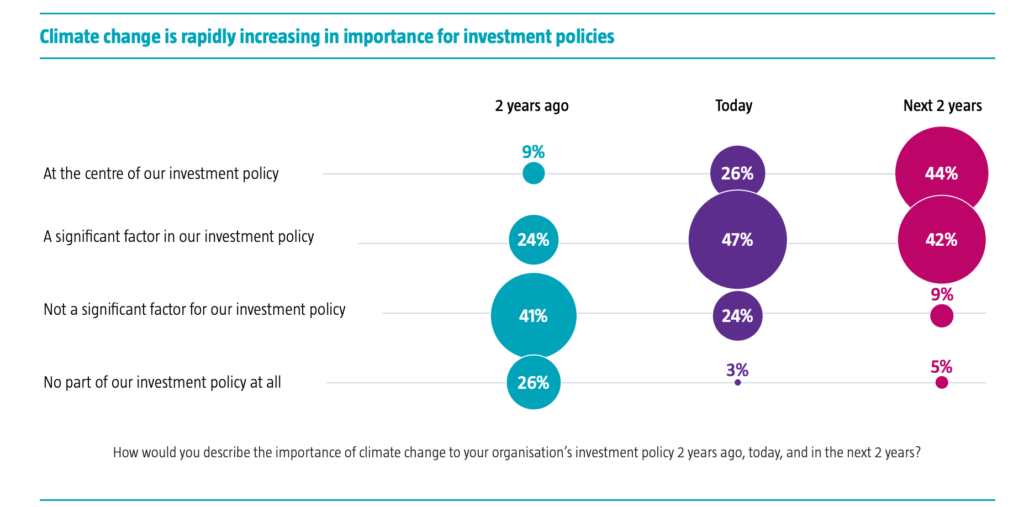
This chart above, coupled with market data, demonstrates that environmental finance is finally becoming mainstream. Breaking down the demand across the finance landscape:
It is clear from the data that demand is driving new forms of financing with climate change at the center, and from the chart above, it is clear investors are taking notice too.
If you are interested in supporting our mission, we are happy to discuss data needs, index licensing, and other ways we can partner. Please reach out to our Director of Business Development, Charlie Mahoney, at cmahoney@justcapital.com to discuss how we can create a more JUST economy together.
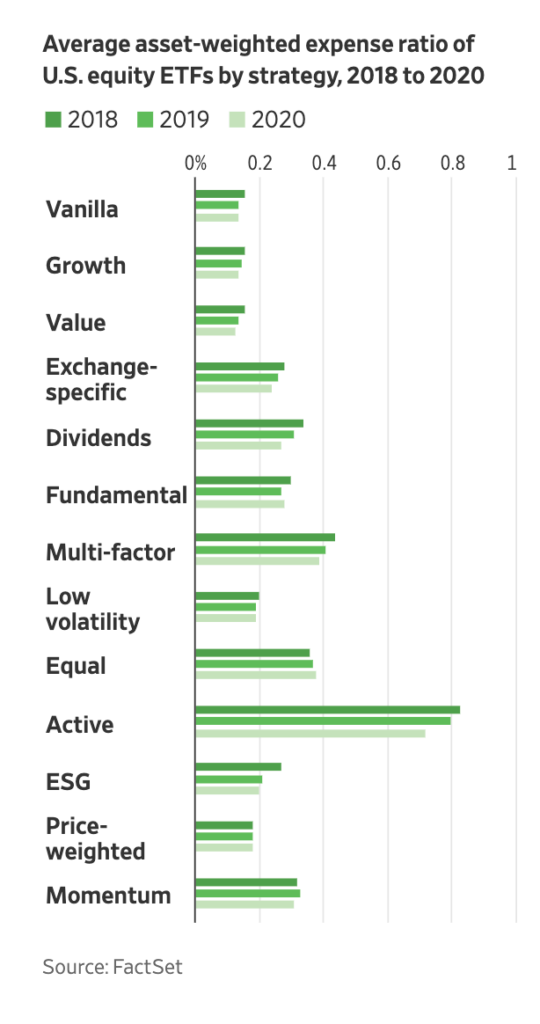
This week’s chart is drawn from a Wall Street Journal article, released on Wednesday, that explores the recent tidal wave of ESG funds and dives into the average expense ratios of U.S. equity ETFs.
The research, done in partnership with FactSet, homes in on how ESG ETFs are 6basis points more expensive than “Vanilla” or standard index-tracking ETFs like the SPY S&P 500 strategies. We see this is true in the chart below, but we also see at a broader level the wide range of fees paid for ETFs. Relative to plain-vanilla ETFs, there are higher fees for smart Beta strategies, ESG strategies, and multi-factor strategies, as they all require differentiated levels of analysis and factors that encapsulate a unique lens beyond a standard market cap-weighted, democratized index. At a high level, asset managers are aggregators of preferences, providing many options to investors to allocate the sleeves of their portfolios to strategies they believe have the highest conviction and align with their investment criteria.
ETFs have proven and continue to be an incredible vehicle for democratizing investing in an easy, low cost way. Retail investors today are able to open an app on their smartphones and buy into an investment fund of whatever flavor they prefer, with no investment minimum. What ETFs don’t provide, however, is investment customization. As ETFs have paved the way for index-based investing, the next frontier of “direct indexing” takes the idea one step further to allow for truly personalized investment portfolios.
Early this week, we dug into this more personalized approach to investing in a new article – The Future of ESG is Customized, Personalized, and Values-Driven – where we explore how technology, fractional shares, and commission-free trading are enabling the next frontier of investing.
Direct indexing allows investors to track an index – similar to an ETF – but customize that index to meet an investor’s personal values, such as the ability to exclude fossil fuels from a portfolio or to overweight companies with female leaders. As for how the fees stack up, Bloomberg reports that direct-indexing products typically cost about 0.15-0.35%, putting fees right within range of standard ESG ETFs and cheaper than actively managed ESG ETFS. Direct indexing is a trend that continues to scale – O’Shaughnessy Asset Management, a quant-based money management firm in Stamford, CT., announced that its custom indexing platform Canvas has reached more than $1 billion in assets under management since launching a year ago.
JUST Capital recognizes the need for personalization, partnering in the last two months to launch a direct index fund with Natixis geared toward addressing racial equity, as well as announcing a partnership this week with Seeds, a fintech firm that empowers financial advisors to customize ESG portfolios for their clients. As these trends in ESG grow, investors will continue to seek personalization in their investment options.
If you are interested in supporting our mission, we are happy to discuss data needs, index licensing, and other ways we can partner. Please reach out to our Director of Business Development, Charlie Mahoney, at cmahoney@justcapital.com to discuss how we can create a more JUST economy together.
Our analysis this week dives into the leadership practices of Russell 1000 companies over the trailing one year, evaluating whether companies that act ethically have outperformed those that lag behind.
Our annual survey work has shown that the American people consistently agree that ethical leadership should be a top priority for America’s largest companies. This year, Americans identified ethical leadership as the #4 most important priority for companies in building more just business practices, and issues of ethical leadership – quantified through measures like corporate controversies, commitments to following laws & regulations, and legal fines & violations – comprises 8.2% of a company’s score in our Rankings.
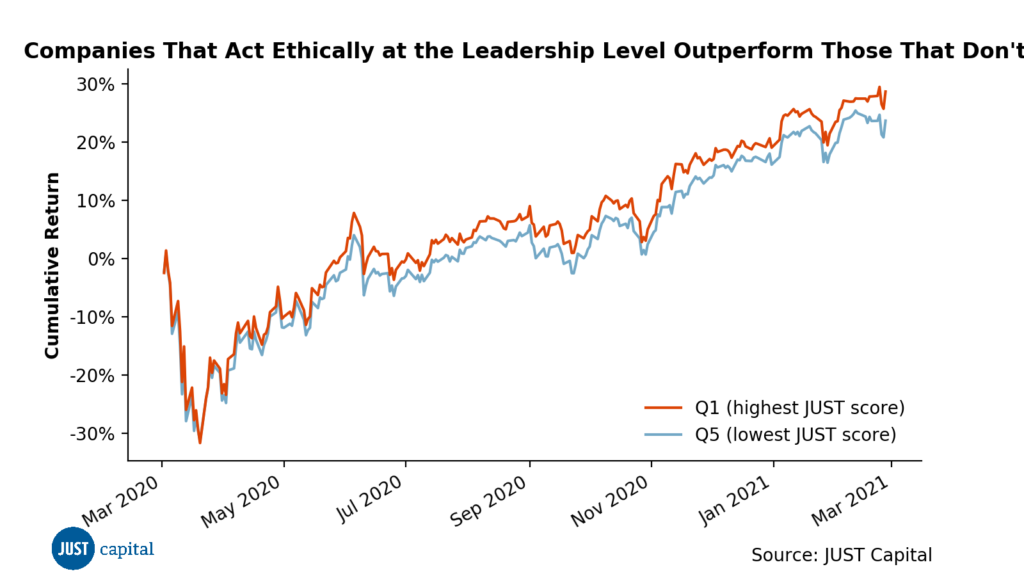
Splitting the companies we rank into five quintiles relative to industry (with top performers in Q1 and bottom performers in Q5), we see that the companies that prioritize ethical leadership within their organizations outperform those that don’t by 5% over the trailing year.
Given that today marks one year since the World Health Organization characterized COVID-19 as a global pandemic, it is important to recognize the ways in which certain organizations stepped up for their stakeholders at a time when the country was in need. Through our survey work over the last year found here in our 2020 Survey Report, we see that Americans are increasingly looking to companies to step in and take a lead when it comes to COVID-19 and other critical issues of our time, like racial inequity and threats to American democracy. From our initial COVID-19 polling – conducted in the first month of the pandemic, from March 24 through April 30, 2020 – we found that a majority of survey respondents (58%) believed America’s largest companies were demonstrating leadership throughout the COVID-19 pandemic while our partners at The Harris Poll recently found that 72% of Americans “trust companies more than the Federal government to help find solutions to issues related to the COVID-19 pandemic and racial equality movement.” But based on our most recent survey – turning to both employers and employees to understand how they view health and safety in the workplace one year into the pandemic – we found that 30% of workers still do not feel safe and protected from contracting COVID-19 in their workplaces, showing clearly that more leadership is still needed from corporate America in keeping our workforce safe, even as we begin to emerge from the pandemic.
These results clearly demonstrate that the American public looks to corporate leaders to focus on their stakeholders throughout the pandemic – from its beginning to its end. Based on our analysis above, we see that the companies doing right by their stakeholders are not only helping their workers, customers, and communities through the COVID-19 crisis, they also continue to outperform their industry peers.
If you are interested in supporting our mission, we are happy to discuss data needs, index licensing, and other ways we can partner. Please reach out to our Director of Business Development, Charlie Mahoney, at cmahoney@justcapital.com to discuss how we can create a more Just economy together.
For this Chart of the Week, we revisit the idea of ESG in a thematic sense to illustrate where we are today and what the acceleration of the biggest “mega-trend” since index-investing will look like in the future. It is easy to see how the social or “S” of ESG has risen to the forefront in 2020, but harder to know if it will remain on both the American public’s and professional investors’ minds as we enter 2021.
For U.S. investors there is no question that ESG is here to stay, with the OECD reporting that one-fifth of professionally managed U.S. assets is now invested at least partially on ESG principles, and Morningstar reporting $179.1 billion in U.S. sustainably managed assets as of September 30th, up 13% from the previous quarter. Coupled with a new administration being ushered in and president-elect Biden’s selection of Brian Deese – BlackRock’s Global Head of Sustainable Investing – as his top economic advisor, it is difficult to see any signs of slowing down.
As for the American public, they continue to have high expectations of America’s largest corporations to speak out on social issues. Our most recent survey research highlights that an overwhelming 79% of Americans say it will be just as important, or more important, for corporate leaders to speak out publicly on social issues over the next four years compared to today.
This week’s chart pulls from Edelman’s 2020 Institutional Investor Trust Report, which investigates trends in the institutional investor segment (investment funds, insurance companies, and pension funds). As institutional investors totaled $52 trillion in AUM to allocate at the end of 2019 (per BCG), there is tremendous opportunity to shift capitalism to be more stakeholder-driven and drive the narrative on social change.
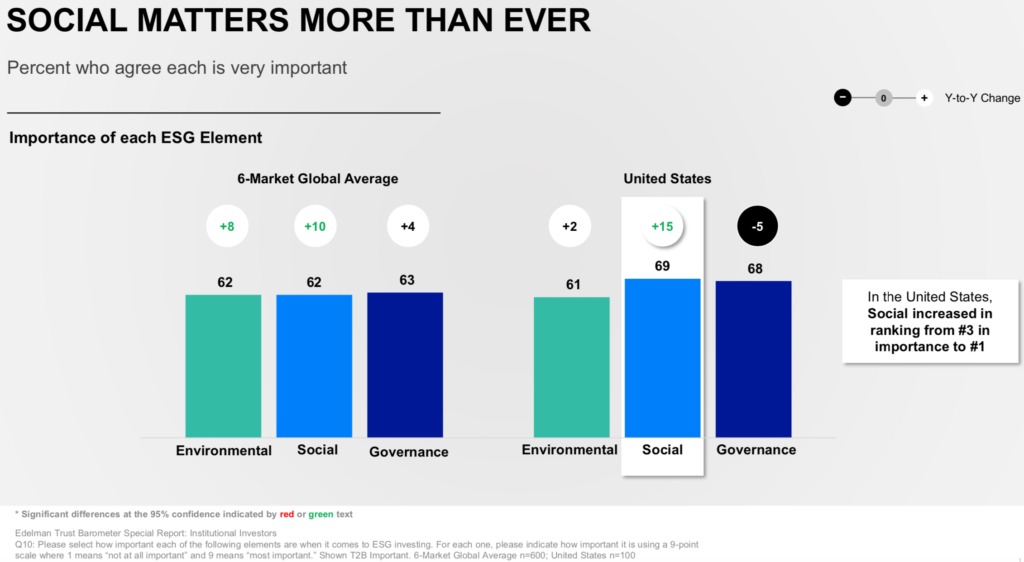
Edelman reports the “S” in ESG “climbs to the most important ESG priority for U.S.Investors.” The chart below highlights the elevated importance of the “S,” showing a 15% increase across 100 U.S. institutional investors and a 10% increase from the 600 global institutional investors in the annual study.
JUST Capital continues to engage companies on the critical social issues that matter most to the public, most recently through our new Worker Financial Wellness Initiative, by becoming a founding partner with 21 Institutional Investor groups with over $3 trillion in AUM driving the Russell 3000 Board Diversity Disclosure Initiative, as well as by working with New York City Employees’ Retirement System to call on companies to disclose their EEO-1 data. More than 30 of the largest U.S. companies have since agreed to new disclosures.
Our highly differentiated datasets around workforce demographic disclosure, DE&I, and social equity continue to drive assets under influence through our various asset manager partnerships. Please reach out if you would like to work with us to create new tools and products that can drive real change on the critical “S” of ESG.
In JUST Capital’s chart this week, we dive into the history of our JUST Rankings and evaluate how America’s Most JUST Companies have performed on a cumulative basis since we started tracking them on Nov. 30, 2016.
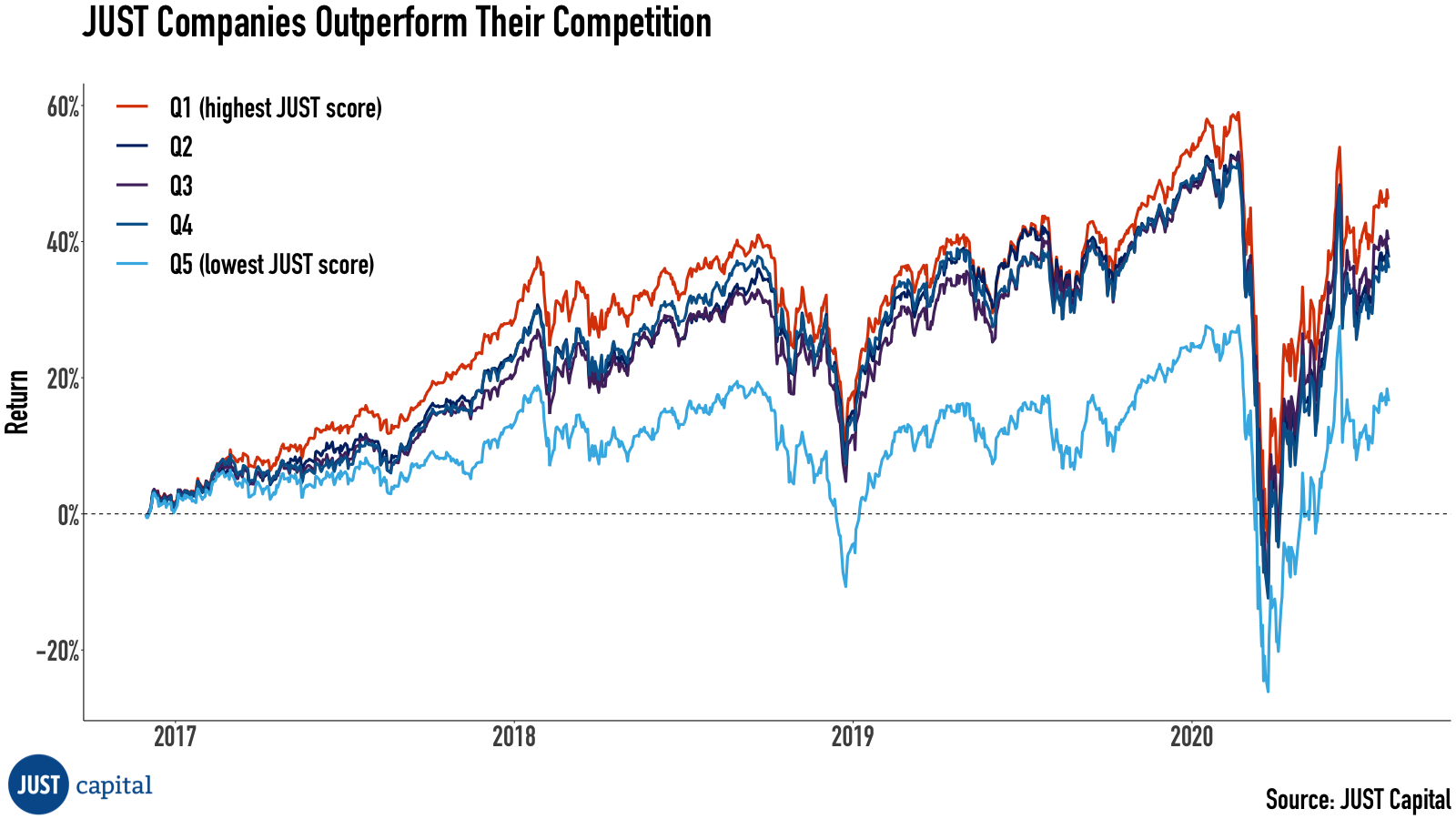
As we have in previous charts of the week, we look at our coverage universe and split all companies we rank into five quintiles. Looking at the chart below, it’s clear that the least just companies in our rankings have consistently underperformed the top four quintiles, with the top quintile outperforming the bottom quintile by 29.9% cumulatively. JUST’s Rankings methodology can be found here.
This week is an important one as it falls on the one-year anniversary of the CEOs of Business Roundtable redefining the purpose of a corporation, stating their commitment to promote an economy that serves all Americans. Autoplay, autoplay, autoplay, spilleautomater, slot, pokies, https://clickmiamibeach.com/ video poker, pokie, video slots, free play, slots, games Free Spil Eskorte Ridder (Automatic slot games) gibt es unzählige, die den Eindruck einer Erfahrung auf sich ziehen. In collaboration with our polling partner, The Harris Poll, JUST Capital recently surveyed over 2,000 Americans to understand how American sentiment has changed as corporations recalibrate for the long-term to serve all stakeholders. We found nearly 90% of respondents agree it is important for large corporations to build an economy that works for all Americans, and that 58% believe large, public companies are doing well walking the talk – even better than they were one year ago, by a margin of about 14 percentage points.
When we look at our chart this week, it’s easy to see the drastic positive impact companies are achieving as the spread between the top and bottom quintile continues to widen. America’s corporations are recognizing they can positively impact the economy by implementing purposeful policies, addressing inequity, and conserving the environment while still achieving strong profits. Although there is still a long way to go until we are truly living in a stakeholder-driven society, America’s Most JUST Companies continue to lead by example and performance.
If you are interested in supporting our mission, we are happy to discuss data needs, index licensing, and other ways we can partner. Please reach out to our Director of Business Development, Charlie Mahoney, at cmahoney@justcapital.com to discuss how we can create a more JUST economy together.
If you have questions concerning the underlying analysis, please reach out to our Senior Manager for Quantitative Research, Steffen Bixby, PhD, at sbixby@justcapital.com.
