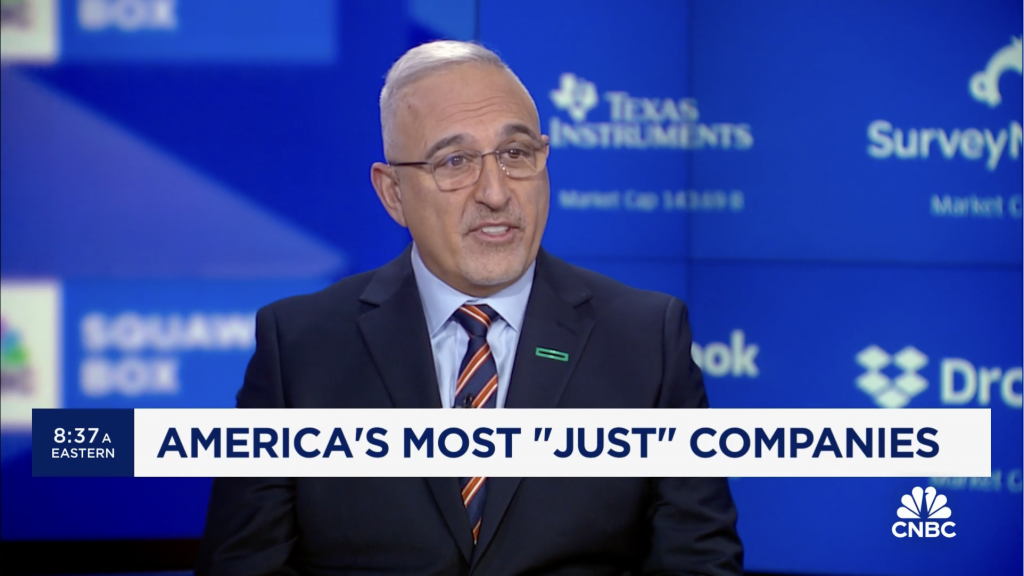
On Monday, JUST Capital and CNBC announced that Hewlett Packard Enterprise (HPE) took the 2024 title for America’s Most Just Company. For HPE CEO Antonio Neri, the recognition is evidence of his team’s meticulous work to deliver positive outcomes on worker, environment, community, and other issues Americans care most about. Neri underscored it’s all about results.
“Our job is to create value and my measure of value is not just shareholder value,” Neri said at JUST’s 2024 Leadership Summit on Monday at the NASDAQ. “It’s value for the people who participate in the ecosystem where we deliver business results or other types of outcomes for our customers and employees. Ultimately, stock price is a reflection of how you do things and what you deliver. One of the sayings we have at the company is ‘you have to win the right way.’”
HPE blazed past its peers and other industry leaders in JUST’s rankings of the Russell 1000 (approximately 937 companies when you account for mergers, acquisitions, and delistings). While HPE has been in the JUST 100 every year from 2018 through 2024, this is HPE’s first time in the top spot.
The company’s standout leadership on issues like fair pay, climate change, and offering apprenticeship programs, such as its Cyber Career Reboot program, helped propel its performance. Other notable data points include the following:
“I take great pride in HPE’s recognition as a leader by JUST Capital on the issues vital to Americans,” Neri said in a previous statement. “Our purpose is to advance the way people live and work, which is evidenced in our commitment to reducing environmental impacts throughout our value chain, supporting our team members with exceptional benefits and talent programs, and investing in our communities and supply chain.”
During a panel discussion on Monday, Neri and JUST Capital co-founder and chairman Paul Tudor Jones responded to questions about the recent pushback against ESG, and underscored that stakeholder issues aren’t about politics, but about promoting better long-term business practices.
“I differentiate between just behavior and ESG, because they do overlap in part, but they are really different,” Jones said. “What we’re doing with our rankings is reflecting what the American public says.”
Neri said he plans to continue investing in areas that JUST Capital ranks, saying it’s good for shareholders, as well as other stakeholders.
That assumption is buoyed by real financial data. The JUST 100 Index has beaten the Russell 1000 Equal Weighted Index by 38.5% since inception and 3.1% YTD. And JUST’s worker-focused index – meaning companies that rank most highly on worker issues – has outperformed the Russell 1000 Equal Weighted Index by 103.75% since 1/1/2018.
“It starts with a purpose,” Neri said on Monday. “What is our purpose? Why do we come to work every day? That purpose is to enhance the way people live and work. And how do we do that? By engineering an experience that will unlock your full potential, whether you are a business, shareholder or employee.”

Amid the fiery debate around “woke capitalism” and pressure from 13 Republican Attorneys General to Fortune 500 companies following the Supreme Court’s decision on race-based college admissions, some experts worried that CEOs would back down from diversity, equity, and inclusion commitments around things like pay equity.
But in actuality, the opposite is true – at least that’s according to Maria Colacurcio, CEO of Syndio, a software tech company that helps Fortune 500 companies and others advance policies promoting pay equity and career equity, or policies that promote fair pay and fair promotion, respectively. Prior to joining Syndio, Colacurcio co-founded Smartsheet, a workplace management platform, and held leadership roles at Starbucks and Microsoft.
According to Colacurcio – who works with clients like Salesforce, Walmart, American Airlines, and General Mills – many C-suite leaders are pursuing pay equity and fair promotion policies more aggressively than before. In fact, some are “ignoring” the letters from Republican Attorney Generals altogether, she noted.
Business leaders aren’t backing down from the issue of pay equity because it continues to be an issue of interest for employees, which plays into the war for talent, and because of new state-level pay transparency laws, which are forcing companies to disclose salary ranges, she said. In addition, she noted, there’s mounting regulatory pressure – amid growing interest from the the Equal Employment Opportunity Commission (EEOC), whose chair recently declared pay equity a top focus, and the European Union, which passed a directive requiring pay transparency.
In a recent Q+A with JUST Capital, the Syndio CEO discussed the financial case for pay equity, what she learned from serving as a director at Starbucks during the company’s pay equity analysis, how to begin conducting an internal pay equity audit, artificial intelligence, and more.
Editor’s note: The following has been lightly edited for length and clarity.
There’s growing political debate around issues like pay equity. Have you seen a scaling back of CEOs on these issues?
We work with primarily Fortune 2000 companies, and we’re actually seeing quite the opposite. So in the wake of salary transparency laws, and a competitive talent market, which continues even amidst all the news of layoffs, we’re seeing a lot of companies doubling down on this work, including bellwethers across tech like Microsoft, Walmart in retail, Moderna in healthcare, and so on.
I think part of that is because folks realize there’s no going back to the old way. This generation of employees expects companies to pay equitably.

So what I’m hearing is that companies are not scaling back.
Absolutely. I think a lot of folks started immediately presuming that the Supreme Court’s recent ruling would cause a big rollback in diversity practices. And I think what it’s doing is more so bringing to light, what is the right way to measure this? What is the right way to think about analytics and measurement to ensure that we’re tracking in the right way toward our goals? I think that’s the really important part of this conversation that we need to continue to focus on.
Walk me through the bottom-line case for advancing pay equity.
This is about not only attracting the right type of talent, the type of talent that’s going to drive business performance, but also retaining that talent, because retaining your way to some kind of aspirational goal is much more efficient and cost effective than hiring your way to that goal. Gartner research found that 58% of workers would consider switching jobs for more transparency. For Gen Z employees, that number jumps to 70%.
Studies have shown that businesses with more diverse teams and leadership have better financial performance. According to McKinsey & Company, companies in the top quartile for gender diversity were 25% more likely to have above-average profitability than those in the bottom quartile. Additionally, companies with more racial and ethnic diversity were 36% more likely to have above-average profitability.
You served as a director at Starbucks, where you played a role in the company becoming one of the first Fortune 50 companies to go public with its pay equity results. What did you learn from that? I imagine that it’s scary for a company to do that for the first time.
It is scary. And kudos to Starbucks for being so progressive and being first to really take transparency and want to take it to that level, because no one was really doing that at the time. And, you know, they continue to be just an absolute powerhouse in what they’re doing.
That experience – in addition to co-founding Smartsheet [a software as a service offering for collaboration and work management] – was the impetus for Syndio, for figuring out how to solve these issues through technology.
Rob Porcarelli was the VP Assistant General Counsel at Starbucks – he now works as Syndio’s Chief Legal Officer. Through him, I learned how pay equity initiatives worked. They’re usually done through an outside consulting firm or law firm – it’s just very cumbersome, it’s archaic. It’s a long process. And more importantly, the recipient of the information doesn’t learn much, they just get a big stack of paper back, which tells them who to pay and how much, but they don’t learn anything about the root cause of the policies and behaviors that are driving those disparities. So we started talking. It was really this idea of like, how do we fix starting pay?

Why are you passionate about pay equity and career equity on a personal level?
So when I left Smartsheet, I had taken a couple years off to stay at home with my young kids, and I went through a divorce as I was transitioning back into the workforce. The motherhood penalty was a very real thing for me, even with the experience I’d had having worked at Microsoft and having been in tech for a long time. My experience with the motherhood penalty was very much a gut punch.
So I think that, combined with what Rob taught me in the process of going through that effort for Starbucks, is what opened my eyes to the fact that there’s so many different facets to this problem. It’s not just the fact that companies don’t have their fingertips on this data and analysis, it’s that they can’t do analysis quickly and efficiently. It’s about perception. How are folks perceived when they move into that role of motherhood? How does that show up in pay? How do we begin to combat that?
If I was a company contemplating taking on a pay equity or an opportunity analysis, can you walk me through some of the steps involved? Who should I talk to?
So I think the folks to get in the room are your HR team, your CHRO, your head of compensation or whoever’s handling that, and then I think the legal perspective is another really great perspective to have in the room, so your chief legal officer.
Now I’m the CEO of Syndio, so I’m gonna highly recommend our platform – we have clients who are best in class in their industries. I’m also going to recommend some free resources we have like our guide titled “The New Way to Fair Pay,” and our helpful communications playbook.
Then start the conversation: How can we make pay and opportunity equity a strategic business priority?
The best time to address pay equity is now. For every minute you wait, it actually compounds on itself and gets worse. There’s remediation that you’re going to have to pay if you’re living in a place where you have disparities because of gender, race, ethnicity – not to mention the potential brand catastrophic risk, if that comes out, in addition to lawyers, fees, settlement costs, other things like that, if you are entangled in some sort of litigation.
On the opportunity equity side, or ensuring all employees have the same shot at promotion, I think the real selling point here is that without precise metrics, a broad-based DEI effort can spend a lot of time and money trying to fix the wrong thing. There’s tech out there to help companies tackle DEI efficiently, in a really modern and specific way, using analytics to drive the measurement. It will show you where progress has been made and where there’s still opportunities for progress.
Artificial intelligence has generated a lot of interest in how it will impact the way people work. What impact do you see AI having on the work you do?
While AI isn’t new, the sophistication of AI is growing, and that will inevitably have an impact on how HR understands and interacts with information, including workplace equity. Natural language capabilities will empower companies to democratize insights and infuse fairness into decision-making at a larger scale. AI’s speed and efficiency can streamline data preparation for analysis, facilitating faster and more frequent assessments. With caution and understanding around the use of inputs, AI’s predictive capabilities can drive companies from reactive to proactive equity management.
However, these potent tools are built upon existing language and data and can therefore amplify biases ingrained in the status quo. To address this, we must focus on developing generative AI, large language models, and natural language processing tools that actively counteract biases in pay and opportunity-related decisions.
Members of JUST Capital’s Corporate Impact Initiatives engage with Syndio, among other impact partners, to help them navigate workforce investments and deliver on their equity commitments.

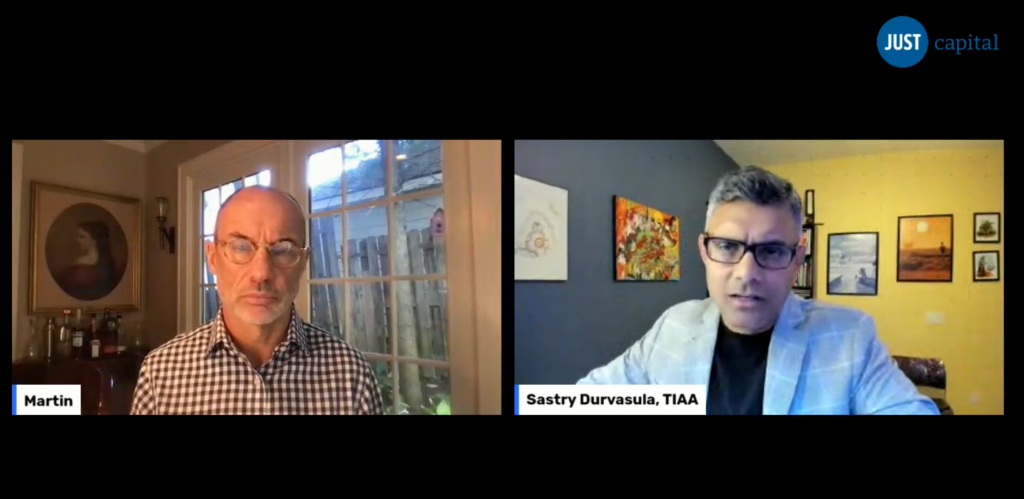
Artificial intelligence is influencing “every segment” of TIAA’s portfolio, according to the company’s chief information and client services officer, Sastry Durvasula. “I think AI will have a profound impact on our business.”
Considering the context, that’s no small statement. Durvasula is responsible for the global technology and client services operations at one of America’s largest retirement and investment solutions providers. TIAA, founded over 100 years ago by Andrew Carnegie, currently has $1.3 trillion in assets under management.
In a recent episode of our ongoing LinkedIn Live interview series, “JUST Better Business,” Durvasula spoke with JUST Capital CEO Martin Whittaker about AI’s “spectrum of impact,” which includes everything from changing research operations to better protecting customers to helping create new products and services. In the wide-ranging interview, the executive explained why he’s optimistic about the technology’s potential to help customers, employees, and the economy more broadly.
The TIAA leader explained that the company is deploying AI for customers in numerous, different ways. For younger workers who are accumulating wealth, it’s about convincing them to invest and grow their retirement funds. From a marketing and a product-offerings perspective, he explained, it’s about deploying AI to improve their retirement accumulation experience – from personalizing financial products, to providing better insights, to making customer experiences easier to navigate, he said.
For retirees who are “de-cummulating” their wealth, he said, AI’s impact is both about offering more personalized services and products, but also about consumer protection and privacy. “Retirees are the most vulnerable population from a fraud cyber point of view. So we have been deploying AI solutions to protect them from cyber fraud and attacks,” Durvasula said.
Artificial intelligence will offer incredible opportunities to boost efficiency for workers in financial services, Durvasula told Whittaker.
“We need to create insights and we have a gazillion financial documents that we need to surf through to get those insights. There’s a lot of operational inefficiencies that do exist in the current financial services industry. I think AI will give us a big lift from an operational efficiency standpoint,” he said.
By linking the company’s data and AI policies in a coherent strategy, TIAA can help create new products to help support the company’s goal of being the leader in lifetime retirement solutions, he said.
In addition to helping TIAA achieve more with less time and energy, AI will provide an increasing amount of opportunities for employees to upskill and advance.
“I think anybody who has business acumen or technical acumen or both can actually, you know, be part of this revolution,” Durvasula said.
“We’ve created different what we call guilds. Obviously the most prominent one is the data and AI guild, the next one actually, that’s quite popular is Cyber. And we’ve given access to the entire company to these guilds,” he explained. “So say I have a call center employee servicing representative who deals with fraud transactions. If she wants to join the AI guild to learn how AI will be employed in fraud solutions, she’s able to join and, and she can go through the training which is structural training with access to various industry certifications as well.”
Of course, the potential for unjust business behavior is big, the TIAA acknowledged. “There is a lot of potential damage,” he said, citing bias and misinformation. But the executive explained that the company is taking a proactive approach to mitigating unwanted outcomes.
“We have taken a proactive stance on this. We released our first internal responsible AI policy. And we are beginning to codify that as we implement some of these new cases, both client facing as well as colleague facing,” he said.
But Durvasula sees AI’s impact being more positive, especially in reducing economic inequality and increasing diversity.
“Women make 30% less in retirement income and minorities, especially Black and Hispanic Americans, have various issues when it comes to retirement savings,” he said. “So if you’re solving for these types of complex problems that are societal, we need a workforce that actually has a level of diversity in designing solutions.”
Durvasula explained TIAA is partnering with a number of universities, nonprofits, and groups to boost diversity in its workforce, including initiatives with the Society of Hispanic Professional Engineers, the Society of Women Engineers, the Blacks In Technology Foundation and others.
“We want to retire inequality,” the TIAA exec said. “It is important to have a positive impact. I’m quite optimistic about the future.”
What does it actually take to drive major environmental action within a company or industry? What moves a company from making public commitments to executing scalable plans?
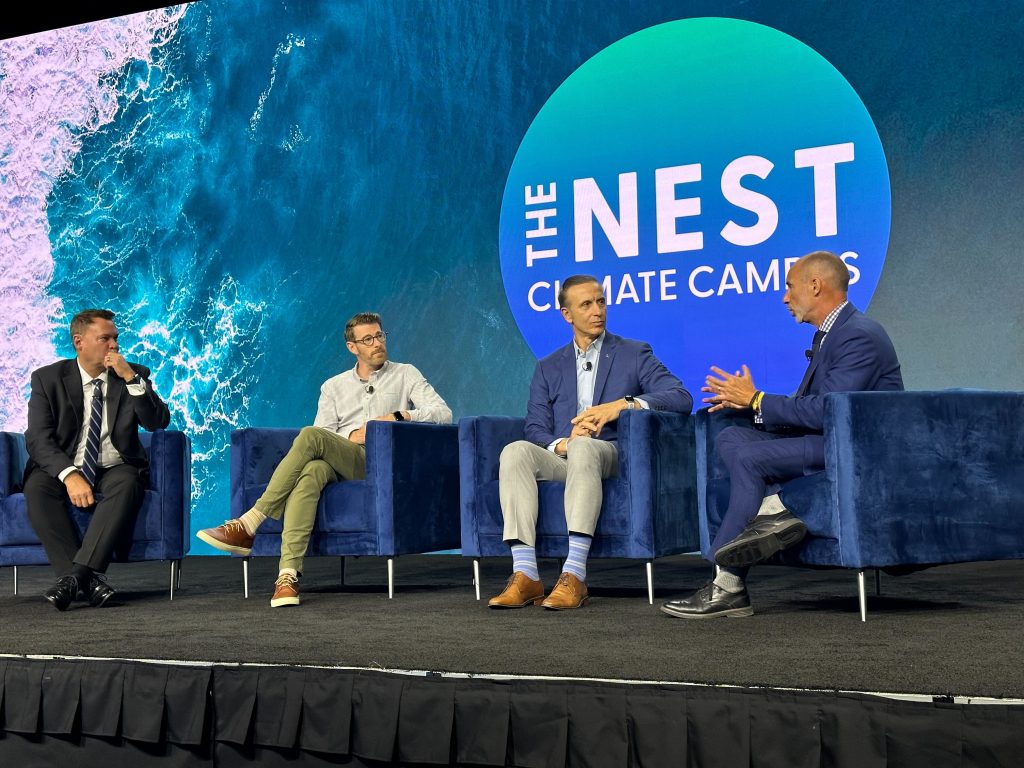
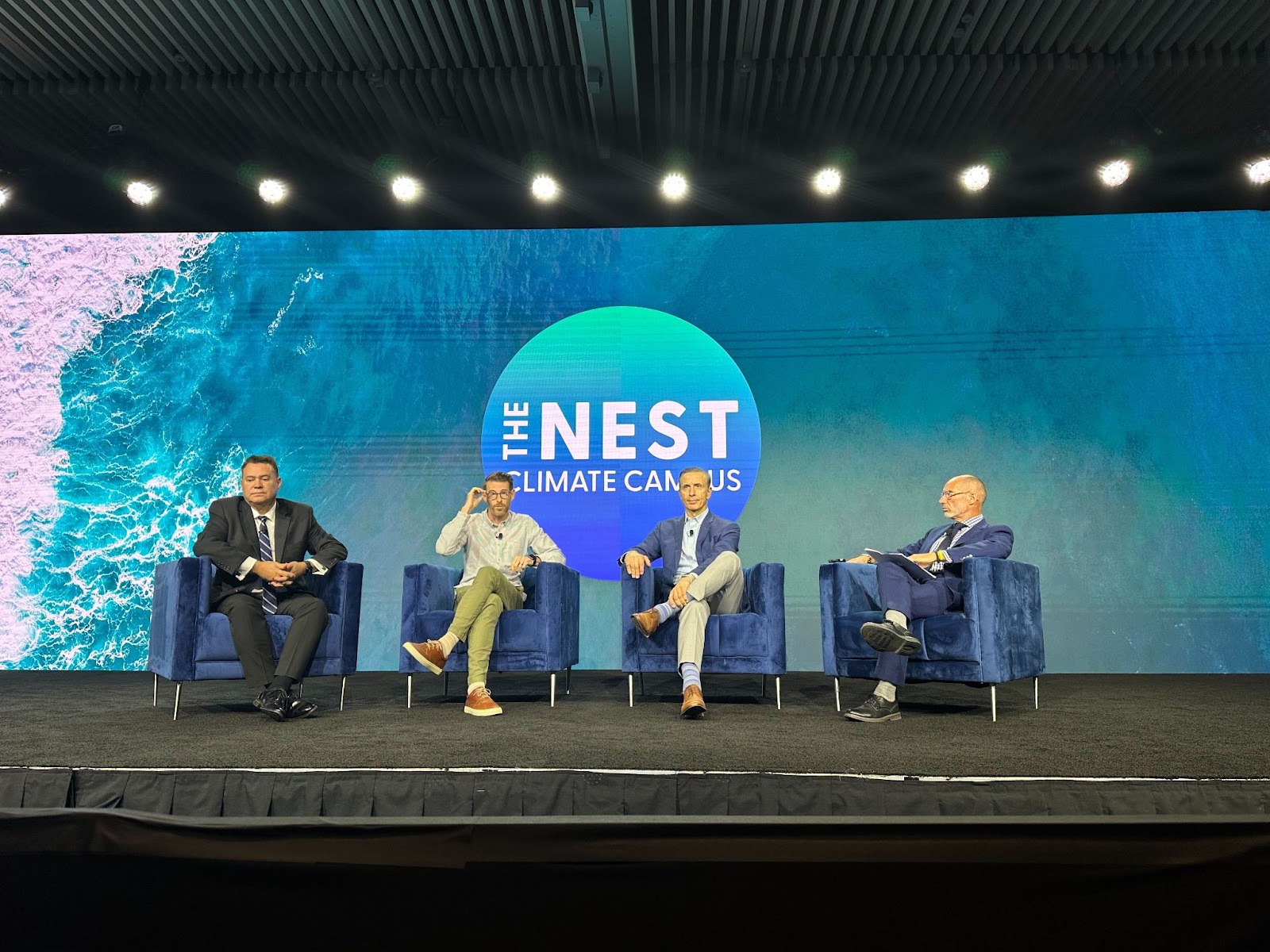
Those were key questions posited by JUST Capital CEO Martin Whittaker in a panel event at The Nest Climate Campus during Climate Week alongside three executives making real headway on environmental issues: namely, leaders from food safety and chemicals company Ecolab, building technology and energy solutions company Trane Technologies, and enterprise cloud applications provider Workday.
Workday ranks No. 1 in JUST Capital’s Rankings of Russell 1000 companies leading on Environment. The company has achieved a Net-Zero carbon footprint and is committed to sticking to that by mitigating the company’s entire carbon legacy and making progress on its verified 1.5-degree Net-Zero commitment. Workday’s also enacting change in its supply chain by having 70% of its suppliers make science-based targets by 2026.
Trane Technologies ranks 2nd overall in its industry for its environmental action, including having a 2030 Net Positive Water commitment and pioneering the Gigaton Challenge, an initiative to reduce one billion metric tons of greenhouse gas emissions from its customer’s carbon footprints by 2030.
And EcoLab ranks first in its industry as a leader driving climate innovation with a verified 1.5-Degree Science-Based Target that aims to halve the company’s emissions by 2030 and achieve Net-Zero by 2050, among other environmental strategies.
The executives discussed a range of learnings from their work, including how to drive buy-in with different stakeholders like consumers and shareholders, aligning internally as a company on common goals, and ensuring your plans incorporate important factors like equity.
Emilio Tenuta, senior vice president and chief sustainability officer at Ecolab, kicked off the conversation by addressing the elephant in the room – the anti-ESG political rhetoric that’s been seeping into boardrooms and investor meetings around the country.
“Climate action has become a polarizing topic with ESG and so on, which is unfortunate,” he said. Tentua explained why there’s so much polarizing rhetoric around environmental issues, and offered a clear strategy to address it.
“Part of the challenge is that when we hear organizations talking about their ESG leadership, they focus on ‘it’s the right thing to do,’ which I think falls flat. I’ll just throw it out there,” he said. “I think we need to build on that. If it’s not aligned with your business strategy, and will drive customer growth, and opportunities to drive innovation, and the ability to really demonstrate how this is the right thing to do, but more importantly, it drives results and performance in terms of your business, then I think we’re going to continue to have this conversation.”
In other words, companies only leading with the moral case will never be as effective as those leading with the business case.
“That’s a big part of ‘the why’ really for us on climate action – it’s core to our business strategy,” the Ecolab exec said. “And we have a leadership commitment, that this is not only the right thing to do, but it’s also good business for us, in terms of driving our business results.”
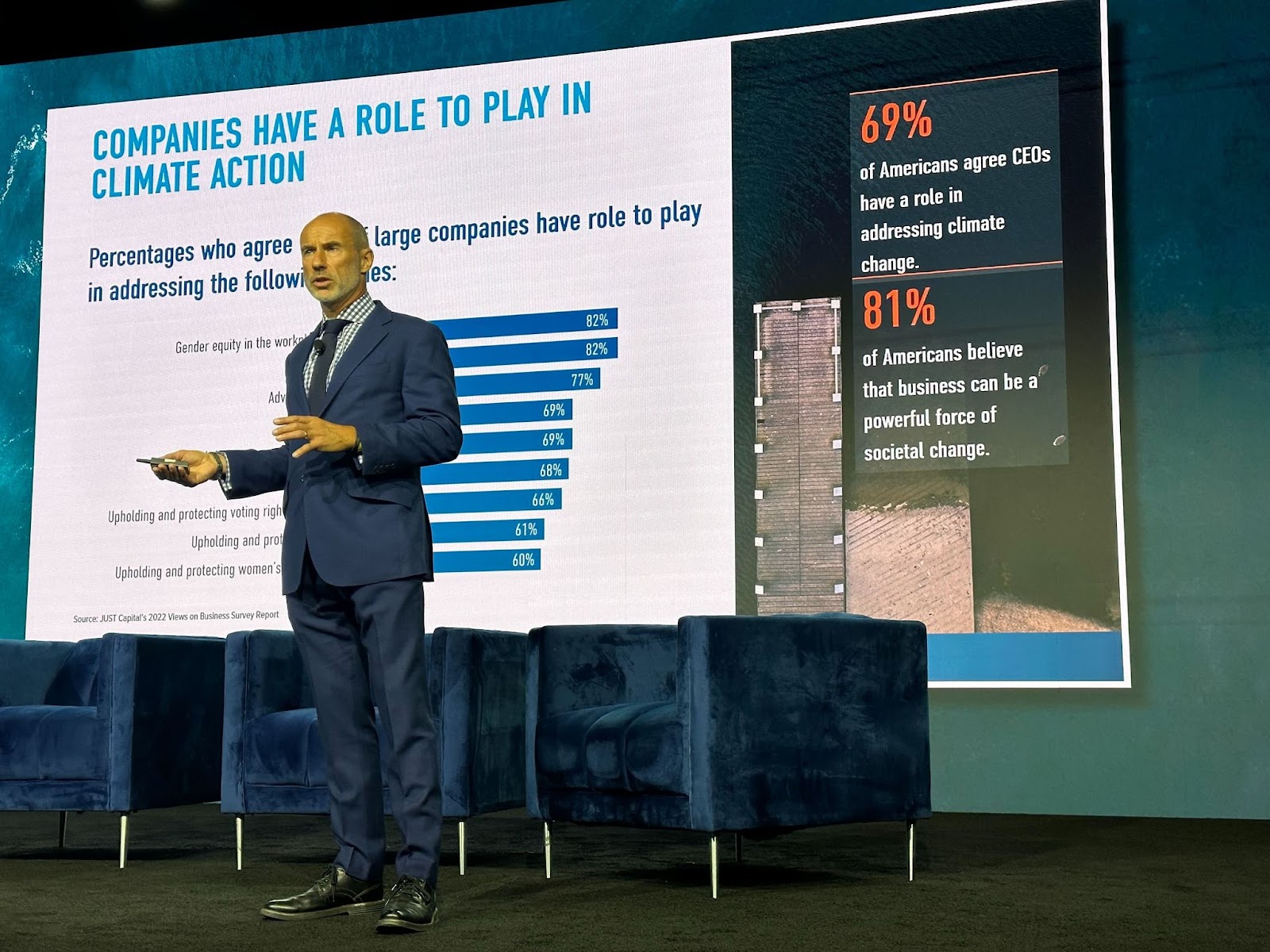
Scott Tew, vice president and sustainability and managing director at Trane Technologies, agreed that having support from a company’s top echelons is critical to making progress on environmental issues.
“Our leadership team heard that 40% of the world’s spent energy is related to heating and cooling buildings. It’s a tremendous opportunity and a concern for our sector. Our leadership team began to grapple with what’s our world here. If we believe the science, if we believe a company has to step forward, why not us?” Tew said.
After realizing the moral, and business opportunity, Tew said that Trane’s leadership asked, “What would it take to move the needle?”
“In 2019, the leadership team made a bold commitment of a gigaton challenge, to reduce emissions of our products that we sell to customers by a billion metric tons by 2030. It was an all-in moment for the company,” he said.
Having full commitment from the company’s leadership around specific, measurable goals, was key. And investors loved the news, The Trane Technologies vice president said.
“Shareholders love it,” Tew said. “We’re linking emissions and revenue growth.”
Erik Hansen, senior director of environmental sustainability at Workday, said that in driving buy-in from colleagues, executives, and shareholders, it’s important to highlight the consumer demand for environmental action.
“Customers increasingly care about climate change, their footprint, their supply chain footprint. This is moving – from several years ago where this was sort of, like ‘a nice to have’ – to table stakes. Over the past 12 months or so, we’re really seeing that ramp up,” Hansen said.
The Workday senior director suggested that in addition to the market opportunity, there’s significant benefit to avoiding reputational or regulatory damage.
“This conversation is only accelerating. Don’t wait five years to get a temperature check on your emissions or your footprint. Start right now,” he added.
In addition to setting specific goals, Hansen added that CEOs and leaders should incorporate equity into their environmental plans.
“We have to acknowledge that underrepresented communities are often the hardest hit with the effects of climate change – pollution, climate disasters. And so we can apply that lens of equity to the decisions that we’re making, in terms of climate strategy? How do you do that with the lens of resiliency, climate equity, climate justice, other environmental outcomes beyond just carbon? Every company should be considering this lens,” he said.
To unpack your company’s environmental performance in the JUST’s Rankings and gain insights into how to improve on core climate issues, please reach out to corpengage@justcapital.com.

For decades, many in the business community viewed a “lean and mean” operational strategy as the winning playbook: minimize costs in order to maximize profits – especially when it comes to labor costs. But a growing body of research indicates that when it comes to employees, mindsets need to shift and labor costs should instead be considered investments with the power to deliver strong returns.
On the cutting edge of that research is Zeynep Ton, MIT Professor and president of the nonprofit Good Jobs Institute. In her recently published book, “The Case for Good Jobs,” Ton lays out the key findings of years of research spent analyzing companies like Sam’s Club, Quest Diagnostics, and several factories, restaurants, retail stores, and call-fulfillment centers. Her main finding is that investing more in one’s workforce is more cost-effective than investing the bare minimum or “lean” amount, and that customers and shareholders benefit significantly when workers are supported.
In a recent conversation with JUST Capital – as part of the Worker Financial Wellness Initiative, supports company leaders as they prioritize workers’ financial security – Ton dove deeper into her findings and the changing notion of what it means to be a top performing company.
As she puts it: “Investing in workers isn’t about being nice. You’re doing this because this is how you win with customers. This is how you win as a business.”

At first glance, minimizing labor costs in any way possible makes sense. If labor is just another cost to be minimized, then of course, paying market rate, as opposed to a living wage, is a good call. But the reality is, human capital is a bit more complicated than that, Ton explained.
(A living wage is the amount of money needed for a given worker to cover the cost of their family’s minimum or basic needs in the area in which they reside).
“Paying workers low wages is actually very expensive for companies. Think about the costs of high turnover, the costs associated with low wages like lost sales, lost productivity, mistakes, errors, customer frustration,” Ton said.
In essence, when workers feel they’re replaceable, they act replaceable, she explained. And in addition to the high costs of replacing workers, companies have to foot the even greater costs associated with poor operational execution and a styming of innovation.
“If you have poor attendance, minimal effort and poor execution, and a cycle of high turnover, then middle managers are firefighters,” Ton said. They’re not managing their business or thinking of ways to make things more innovative or efficient, she explained, they’re fighting fires all the time.
At companies with low worker investments (low investments in wages, benefits, training, and career development), Ton explained that she’s observed turnover levels ranging between 40-400%, with 400% meaning a typical person stays for three months maximum. That translates into millions of dollars lost. “The direct cost of turnover ranges from 10-20% of payroll dollars that the company spends. And that’s just the costs associated with recruitment, hiring, onboarding, etc.,” she said.
“Competent leaders who want to run great companies, deep down, they know that you can’t run a great company if you don’t have a great team. You have to position your team for success,” Ton said. “So what I do in my book is articulate a case study on why they should do it and how they can do it.”
The good news is, there is a better strategy – what she calls the “Good Jobs Strategy” – where workers, customers, and shareholders reap more rewards. According to Ton, one key part is investing in workers while at the same time creating a culture of high expectations.
She cited Costco as an example. In 2022, the company’s U.S. average hourly pay was around $26 per hour, compared to the average retail worker wage of $16 per hour. That $10 extra is significantly higher, but has resulted in a more loyal and hardworking workforce, her research shows. Costco’s turnover is a “fraction” of the industry’s, Ton said.
Investing in workers doesn’t just mean paying a living wage or expanding benefits, it’s also about how companies operate, she said.
Costco sets up their workers for success even further by focusing and simplifying their inventory and investing in more training and cross-training, which allows workers to help customers as needed, Ton said. By having far fewer products than typical grocery stores, Costco’s workers are more knowledgeable about them (where they’re located, how they taste, typical shipping times), and that makes a better experience for the customer, Ton explained.
“At the same time, Costco has high expectations of its workers – the mindset is to create high value for the customer,” she said.
It’s a strategy that’s been working. Costco has continued to outperform its competitors and deliver good returns for investors.
“If you are customer-centric – which many businesses are – you have to be frontline-centric, because if the frontline employees don’t serve the customers well, if they’re not improving the business all the time, then you’re not creating value for the customers,” she said.
Indeed, multiple recent studies support Ton’s findings, showing that worker wellbeing – a byproduct of investments in their training, benefits, and wages – is associated with higher firm profitability, and that companies with the highest levels of worker satisfaction outperform standard benchmarks in the stock market.
Healthy investments in workers is also what Americans – from all backgrounds – want from CEOs. JUST Capital’s 2022 polling of the nation’s public shows that Americans agree that the top priority for companies should be to pay their workers a fair, living wage. The public also said that worker health and safety, career development, benefits, and diversity & inclusion should be among a company’s top priorities.
“By better serving consumers, through employee investments, you better serve shareholders,” Ton said.
The Worker Financial Wellness Initiative is a vibrant and growing community of business leaders dedicated to improving the financial health and security of their workers. The Initiative includes peer learning opportunities for C-Suite leaders; resources and events for HR and compensation professionals; direct assistance to companies on how to develop and deploy a Worker Financial Wellness Assessment, and how to use it to identify areas for improvement and immediate next steps; and public opportunities to celebrate corporate leadership.
To learn more about the Initiative and how you can join, click here.
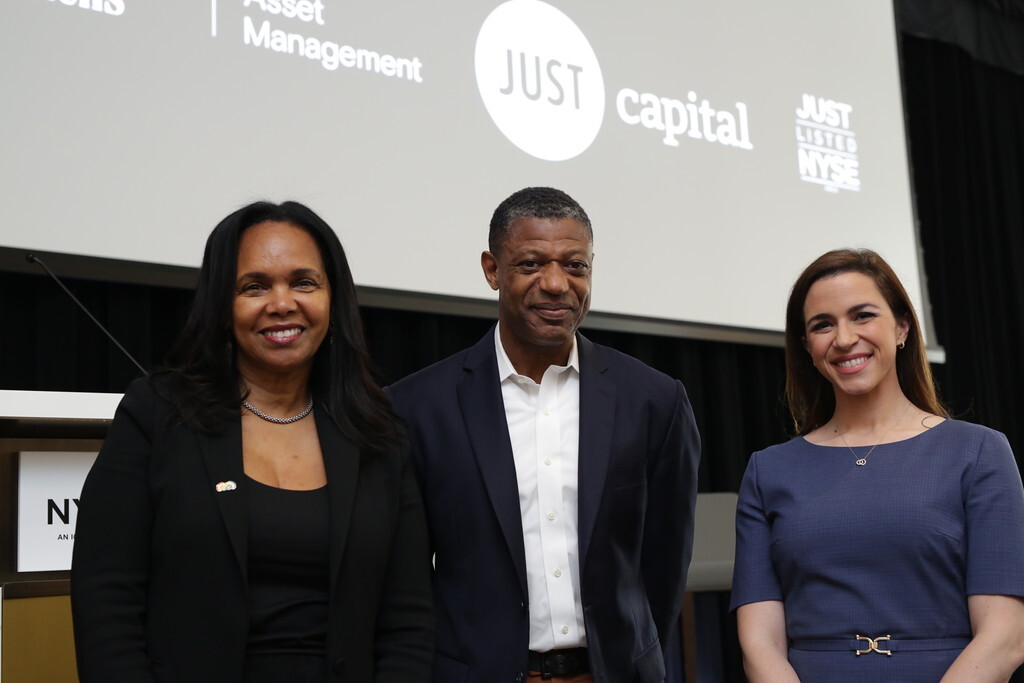
Earlier this week, JUST Capital marked its five-year anniversary of the JUST ETF with a panel series at the New York Stock Exchange. The ETF was launched in 2018 in partnership with Goldman Sachs Asset Management to track the top 50% of Russell 1000 companies according to the priorities of the American public.
At the event, CNBC’s Leslie Picker moderated a riveting conversation titled “The Value of Investing in Just Business” featuring Priscilla Sims Brown, CEO of Amalgamated Bank, the financial institution self-described as “America’s socially responsible bank” with $7.8 billion in assets and $53.6 billion in custody and investment assets under management, as well as Roy Swan, Director of Mission Investments at the Ford Foundation, one of the largest private foundations in the U.S. with a $16 billion endowment and a commitment to addressing inequality. (Note: Ford Foundation is a JUST Capital Foundation Partner).
Brown and Swan delivered multiple key insights on how CEOs and business leaders can create shareholder value while also prioritizing other stakeholders like workers, communities, and the environment.
CNBC’s Picker kicked off the discussion by asking Brown and Swan to weigh in on the bottom-line case for just business behavior.
Swan discussed how prioritizing workers and communities is at the heart of American capitalism. He explained that visionary economist and “Wealth of Nations” author Adam Smith’s theory of the “invisible hand” was not intended to keep markets completely unchecked, but to advance the success of the economy through self-interest that creates mutually beneficial, interdependent outcomes.
Swan added that he uses the phrase “patriotic capitalism” to encapsulate the business case for just corporate behavior.
“Patriotic capitalism is a capitalism that puts the interest of country, democracy, and the common good first,” he said. “It is enlightened self-interest that understands that capitalism is best optimized and sustained when our country, democracy and the common good are prioritized. Otherwise, there is no American economy.”
Amalgamated Bank CEO Brown agreed that value for workers and their families lies at the center of American capitalism.
“At Amalgamated Bank, we’re a living experiment of doing well by doing good. And it’s working,” she said.
“We’re making the business case by taking stands on a few core issues like gun violence in America and reproductive rights. We’re transparent in our values, you can read about them on our website. That transparency is key to driving good business and financial outcomes,” she added.
Both Brown and Swan underscored the importance of leveraging more data to continue building the case for just business behavior.
“The more we show the numbers underscoring the business case for doing good, the stronger the case becomes,” Brown said. “We need more research and data, especially on costs and controls for externalities.”
Swan cited research showing how prioritizing workers, specifically worker engagement, results in shareholder value. Loyal, engaged workers produce more, are out sick less, and have lower turnover, research has shown. That translates into “billions of dollars in profits” for a corporation and its shareholders, he explained.

Swan and Brown agreed that ESG and impact investing have come under intense scrutiny over the past several months, and acknowledged that it’s creating more questions for CEOs. However, both leaders agreed that the move toward transparency and corporate disclosure is here to stay.
“The term ‘ESG’ has been weaponized by polarizing opportunists who want to divide us,” Swan said. “A lot of arguments against ESG are actually arguments against impact investing which, unlike ESG disclosures, actually does seek specific outcomes.”
He explained that while impact investing might want to increase the number of good jobs for workers, or increase the number of companies that produce renewable alternatives to fossil fuels, ESG is a disclosure framework. “The movement of governments around the world who value a framework to disclose non-GAAP information isn’t going away.”
Brown added that she’s hopeful about the future of just corporate behavior. Swan concurred, citing JUST Capital’s recent newsletter highlighting a shift among some Republicans toward embracing a stakeholder model, pointing to what he calls a potential “thawing” of the movement against what’s been labeled “woke capitalism.”
“Call it ESG. Don’t call it ESG. Call it global warming. Don’t call it global warming,” Brown said. “The point is – keep pushing forward on issues that matter on a values level.”
