2024 was a transformative year that marked AI’s emergence as a defining force in corporate America. Integration of generative AI kicked into high gear – as did public awareness and media scrutiny of both the revolutionary potential of AI and its unknown implications for business, workers, and society.
According to JUST Capital’s annual Americans’ Views on Business Survey, 70% of the American public believe that CEOs from large companies have a role to play in ensuring the ethical use of AI. This finding underscores a clear mandate for corporate leaders on responsible AI adoption.
As 2024 draws to a close, JUST Capital conducted an analysis of how America’s largest companies are approaching this technological transformation. This research examined public disclosures from the JUST 100, the top 100 performing companies in JUST Capital’s annual Rankings, revealing how these market leaders adapted to and communicated about AI’s growing influence on their operations, governance, and strategic planning.
This exploratory analysis identified six topics that appear in companies’ public communications on AI initiatives: ethical AI practices, sustainable AI applications, worker training and upskilling, AI product development, cybersecurity considerations, and AI for social impact.
“In these early days of the AI revolution, companies and technologies are advancing at a breakneck pace, often outstripping the patchwork of emerging and sometimes conflicting regulatory frameworks,” says Justin Antonipillai, Founder & CEO of Stewardshipped.ai and JUST Capital AI Advisor. “This presents a tremendous opportunity for bold corporate leadership. By transparently disclosing their AI strategies and demonstrating ethically grounded practices, companies can set a new standard for responsible innovation. I’m excited to help spotlight these critical corporate initiatives creating a roadmap for the broader business community to follow and build upon.”
Taking a leadership Role: Salesforce comprehensively detailed their AI initiatives, spanning ethical AI practices, sustainable AI applications, AI product development, and workforce training. “As the #1 AI CRM, we have a responsibility to lead with trust, mitigate bias, and involve diverse teams in the development of our technology — all while reducing the impact of AI on the planet.”
Principles into Practice: Intuit’s Responsible AI Principles include “powering prosperity, enhancing human talent, fairness, accountability, transparency, and privacy and security. We operationalize our principles through a governance model designed to identify risk and prevent potential identified harms. Our multidisciplinary approach includes internal review, executive level oversight through our AI Governance Committee, employee training, and channels for stakeholder feedback.”
AI as a Climate Solution: Microsoft is harnessing AI to further its climate goals. “Microsoft is investing in AI-based solutions in areas where progress on our global sustainability goals is bottlenecked. In November 2023, we published a white paper and playbook that expands on the incredible potential of AI to accelerate sustainability solutions and introduces our five-point playbook for creating the needed enabling conditions to unlock the transformative potential of AI for sustainability.”
Training the Future: ServiceNow’s report highlights their commitment to AI enhancement, “making it easy to create and use AI and generative AI (Gen AI) to maximize talent impact and value. We see technology as enhancing productivity, not replacing talent.”
“This analysis is encouraging. It shows that leading companies recognize the importance of transparency in building trust with stakeholders,” says Jon Iwata, Executive Chairman, Data & Trust Alliance and JUST Capital AI Advisor. “Those that proactively disclose their AI practices and strive to deploy AI responsibly to achieve business outcomes are building the foundation for sustainable innovation.”
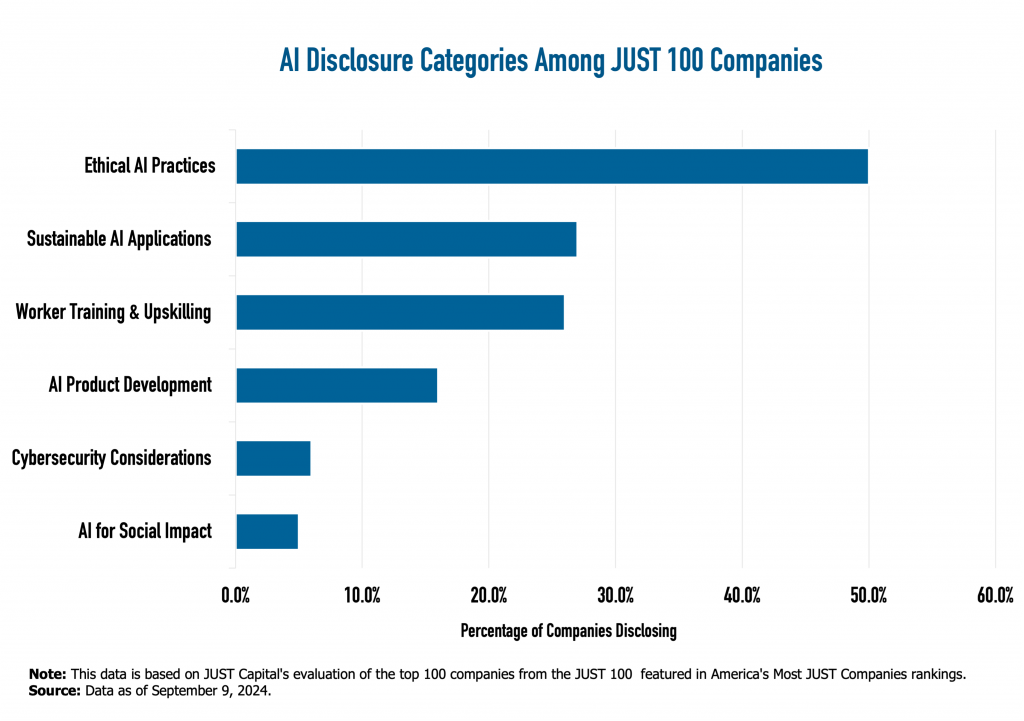
The rates of disclosure among JUST 100 companies in 2024 reinforce what we have heard from the American public – AI’s role in business is pressing and stakeholders are seeking transparency. We expect rates of disclosure to only increase as AI continues to reshape business in 2025 and beyond. Leading companies will face increasing pressure to demonstrate how their AI initiatives deliver value, while simultaneously adhering to developing governance frameworks, sustainability considerations, and meaningful workforce development. The challenge ahead will be maintaining the balance between innovation and responsibility, ensuring that the technological advancement and opportunity AI brings aligns with societal expectations for its ethical deployment.
Interested in learning more about leading disclosure practices and your company’s performance on key stakeholder issues? Please reach out to corpengage@justcapital.com.

2024 has already been a big year for environmental and climate action in the private sector. Governments of all sizes have implemented new measures that will require certain companies to disclose their greenhouse gas emissions and climate risks.
Following last year’s adoption of the EU’s Corporate Sustainability Reporting Directive and California’s two climate disclosure laws (the Climate Corporate Data Accountability Act and the Climate-Related Financial Risk Act), the Securities and Exchange Commission (SEC) approved a rule that requires some companies to disclose both greenhouse gas emissions and climate risks to their business, the specifics of which are still being challenged in court.
A majority of Americans favor more disclosure from companies on these issues. Our Polling of the American Public found that 73% of Americans strongly or somewhat favor federal requirements for disclosure on environmental data like greenhouse gas emissions. Other research indicates that 90% of investors say that the CSRD and SEC rules will drive better investment decisions.
We evaluated the 10 companies with the best environmental performance in our 2024 Rankings of America’s Most JUST Companies. All 10 of these companies have set an emissions reduction target and we also found that these leaders are outperforming the remainder of the Russell 1000:
Read more about how these companies are taking action. The top 10 are listed below in ranked order on environmental performance based on the 2023 Rankings:
Hewlett Packard Enterprise is a top-performing company on the Environment Stakeholder, in addition to leading the Russell 1000 on overall performance, ranking first overall in our 2024 Rankings. HPE has committed to multiple ambitious climate goals, including achieving Net Zero across its entire value chain by 2040, a 70% reduction in Scope 1 & 2 emissions from 2020-2030, and a 42% reduction in Scope 3 emissions from 2020-230. HPE was the first company within its industry to set a verified 1.5-degree Science Based Net Zero Target, and in 2022 even moved up their commitment date for achieving Net Zero from 2050 to 2040. HPE is focused on finding low-impact suppliers and partnering with suppliers who have their own science-based targets, while also pushing out more sustainable options for their customers to reduce the company’s scope 3 emissions.
Johnson & Johnson has been a continued leader in the environmental space, being the 2nd top-performing company in the Russell 1000, moving up from the 8th spot on last year’s rankings. Johnson & Johnson’s climate action plan revolves around improving operational performance and optimizing their value chain. This plan includes sourcing 100% of their electrical needs from renewable resources by 2025, with 100% of their European operations already achieving this, and launching the Johnson & Johnson Supplier Sustainability Program. The company’s long-term goal is to achieve Net-Zero across all of its value chain by 2045, recognizing that to achieve environmental health equity, there needs to be a focus on tackling climate issues.
Microsoft Corporation has committed to the most robust climate commitments, pledging to be carbon-negative and zero waste by 2030. The pledge goes beyond this, as the company has pledged to remove the amount of carbon equivalent from the atmosphere of all of its historical emissions by 2050. Microsoft has disclosed detailed plans of how they going to achieve these goals and is partnering with global industry-leading organizations to move forward in the field of carbon removal. Microsoft has also pledged to be water-positive by 2030. Since initiating this program, they have secured contracts for projects expected to deliver over 35 million cubic meters of volumetric water benefits throughout the lifespan of these initiatives.
McCormick & Co. Inc. is focused on creating sustainability within the Food, Beverage, and Tobacco industry, honing in on the increased use and branding of sustainable herbs and spices. McCormick has identified the environmental impact of their most iconic branded ingredients and is leading research on how to minimize the environmental impact of their product with the largest carbon footprint, black pepper. The company is also partnering with vanilla farmers in Madagascar to help protect biodiversity in the region through providing the local farmers training on agricultural practices that meet third-party sustainability certifications. All of these efforts are being pursued to ensure the company meets its 2050 goal of Net Zero.
Accenture has met its 2025 Science Based Targets Initiative (SBTi) goal, achieving a 57% reduction in total emissions based on a 2016 baseline and reduced scope 1 and scope 2 emissions by 91%, significantly surpassing their goal of a 65% absolute reduction target. The company has since committed to even more reductions, and has gotten approval from SBTi for another near-term target to be achieved by 2030. Accenture has also invested in nature-based carbon removal solutions, that are predicted to remove millions of metric tons of carbon over the next 20 years. In addition, in 2023 Accenture did achieve its goal of 100% renewable electricity in all of its offices.
Adobe Inc. has adopted a three-tiered approach to sustainability, focusing on product sustainability, operational sustainability, and policy advocacy/thought leadership. Through these efforts, Adobe has a verified 1.5-degree Science Based Net Zero Target. The company’s products help reduce environmental impacts associated with physical software manufacturing, packaging, and distribution, which contributes to their goal of reducing scope 3 emissions associated with product use. Operationally, 80% of their offices globally are LEED or green building certified, and they are committed to sourcing 100% of their electricity from renewable sources by 2025. Adobe has also supported legislation advocating for the deployment of clean renewable energy in areas where they have digital supply chain operations
Bank of America Corporation is leveraging its position as a leading financial organization to invest in sustainable finance. The company collaborates with enterprises in agriculture, transportation, and aviation fuel sectors, offering education and services to help them integrate sustainability into their investments and develop resilient infrastructure. Bank of America has also pledged to reach Net Zero by 2050 within their finance activities, operations, and supply chain. In addition, the company’s Environmental Business Initiative will deploy and mobilize $1 trillion by 2030 to accelerate the transition to a low-carbon, sustainable economy, as part of a broader $1.5 trillion sustainable finance goal aligned to addressing the United Nation’s Sustainable Development Goals (SDGs).
The Procter & Gamble Company climate action plan includes achieving Net Zero by 2040, with additional science-based targets to be achieved by 2030. The company aims to reduce operational emissions by 50% and supply chain emissions by 40% by 2030. In order to tackle waste, Procter & Gamble is aiming to have 100% recyclable or reusable packaging in all consumer products by the same deadline. The company is also focused on reducing water use operationally, specifically in areas where there is a high level of water stress. Through partnerships, Procter & Gamble has embarked on a data-based water risk assessment to identify which water basins are most at risk and has started restoration projects to help restore these essential water sources.
Edwards Lifesciences Corp is aiming to achieve carbon neutrality by 2030 and has made verified commitments to the Science Based Targets Initiative (SBTi) for emission reductions aligned with the 1.5 Degree Warming Scenario. The company prioritizes efforts to diminish its waste and water footprints, striving to innovate new technologies to minimize production waste and regularly evaluating water risks across its operations. Additionally, Edwards Lifesciences is enhancing the sustainability of its operations by implementing renewable energy projects at its facilities and attaining LEED Gold certification for its Irvine campus.
Biogen Inc. has rolled out its initiative, Healthy Climate, Healthy Lives to increase sustainability within their organization and have a positive impact on overall public health. As part of their initiative, they have committed to reaching Net Zero by 2045 as verified by the Science Based Targets Initiative (SBTi). In year two of the initiative they have made reductions in direct emissions and sustained 100% renewable electricity within their operations. Biogen is participating in strategic collaborations with the Harvard T.H Chan School of Public Health, MIT Joint Program on the Science and Policy of Global Change the Technology and Policy Program, and The World Business Council for Sustainable Development’s (WBCSD) Healthy People, Healthy Business project – which Biogen co-chairs, all to assess and understand the impacts of climate issues on public health.

This report was written by Laura Thornton, Senior Manager of Environment at JUST Capital, and Shannon Cabral, Research Analyst at JUST Capital.
When it comes to climate action, new data on America’s largest companies reveals mixed results.
JUST Capital’s latest analysis of Russell 1000 climate commitments and emission data shows real progress on long-term pledges – more CEOs are promising action over the next few decades. But there’s been less progress on actual emissions reductions over the last few years.
The data serves as a crucial discussion point for business and policy leaders ahead of Climate Week, which draws business, government and civil leaders to the UN General Assembly’s convening on climate issues.
Analyzing public disclosures from the Russell 1000 as of August 14, 2023, JUST Capital found inspiring news: commitments are growing. The bad news? Emissions are not always following suit.
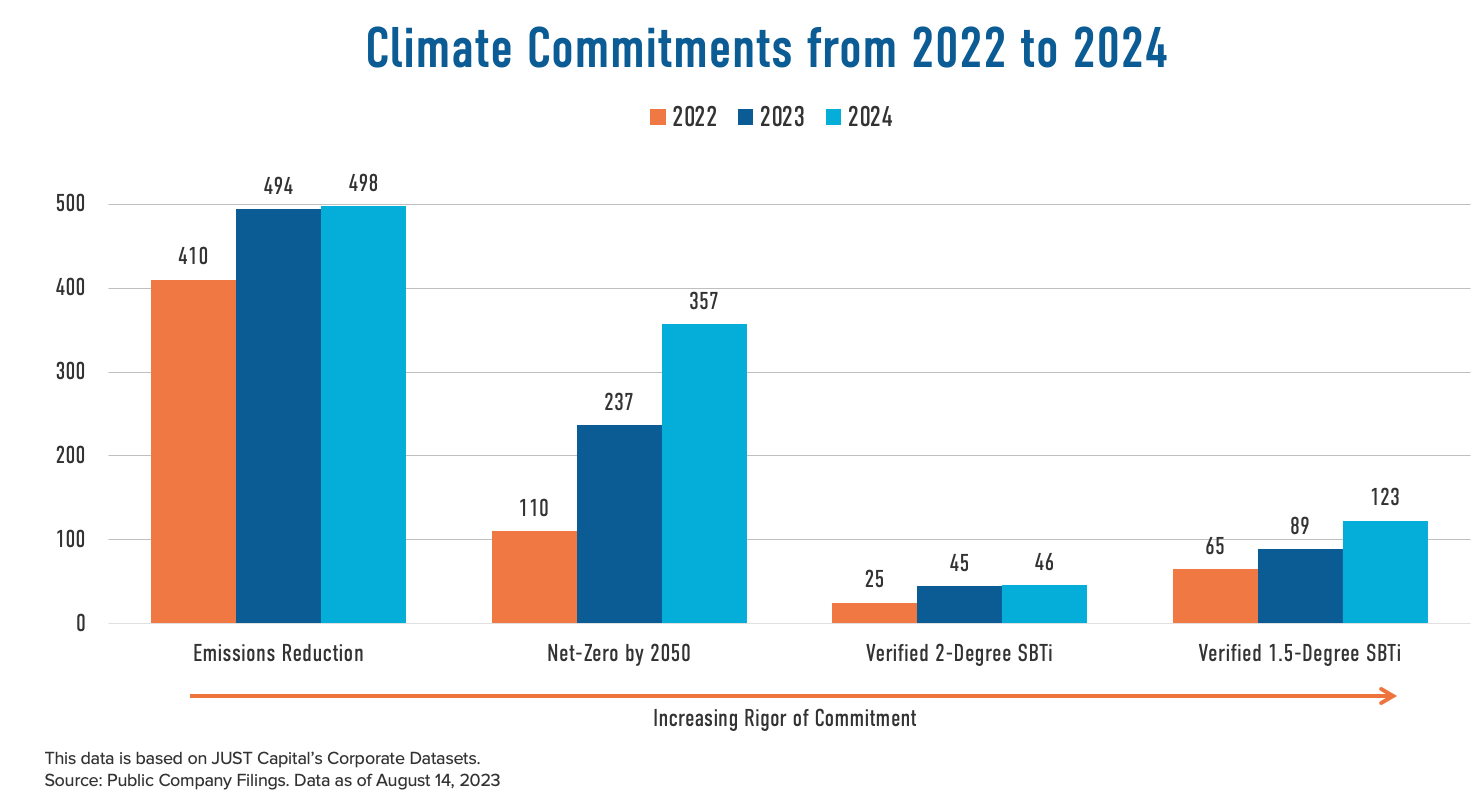
As part of our Rankings of America’s Most JUST Companies, we monitor, track, and analyze corporate climate commitments across 37 industries. Our analysis centers around four categories, listed in order of increasing rigor:
Over the course of three years of measurement, we have seen an increase in every category of commitment – a hopeful sign for corporate action on climate issues. Net-Zero commitments have tripled, and our most rigorous category, Verified 1.5-Degree SBTi has doubled since the start of our measurement.
The increase, albeit small, in two categories, Emissions Reduction and Verified 2-Degree SBTi, could be attributed to a number of factors. Emissions reduction commitments are simple time-bound statements with a specific amount of committed reduction. With a push for more action on climate, we see companies increasing the rigor of their commitments by expanding their scope, shortening their time horizon, or attaining scientific verification of their goals. 2-degree SBTi commitments are being phased out, which explains their stagnant growth. Industries with the greatest increases of commitments include Industrial Goods, Software, and Commercial Support Services industries.
Despite the promising growth across these categories, corporate action on reducing actual emissions is lagging overall – signaling the need for more urgency around this issue.
In exploring which companies are in fact making real change, there were a few key takeaways. It is a fair assumption that companies most likely to be reducing emissions are the ones with more robust targets, while less rigorous commitments yield less reductions. We see this in action with companies that have committed to science-based targets – which have reduced their emissions the most over the past year.
26 of 123 with the most robust targets disclosed an actual reduction of emissions in the past year. Unfortunately, companies with a general commitment to reducing emissions (e.g. reduce 50% by 2045) or Net-Zero climate commitments have, on average, increased their emissions. This further supports the need for verified science-based commitments, as unverified commitments lack the accountability mechanism to drive meaningful change across a company’s sustainability strategy when there are external parties involved in the construction and progress of these goals.
Climate commitments are more than just a singular statement, there are many underlying details that inform the strategy and pathway to a company’s public goals. This is how we begin to see if companies are really walking the walk or sparking concerns around greenwashing.
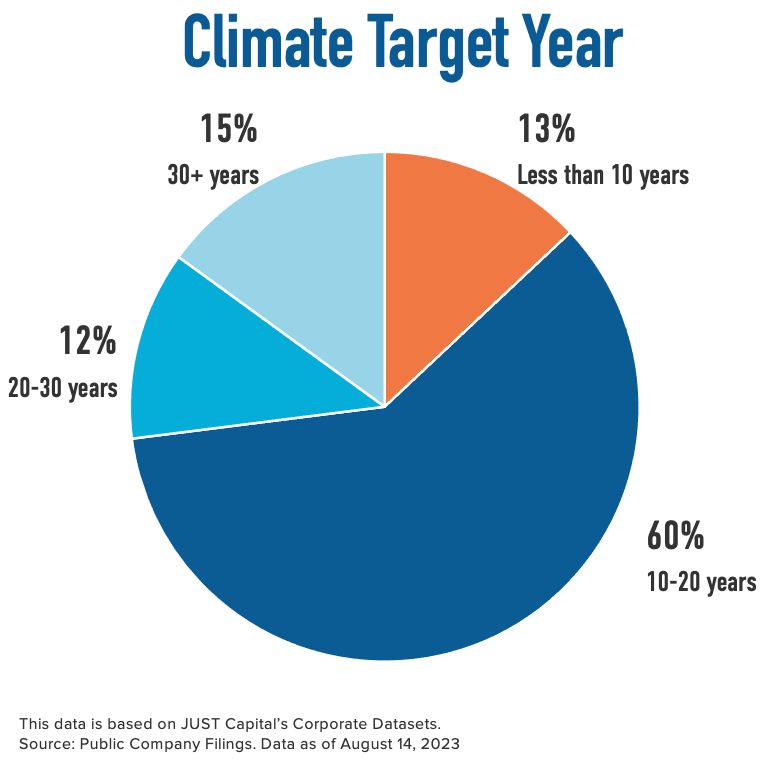
More than half of Russell 1000 companies are aiming to complete their reductions in the next 10-20 years, with the average target year being 2034. With 2050 being the absolute deadline to achieve Net-Zero to meet a 1.5 degree warming scenario, one hopes that the majority of companies are committing to an earlier deadline. Or if companies need the full amount of time to achieve reductions, they can set targets to achieve a portion of their overall reductions before the final target year, known as interim targets, to show their dedication to achieving their stated goals.
That said, among companies with Net-Zero commitments, only 11.48% have publicly set interim targets. This will be a key space to watch as time goes on and more aspects of these commitments get put into action and monitored by customers and investors alike.
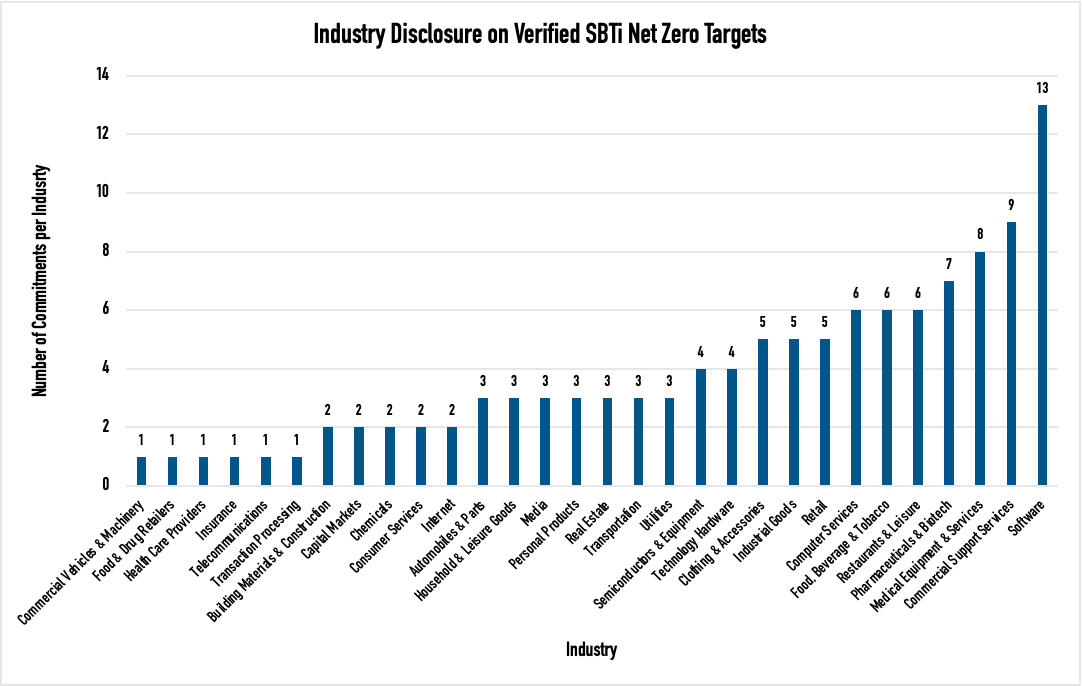
This year, we also began tracking SBTi’s latest category of commitment – a verified Net-Zero target – for the first time, which 115 companies have committed to. We see the most of these disclosures in the Software and Commercial Support Services industries. The increasing amount of avenues for companies to verify the scientific accuracy of their commitments is a sign that companies value progress and integrity in this currently unregulated space, especially in a time where concerns of greenwashing are high.
Looking ahead, business leaders can turn their attention to making more aggressive commitments by understanding the approach of industry peers and providing details on how and when they will achieve each portion of their commitments.
We are entering a transition between celebrating commitments and holding companies accountable to them by measuring action, and it will be telling who steps out to the front of the pack.
To unpack your company’s environmental performance in the 2023 Rankings and gain insights into how to improve on core climate issues, please reach out to corpengage@justcapital.com.
As this year’s Earth Day approaches, the world continues to stare down massive global consequences if governments, businesses, and other institutions do not take ambitious climate action. Released last month, the IPCC’s 2023 Climate Change Report signals that a vast reduction in fossil fuel use is urgently needed to slow global warming and ensure a livable, sustainable future.
Following last year’s SEC proposal to require public companies to disclose climate metrics, it seemed that corporate America was poised to be held accountable for its contributions to climate change. One year later, the rule is still not finalized with the SEC potentially easing requirements for companies following its public comment period.
Our survey research has shown that 86% of Americans, on both sides of the political aisle, are in favor of federal climate disclosure requirements. And with proposed requirements still uncertain, it remains in the hands of corporate leaders to determine what action to take and how it should be disclosed. Transparency will be crucial in the decades to come, and our analysis has shown that corporate leaders across industries are already paving the way.
To shine a light on these leaders and show what “good” looks like, we’re unpacking the efforts of the 36 companies that topped their industries on environmental issues in our 2023 Rankings of America’s Most JUST Companies. Many of these companies, regardless of their sector, have set ambitious emissions targets in an effort to mitigate the climate crisis, going beyond standard disclosure practices to focus their sustainability efforts on elements most material to their business models. And some also appear in our round-up of the top 10 companies leading on environmental performance overall in our Rankings.
Read on to explore how these 36 industry leaders are taking action.
Bank of America
Industry: Banks
Overall Rank: 1
As one of eight companies in its industry to make a Net-Zero commitment, Bank of America leads its industry on Resource Efficiency and Pollution Reduction. Notably, Bank of America boasts high percentages of renewable energy use, tying for first on this metric, both in its industry and overall. Additionally, Bank of America offers lending to customers for renewable projects and is a member of the Glasgow Financial Alliance for Net-Zero.
Accenture
Industry: Commercial Support Services
Overall Rank: 4
Accenture leads its industry on Pollution Reduction and Resource Efficiency. One of four Commercial Support Services companies to have a verified 1.5-Degree Science-Based Target, Accenture is committed to reaching Net-Zero by 2025. Accenture engages with its suppliers to achieve its ambitions, requiring 90% of suppliers to disclose emissions reduction plans and providing sustainable value chain strategies focused on circularity.
Hewlett Packard Enterprise
Industry: Computer Services
Overall Rank: 7
Hewlett Packard Enterprise is the only company in the Computer Services Industry with a verified 1.5-Degree Science-Based Target. First in its industry on Pollution Reduction, Sustainable Materials, and Climate Commitments, HPE has set multiple ambitious sustainability targets. HPE requires the adoption of science-based emissions reduction targets for its supply chain and is an early adopter of the reporting recommendation guidelines from the G20 Financial Stability Board’s Task Force on Climate-Related Financial Disclosures (TCFD).
Apple
Industry: Technology Hardware
Overall Rank: 8
Apple is one of three companies in the Technology Hardware Industry to have a verified 1.5-Degree Science-Based Target and has set a near-term target to achieve carbon neutrality by 2030. Thanks to these ambitious commitments, Apple ranks first in its industry for Climate Commitments. Apple is also first in its industry for having the highest percentage of renewable energy usage.
Intel
Industry: Semiconductors & Equipment
Overall Rank: 9
Intel has disclosed a 2040 Net-Zero Commitment, aiming to achieve 100% renewable energy in all of its global operations by 2030. Tied for first in its industry for having high percentages of renewable energy usage, Intel maintained 100% renewable energy usage within its U.S.-based operations in 2021.
T-Mobile
Industry: Telecommunications
Overall Rank: 20
T-Mobile is first in its industry on Pollution Reduction, Climate Commitments, and Resource Efficiency. Setting a verified 1.5-Degree Science-Based Target to achieve Net-Zero by 2040, T-Mobile has already achieved its 2021 goal to source 100% of its electricity usage from renewable sources.
Ecolab Inc
Industry: Chemicals
Overall Rank: 21
Ecolab’s verified 1.5-Degree Science-Based Target aims to halve the company’s emissions by 2030 and achieve Net-Zero by 2050. Ecolab is one of two companies within its industry to have a verified Science-Based Target and is working to achieve its goals by electrifying fleet vehicles, committing to 100% renewable energy in global operations, and engaging with its supply chain. Ecolab also ties for first in its industry on Sustainable Materials, conducting Life Cycle Assessments on its products to assess their environmental impacts.
Mastercard
Industry: Transaction Processing
Overall Rank: 22
Mastercard has a verified 1.5-Degree Science-Based Target, aiming to reduce Scope 1 and 2 emissions by 38% and Scope 3 emissions by 20% by 2025. One of only three Transaction Processing Companies to have a verified commitment, Mastercard is focusing on the decarbonization of its operations and supply chain.
Elevance Health
Industry: Health Care Providers
Overall Rank: 30
Elevance Health’s approach to sustainability is divided into four targets: carbon-neutral operations, 100% renewable energy procurement, science-based emissions reduction targets set by suppliers, and support to individuals challenged with economic insecurity. One of just two Health Care Providers that have committed to a Net-Zero Target, Elevance Health achieved carbon neutrality in 2021.
Workday
Industry: Software
Overall Rank: 33
Workday ranks first for Environment across all industries. Leading the competitive Software Industry on Pollution Reduction, Sustainable Materials, and Resource Efficiency, Workday has invested $1 million in carbon removal, discloses a verified 1.5-Degree Science-Based Target, and is going a step further to mitigate all historical carbon emissions. Through this ambitious effort, Workday will become one of the first companies to have a lifetime negative carbon footprint.
Avangrid
Industry: Utilities
Overall Rank: 45
Tied for first in its industry for Climate Commitments, Avangrid is one of just two Utilities companies to have set a verified 1.5-Degree Science-Based Target. Avangrid is seeking to achieve carbon neutrality, committing to 100% renewable energy in its corporate buildings by 2030. Avangrid is also tied for first in its industry for having high percentages of renewable energy usage.
General Motors
Industry: Automobiles & Parts
Overall Rank: 50
General Motors is one of just two companies in the Automobiles & Parts industry to have set a verified 1.5-degree Science-Based Target. The company’s Climate Action Framework is centered around creating an equitable transition to electric vehicles and improving the overall sustainability of its current products. Tied in its industry on the Sustainable Materials Issue, General Motors also ranks first overall for Pollution Reduction.
Lockheed Martin
Industry: Aerospace & Defense
Overall Rank: 54
As part of its 2025 Sustainability Plan, Lockheed Martin set a 2030 target to reduce Scope 1 and 2 emissions by 70%. One of nine Aerospace & Defense companies to set an emissions reduction target, Lockheed Martin has pledged that, by 2025, it will offset 100% of carbon emissions from business travel as well as continue to invest in and install carbon removal technologies.
McCormick & Co
Industry: Food, Beverage, & Tobacco
Overall Rank: 57
McCormick & Co has set a verified 1.5-Degree Science-Based Target to reach Net-Zero by 2050, one of only six companies in its industry to do so. Tied for first in its industry for Climate Commitments, McCormick is also working to reduce its carbon footprint by adopting more sustainable packaging practices.
Cummins
Industry: Commercial Vehicles & Machinery
Overall Rank: 67
Cummins’ Planet 2050 sustainability strategy aims to reduce Scope 1 and 2 emissions by 50% and Scope 3 emissions of newly sold products by 25%. Also by 2050, Cummins pledges to reduce absolute water consumption by 30%. Cummins is one of just two companies in its industry to have a verified 1.5-Degree Science-Based Target and is tied for first in its industry on Climate Commitments.
Akamai
Industry: Internet
Overall Rank: 78
Akamai leads its industry with five main sustainability targets for 2030, including 100% renewable energy to power global operations, a 50% more energy efficient platform, 100% mitigation of operational emissions, engagement with suppliers to set their own emission reduction targets with results evident by 2030, and recycling 100% of e-waste. Through these initiatives, Akamai has committed to reaching Net-Zero emissions by 2030.
Ball Corp
Industry: Industrial Goods
Overall Rank: 87
Ball Corp has set a verified 1.5-Degree Science-Based Target to achieve Net-Zero by 2050 and continues to improve the sustainability of its products, aiming to source 100% of its aluminum from certified sustainable sources. First in its industry for Sustainable Materials, Ball Corp is working with its supply chain to ensure that the aluminum used in its cans and bottles are, on average, 85% recycled content.
Owens Corning
Industry: Building Materials & Construction
Overall Rank: 96
With a 2030 pledge to reduce Scope 1 and 2 emissions by 50% and Scope 3 emissions by 30%, Owens Corning ties for first in its industry for Climate Commitments, also setting a verified 1.5-Degree Science-Based Target – one of only two companies in its industry to do so. Owens Corning is a member of the Better Plants Program, a Department of Energy initiative to improve and advance energy efficiency in commercial and industrial buildings in the U.S.
Nike
Industry: Clothing & Accessories
Overall Rank: 97
Nike’s Move to Zero initiative has demonstrated the company’s commitment to emissions reduction. With a verified 1.5-Degree Science-Based Target, Nike has set three 2025 targets centered around reducing emissions by prioritizing sustainable materials, using recycled waste in Nike products, and reducing fresh water consumption by 25%. Nike leads its industry on Pollution Reduction, with the highest percentage of renewable energy usage among its peers.
Johnson & Johnson
Industry: Pharmaceuticals & Biotech
Overall Rank: 101
First in its industry for Pollution Reduction and Sustainable Materials, Johnson & Johnson is finding innovative ways to reduce the environmental impacts of its products through multiple sustainability-focused partnerships. Johnson & Johnson also has set a verified 1.5-Degree Science-Based Target and is committed to reaching Net-Zero by 2045.
Edwards Lifesciences
Industry: Medical Equipment & Services
Overall Rank: 104
First in its industry for Climate Commitments, Edwards Lifesciences is one of just two Medical Equipment & Services companies with a verified 1.5-Degree Science-Based Target to reach carbon neutrality by 2030. Additionally, Edwards Lifesciences has set 2025 targets to reduce both waste generation intensity and water withdrawal intensity by 10%.
eBay
Industry: Consumer Services
Overall Rank: 103
In 2021, eBay achieved carbon neutrality in its Scope 1 and 2 emissions. With a verified 1.5-Degree Science-Based Target to achieve Net Zero by 2030, eBay is also working to increase its renewable energy use and reduce its water consumption and waste generation. eBay is first in its industry for Pollution Reduction, Sustainable Materials, and Climate Commitments and is the only Consumer Services company with a 1.5-degree climate commitment.
Procter & Gamble
Industry: Personal Products
Overall Rank: 106
First in its industry for Pollution Reduction and Resource Efficiency, Procter and Gamble has set a verified 2-Degree Science-Based Target to reach Net-Zero by 2040. Disclosing a comprehensive Climate Transition Action Plan, the company is investing in renewable energy and is tied for first in its industry for the highest percentage of renewable energy usage.
Hasbro
Industry: Household & Leisure Goods
Overall Rank: 113
Second in its industry for Sustainable Materials, Hasbro is working to improve the sustainability of its products, using plant-based or recyclable materials in its toys, continuing its global toy recycling program, and implementing sustainable packaging principles. Hasbro is also setting a Net-Zero target for 2050, one of only four companies in its industry to do so.
CVS Health
Industry: Food & Drug Retailers
Overall Rank: 120
First in its industry for Climate Commitments, CVS has set a verified 1.5-Degree Science-Based target to reach Net-Zero by 2050 and a 2030 goal of achieving carbon neutrality. CVS has a three-tiered climate action plan focused on enabling sustainable operations, adopting new climate policies, and promoting animal welfare. CVS has also set a 2030 target to reduce plastic use in its operations by 50% and is tied for first in its industry for its commitment to using Sustainable Materials.
Ameriprise Financial
Industry: Consumer & Diversified Finance
Overall Rank: 124
Ameriprise Financial leads its industry on Sustainable Materials and Resource Efficiency. By implementing sustainable practices in its operations, including increasing building energy efficiency and reducing paper waste, Ameriprise Financial has lowered its Scope 1 and Scope 2 emissions.
Goldman Sachs
Industry: Capital Markets
Overall Rank: 131
Leading its industry on Climate Commitments, Goldman Sachs has set a 2030 Net-Zero target. Goldman Sachs also boasts high percentages of renewable energy use and has a 2025 goal of procuring 100% renewable energy for its global electricity consumption.
Principal Financial Group
Industry: Insurance
Overall Rank: 138
Principal Financial Group has set both near- and long-term climate targets, including a 2035 goal to reduce emissions by 40% and a 2050 goal to reach Net-Zero. Year-over-year since 2018, Principal Financial Group has consecutively reduced greenhouse gas emissions. Tying for first in its industry for Pollution Reduction, approximately 61% of Principal Financial’s energy consumption in the U.S. is from renewable resources.
Marathon Petroleum
Industry: Oil & Gas
Overall Rank: 173
Marathon Petroleum has set reduction targets across all three scopes of emissions, including a 30% reduction of Scope 1 and 2 by 2030 and a 15% reduction of Scope 3 Category 11 emissions by 2030. First in its industry for Sustainable Materials, Marathon Petroleum conducts biodiversity assessments and has set a 2025 target to integrate sustainable vegetation and habitat management into 50% of the areas surrounding pipelines.
FedEx
Industry: Transportation
Overall Rank: 178
FedEx has set a goal to achieve carbon neutral operations through the electrification of its fleet vehicles and the adoption of sustainable fuels. FedEx is also engaging with consumers and suppliers to offer carbon-offset shipping and sustainable packaging options.
Weyerhaeuser
Industry: Real Estate
Overall Rank: 205
Weyerhaeuser has set a verified 1.5-Degree Science-Based Target, pursuing Net-Zero by 2050. The company also launched the Forest to Frame Alliance to engage its entire supply chain in its Net-Zero ambitions. First in the Real Estate Industry in Pollution Reduction and Resource Efficiency, Weyheauser is second in its industry for high percentages of renewable energy usage.
Las Vegas Sands
Industry: Restaurants & Leisure
Overall Rank: 291
Las Vegas Sands has committed to a verified 2-Degree Science-Based Target, aiming to reduce greenhouse gas emissions by 17.5% by 2025. The company is implementing energy efficiency within its operations to undergo a low-carbon transition, as well as focusing on water stewardship by reducing water consumption.
Williams-Sonoma
Industry: Retail
Overall Rank: 331
Tied for first in its industry for Climate Commitments, Williams-Sonoma has a verified 1.5-Degree Science-Based Target and a near-term target of carbon neutrality by 2025. The company is first among Retail companies for having the highest percentage of renewable energy usage, as well as first in Sustainable Materials, thanks to its efforts to increase the circularity of its products.
International Paper
Industry: Basic Resources
Overall Rank: 408
Ranking first in its industry on Pollution Reduction, International Paper discloses the highest percentages of renewable energy use compared to peers. International Paper is also one of just two companies in its industry to have a verified 2-degree Science-Based Target, with a commitment to reduce 35% of absolute emissions across all three scopes by 2030.
News Corporation
Industry: Media
Overall Rank: 589
News Corporation is one of two companies within the Media Industry to have a verified 1.5-Degree Science-Based Target. Tied for first for Climate Commitments, News Corporation discloses an entire Net-Zero Transition Plan and has committed to reducing fuel and carbon emissions by 60% by 2030.
Enviva
Industry: Energy Equipment & Services
Overall Rank: 729
Enviva has made a 2030 Net-Zero commitment, along with five other companies in its industry. With efforts to sustainably source wood and invest in the conservation and restoration of forests, Enviva is first in its industry for Pollution Reduction and second for Climate Commitments.
To unpack your company’s environmental performance in the 2023 Rankings and gain insights into how to improve on the issues that matter most to the American public, please reach out to corpengage@justcapital.com.

The “E” in ESG remains a core focus for corporate leaders – along with regulators and lawmakers. Some state and federal legislators continue to challenge companies’ environmental actions. At the same time, companies are grappling with new sustainability disclosure requirements coming out of the EU and what’s to come from the SEC‘s rule on climate-related disclosures.
Amid these moves, and as this week marks the 53rd annual Earth Day, we took a look at how America’s largest employers are stepping up to manage their environmental impact.
A majority of Americans (88%) JUST Capital surveyed in partnership with Ceres and Public Citizen agree large companies have a responsibility to reduce their environmental impact. An additional 87% said it is important that large companies publicly report data about their impact on society regarding climate. Climate also remains high on the agenda of investors, making up a majority of ESG-related shareholder proposals this proxy season.
To see how companies are measuring up against these expectations, we evaluated the 10 companies with the best environmental performance in our 2023 Rankings of America’s Most JUST Companies. All 10 of these companies have set a Net-Zero target and we also found that these leaders are outpacing the remainder of the Russell 1000:
Read more about how these companies – some of which also appear in our round-up of industry leaders on environmental performance – are taking action. The Top 10 are listed below in ranked order on environmental performance based on the 2023 Rankings.
Ranked 33rd in America’s Most JUST Companies
Software company based in Pleasanton, California
Workday is the top-performing company on the Environment stakeholder, placing first in the overall Rankings and its industry. At Climate Week 2022, JUST CEO Martin Whittaker discussed with Workday’s Erik Hansen the company’s ambitious verified climate commitment, a 1.5-degree Science-Based Target, to reach Net-Zero emissions within its operations by 2030. Workday is also mitigating its historical emissions, becoming one of the first companies to achieve a lifetime net carbon footprint of zero. Additionally, Workday is tied for first within its industry for having the highest percentage of renewable energy within its overall energy use portfolio.
Ranked 7th in America’s Most JUST Companies
Computer Services company based in Spring, Texas
Hewlett Packard Enterprise‘s (HPE) verified 1.5-degree Science-Based Target contains near-term and long-term goals to achieve Net-Zero emissions by 2040, including an absolute reduction of all scope emissions by 90%. Through innovative technology, HPE is increasing the energy efficiency of its products and lowering the environmental cost for consumers. These efforts earned HPE a tied-for-first spot on the Sustainable Materials Issue in our Rankings, within the Computer Services industry. HPE is also tackling its supply chain emissions, and through direct collaboration with suppliers, has set a goal for 2030 that 80% of HPE product suppliers have their own Science-Based targets.
Ranked 78th in America’s Most JUST Companies
Internet company based in Cambridge, Massachusetts
Akamai is working toward a 2030 Net-Zero Target through clean energy projects, engagement with suppliers, and creating a 50% more energy-efficient platform. The company is aiming to achieve a goal of 100% of its global operations utilizing renewable energy by 2030 through partnerships with its data center providers. Akamai also ranks first in its industry for pollution reduction and resource efficiency.
Ranked 3rd in America’s Most JUST Companies
Software company based in Redmond, Washington
Microsoft has consistently positioned itself as a leader in sustainability and has pledged to go beyond Net-Zero, committing to being carbon negative by 2030. This ambitious commitment includes removing more carbon than the company emits by 2030 and, by 2050, removing all of the company’s historical emissions. Microsoft is also committed to becoming water positive by 2030, through collaborating with nonprofits and focusing on habitat restoration. Microsoft is investing in circularity by setting a target of zero waste by 2030, creating more sustainable products for consumers to eliminate waste, and optimizing waste diversion practices within its data centers and campuses.
Ranked 106th in America’s Most JUST Companies
Personal Products company based in Cincinnati, Ohio
Procter & Gamble’s (P&G) approach to sustainability includes four tiers – climate, waste, water, and nature. Procter & Gamble’s climate-focused initiatives include achieving Net-Zero by 2040, disclosing a Climate Transition Action Plan to track progress, and maintaining accountability to achieving its goals. The company’s reducing waste with a target to use all recyclable or reusable packaging for consumer products by 2030. P&G also aims to help build a water-positive future, focusing first on high water-stressed areas where the company operates. The company’s nature-centric goals also include engaging suppliers to source more ethical products and a commitment to no deforestation as a result of souring its palm, pulp, and paper packaging.
Ranked 1st in America’s Most JUST Companies
Bank based in Charlotte, North Carolina
Bank of America’s Approach to Zero strategy includes a commitment to reaching Net-Zero by 2050. The company achieved carbon neutrality in 2019, in addition to reaching its goal of using 100% renewable electricity. To achieve its Net-Zero goal, the company is leveraging its position as a financial institution and mobilizing $1 trillion by 2030 to accelerate its own climate transition. Bank of America’s Environmental Business Initiative has lent $200 billion toward sustainable business activities, including targeting industries essential to achieving the environmental transition such as transportation and clean energy.
Ranked 48th in America’s Most JUST Companies
Computer Services company based in Armonk, New York
IBM has disclosed 21 climate-related goals, including reaching Net-Zero across its operations by 2030. IBM also is focused on the conservation and preservation of biodiversity, pledging to source more sustainable materials and reduce water withdrawals in areas identified as high risk. Within its supply chain, IBM is building on its 2010 goal of all firsthand suppliers maintaining their own environmental management systems, and requiring suppliers in emission-intensive sectors to set scientific emission reduction targets aligned with a 1.5-degree warming scenario.
Ranked 101st in America’s Most JUST Companies
Pharmaceutical & Biotech company based in New Brunswick, New Jersey
Johnson & Johnson’s approach to sustainability is grounded in climate change as a global health crisis. The company’s targets include decarbonization in its operations and supply chain, providing more sustainable products to consumers, and furthering environmental health equity. Johnson & Johnson’s Net-Zero Target aims to achieve carbon neutrality by 2030, with the ultimate goal of reaching Net-Zero across its entire value chain by 2045. The company’s environmental health equity strategy is a part of a larger company initiative launched in 2020, “Our Race to Health Equity,” which identifies solutions to eliminating health inequality for individuals that are a part of at-risk communities.
Ranked 4th in America’s Most JUST Companies
Commercial Support Services company based in Chicago, Illinois
Accenture has a commitment to reaching its own Net-Zero Target by 2025 and is working with companies to assist in helping them achieve their own Net-Zero ambitions. Accenture is taking advantage of its unique position to further sustainability in a range of industries. The company works with C-suite executives to set Science-Based targets, procure renewable energy, and implement new sustainable business models. Accenture has also made progress on its 2025 zero waste target, committing to purchasing only reusable or plastic-free items for its global operating locations.
Ranked 87th in America’s Most JUST Companies
Industrial Goods company based in Broomfield, Colorado
Ball Corp has a Climate Transition Plan, which includes reaching Net-Zero prior to 2050 and reducing carbon emissions by 55% by 2030. Ball Corp ranks first in its industry on the Environment stakeholder, disclosing multiple plans to achieve its sustainability goals dependent on the decarbonization of aluminum. The company is embedding circularity in its product development, through a global recycling roadmap, working with suppliers to achieve 85% recycled content in its cans, and investing in green infrastructure. Through these efforts, Ball Corp leads Industrial Goods companies in our Rankings on the Sustainable Materials Issue.
To unpack your company’s environmental performance in the 2023 Rankings and gain insights into how to improve on the issues that matter most to the American public, please reach out to corpengage@justcapital.com.
