
“Particularly with middle- and lower-income consumers, they’re feeling under a lot of pressure right now.”
That worrying statement comes from McDonald’s CEO Chris Kempczinski, who earlier this week sat down with Fortune for a conversation on the state of the business. Going further, he relayed that traffic among these demographics is down double-digits, with low-income consumers skipping breakfast in particular.
Other indicators are also concerning. This week brought a dismal jobs report (the first time in four years the economy lost jobs). A new Federal Reserve Bank of New York poll shows that people’s confidence in their ability to find work if they lose their job is the lowest it’s been since they started polling in 2013. They also suggest lower-income households have already begun to change their shopping habits to withstand economic uncertainty.
How are companies responding to help their less well-off customers?
McDonald’s itself is currently cutting prices on certain food combos and offering limited time deals to help customers feeling the pinch. Other chains are making similar attempts,such as Domino’s recent “Best Deal Ever” promotion, which offered any pizza toppings for $9.99.
Other industries are also following suit. FanDuel gave $80,000 to restore Philly’s Septa train service for the Eagles’ season opener after the city officials said it would have to cut express service thanks to budget shortfalls. Grocer Aldi cut prices on 400 everyday items over the summer to offset rising food costs; energy companies (including Eversource) provide eligible customers with up to a 50% monthly discount on their electric bill and flexible payment plans; and earlier this year Target dramatically expanded their healthcare products under $10 to make health and wellness purchases more budget-friendly.
As more and more Americans become squeezed financially, we will surely see more efforts by just companies to ease the pressure.
We will be tracking them.
-Martin
The Washington Post reports that Anthropic (creator of the Claude AI model) has agreed to a history-making $1.5 billion class-action settlement with authors and publishers for allegedly downloading millions of books without permission — marking a notable legal precedent in the ongoing clash between AI development and creators’ rights.
Fortune reveals that the average employee age at tech companies has increased by five years as AI-enabled entry-level job cuts reshape their workforce.
Taco Bell is scaling back their use of AI after the technology led to worse problems with customer ordering compared to human employees.
Former Just Capital board member Dan Hesse discusses authentic leadership as a key way to unlock business value on The Mentors Radio podcast.
The Wall Street Journal reports that health insurance costs for employers are rising more than they have in 15 years, stunning small businesses in particular.
Business Insider looks at how the attempt to crack down on Elon Musk’s pay backfired spectacularly and what lessons can be learned going forward.
Newsweek examines how job changing is dwindling as workers find it harder to secure higher pay at a new company.
Following the removal of their new logo, Cracker Barrel is officially ending all of its restaurant remodels to respond to consumer backlash. Fortune has the story.
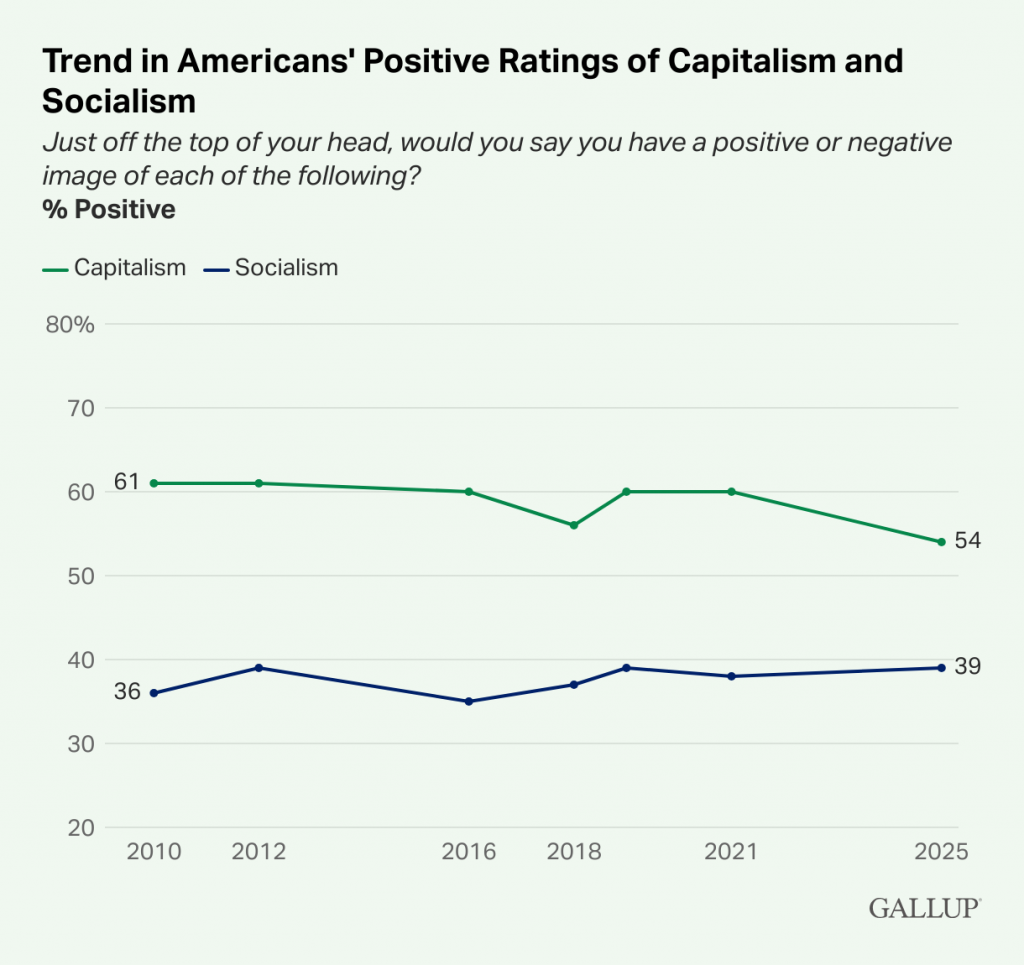
Gallup reveals that only 54% of Americans have a positive view of capitalism, down from 60% in 2021.

Last week, we explored how internship programs can deliver real business value when done right. This week, I’m putting our money where our mouth is by sharing findings from one of our own summer intern projects: an analysis by Sofia Maria Giorgianni that reveals crucial insights about how America’s most just companies are approaching AI workforce development.
Sofia’s research couldn’t be more timely. Our polling shows that AI is a critical issue to the American public with 70% of respondents agreeing that CEOs have a key role to play in the ethical use of AI, and Americans consistently rank worker advancement and training as a top issue. As AI reshapes the private sector, a critical question emerges: How are companies investing in their workers to ensure they can thrive in an AI-powered future? The answer, according to our data, is encouraging.
Among the 2025 Just 100, 84% of companies mention AI in their disclosures, yet only 20% specifically disclose AI talent development initiatives. This represents both a challenge and an opportunity. The companies leading the way – including Salesforce, Constellation Energy, Boston Scientific, Visa, and The Hershey Company – span 13 different industries, showing that AI readiness isn’t just a tech sector concern.
Interestingly, companies with AI training initiatives tend to rank higher overall in our Rankings of America’s Most Just Companies while those without such programs skew toward the bottom. This suggests a link between future-readiness and just business behavior. Companies that invest in their workers’ AI capabilities are often the same ones excelling across other stakeholder dimensions.
Sofia’s work demonstrates how fresh perspectives can illuminate critical business challenges. Her proposed AI talent development metric will help us track – and encourage – this emerging dimension of corporate performance going forward.
Be well,
Martin
Fortune looks at how AI is already flattening organizational structures, removing managers and distance between staff and the C-suite.
The New York Times reveals 21 ways people are using AI to cut down their workloads.
AI startup Perplexity makes a $34.5 billion dollar bid for Google Chrome’s browser. Bloomberg has the story.
Pew Research Center finds Americans remain split on whether companies should issue public statements on political or social issues — roughly half view them as important, but opinions vary significantly by race and political affiliation.
The Wall Street Journal digs into the data that shows the era of big pay raises for low-wage workers is over.
The Washington Post reports that Nvidia and AMD have agreed to remit 15% of their revenue from AI chip sales in China to the U.S. government as part of an unusual arrangement tied to export licenses, sparking warnings about potential constitutional conflicts.
Axios outlines the mounting pressures on consulting firms as both AI efficiency gains and government contract cuts disrupt the traditional billable hours model.
Fortune reveals that despite CEOs across the country instituting RTO mandates, only 7% of them regularly appear in their own offices.
The New York Times explains that Big Tech’s net-zero proclamations are on shaky ground due to the massive spike in energy usage from their AI investments.

Axios examines how companies have used economic downturns to replace workers with automation and how another recession would likely accelerate businesses replacing workers with AI.
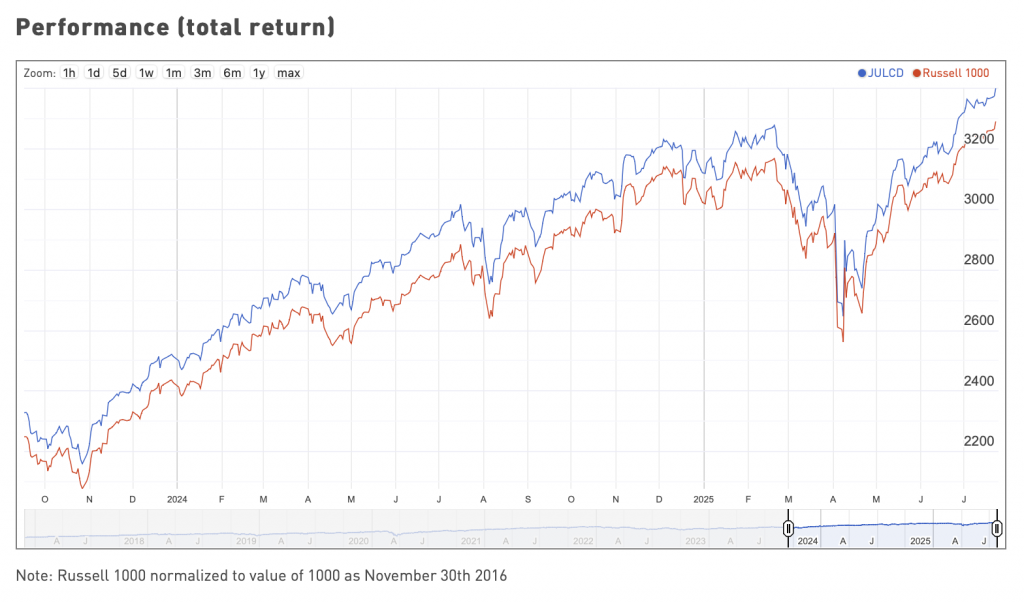
According to Morningstar, U.S. ESG funds experienced net outflows in both 2023 and 2024, reversing a decade of growth as traditional sustainability strategies face mounting skepticism. The latest data from GS Sustain also points to 23 consecutive months of outflows for North American sustainable equity funds. Amid this retreat, I’m excited to share that JUST Capital’s stakeholder-focused approach is demonstrating remarkable resilience as of June 30, 2025.
Since inception in December 2016 the JUST U.S. Large Cap Diversified Index (JULCD) has delivered cumulative returns of 231.9%, outperforming the Russell 1000 Cap-Weighted Index by 11.4 percentage points. Meanwhile, our JUST 100 Index has generated an impressive 49.7 percentage points of alpha over its benchmark, with returns of 125.7% versus 76.1% for the Russell 1000 Equally Weighted Index since March 2019.
We also see persistent outperformance at the company level. Those in the top decile of JUST overall scores have outperformed their counterparts in the bottom-decile by a remarkable 90.2 percentage points since January 2018. Notably, companies that prioritize worker investments – providing fair wages, comprehensive benefits, strong health and safety protections, robust training and advancement opportunities, and fostering inclusive workplaces – see the biggest dividends. Top-decile performers in our Worker stakeholder have generated a spread of 129.7 percentage points over their bottom-decile peers since January 2018.
Investors are noticing the opportunity. While traditional ESG investing has declined, the JUST ETF attracted net inflows in both 2024 and year-to-date 2025.
All of this is supported by our proprietary research, which points to an “efficient frontier” of stakeholder performance that varies by industry, by financial measurement, and by the underlying stakeholder issue in question. If you’d like to learn more, please reach out.
Be well,
Martin
Business Insider reports that several U.S. senators are pushing Delta for more information on their new pricing plan, which aims to use AI to set ticket prices.
Fortune looks at how the overwhelming increase of bots on the internet – accounting for 50% of all internet traffic last year – is poised to become more of a problem as AI proliferates. More inside.
Bill Gates, Steve Balmer, and others are putting $1 billion over the next 15 years into “AI for good” to support people who work in undeserved jobs like parole officers, social workers, and more. The American Bazaar has the story.
The Wall Street Journal looks at the growing number of technology companies aiming to upend food delivery with AI powered robots.
Fortune reveals that researchers from top AI companies are warning that they’re losing the ability to understand how their AI is thinking.
The New York Times examines how the immigration crackdown is straining the caregiving industry, particularly senior centers in the U.S.
GM’s profits shrank by $1.1 billion due to tariff impacts. The Wall Street Journal has the story.
Inc. looks at the pushback Starbucks is receiving from its new RTO mandate – which would ask many of its corporate employees to relocate to Seattle or Toronto within 12 months.
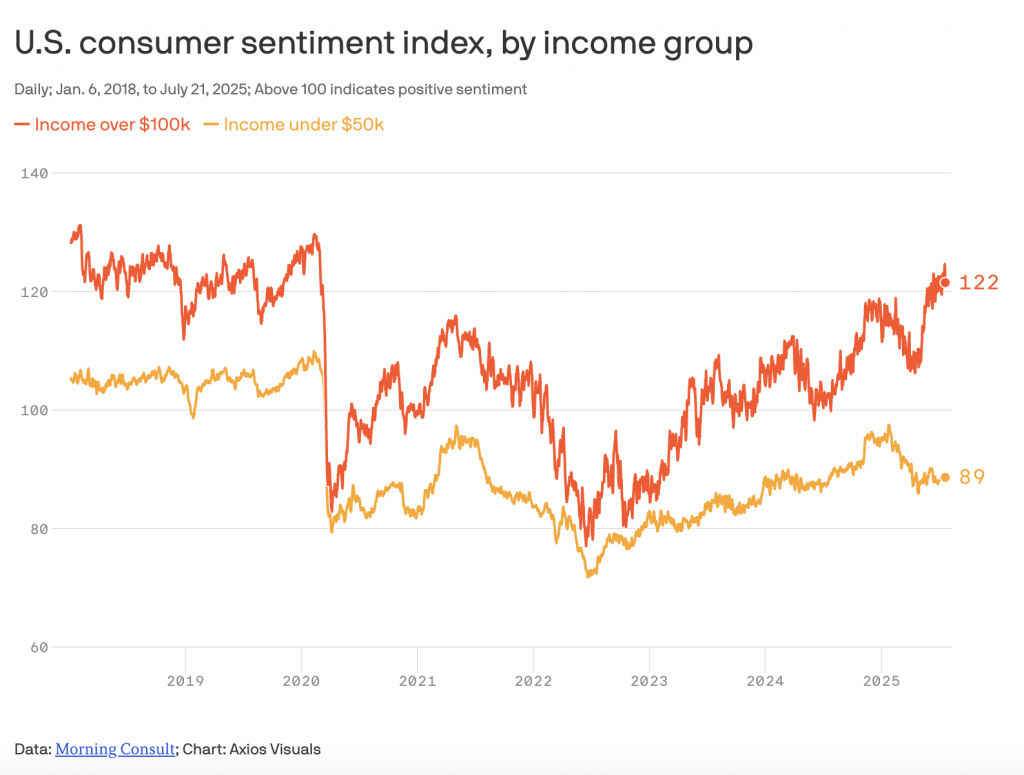
Axios looks at the growing sentiment gap between rich and poor Americans and finds the divide growing wider than it has in many years. Explore the findings here.
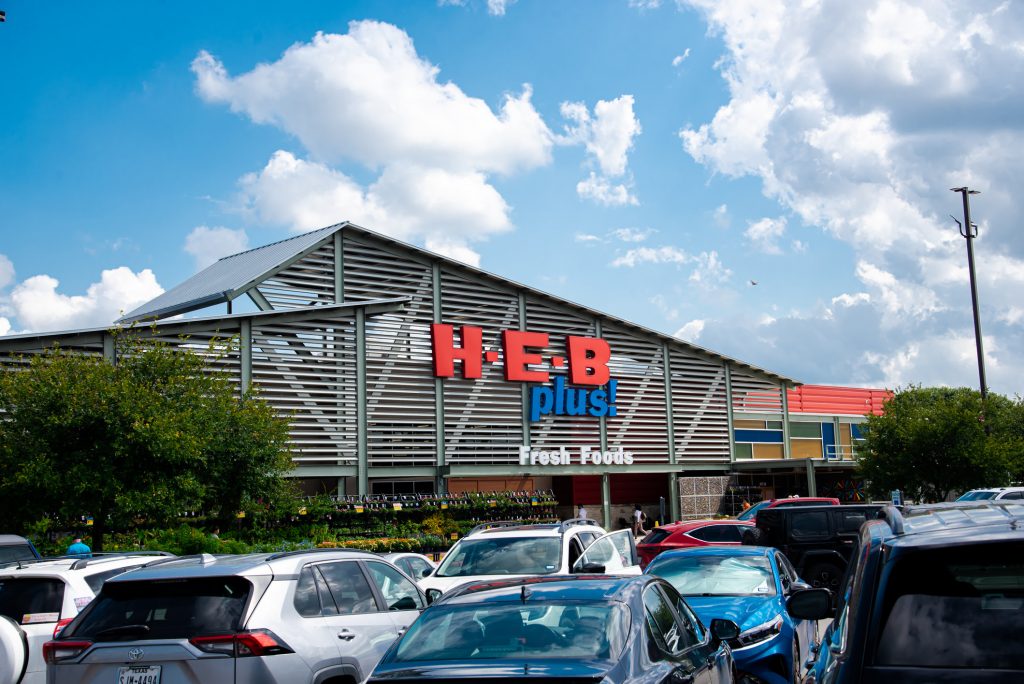
The devastating floods that swept through Central Texas over the Fourth of July weekend have once again demonstrated a fundamental truth about companies in America: in times of heartbreak and crisis, the just ones show up.
Even as search and rescue operations continue in Kerr County and surrounding areas, we’re witnessing meaningful displays of corporate humanity at work. Several of America’s largest companies have jumped in – from Airbnb.org to Lowe’s to AT&T – as they did following the wildfires in Los Angeles earlier this year and in the aftermath of Hurricane Helene in North Carolina last year.
One Texas-based company stands out from the pack. H-E-B grocery chain has proven that their motto “No Store Does More” is more than just a marketing tagline. With roots in Kerrville – the epicenter of the current flooding – H-E-B’s response has been both immediate and significant. And it isn’t an anomaly – it’s an extension of their everyday commitment to Texas communities. The company:
When one Facebook user posted a video of H-E-B disaster relief vehicles heading toward flood zones, the comment “This is exactly why Texans love HEB!” captured a sentiment that runs deep.
The floods in central Texas are a tragedy that will require sustained support from multiple sources. But they’ve also shown that in a divided time, American businesses can help us come together.
Be well,
Martin
The Wall Street Journal features some of the upstarts looking to profit from Google Search’s demise, as people stop clicking on links and ads and switch to reading AI summaries.
According to Fortune, students and professors are both using AI at higher rates, either to complete assignments or create lesson plans.
Meanwhile, the Atlantic asks the important question: “What should young people study when AI threatens to take their jobs?”
The New York Times highlights the debate over which group of workers will be most affected by AI layoffs: new workers, or the experienced?
Yahoo Finance runs down which states have new minimum wage laws going into effect this week.
Fortune reveals that 75% of employers now use personality and skill tests in addition to traditional job application materials to cut down on hiring time.
NPR breaks down how the “no taxes on tips” rule in Trump’s spending bill will work for employees.
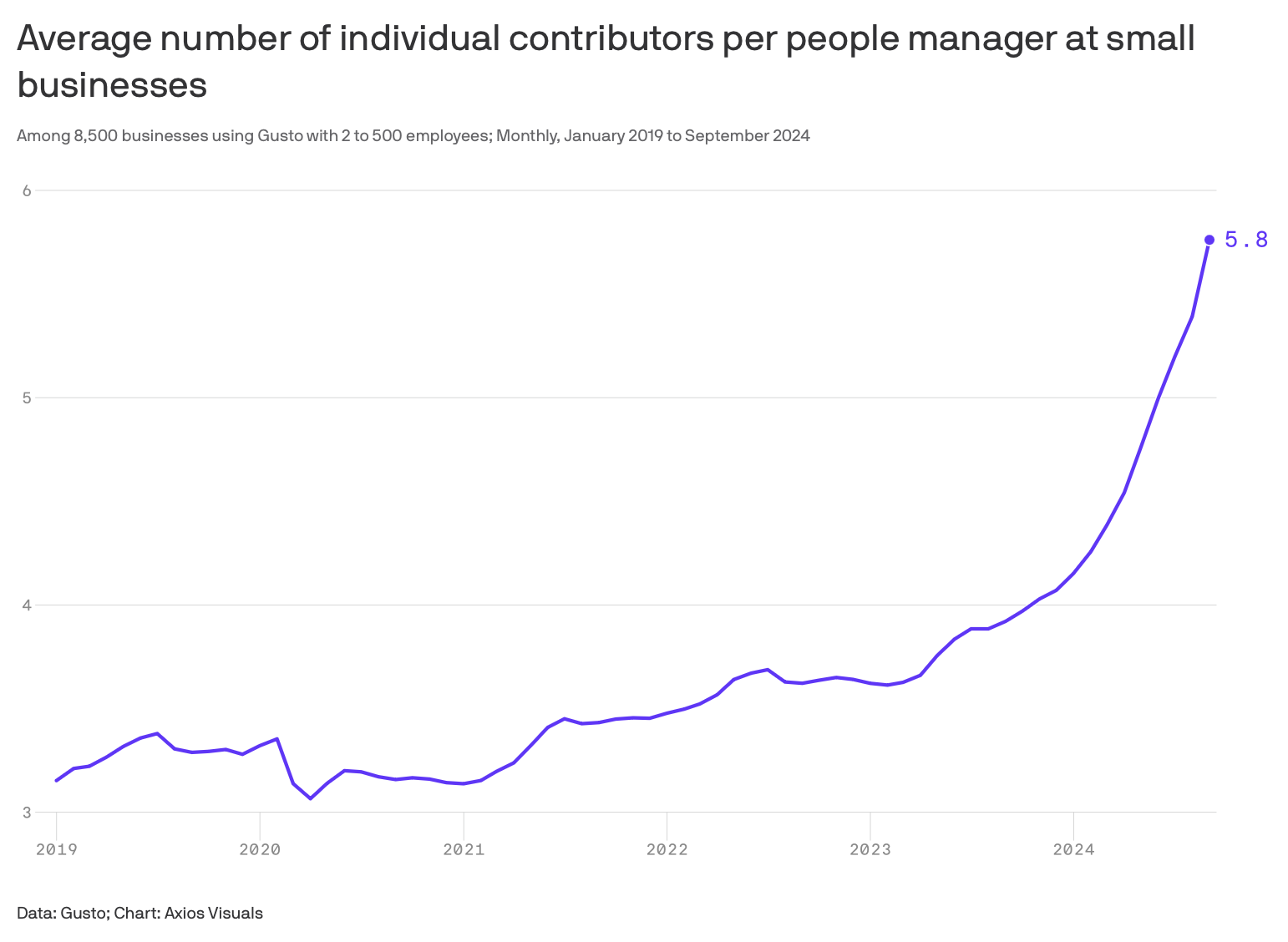
Axios looks at how middle managers are now overseeing more people on average and how cost-cutting and AI investments are hastening this trend.

Amid ongoing macroeconomic uncertainty and emerging AI-driven labor market disruptions, workforce leaders face the dual challenge of investing meaningfully in their workforce and demonstrating their value proposition to meet rising employee expectations.
What do Americans want from their employers? The public tells us year after year that fair wages matter most, but they also clearly indicate that pay alone doesn’t define a good job. Across every demographic group, Americans consistently prioritize benefits, worker well-being, ethical leadership, and transparent communication as hallmarks of just companies.
The Just Jobs Performance Tracker supports Russell 1000 leaders facing tough decisions on their human capital strategy through comprehensive access to benchmarking data and leading workforce practices. This singular destination is built to help enhance job quality, strengthen recruitment and retention, and unlock organizational excellence.
The business case for Just jobs is compelling: As of June 11, 2025 Just Capital’s Workers Index has outperformed its Russell 1000 benchmark by 16.6% since its inception in December 2021. The Workers Index tracks the top 20% of Russell 1000 companies with high performance on Worker issues in the annual Ranking of America’s Most JUST Companies.
This Performance Tracker is the third iteration of a tool formerly known as the JUST Jobs Scorecard, building on earlier versions with updated company data, refreshed benchmarks, and an enhanced peer comparison feature to provide deeper insight. It is accessible within the JUST Intelligence platform.
The JUST Jobs Performance Tracker enables companies to assess disclosure and performance on 27 data points across five key topic areas that are foundational to quality jobs: Wages & Compensation; Benefits; Hiring & Stability; Training & Development; Employee Wellness & Belonging. To develop the JUST Jobs Performance Tracker, JUST Capital assessed corporate disclosure and performance on these data points, scoring companies on a continuum of practice from 0 points for no disclosure through 4 points for leading practice.
Companies earn JUST Jobs Leadership designation by achieving an overall average score at or above 3.00, and can earn Top Performer status through earning a perfect 4.00 on all data points within any one topic area or Top in Industry for achieving the highest average score for their industry on the data points in a given topic area.
Additional methodological details can be found here.
Here are our findings:
The Just Jobs Performance Tracker, based on data collected through November 2024, reveals a continued overall trend of steady employee policy transparency and workforce investment despite early indications of an evolving social and political environment.
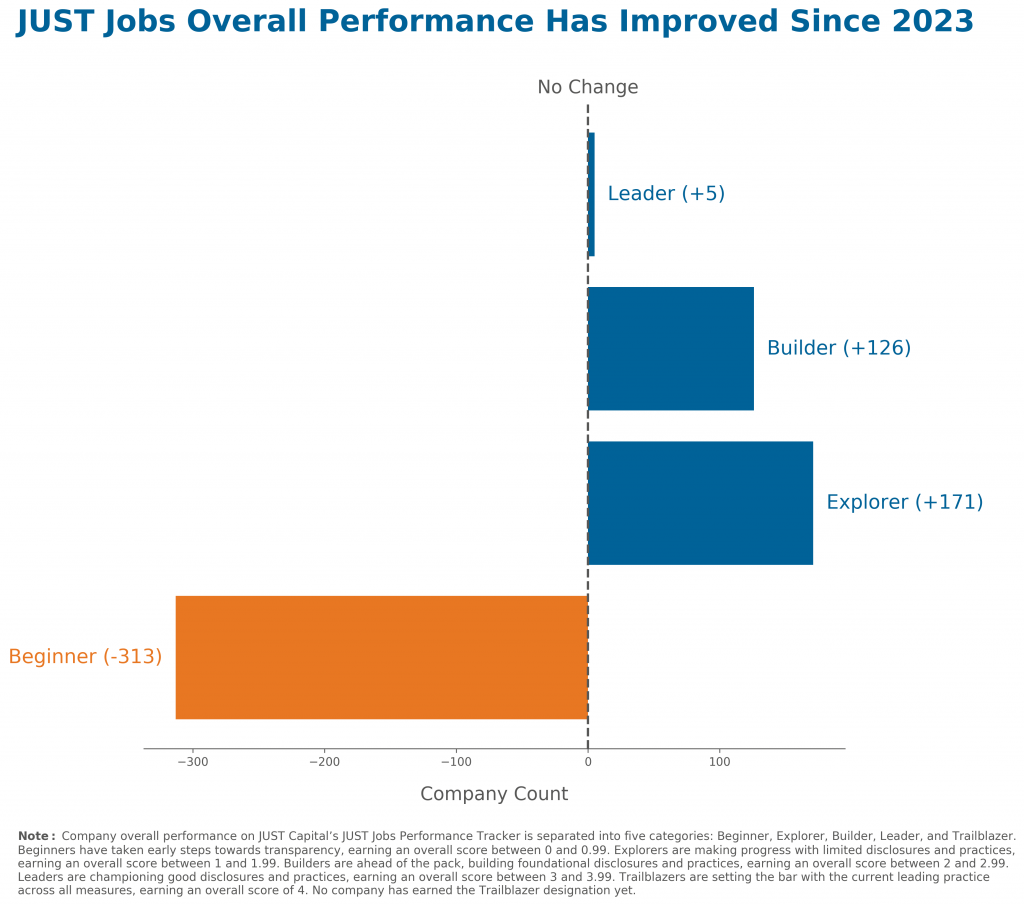
Notably, the proportion of companies earning the lowest possible score (0.00) decreased for every topic, indicating attention to disclosure across key job categories.
And disclosure rates in the tracker increased between 2024 and 2025 for almost all data points. The following saw some of the more notable jumps, indicating an increased focus on building a robust talent pipeline:
Pressure around non-financial reporting has become even more complex between 2024 and 2025. So far, in 2025, our ongoing tracking of key disclosures – including workforce policies – indicates that company impact report releases are down by 27% compared to this time last year. It is too early to say whether this is a delay or a retreat. While company leaders have told us they are being more cautious about how and when they communicate their stakeholder efforts in today’s environment, the work continues internally. Corporate leaders tell us they’re being more strategic about tying every initiative directly to business value and managing legal risks. We expect to have clearer visibility on how this context impacts disclosure trends by Q4.
This business-based caution stands in contrast to our understanding of public demand for transparency. Our survey work finds increased support year over year for disclosure across all categories – including minimum wage and average wage for different worker demographic groups. Meanwhile, the American public ranked “Communicates transparently” as the #4 priority issue for business behavior in 2024, followed by “Provides benefits and work life balance” and “Supports workforce advancement and training”.
Representation of overall Just Jobs leadership across industries demonstrates a continued investment in job quality and disclosure across the U.S. workforce.
Consistent with 2024, the Just Jobs Leaders each represent a different industry with a range in workforce compositions:
Three companies were just shy of reaching the overall average score required to be named an overall JUST Jobs Leader, but still outperformed their peers:
Company disclosure tends to lag across industries on all but a few Wages & Compensation metrics. With wage-related issues as the American public’s top priority, especially amidst rising cost of living, this provides an area in which companies can take advantage of an existing transparency gap and emphasize their employee value proposition.
Additionally, while companies are sharpening their benefits policies and improving offerings for employees, few in the JUST Jobs Performance Tracker are providing what experts and company examples indicate is leading practice. By investing in comprehensive benefits and transparent communication, companies can stand out in meeting the expectations of the American workforce.
A few key policies with wide-ranging public support have relatively low disclosure, and indicate where companies looking to demonstrate leadership can differentiate themselves through disclosure of existing policies:
The transparency gaps and opportunities outlined above reflect a broader shift in the American employment landscape, one that has significant implications for the current administration’s domestic job creation goals. While the administration has prioritized reshoring manufacturing jobs and creating employment opportunities domestically, our polling reveals that Americans aren’t simply seeking any employment — they’re searching for quality positions that offer genuine value and security.
Manufacturing — a focal point in the administration’s job creation strategy — presents a mixed picture of job quality in the JUST Jobs Performance Tracker. Key manufacturing industries such as Aerospace & Defense, Automobile & Parts, Energy Equipment & Services, Semiconductors & Equipment, and Utilities show a wide range in performance across core job quality metrics.
While these industries tend to score well on Training & Development and Employee Wellness & Belonging, they lag on Wages & Compensation and Benefits — two areas workers consistently rank as top priorities. Even within lower-performing topics, variation exists: Energy Equipment & Services’s top Wages and Benefits scores are among the lowest across all industries on both compensation-related topics, whereas Utilities performs relatively well on Wages & Compensation, and Semiconductors & Equipment is strong on Benefits.
Utility companies may offer a positive blueprint for building JUST Jobs among a domestic workforce. Although there is significant room for improvement on key job quality practices and disclosures, Utilities led all 36 industries in the Just Capital universe with the highest average overall score. American Water Works achieved Just Jobs Leadership designation, leading the industry in Training & Development and Employee Wellness & Belonging. Another domestic utility company American Electric Power is top in the Utilities industry on Wages & Compensations and discloses key benefits including paid parental leave, sick leave, and paid time off.
Axios and Harris Poll’s 2025 reputation rankings landed this week, concluding that prices – not politics – are now driving corporate reputations.
This finding resonates with our own research. In 2024, we saw significant amounts of alignment across demographics. For the first time in our polling history, we saw fair pricing – which respondents describe as “pricing in line with … value and quality” and companies avoiding “price gouging or excessive price increases” – emerge as a significant bipartisan issue. Interestingly, of the 2025 JUST 100 companies included in the Axios/Harris Poll rankings, the coverage is even; nine are classified as non-partisan, three lean “blue” and two lean “red”.
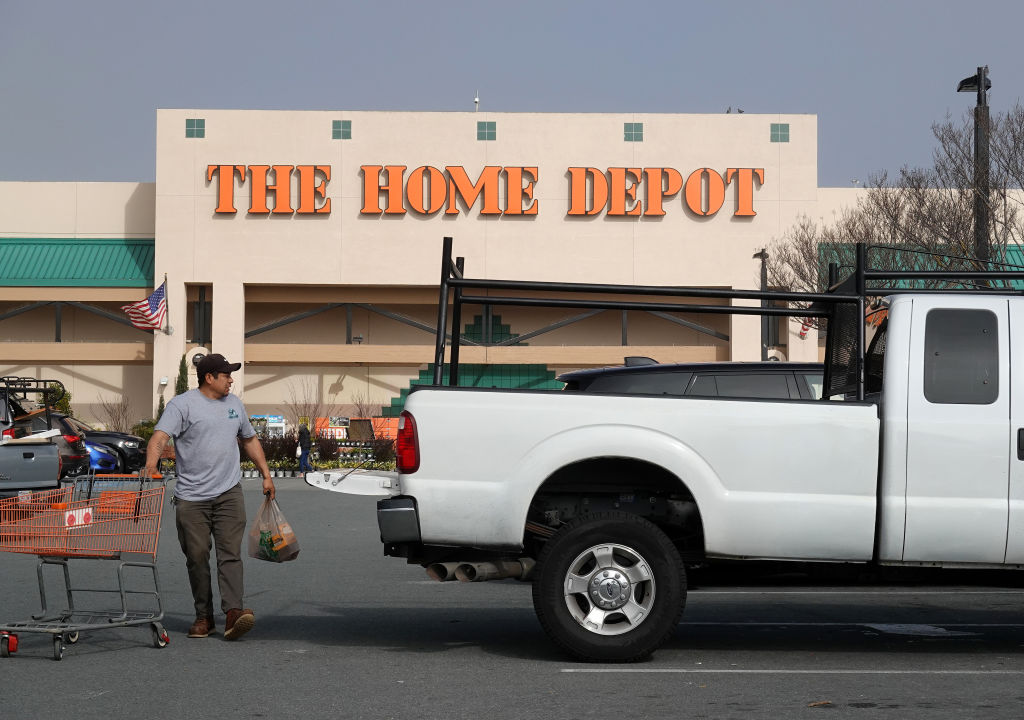
Given today’s cost of living, this should not be surprising, and companies are already responding to the call. Home Depot recently announced they are not planning to raise prices due to tariffs, but shared that some products may no longer be available as a result. During recent egg shortages, Trader Joe’s – the top company on Axios and Harris Poll’s list – was able to keep prices low by working directly with suppliers and focusing on product selection.
Serving customers through greater transparency and fairness is also very much in line with financial performance. Updating our figure from last week – as of May 27, 2025 our Customer Index has outperformed the Russell 1000 Equal Weighted benchmark by 4% since inception in December 2021.
When companies master the basics of treating people fairly, offering good value products and serving all stakeholders, Americans are ready to reward them, regardless of politics.
Be well,
Martin

“Don’t waste a good crisis. My most favorite leadership roles are ones that I’ve been leading through transformational change and market volatility.”
Mashable reports that the congressional budget bill has a special provision that would ban states from regulating AI for the next decade.
Fortune discusses the claim from a current LinkedIn exec that AI is already starting to “break the first rung” on young peoples’ career ladder, with many companies automating much of the work that new graduates did to break into tech, law, and other professions.
Meanwhile, the New York Post highlights how much of Gen-Z is pivoting to trade work amid AI uncertainty and the extreme rising cost of college.
Axios sits down with Anthropic CEO Dario Amodei who says we’re not taking the job loss implications seriously enough, and there is a possibility that AI wipes out “half of all entry level jobs.”
Debates continue over two versions of a “no taxes on tips” bill up for votes in Congress. The Washington Post shares concerns that this change would encourage restaurants to keep base wages artificially low. Vox concurs, saying that “tipped workers need a raise, not a tax break.”
When it comes to overtime, legal firm Jackson Lewis sees the potential for employers to “restructure compensation to provide employees more take-home pay without incurring higher payroll costs by reducing pay for non-overtime hours and permitting more overtime work that is tax-free — a win for employers and employees.”
Fox News released an op-ed stating that no taxes on overtime is actually the far more important bill with a greater impact for working people, despite receiving less press.
Pew’s latest polling shows support for stricter environmental regulations outweighs opposition in a majority of states.
As layoffs across tech continue, Meta announces plans to rate more employees “below expectations” to make culling easier.
Despite rolling back many Covid-era perks for their employees, The Financial Times seems to think that Covid-era benefits bestowed on C-suites are here to stay.

Axios reveals new data that shows that 77% of Americans think companies are moving too quickly on AI, and would prefer delaying breakthroughs to avoid potential catastrophic mistakes.
