
Recent research on public attitudes toward AI reflect a rising level of unease and concern about the technology and its potential impacts on the workforce, relationships, and education. A closer look at public priorities suggests the views of the public are more nuanced than other polls may indicate and the path forward for AI-focused corporate leaders is clearer than overall sentiment polling implies.
In March 2026, Just Capital prompted the American public to prioritize AI-related issues rather than measure general sentiment. The results reveal that public support for AI is not absent but conditional: it depends on whether companies can demonstrate how they are managing risk responsibly while delivering on AI’s greatest potential to improve society. An early review of corporate disclosure suggests most companies have not yet made that case clearly or consistently.
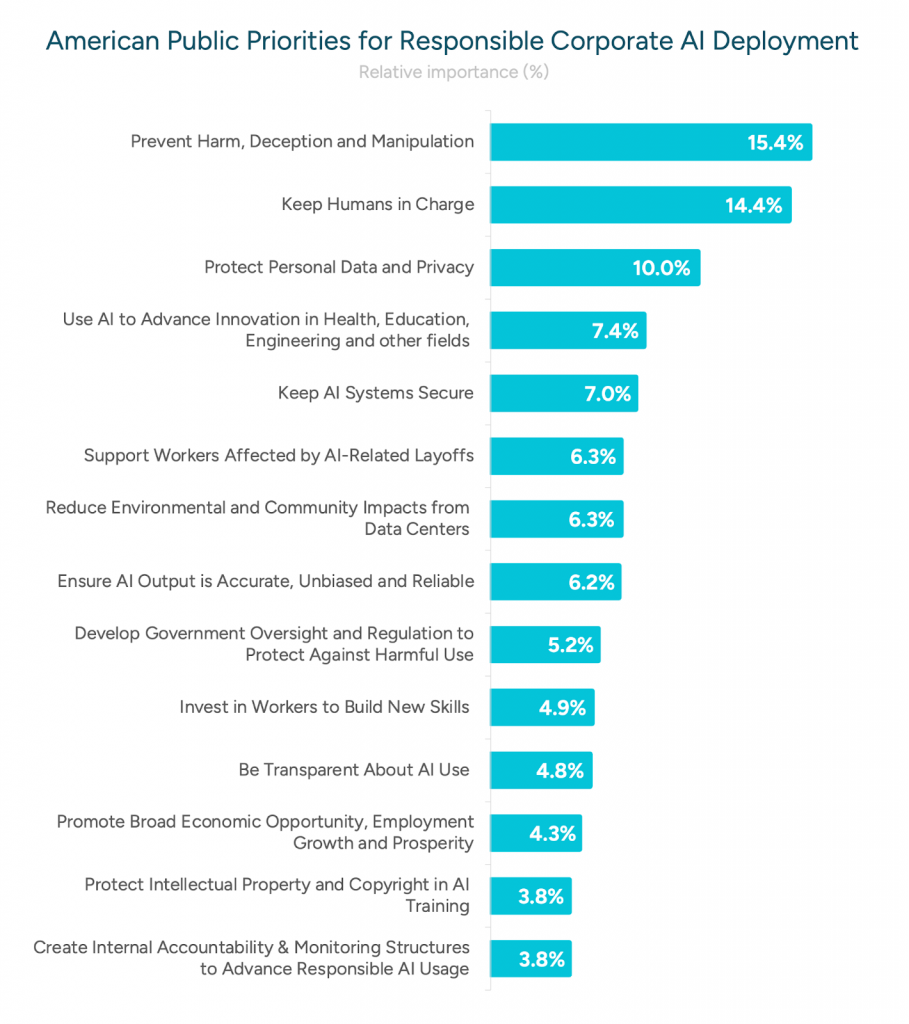
When asked to rank priorities rather than express general views, Americans reveal a more balanced perspective than headline sentiment polls suggest. They highly prioritize the use of AI to advance innovations in health, education, and engineering to solve complex societal problems, even ranking this above concerns around workforce disruption and environmental impacts.
At the same time, the three highest-ranked priorities are focused on safety concerns: preventing harm, deception, and manipulation; keeping humans in charge; and protecting personal data and privacy. This suggests public support would be bolstered by companies articulating the guardrails around the technology. Americans are watching to see whether companies can deploy AI responsibly.
We reviewed AI-related disclosures at six hyperscalers and 104 additional companies that rank highly in the organization’s measure of overall responsible business practices. Even among these 110 companies, most with strong disclosure track records across workforce, community, environment, customer, and governance issues, AI-related reporting is inconsistent and lacks common definition.
Two of six hyperscalers publish dedicated AI Transparency Reports. Fifty percent of companies disclose board-level involvement in AI risk oversight, but just 37% of the 110 companies analyzed disclose responsible AI principles or guidelines. Among those that do, disclosure is uneven on the issues Americans rank highest: only 16 companies mention preventing harm, deception, and manipulation; 27 mention human oversight; and 37 mention customer privacy and data protection.
Across Just Capital’s broader analysis of 933 public American companies, the picture is even less clear. The share of companies committing to not selling user data in any context dropped 3.5% year over year, and 3% fewer companies commit to not using user data for advertising. The average number of employee training hours fell from 24.34 per employee in 2024 to 21.96 in 2025, despite calls for more AI-focused training and reskilling opportunities. Among the smaller group of 110 companies analyzed further, 39 disclose formal AI training programs for employees.
As companies accelerate AI deployment, clearly and consistently defining responsible AI development and deployment will be a meaningful point of distinction for the American public. This analysis suggests the public will be more likely to extend trust to companies that demonstrate they are using AI to deliver genuine social benefit while protecting people from the greatest risks.
The full list of public priorities identified by Just Capital is below. These priorities are being translated into trackable metrics for ongoing analysis.
Methodology
Just Capital regularly conducts independent surveys to track Americans’ priorities, values, and expectations for corporate behavior, which serve as a foundational input into its Just Intelligence tool, rankings, and research products. Priorities weights were determined via maximum-differential (Max-Diff) to quantify the relative importance of each of the AI-related issue statements.
This survey was conducted online within the United States by Just Capital from March 12–16, 2026 among 2,012 U.S. adults ages 18 and older. Data from this survey have been weighted to align with known population parameters from the U.S. Census Bureau on key characteristics including [age, gender, geography, etc.]. While weighting adjusts for demographic imbalances, this survey is based on a non-probability sample and therefore no estimate of theoretical sampling error can be calculated. Findings should be interpreted accordingly.
New York, NY, March 17, 2026 – Today, in partnership with CNBC, we are announcing our 2026 Rankings of America’s largest public companies. Now in their 10th year, the Rankings celebrate companies for their performance on the issues that matter most to the American people, such as paying a fair, living wage; supporting worker well-being, advancement, and training; communicating transparently; and acting ethically at the leadership level.
The 2026 Rankings showcase responsible business leadership across 20 industries. As AI and other transformative technologies reshape the economy, business leaders require precise, decision-grade data to weigh tradeoffs, manage risk, and plan for the future. In service of this, ranked companies can now explore their performance in-depth through Just Capital’s flagship Just Intelligence product. The platform has been updated to include an AI-enabled chatbot, currently in beta, which allows users to pose queries that draw on Just Capital’s robust corporate performance database and business case library.
This year, Just Capital is proud to celebrate 21 companies with Industry Leader designations. View them below, and explore the Rankings here.
Automobiles & Parts: Lear Corporation
Banks: M&T Bank Corp
Basic Resources: Freeport-McMoRan Inc
Chemicals: Ecolab Inc
Construction & Materials: Trane Technologies
Consumer Products & Services: Nike Inc
Energy: Marathon Petroleum Corp
Financial Services: S&P Global Inc
Food, Beverage & Tobacco: The Hershey Company
Health Care: The Cigna Group
Industrial Goods & Services: Union Pacific Corp
Insurance: The Hartford Insurance Group
Media: The Walt Disney Company
Personal Care, Drug & Grocery Stores: CVS Health Corporation
Real Estate: Zillow Group Inc
Retail: Lowe’s Companies, Inc.
Technology: HP Inc
Telecommunications: Ciena Corporation
Travel & Leisure: Starbucks Corporation
Utilities: Constellation Energy Corporation & Public Service Enterprise Group Inc
The 2026 Industry Leaders demonstrate common areas of strength across sectors including workforce investment, governance discipline, and environmental transparency. All Industry Leaders are ranked in the top 100 overall, and 16 of 21 improved their overall rank year-over-year
“At a time of great uncertainty, and with questions being asked about the future of capitalism, our Rankings are designed to celebrate American business at its best,” says Just Capital CEO Martin Whittaker. “This year’s Industry Leaders demonstrate that delivering value for shareholders, the economy, and society at large is not a trade-off, it’s a blueprint for success.”
Just Capital tracks the financial performance of the top performing companies in their analysis. The organization’s flagship index (JULCD) tracks the top 50% of performers across each industry and, as of March 10, 2026, has outperformed the Russell 1000 benchmark by 12.7% since inception in 2016. The Just 100 Index which tracks the top 100 overall performers has outperformed the Russell 1000 equal-weighted index by 55.6% since inception in 2019.
In February 2026, the organization released enhanced capabilities within its flagship Just Intelligence product. Just Intelligence supports strategic planning and decision-making by offering a comprehensive view of public expectations and sector realities, and by connecting those signals to core business outcomes. The platform is built on more than a decade of Just Capital’s public opinion research and corporate performance data, and surfaces areas of relative over- and under-performance across a company’s stakeholder ecosystem, including workers, customers, communities, environment, and shareholders.
Just Intelligence now includes a new AI-powered chatbot for users to understand and improve their company’s stakeholder performance in a more accessible and engaging manner. Users can pose queries in natural language to quickly surface actionable insights from Just Capital’s database of performance analysis and business case library. The chatbot is currently in beta and available to paid subscribers of Just Intelligence.
Since 2015, Just Capital has surveyed nearly 200,000 Americans on their priorities for just business behavior. The annual Rankings assess 933 of the largest publicly traded U.S. companies using a model grounded in the priorities of the American public. Companies are evaluated across 17 issues spanning workforce investment, customer trust, governance accountability, environmental performance, and community impact.
For the 2026 Rankings, Just Capital updated its industry classification to align with Industry Classification Benchmark (ICB) supersectors. This year the organization introduced new industry-specific data points and removed data points that were less relevant based on industry context. Many metrics continue to be evaluated across the full universe, ensuring comparability on cross-industry topics including broadly applicable governance and workforce practices.
Today, we welcome Douglas (Doug) Haynes to the Just Capital Board of Directors. Doug joins the board with decades of experience in asset management, consulting, and technology services. His full bio can be found below.
“Doug has been a longstanding partner and advisor to Just Capital and his deep understanding of what C-suite leaders need and value makes this the perfect moment to formalize his role,” says Just Capital CEO Martin Whittaker. “As we continue to grow as an organization, Doug’s perspective at the board level will be invaluable. Welcome Doug!”
Douglas D. Haynes
Douglas (Doug) Haynes is an experienced executive leader and entrepreneur in the asset management, consulting, and technology services industries.
Doug began his career as a software developer for the Central Intelligence Agency then became a design engineer and marketing professional for GE Plastics before earning his MBA.
In 1992, Doug joined McKinsey & Company where he helped build the firm’s practices in Operations and High Tech and served the leaders of several Fortune 100 corporations. He was a member of the Atlanta, London, Connecticut, and New York offices. Doug became a Senior Partner and led the Northeast Region of the US and Global Operations practices before retiring from the firm after 22 years.
Doug joined Steve Cohen’s hedge fund (SAC) in 2014 as an advisor, guided the founder through the transformation to Point72 Asset Management, then became the new firm’s first President. His four-year tenure featured outperformance of peer competitors, restoration of Cohen’s SEC license, launch of the firm’s venture capital arm and raising nearly $4.5bn in assets for the fund’s launch.
Doug is an active board member and philanthropist for the causes of poverty-fighting and veterans’ support. He is a founding board member of the Cohen Veteran’s Network; a board member, Audit and Finance Committee chair, and Executive Committee member of the Robin Hood Foundation in New York; and board member and Finance Committee member of Camp Southern Ground in Georgia. He is also a founding board member of the Center for Global Enterprise. Doug has served as a board member and/or advisor to Singtel Corporation, the Darden Graduate School of Business, Cohen Veteran’s Bioscience, Villanova University, and the Canterbury School.
Doug graduated summa cum laude in mechanical engineering from West Virginia University and was a Shermet Scholar at the Darden Graduate School of Business. He is the author of a book on effective CEO leadership and six works of historical fiction. He and his wife, Laurice, live in Ridgefield, Connecticut.

Note: This op-ed was previously published by Fortune on February 19, 2026.
Today’s CEOs could be the most consequential corporate leaders in American history. The decisions they make will go a long way to determining whether the most powerful technologies ever developed strengthen the foundations of American capitalism or undermine them. It’s not an exaggeration to say the stability of the modern socio-economic system on which markets and business depend is at stake. Fortunately, executives have access to greater magnitudes of data and computing power than ever before in order to get this transition right.
Two realities define the leadership challenge ahead. First, company leaders know they have no choice but to embrace new technologies fully, at speed and with unprecedented levels of investment in order to remain competitive. Second, they understand that the transition to an AI-powered economy will reverberate widely, reshaping jobs, income models, communities, and the role of business in society in ways that are very difficult to predict. We’re already seeing the decoupling of economic growth and labor outcomes begin to play out. What happens if the value of labor drops to effectively zero?
Technological disruptions have happened throughout history. The problem is that this time it is unfolding faster, on a grander scale, and with greater implications, than any before. Whereas previous technological leaps forward were measured in years, with agentic AI, automation, quantum computing, and humanoid robotics, the adaptation time has been compressed to months. This gives leaders little time to experiment, adjust, and course-correct. If they are perceived as being behind the curve or investing incorrectly, the consequences are swift and severe. For society, and those who govern, the transition is felt almost daily. When you have near zero adjustment time, it’s akin to flying blind.
The warning signs are visible in Just Capital’s research. In our latest polling, only 35% of Americans say the current form of capitalism is working for the average person. In our AI-specific surveys, 48% of the American public predict AI will replace workers and eliminate many jobs and a majority is most worried about AI’s impact on social stability and safety.
From my frequent conversations with global business leaders, they are acutely aware of the challenge. Concerns for the future of capitalism continue and recently, executives debated whether the greater threat to the economy and society is artificial intelligence or the continued concentration of wealth and opportunity.
No one is arguing against the need for technological progress. Breakthroughs in healthcare, education, productivity gains, and innovations we cannot yet imagine are now closer than ever. Some predict all of that may in fact create new jobs; others foresee a “blood bath”. Capturing the benefits of transformation while preserving broad participation in economic growth will take new approaches by leaders on how technology is deployed, how the gains and disruptions are managed, and how companies are structured and run.
Forward-thinking business leaders understand that at its core, our capitalist system is built on the shared belief that economic growth creates opportunity, that effort and participation are rewarded over time, and that when businesses create value for all their stakeholders, they thrive financially and competitively.
Putting this into practice is the trick. The era of stakeholder management defined by broad frameworks, generalized commitments, and aspirational language is over. For too many, stakeholder considerations became a compliance exercise that proved to be too imprecise to guide real tradeoffs, withstand scrutiny, or serve as a source of genuine strategic insight.
Today’s hyper-competitive business environment necessitates the opposite: precise, decision-grade data and intelligence rigorous enough to help leaders make higher-confidence choices about strategic planning, capital allocation, workforce design, community engagement, and technology deployment in real time. And all on a company-specific basis. A retailer trying to balance customer satisfaction, supply chain automation, and a frontline workforce has very different priorities than a software company competing for top AI talent while trying to evaluate their footprint on communities.
Understanding the causal relationships between stakeholder investments and core business outputs is central to this. Mapping performance against peers and best practices, identifying areas where operational or reputational risks may be lurking, and pinpointing unseen organizational strengths that can be maintained, elevated, and leveraged are also vital.
Above all, leaders must clearly understand how specific investments in talent, consumer engagement, community resilience, and environmental stewardship translate into total returns. That clarity will drive both business success and societal value creation. While AI raises the stakes for this work, it also makes it possible.
The future of American business and that of its people are inexorably intertwined. As the country approaches the 250th anniversary of its founding, it feels like the next three years will shape the next 3 generations at least.
Organization Unveils Second Generation Platform and New Brand Identity to Help Business Leaders Deliver Value for Shareholders, Economy, and Society
NEW YORK, NY February 17, 2026 – Just Capital, the foremost independent organization advancing responsible business leadership, announced the culmination of its strategic transformation into a stakeholder-focused data and insights platform. Building on more than a decade of impact, the organization released an updated version of its flagship Just Intelligence product, alongside a new brand identity, logo, and website, to serve as an objective partner to companies as they shape outcomes for their business, workers, communities, and the economy and society at large.
“Just Capital’s evolution was driven by the conviction that the decisions leaders make today will define business and societal outcomes for decades to come,” said Martin Whittaker, Chief Executive Officer of Just Capital. “We have enhanced our capabilities to help companies optimize their stakeholder investments through independent and comprehensive insights in service of their ability to compete and win in a changing marketplace. Our vision is an economy where business success and shared prosperity move forward together.”
Just Capital has launched upgraded functionality and performance data within Just Intelligence. Just Intelligence supports strategic planning and decision-making by offering a comprehensive view of public expectations, sector realities, and stakeholder performance, and by connecting those signals to core business outcomes. The platform is built on Just Capital’s decade of public opinion research and corporate performance data, and it surfaces areas of relative over- and under-performance across a company’s stakeholder ecosystem, including workers, customers, communities, environment, and shareholders. New features include:
These capabilities help leaders identify which stakeholder investments have the power to drive long-term business performance, enabling them to create value that compounds beyond their firm to benefit shareholders, the economy, and society at large.
“At a time where looking around corners has never been more important, Just Intelligence offers insights leaders can use in moments of complexity to evaluate real tradeoffs across growth, risk, technology, and societal expectations,” said Whittaker. “Our goal is to help leaders navigate those tradeoffs with clarity and confidence.”
Just Capital’s transformation was informed by a review process including direct engagement with CEOs, C-suite leaders, and board members of some of America’s most influential companies. Five Fortune 500 companies are vanguard users of the paid product, helping to shape the platform’s evolution ahead of broader market rollout and adoption. Just Intelligence and the platform’s ongoing enhancements are grounded in feedback from a beta period with 250+ corporate users and interviews with more than 45 business leaders on the user experience, value proposition, and industry relevance.
Russell 1000 companies have access to the Performance Explorer tool with select stakeholder indicators available. Subscribers can access full metrics, Peer Comparison, and Leading Practice capabilities. The platform and its features will be updated on an ongoing basis.
Just Capital’s refreshed visual identity marks the evolution of the organization from an external evaluator to a performance partner. The new website and tools within Just Intelligence are built to support forward-looking decision-making rather than retrospective assessments of past performance. Just Capital’s annual Rankings will continue to serve as a tool to showcase performance and insights to inform responsible business leadership. The 2026 Rankings will be announced in March 2026.
In Fall 2025, Just Capital launched its inaugural research from surveys of corporate leaders, investors, and the American public on responsible AI deployment. The organization will conduct quarterly pulse surveys through 2026 and beyond, providing ongoing insights for corporate leaders, investors, and policy makers as perspectives continue to evolve. AI-focused insights will feed into Just Intelligence in 2026.
As part of this strategic focus, the Corporate Impact Lab has begun the process of becoming an independent organization. Just Capital has been proud to incubate the Corporate Impact Lab since its inception in 2022. In 2026, the Corporate Impact Lab will be fiscally sponsored by Just Capital and operate independently. Both organizations share the mutual goal of the Corporate Impact Lab becoming a fully independent organization in 2026, subject to the completion of necessary regulatory, legal, and other administrative requirements.
Just Capital is the foremost independent organization advancing responsible business leadership. We translate insights from public polling, performance data, and financial analysis into actionable intelligence leaders can use to drive long-term business success and shared prosperity for people across America. Our flagship product Just Intelligence is designed to offer a comprehensive view of public expectations, stakeholder performance, and sector realities in order to drive responsible decision-making. When companies make better decisions, they can create lasting value for shareholders, contribute to stronger communities, and help drive broader economic and societal progress. For more information, visit justcapital.com.
For media inquiries, please contact:
Tyler Spalding: tspalding@justcapital.com

Yesterday, I shared a Q&A I recently had with Steve Beard on LinkedIn. Steve is CEO of Covista, which recently completed a transformation into America’s largest healthcare educator. It’s a fascinating story that got me thinking more broadly about what distinguishes leaders who successfully navigate profound transformation. The news that Enrique Lores has been named CEO of PayPal and The HOW Institute’s annual release of their State of Moral Leadership in Business report added more food for thought on this increasingly critical topic.
Enrique received our inaugural JUST Capital Lifetime Achievement Award last year for his exceptional leadership at HP Inc. During his tenure, he guided the company through a fundamental strategic transformation while consistently investing in workers, customers, and communities. I have confidence he’ll do the same at PayPal.
What do Steve and Enrique have in common? Both understand that transformation and stakeholder investment aren’t competing priorities, they’re mutually reinforcing.
Covista sits at the intersection of workforce, health, education, and technology. When I asked about Covista Open Doors, their new initiative to expand access to healthcare careers, Steve went straight to the heart of it. “We train and develop the folks that care for all of us,” he told me. “And we’ve got an opportunity that we believe is too good and too important to pass up.”
Enrique operated with the same philosophy at HP. At our flagship Best of American Business event last year he shared his conviction that “…business success and social responsibility are not separate pursuits. They are deeply connected.”
Both leaders also embody authentic leadership grounded in personal experience. Steve, a first-generation college graduate, told me that creating opportunity for historically excluded populations is simply part of who he is. Enrique started at HP as an intern nearly four decades ago, inspiring his commitment to workforce advancement and long-view leadership.
The HOW Institute report demonstrates how rare this kind of human, stakeholder-first leadership may be but also how vital it is to the process of transformation.
Be well,
Martin
The New York Times surveyed prominent technologists, economists, and philosophers and found deep disagreement over whether AI will ultimately expand opportunity or accelerate inequality. They also put out a separate opinion piece featuring three economists debating the impact AI is already having on the economy.
Fortune reports that Citigroup CEO Jane Fraser is pushing an employee training initiative across the organization to reskill their workforce with AI tools before automation reshapes people’s roles.
Axios examines why employees aren’t buying the hype for AI the same way their employers are.
The Washington Post reports a widening labor gap as demand for electricians, plumbers, and skilled trades grows while white-collar hiring slows..
Fortune finds more employers abandoning performance-based raises in favor of flat, across-the-board increases — a move meant to more broadly retain workers.
Bloomberg reveals that CEOs are increasingly anxious about economic slowdown, geopolitical instability, AI backlash, and workforce morale with fewer leaders confident they can manage multiple risks at once.
HR Dive highlights new research showing that replacing an employee now costs employers more than $45,000 on average, strengthening the business case for retention.
The Wall Street Journal reports that The Washington Post is laying off about one third of its workforce as digital subscription growth slows and legacy media companies continue to struggle with advertising and audience fragmentation.

A KFF Health Tracking Poll finds health care costs, expiring ACA tax credits, and insurance affordability are top voter concerns, particularly with many companies having to alter their health benefits due to rising prices.
