Workers today value professional growth opportunities that can help broaden their skills and ultimately advance their careers. We know this from our 2019 survey, which asks the American public what matters most when it comes to business practices today.
Successful career development programs can certainly help workers achieve their career goals, and they can also pay off significantly for the companies that offer them. They increase employee retention and engagement, improve overall company branding, aid long-term workforce succession planning, and help to fill internal skills gaps.
However, “successful” is the operative word here. Many companies don’t successfully pull off career development initiatives. A recent Gallup survey, for example, found that while 66% of managers participate in a professional development program, most still don’t see a clear career path for themselves or how such programs are benefiting them.
Another recent survey from Harvard Business Publishing Corporate Learning found that nearly half of all workers surveyed are dissatisfied with their employer’s learning and development programs.
So, what puts one career development program above the rest? The reality is that exactly what constitutes a great career development program will differ from employer to employer, but the most successful ones adopt most or all of these seven basic qualities.
Leaders often create career development initiatives around what they need to build a talented workforce, but they overlook employees’ needs and goals. If employees’ goals aren’t factored in, the program won’t be successful.
Companies that do it right ask employees for input on what type of career growth and training opportunities they would benefit from and appreciate the most — and then tailor their policy to those findings. This can be done through employee surveys or even on a more personalized level.
HubSpot — which scored very well for providing workers with skills training and opportunities for career development in our 2020 Rankings — has garnered a reputation for listening to its employees’ development needs while also providing professional growth opportunities targeted at different jobs.
Among many programs, the software company offers everything from an online course platform to small-group manager discussions (Think Spaces) to its annual HubSpot Fellows “mini-MBA” program in which HubSpot executives and Harvard Business School professors deliver a four-day course to “high-potential” employees on topics ranging from high-stakes decision making to leading with empathy.
The most effective programs are those that are designed to fit the various skills and long-term career needs of employees. And that generally means taking a multifaceted approach — because no two employees are the same.
DocuSign, which is the number one company for career development in our 2020 Rankings, offers a full range of career development opportunities tailored to individuals, including internal mentorships, internships, job rotation — so employees can learn about other roles and departments — and training courses.
DocuSign’s mentoring program has been so successful among women in particular that in 2017, the company introduced “speed mentoring” events for female employees.
Our FREE weekly newsletter about the future of capitalism and the movement to build a more equitable marketplace in America.
A career development program won’t be very effective unless employees 1) know it exists and 2) are encouraged to take part. This means knowing that their manager will let them take time to, say, attend an online training session or shadow another employee.
Employees are much less likely to seek a degree that could help their career growth if they worry their boss will be suspicious of their future intentions.
Thus, companies that actively promote their training and other career development opportunities to employees are likely to see the most participation — and, in turn, positive impact.
Salesforce’s Trailhead program, for example, is an online training course that is used both to onboard new employees as well as provide various types of training throughout their careers at the company. Salesforce not only encourages all of its own employees to use it, but the company also makes it available to other companies looking to train their staff on Salesforce usage.
The reality is that employers can only provide so much training and experience internally. To provide employees with the most cutting-edge skills or the certification or degree that will equip them with the right credentials and knowledge, companies typically must provide employees with training from an external organization, whether a university, local technical college, or even professional membership group.
The most forward-thinking employers today offer their workers some degree of tuition reimbursement or student loan repayment assistance benefits.
Synchrony Financial, for example, offers full-time employees up to $20,000 per year in tuition reimbursement and part-timers $5,000 per year. Since 2015, more than 900 Synchrony employees have participated in the program.
Adobe’s Learning Fund will reimburse employees up to $10,000 per year for tuition and books for courses and degree programs that meet the company’s eligibility criteria. Employees can also get up to $1,000 annually for short-term learning and skill development opportunities, such as conferences, workshops, and training courses.
Smart companies are always staying one step ahead — and that goes for internal development as well. They forecast what skills their workforce will need in the future and work on building those skills today.
One example: Investment and insurance company The Hartford has taken a proactive approach to reskilling its workforce for the future by introducing HartCode, a program that provides non-developer employees with the skills and training needed to become junior developers on its IT team.
The assumption that only the most junior employees — or those still in early or middle stages of their career — want training and development isn’t true. In fact, an AARP survey found that more than eight out of 10 employees ages 45 to 64 want the opportunity to learn something new on the job.
Companies that want to keep all of their employees satisfied need to acknowledge that every employee can benefit from training and feeling like their workplace is helping them grow.
AT&T is one company that promotes continuous learning among even its most veteran employees. The telecom giant has encouraged employees of all ages to take online courses on technology-focused topics such as Big Data and virtual technologies.
One common problem is that leaders don’t have a handle on the effectiveness of their company’s career development program, because they don’t track it closely enough.
Companies currently report things like the number of people who participated in training programs, the average amount spent on each employee, or the average amount spent on career development. While these stats are a start to understanding utilization, understanding performance requires tracking how people progress at an organization and whether the skills they’ve garnered through the program have benefitted them and been useful.
Air Products, which offers a variety of online learning courses, provided employees with an average of 32 hours of training in 2016. But more importantly, an analysis found that the training led to a 19.2% improvement in job performance and that 85.7% of employees used the new skills they learned within one month.
To stay up to date on all the latest shifts companies are making to support their workers, customers, the environment, and more, sign up for our free weekly newsletter, The JUST Report, today!
In today’s tight labor market, companies are facing high turnover and fierce competition. Across industries, benefits like paid parental leave and career development are becoming more commonplace as companies work to attract and retain talent, as well as reskill employees for an increasingly automated workplace.
Employers are investing in their workers in new and significant ways, and in recent years, more companies are offering tuition reimbursement and other education assistance programs. And with about 60% of the entire civilian labor force without a Bachelor’s degree as of 2018, this offering has the potential to transform the lives of workers across the U.S.
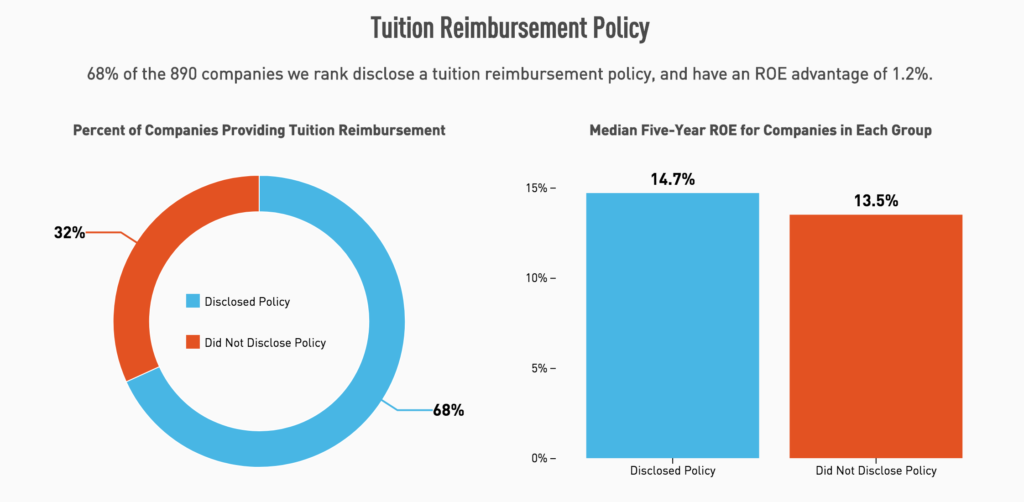
According to our recent JUST Jobs analysis on company disclosure related to nine key worker issues, about two-thirds of the largest, publicly traded U.S. companies offer tuition reimbursement to their employees. And, good news – those disclosing a tuition reimbursement policy also generate an ROE advantage 1.2 percentage points higher than their peers.
While the majority of companies offer tuition reimbursement to their employees, this benefit might not always reach the workers who really need it – like those on the front lines of traditionally lower wage industries such as retail and restaurants. In 2018, 86% of workers earning at or below the federal minimum wage did not have a Bachelor’s degree – typically an entrance requirement for higher paying jobs.
In these industries, we’ve found that, interestingly, higher proportions of companies offer tuition reimbursement – with 78% of Food & Drug Retailers and 73% of Restaurants & Leisure companies disclosing tuition reimbursement (while Retail lags behind at 59%).
However, tuition reimbursement might not ultimately reach the cashiers, servers, call center workers, and store associates earning lower wages on the front lines. Companies like Macy’s, Domino’s, and Dunkin’ Brands offer education assistance only to their corporate staff, excluding front-line workers and hourly associates. Arguably, front-line workers could benefit significantly from tuition reimbursement, gaining access to higher wages and greater economic mobility.
Still, there is a handful of leaders – including Walmart, Starbucks, and H&R Block – ensuring that tuition reimbursement is available to all workers, extending the benefit beyond its headquarters, salaried, and corporate staff. The restaurant industry, especially – faced with the highest quit rates since 2001 – has stepped up to provide better benefits and career opportunities to its workers. Last year, for example, McDonald’s announced an initiative – following its windfall from the Tax Cut & Jobs Act – that it would allocate $150 million over five years toward providing almost 400,000 U.S. restaurant employees with accessibility to its education program.
Companies that invest in the education of their workforce are likely to see employees stay longer and move into senior positions more frequently. And as corporate America moves toward automation and the future of work, employers are seeking out more skilled employees. By investing in education, companies can foster the skills they need in their own workforce, focusing on retention and alleviating the high costs of replacing or hiring workers.
With our research showing that tuition reimbursement correlates with a return on investment, it’s clear that programs like this can create a win-win for companies and employees alike – both upskilling workers and improving the bottom line. And for companies in low wage industries especially, investments in better benefits and higher wages have the potential to influence not only their workers’ well-being and their company’s performance, but the overall course of income inequality in our country.
In the coming year, we will continue to track what companies offer around this and other core worker benefits – in an effort to better understand both the state of just business behavior and its impact on American workers today.
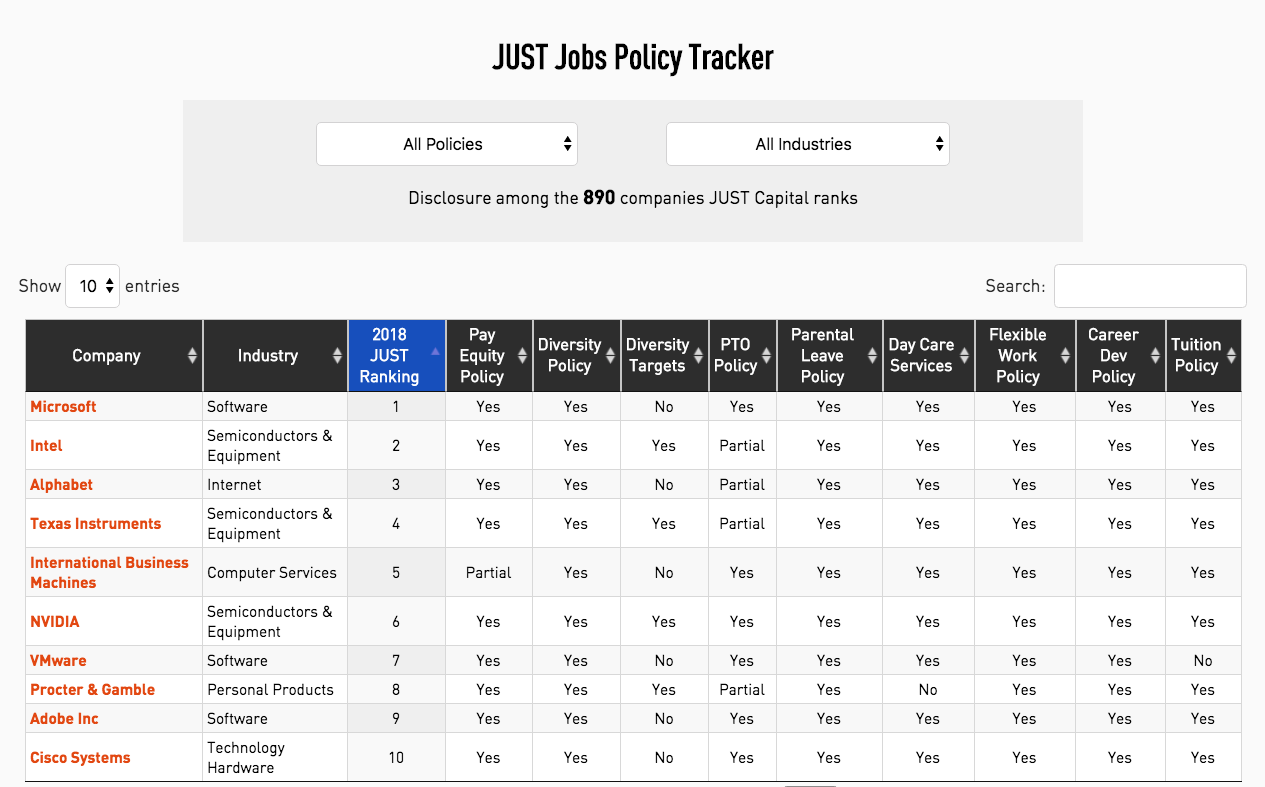
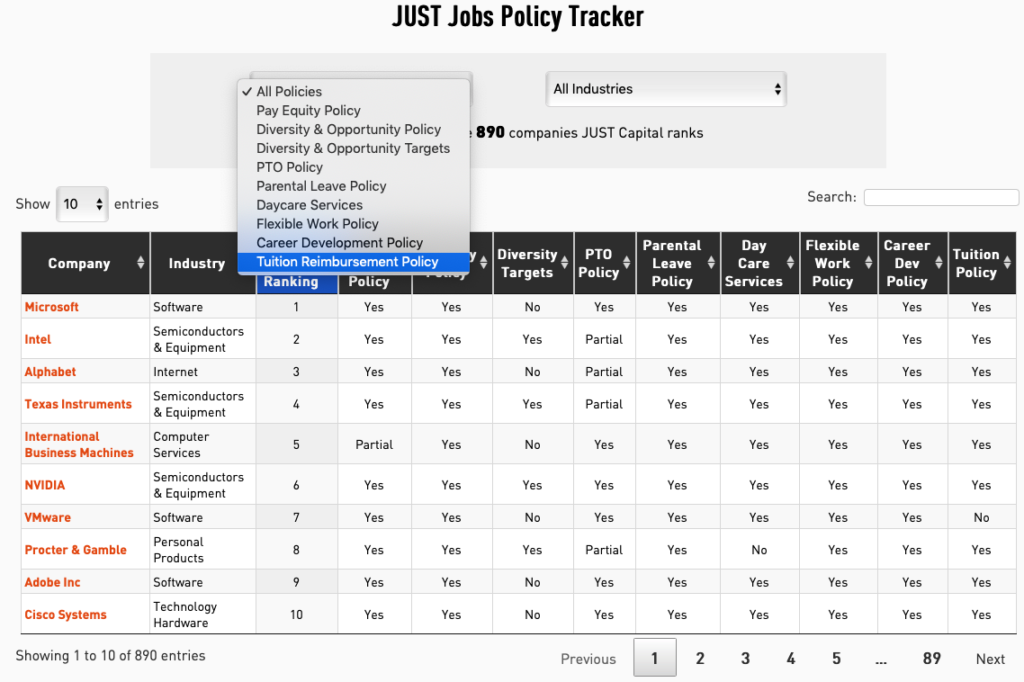
To explore the data and links to all the relevant policies at the 890 companies we analyze, visit the JUST Jobs Policy Tracker, and select “Tuition Reimbursement” from the pull down menu.
Last week, Amazon announced that it would launch a massive new retraining program, committing $700 million over six years toward retraining about a third of its staff – from headquarters staff to warehouse workers – to transition to more high-tech jobs.
Globally, companies spend over $200 billion annually on training programs, with about $141 billion of that coming from U.S. employers. Companies like JP Morgan Chase, AT&T, Walmart, and Accenture have all recently committed significant resources toward training initiatives. And we hope to continue to see more investments on this scale in the months and years to come.
While economists and policy-makers continue to debate the jobs impact of automation and A.I., it is clear that many business leaders are moving forward with plans to retrain their workforces and are encouraging others to do the same. IBM CEO Ginni Rommety, for example, has spoken out in the media and before Congress about the training needs that coincide with the rise of A.I., stating “our challenge as a society isn’t about A.I. replacing jobs—it’s about people and skills.”
For decades employers have utilized training programs to meet their workforce needs. Yet, as structures of work continue to change, and new technologies emerge companies face a renewed responsibility to ensure their workforces have access to training throughout their careers. These changes are fueling businesses’ adoption and expansion of long-standing training strategies, such as apprenticeships, across industries including the tech sector.
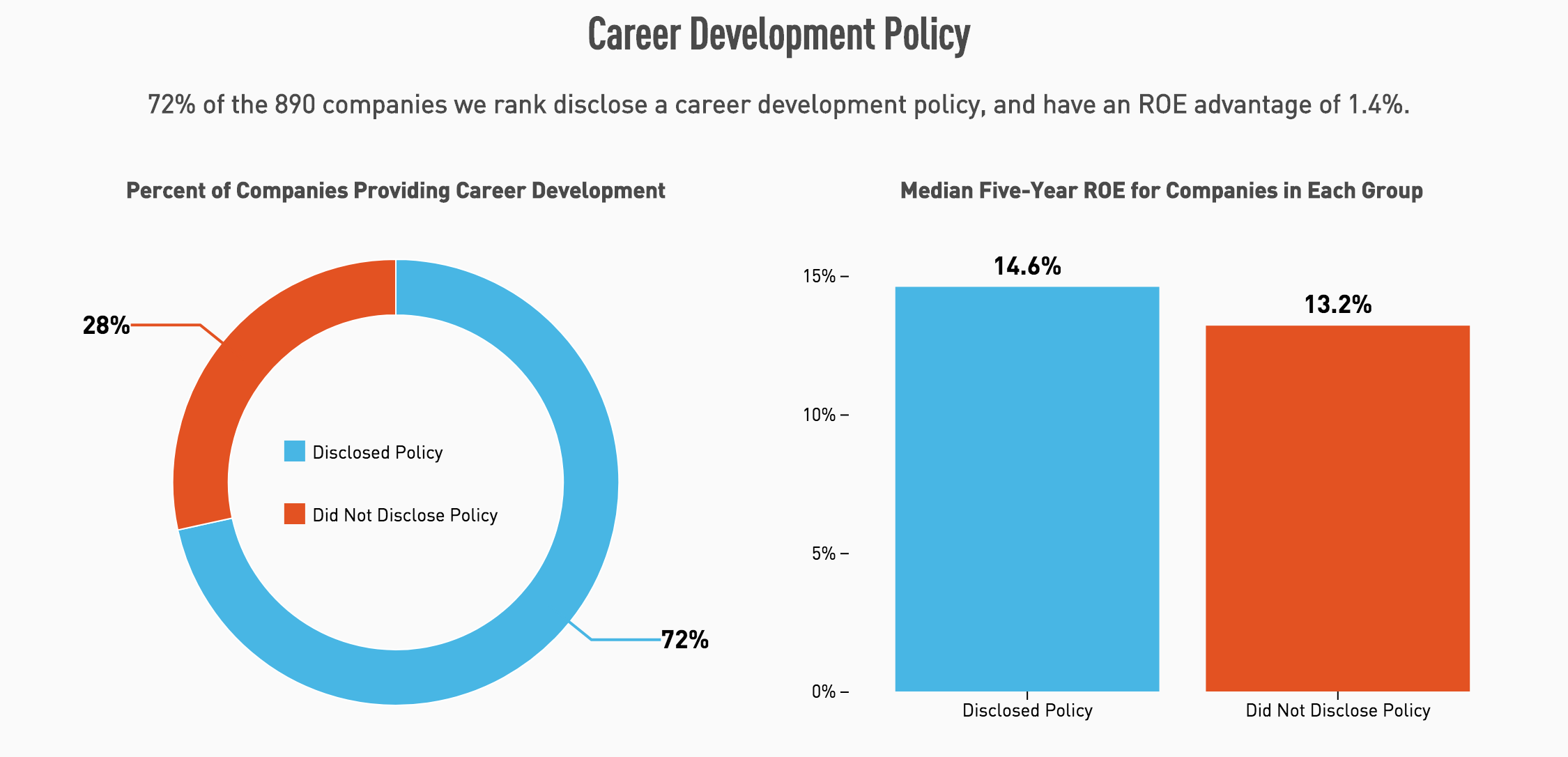
In our recent analysis of human capital disclosure at the largest, publicly traded U.S. companies – the Win-Win of JUST Jobs – we analyzed what companies disclosed on nine core worker policies, including career development and training.
What we found is that 72% of companies disclosed that they offer career development – and what’s more, those companies boast an ROE advantage 1.4 percentage points higher than their peers, showing that skills training is not just a win for workers, but a win for companies.
While the benefits of training programs are clear, companies still face myriad challenges and stumbling blocks when implementing reskilling programs. It’s difficult and costly for employers to map the skills of their current workers and identify what they need, and layoffs remain par for the course as training strategies are often not shared across all levels of a company. Training also can be lengthy and cumbersome for employees, and it’s difficult for employers to measure the impact, not only against employee experience but company productivity and success in the market.
Moreover, these types of training don’t exist in a vacuum and must reinforce other just business practices like paying a living wage, as well as programs that support worker safety and well-being. While Amazon’s retraining initiative signals an important investment for its low-wage workers, the company has continued to come under fire for its working conditions and pay practices. Just this week, Prime Day sparked a wave of demonstrations in Minnesota, New York, Seattle, San Francisco, as well as in Europe.
In all of this, transparency is key. The more companies disclose their career development programs and investments, the better poised we are to help evaluate the impacts of these initiatives on the American workforce. In the coming year, we will continue to push for disclosure on this and other core worker policies, as we track how companies are responding to and preparing for the future of work. No matter what, as Rometty said, we must create “a culture of lifelong learning” – preparing workers for an ever-shifting technological landscape at work.
To explore the data and links to all the relevant career development policies at the 890 companies we analyze, track, and rank, visit the JUST Jobs Policy Tracker, and select “Career Development” from the pull down menu.