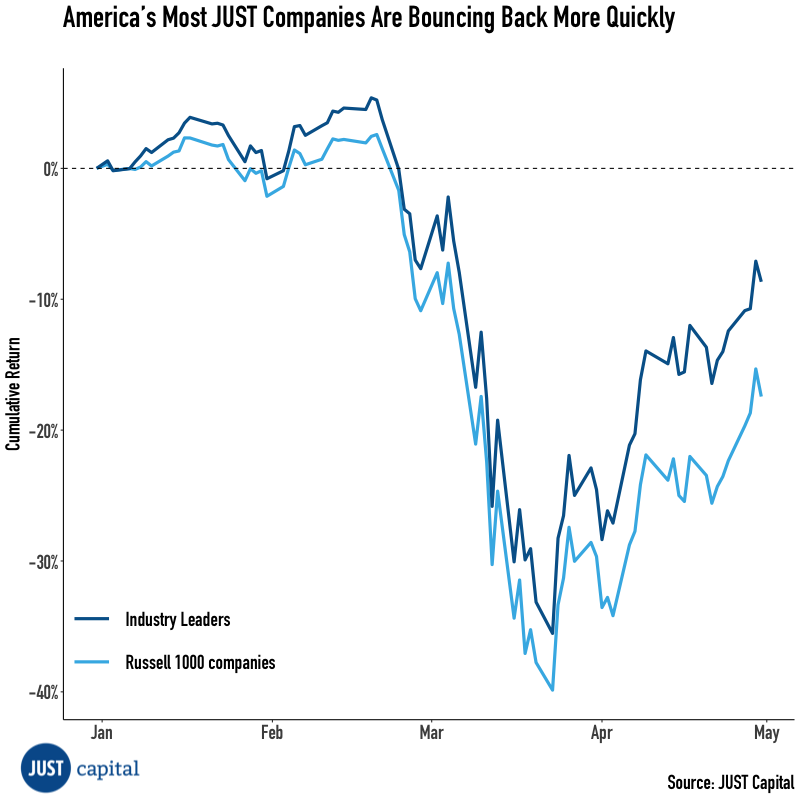
In this edition of Chart of the Week, we evaluate the top performing companies from our 2020 Rankings across the 33 industries we cover to see how they have performed since the beginning of the year. These Industry Leaders stand head and shoulders above their sector peers for their efforts to prioritize the needs of all their stakeholders – and based on our analysis, we’re seeing that they’re also doing right by their shareholders as the current recession continues to unfold.
Grouping the Industry Leaders of each sector into an equally weighted and monthly rebalanced portfolio and comparing them to the overall market, we see that JUST Industry Leaders recover at a faster rate, returning -8.67% on a cumulative basis from 1/1/2020 through 4/30/2020, relative to the -17.43% performance of the average company we evaluate over the same period.
This is not surprising, as many industry leaders have emerged as strong leaders not only prior to, but during the coronavirus pandemic. Starbucks (#1 in Restaurants & Leisure) has implemented far-reaching policies to ensure the safety of its frontline workers, support their financial and mental health, and raise pay for by $3 per hour through the end of May. Verizon (#1 in Telecommunications) has stepped up as a community leader, committing over $55 million in relief efforts to nonprofits around the globe while extending customers’ data coverage for 60 days even if they cannot pay. These companies, like many that stand out in our COVID-19 Corporate Response Tracker, are focused on the long term and emphasize care over cost.
This analysis illustrates our belief that the companies leading in their industries – that support the needs of all their stakeholders, and not just their shareholders – remain most resilient in the face of economic crisis. When we emerge from the pandemic, there will be a new benchmark for just corporate behavior, and companies that best supported their stakeholders throughout the crisis are likely to continue to outperform in the market as we move through and past the downturn.
We’re continuing to analyze how companies are performing in the market, as well as for their stakeholders, throughout the COVID-19 crisis. Check out all our coverage here, and stay tuned for next week’s chart.
If you are interested in supporting our mission, we are happy to discuss data needs, index licensing, and other ways we can partner. Please reach out to our Director of Business Development, Charlie Mahoney, at cmahoney@justcapital.com to discuss how we can create a more JUST economy together.
Disclaimer: Performance is for illustrative purposes only and does not represent the performance of any fund or index currently offered by JUST Capital or any of its partners. Results over a limited period may not be indicative of potential performance across a range of market conditions, and more concentrated portfolios may offer higher volatility than more diversified ones.
Today Martin Whittaker joined Yahoo Finance to speak with Julie Hyman, Julia La Roche, and Adam Shapiro about how companies are tackling the coronavirus.
He discussed our COVID-19 Company Tracker, highlighting some of the companies that have really stepped up to lead right now – including Target and Dollar General – as well as his predictions for whether or not the policy changes businesses are implementing will stick around.
Check out the full video below.
Workers today value professional growth opportunities that can help broaden their skills and ultimately advance their careers. We know this from our 2019 survey, which asks the American public what matters most when it comes to business practices today.
Successful career development programs can certainly help workers achieve their career goals, and they can also pay off significantly for the companies that offer them. They increase employee retention and engagement, improve overall company branding, aid long-term workforce succession planning, and help to fill internal skills gaps.
However, “successful” is the operative word here. Many companies don’t successfully pull off career development initiatives. A recent Gallup survey, for example, found that while 66% of managers participate in a professional development program, most still don’t see a clear career path for themselves or how such programs are benefiting them.
Another recent survey from Harvard Business Publishing Corporate Learning found that nearly half of all workers surveyed are dissatisfied with their employer’s learning and development programs.
So, what puts one career development program above the rest? The reality is that exactly what constitutes a great career development program will differ from employer to employer, but the most successful ones adopt most or all of these seven basic qualities.
Leaders often create career development initiatives around what they need to build a talented workforce, but they overlook employees’ needs and goals. If employees’ goals aren’t factored in, the program won’t be successful.
Companies that do it right ask employees for input on what type of career growth and training opportunities they would benefit from and appreciate the most — and then tailor their policy to those findings. This can be done through employee surveys or even on a more personalized level.
HubSpot — which scored very well for providing workers with skills training and opportunities for career development in our 2020 Rankings — has garnered a reputation for listening to its employees’ development needs while also providing professional growth opportunities targeted at different jobs.
Among many programs, the software company offers everything from an online course platform to small-group manager discussions (Think Spaces) to its annual HubSpot Fellows “mini-MBA” program in which HubSpot executives and Harvard Business School professors deliver a four-day course to “high-potential” employees on topics ranging from high-stakes decision making to leading with empathy.
The most effective programs are those that are designed to fit the various skills and long-term career needs of employees. And that generally means taking a multifaceted approach — because no two employees are the same.
DocuSign, which is the number one company for career development in our 2020 Rankings, offers a full range of career development opportunities tailored to individuals, including internal mentorships, internships, job rotation — so employees can learn about other roles and departments — and training courses.
DocuSign’s mentoring program has been so successful among women in particular that in 2017, the company introduced “speed mentoring” events for female employees.
Our FREE weekly newsletter about the future of capitalism and the movement to build a more equitable marketplace in America.
A career development program won’t be very effective unless employees 1) know it exists and 2) are encouraged to take part. This means knowing that their manager will let them take time to, say, attend an online training session or shadow another employee.
Employees are much less likely to seek a degree that could help their career growth if they worry their boss will be suspicious of their future intentions.
Thus, companies that actively promote their training and other career development opportunities to employees are likely to see the most participation — and, in turn, positive impact.
Salesforce’s Trailhead program, for example, is an online training course that is used both to onboard new employees as well as provide various types of training throughout their careers at the company. Salesforce not only encourages all of its own employees to use it, but the company also makes it available to other companies looking to train their staff on Salesforce usage.
The reality is that employers can only provide so much training and experience internally. To provide employees with the most cutting-edge skills or the certification or degree that will equip them with the right credentials and knowledge, companies typically must provide employees with training from an external organization, whether a university, local technical college, or even professional membership group.
The most forward-thinking employers today offer their workers some degree of tuition reimbursement or student loan repayment assistance benefits.
Synchrony Financial, for example, offers full-time employees up to $20,000 per year in tuition reimbursement and part-timers $5,000 per year. Since 2015, more than 900 Synchrony employees have participated in the program.
Adobe’s Learning Fund will reimburse employees up to $10,000 per year for tuition and books for courses and degree programs that meet the company’s eligibility criteria. Employees can also get up to $1,000 annually for short-term learning and skill development opportunities, such as conferences, workshops, and training courses.
Smart companies are always staying one step ahead — and that goes for internal development as well. They forecast what skills their workforce will need in the future and work on building those skills today.
One example: Investment and insurance company The Hartford has taken a proactive approach to reskilling its workforce for the future by introducing HartCode, a program that provides non-developer employees with the skills and training needed to become junior developers on its IT team.
The assumption that only the most junior employees — or those still in early or middle stages of their career — want training and development isn’t true. In fact, an AARP survey found that more than eight out of 10 employees ages 45 to 64 want the opportunity to learn something new on the job.
Companies that want to keep all of their employees satisfied need to acknowledge that every employee can benefit from training and feeling like their workplace is helping them grow.
AT&T is one company that promotes continuous learning among even its most veteran employees. The telecom giant has encouraged employees of all ages to take online courses on technology-focused topics such as Big Data and virtual technologies.
One common problem is that leaders don’t have a handle on the effectiveness of their company’s career development program, because they don’t track it closely enough.
Companies currently report things like the number of people who participated in training programs, the average amount spent on each employee, or the average amount spent on career development. While these stats are a start to understanding utilization, understanding performance requires tracking how people progress at an organization and whether the skills they’ve garnered through the program have benefitted them and been useful.
Air Products, which offers a variety of online learning courses, provided employees with an average of 32 hours of training in 2016. But more importantly, an analysis found that the training led to a 19.2% improvement in job performance and that 85.7% of employees used the new skills they learned within one month.
To stay up to date on all the latest shifts companies are making to support their workers, customers, the environment, and more, sign up for our free weekly newsletter, The JUST Report, today!
As we approach Labor Day this year, our nation finds itself in a moment of (likely soon-to-be fleeting) economic expansion and a tight labor market, yet facing greater uncertainty around the quality of American jobs. Structures of work continue to change, inequality continues to rise, and the social contract between companies and their workers continues to weaken. Whether a retirement plan, healthcare benefits, or a living wage, many workers can no longer count on their employers to deliver the economic security they need. But workers have not given up on this basic tenet.
Worker pay and well-being continue to be core priorities when it comes to what Americans want from corporate America today, based on our annual survey on just business behavior that has engaged nearly 100,000 Americans over the past five years. And across demographics – even political affiliation – Americans agree that companies should prioritize fair pay, benefits, a living wage, safety, equal opportunity, skills training, work-life balance, and more.
A resounding 80% of Americans feel that companies do not currently share enough of their success, believing they favor shareholders above all other stakeholders. There is a tremendous opportunity – especially in light of the Business Roundtable’s renewed Statement on the Purpose of a Corporation – for the private sector to play a defining role in improving people’s lives and restoring faith in the American Dream.
We know from years of research that the companies that invest in workers, customers, and communities, outperform their peers. And that people want to work for, buy from, and invest in just companies – so there are clear competitive advantages to win the race for talent, purpose-driven consumers, as well as ESG-focused investors.
The good news is that there are companies – in every sector – leading the way in serving their employees through the wages and benefits they provide, along with the programs and initiatives they offer to keep their employees safe, healthy, and prepared for the future of work.
Here are some of the concrete actions these companies – the Top 33 Companies for Workers by industry, in order of their overall JUST Capital rank – are taking:
Microsoft
Industry: Software
Overall JUST Capital Rank: 1
In 2018, Microsoft was called an “old-school tech company [with] a decidedly new-school approach to employee benefits” by Fatherly Magazine, thanks to its adoption benefits, daycare services, and assistance to parents with special needs children.
International Business Machines
Industry: Computer Services
Overall JUST Capital Rank: 5
IBM’s Global Work/Life Fund – a multi-year, $50 million effort to address work-life balance challenges worldwide – increases the availability of dependent care services in communities where IBM employees live and work.
NVIDIA
Industry: Semiconductors & Equipment
Overall JUST Capital Rank: 6
NVIDIA has grown its Women in Technology programs beyond its headquarters, and in 2019, expanded the initiative – helping female employees to broaden their technical knowledge and skills – to India.
Procter & Gamble
Industry: Personal Products
Overall JUST Capital Rank: 8
P&G has prioritized equal pay and gender equality, along with its efforts to commit to achieving 50/50 representation of women and men at all levels of the organization.
Cisco Systems
Industry: Technology Hardware
Overall JUST Capital Rank: 10
Cisco offers up to $10,000 in tuition reimbursement to employees, and partners with learning platform Degreed to provide extensive training and career development opportunities to employees.
Humana
Industry: Health Care Providers
Overall JUST Capital Rank: 11
Last year, Humana achieved its Bold Goal for employees, improving the health of those who work for the company by 20 percent, through programs and services that help employees focus on their mental and physical health and well-being.
Accenture
Industry: Commercial Support Services
Overall JUST Capital Rank: 12
Accenture has committed to hiring 5,000 U.S. veterans and military spouses by 2020, and provides training to military service members interested in careers in software engineering.
General Motors
Industry: Automobiles & Parts
Overall JUST Capital Rank: 14
This year, GM was recognized by Equileap for its commitment to gender equality – from achieving pay equity across all salary bands in 2018 to prioritizing gender representation in the C-Suite and Board to combatting sexual violence in the workplace.
General Mills
Industry: Food, Beverage, & Tobacco
Overall JUST Capital Rank: 15
Workplace safety is a top priority for General Mills, which has committed to creating an incident-free environment for employees – mitigating workplace hazards and reducing environmental impacts at all locations.
ResMed
Industry: Health Care Equipment & Services
Overall JUST Capital Rank: 18
ResMed offers strong work-life balance and prioritizes employee health and well-being through its on-site fitness centers, subsidized quit-smoking programs, and mental health counseling.
3M Co
Industry: Industrial Goods
Overall JUST Capital Rank: 26
In addition to its strong parental leave program – which 805 men and 354 women participated in in 2018 – 3M offers adoption assistance, parenting resources, and scholarships for dependents of employees.
Exelon Corp
Industry: Utilities
Overall JUST Capital Rank: 31
Exelon celebrates its team through its Safety Achievement Awards – awarding employees that go above and beyond their jobs to improve public safety with prize money to donate to the safety-related charity of their choice.
Facebook
Industry: Internet
Overall JUST Capital Rank: 35
Facebook’s impressive employee perks include wellness reimbursements, financial assistance to new parents, dry cleaning and laundry services, and a 30-day break every five years.
Owens Corning
Industry: Building Materials & Packaging
Overall JUST Capital Rank: 36
In 2017, Owens Corning employees tackled an average of 17 hours of training, taking advantage of the company’s mentoring programs and leadership training, as well as tuition support and graduate-level assistance.
Nielsen Holdings
Industry: Media
Overall JUST Capital Rank: 40
Nielsen’s myTime program provides unlimited vacation days to associates, providing them with flexibility and autonomy to manage their work and vacation time.
Verizon Communications
Industry: Telecommunications
Overall JUST Capital Rank: 44
Verizon aims to invest in the advancement of women and people of color on its team – through its Pay Equity Commitment, leadership training and networking for employees of color, and unconscious bias workshops for leadership.
Principal Financial Group
Industry: Insurance
Overall JUST Capital Rank: 54
Principal Financial provides on-site child development centers for new parents, as well as mothers’ rooms to support moms when they return to work.
Eli Lilly & Co
Industry: Pharmaceuticals & Biotech
Overall JUST Capital Rank: 58
Eli Lilly has conducted pay equity studies in the U.S. for 20 years, and in 2018, announced it would expand its efforts by increasing the number of companies covered by its assessments.
DowDuPont
Industry: Chemicals
Overall JUST Capital Rank: 67
This year, DowDuPont split into three companies – DuPont de Nemours, Dow, and Corteva – all of which offer flexible working hours and strong work-life balance.
eBay
Industry: Retail
Overall JUST Capital Rank: 68
eBay provides exceptional paid parental leave to new parents – with 24 weeks offered to new mothers and 12 to fathers and secondary caregivers.
Zillow Group
Industry: Real Estate
Overall JUST capital Rank: 69
In its first-ever CSR Report – released last week – Zillow shared that women earned $1.01 for every dollar a man with similar skills made in a comparable role.
ExxonMobil
Industry: Oil & Gas
Overall JUST Capital Rank: 82
ExxonMobil has seven employee-led resource groups that offer developmental programs, community service opportunities, and mentoring to support its team.
Southwest Airlines
Industry: Transportation
Overall JUST Capital Rank: 86
Southwest Airlines provides extensive skills development opportunities through its own training facility, rotational development program, and tuition reimbursement (up to $5,000 annually).
Deere & Co
Industry: Commercial Vehicles & Machinery
Overall JUST Capital Rank: 107
Deere employees have access to extensive volunteering and charitable giving opportunities – including the company’s FIRST mentorship and global Citizenship programs.
Baker Hughes GE
Industry: Energy Equipment & Services
Overall JUST Capital Rank: 113
Baker Hughes GE is contributing to Balance the Equation – parent company GE’s goal to have 20,000 women fill STEM roles by 2020, an effort to close the gender gap in technical fields.
Citigroup
Industry: Banks
Overall JUST Capital Rank: 131
Citi provides a range of programs for work-life balance management – including on-site medical clinics, health advocacy programs, and Save Well plans to help employees build personal financial sustainability.
Mastercard
Industry: Consumer & Diversified Finance
Overall JUST Capital Rank: 132
As part of its award-winning Girls4Tech program, more than 3,500 Mastercard employees mentored more than 400,000 girls in 25 countries – an opportunity to contribute to the global advancement of women in STEM.
Raytheon
Industry: Aerospace & Defense
Overall JUST Capital Rank: 138
In 2018, Raytheon expanded its commitment to diversity & inclusion by broadening representation of women and people of color in leadership positions.
Expedia Group
Industry: Restaurants & Leisure
Overall JUST Capital Rank: 145
In addition to more traditional time off benefits like sick days and paid vacation time, Expedia offers travel discounts and leisure travel reimbursements to its employees.
Goldman Sachs
Industry: Capital Markets
Overall JUST Capital Rank: 164
As part of its efforts to drive progress on diversity & inclusion, Goldman Sachs launched its “Identity Matters” workshop, a classroom curriculum for its team to address inclusion barriers, focusing on race and ethnicity.
Electronic Arts
Industry: Household Goods & Apparel
Overall JUST Capital Rank: 171
In keeping with its goal to “inspire the world to play,” EA strives to create a fun working environment – providing onsite fitness centers and free games to employees.
Newmont Mining
Industry: Basic Resources
Overall JUST Capital Rank: 197
Newmont Mining has collective bargaining and enterprise agreements across the globe, with union agreements in place in five countries – including Australia, Ghana, Peru, the U.S., and as of 2018, Suriname.
McKesson Corp
Industry: Food & Drug Retailers
Overall JUST Capital Rank: 325
McKesson’s “Taking Care of Our Own” fund offers emergency assistance to employees working 20 or more hours per week, who face difficulty following personal hardships or natural disasters, and assisted 281 employees in 2018.
This piece was originally published on Forbes.com.
