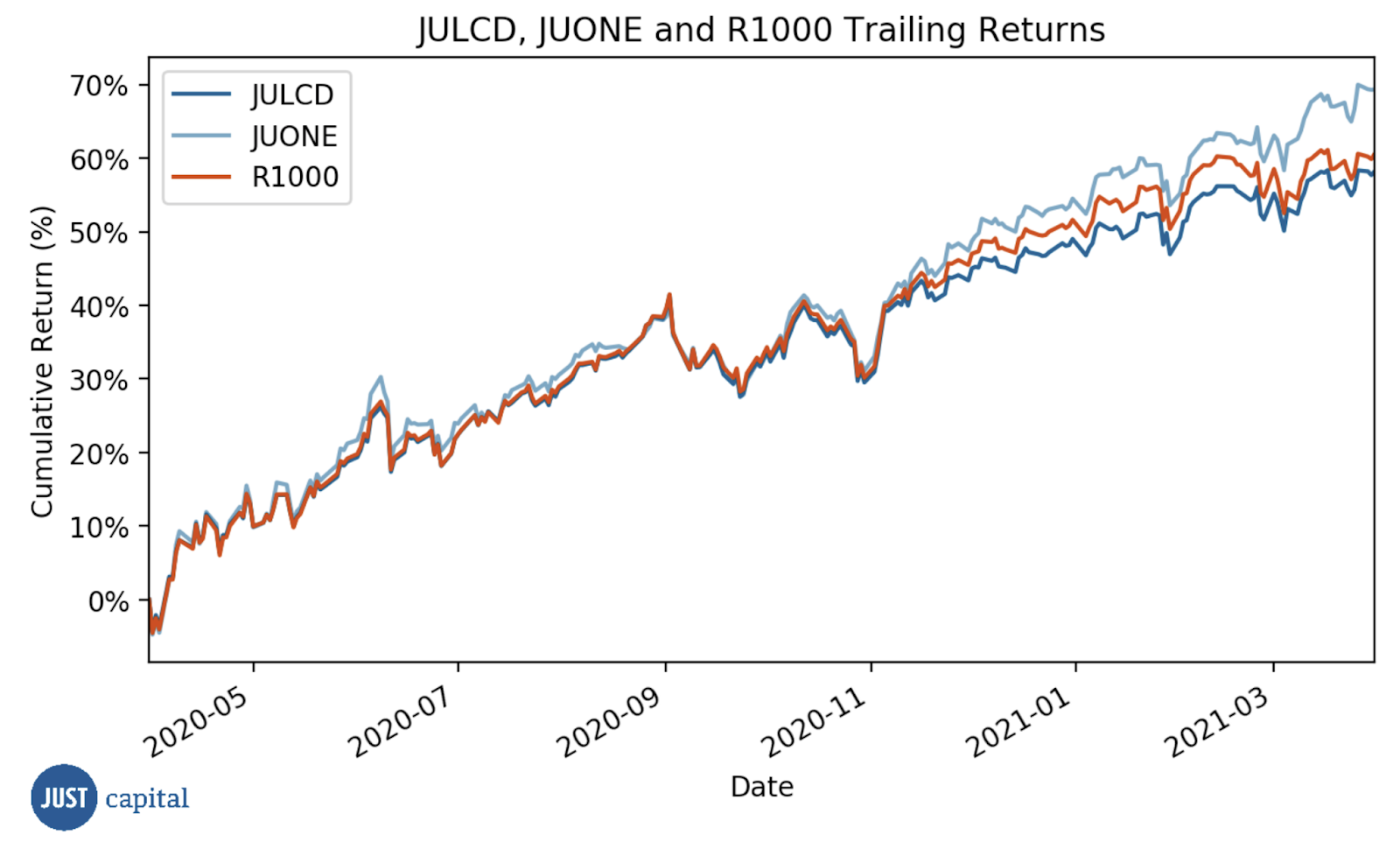
Our chart this week looks at the performance of our two active indexes – the JUST 100 (JUONE) and the JUST U.S. Large Cap Diversified (JULCD) – over the trailing year relative to the Russell 1000 Index.
The JUONE Index, recently hitting its two-year anniversary since inception on March 22, 2019, was constructed to track JUST Capital’s 100 highest-ranked Russell 1000 companies on an equal-weighted basis and includes the best-performing companies in our annual Rankings of America’s Most JUST Companies. Looking at the performance of the JUST 100, we see significant alpha relative to the average Russell 1000 company we rank, with JUST 100 companies returning 69.3% over the trailing -year and the average Russell 1000 company at 60.6% as of 3/31/2021. Our broad-based JULCD Index has slightly underperformed the Russell 1000, returning 58.2% over the trailing year.
Investors continue to see value in the JUST methodology, as the Morningstar bronze-medalist JUST ETF – which tracks the broad-market JULCD Index – continues to scale and recently crossed $225 million in assets under management, a 20% increase in assets since year-end. While we have a strong partnership with Goldman Sachs with the JUST ETF, JUST Capital is actively seeking a dedicated asset management partner interested in launching an investment product around the JUST 100 Index.
Highlighting unique attributes of the JUST 100 further:
The JUST 100, as we see above, is a unique portfolio of companies driving stakeholder capitalism forward, going above and beyond to advocate for the environment, their workforce diversity, and better pay for their workers. Given the leadership, performance, and impact of JUST 100 companies, it is clear that a JUST 100 thematic investment product fits a unique need in the market as our methodology and Rankings reflect the priorities of the American public.
Please don’t hesitate to reach out to our Investor Products team if you are interested in speaking further about the JUST 100 Index.
If you are interested in supporting our mission, we are happy to discuss data needs, index licensing, and other ways we can partner. Please reach out to our Director of Business Development, Charlie Mahoney, at cmahoney@justcapital.com to discuss how we can create a more JUST economy together.

2020 has been a year of profound change and upheaval – from the COVID-19 pandemic to our national reckoning with racial injustice to last week’s unprecedented election and the continued fight for American democracy. Amidst these monumental and unusual events, the call for stakeholder capitalism has continued to mount, with workers’ needs – health, safety, security, fair treatment, and pay – at the forefront of the conversation.
Earlier this year, JUST Capital and PayPal launched the Worker Financial Wellness Initiative, a new, critical project to make workers’ financial security and health a C-suite and investor priority. And at the Forbes JUST 100 Virtual Summit – where we celebrated the 2021 Rankings of America’s Most JUST Companies on October 14 – we discussed why worker financial wellness must be a priority for corporate leaders, now more than ever, in conversation with PayPal CEO Dan Schulman, JUST Capital Cofounder & Chairman Paul Tudor Jones, and Chief Strategy Officer Alison Omens.
Explore our key takeaways below.
Even before the COVID-19 crisis hit the U.S., far too many Americans were struggling to pay their bills each month, an issue that has only been exacerbated as our economy has contended with the impacts of the pandemic. In 2018, PayPal CEO Dan Schulman decided to find out whether employees were able to make ends meet – and because his company paid employees at or above market, he expected a good news story. But when he surveyed his workers, he learned that more than two-thirds of call center and entry level employees were struggling to pay their bills each month, let alone save for their futures or for emergencies. Dan explained that “our mission as a company is to democratize financial access,” and that while PayPal’s focus had been to achieve this mission for customers, its employees were being left behind. In better understanding the financial health and security of his workers, Schulman was able to evaluate the broader implications of his mission, and make critical changes to ensure that workers were not simply the purveyors of this mission, but also its beneficiaries.
In our six years of polling the American public, we’ve heard every year that workers are the most important stakeholder for corporate America, and that paying a living wage is critical to creating a more just form of capitalism (this year, and last, Americans agree that paying a fair, livable wage should be the top priority for companies). In discussing why this issue is so important, Tudor Jones emphasized that “paying a living wage is the first great step to reducing the inequality gap, taking care of employees, and hopefully building a larger pie for the entire country.” Today, among the 20 million workers who work for the Russell 1000 companies we evaluate, we estimate that 50% currently do not make a living wage. Tudor Jones identified Schulman as “the flag bearer” in driving change on this issue, and believes that boards, shareholders, and employees themselves will increasingly demand a living wage.
There is a pervasive narrative on Wall Street that raising wages destroys value – something we saw play out recently when Costco stocks dropped after the company announced that it was maintaining COVID-19 wage hikes for its frontline workers. Schulman called this narrative “fundamentally wrong” – noting that the single biggest competitive advantage for any company is the talent and passion of its workers, and that the most talented people want to work for companies that both stand for a purpose and ensure their financial security. “I actually think if you don’t have a purpose as a company and don’t treat your workers as your most valuable asset,” Schulman explained, “then you minimize your profitability going forward.” Tudor Jones agreed, suggesting that the market is beginning to understand this, bolstered by growing research to suggest that a company’s “net contribution to society” is key to the formula for raising the company’s net value overall.
Healthier employees not only have the ability to strengthen the financial health of their companies (and in turn, the economy), they create a healthier democracy. Schulman noted that “democracy asks us to rise above our own self interest to support what’s right for the whole,” but when employees are financially insecure, they question the system. A strong economy, a healthier capitalism that really cares about everyone, is essential for a strong democracy – and that begins with treating workers right. Tudor Jones emphasized the critical importance of this work: “We’re not going to change this country, we’re not going to feel embarrassed to be Americans, we’re not going to be proud of what we do every day unless we change where we work first. It’s the only way we’re going to get gender equity, income equity, wealth equity, or racial equity. It’s the only way we’re going to do it.”
You can watch the full JUST 100 Virtual Summit here.
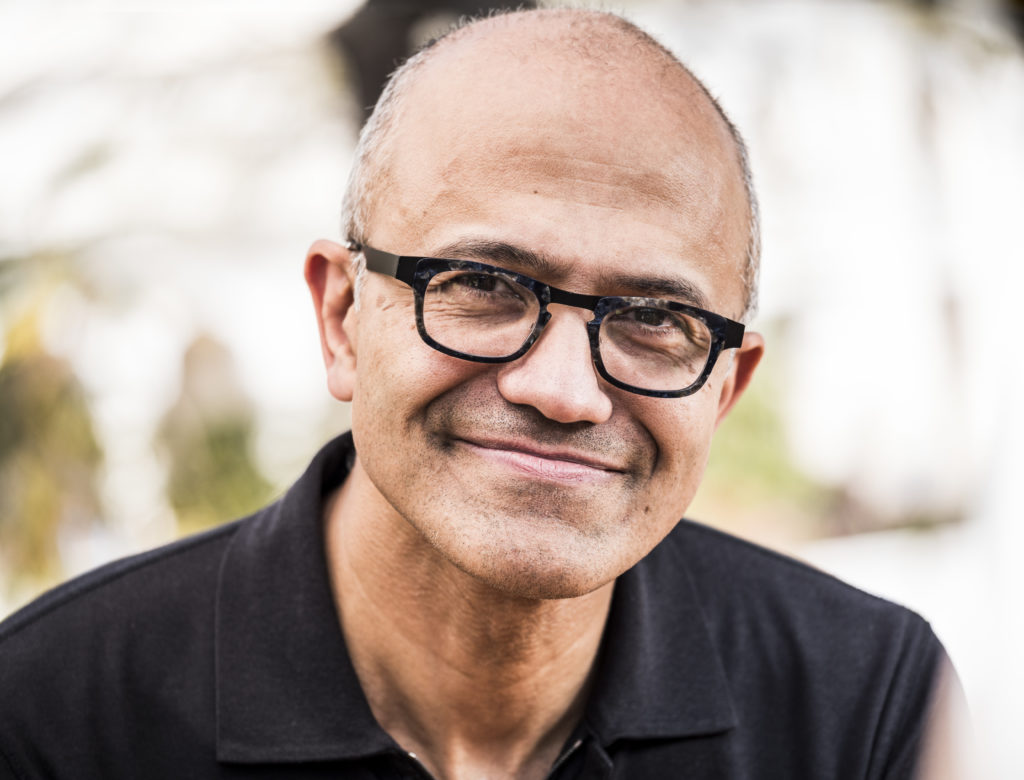
Microsoft CEO Satya Nadella. (Microsoft)
This year, we released the 2021 Rankings of America’s Most JUST Companies on October 14, and for the third year running, Microsoft took the lead. At the Forbes JUST 100 Virtual Summit, JUST Board Member and CEO of Grameen America, Andrea Jung, sat down with Microsoft CEO Satya Nadella to discuss his leadership. Nadella is one of the most prominent proponents of adopting stakeholder capitalism, and he explained how to make that a reality in light of COVID-19, our national reckoning with racial injustice, and recent challenges to American democracy.
On navigating the extraordinary challenges of 2020, Nadella began by saying that Microsoft’s three-time No. 1 rank in the JUST 100 is “really the recognition of all the people I work with, my team members and coworkers, and their hard work every day, living our mission and our culture.” It’s this commitment to mission, culture, and purpose that Nadella credits with Microsoft’s competitive advantage, and it’s something he has been fostering in his seven years as CEO, as well as his 28 years at the company.
Watch the full talk here and explore our key takeaways below.
Stakeholder capitalism has faced criticism for being little more than rhetoric, a buzzword for corporations looking to align themselves with ideals of sustainability and ESG. But in the conversation, Nadella pushed back, emphasizing that “in the midst of this pandemic, [it’s fair to] to essentially have a referendum on capitalism. We all have to recognize: What is the core purpose of a corporation?” Rather than simply generating a profit for shareholders, Nadella believes that this purpose must lie in finding profitable solutions to the issues faced by people and our planet, and that the measure of corporate success lies not in the surplus companies create in their own enterprise, but in the surplus they create around them. Microsoft’s long-time commitment to these ideals, and its ability to execute its social mission, are key to its competitive advantage in our Rankings, and as evidenced by the company’s best quarter ever.
Microsoft has consistently been a leader in the arena of environmental impact and sustainability, pioneering new technologies and initiatives that reduce its footprint. Recently, Microsoft announced that it aimed to be carbon negative by 2030 and that by 2050, the company will essentially “go back in time” to reclaim all the carbon it had emitted since 1975. Nadella recognizes that of course climate change is a global issue that a single company can;t solve, but believes that these ambitious efforts can create a “ripple effect through our ecosystem of suppliers and partners,” driving powerful change across its operations.
In the midst of a contested election, Americans are looking to companies – and particularly those in the tech sector – to play a critical role in protecting democracy. Nadella agrees, emphasizing that “as an American company and as a tech company, our standing in the world and in the U.S. comes because of the vibrancy of American democracy.” With technology both a powerful tool and pervasive challenge of American society today, Nadella sees a “wide gamut” of efforts that Microsoft can make to help ensure that democracy continues to thrive, from making the democratic process itself more secure to protecting the digital discourse around key issues like racial injustice. With the foundations of our democratic system at stake, leaders like Nadella are poised now, perhaps more than ever, to play a key role in their protection.
In the debate around stakeholder capitalism, a pervasive myth holds strong among corporate and investment leaders that doing right by workers, communities, customers, and the environment hurts shareholder returns. Throughout the COVID-19 crisis, Microsoft continued to pay its employees and contractors, despite pandemic constraints like the closure of its corporate campus. Nadella shared that decisions like these, in support of the company’s stakeholders, stem from Microsoft’s long-term mission and principles to create success around itself, something the company’s shareholders have a vested interest in. He shared that “our shareholders want us to do this,” driving home that his company’s competitive advantage – its success in the long term and the value it creates for shareholders – is derived from its commitment to all its stakeholders.
In this unprecedented moment, corporate leaders are faced with urgent questions around how to lead their companies – through the pandemic, social unrest, and political tumult – and what, in turn, that means for society. Jung asked Nadella what he believes his personal responsibility is to lead in this moment. “I always go back to that social contract of our company with the world around us. Because that to me is at the core of the license to operate,” he said. “You can’t exist if all you’re doing is benefiting yourself. … Profit [comes] because of the larger surplus you’re creating around you.”
With our country and our world facing profound new challenges, this sense of purpose must continue to fuel not only what corporate leaders say on the issues that matter most, but how they act. Nadella emphasized that, by holding fast to culture and purpose through this time of upheaval, corporate leaders can help ensure greater resiliency and a better future for Americans, as well as continued success for their companies.
You can watch the full JUST 100 Virtual Summit here.
On October 14, JUST Capital launched the 2021 Rankings of America’s Most JUST Companies – our fifth annual list of the companies doing right by all their stakeholders – shining a vital light on how companies have responded during the COVID-19 pandemic and how they continue to shape our economy through the crises of our time.
In celebration of these leading companies, JUST Capital – in partnership with Forbes – gathered visionaries, impact investors, and corporate leaders at the Forbes JUST 100 Virtual Summit, a series of discussions around how corporate America can and must support their stakeholders through COVID-19, advance racial equity in America, and chart the course for business in a post-pandemic world.
In the coming weeks, we’ll be unpacking key takeaways from our panel conversations, including:
In the meantime, watch the full talk below, and explore all the conversations from our 2021 event here.
In the period between June and October 2020, after our data collection process concluded but before our Rankings were released, Facebook was the subject of several high-profile media controversies related to the spread of misinformation, hate speech, and other discriminatory and incendiary content on its platforms. In some instances, such as in Kenosha, Wisconsin, it is alleged that Facebook’s failure to swiftly and systematically remove such content from its flagship platform may have indirectly contributed to the deaths of protesters.
Compounding our concerns about Facebook are the outcomes of its own Civil Rights Audit, released in July, which details its performance on matters including voter suppression and voter information, building a civil rights accountability infrastructure, content moderation and enforcement (including hate speech and harassment), advertising targeting and practices, diversity and inclusion, fairness in algorithms, and the civil rights implications of privacy practices, among others. While the transparency demonstrated by undertaking and publishing an audit of this type – voluntary in nature – is a positive step, the auditors noted that they had watched the “company make painful decisions over the last nine months with real world consequences that are serious setbacks for civil rights” and that “Facebook’s approach to civil rights remains too reactive and piecemeal.”
From recent polling conducted in collaboration with The Harris Poll, we found that almost two in three Americans (63%) say that companies have a moderate to significant role to play in taking an active stand against the spread of disinformation by identifying and debunking falsehoods and propaganda. Yet Facebook stands accused of repeatedly failing to halt the spread of misinformation and incendiary content, both of which could be categorized as acts of omission or non-action. An act of omission is more overt and measurable, particularly in the context of our research and ranking work. Facebook has not deliberately incited violence from extremist groups on its platform, but there is credible evidence to suggest that the company did not act with the speed and force necessary to stop it.
Recognizing that the spread of misinformation online is a complex problem for which a perfect solution may not exist, we have therefore put Facebook’s 2021 ranking “under review” and withheld the JUST Seal that denotes a company’s inclusion as one of America’s Most JUST Companies. The Seal is a reward for proven excellence. Until Facebook’s performance and alleged shortfalls are better understood, we deem unproven its case for JUST Capital’s highest honor.
Our objectives in ranking companies, and awarding leaders the JUST Seal, is simple: We want to measure company performance as accurately and objectively as possible, and we want to recognize, celebrate, and incentivize true leadership.
In the coming year, we will be taking concrete steps to further explore and quantify how Facebook’s actions (and inactions), and similar business behaviors by other internet companies, can be better reflected in our Rankings, in order to meet these objectives. These efforts start with our Polling Team, which will embark on a survey research program to better understand public opinion on these types of controversies. We will use a combination of qualitative and quantitative research fielded among a random sample of the American public, aged 18+, to understand:
We will further investigate the extent to which our existing metrics are adequately capturing the social consequences of Facebook’s actions and other corporate actions like it. Facebook’s above-average performance on the fourth most important Issue in our Rankings, “Acts ethically and with integrity at the leadership level and takes responsibility for wrongdoings,” may reveal that one or more of its underlying metrics are not calibrated or sufficiently targeted to signals of repeated failures of leadership on matters of enormous social consequence. We will be conducting a detailed analysis of our metrics on this Issue and, as ever, working toward better measurement.
We will be updating this website with our progress in 2021.
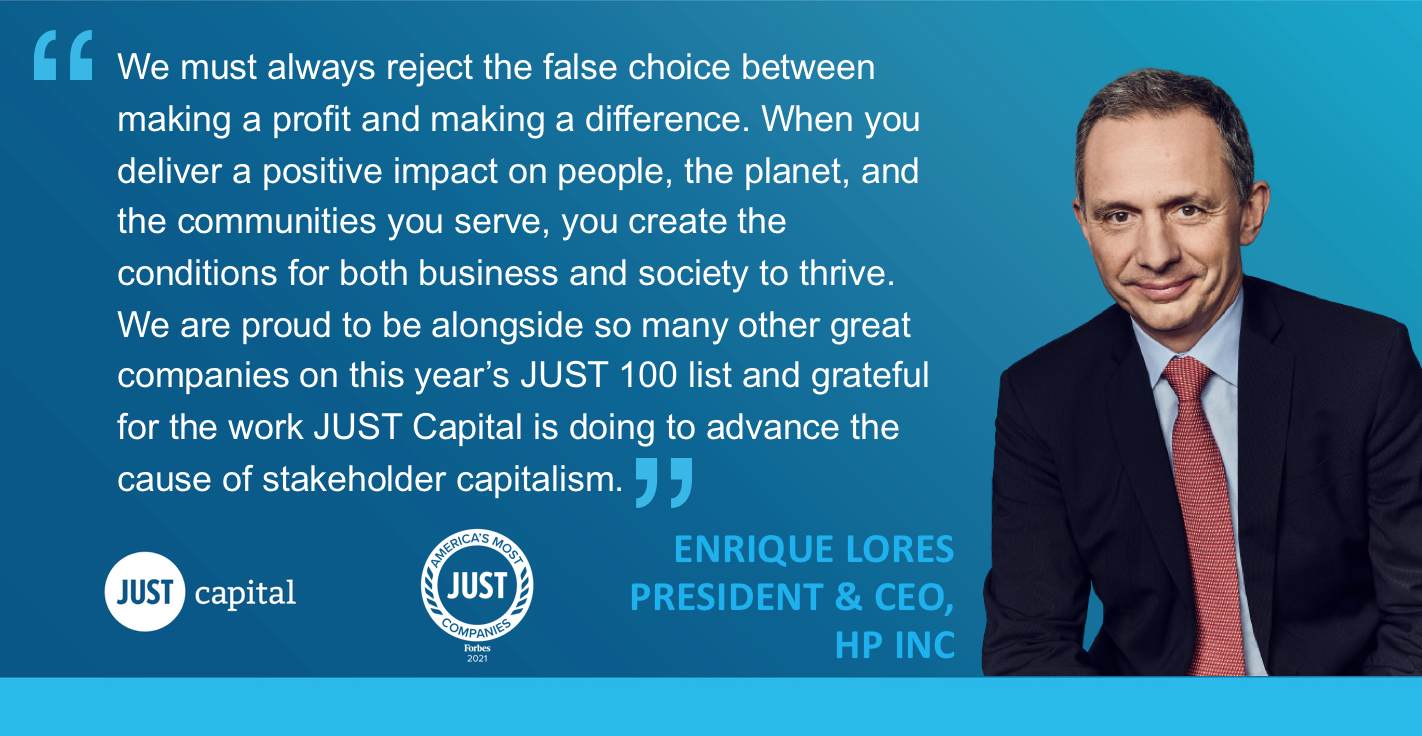
This week saw the release of our new annual rankings of America’s Most JUST Companies and our celebration with Forbes of the new JUST 100 list. It’s a big occasion for the organization, and a chance to spotlight our mission and hear directly from corporate leaders on why all this matters. The event did not disappoint. (And you can watch the replay here.)
Ken Chenault, former CEO of American Express and Chairman & Managing Director of General Catalyst, discussing how to lead through a crisis, explained that “reputations are made or lost in times of crisis.” On racial inequity, he advised, “This is not rocket science. There has to be focus, persistence…This is not something that can be a flavor of the year. It has to be an ongoing effort.”
Satya Nadella, CEO of Microsoft, speaking about stakeholder capitalism more broadly, observed: “I think it’s fair, in 2020, in the midst of this pandemic, to essentially have a referendum on capitalism…We all have to recognize: What is the core social purpose of a corporation?” He also noted businesses’ connection to democracy itself: “There is a wide gamut of things that we should do to ensure democratic institutions continue to thrive, as all of us as citizens and as businesses depend on these institutions on being strong.”
Ken Frazier, CEO of Merck, struck a powerful note in his remarks on equity: “If you’re complacent with the status quo, you’re complicit in the structural racism and inequality that the status quo hides,” and discussed the steps corporate America not only needs to take within, but also in support of addressing deep structural disparities in society – in education, in criminal justice, in health equity, and more. And Risa Lavizzo-Mourey, board member of Intel, Merck and GE, highlighted the importance of worker health and safety from factory floor to hospitals: “It also needs to extend beyond what we do in a corporation, and that requires us to use our influence and make sure that safety extends out beyond into society.”
A major focus for JUST right now is the Worker Financial Wellness Initiative, with PayPal and other partners. Speaking about this, our Chair Paul Tudor Jones emphasized that “having companies understand and measure how many of their employees aren’t making a living wage is the first big step towards reducing that inequality gap.” Dan Schulman, PayPal’s CEO, elaborated: “When we don’t have financially healthy and safe employees, they start to question the system. Our whole democracy relies on rising above your own self-interest. Creating a healthy economy, a healthy capitalism, and a strong democracy…that’s crucial for our future.”
Pharrell Williams had the last word: “I love my country for its progression, but I REALLY love it for its untapped potential.”
The JUST movement is on a roll, and I invite everyone who reads this to reach out, forward the invitation to others and join us.
Be well,
Martin Whittaker
P.S. I’d be personally honored if you would consider making a gift today to support JUST’s work and mission so that we can continue to push forward on building an economy that works for all Americans.
This week, we wanted to highlight some of the standout policies of our JUST 100 leaders. Here are a few:
Microsoft, America’s Most JUST Company, led on financially supporting workers through the COVID-19 crisis by continuing to pay contract workers during facilities and store closures.
JPMorgan set quantitative targets to increase representation of women, veterans, and employees with disabilities, demonstrating a commitment to equity across the organization. In 2019, JPMorgan committed to hiring over 4,000 Black students into entry-level roles over five years, and invested in Black talent retention with its Advancing Black Leaders initiative.
Target prioritized frontline workers during the pandemic by providing hourly wage increases and by offering $250-$1500 bonuses to hourly store managers, the highest amount among retailers. In addition, they were one of the few companies to permanently extend hazard and raise wages $15 an hour.
Mastercard helped individuals and companies weather COVID-19 with financial and in-kind support for small businesses and frontline workers, including $250 million in support for small businesses, and $10 million in emergency grants to frontline workers.
AT&T rewarded frontline workers with hazard pay in the form of a 20% hourly wage increase during the pandemic. They also extended its existing emergency PTO from 80 hours to 160 in order to meet varying employee needs.
Wednesday, October 28th at 2PM to 3PM ET – How to Make Worker Financial Wellness a C-Suite Priority
Participants will hear from JUST, the Financial Health Network, and the Good Jobs Institute on how and why companies should conduct an assessment of wages, benefits, and employees’ overall financial health, and also hear how PayPal increased the net disposable income of workers to 16%, up from as low as 4% in some regions. Join our webinar here.
Thursday, October 22nd at 1PM ET – Business Elects to Lead
Tune into Episode 3 of 3BL Virtual Forum to hear Martin in conversation with Simon Mainwaring on ESG, corporate purpose, and what to expect in the next year. Register here
For this week’s release of America’s Most JUST Companies, our media partner Forbes explored the leading companies in depth – discussing what stakeholder leadership looks like with CEOs of the JUST 100, highlighting the Women Leading America’s Best Corporate Citizens, and unpacking why America’s retail giants – like JUST 100 leader Target – are being hailed as heroes. Business Insider showcased the Top 10 unpacking scores on worker pay, racial justice, and climate change.
If you are curious about how Business Roundtable signatories on the revised Statement on the Purpose of a Corporation stacked up on stakeholder performance, we have the analysis here, featured in yesterday’s Fortune CEO Daily.
Rounding out this week of coverage, CEO Martin Whittaker was featured in Reuters discussing the importance of disclosure in advancing racial equity across corporate America and last week’s release of our Worker Financial Wellness Initiative was highlighted in the Journal Transcript.

As we celebrate the 2021 Rankings of America’s Most JUST Companies, this week’s chart looks closely at what it actually means to be a leader in the stakeholder economy. JUST 100 companies not only pay 18% to their median workers, use 123% more green energy, and give 6 times more to charitable causes, they had a 7.1% higher return-on-equity, as well as 56% higher total shareholder return over the past five years, showing that doing right by all stakeholders is good for shareholders.
