
Recent research on public attitudes toward AI reflect a rising level of unease and concern about the technology and its potential impacts on the workforce, relationships, and education. A closer look at public priorities suggests the views of the public are more nuanced than other polls may indicate and the path forward for AI-focused corporate leaders is clearer than overall sentiment polling implies.
In March 2026, Just Capital prompted the American public to prioritize AI-related issues rather than measure general sentiment. The results reveal that public support for AI is not absent but conditional: it depends on whether companies can demonstrate how they are managing risk responsibly while delivering on AI’s greatest potential to improve society. An early review of corporate disclosure suggests most companies have not yet made that case clearly or consistently.
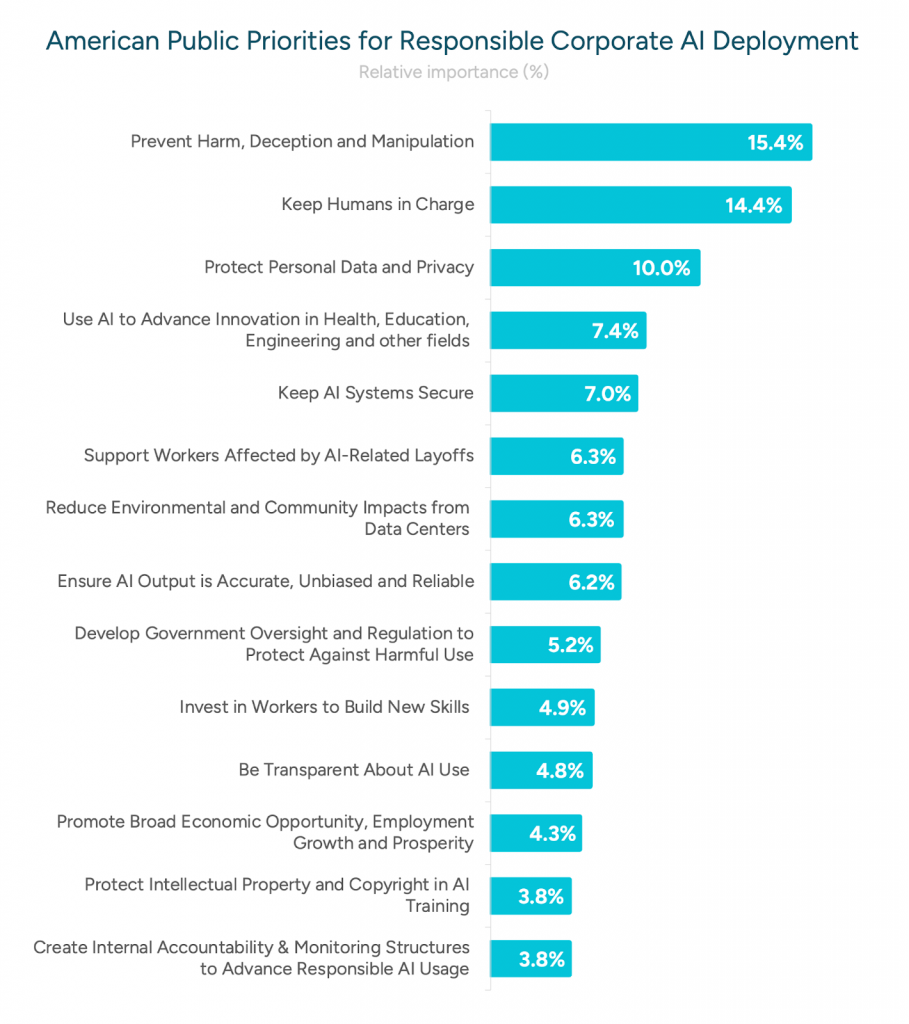
When asked to rank priorities rather than express general views, Americans reveal a more balanced perspective than headline sentiment polls suggest. They highly prioritize the use of AI to advance innovations in health, education, and engineering to solve complex societal problems, even ranking this above concerns around workforce disruption and environmental impacts.
At the same time, the three highest-ranked priorities are focused on safety concerns: preventing harm, deception, and manipulation; keeping humans in charge; and protecting personal data and privacy. This suggests public support would be bolstered by companies articulating the guardrails around the technology. Americans are watching to see whether companies can deploy AI responsibly.
We reviewed AI-related disclosures at six hyperscalers and 104 additional companies that rank highly in the organization’s measure of overall responsible business practices. Even among these 110 companies, most with strong disclosure track records across workforce, community, environment, customer, and governance issues, AI-related reporting is inconsistent and lacks common definition.
Two of six hyperscalers publish dedicated AI Transparency Reports. Fifty percent of companies disclose board-level involvement in AI risk oversight, but just 37% of the 110 companies analyzed disclose responsible AI principles or guidelines. Among those that do, disclosure is uneven on the issues Americans rank highest: only 16 companies mention preventing harm, deception, and manipulation; 27 mention human oversight; and 37 mention customer privacy and data protection.
Across Just Capital’s broader analysis of 933 public American companies, the picture is even less clear. The share of companies committing to not selling user data in any context dropped 3.5% year over year, and 3% fewer companies commit to not using user data for advertising. The average number of employee training hours fell from 24.34 per employee in 2024 to 21.96 in 2025, despite calls for more AI-focused training and reskilling opportunities. Among the smaller group of 110 companies analyzed further, 39 disclose formal AI training programs for employees.
As companies accelerate AI deployment, clearly and consistently defining responsible AI development and deployment will be a meaningful point of distinction for the American public. This analysis suggests the public will be more likely to extend trust to companies that demonstrate they are using AI to deliver genuine social benefit while protecting people from the greatest risks.
The full list of public priorities identified by Just Capital is below. These priorities are being translated into trackable metrics for ongoing analysis.
Methodology
Just Capital regularly conducts independent surveys to track Americans’ priorities, values, and expectations for corporate behavior, which serve as a foundational input into its Just Intelligence tool, rankings, and research products. Priorities weights were determined via maximum-differential (Max-Diff) to quantify the relative importance of each of the AI-related issue statements.
This survey was conducted online within the United States by Just Capital from March 12–16, 2026 among 2,012 U.S. adults ages 18 and older. Data from this survey have been weighted to align with known population parameters from the U.S. Census Bureau on key characteristics including [age, gender, geography, etc.]. While weighting adjusts for demographic imbalances, this survey is based on a non-probability sample and therefore no estimate of theoretical sampling error can be calculated. Findings should be interpreted accordingly.

At JUST Capital, we are excited about the tremendous potential of artificial intelligence to drive positive change in business and society. But we are also keenly aware that if deployed irresponsibly, AI risks exacerbating societal divisions and inequities.
As companies increasingly adopt AI tools, how can they ensure these technologies align with the priorities of the public and benefit all stakeholders? The Just AI Initiative by JUST Capital aims to shed light on this critical question.
Grounded in extensive public opinion research, the concept of Just AI is to help companies implement AI in ways that reflect Americans’ values around fairness, privacy, inclusivity, and shared prosperity. Its multifaceted approach encompasses measurement, education, and engagement to incentivize responsible AI across the private sector.
Here at JUST, we always focus our work on the issues the American public cares about most, not what special interests or opportunists want. Our ability to drive change depends on the value we provide companies seeking to make AI work better for all stakeholders.
Central to our approach to Just AI are principles like stakeholder orientation, transparency, and accountability. Companies are encouraged to consider AI’s impact on workers, customers, communities and the environment, and shareholders. To encourage trust, companies will want to be transparent both in their objectives as well as how their models are being created and deployed. Opening algorithms to outside audits and communicating the objectives they are pursuing with AI are also clearly emphasized.
The concept of Just AI is to help companies implement AI in ways that reflect Americans’ values around fairness, privacy, inclusivity, and shared prosperity.
For nearly ten years, JUST has tracked corporate stakeholder performance by gathering both quantitative data and qualitative feedback from diverse stakeholder groups. This will be central in our approach to AI as well. These insights will help inform what data we might track in future iterations of our rankings to identify leaders others will want to emulate.
As always our goal is to drive and scale adoption of just business behavior and support on-the-ground outcomes: Are workers being treated fairly? How is AI impacting customer service and privacy? What are the environmental impacts? Will shareholders be impacted by new risks? We want specifics. We want measurable results.
Partnership is another core tenet of the Initiative. Collaborating closely with academics, companies, and civil society will enable knowledge sharing on issues like algorithmic bias and help build best practices. Our aim with Just AI is to keep abreast of the latest research and stakeholder input to inform our models.
Within JUST Capital, rigorous internal governance and training will be reinforced. We aim to walk the walk when urging others to use AI responsibly. That means making accountability, ethics, and transparency central to our own AI capabilities. It will be a journey for us, too.
In spotlighting leadership and providing meaningful benchmarks, Just AI ultimately seeks to steer one of the most transformative technologies towards serving the public good. Its success will depend on delivering value to companies willing to embrace this vision.
The potential of AI to improve lives is immense, but it’s not a foregone conclusion. That’s why Just AI matters.
I invite other leaders passionate about ethical AI to connect and explore how we can partner. Together, we can ensure AI fulfills its promise to benefit all.
Get in touch by sending a note to corpengage@justcapital.com to explore ways to get involved in the work.
Robert Marsh is JUST Capital’s Chief Information Officer.

Artificial intelligence is influencing “every segment” of TIAA’s portfolio, according to the company’s chief information and client services officer, Sastry Durvasula. “I think AI will have a profound impact on our business.”
Considering the context, that’s no small statement. Durvasula is responsible for the global technology and client services operations at one of America’s largest retirement and investment solutions providers. TIAA, founded over 100 years ago by Andrew Carnegie, currently has $1.3 trillion in assets under management.
In a recent episode of our ongoing LinkedIn Live interview series, “JUST Better Business,” Durvasula spoke with JUST Capital CEO Martin Whittaker about AI’s “spectrum of impact,” which includes everything from changing research operations to better protecting customers to helping create new products and services. In the wide-ranging interview, the executive explained why he’s optimistic about the technology’s potential to help customers, employees, and the economy more broadly.
The TIAA leader explained that the company is deploying AI for customers in numerous, different ways. For younger workers who are accumulating wealth, it’s about convincing them to invest and grow their retirement funds. From a marketing and a product-offerings perspective, he explained, it’s about deploying AI to improve their retirement accumulation experience – from personalizing financial products, to providing better insights, to making customer experiences easier to navigate, he said.
For retirees who are “de-cummulating” their wealth, he said, AI’s impact is both about offering more personalized services and products, but also about consumer protection and privacy. “Retirees are the most vulnerable population from a fraud cyber point of view. So we have been deploying AI solutions to protect them from cyber fraud and attacks,” Durvasula said.
Artificial intelligence will offer incredible opportunities to boost efficiency for workers in financial services, Durvasula told Whittaker.
“We need to create insights and we have a gazillion financial documents that we need to surf through to get those insights. There’s a lot of operational inefficiencies that do exist in the current financial services industry. I think AI will give us a big lift from an operational efficiency standpoint,” he said.
By linking the company’s data and AI policies in a coherent strategy, TIAA can help create new products to help support the company’s goal of being the leader in lifetime retirement solutions, he said.
In addition to helping TIAA achieve more with less time and energy, AI will provide an increasing amount of opportunities for employees to upskill and advance.
“I think anybody who has business acumen or technical acumen or both can actually, you know, be part of this revolution,” Durvasula said.
“We’ve created different what we call guilds. Obviously the most prominent one is the data and AI guild, the next one actually, that’s quite popular is Cyber. And we’ve given access to the entire company to these guilds,” he explained. “So say I have a call center employee servicing representative who deals with fraud transactions. If she wants to join the AI guild to learn how AI will be employed in fraud solutions, she’s able to join and, and she can go through the training which is structural training with access to various industry certifications as well.”

Of course, the potential for unjust business behavior is big, the TIAA acknowledged. “There is a lot of potential damage,” he said, citing bias and misinformation. But the executive explained that the company is taking a proactive approach to mitigating unwanted outcomes.
“We have taken a proactive stance on this. We released our first internal responsible AI policy. And we are beginning to codify that as we implement some of these new cases, both client facing as well as colleague facing,” he said.
But Durvasula sees AI’s impact being more positive, especially in reducing economic inequality and increasing diversity.
“Women make 30% less in retirement income and minorities, especially Black and Hispanic Americans, have various issues when it comes to retirement savings,” he said. “So if you’re solving for these types of complex problems that are societal, we need a workforce that actually has a level of diversity in designing solutions.”
Durvasula explained TIAA is partnering with a number of universities, nonprofits, and groups to boost diversity in its workforce, including initiatives with the Society of Hispanic Professional Engineers, the Society of Women Engineers, the Blacks In Technology Foundation and others.
“We want to retire inequality,” the TIAA exec said. “It is important to have a positive impact. I’m quite optimistic about the future.”
