
The business case to support parents is overwhelming. Policies supporting parents are critical to recruiting new – and retaining existing – workers, especially in a tight labor market, not to mention boosted worker productivity. A recent report from Moms First and BCG suggests that companies that strategically allocate resources to childcare benefits are seeing a return on investment of 90% to 425%.
Year after year the Just Capital polling highlights that the American public wants companies to prioritize their workers, specifically by providing benefits and work-life balance among the top five issues. In fact, a survey of working mothers further connects the dots between receiving more parental leave and being more satisfied at their workplace.
As a result, we see leading business executives prioritize these policies. In a Just Capital interview with Morgan Stanley Chief Medical Officer Dr. David Stark, he said paid parental leave “has low direct costs” and “a significant impact in terms of improving productivity, retention, and employee morale.”
We are also seeing companies realize the benefit of more publicly offering benefits geared towards families and caregivers. From 2023 to 2024, disclosure of paid parental leave for both primary and secondary caregivers increased by seven and eight percentage points, respectively.
So what employers lead the pack with their policies in 2024? Just Capital analyzed the policies and practices of the Russell 1000 and five came to the forefront.
You can find more information about corporate practices and policies like those elevated here in the latest version of our Just Jobs Scorecard, a data-driven interactive tool companies can use to assess their performance and transparency on key job quality practices and worker policies.
In the meantime, check out the full list, as well as NBC News’ coverage of it, below.
If you’re a corporate leader, we invite you to unpack your company’s performance in the 2024 Rankings and/or the Just Jobs Scorecard, gain insights into how to improve on the issues that matter most to the American public, and/or learn how to engage with Just to take action to support worker well-being though the Corporate Impact Lab. Please reach out to corpengage@justcapital.com.
Ranked 2nd in the Commercial Support Services industry in the annual Rankings of America’s Most Just Companies
The Benefits:
Ranked 1st in the Transaction Processing industry in the annual Rankings of America’s Most Just Companies
Ranked 2nd in the Clothing & Accessories industry in the annual Rankings of America’s Most Just Companies
The Benefits:
Ranked 5th in the Capital Markets industry in the annual Rankings of America’s Most Just Companies
The Benefits:
Ranked 14th in the Software industry in the annual Rankings of America’s Most Just Companies
The Benefits:
Methodology note: All of these companies exemplify leading practice by offering inclusive paid parental leave for 20 or more weeks to both primary and secondary caregivers, in addition to offering emergency backup and subsidized routine dependent care policies.

Investing in human capital is one of the essential elements of business leadership today.
Business Insider’s look at how childcare benefits boost retention – some companies saw positive returns on investment of up to 425% – and a report by Investment News on how companies like DoorDash are experimenting with new financial wellness benefits for gig workers are two recent examples of this in action.
However, without a comprehensive set of metrics and a clear definition of what good actually looks like, it’s very difficult to measure performance on a consistent basis let alone know where to invest in order to improve. Enter JUST Capital’s newest offering – the JUST Jobs Scorecard.
The new tool, funded by the Bill & Melinda Gates Foundation, provides a unique view into how companies are performing and what they can do to improve on 31 distinct data points across six job quality topics, scoring companies on a scale of 0-4, with 4 being the highest. The final score is determined against research-backed thresholds, which range from “no disclosure” to “leading practice” on the issues that JUST tracks. Topics cover the key worker priorities as identified by the public:
Top performers include JPMorgan Chase & Co, Hewlett Packard Enterprise, Dayforce, Starbucks, Union Pacific, and American Electric Power Company.
We offer these scorecards as a resource to anyone interested in improving human capital performance in business. To use the Scorecard visit the tool or get involved by contacting corpengage@justcapital.com.
Be well,
Martin

(Photo courtesy of Dayforce)
“We are collectively redefining how we work – including virtual, hybrid, and the gig economy – resulting in a boundless workforce that is fluid, always-on, and borderless. To keep pace with this rate of change, organizations need to prioritize investments in their people to create an agile and skills-based culture that fosters an engaged and thriving workforce.”
Rob Marsh, our AI Advisor, took to LinkedIn to discuss the future impact of “virtual robots”, AI-powered entities capable of performing a wide range of tasks and even operating autonomously in certain contexts. Read the whole post here.
An artificial intelligence-powered chatbot created by New York City to help small business owners is under scrutiny for sharing bizarre advice that misstates local policies and advises companies to violate the law, the AP reports.
A New York Times article dives into the debate economists are having around how much more efficient AI will make companies in the short term.
A new report by The Financial Times explores new financial products that could incentivize countries to preserve biodiversity and natural resources.
Axios reports on a new study that shows for most employers, childcare benefits pay for themselves through reduced absenteeism and lower rates of attrition. Check out the study here, and then learn more about our own Corporate Care Network initiative.
The EPA releases new, strict emissions standards for heavy-duty trucks in a bid to curb carbon emissions. The Associated Press has the story.
The Wall Street Journal takes a look at how Gen-Z is eschewing colleges and white collar jobs for trade schools and working with their hands, seeing it as a safer, more fulfilling path in a world where the value of a degree is plummeting and AI seems poised to make sweeping job changes across many industries.
Google will delete billions of Chrome browser records in the wake of a lawsuit saying the company was being deceiving by still tracking user activity while in Incognito mode. The New York Times explains.
A new study by Deloitte and Tufts University finds that the large majority of professional investors globally have put in place ESG investment policies over the past several years. These firms cite factors including regulatory requirements, improved performance and talent attraction. ESG Today has the story.
A Wall Street Journal article takes a close look at just how far $100 goes at your local grocery store today after five years of persistent food inflation, a top concern for consumers. Take a look here.
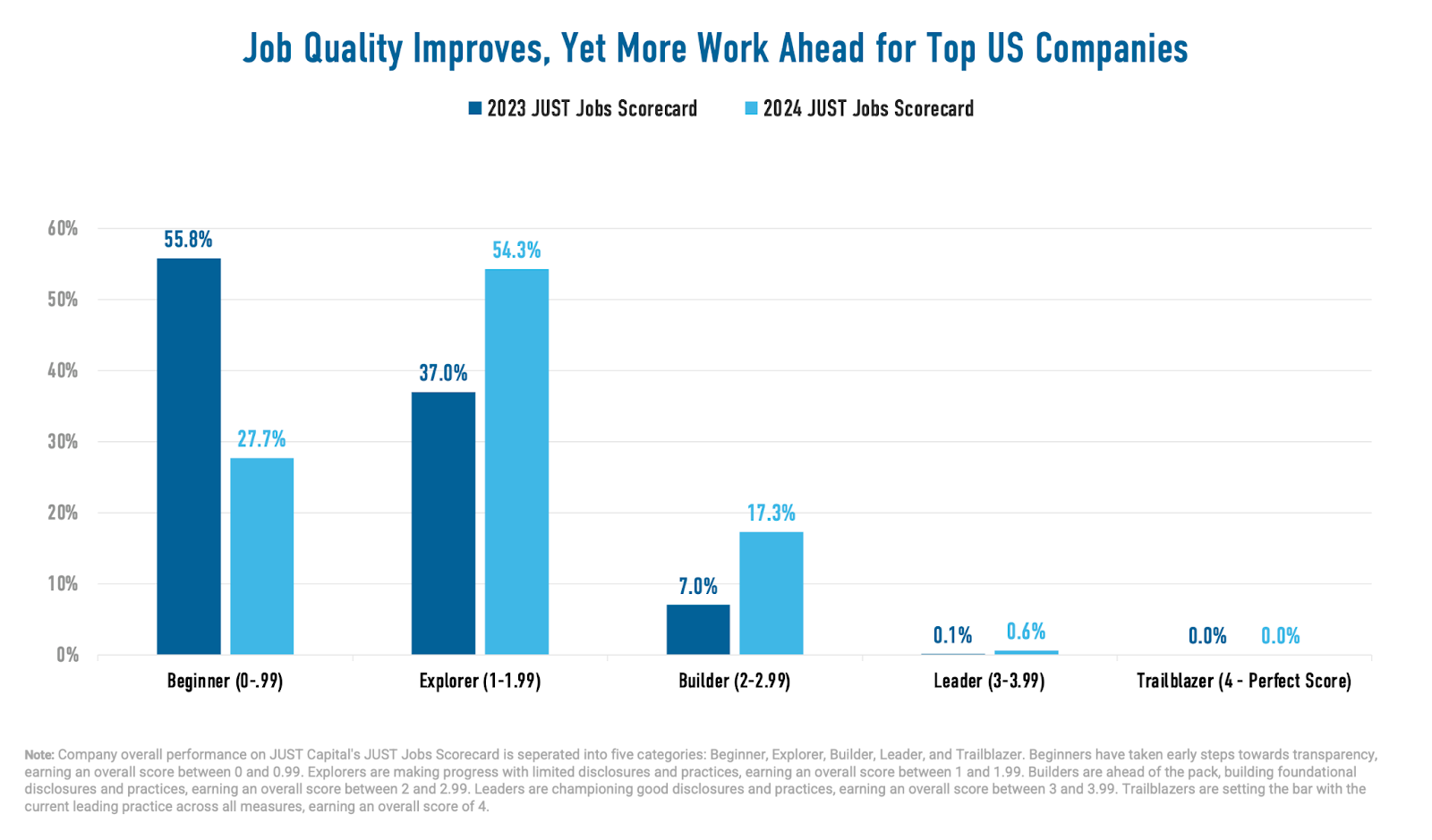
This week’s chart comes from our newly released JUST Jobs Scorecard. While America’s largest companies have more work to do to improve transparency around some key job quality data points, overall performance on the 2024 JUST Jobs Scorecard speaks to noticeable improvement since the 2023 pilot version of this tool. More than one fourth of companies (256 companies, or 27.3% of all scored companies) have moved from the Beginner category (taking early steps towards transparency, overall scores between 0 and 0.99) into the Explorer category. Explore deeper insights here.

Recruitment and retention remain key challenges corporate leaders faced this year. Against a backdrop of unionization drives, strikes, return-to-office plans, and AI evolution, workers are continuing to ask for what they want in a good job and are willing to voice their discontent – or find another role – if they feel overlooked. One central component they’re seeking? Opportunity. A majority of workers expect employers to prioritize advancement, career development, and skills-building – but too many executives are not following through.
JUST Capital’s polling of the American public consistently finds that Americans want to see investment in creating quality jobs that lead to opportunities for the workforce from companies. Americans we polled across party lines overwhelmingly agree that it’s a company’s responsibility to create quality jobs by providing clear career pathways to job opportunities with higher pay (83%) and regularly increasing wages to keep up with the rapidly rising cost of living (87%).
Investing in workers also makes operational sense for businesses. Research shows that when employers give workers learning opportunities in the workplace, they’re less likely to leave. Similar findings highlight that “employment capital” – non-wage components of work like benefits and career advancement prospects – are important to job quality and economic security. JUST data also finds that companies with better disclosure and performance on human capital issues don’t suffer financial consequences beyond short-term profit maximization and tend to outperform their Russell 1000 peers.
When companies invest in their employees’ careers and provide opportunities for advancement within and beyond the company, it’s something to celebrate. At JUST, we firmly believe in the importance of elevating business leadership on the issues of importance to the American people. It’s why we’ve been excited to partner on the Worker Financial Wellness Initiative, create Rankings that track performance on the issues that matter most in defining just business behavior, and highlight the state of disclosure on key workers metrics. It’s also why we’re excited to partner with The American Opportunity Index, which assesses economic mobility and opportunity generation for American workers at some of the largest employers in the country. The Index highlights leaders in real-world outcomes for workers. But what are companies doing to create the conditions that lead to those opportunity outcomes for workers?
JUST Capital is partnering with the Schultz Family Foundation and the American Opportunity Index to connect the dots on how corporate policies translate to real-world outcomes for workers.
In a series of leadership spotlights, we’ll lift up examples of corporate policies and performance, tracked in JUST Capital’s forthcoming JUST Jobs Scorecard, that respond to the American public’s expectations of business today and create the positive outcomes for workers assessed in the Index. This work will serve as an opportunity to learn from leaders about their company’s journey, challenges, and successes in creating opportunity in the workplace. It will illuminate how strategic inputs – commonly disclosed workplace policies – can serve as actionable catalysts for economic opportunity and overall job quality.
The Index assesses how well companies are investing in their workforce to drive business performance and individual employee growth by focusing on worker outcomes, i.e., the level of opportunity workers achieve within the company and beyond. And to understand what’s behind these leaders’ success, we must also look at the policies and practices in place that create an environment in which opportunities for workers to thrive exist.
The series of spotlights on leaders’ policies and practices aims to offer guidance on specific actions that companies can take to drive opportunity and mobility for their workers. It will highlight key practices from JUST Capital’s JUST Jobs Scorecard that yield the impacts measured in the American Opportunity Index. Insights from the forthcoming JUST Jobs Scorecard and the recently released Index can be used together to understand what policies and practices – or inputs – create conditions for opportunity outcomes – or outputs. These tools together offer a look at the corporate journey from policy to outcome and can be helpful in informing job quality and worker strategy.
At JUST Capital, our understanding of companies’ stakeholder performance is grounded in recognizing crucial inputs that lay the foundation for desired outcomes. These inputs, such as pay equity policies and apprenticeship programs, form the basis of our analysis and align with the Index’s five performance areas.
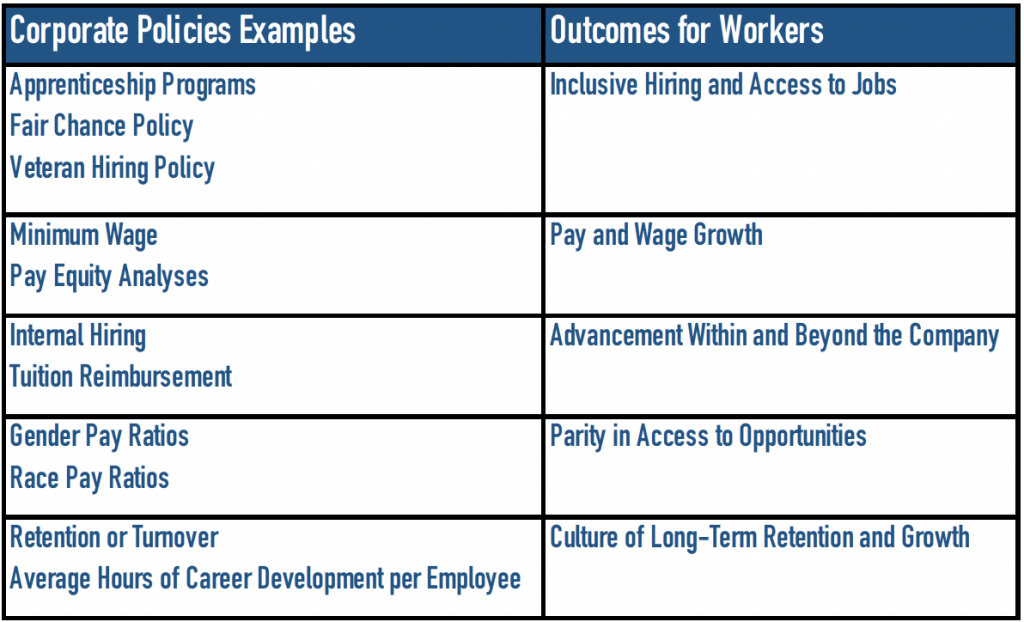
As we establish this connection, it becomes imperative to pinpoint key inputs, or policies, that companies should prioritize when shaping and investing in their workers to influence the outcomes tracked by the Index. Companies can view these inputs as potential actions to adopt, in turn creating the conducive conditions necessary to foster more opportunity for their workers. By strategically implementing and emphasizing these policies, companies can shape a work environment that not only meets performance standards, but also enhances overall job quality and opens up avenues for professional growth and development.
As we delve into upcoming leadership spotlights, there is a valuable opportunity for companies to glean insights and enhance their performance in terms of job quality, influencing the real-world experiences of countless workers. We encourage companies to actively engage with the Index, understanding their own strengths and growth areas, while keeping an eye out for the JUST Jobs Scorecard in early 2024 to delve into specific data details around policies and practices.
For more information on the American Opportunity Index, JUST Jobs Scorecard, our partnership, or more, please reach out to corpengage@justcapital.com.

As 2023 has unfolded, the spotlight on jobs and job quality hasn’t let up. News of layoffs and questions of if and when a recession will hit persist. Some employers are choosing to raise wages as workers across the country feel the impacts of inflation on their wallets. While these issues are exacerbated at the moment, and have been for the last three years, JUST Capital polling has consistently found that the American public wants companies to put their workers first. This is true across demographics we survey, including age, race, gender, income group, and political affiliation.
For companies, navigating how to invest in their workers and prioritize job quality remains a challenge. While there are emerging definitions of what “good” performance looks like, we lack clear standards for what companies should be disclosing and how to benchmark their efforts. To help companies navigate this space, we created the JUST Jobs Scorecard. The JUST Jobs Scorecard is a data-driven, interactive tool that helps corporate leaders assess job quality performance on 28 data points across seven key topic areas and prioritize ways to improve through clear disclosure and performance thresholds from “no disclosure” up to the “leading” practice.
This first iteration of the JUST Jobs Scorecard has provided us with some key insights into what we can currently measure and how we might incentivize more JUST Jobs in America today. The first takeaway is stark: there is low disclosure across all companies, even on basic job quality policies and practices. That fact tells us this is an emerging – not established – area of focus regarding corporate stakeholder performance and disclosure.
Through a more positive lens, corporate leaders can consider it a “blue ocean” opportunity, where leadership can quickly be established by taking action to disclose more data around how they are investing in and supporting their most important value creators – their workers.
Where consensus exists on what data to disclose, how to disclose it, and the business case behind why it’s important, we see real progress. A great example is within Workforce Race/Ethnicity Diversity Data, where we’ve seen disclosure of the gold standard – the EEO-1 Report or similar intersectional data – more than triple in the last year alone.
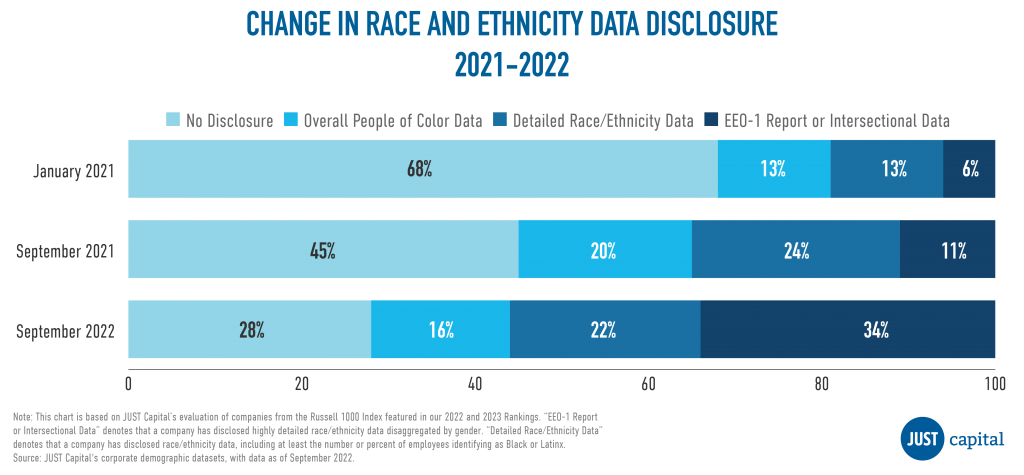
That said, this data point is only one of a few that we are tracking in the Scorecard that have high levels of disclosure. That group includes:
In contrast, disclosure across three quarters of all data points in the Scorecard is less than 40% as illustrated in the chart below:
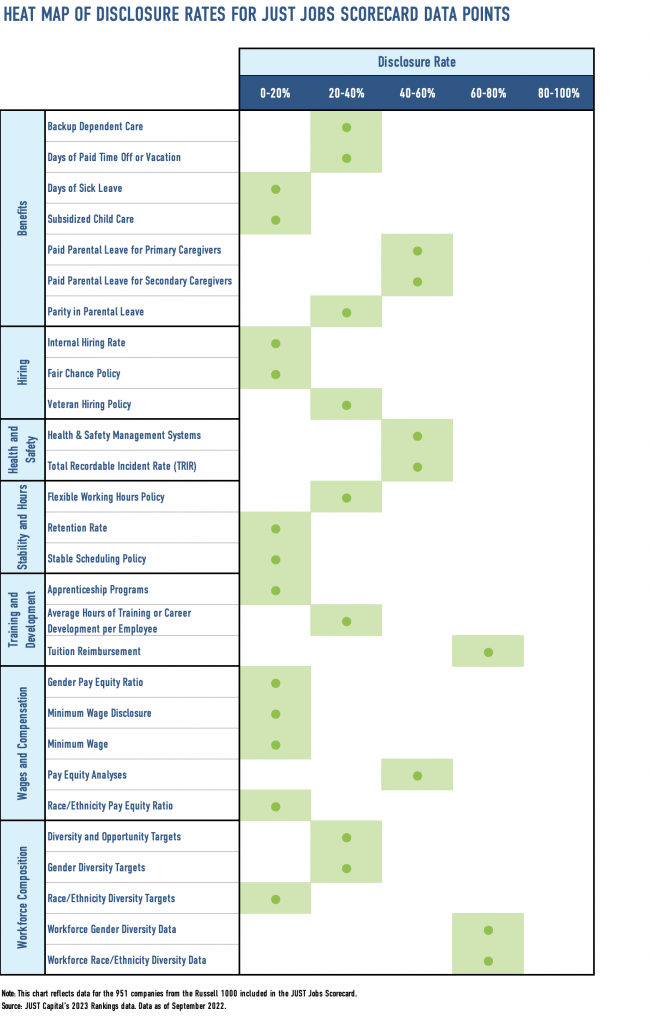
These results indicate a pressing need to incentivize business leaders to increase transparency on key job quality metrics. There is ample benefit for employers: by clearly communicating their employee value proposition, companies are able to better recruit, retain, and advance employees. They’re also meeting the growing expectations of their shareholders. But the current state of disclosure also provides an opportunity for companies to demonstrate leadership as they lean into disclosure and performance improvements on the issues that matter most to their workforces – and to the American public.
Even on some metrics of top priority to Americans we polled, such as wages, the vast majority of Russell 1000 companies lack transparency.
The impacts of the COVID-19 pandemic might lead one to assume that companies are clear about the necessity of disclosing that they provide paid sick leave to their employees. In fact, only 9.3% of Russell 1000 companies disclose any paid sick leave, and some corporate leaders on this issue may not receive their due because of a lack of transparency about that fundamental benefit.
When it comes to retention and advancement – clear indications that a company is a place for long-term growth and opportunity – disclosures are also low: just 4.2% of companies disclose a retention rate and 7.4% disclose an internal hiring rate.
Ultimately, the JUST Jobs Scorecard makes it clear that major U.S. companies have a leadership opportunity, in many aspects, in front of them. Taking action to disclose key job quality metrics, and improve them where needed, can help set a company apart as an employer of choice. It can also establish a company as a leader on jobs at a crucial juncture for the U.S. labor market. And it’ll benefit the bottom line as well.
We took a look at the market performance of the top quintile of companies within the overall JUST Jobs Scorecard Overall Score and Topic Scores. Each area showed substantial alpha in 2022. The top performers in Safety and Training led the way, with 12% alpha each, but the outperformance in each category further reinforces the importance of creating just jobs to drive long-term business success.
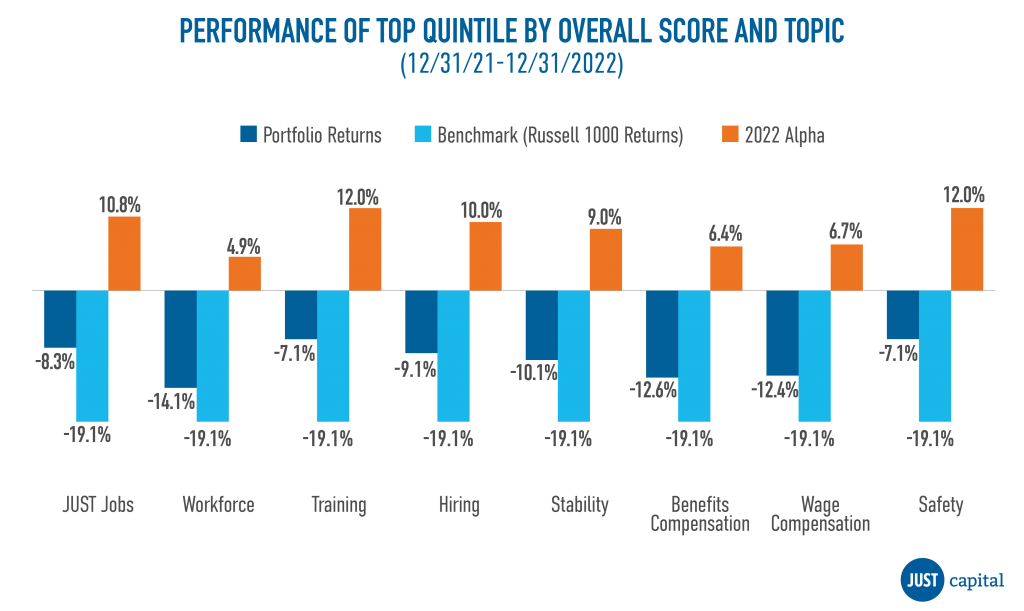
So, the business and investor case are there. Where, and how, to start on the journey remains a challenge for many corporate leaders. That’s where the JUST Jobs Scorecard comes in. JUST Capital will soft launch the Scorecard on April 5, at which point corporate leaders at Russell 1000 companies will be able to view their Scorecards, respond to insights through additional disclosure and guided implementation, and share valuable feedback before a public roll out later this year.
To unpack your company’s performance in the upcoming JUST Jobs Scorecard and gain insights into how to improve on the issues that matter most to the American public, please reach out to corpengage@justcapital.com.
