On Wednesday, June 10, JUST Chairman and Founder Paul Tudor Jones joined Andrew Ross Sorkin on CNBC – along with Nasdaq President CEO, Adena Friedman, and Vista Equity Partners Founder, Chairman, and CEO, Robert Smith – for the second edition of our video series, Building a Just Future: The Road to a More Inclusive Economy.
Watch the full panel below and read the recap here.
We have an opportunity to build a better economy. The question is whether we will seize it.
The COVID-19 pandemic has not only wrought untold human tragedy, it has laid bare the fault lines and fundamental brittleness of our global economic system. By the time we beat back the virus, trillions of dollars in market value will have been wiped out, we’ll face a mountain of debt the likes of which we have not seen since World War II, and – in the United States, at least – we’ll have tens of millions unemployed, hundreds of millions of livelihoods impacted, and a tax revenue base grossly undercut by weaker demand.
History teaches us that crises of this magnitude always leave their mark on society. In this case, I believe permanent change will come to the way we practice capitalism. Not because of some newfound human idealism, though that might happen, but out of sheer necessity. For it’s only by building a more resilient, inclusive, and just economy, where business drives value for all stakeholders, where long-term systems thinking supplants short-term opportunism, and where as many people as possible have a stake in the recovery, that we can generate the breadth and scale of wealth creation now required.
The post-WWII boom of the 1950s and ‘60s was perhaps the greatest period of wealth creation in history. John Maynard Keynes, whose legacy made him the most influential economist of the time, summed up the prevailing wisdom: “prioritizing short-term gains through profit maximization comes to the detriment of long-term value creation, which in turn yields weaker companies that contribute less to society.” This thinking helped to establish the American middle class and drive tremendous gains in productivity and innovation. Annual GDP growth across the OECD averaged 4-5%. Economically speaking, this level of growth is what we must return to.
Business as usual won’t cut it. To have a hope of building the economic engine we now need, the reign of shareholder primacy must end. Milton Friedman’s exhortations to focus corporate purpose solely on shareholders’ needs addressed the problems in the markets in the 1970s and brought much needed discipline to capital allocation. But it is no longer fit for purpose. Even before the coronavirus crisis, we needed a course correction. The U.S. had reached levels of income and wealth inequality last seen in the 1930s. Productivity from 2010-2018 has been merely 0.9%, down from 2.3% from 1990-2008. The costs of continuing down this path are too high.
What coronavirus has done is reset the economy. It has accelerated the need for a new, better operating system that gives more Americans the incentives and, in many cases, the opportunities they need to create broad-based prosperity.
That system is stakeholder capitalism. A system that shares the spoils of victory with those who make it possible. A system that motivates capital to focus on long-term value creation; that promotes disclosure and performance measurement on issues society cares about; that fosters systems thinking and mutual resiliency; and that captures for all time the incredible spirit of community that has characterized corporate America’s response during the crisis itself.
Cynics, of course, will have their say. But those who dismiss the stakeholder approach as either a “publicity stunt” or “window dressing,” or as some sort of backdoor socialist takeover designed to limit market freedoms and redistribute wealth, are either lazy in their thinking or blinded by ideology. We don’t have time for those debates any longer. The jury is not only in, the case is closed and the court has been dismissed.
One by one, over the past few years, we’ve seen stakeholder capitalism gain high-profile champions. The CEOs of the Business Roundtable reversed years of commitment to shareholder primacy to embrace it. The World Economic Forum has put it front and center. The heads of the world’s largest asset management companies, like BlackRock’s Larry Fink and State Street’s Cyrus Taraporevala, have called on CEOs to look past profits at all costs, and the leadership teams of the JUST 100, among others, have answered. Wall Street titans like JUST’s founder and chairman Paul Tudor Jones and Bridgewater founder and chairman Ray Dalio have declared we need to reimagine capitalism. Executive directors of massive pension funds, like the Washington State Investment Board’s Theresa Whitmarsh, have said shareholder primacy destroys long-term value.
In fact, I am hard pressed to come up with any credible defenders of shareholder primacy at this point. Will anyone call for a return to the status quo? I seriously doubt it.
Let this be the moment when all of this talk manifests into reality. For what is plain now is that companies that come out of our current crisis in the best shape will be those that have the strongest relationships with the people who make them flourish. These companies will have a renewed sense of value for the employees and contractors who managed to keep the lights on in our darkest hour. They will have taken steps to support their suppliers – especially the smaller, private businesses that collectively represent the backbone of the U.S. economy. They will have supported the communities where they operate, and bent over backwards to make sure their customers were properly cared for.
The JUST COVID-19 Corporate Response Tracker is capturing and recording all of this, and we have already seen corporations like Target, Starbucks, PepsiCo, and Microsoft taking swift action to ensure the health and financial well-being of their stakeholders through policies like paid leave and community support. It is business at its best.
Needless to say, all of this is also better for shareholders. Research from Morningstar indicates that, in fact, sustainability-led funds are outperforming their peers at this time, as they have in previous crises. The emphasis on quality companies that invest for long-term impact combined with lower ESG risk validates the argument for sustainability as a hedge during down-markets. We are seeing this firsthand as our own JUST Index is outperforming the S&P 500 in this same period. Almost all of the investors we talk to believe that the crisis will accelerate interest in ESG strategies, as well as influence the underlying strategies themselves, mostly by emphasizing the “S” – the social factors that are currently so critical.
The struggle against the coronavirus has often been likened to wartime. It’s an unfortunate but apt comparison, and one that enables us to see our way through to society’s full recovery. We will get there, but the world won’t look the same. JUST Capital, and the network of organizations we work with, will do what is necessary to guide us on this journey.
This article was originally published at Forbes.com.
Today, State Street CEO Cyrus Taraporevala announced that they would be using their proxy voting power to ensure companies were identifying material ESG issues and incorporating the implications into their long-term strategy. This is a big move, and echoes the plans by BlackRock to embed sustainable investing principals into its core strategy.
We agree that ESG is no longer an optional consideration – they are vital metrics and indicators for the long-term financial sustainability of a company.
Taraporevala said as much during our Bloomberg Investor Breakfast last year. When asked about the future of ESG investing, he stated “my hope is that within the next 5 or 10 years, ESG investing will just be considered investing.”
Watch below:
EPFR and Informa Financial Intelligence released a staggering chart this week, showing that as wider equity markets have lost funds, ESG funds have only seen their investment levels increase. It’s another piece of data showing that investors are realizing that ESG considerations are vital to the long-term sustainability of a business.
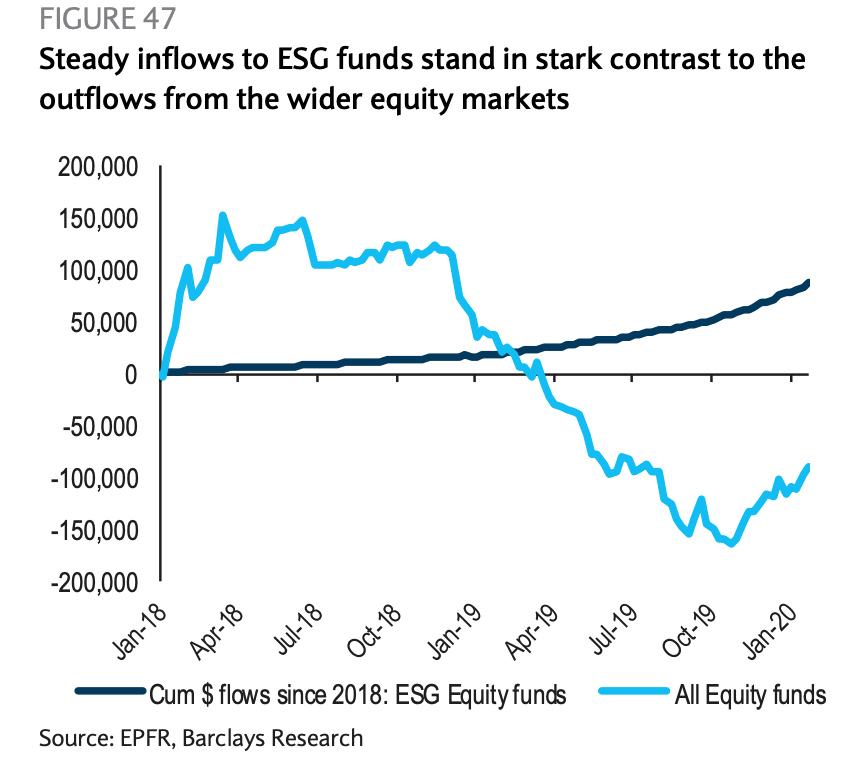
For more of their research, click here.
Back in August, the Business Roundtable, an association of the chief executive officers of nearly 200 of America’s largest and most influential companies, released a new Statement on the Purpose of a Corporation. After 41 years of endorsing a governance model of shareholder primacy, the organization boldly committed to focus on delivering value to all its stakeholders, “for the future success of our companies, our communities and our country.”
181 CEOs signed the Statement, committing to lead their companies for the “benefit of all stakeholders – customers, employees, suppliers, communities and shareholders.”
Critics of the shift generally fell into two camps – those who believed the Statement went too far, undermining fiduciary duty, and skeptics who believed it didn’t go far enough, representing mere words, not actions.
For the converted, many saw the Statement as a reflection of how many top CEOs currently run their companies, while others saw it as a historic paradigm-shift that would help companies, boards, and investors chart a new course for the future of capitalism.
Regardless of where you stood on that skeptic-to-convert spectrum, everyone started asking for a scorecard that would help us understand how these companies were actually performing on key stakeholder issues.
JUST Capital has the answer. Our mission, as a nonprofit organization, is to openly and transparently measure, in a data-driven way, corporate performance on stakeholder issues, as well as to incentivize improvements. We have been doing this for four years. We are also the only organization tracking how the American public thinks about stakeholder performance, and which issues they prioritize.
Today we are pleased to release a stakeholder analysis for the Business Roundtable Signatories, based on the analysis that fuels our 2020 Rankings of America’s Most JUST Companies, as well as our own framing for how companies can optimize the creation of value in this new era of stakeholder capitalism.
JUST Capital has polled more than 96,000 Americans over the past five years to intimately understand which issues the public wants corporations to prioritize to restore trust and create an economy that serves all Americans. We also have four years of corporate performance data on those issues, as well as market analysis that shows the business and investment case for adopting these business behaviors.
By the Numbers
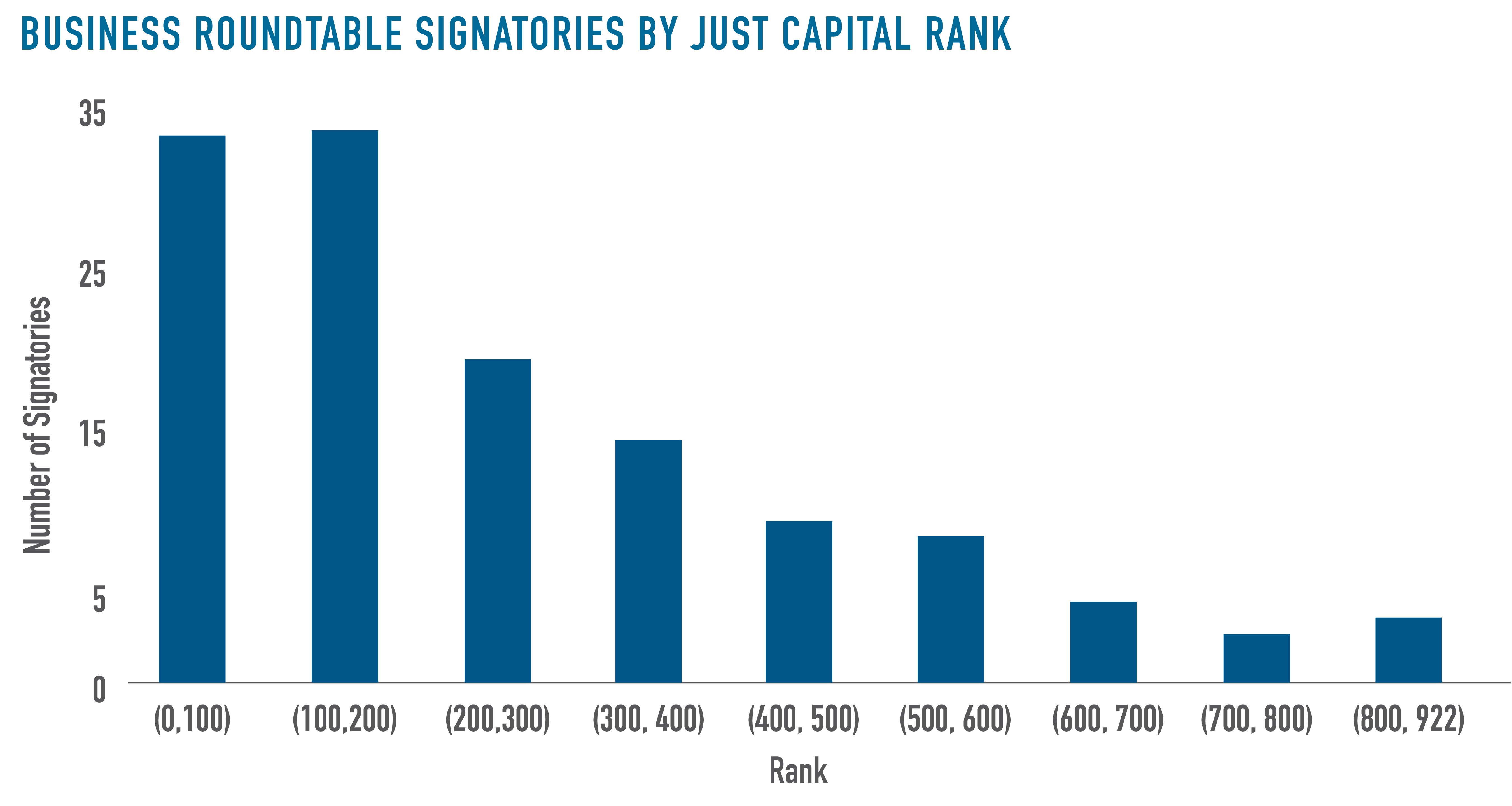
Overall, a healthy majority of the Roundtable’s signatories scored well this year. They are not performing quite as well as the top companies, the JUST 100, but are close. And 34 of the signatories are, in fact, featured in the JUST 100, including Apple, Salesforce, Anthem, P&G, Cisco, GM, IBM, AT&T, Accenture, and Xylem.
Our analysis is based specifically on 134 of the 181 signatory companies, as we track, measure, and rank Russell 1000 companies each and every year. If a company is not included in the Russell because they are a private corporation or for other rules-based reasons, we do not yet have data on those companies. For the 134 signatories that were included in our universe, we analyzed those companies across five stakeholder groups – including Workers, Customers, Communities, the Environment, and Shareholders – covering 29 Issues – like whether companies pay a living wage or protect the environment, and over 400 data points – from paid parental leave to veteran hiring and supplier policies.
Here’s how 134 of the Business Roundtable signatories stack up:
Serving Stakeholders
So aggregate performance was high. We next explored how the Business Roundtable signatories performed regarding key issues relating to each stakeholder.
First a note to explain that our stakeholder definitions are modestly different than the Business Roundtable’s purpose statement framing. We think similarly about employees (which we categorize as “Workers”), Customers, and Shareholders. The Roundtable considers issues relating to the environment and sustainable business practices as a component of how they serve communities, whereas the American public sees the Environment as a separate stakeholder. JUST combines supplier issues that matter most to the public – like upholding human rights standards in the international supply chain and supporting local, diverse, and veteran suppliers in the communities in which they operate – within our Communities stakeholder, rather than breaking suppliers out as a separate stakeholder.
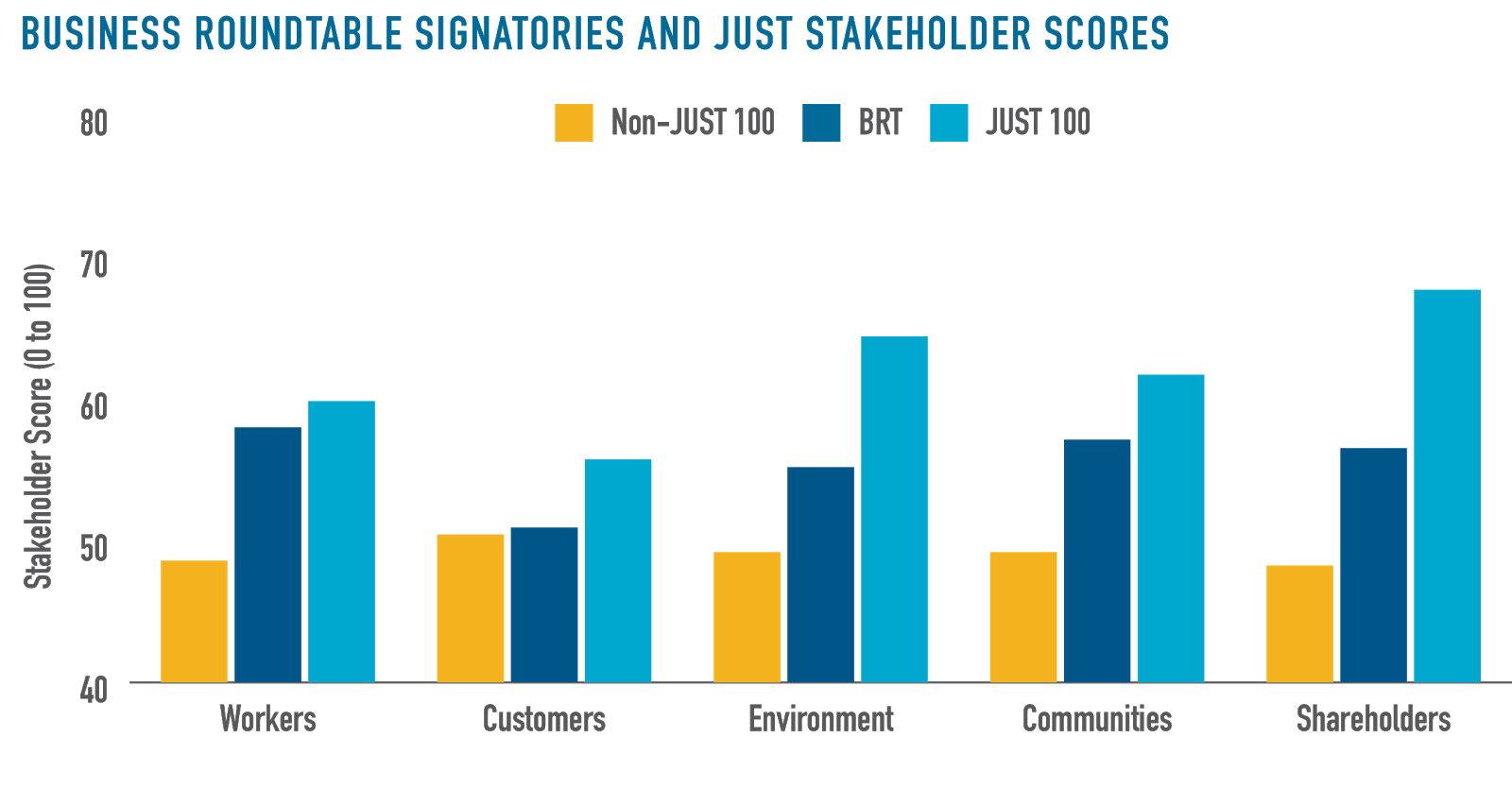
Overall, you can see that the 134 Business Roundtable signatories are performing well above average when it comes to serving their stakeholders, except for Customers, where we are measuring issues like creating quality, safe products that do not harm health, the environment, or society, and protecting privacy.
Specifically, compared to other Russell 1000 peers not in the JUST 100, the Business Roundtable signatories perform:
Note: the “Non-JUST 100” category above includes all of the Russell 1000 companies we rank minus the JUST 100.
Impacting the Future
While the current performance of the Business Roundtable signatories shows that many of the top companies are already operating with a stakeholder-focused mindset compared to their peers, increased investments by this incredibly influential community of corporations could have massive ripple effects throughout our economy.
For instance:
In the coming year, we will continue to track the actions they make toward their commitment – to support their workers, customers, communities, and more – in an effort to understand how this shift toward stakeholder capitalism impacts our economy, and the lives of all Americans.
On December 10, we celebrated America’s Most JUST Companies in New York, along with Forbes, JUST 100 leaders, and special guests from the business, investment, and impact communities.
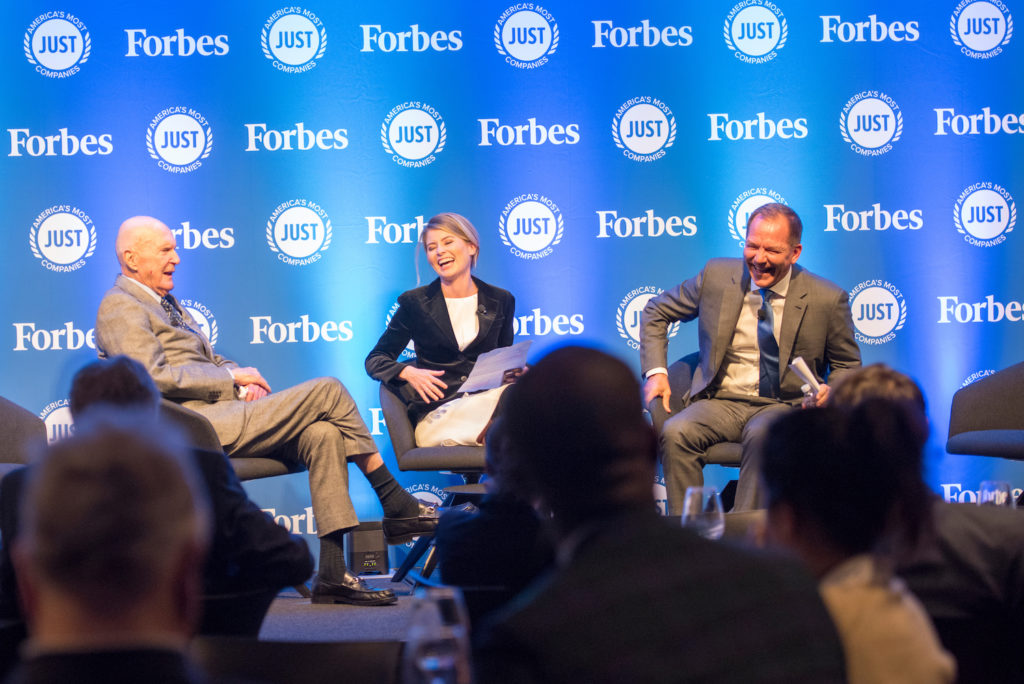
JUST Capital Co-Founder and Chairman Paul Tudor Jones II kicked off the night with a lively conversation with legendary hedge fund manager Julian Bloomberg anchor Vonnie Quinn to discuss the markets and the business case for being just:
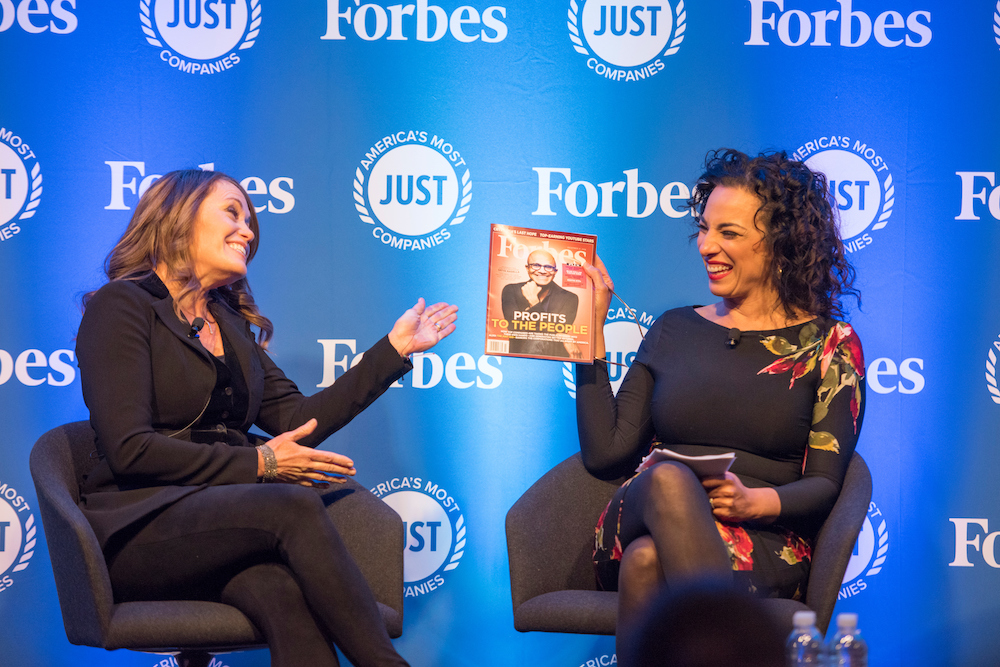
Peggy Johnson, Executive Vice President of Microsoft and Michelle Miller of CBS then unpacked how America’s Most JUST Company is transforming its culture and products to do right by the people it serves.
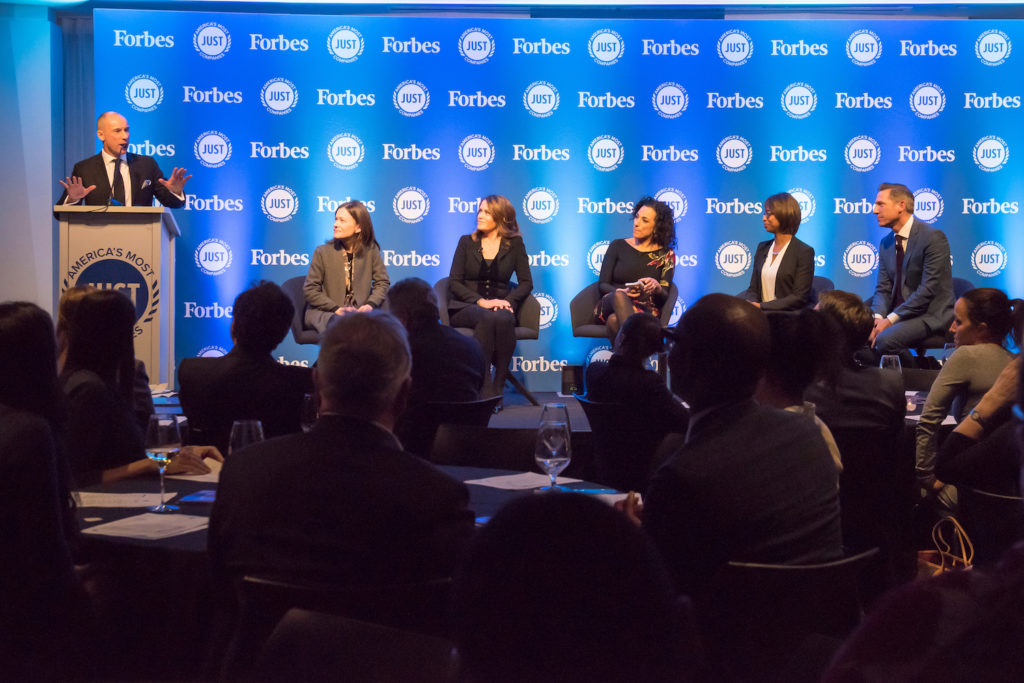
Finally, Michelle and Peggy were joined on stage by Alicia Boler Davis, Executive Vice President, Global Manufacturing, General Motors, Craig Buchholz, Chief Communications Officer, Procter & Gamble, and Ardine Williams, Vice President of Worldwide People Operations, Amazon for a provocative discussion on leading just companies through turbulent times.
Watch the video of the complete program here:
And stay tuned as we are thrilled to continue to highlight companies doing right by America and their work in building a more just marketplace that works for all. Here are some more favorites from the celebration:
