
This report was written by Daniel Krasner, Rachael Doubledee, and Matthew Nestler.
Just Capital’s data shows the overwhelming majority of Americans from all political and demographic backgrounds want companies to prioritize worker wages. Until recently, the conversation has centered around workers who are on a company’s payroll.
But now, some business leaders are recognizing their power to set standards not just for their own workforce, but also for the companies that comprise their supply chains, the vast network of companies that support another’s operations.
New Just Capital research identified five companies mandating or encouraging their supply chains to pay their workers a living wage: Accenture, Morgan Stanley Capital International (MSCI), Smartsheet, Analog Devices, and Teradyne.
But there’s much room for leadership in this area. Of the Russell 1000, just 30 have policies on living wages for supply chain workers, per the analysis.
Addressing worker wages in a firm’s supply chain helps boost the bottom line. One report published by the University of Cambridge and other partners noted benefits of living wages, including decreased human capital losses due to increased retention and lower turnover. In the supply chain, this translates to greater reliability and higher quality products from suppliers. Influencing suppliers to treat workers fairly, pay a living wage, and actively supporting suppliers in attaining these targets is an important strategy that some companies are already adopting.
It also helps companies protect their reputations. Pressures from expected EU Regulations and recent headlines around American companies’ labor violations and exploitation of migrant children have underscored the importance of accounting for supply chains, and ensuring that they are reliable and do not expose companies to reputational risk.
CEOs focusing on their workforces and supply chains have tremendous power to reshape the American economy, Just Capital’s joint research with Revelio Labs estimated that roughly 11.1 million workers do not make enough money to support a family of two working adults and two children.
In this report, Just Capital outlines the current state of America’s largest companies when it comes to supplier wages, as well as best practices for business leaders.
To understand how companies influence suppliers on living wage, we took a closer look at disclosures of America’s largest public companies. We found that just 30 companies in the Russell 1000 require or encourage suppliers to pay their employees a living wage. Out of those 30, nine companies describe this policy as a supplier requirement.
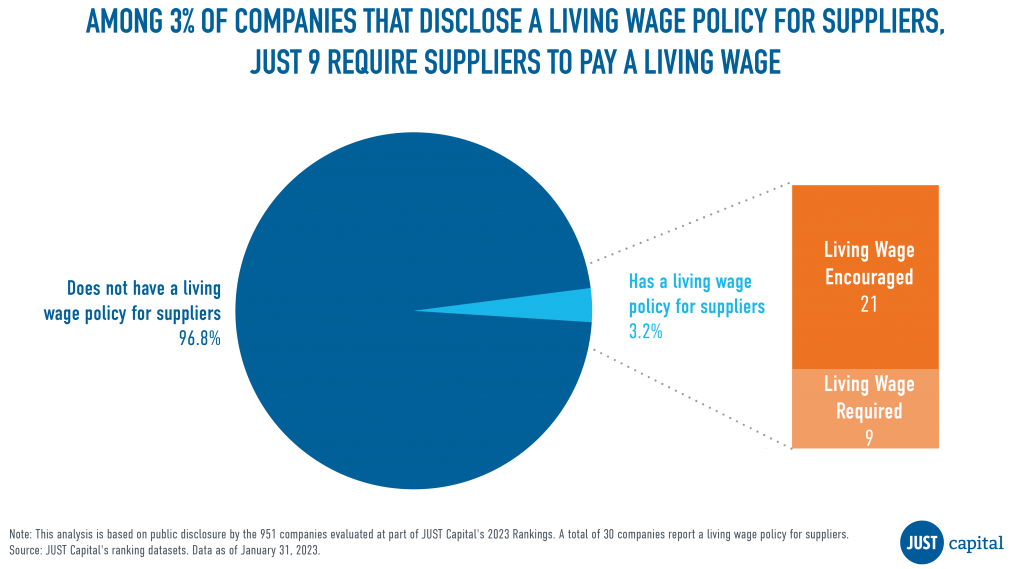
Companies who introduce living wage clearly with a definition and guidelines help suppliers understand, prioritize, and conform to requirements.
Although there are multiple living wage estimators and accrediting institutions, both domestically and internationally, they all follow similar methodological approaches and include common elements when estimating a basic needs budget. At Just Capital, we use MIT’s Living Wage Calculator to evaluate company wage performance for their United States employees on two population-weighted national average living wage estimates. These estimates provide two wage thresholds for different family sizes (one full-time worker with no children and two full-time workers with two children).
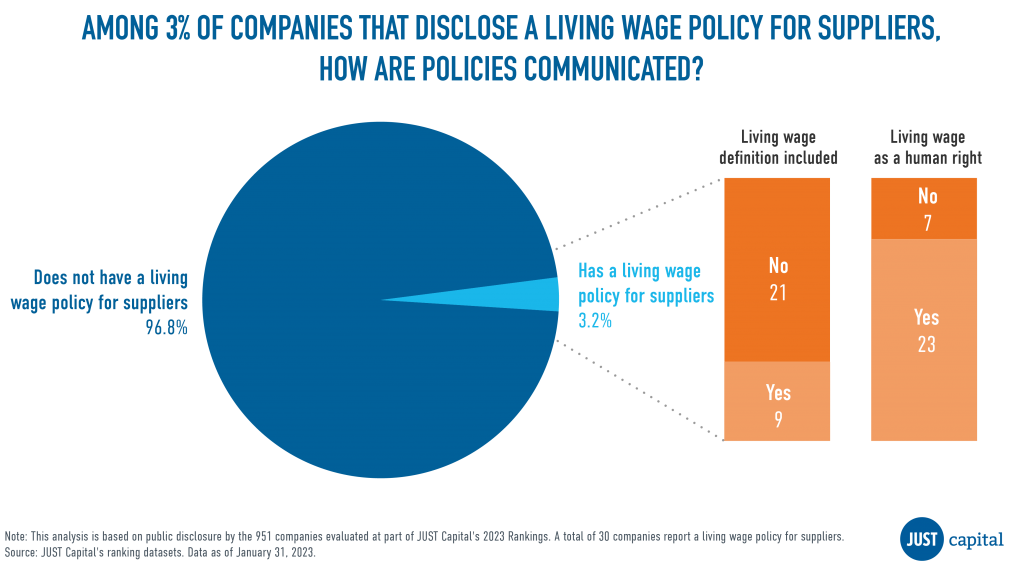
Of the 30 companies that encouraged or mandated living wages for supply chain workers, 23 companies stated that they considered receiving a living wage to be a human right. Interestingly enough, we found that only 9 of the 30 companies included a definition of living wage.
To better communicate their expectations to supply chain partners, companies can publicly clarify how they understand the concept of living wage by publishing a definition.
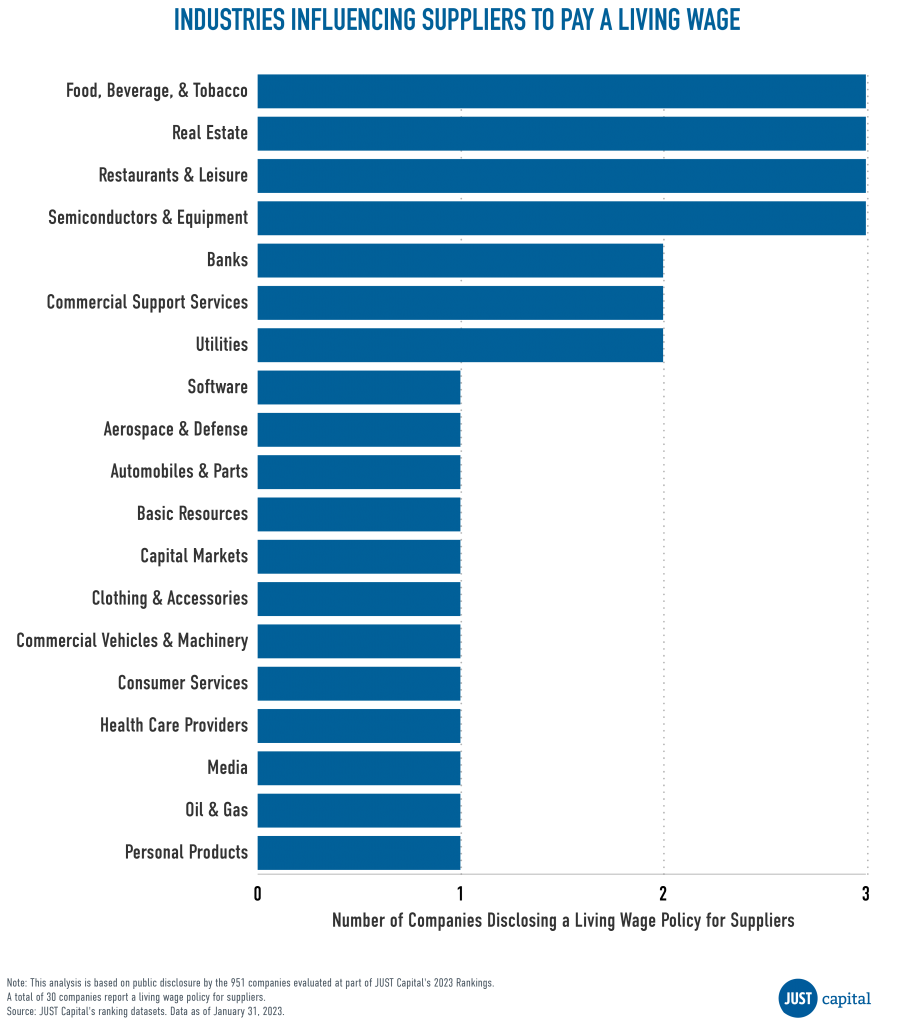
While we expected to find that companies who influence their supply chains to provide a living wage might be concentrated in industries with short supply chains and majority white collar workers, instead, we found that there is low but somewhat industry-distributed traction around companies encouraging or requiring their supply chains to pay a living wage. 19 out of the 36 industries we track (or 53%) were represented across the 30 companies that influence their suppliers to pay a living wage. The sheer diversity in the companies recommending this important benchmark to suppliers demonstrates that for these industries, the concept of living wage is not a foreign concept.
Through our analysis we identified five companies: Morgan Stanley Capital International (MSCI), Accenture, Analog Devices, Smartsheet, and Teradyne who are leading on supply chain living wage commitments as well as wages for their own employees. In modeled estimates (produced by Just Capital in partnership with Revelio) of the share of employees earning a living wage at each Russell 1000 company, all five of these organizations were in the top quartile of companies in terms of that predicted share. What’s more, all five disclosed a living wage policy or encouragement for suppliers. These companies’ approaches suggest three best practices in supply chain living wage commitment disclosure:
Morgan Stanley Capital International (MSCI) (Commercial Support Services)
Morgan Stanley Capital International (MSCI) is a research firm focused on investments and stock analytics. They have some of the strongest language in the Russell 1000 around disclosure, requiring rather than encouraging that suppliers pay their employees a living wage. In addition, MSCI provides a clear definition of living wage which is essential in influencing behavior change.
Accenture (Commercial Support Services)
Accenture specializes in strategy and consulting around a broad range of services for companies to optimize their business operations. Accenture is headquartered in Dublin, Ireland, and works to scale living wages throughout their own operations and supply chain.
Accenture has developed an action plan and targets for scaling living wage throughout their global operations and supply chain, and they regularly disclose progress and update targets. They currently hold a ‘real living wage’ accreditation in the United Kingdom, and require suppliers in the United Kingdom to pay employees a living wage. At present, they strongly encourage suppliers in global operations to pay a living wage. As part of their work with suppliers, they also employ best practices such as regularly reviewing supply chain practices. They are meaningful contributors in the global conversation about living wage, and frequently collaborate with the World Economic Forum to provide guidance and best practice solutions.
Analog Devices Inc (Semiconductors & Equipment)
Analog Devices, Inc. (ADI), is an integrated circuits company based in Wilmington, Massachusetts. Analog devices is one of the few companies in the Semiconductor Industry that encourages suppliers to provide a living wage to employees as an addition to scaling living wage in their own workforce. ADI has identified living wage as a key focus area in self-education to improve their own operations and supply chain practices. While they do not offer a definition of living wage yet, they are clear in providing guidance on how they would like suppliers to treat their employees– recommending suppliers provide employees with paid vacation and sick leave.
Smartsheet (Software)
Smartsheet specializes in project management and team collaboration software. While they do not define living wage for suppliers or their own operations, they do require suppliers to pay employees a living wage. They also include additional working conditions that suppliers are required to uphold including a safe and healthy work environment, and ethical conditions. Smartsheet has an eye toward passing the living wage down past their own operations and suppliers; in addition to requiring that suppliers pay a living wage to their employees, they also require that suppliers also pay their own contractors a living wage and guarantee the same working conditions. This kind of impact is far reaching, leveraging multiplier effects to create positive changes in workers wages well beyond their own operations.
Teradyne (Semiconductors & Equipment)
Teradyne is a semiconductor company specializing in test equipment headquartered in North Reading, Massachusetts. Teradyne discloses that they ensure a living wage for their own employees through their own labor practices, and they expect suppliers to follow the same practice. While they do not supply a definition of living wage, they have focused efforts on improving their supply chain practices, and clearly disclose strategies and processes taken to improve and engage supplier practices. They outline a management approach designed to ensure that they are implementing responsible sourcing practices that engage all stakeholders in their own company, environment, governance, the communities they impact and in the products that they produce.
Calls from both the American public and shareholders for greater transparency into corporate spending on political campaigns and lobbying efforts are not new, but they have grown louder and more insistent in recent years. Corporate America’s response to the attack on the U.S. Capitol on January 6, 2021 brought greater attention to if, and how, companies disclose their lobbying spend and contributions they make to political candidates.
A 2022 survey from JUST, Ceres, and Public Citizen found 80% of Americans think it is very/somewhat important for companies to disclose their political donations and lobbying. And 81% would support federal requirements on political spend and lobbying. Participants in focus groups reaffirmed the importance of greater transparency, suggesting that the American public would trust a company more if they clearly disclosed their actions, including spend on political and lobbying activities. The public wants to see that companies are following through on their commitments – especially as political spend is seen as affecting the regulatory processes that protect workers, the environment, and communities.
Companies’ hesitancy to clearly disclose political and lobbying spend has long been a source of scrutiny from shareholders. Investors have continued to push for more public data as reporting requirements on political contributions vary by state, making clear, detailed information even less accessible. As proxy season gets underway, investors’ focus is only intensifying. A recent report from As You Sow analyzing ESG-related shareholder proposals found one in five were on “political influence,” including lobbying and contributions, second only to climate.
Given this heightened call for transparency – and the opportunity companies have at hand to increase trust – we took a look at if and how Russell 1000 companies disclose their political spend and/or lobbying efforts through public-facing corporate materials.
Across the Russell 1000, our analysis found that 31% of companies disclosed spend for both political contributions and lobbying clearly through their brand’s public-facing online presence. On the other hand, 44% of companies did not disclose both political contributions and lobbying spending. Of the remaining companies, 24% disclosed political contributions, but not lobbying spend. Less than 1% of companies disclosed their lobbying spending, but not their political contributions.
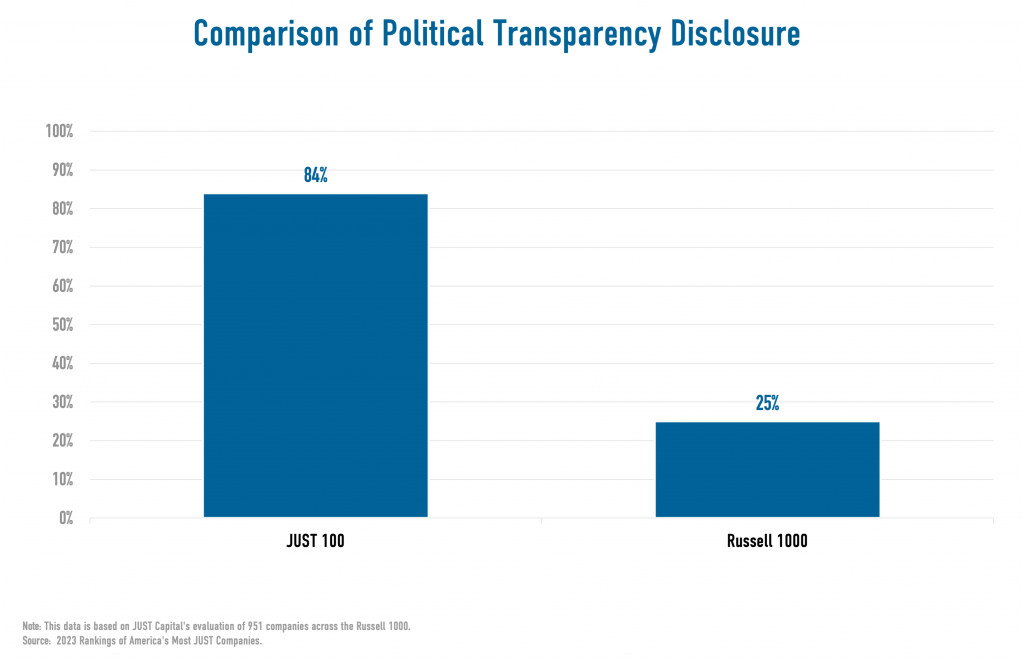
While disclosure of political spending is low across the full Russell 1000 companies within the JUST 100 – the top 100 companies in our 2023 annual Rankings – provided significantly more disclosure on their political spending than the remainder of the Russell 1000. Of the JUST 100, 84% provide disclosure on both political contributions and lobbying spending, compared to only 25% of the companies outside of the JUST 100. Similarly, only 1% of the JUST 100 provide the lowest level of disclosure with no mention of either practice, compared to 49% of the rest of the companies in our Rankings.
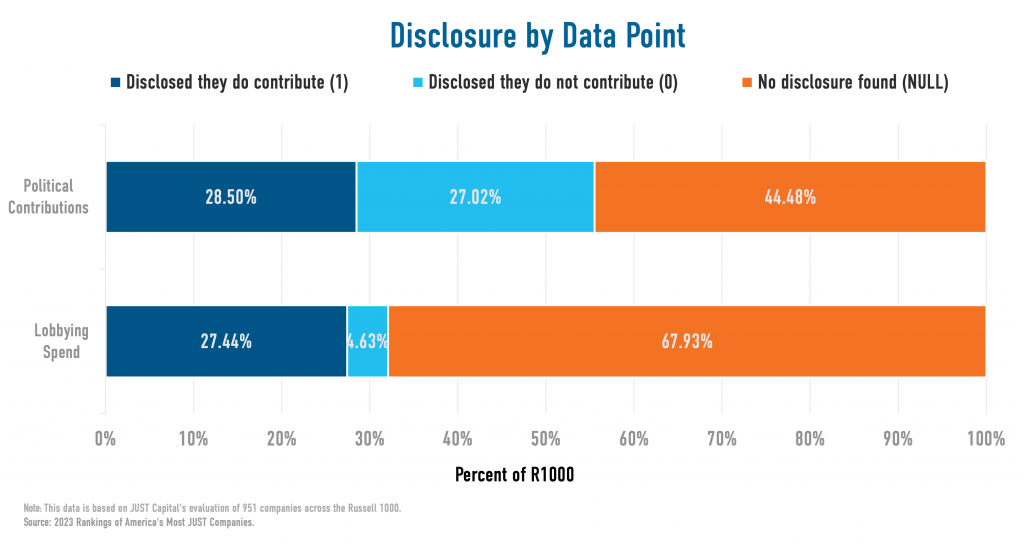
Overall, companies were less likely to disclose lobbying spending than political contributions. Across the Russell 1000 companies we rank, 55% disclosed that they made political contributions or explicitly stated that they did not make political contributions compared to 32% of companies who disclosed that they spent money on lobbying efforts or explicitly stated that they did not partake in lobbying. Following this trend, 67% provided no information on their lobbying spending compared to 44% of companies who did not provide disclosure of their political contributions.
Across all 36 industries JUST Capital analyzes, Utilities and Energy had the highest percentages of companies that disclosed clearly on both political transparency metrics. Utilities emerged as the clear overall leader with 82% of companies within the industry providing transparent political disclosure. Energy-related industries such as Energy Equipment & Services and Oil & Gas followed similar patterns of disclosure, with the largest shares of companies in those industries disclosing transparently on both lobbying and contributions.
Technology and Finance industries had the lowest rates of political transparency. Software emerged as the overall industry laggard, with the lowest percentage of disclosure on both political transparency data points – 72% of companies within the industry provided no disclosure on both political contributions and lobbying spending. Computer Services, Internet, and Technology Hardware follow a similar pattern of behavior, with the smallest share of companies disclosing both, the largest share disclosing neither, and the second largest share disclosing only political contributions.
Finance l industries similarly struggled to disclose their political and lobbying behaviors. Consumer & Diversified Finance was the overall runner-up behind Software for least transparent disclosure as 67% of companies in this industry provided no disclosure. Banks and Capital Markets follow a similar pattern, with the largest percentage of companies within these industries choosing not to disclose on both political and lobbying behaviors.
While disclosure may seem risky, transparency and trust go hand in hand for the American public. Providing more disclosure and transparency on their political behaviors is one way companies can help curb the public’s growing distrust of large corporations. The leading industries in this space are no strangers to scrutiny, and have benefitted from clear disclosures that allow them to stay ahead of messaging, reduce reputational risk, and increase trust in consumer confidence. Interestingly, the laggard industries in this space are now under scrutiny that the leaders have long occupied.
As activist shareholders and the general public continue to demand greater transparency in how companies follow through on commitments to their stakeholders, lobbying and political spending has increasingly been raised alongside the social and environmental efforts these funds are seen as helping or hurting. To weather scrutiny in the public square, companies looking to increase trust can ensure that their political and lobbying spends match their brand values and public commitments, and transparently disclose their spending.
To unpack your company’s political disclosure performance in the 2023 Rankings and gain insights into how to improve on the issues that matter most to the American public, please reach out to corpengage@justcapital.com.

The events of the last few years — from the pandemic to the overturn of Roe v. Wade — have eroded the lines between corporate and public affairs, and CEOs are feeling the pressure. They’re being asked by internal and external stakeholders to weigh in and take action on social and political issues, from LGBTQ rights to climate change.
At the same time, they are hearing from others who believe corporate social responsibility has gone too far, a topic JUST recently discussed with Edelman’s U.S. Head of Social Impact and Sustainability, and who think it’s distracting them from the business of making money. With the 2024 presidential run right around the corner, CEOs aren’t likely to find reprieve.
JUST Capital is continuing our occasional interviews with experts on hot-button, in-the-news topics that CEOs and market leaders must navigate.
So to get a sense of how business leaders can navigate the debate around America’s democratic values, we turned to Rhett Buttle, Founder and Principal of Public Private Strategies, and Daniella Ballou-Aares, Founder and CEO of the Leadership Now Project. Both Buttle and Ballou-Aares’ organizations are founding partners of the Business and Democracy Initiative, a coalition that works to mobilize business to help restore trust in democratic institutions, recognizing the close ties between healthy democracies and healthy economies.
In his annual letter to shareholders, JPMorgan CEO Jamie Dimon reiterated that protecting democracy should be a priority across the political aisle. And JUST’s polling of the American public reinforces that.
We found that 72% of Americans say corporate America has a responsibility to protect the democratic process by promoting free and fair elections. Whether this sizable majority is in agreement with what exactly this means is not clear, however, regardless of politics we have also found that 81% of Americans think it is very or somewhat important for companies to disclose their political donations and lobbying efforts.
In other words, be more transparent about who and what you’re supporting with your corporate dollars. Notwithstanding, recent JUST analysis finds that only 31% of Russell 1000 companies are disclosing spending on political contributions and lobbying.
Buttle and Ballou-Aares explained the importance CEOs play in making change and why business leaders should continue to take meaningful action on issues that are important to them.
As trust in the government, media, and other institutions remains low worldwide, business leaders have emerged as relatively more trusted to be transparent and put the interests of their stakeholders first.
The 2022 Edelman Trust Barometer showed that business is the world’s most trusted institution. And the firm’s 2023 report found that business was the only institution seen as competent and ethical.
“People don’t feel that the government is responsive to their interests and needs and are looking for leadership elsewhere,” Buttle and Ballou-Aares said. “That’s part of why CEOs are in the hot seat.”
CEOs can exercise their power without getting deep into political quarrels, the experts explained. We heard similar sentiments from the American public in our recent focus groups. The public wants to see companies take action in a way that’s above the partisan fray, and relates to the core interests of their business and stakeholders.
“The reality is that companies have a lot of power politically, including to undertake efforts that make the political system more representative and accountable,” they said.
Buttle and Ballou-Aares pointed to recent historical examples of how CEOs have spoken out on issues that are important to their constituents, like the broad coalition of business leaders last year advocating for Electoral Count Act reforms that passed with bipartisan support.
“Business leaders have a legacy of supporting critical and lasting change. The trouble is that the conversation around this topic has been warped,” Buttle and Ballou-Aares said.
There is evidence that some business leaders are resorting to “greenhushing,” the act of refraining from speaking publicly on climate policy (and anything that could broadly be called “ESG”), in response to business getting sucked into polarizing political battles. And this, ultimately, could be more harmful than helpful to their relationships with their stakeholders, Edelman’s U.S. Head of Social Impact and Sustainability Alex Heath recently told JUST.
But Buttle and Ballou-Aares said CEOs should weigh the risks of speaking up with the costs of staying silent.
“Freedom of speech is fundamental to our democracy and our economic stability. Rather than standing down in the face of retaliation, companies have a vested interest in working together to uphold our democratic values,” they said. Ballou-Aares pointed to recent comments Disney CEO Bob Iger made at a shareholder meeting to illustrate her point.
Media bias, cancel culture, and managing different stakeholders make speaking out a difficult decision for CEOs. But Buttle and Ballou-Aares underscored that the American public wants to hear from its business leaders. “Business leaders should be confident that their voices matter and that the people they interact with – from employees to customers to communities – want to hear from them on critical issues.”
Buttle and Ballou-Aares draw explicit connections between democratic stability and economic strength, “Unstable governments are considered likely to interfere in free markets and to be generally unsafe global investments. Healthy democracies, meanwhile, are known to enable strong business environments.” This is true regardless of partisan politics, and it’s why business leaders must be ready to act on to protect our democracy, the cornerstone of a dynamic and inclusive economy.
Learn more about the Business and Democracy Initiative and explore additional steps the Leadership Now Project recommends business leaders take to protect democracy.
Note: Rhett Buttle and Daniella Ballou-Aares answered questions for this interview in writing and and both on behalf of the Business & Democracy Initiative.

This report was written by Jordyn Avila, Senior Strategic Partnerships Manager, Corporate Impact, and Matthew Nestler, Director of Research Insights, Corporate Impact.
In recent years, the COVID-19 pandemic has exposed the severity of America’s ongoing childcare and caregiving crises – with a recent analysis showing that 22% of American workers are also caregivers. Reports suggest that the childcare industry continues to deteriorate, exacerbating the obstacles that working parents already face in achieving work-life balance, including the lack of federally mandated parental leave.
In a recent Just Capital survey, we found that 64% of Americans believe that in order to promote gender equity in the workplace, it is necessary for companies to provide at least 12 weeks of paid parental leave to all workers.
Despite strong support from the public, there is no guaranteed paid leave for the American workforce. The United States is one of just seven countries in the world without paid maternity leave and one of 83 without paid paternity leave. In the U.S. today, only the Family and Medical Leave Act (FMLA) provides eligible employees up to 12 weeks of unpaid leave per year, compared to an average of 29 and 16 weeks of paid maternity and paternity leave, respectively, among countries with mandated parental leave. Furthermore, just 56% of American workers have been found to be eligible for FMLA leave, with numbers even lower for people of color and low-wage earners. As of January 2023, 13 states and Washington DC offer paid parental leave (with five policies not yet in effect), though not all offer the 12 weeks Americans agree are necessary.
Due to this lack of governmental support, it’s largely up to companies to take the lead on paid parental leave. And with just 23% of civilian workers estimated to receive paid family leave – and only 12% of low-wage earners in the private sector – the need for action is urgent. Furthermore, paid parental leave is not only beneficial for working families. Because it provides opportunities for increased labor force participation and potential GDP increases, as well as improved employee performance, paid parental leave can strengthen companies and the economy overall.
In an effort to better understand how corporate America is currently delivering on this issue, we analyzed whether America’s largest companies – the Russell 1000 – disclose paid parental leave policies, and if so, what that disclosure looks like. This analysis is part of our new Corporate Care Network – which will explore how companies are supporting working families and spotlight best practices from corporate leaders taking the lead on issues from subsidized child care to paid parental leave. Dig into the full findings below.
In analyzing the Russell 1000 companies we rank, we found that 60%, or 568 companies, disclosed a paid parental leave policy as of September 2022 – a 13 percentage point increase over the year prior when 47%, or 444 companies, disclosed.
While this increase is heartening, when we look closer at the data we find that far fewer companies disclose the specific number of weeks offered to primary and secondary caregivers, with 43%, or 408 companies, providing the number for primary caregivers and 41%, or 388 companies, disclosing the same for secondary caregivers. We did find that, like the overall disclosure percentages, these numbers also increased over the past year, with 47 more companies disclosing the number of weeks for primary caregivers (38% to 43%) and 36 more disclosing for secondary caregivers (37% to 41%).
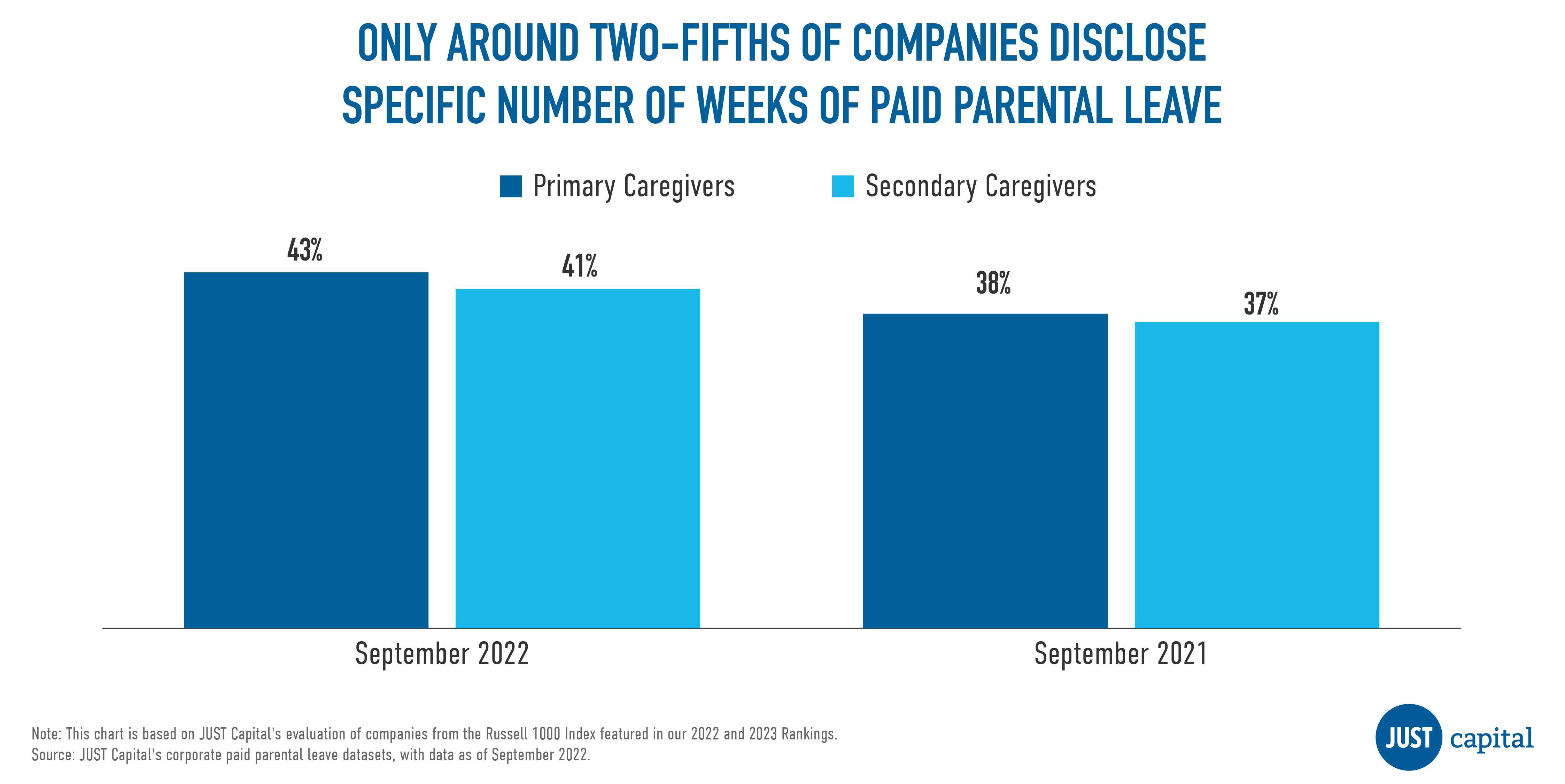
The benefits of paid parental leave are significant for both primary and secondary caregivers. Study after study shows that access to paid leave leads to better health outcomes for both mothers and children. It’s also been found that when men take paid leave, we see lower divorce rates, closer relationships between fathers and children, and lower rates of postpartum depression and other maternal health issues. With growing support for equitable weeks of paid parental leave, disclosure of specific weeks for both primary and secondary caregivers is a critical first step for corporate leaders looking to drive change on this issue overall.
While disclosure itself is key to understanding the current landscape of paid parental leave, it is increasingly considered a corporate best practice to offer parity in paid leave for both primary and secondary caregivers. Leading to better outcomes for workers and their families, parity in paid leave is a more inclusive practice, acknowledging all family types and the roles that parents play in childcare, regardless of their gender identity, relationship status, or sexual orientation.
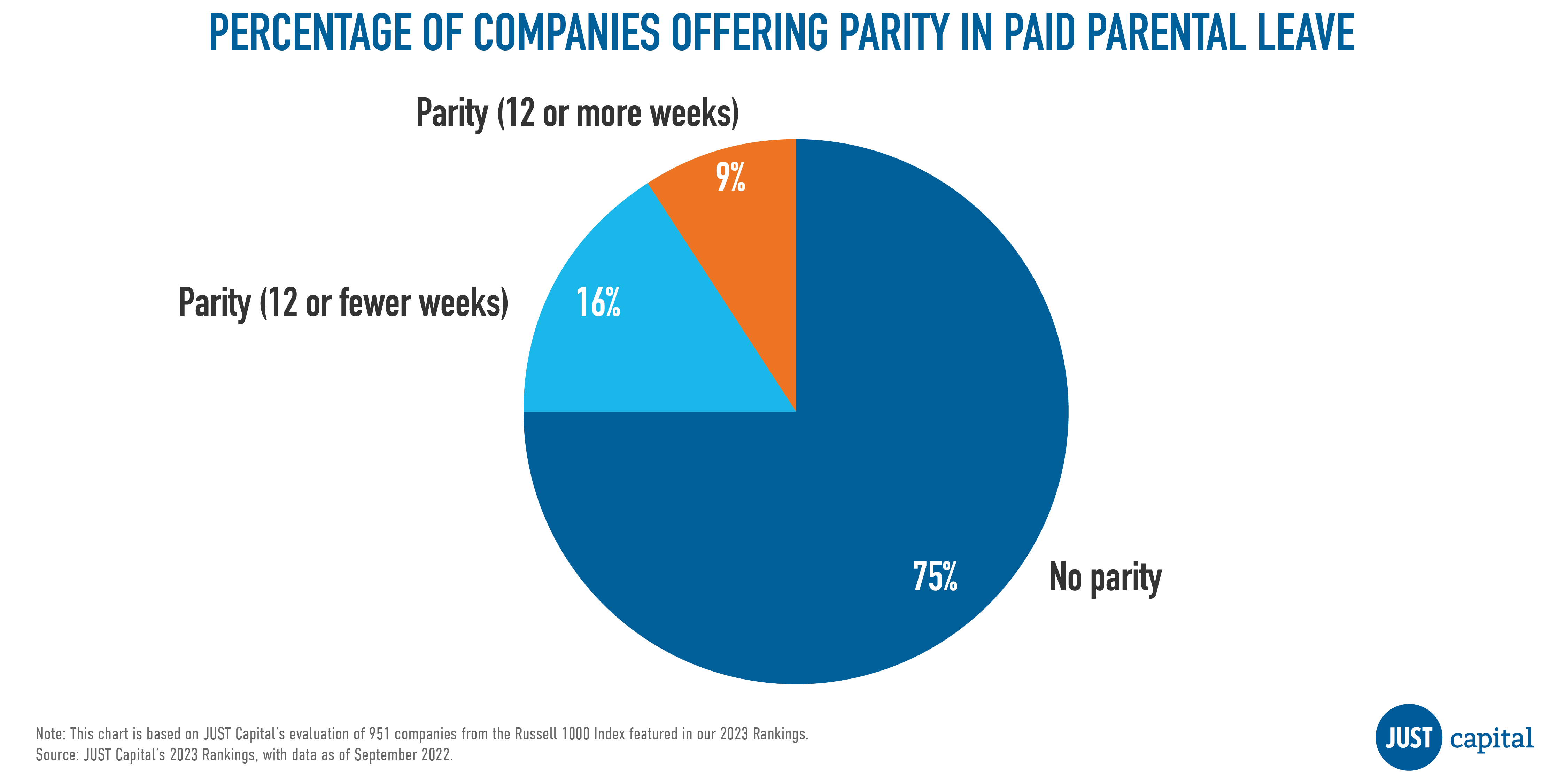
To assess how companies perform, we look at how many provide parity in leave at or more than 12 weeks. As of September 2022, 9%, or 87 companies, provide equal weeks of paid leave to primary and secondary caregivers, compared to 6%, or 59 companies, a year earlier – an increase of 3 percentage points and 25 companies.
Among the 36 industries we analyze, none demonstrated full disclosure, in which all companies disclosed the specific number of weeks of paid leave for both primary and secondary caregivers. Just nine of these 36 industries had a disclosure rate above 50%, though there were some standouts. Of the 25 companies in the Oil & Gas industry, 72% disclosed the weeks of paid parental leave offered to both primary and secondary caregivers, closely followed by the Internet industry with 67% of companies disclosing, Transaction Processing (65%), and Banks (63%).
16 industries have a disclosure rate between 30% and 50%, representing 196 companies that disclose the number of weeks of paid leave for both primary and secondary caregivers. However, nine industries fell below the 30% disclosure rate.
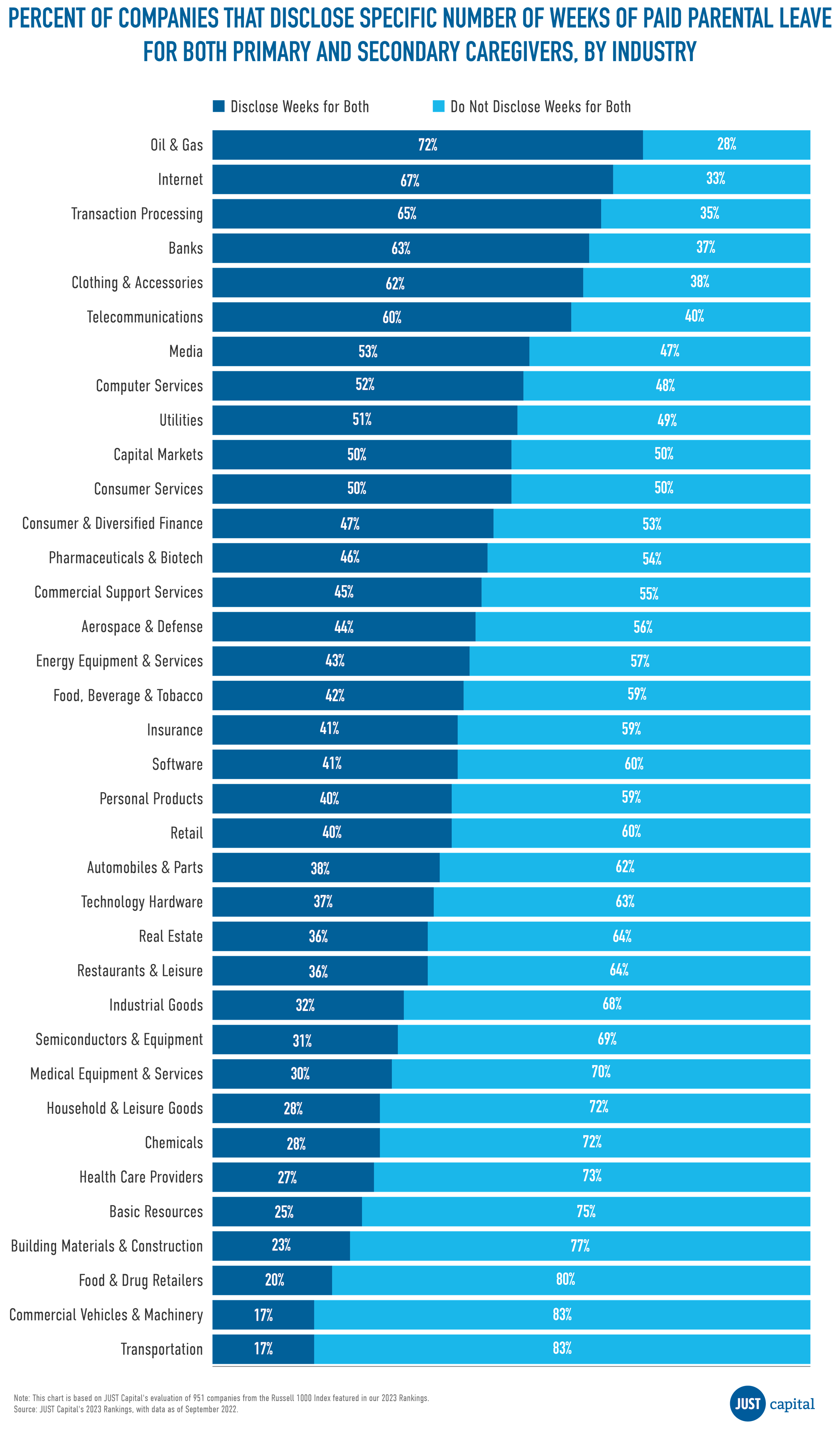
Based on these findings, there is a clear opportunity for Russell 1000 companies – particularly in certain industries – to not only disclose that they offer paid parental leave, but the number of weeks they provide.
In looking at the policies of companies that disclose the number of weeks of paid leave, we found that primary caregivers receive between one and 26 weeks, with a mean of 10.5 weeks, and a median of 10 weeks. Secondary caregivers also receive a range of one to 26 weeks, but the mean and median are 7.6 weeks and six weeks, respectively. As a way to further assess performance, we quantify the average number of weeks of paid parental leave for both primary and secondary caregivers by industry. The highest performing industry is Internet, offering 18 weeks on average for primary caregivers and 17 on average for secondary caregivers. Software is also leading by offering an average of 16 and 12 weeks to primary and secondary caregivers, respectively.
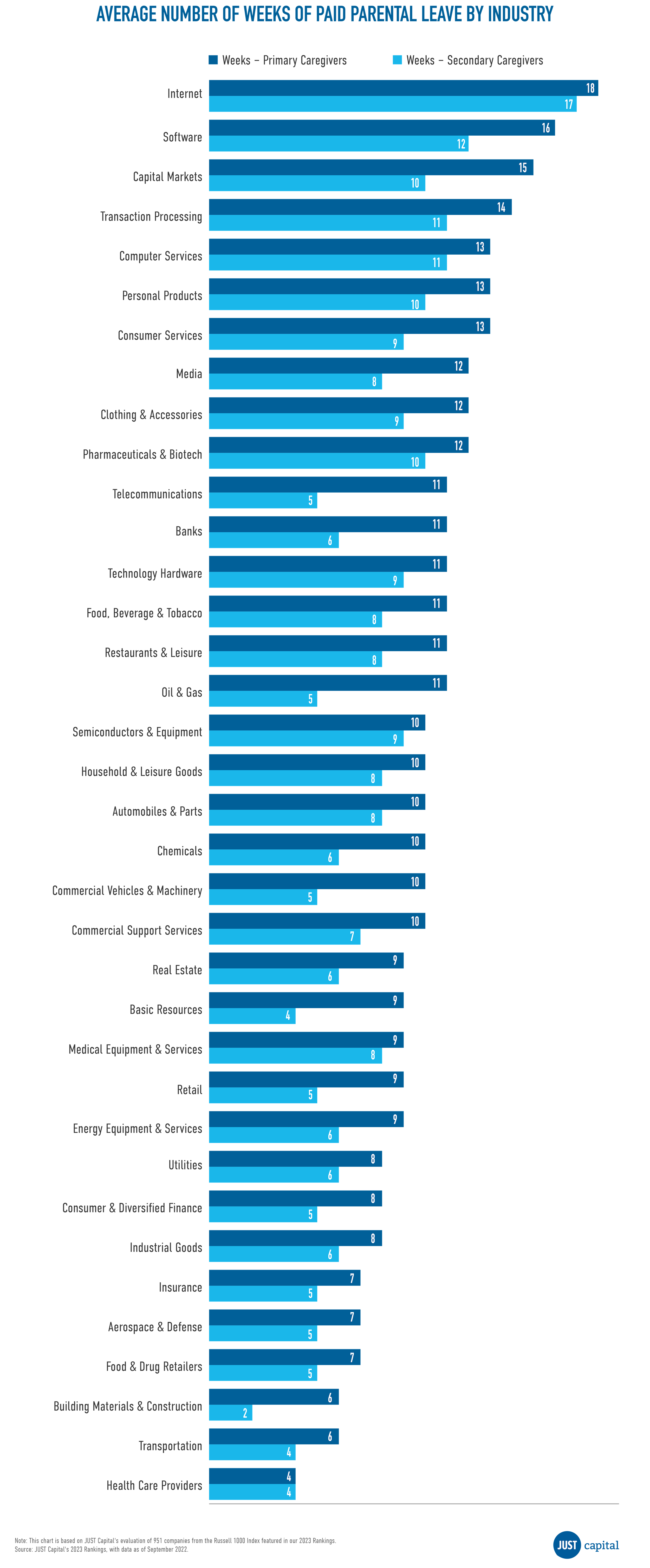
Although our Just Jobs Scorecard awards the highest score (4/4) to companies offering 24 weeks or more of paid parental leave, this analysis reveals that 10 industries offer an average of 12 or more weeks of paid parental leave for primary caregivers, while only two offer the same for secondary caregivers. 26 industries offer, on average, fewer than 12 weeks of paid parental leave for primary caregivers and 34 offer the same, on average, for secondary caregivers. For primary caregivers, 15 industries offer between 10 and 12 weeks on average, and for secondary caregivers, 17 industries offer between 4 and 6 weeks.
Only Health Care Providers offered an equal average amount of leave for primary and secondary caregivers. All other industries provided more weeks of paid parental leave to primary caregivers.
While our latest analysis signals that corporate America is steadily improving its efforts around paid parental leave, millions of workers around the U.S. do not have access to paid parental leave to welcome home their newest family member, to recover from a birth event, and to adjust to life with a new child. Women, people of color, and individuals who identify as LGBTQ are least likely to have access to paid leave, exacerbating racial and gender inequities in workplaces. Without a federal mandate or policy, workers of all types rely on the private sector to ensure that they have access to adequate paid parental leave, a key benefit for companies to improve retention, attract talent, and strengthen employee health and wellness and engagement.
