Eighteen months following the swell in diversity, equity, and inclusion (DEI) commitments from corporate America, stakeholders from employees to investors to regulators are looking for signals of action and progress. For many, that means asking companies to disclose the racial and ethnic demographic makeup of their workforce. This week, we published a new analysis that examines if, and how, Russell 1000 companies are sharing this information.
Our analysis found that, as of September 2021, just over half of the Russell 1000 (55%) share some racial and ethnic workforce data. But, only 11% of companies disclose intersectional data in an EEO-1 report – the federally mandated annual report in which companies with at least 100 employees provide information on gender, race, and ethnicity by job categories.
For this edition of Chart of the Week, we took a look at how those companies that do disclose EEO-1 or equivalent data performed compared to their peers that don’t disclose this intersectional data.
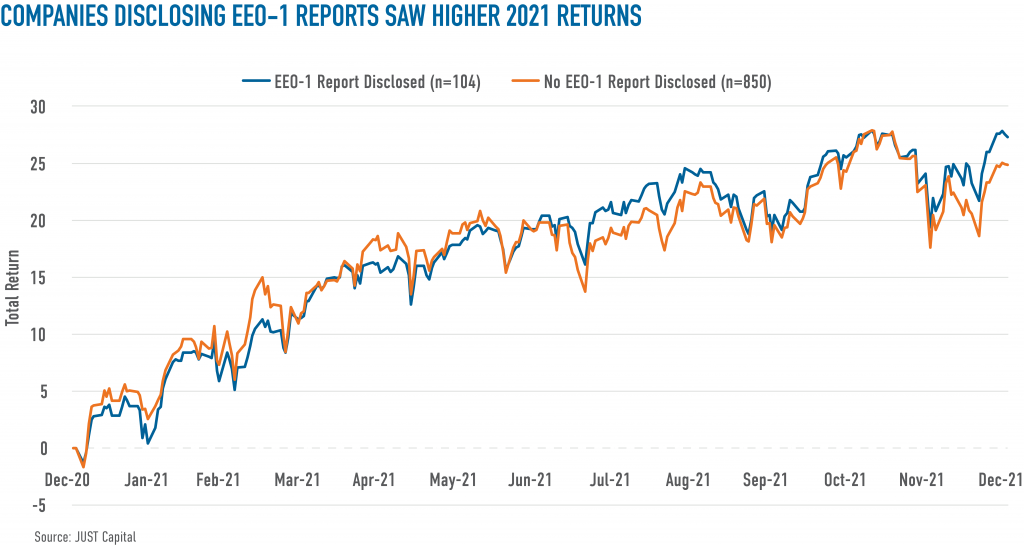
Looking at this subset of companies, we see that they saw higher returns than those that didn’t disclose an EEO-1 report or equivalent by 2.4% over the trailing one-year period ending in 2021.
With companies staring down proxy season, requests to disclose this information could rise even further to the top of shareholder agendas. “This is the information investors want to see more of,” JUST Director of Corporate Equity, Ashley Marchand Orme, said in a CNBC interview this week. “Companies are already collecting it so the lift to provide this information is relatively low. It’s just a matter of companies making this information more public.”
If you are interested in supporting our mission, we are happy to discuss data needs, index licensing, and other ways we can partner. Please reach out to ESG Business Development Associate, Michael Wirtz, at mwirtz@justcapital.com.
Labor Day 2021 marks nearly 18 months into the COVID-19 pandemic in the U.S., and this week we highlighted the 32 companies – by industry – that have prioritized their workers during these tumultuous times. The companies – which top our Rankings on worker issues within their industries, from Retail to Software to Transportation – have established practices to keep their workers safe during the pandemic, disclosed demographic details as a first step toward advancing racial equity, offered benefits to help workers climb the job ladder, and more.
For this edition of Chart of the Week, we take a look at how these 32 companies perform compared to the rest of the Russell 1000 companies we rank:
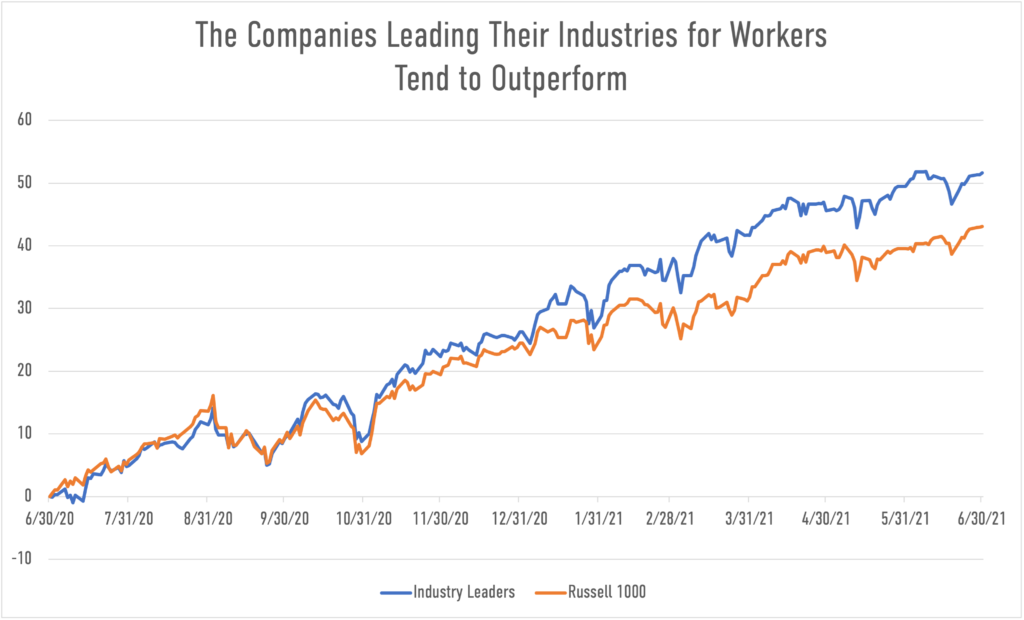
Looking at these industry leaders (excluding the top company for Internet – Facebook – as it is under review for our 2021 Rankings), we see that they have outperformed the Russell 1000 by 8.6% over the trailing one-year period.
These companies are at the forefront of their industries – and many at the vanguard of corporate America overall – when it comes to worker well-being. And their performance shows that, even during one of the most challenging years in recent history, it pays to treat your workers well.
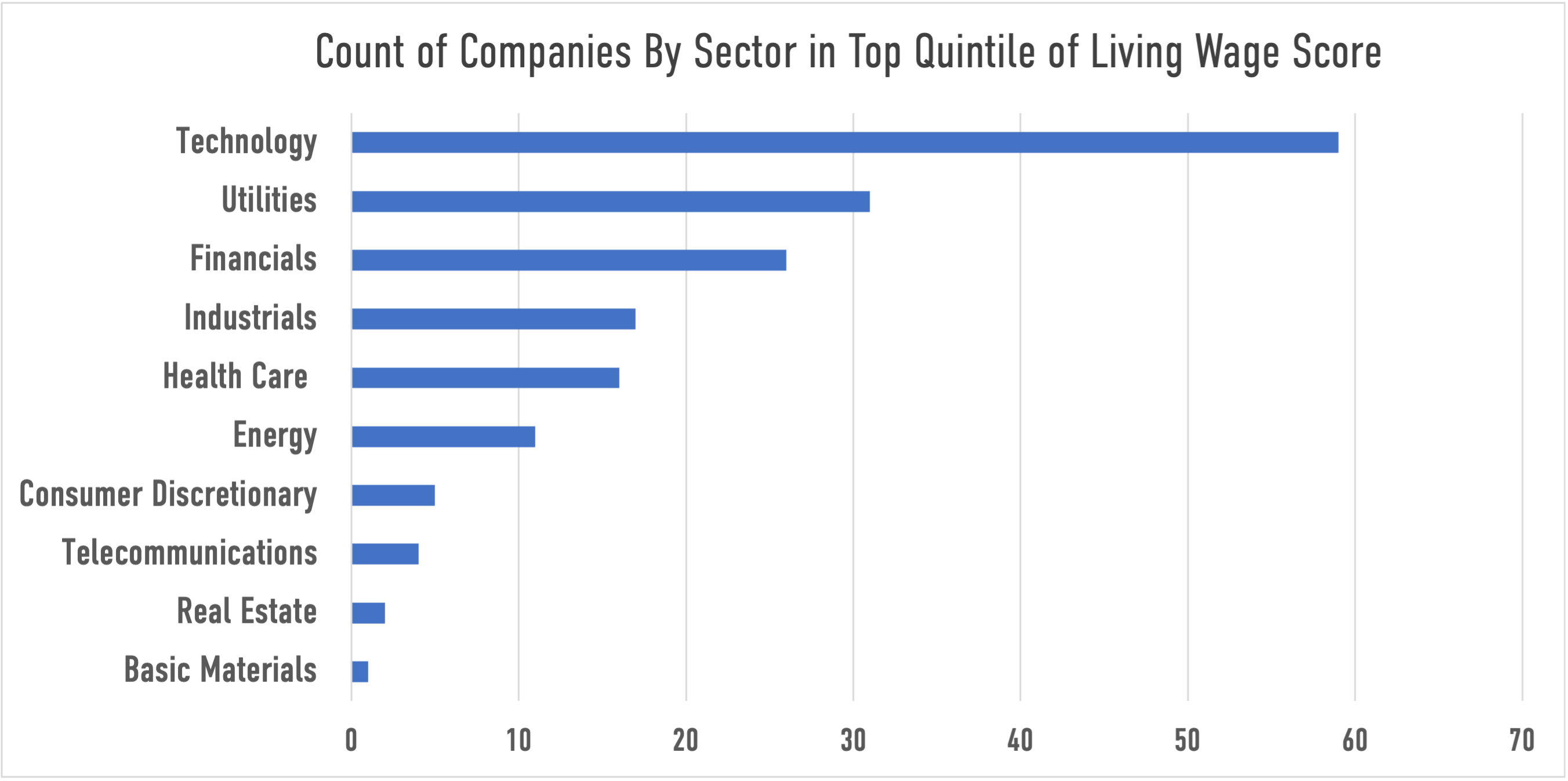
JUST Capital’s highest weighted issue in our 2021 Rankings of America’s Most JUST Companies, per our polling of the American public, is whether or not a company pays a fair, livable wage. Our chart this week looks at the sector breakdown of the companies that score highest on the living wage metric. Within the top quintile of living wage metric scorers, we find that Technology and Utilities companies comprise the majority of those that pay relatively more workers a living wage, or enough to cover the local cost of food, housing, and medical care, among other basic necessities.
The impetus: The Worker Financial Wellness Initiative was created in Q4 2020 by JUST Capital and PayPal, in collaboration with the Financial Health Network and the Good Jobs Institute, to make paying a fair, livable wage and assessing worker financial security and health a C-suite and investor priority.
The importance: On July 13, JUST Capital announced the first cohort of companies joining the Initiative, including Chipotle, Chobani, Even, Prudential Financial, and Verizon. With this first cohort representing approximately 260,000 American workers across a range of industries, the program presents a unique opportunity to demonstrate what companies can accomplish when they come together with a shared goal of improving the financial health and resilience of workers across the nation.
If you are interested in supporting our mission, we are happy to discuss data needs, index licensing, and other ways we can partner, please fill out our request form to answer a few questions, and someone from our Investor Solutions team will reach out to you within business days.
In last week’s chart, we explored racial and ethnic board data disclosure across companies within the Russell 1000. In this week’s edition, we look at the companies we rank that invest in workforce training programs, such as Starbucks (#68 in our Rankings), by offering tuition reimbursement or education assistance.
As we highlight in our Corporate Racial Equity Tracker, education and training programs are a critical dimension of advancing racial equity in the workplace and community. In a recent survey in which we asked Americans what they thought companies should do to advance racial equity, we found that 86% of respondents overall and 89% of Black respondents believe it is important for large companies to provide education and training for workers, including apprenticeships, tuition reimbursement, and career development programs.
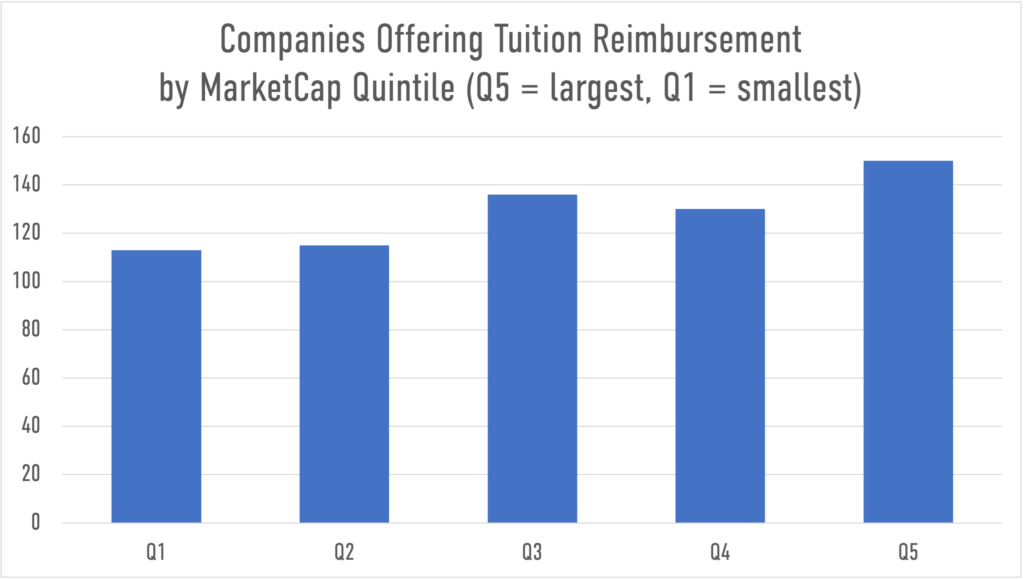
We analyzed the 653 companies that offer tuition reimbursement (out of 928 that JUST Capital ranks) and found that those in the three largest market capitalization quintiles (Q3-5) are most likely to offer tuition than the two lower market cap quintiles (Q1-2).
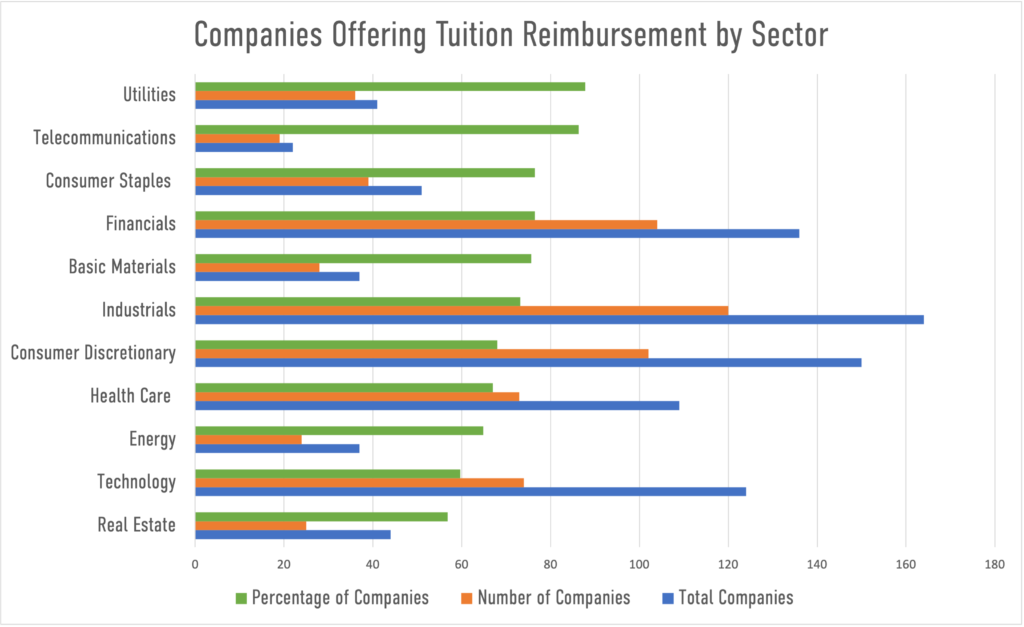
When we looked at these companies by sector, we found a higher percentage of Utilities and Telecommunications companies offer tuition benefits, compared to much lower percentages in the Real Estate and Technology sectors. Among companies leading in this area are several JUST 100 companies – including American Electric Power Company (JUST Rank #51) and Dominion Energy Inc. (JUST Rank #64) in the Utilities sector and AT&T Inc. (JUST Rank #8) and Verizon Communications Inc. (JUST Rank #42) in the Telecommunications sector.
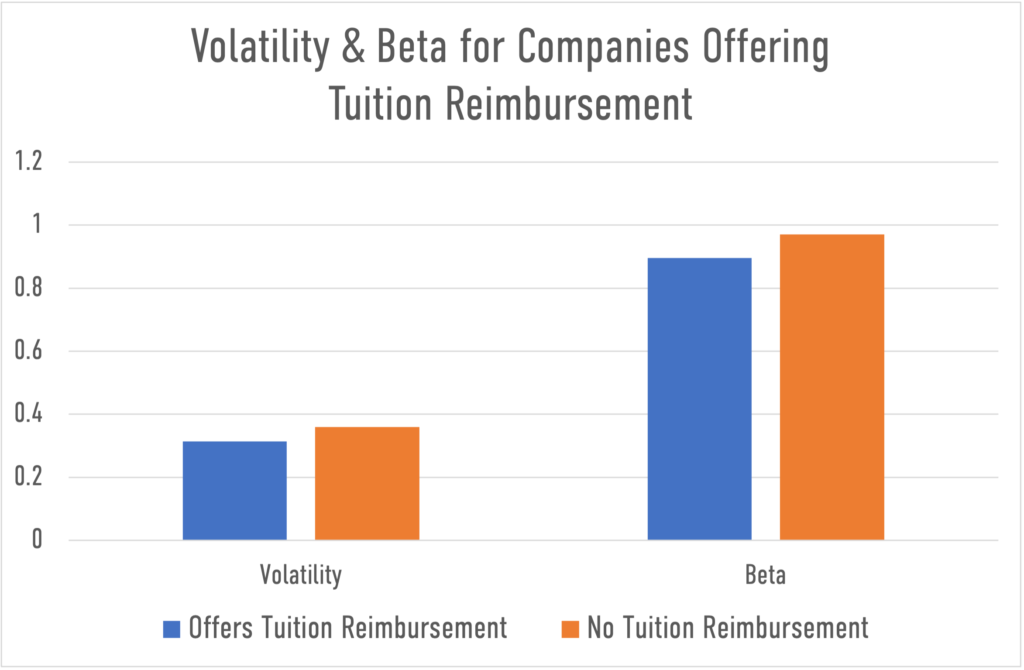
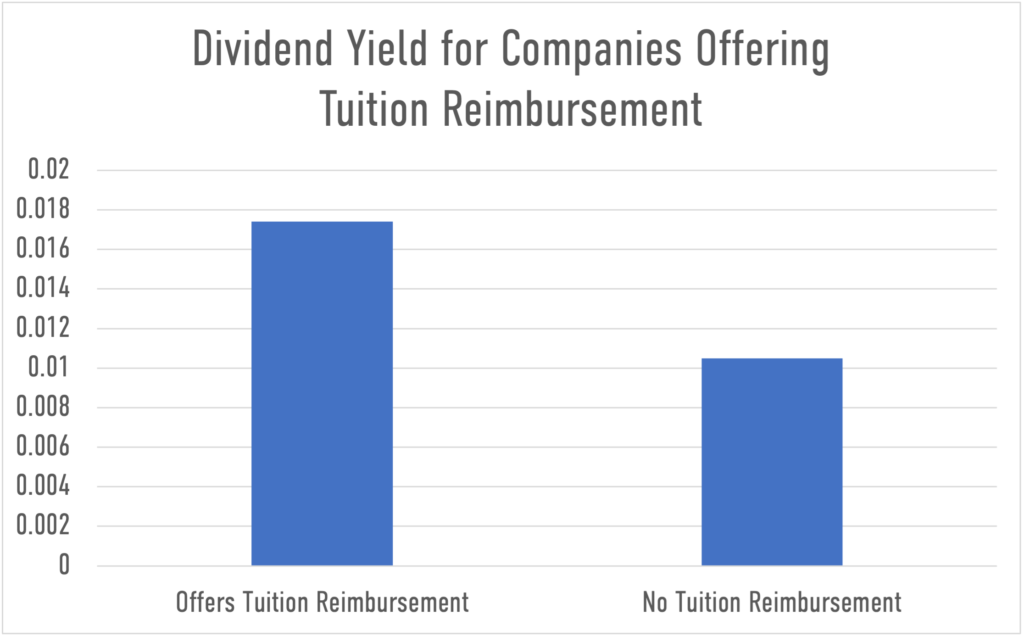
We also found that companies offering tuition reimbursement were less volatile and had higher dividend yields than those offering no tuition reimbursement benefits.
Finally, we found that companies offering tuition reimbursement had higher profitability ratios relative to those that do not offer this benefit. These profitability/return ratios represent the company’s ability to generate returns to its shareholders, and the correlation may be due to the largest companies’ ability to both bring in better returns and afford expensive benefits than smaller companies.
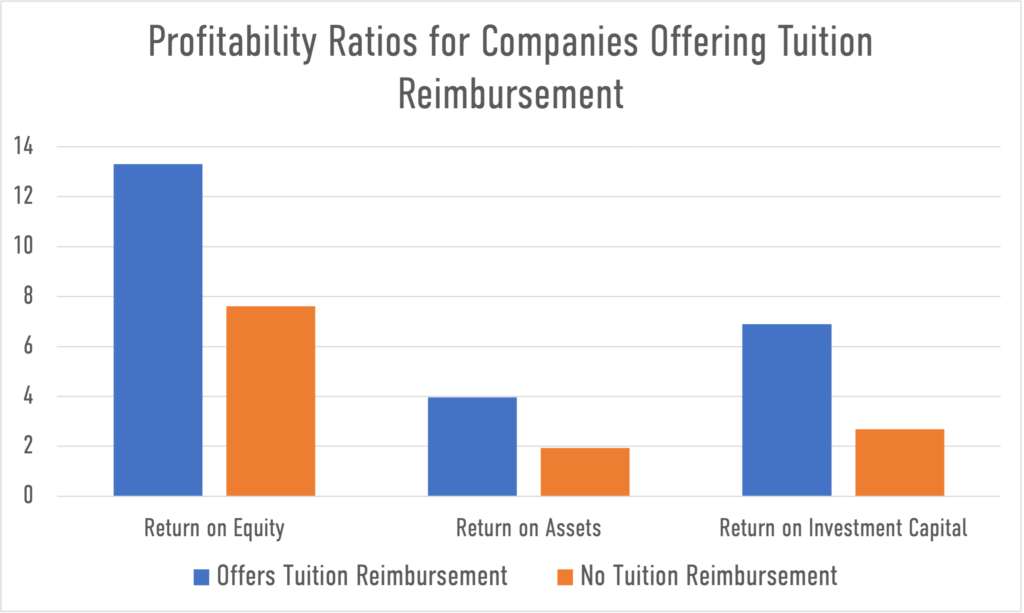
In working to advance racial equity in the workplace and across the communities their companies most impact, corporate leaders should ensure that their career development programs offer opportunity-increasing outcomes that address systemic educational disparities. As we see above, organizations that seek to progress in their racial equity journeys related to education and training can take steps to offer tuition reimbursement as a concrete action without financial disincentive.
If you are interested in supporting our mission, we are happy to discuss data needs, index licensing, and other ways we can partner, please fill out our request form to answer a few questions, and someone from our Investor Solutions team will reach out to you within two business days.
Following up on our recent report exploring racial and ethnic board data disclosure at the 100 largest employers in the Russell 1000, we’re now going to take a look at our larger Rankings set of companies in that index, analyzing the characteristics of those that disclose their racial and ethnic board diversity relative to those that do not.
With increased external pressure for greater board diversity from investors, financial exchanges, and government, it is clear that stakeholders are expecting corporations to include in their commitments to fighting systemic inequity by building diverse boards. Organizations like the Board Diversity Action Alliance argue that diverse leadership at the very top is necessary to make these commitments work. A growing number of shareholders are convinced – as we highlighted in last week’s chart, board diversity has constituted 9% of ESG proposals this proxy season.
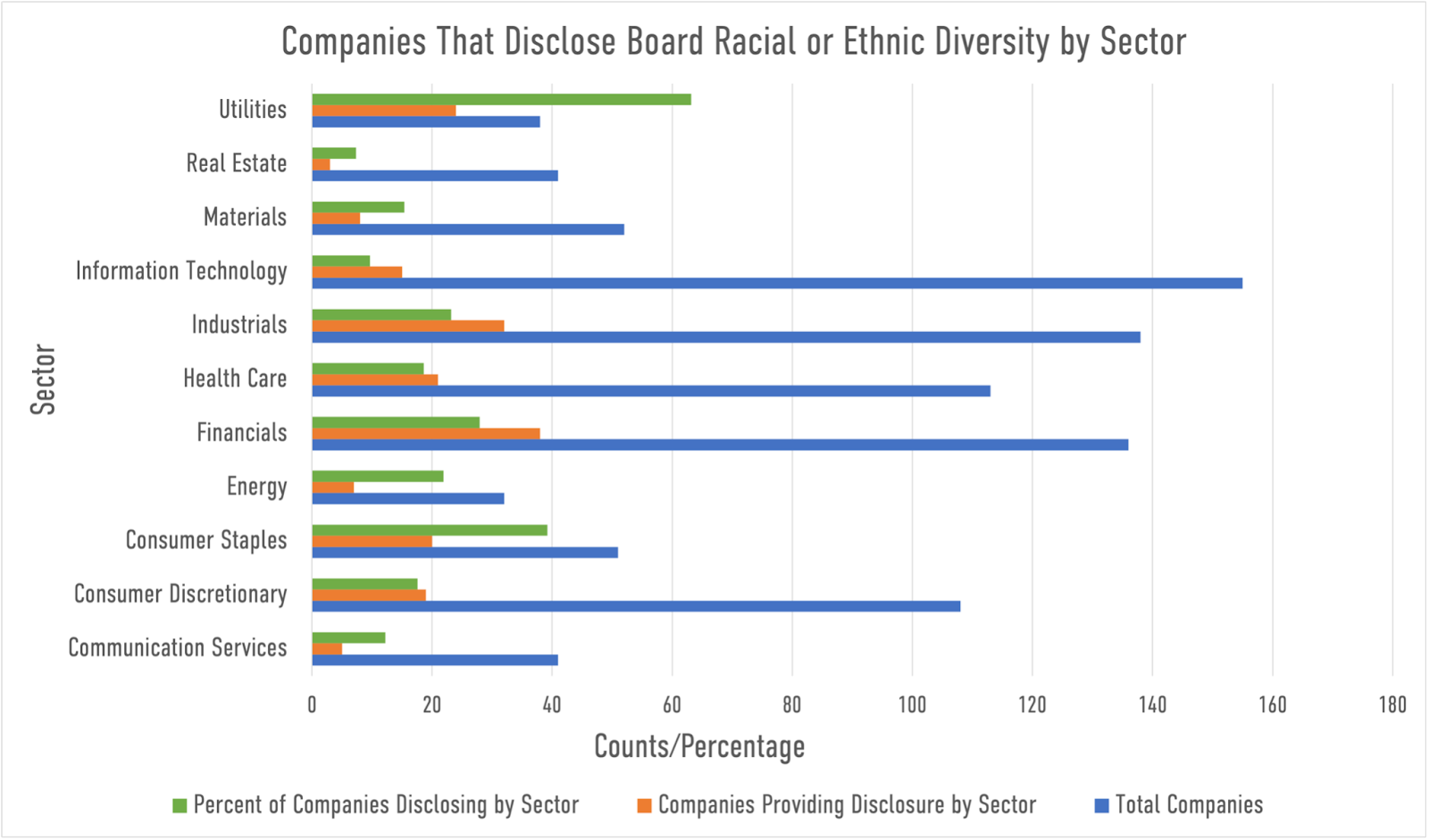
Our charts this week highlight the sectors that have provided disclosure of their boards’ racial and ethnic diversity relative to other sectors that did not disclose. Looking at the data, we see significant disclosure percentage-wise within the Utilities sector, with 63% of companies disclosing their board racial and ethnicity data, followed by 39% of companies in the Consumer Staples sector. It is worth noting that many of the country’s largest utilities companies operate in states with board disclosure requirements like California, Illinois, and New York.
American Electric Power (JUST Ranked #53) is an example, however, of a utilities company that has gone beyond a requirement for disclosure, with 50% of its board seats filled by directors who are not white men as of April 2021, as disclosed on its website.
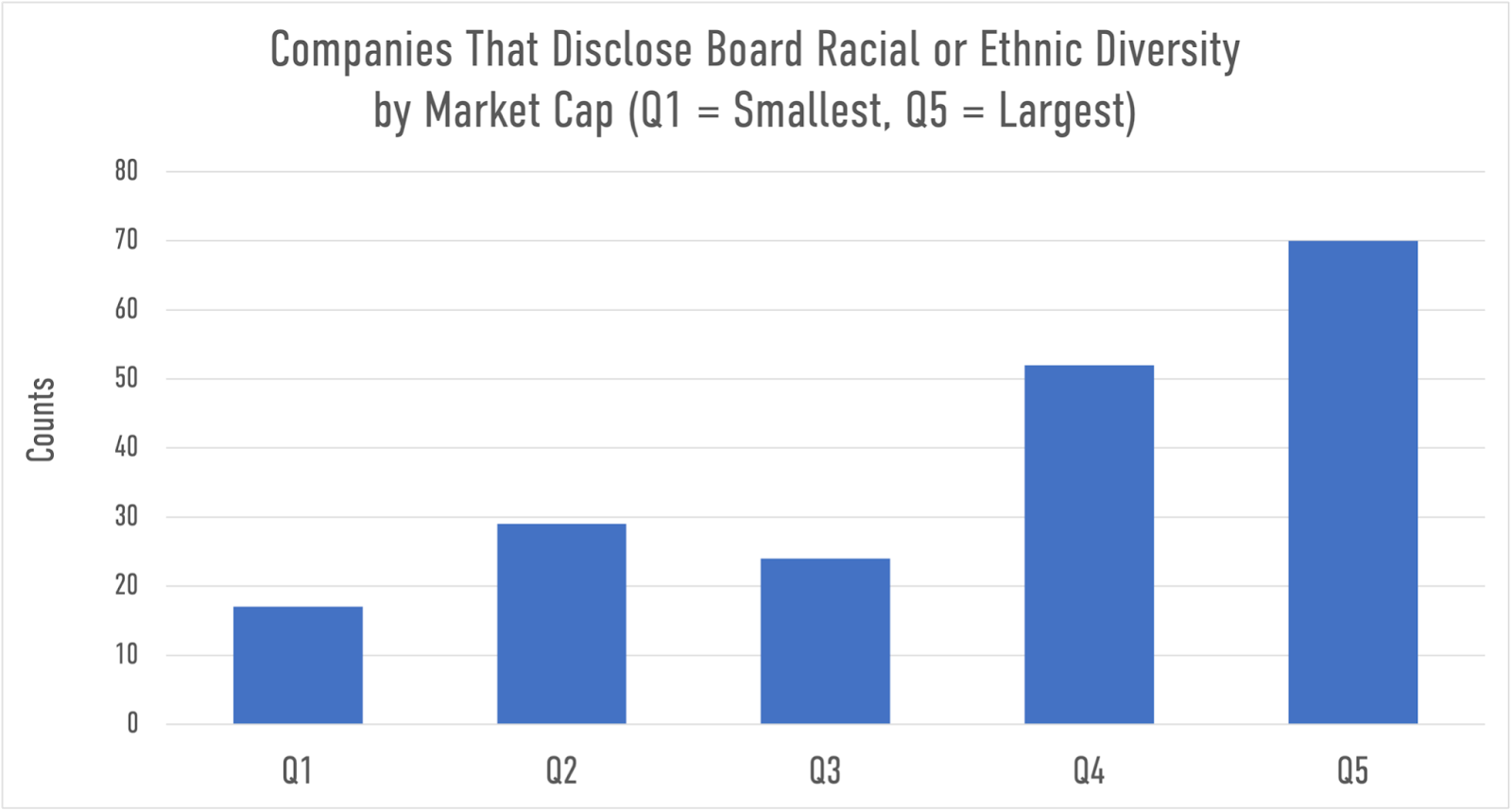
Looking at the breakdown of companies by market cap, we see that companies in the two largest market capitalization quintiles (Q4-5) are most likely to disclose relative to the three lower market cap quintiles (Q1-3).
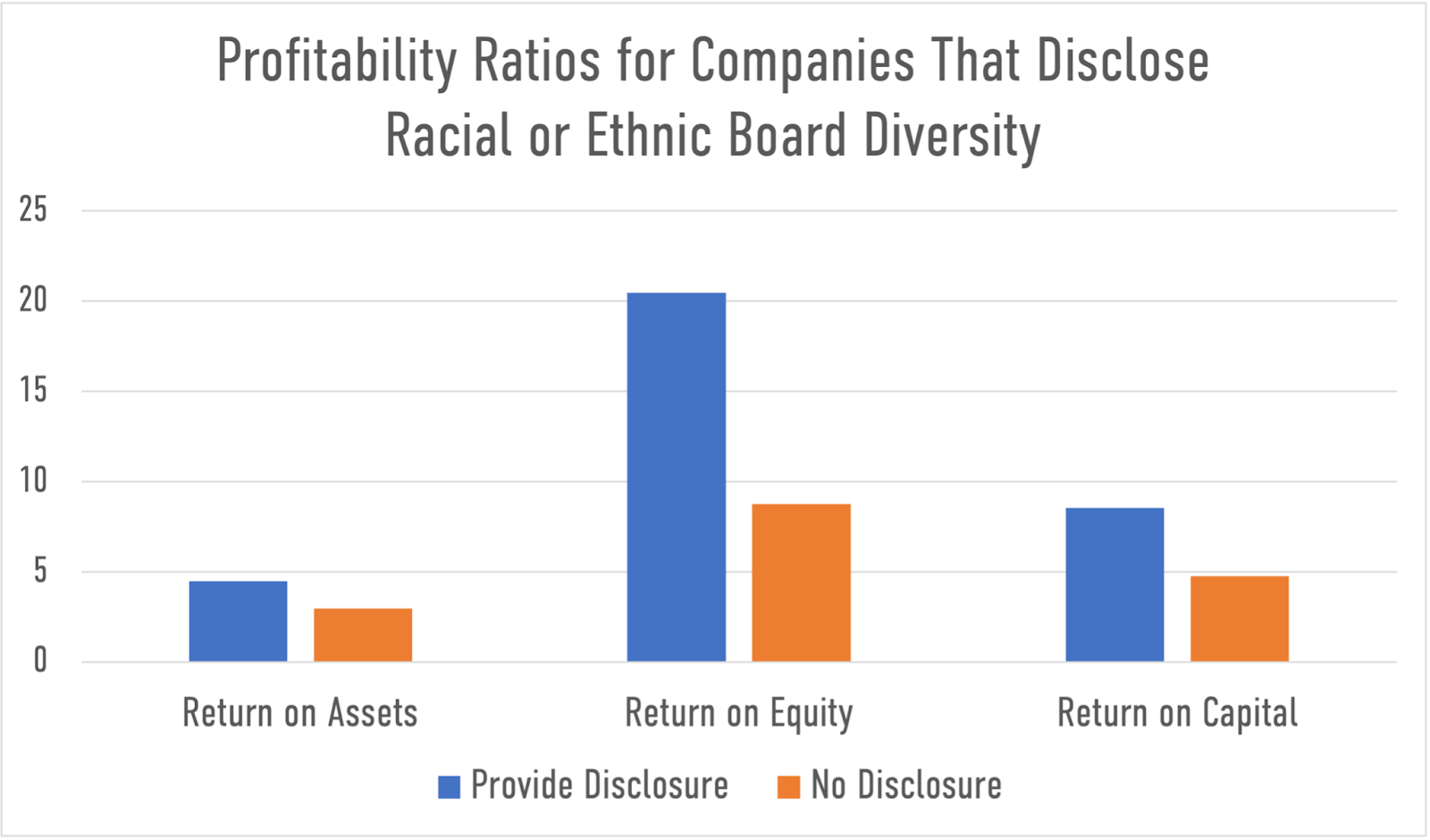
We also looked at profitability ratios, financial metrics analysts and investors use to measure and evaluate the ability of a company to generate profit relative to revenue, balance sheet assets, operating costs, and shareholders’ equity during a specific period. Companies commonly look for a high ratio, as this means the business is performing well by generating revenues, profits, and cash flow.
Looking at the data for Return on Equity (ROE), Return on Assets (ROA), and Return on Capital (ROC), we see that each is significantly higher for companies that disclose racial or ethnic board diversity data.
Lastly, we see a cumulative return of 42.9% over the trailing 12 months (as of 5/31/2021) from the 193 companies that disclose board diversity data by race and ethnicity, compared to the 735 companies that provide no disclosure at all, with a return of 35.3%.
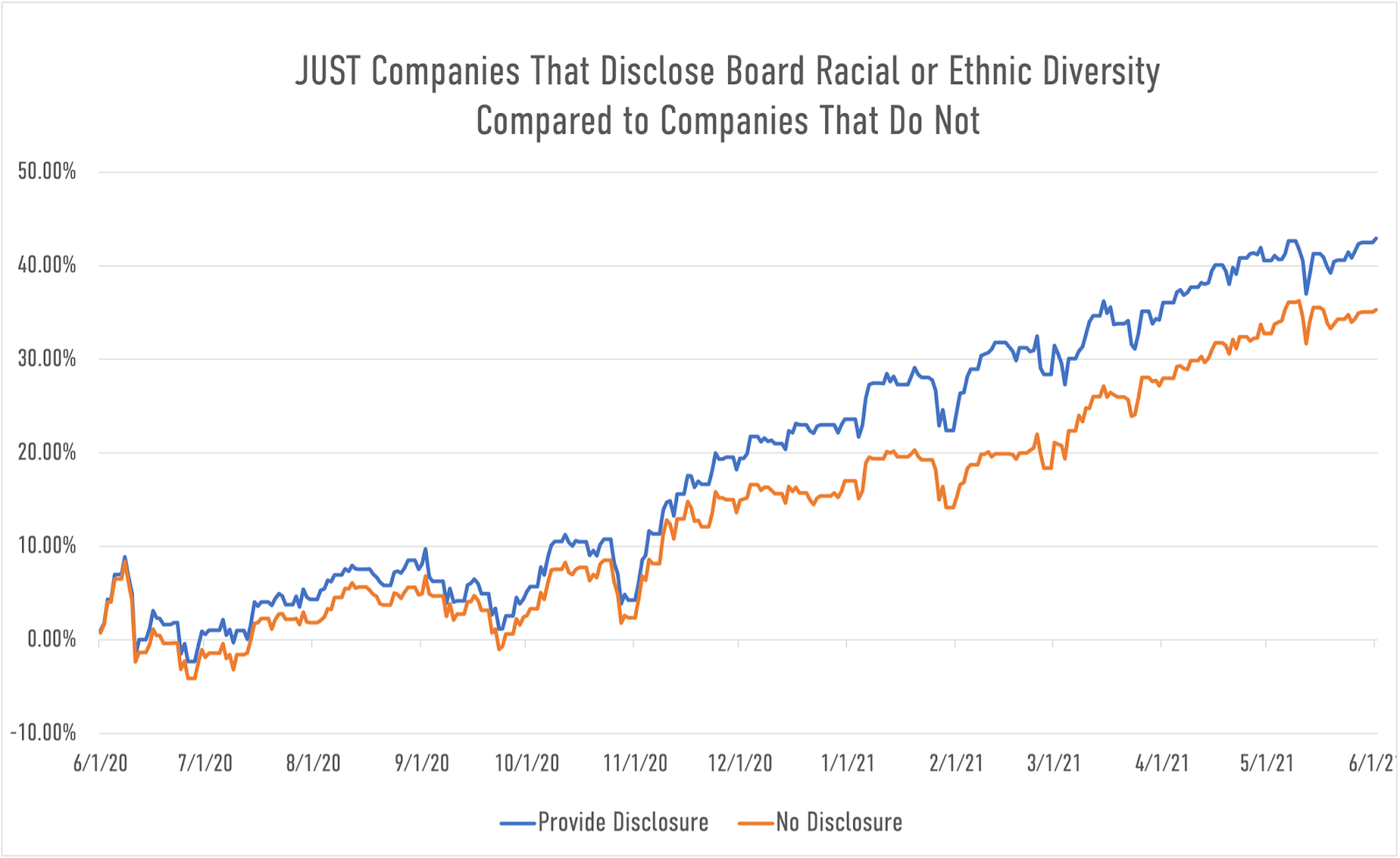
Increased disclosure is one of the key first steps to advancing toward racial, ethnic, and gender diversity – whether in the boardroom or in the workplace, and as we explore in detail in our JUST Report published this week, there are clear indicators that pressure to release board composition data is not letting up. While companies have historically wanted to keep this data close, especially if they consider it unfavorable, our analysis indicates that at the least, there is no financial disincentive to releasing it and pursuing greater diversity in the boardroom.
If you are interested in supporting our mission, we are happy to discuss data needs, index licensing, and other ways we can partner, please fill out our request form to answer a few questions, and someone from our Investor Solutions team will reach out to you within two business days. Please send any requests to republish our Chart of the Week charts to Charlie Mahoney.
In this week’s chart, we pull from the June 2021 edition of the ESG Acceleration report from MUFG Research (NOTE: member gated) to highlight not only the rise in the number of shareholder resolutions filed but the wide range of ESG issues addressed.
The chart below highlights the broader trend in the rise of shareholder activism related to ESG issues and how investors are increasingly using proxy votes to express their views on company behavior, rather than relying on company disclosure. This past year, climate change, human capital metrics, and diversity, equity, and inclusion (DEI) were especially relevant to shareholders. Increased demand for transparency, targets, reporting metrics, and business impact assessments have all rapidly gained momentum, as we see below.
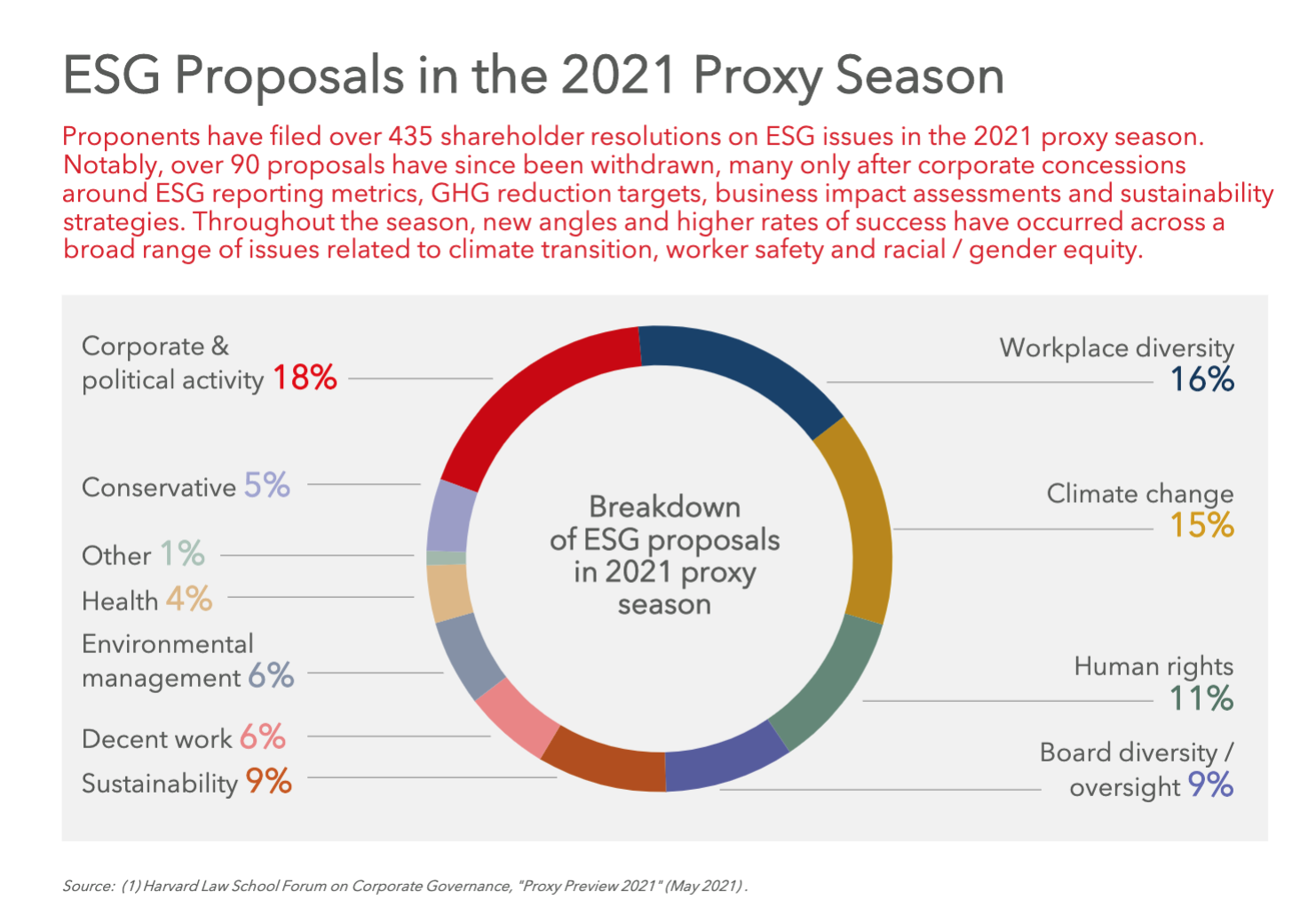
Investors and shareholders continue to demand more, as disclosure is considered a meaningful first step – however, it doesn’t always lead organizations to take meaningful action toward their ESG goals. Bloomberg reports campaigns launched through June 21 at companies with a market value of more than $1 billion reached 116, up from 87 over the same period in 2020. Furthermore, we see the demand for more than disclosure in corporate debt issuance as well, as investors show their willingness to pay a premium or “greenium” for companies to publicly link their debt to ESG goals, with the sustainability-linked-debt market expected to surpass $200 billion this year per S&P, up 54% from the year prior.
Last month, activist investor Engine No. 1 won three of four contested board seats as part of its $30 million Reenergize Exxon campaign, demonstrating that ESG activism can drive actual change and will continue to be a focus as we emerge from the pandemic. Engine No. 1 has continued its activist approach this week with an initiative to empower passive investors through the launch of a new ETF (ticker: VOTE) that aims to encourage better behavior using its shareholder voting rights and will follow voting guidelines aiming to get businesses to invest in employees, communities, customers, and the environment. We’re actually going to be speaking with them and Betterment on June 30th on how they hope to transform retail investing with this offering. Sign up to listen here.
To further highlight the surge in ESG proposals meant to change corporate behavior, we’re showcasing another chart from MUFG. This one is focused on BlackRock, the world’s largest asset manager and an outspoken supporter of sustainability initiatives over the past few years, and how its votes have broken down over the last year.
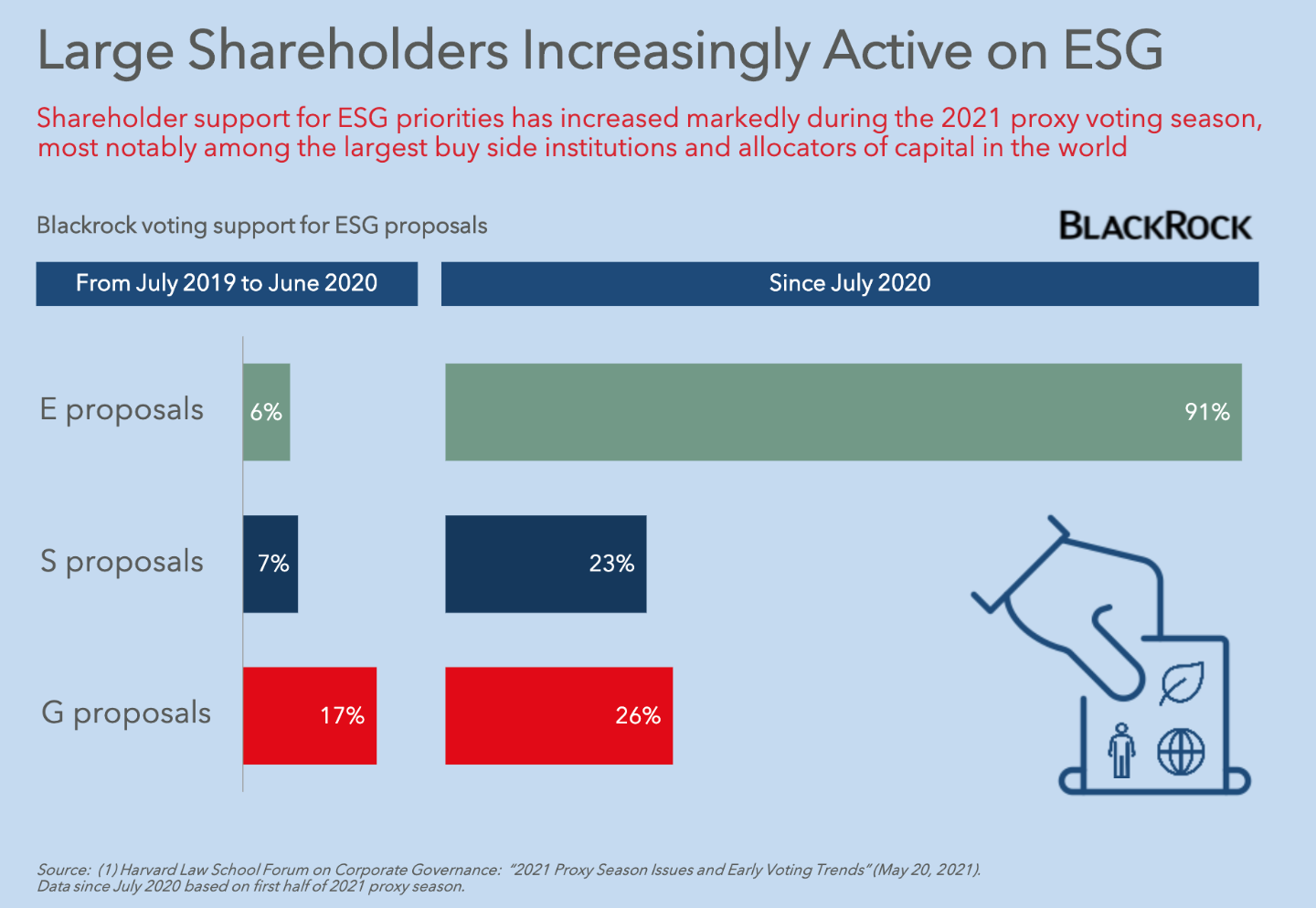
It is clear we are at the forefront of a shift toward broader transparency and accountability. Investors and shareholders not only demand to know what the benchmark looks like for the companies they invest in, but how they are progressing on the broader commitments they have made to address them. As we have seen from Engine No. 1, ESG shareholder activism is now at the forefront as human capital, DEI, and environmental proposals continue to gain traction and importance in 2021’s proxy season.
If you are interested in supporting our mission, we are happy to discuss data needs, index licensing, and other ways we can partner, please fill out our request form to answer a few questions, and someone from our Investor Solutions team will reach out to you within two business days.
