Since 2015, JUST Capital has surveyed more than 110,000 Americans on what they believe U.S. companies should prioritize most when it comes to just business behavior. Over the course of six years of polling, our work has shown that the American public believes that worker health and safety should be a key priority for companies, and in our Rankings, it is consistently among the core measures by which we evaluate companies.
Since the start of the pandemic, worker health and safety has become an increasingly critical issue, and there has been mounting research showing its importance, as well as Americans’ dissatisfaction with the way companies have ensured that their workers remain healthy through this time. 84% of Americans believe worker health and safety is more important this year due to the COVID-19 pandemic – suggesting heightened expectations from the public. Companies continue to be singled out for both excellence in and failure to protect the health and safety of their workforces, with some stepping up to exemplary levels of worker treatment, and some falling far behind their peers. The public is divided on how well large companies are doing in protecting the health and safety of their workers during the pandemic, but it’s clear the issue is a key driver in the public’s perception of just corporate behavior.
Many large companies are taking action to protect workers during the pandemic, but perceptions of workplace safety have declined. As we’ve found in our COVID-19 Corporate Response Tracker, a majority (59%) of the 1000 largest public U.S. companies have taken steps to add health and safety precautions, such as enhanced cleaning and social distancing protocols, and an additional 25% have offered free personal protective equipment to their workers. But polls show a decline in perceived safety of workplace conditions since the pandemic. Long before the coronavirus outbreak, a 2018 poll from NORC (see Sources for more details) showed that almost nine in 10 (89%) Americans agreed that the safety of workers should be a high priority for companies and 93% felt they worked in good workplace conditions. Polling by Gallup showed a decline since 2019 of those who say they are “completely satisfied” with the physical safety conditions of their workplaces. In August 2020 only 65% of respondents agreed that they were satisfied with their workplace conditions – a 9 percentage point drop from 74% in July of 2019.
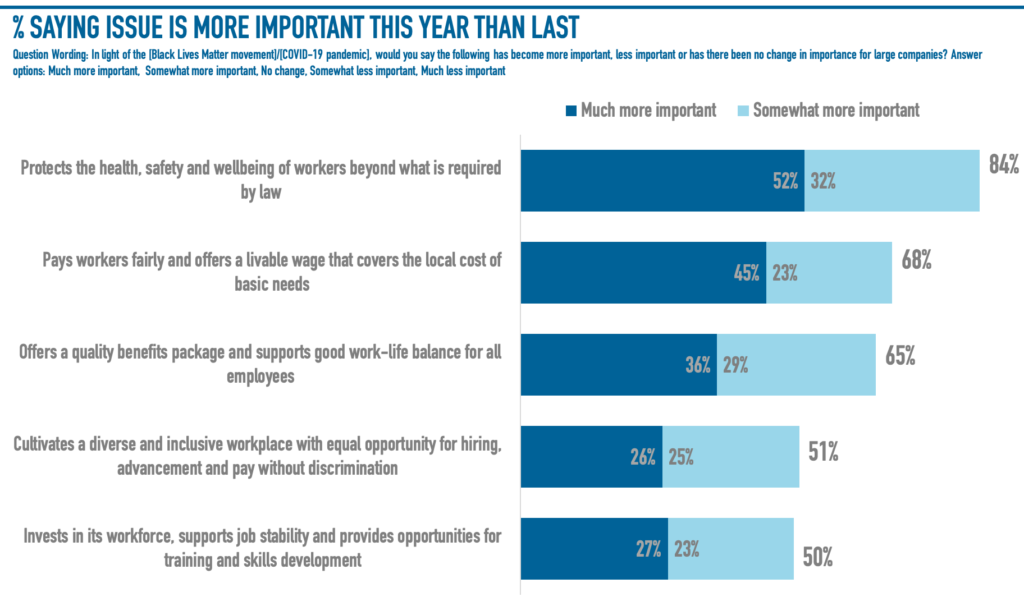
In this year’s nationally representative survey – which reached 4,500 American adults – we again found that protecting the health, safety and well-being of workers (beyond what is required by law) should be a top priority for companies, the sixth most heavily weighted issue among the 19 Americans identified. What is more, a vast majority (84%) of respondents say that protecting the health, safety and well-being of workers is more important in 2020 – a year that saw both a global pandemic and nationwide protests against racial injustice – than it was last year. By contrast, just 65% believe it is more important this year for companies to offer a quality benefits package and support good work-life balance, and only 50% believe it is more important this year for companies to invest in their workforces, support job stability, and provide opportunities for skill development.
Worker health and safety is a universally acknowledged priority for Americans, but there is less consensus around how well large companies are doing in protecting the health and safety of their workforce during the pandemic. While a majority of Americans (62%) say companies are having a positive impact on the health and safety of their workforce, just 43% say America’s largest companies are showing leadership during the COVID-19 outbreak. Black and Hispanic Americans, and those in the lowest income ranges, are overrepresented in essential or frontline jobs, putting them at higher risk of exposure to COVID-19. This is in comparison to a greater proportion of white and higher income workers who have the ability to work from home. It’s also notable that Black and Hispanic Americans are less likely to say large companies are showing leadership during the pandemic (37% and 38% respectively), compared to white respondents (48%).
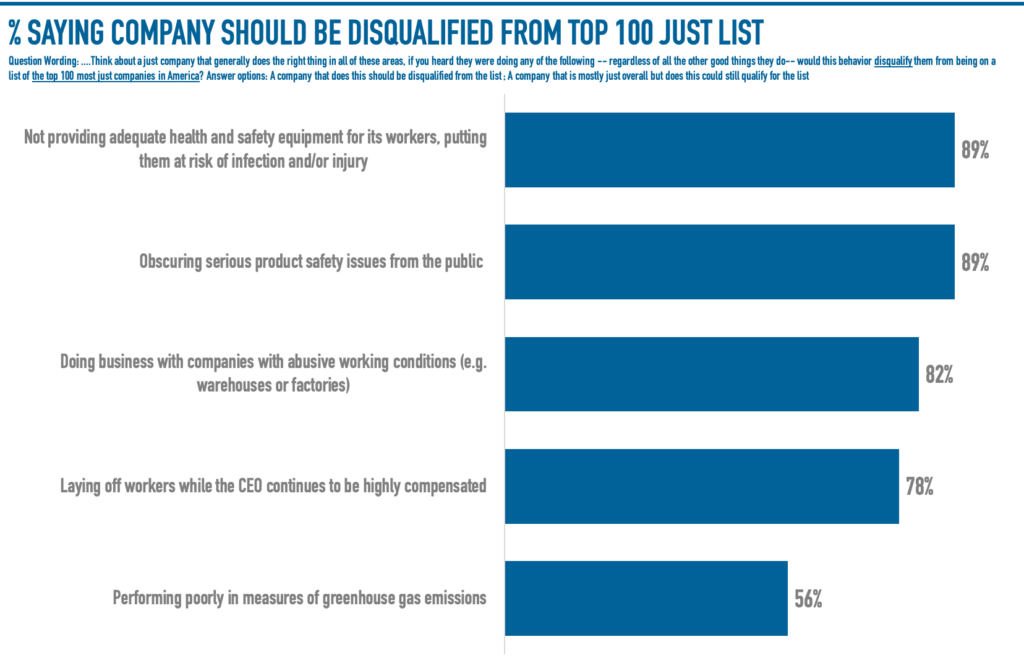
The stakes are high when it comes to workplace safety, for workers as well as the companies that employ them. While most Americans (62%) believe that though companies are having a positive impact on the health and safety of their workforce right now, a vast majority (89%) say that if a company failed to provide adequate health and safety equipment for its workers, putting them at risk of infection and/or injury, they should be immediately disqualified from a list of America’s Most JUST Companies. Companies cannot afford to walk back workplace safety measures if they hope to remain in the good graces of public opinion. Should a company reverse their health and safety policies post-pandemic, most people (89%) feel that they don’t deserve a place on the list of America’s Most JUST Companies.
While the nation is on the precipice of a new administration, we continue to battle the effects of the pandemic among other crises. The American public continues to tell us that U.S. companies should prioritize worker health and safety – with virtually no change since we initially took the public’s pulse on this issue eight months ago, at the start of the COVID-19 crisis. It will be interesting to see how the next few months unfold as a new president is installed, a federal coronavirus plan is mandated – including a potential revamp of OSHA – and we make our way through to the other side of a pandemic that has impacted our lives since the early part of 2020. The question is, will corporate America live up to the public’s expectations in protecting their workforce?
Sources
National Opinion Research Center [NORC]; Survey Sponsor: NORC GSS, with funding from NSF; Study Date: April 12, 2018 – November 10, 2018; Sample: National adult; Sample Size: 2348; Geographic Coverage: United States; Interview Method: Computer-assisted personal interview (CAPI),
Gallup Organization; Study Date: July 30, 2020 – August 12, 2020; Sample: National adult; Sample Size: 1031; Geographic Coverage: United States; Interview Method:Telephone interview, cell phone; Telephone interview, landline.
Survey Information Organization: Gallup Organization; Study Date: August 1, 2019 – August 14, 2019; Sample: National adult; Sample Size: 1522; Geographic Coverage:United States; Interview Method: Telephone interview, cell phone; Telephone interview, landline.
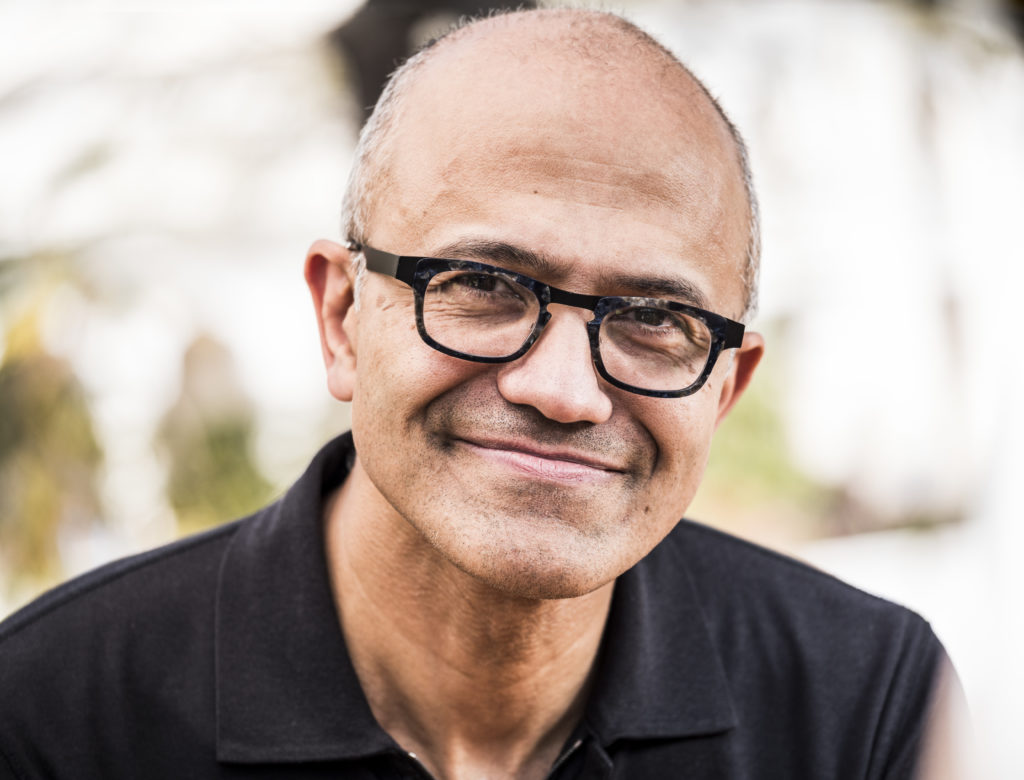
Microsoft CEO Satya Nadella. (Microsoft)
This year, we released the 2021 Rankings of America’s Most JUST Companies on October 14, and for the third year running, Microsoft took the lead. At the Forbes JUST 100 Virtual Summit, JUST Board Member and CEO of Grameen America, Andrea Jung, sat down with Microsoft CEO Satya Nadella to discuss his leadership. Nadella is one of the most prominent proponents of adopting stakeholder capitalism, and he explained how to make that a reality in light of COVID-19, our national reckoning with racial injustice, and recent challenges to American democracy.
On navigating the extraordinary challenges of 2020, Nadella began by saying that Microsoft’s three-time No. 1 rank in the JUST 100 is “really the recognition of all the people I work with, my team members and coworkers, and their hard work every day, living our mission and our culture.” It’s this commitment to mission, culture, and purpose that Nadella credits with Microsoft’s competitive advantage, and it’s something he has been fostering in his seven years as CEO, as well as his 28 years at the company.
Watch the full talk here and explore our key takeaways below.
Stakeholder capitalism has faced criticism for being little more than rhetoric, a buzzword for corporations looking to align themselves with ideals of sustainability and ESG. But in the conversation, Nadella pushed back, emphasizing that “in the midst of this pandemic, [it’s fair to] to essentially have a referendum on capitalism. We all have to recognize: What is the core purpose of a corporation?” Rather than simply generating a profit for shareholders, Nadella believes that this purpose must lie in finding profitable solutions to the issues faced by people and our planet, and that the measure of corporate success lies not in the surplus companies create in their own enterprise, but in the surplus they create around them. Microsoft’s long-time commitment to these ideals, and its ability to execute its social mission, are key to its competitive advantage in our Rankings, and as evidenced by the company’s best quarter ever.
Microsoft has consistently been a leader in the arena of environmental impact and sustainability, pioneering new technologies and initiatives that reduce its footprint. Recently, Microsoft announced that it aimed to be carbon negative by 2030 and that by 2050, the company will essentially “go back in time” to reclaim all the carbon it had emitted since 1975. Nadella recognizes that of course climate change is a global issue that a single company can;t solve, but believes that these ambitious efforts can create a “ripple effect through our ecosystem of suppliers and partners,” driving powerful change across its operations.
In the midst of a contested election, Americans are looking to companies – and particularly those in the tech sector – to play a critical role in protecting democracy. Nadella agrees, emphasizing that “as an American company and as a tech company, our standing in the world and in the U.S. comes because of the vibrancy of American democracy.” With technology both a powerful tool and pervasive challenge of American society today, Nadella sees a “wide gamut” of efforts that Microsoft can make to help ensure that democracy continues to thrive, from making the democratic process itself more secure to protecting the digital discourse around key issues like racial injustice. With the foundations of our democratic system at stake, leaders like Nadella are poised now, perhaps more than ever, to play a key role in their protection.
In the debate around stakeholder capitalism, a pervasive myth holds strong among corporate and investment leaders that doing right by workers, communities, customers, and the environment hurts shareholder returns. Throughout the COVID-19 crisis, Microsoft continued to pay its employees and contractors, despite pandemic constraints like the closure of its corporate campus. Nadella shared that decisions like these, in support of the company’s stakeholders, stem from Microsoft’s long-term mission and principles to create success around itself, something the company’s shareholders have a vested interest in. He shared that “our shareholders want us to do this,” driving home that his company’s competitive advantage – its success in the long term and the value it creates for shareholders – is derived from its commitment to all its stakeholders.
In this unprecedented moment, corporate leaders are faced with urgent questions around how to lead their companies – through the pandemic, social unrest, and political tumult – and what, in turn, that means for society. Jung asked Nadella what he believes his personal responsibility is to lead in this moment. “I always go back to that social contract of our company with the world around us. Because that to me is at the core of the license to operate,” he said. “You can’t exist if all you’re doing is benefiting yourself. … Profit [comes] because of the larger surplus you’re creating around you.”
With our country and our world facing profound new challenges, this sense of purpose must continue to fuel not only what corporate leaders say on the issues that matter most, but how they act. Nadella emphasized that, by holding fast to culture and purpose through this time of upheaval, corporate leaders can help ensure greater resiliency and a better future for Americans, as well as continued success for their companies.
You can watch the full JUST 100 Virtual Summit here.

Almost three quarters of the largest public school districts in America opened this year as remote learning only. (kawee/Adobe Images)
A child care crisis was brewing long before COVID-19 struck the United States earlier this year. Before the pandemic, parents across the country were already faced with a child care market riddled with issues of availability, accessibility, and quality, and priced at an exorbitant cost. JUST’s data showed that on top of that, the vast majority of the largest American companies lacked any child care benefit. The coronavirus crisis has not only exacerbated these existing issues with child care but it has also exposed new challenges and uncertainties for working parents. And the latest hurdle is a messy, unpredictable, and unprecedented back-to-school season.
This year, 73% of the nation’s 100 largest public school districts, serving 8 million children, will only be opening their classrooms remotely. Others are opting for a hybrid approach, involving a combination of in-person and remote learning. Whether learning is fully or partially remote, many children aged 0 to 13 will require adult supervision and after-school care to fill in child care gaps as parents continue to work.
The added problem, though, is that the pandemic has also dramatically changed the child care provider landscape and parental preferences for care.
A survey conducted by the Bipartisan Policy Center at the start of the pandemic found that 60% of both center- and home-based child care providers were closed. More recent survey data from the National Association for the Education of Young Children (NAEYC) at the end of the summer found that 18% of child care centers and 9% of home-based child care continued to remain closed. For those child care providers that have weathered the pandemic or have reopened, there are unprecedented costs and considerations.
For instance, providers must simultaneously invest in staff, enhanced sanitization and cleaning procedures, and personal protective equipment while also reducing enrollment and class sizes to promote social distancing. NAEYC survey research from July shows that 70% of providers are incurring substantial costs to adjust their operations to meet these critical health and safety needs. These costs ultimately fall back onto parents, who are already burdened with child care’s high price tag.
At the same time, however, the pandemic has altered parental choices for child care. A Care.com study found that 63% of parents surveyed were somewhat or very uncomfortable sending their child to center-based child care. Instead, 35% of respondents were considering shifting to home-based care. The American public appears to have similar attitudes toward school reopening, too, with 46% agreeing that reopening should come with major adjustments and 31% preferring for schools not to reopen at all, according to a report by the Associated Press-NORC Center for Public Affairs Research.
As working parents juggle closures with their own preferences, earlier survey research from Boston Consulting Group estimated that 60% of them had not found alternative child care or school arrangements. And the need for child care is high for both those parents who are able to work from home and those working in-person. In April, a Bipartisan Policy Center survey of parents with young children found 43% of parents working remotely due to COVID-19 needed some type of child care, while 49% who were “essential” workers – disproportionately women and people of color – required more formal child care services.
Working mothers have shouldered the brunt of filling these unmet child care needs during the pandemic. The Center for American Progress’ recent analysis of the U.S. Census Bureau’s Household Pulse Survey discovered that millennial mothers were almost three times more likely than fathers to be unable to work as a result of child care and school closures. Working mothers have been making tradeoffs to fully meet their families’ child care needs even before the COVID-19 pandemic, which can result in absenteeism at work, lost wages, or even exits from the labor force altogether. These tradeoffs have significant implications for perpetuating gender inequities and cost families millions each year.
Unmet child care needs impact employers, too. Prior to the pandemic, American employers were estimated to lose $12.7 billion a year due to breakdowns in typical child care arrangements that lead to lower employee productivity and greater absenteeism and turnover. A Brookings researcher recently told Barron’s that school closures will cost the U.S. economy $56 billion per month in lost productivity, as parents navigate both work and caregiving. Over a typical school year, that could amount to $500 billion if schools continue to stay closed.
An overwhelming consensus among parents – 96% of those surveyed earlier this year – is that the government and businesses must act to provide working parents with additional support for child care. JUST Capital’s own polling has found that the American public believes that a one-two punch is needed to tackle issues of childcare provision. Specifically, when we asked who should be responsible for providing a stipend to fund childcare services, 62% of respondents selected either federal or state government.
But in the absence of any federally coordinated response to the COVID-19 care crisis, the responsibility falls on companies to step up to help their working parents fill the gaps in care arrangements as children return to school this fall. Our polling shows that there’s a growing demand from Americans that employers play a role in providing financial support for child care for their workers: 39% of Americans say that employers should be responsible for doing so.
Prior to the pandemic, the landscape of company-provided child care generally included three options: on-site child care, subsidies for off-site child care providers, and subsidized backup dependent care, which can be used when existing care arrangements fall through. JUST Capital’s analysis of companies in the Russell 1000 shows that before the pandemic, the vast majority of companies did not provide any type of child care benefit to their working parents. Just 6% of companies provided child care through a center on site, 8% offered subsidized child care, and 15% offered backup dependent care.
The COVID-19 pandemic elicited an additional dependent care response from companies in light of child care and school closures and disruptions to employees’ typical care arrangements: 9% of the companies we evaluated this year instituted or extended their backup dependent care benefit that were specific to the challenges presented by the pandemic. These benefits were a mix of increased backup dependent care support or additional paid time off for employees to deal with care challenges in response to COVID-19.
Of the few companies that added backup dependent care benefits in response to the pandemic, most only offered temporary relief. For instance, Visa temporarily increased the number of maximum backup care visits available to its employees to 20 through its partnership with LifeCare. Microsoft and Google offered extensive increased paid time off benefits to their employees. While still a temporary fix, they provided 12 and 14 weeks, respectively, of additional paid leave for employees to deal with dependent care issues and school closures, surpassing the amount of time given by many of their peers. Although these additions are critical in addressing short-term disruptions to child care, the temporary nature of these provisions is insufficient for coping with the ongoing care needs as children return to school.
Backup dependent care and extended time off do not solve the longer-term complexities of child care needs for fully or partially remote school this fall. Parents who are still working from home, back in the office, or on the frontlines require ongoing child care benefits that are flexible enough to meet their unique situations and preferences.
Companies should consider offering employees more flexible benefits, such as subsidies, stipends, or other financial support that can be used for a variety of dependent care arrangements – ranging from center-based care to family, friend, and neighbor care – that best suit their families. Some companies, like Bank of America and Adobe, provided a more flexible dependent care reimbursement as part of their responses to the pandemic. Bank of America’s benefit allows employees to receive up to $100 a day to go toward the backup care of their choice.
Adobe explicitly states the availability of a care reimbursement that can be used however employees see fit: “If care is not available through the Bright Horizons backup care program, you will be offered the option to secure care from your personal network (e.g., a neighbor, friend or babysitter) and receive a reimbursement of $100 per day.”
The nuanced challenges presented by back-to-school in the time of COVID-19 call for companies to consider creative, equitable solutions to obstacles faced by caregivers of all types, whether they are in corporate positions or on the frontlines.
As companies determine what type of policies work for them, those that take employee benefits seriously should bring the same weight they do to health insurance or retirement to child care policies, because the severity and business-side impacts are on the same level. Whether companies decide to step up and provide robust benefits directly or advocate for a federal solution can be up for debate and will likely vary across companies, but what shouldn’t be up for debate is whether this is an issue that should be prioritized.
Over the course of the last year, the nature of work has radically shifted for workforces across the U.S., with many putting their lives at risk on the frontlines and others shifting to working from home. According to our recent survey, 82% of Americans agree that companies should provide the flexibility to work from home, something critically important to public health and safety during this time. Moreover, working from home, done right, has the potential to improve productivity and lower costs for employers.
But working from home comes with its challenges, particularly when it comes to workers’ psychological well-being. Earlier this week, we were joined by Dan Ariely and Kelly Peters of BEworks – which works with companies to apply behavioral science to real-world challenges – to discuss how workers have been impacted by the shift to work-from home, and what business leaders should do to help protect their employees’ mental health and well-being.
Watch the full talk here, explore our key takeaways below, and read their latest research report on what predicts employee work-from-home success here:
Leaders are obligated to keep their employees from burning out.
Workers are facing new challenges when working from home, from prolonged isolation and Zoom fatigue to a lack of boundaries between work and home life. For workers with children, the challenges are even more complex, requiring them to juggle new roles as educators during the school day. Employers need to understand that the stress of these challenges accumulates for employees, potentially leading to burnout or decreased output. Make sure to encourage your employees to turn off at the end of the day and that you understand the specific challenges your individual employees face.
Trust and connection are critical to helping employees stay engaged.
Working from home has significantly diminished the casual connections we all experience in the workplace, like a chat in the kitchen or taking a coffee break with a colleague. More complicated, perhaps, is the potential for diminishing autonomy and trust as managers overcompensate for the lack of an office. Employers should continue to facilitate time for their workers to enjoy social connection with colleagues and an appropriate level of freedom to do their job. These gestures build trust and help employees remain engaged and productive.
Check in with your employees on a personal level.
While working from home, employees may have fewer opportunities to share personal struggles or frustrations with colleagues or supervisors, leading to frustration on the part of workers and a lack of insight on the part of business leaders. Create an open dialogue with your employees, and give them regular opportunities to share what they find challenging or what they feel isn’t working as they work from home. Additionally, share with them what’s happening at a higher level – what the operational challenges are, what the organization is trying, what might shift down the line. This open dialogue is critical, again, to creating trust and making sure employees feel heard.
It’s important to note that many of these same stressors – as well as others that are arguably more devastating, like personal health and financial security – are felt by employees on the frontlines. All business leaders, whether they are leading a team that’s primarily working from home or on site, have an opportunity to reimagine how they support their workers, during COVID-19 and beyond.
BEworks provides additional resources to help organizations ask the right questions and initiate dialogues with employees. Take a look at the broader takeaways from this conversation here, and reach out to the team for more information.
The importance of paid sick leave became even more apparent when the coronavirus pandemic hit, but while businesses across the country remain open, fewer than half of companies in the retail sector have publicly announced a new or expanded paid sick leave policy for their frontline workers – many of whom already had limited access to policies that prioritized their health and well-being.
In a recent survey in partnership with The Harris Poll, we found that 74% of Americans believe that companies should prioritize providing at least 14 days of paid sick leave to all workers during COVID-19, and we’ve continued to track this critical issue throughout the pandemic. Access to paid sick leave not only protects workers against employment insecurity, it also reduces the urgency to come into work while sick. An Accountemps study conducted prior to the COVID-19 crisis, for example, found that nine out of 10 employees admit to reporting to work with flu-like symptoms, which, especially during a pandemic, could exacerbate the health hazards faced by frontline workers.
Among the most vulnerable industries is the retail sector, whose employees find themselves at the frontlines of the pandemic. Researchers for the Harvard Kennedy School’s Shift Project found that nationwide, only 45% of retail workers are estimated to have access to any paid sick leave. Out of the 68 retailers* in JUST Capital’s COVID-19 Corporate Response Tracker – which tracks 300 of America’s largest public companies – only 27 (40%) disclose implementing a supplemental paid sick leave policy in response to the coronavirus pandemic. As of June 9, the largest retailers in America offered an average of 13 days of paid sick leave, which falls short of the 14-day quarantine recommendation by the Centers for Disease Control and Prevention. Home Depot stands out among its industry peers as the retailer with the maximum amount of leave – a generous 24 days, which far exceeds the CDC guidelines.
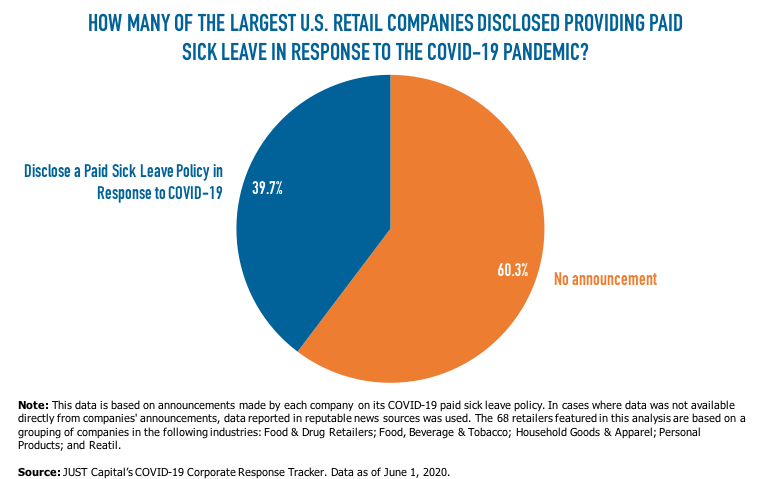
Many companies – like Home Depot – have stepped up to provide this critical protection, but more is urgently needed from corporate leaders, thanks to the lack of federal and state policies and mandates. The United States is one of only three among 22 countries with advanced economies that does not mandate paid sick leave for employees with the flu, which necessitated the introduction of emergency worker protections at the onset of the coronavirus crisis. The legislation included a temporary paid sick leave requirement but exempted companies with 500 or more employees, making many frontline workers reliant on their employers to provide the needed protections.
This lack of a nationwide paid sick leave policy has become increasingly problematic in light of the coronavirus outbreak, which requires quarantine and isolation to contain the spread of the virus. Even though some states and localities have taken it upon themselves to offer employee protection by compelling employers to provide paid sick leave, the majority have not. To date, only 14 states (Arizona, California, Connecticut, Maryland, Massachusetts, Michigan, Nevada, New Jersey, Oregon, Rhode Island, Vermont, and Washington, as well as Colorado and Maine starting next year) and the District of Columbia have paid sick leave laws, putting the responsibility on companies to protect employee’s health and safety.
As businesses continue to reopen and COVID-19 cases rise in parts of the country, it is critical for retail companies to provide paid sick leave to their employees. And although businesses have moved past the initial response phase of the pandemic, 70% of the Americans we’ve surveyed believe that companies should continue to offer at least 14 days of paid sick leave to all employees for at least another year, which signals that Americans are putting workers issues at the forefront of the economic reset.

The pandemic has certainly altered the public perception of acceptable corporate behavior, which is why companies must continue doing right by their employees even beyond this crisis. One way that retailers, whose workers interact with customers every day, can do so is an action the public strongly supports: by instituting permanent paid sick leave policies.
*Note: The 68 retailers featured in this analysis are based on a grouping of companies in the following industries: Food & Drug Retailers; Food, Beverage & Tobacco; Household Goods & Apparel; Personal Products; and Retail.
Aleksandra Radeva is a JUST Capital Research Assistant, focusing on workers and wages, as well as ESG data collection.
Nearly six months into the COVID-19 pandemic, corporate America finds itself at a crossroads. With many businesses reopening and many Americans heading back to work (and many others who have been on the frontlines throughout), it’s perhaps more critical now than ever that our nation’s workers, customers, and communities receive support and protection.
One key action many corporate leaders took at the outset of the pandemic was the provision of hazard pay to support workers who put their lives on the line each day in our country’s stores, banks, warehouses, factories, and restaurants to keep the economy going, shelves stocked, and food on our tables. These employees were deemed “essential workers” and rewarded with “hero pay.”
But over the last several months, many of these policies have expired, despite the fact that cases have actually increased nationally and in many states across the U.S. And with more and more stores requiring customers to wear face masks, it’s clear that frontline employees still face considerable risks in the workplace, underscoring the ongoing need for hazard pay.
COVID-19 has fundamentally changed the nature of work for these essential employees – many of whom are also our nation’s lowest-paid workers – who are now responsible for heightened cleaning procedures, mask policing, crowd management, and more.
And as more leaders talk about “building back better” toward a “Great Reset,” the continuation of higher pay for frontline workers needs to remain at the top of the priority list for creating a more resilient workforce and economy, that not only weathers this crisis, but is prepared to withstand future shocks.
With the original launch of our COVID-19 Corporate Response Tracker, we took a look at hazard pay policies at the nation’s 100 largest employers, and also ran an analysis showing that hazard pay bolsters workers’ earnings more over time than a one-time bonus.
Today, we’re looking at the state of these policies several months later. Throughout the pandemic we’ve been tracking the 300 largest public employers in America, and of the 38 hazard pay policies originally announced by that group, half are confirmed to have expired. An additional 14 have not specified an end date, and so that number is likely higher. For several of these companies with expired policies, we’re seeing a trend – shifting from wage increases to one-time or recurring bonuses, resulting in far lower pay for workers.
Explore below which companies continue to lead for their employees, and which are lagging on this critical worker protection.
A small handful of companies have not only provided hazard pay to their employees, but announced that wage increases would be permanent, beyond the crisis. These include:
Charter Communications announced on April 2 that it gave all frontline workers a $1.50/hour raise, putting them on a path to a $20/hour minimum wage in 2022, effectively making its hazard pay increase permanent.
Target announced it was increasing its starting wage for hourly workers to $15 beginning in July, effectively making its $2/hour hazard pay increase permanent.
Tractor Supply team members received appreciation bonuses through June, and beginning on June 28, the company permanently increased wages for distribution center and store employees.
A couple of companies have extended hazard pay policies with explicit end dates, including:
Dick’s Sporting Goods announced that it would continue to pay store and distribution center employees a 15% hazard pay increase through the end of 2020.
Dollar Tree continues to announce short-term extensions for its $2/hour increase for all distribution center workers and store employees, except store managers, with the policy currently set to remain active through August 29.
For half of companies, hazard pay policies that were announced in March and April have since expired. These include:
Amazon had extended the end date of its increase of $2/hour for warehouse workers from May 16, but let it expire on May 31.
AT&T offered a 20% bonus each pay cycle for frontline workers and up to a $1,000 monthly bonus for frontline managers, but let us know that the policy expired the week of May 8.
Campbell Soup Company provided wage increases to hourly and frontline employees, which expired in the last week of July.
Chipotle extended the end date of its 10% hourly wage increase for restaurant employees from May 24, but let it expire on June 7.
Costco’s initial $2/hour raise expired on April 5, but was extended into May.
DaVita let its $100 per week increase expire on May 30.
Domino’s increased pay for all hourly corporate store and supply chain center team members, but the increase lapsed as of May 31.
General Mills offered daily bonuses to manufacturing employees working on site, which appear to have expired as of April 30.
Kraft Heinz extended its $100/week stipend for factory workers through May 7, but allowed the policy to expire.
Kroger let its hazard pay of $2/hour expire on May 16.
Lowe’s let its $2/hour hazard pay expire on April 30.
PepsiCo allowed its additional $100 weekly bonus expire in late April.
Qurate Retail offered recognition pay to hourly and salaried team members, but discontinued the policy as of May 31.
Starbucks offered a $3/hour increase through May 31.
Ulta Beauty offered a $2/hour increase for distribution center workers through May 31.
US Bancorp had extended its 20% wage increase for frontline workers from late May, but let it expire on June 6.
Walmart told JUST that it had extended the end date of its $2/hour wage increase for e-commerce fulfillment and factory workers from May 25 to July 3, but has since let the increase expire. Shopping center employees have not received a pay increase, but instead received three rounds of bonuses, with the most recent announced on July 21.
Wayfair increased hourly pay for employees in fulfilment center and home delivery operations by $4/hour, but let the policy expire on June 20.
Wendy’s increased pay for crew members in company restaurants by 10%, but let the policy expire as of May 8.
There has been no specific end date for hazard pay policies disclosed by the following companies:
