In a slowing job market and signs of rising unemployment, understanding how companies invest in their workforce has never been more critical. Workers are increasingly asking for meaningful employee benefits and are vocal about their needs for better support, whether it’s for financial wellbeing and the ability to cover their living costs, assistance with caregiving responsibilities, or clear paths for career progression.
JUST Capital’s polling continuously shows how consistent Americans are when it comes to what they want the nation’s largest public companies to prioritize – their workers. Year over year, worker issues including living wage, benefits, career development, worker health and safety, and diversity and inclusion get the highest prioritization and in 2024 comprise 42% of a company’s score in our Rankings of America’s Most JUST Companies.
Investing in workers was a recurring theme in JUST Capital focus groups that will inform the 2025 Rankings. Full findings will be published later this year. Related to how companies can create value for all their stakeholders, one participant shared:
“I feel like a happy employee makes a happy company.” – Male, 40-44, Moderate
And in fact, JUST Capital’s research shows exactly that: investing in workers pays off. Our Workers Leaders Index Concept – which tracks the top 20% of companies in our Rankings that perform best across all five worker-related issues – has outperformed the Russell 1000 Equal Weighted index by 16.46% from December 31, 2021 to July 31, 2024.
As we approach Labor Day, JUST Capital is highlighting the companies leading the way in fostering environments where workers feel valued, supported, and empowered to thrive by actively implementing comprehensive workplace policies that address their workers’ needs head-on. Our analysis found that the top 10 companies for worker issues are outpacing the rest of the Russell 1000 in a number of ways:
JUST Capital is proud to present the list below of Top 10 Companies for Workers with details on how they are leading on the issues that matter most to the American public. The following list is based on performance on Worker Issues from JUST Capital’s 2024 Rankings of America’s Most JUST Companies.
Ranked 2nd in Overall Rankings and 1st for Banks
Bank based in Charlotte, North Carolina
Bank of America invests in its employees’ financial and physical well-being by focusing on competitive wages and comprehensive benefits. The company demonstrates a commitment to paying living wages, with a minimum hourly wage of $23 – one of the highest disclosed among the Top 10 Companies for Workers and well above both the Russell 1000 average of $16.73 and the bank industry average of $18.22. In its commitment to supporting working families, Bank of America offers 16 weeks of paid leave for both primary and secondary caregivers and provides emergency backup care and subsidies for routine day care services. In addition, Bank of America embraces transparency on topics like pay equity and workforce demographics: it’s among the 12.5% of companies that publicly report the results of both their gender and race/ethnicity pay equity analyses and part of the 47% who disclose highly disaggregated workforce demographic data.
Ranked 5th in Overall Rankings and 2nd for Banks
Bank based in New York, New York
Citi demonstrates a strong commitment to fairness and family support through a range of initiatives focused on equity and employee-wellbeing. The company’s dedication to equity is reflected in its pay analysis results, which show that women globally earn over 99% of what men earn. Citi also provides highly disaggregated workforce demographic data by gender, race/ethnicity, and standardized job categories, underscoring its transparency and commitment to an inclusive environment. Supporting its workforce further, Citi offers up to 16 weeks of paid leave to primary caregivers and benefits like preferred access and up to 10% tuition discounts at Bright Horizons child care centers, along with emergency backup dependent care. The company also invests in professional development, providing an average of 38 training hours per employee and offering tuition reimbursement to support employees’ continuous learning.

Ranked 18th in Overall Rankings and 4th for Semiconductors & Equipment
Semiconductors & Equipment company based in Santa Clara, California
NVIDIA’s approach to fostering an equitable and supportive work environment is evident in its commitment to both pay equity and comprehensive employee benefits. Notably, the company offers robust parental leave benefits, including 22 weeks of fully paid leave for birth parents, 12 weeks of paid leave for non-birth parents, including fathers and adoptive parents, and support in offsetting childcare costs by providing a 10% discount on childcare at KinderCare centers. Additionally, NVIDIA stands out for its robust pay equity disclosure, as it is one of only 12.5% of companies overall and 23.5% among industry peers to disclose both their gender and race/ethnicity adjusted pay ratios. The company is also one of very few among the Russell 1000 companies we assess to disclose disaggregated pay equity data by different race/ethnicity categories, showcasing a high level of transparency.
Ranked 16th in Overall Rankings and 4th for Banks
Bank based in New York, New York
JPMorgan Chase invests in its employees’ financial well-being by offering a minimum hourly wage of $20, which exceeds the Russell 1000 average and represents the third highest minimum wage among banks. The company also supports new parents with 16 weeks of paid parental leave for both primary and secondary caregivers and families with various caregiving services. JPMorgan Chase’s equity practices are also reflected in its pay gap analysis results, which show nearly equal compensation across gender and racial lines. Additionally, the company maintains transparency in its diversity efforts by disclosing detailed demographic data by gender, race/ethnicity, and job category.
Ranked 6th in Overall Rankings and 1st for Health Care Providers
Health Care Provider based in Bloomfield, Connecticut
Cigna demonstrates its commitment to workplace equity through pay equity analysis, showing near-parity in compensation for female and underrepresented minority employees. The company also prioritizes transparency by sharing highly detailed workforce demographic data by gender, race/ethnicity, and job category, reinforcing its focus on fostering an inclusive environment. Additionally, Cigna supports its employees’ work-life balance with key benefits including 18 days of paid time off and seven days of paid sick leave annually, paid parental leave, flexible scheduling opportunities, and emergency backup dependent care support.
Ranked 51st in Overall Rankings and 6th for Software
Software company based in Minneapolis, Minnesota
Dayforce sets a high standard in the Software industry with its generous and inclusive parental leave policy, offering 17 weeks of paid leave to all caregivers. This is the highest offering at parity among the Top 10 companies and far surpasses the Russell 1000 average of 11 and 8 weeks of paid parental leave for primary and secondary caregivers, respectively. Additionally, Dayforce invests in its employees by providing unlimited paid time off, 10 days of paid sick leave annually, and both backup and subsidized dependent care benefits. Flexible scheduling opportunities further reflect Dayforce’s dedication to fostering a work environment that truly supports its employees’ diverse needs.
Ranked 90th in Overall Rankings and 1st for Consumer & Diversified Finance
Consumer & Diversified Finance company based in Detroit, Michigan
Ally Financial is among the Top 10 companies with the highest minimum wage of $23 per hour. This wage exceeds the Russell 1000 average of $16.73 and the Consumer & Diversified Finance industry average of $19.00, demonstrating a sustained commitment to competitive compensation for hourly employees. The company also supports working parents by offering equal parental leave to both primary and secondary caregivers and providing discounts on childcare to help ease caregiving costs. This combination of competitive wages and comprehensive family support underscores the company’s ongoing investment in its employees’ well-being and stability.
Ranked 9th in Overall Rankings and 2nd for Semiconductors & Equipment
Semiconductors & Equipment company based in Santa Clara, California
Advanced Micro Devices (AMD) demonstrates a strong commitment to employee well-being through a comprehensive range of benefits, supporting their work-life balance and professional development. AMD offers 12 weeks of fully-paid parental leave for the birth, adoption, or foster placement of a child, ensuring equitable support for all parents and new families alike. Also, the company provides up to 20 days of subsidized backup care annually to help employees with their caregiving expenses. In addition to its family-friendly policies, AMD supports employees’ work-life balance with a minimum of 15 days of paid time off, 20 days of paid sick and family time off, and workplace flexibility, enabling employees to choose what best fits their needs. AMD also supports employees’ professional development and encourages continuous learning through its education assistance program which offsets the cost of education.
Ranked 10th in Overall Rankings and 3rd for Semiconductors & Equipment
Semiconductors & Equipment company based in Boise, Idaho
Micron offers a range of robust benefits to support its employees, including 12 weeks of fully-paid parental leave for all expectant parents and at least 17 days of paid time off annually for rest and recovery. Additionally, the company supports career development and skill enhancement through its academic advancement program which provides financial assistance and resources for employees to pursue higher education and professional certifications. What’s more, Micron provides an average of 62 hours of career training per team member annually, significantly exceeding the industry average of 21 hours. Micron also performs regular pay equity analyses to foster a culture of fairness, ensuring sustained pay equity globally for women and people with disabilities, as well as across race/ethnicity and veteran status in the U.S.
Ranked 26th in Overall Rankings and 2nd for Transaction Processing
Transaction Processing company based in San Jose, California
Paypal demonstrates a strong commitment to employee support through its equitable compensation practices, robust professional development opportunities, and comprehensive benefits package. The company regularly conducts pay equity analyses by gender and race/ethnicity, and its latest assessment reveals that it has maintained 100% global gender and U.S. ethnic pay equity, reflecting its ongoing commitment to fairness and inclusivity. In addition to its focus on equitable compensation, PayPal supports employees’ professional development by offering tuition reimbursement to help cover educational costs and an average of 48 hours of training per employee annually, which is 2.4 times more than the industry average. The company also provides a comprehensive benefits package which includes unlimited paid time off, five days of paid sick leave, equal paid parental leave for all parents, and both subsidized and backup dependent care. To further promote work-life balance, Paypal also offers flexible working arrangements like hybrid work to accommodate diverse needs.
To learn more about our methodology, unpack your company’s performance on worker issues in the 2024 Rankings, and gain insights into how to improve on the issues that matter most to the American public, please reach out to corpengage@justcapital.com.

Amidst the current caregiving and mental health crises, employees are increasingly seeking paid leave benefits to safeguard their well-being, and that of their families. In response, some companies are strategically crafting policies that cater to diverse employee needs, fostering equity and inclusion within their organizations, and integrating more resiliency into their workforces.
Right now, the vast majority of companies fall short of meeting workers’ expectations on paid leave benefits. JUST Capital’s research suggests only 9% of companies offer 12 or more weeks of parental leave for both caregivers, while their 2022 polling found that 64% of Americans believe it is necessary for companies to provide 12 weeks of paid leave for all parents. Worse, just 23% of private industry workers had access to any paid family leave through their employer in 2021, according to the Bureau of Labor Statistics. While 77% of workers in private industry are able to access paid sick leave as of February 2023, low-wage workers are significantly less likely to have paid sick leave compared to high-wage workers (38% vs. 96%, respectively).
JUST Capital tracks companies’ practices around paid family leave, paid sick leave, and other core caregiving policies, and we have observed the emergence of cutting-edge benefits that support employees across various life stages as businesses discover that supporting their employees’ well-being is not only socially responsible, but a smart investment. Paid leave policies improve worker retention and productivity, while minimally increasing operating costs (sometimes producing cost savings). In studies of California’s paid leave program, about 90% of businesses reported either a positive or neutral effect on productivity and almost all businesses (99%) identified positive or neutral effects on employee morale.
Paid leave initiatives are also pivotal in advancing equity within the workforce. Women – particularly mothers – often bear the brunt of caregiving responsibilities, leading to detrimental career choices and perpetuating the gender earnings gap, sometimes known as the “motherhood penalty.” In an analysis of states with paid leave policies, the rate of women leaving their jobs after welcoming a child dropped by 20% in the first year, and up to 50% after 6 years.
Nine years of polling has shown that paid leave policies are a key way for companies to differentiate themselves as a JUST employer. Below, we examine companies leading on implementing paid leave policies to support their diverse workforces, and the results for their employees and their business.
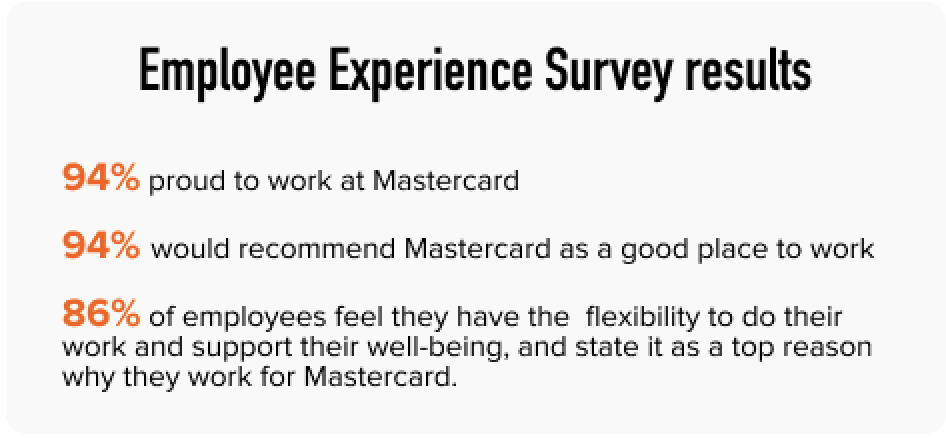
Mastercard offers a bereavement leave policy, acknowledging the need for employees to take the time to grieve and attend to personal matters without the added stress of work responsibilities. Mastercard considers bereavement leave as part of their holistic wellbeing and flexibility offerings, which they continuously revisit to ensure they best support employees and company. Over the years, bereavement leave has expanded and evolved, and in their current policy, employees can take up to 20 days paid time off, which applies to both full- and part-time employees. Recent updates to the policy include expanded time for death of a parent (including in-laws and step-parents) and in the event of a stillbirth or miscarriage.
We have received overwhelmingly positive feedback from employees, who attribute this benefit as a good example of our culture of decency. Feedback has also come in other forms, such as through the employee-led blog on the Mastercard homepage, called “Our Voices.” One employee reflected on their experience using the benefit to grieve the death of their grandparent and support their family, stating that Mastercard is a
Caring and inclusive workplace that values our lives and identities beyond our business hour deliverables.
Mastercard
Cisco has implemented a Critical Time Off policy that goes beyond traditional leave structures. This policy allows employees to take additional time off during significant life events such as the illness of a family member or personal emergencies. Cisco understands that certain situations require extra time and attention, and the Critical Time Off policy is designed to provide the necessary flexibility and support.
Three years ago, Adobe instituted Global Wellbeing Days, enabling their global community to collectively prioritize their wellbeing, disconnect, and recharge without worrying about work. In 2024, Adobe is offering six Global Wellbeing Days. These designated days serve as opportunities for employees to engage in activities and initiatives focused on improving their overall well-being.
At Adobe, we believe that taking time off is essential to the health and wellbeing of every employee. When our employees experience support both in and outside of the workplace, they are better equipped to unleash their creativity and innovate.
With Global Wellbeing Days, we’ve witnessed the profound impact of our community coming together for a collective day of rest. Employees use the time to reconnect with loved ones, focus on their health, or build community with other Adobe colleagues. For instance, the Adobe Golf network arranges golf outings on Global Wellbeing days, while some employees join fellow Adobe colleagues for activities like hikes, local pickleball games, and bike rides. Others choose to spend quality time with their family and pets.
Adobe
Medtronic, a leader in medical technology, understands the commitment of employees serving in the military reserves. To honor and support their dedication to national service, Medtronic provides paid time off for employees to fulfill their military reserve obligations. If reservists get deployed, Medtronic ventures far beyond what’s legally required. Medtronic holds reservists jobs for up to five years and provides differential compensation to cover the difference between their base pay and military pay. Benefits are covered for employees on military leave for up to 24 months. Their Family Care Leave policy includes up to six weeks paid leave for employees who are caregivers in a family where someone (such as a partner) is called to active military duty.
We’ve heard overwhelmingly positive feedback from workers who have utilized our military reserve leave. For them, it’s about more than just time off; it’s about peace of mind knowing that their service is valued and supported. We’ve had employees express deep gratitude for feeling recognized for their military commitments and the flexibility we offer.
Beyond military leave, we’re also proud to offer our employees caregiving support through Wellthy, a care concierge platform that works with families to ease their care burdens. Employees are matched with a dedicated Care Coordinator, who can help manage care in any capacity, big or small. This includes Wellthy’s deep expertise in veterans’ benefits, which can help veterans and their caregivers navigate benefits and coverage offered through the VA and other providers.
Our broader paid leave policies, including our military reserve leave, have significantly impacted our workforce in terms of retention, recruitment, and overall employee satisfaction. By prioritizing paid leave for military reservists, we demonstrate our commitment to supporting our employees’ diverse needs and honoring their service to the country. This approach not only strengthens our workforce by retaining experienced and dedicated individuals but also enhances our reputation as an employer of choice.
Our Family Care Leave, available globally — and expanded leave of up to 24 weeks paid for birthing parents in the U.S. — sets us apart in the marketplace. Combined with our Mission, which provides employees with a profound sense of purpose, our commitment to evolving benefits to meet employee needs is consistently highlighted as a top draw for candidates. …
Overall, our comprehensive approach to paid leave and talent development not only fosters a supportive and inclusive workplace culture but also positions us as a talent destination where diverse, top talent can come, grow, and thrive.
Denise King, Vice President, Global Benefits and Payroll, Medtronic
Pinterest recognizes the physical and emotional challenges that accompany miscarriage or stillbirth and is committed to supporting its employees during these difficult times. The company has a bereavement leave policy in place that covers Miscarriages and Stillbirth, acknowledging the need for employees to take the time they need to heal and cope with such personal losses.
Pinterest also provides a Family Care leave offering up to 12 weeks of full pay should employees need it to care for a seriously ill family member including a child under the care of a Neonatal Intensive Care Unit (NICU) post-birth. This is in addition to Pinterest’s 20 weeks of bonding leave for new parents.
At Pinterest, we’ve seen that people do their best work when they are most inspired, and feel seen and supported. We strive to create benefits that meet the real-world needs of our employees by supporting them through the different stages of family planning and child care, and by putting emotional wellbeing at the forefront. By listening to our employees, we’ve been able to shape our policies to support them when unexpected challenges arise. As our company continues to grow, we will keep working to create benefits that provide choices that are best for our employees’ careers and lives.
Adobe launched its U.S. sabbatical program to celebrate and honor employees’ innovation and contributions, recognizing them as the company’s greatest assets. Once employees reach five years of tenure, their initial sabbatical lasts four weeks. At 10 years, it extends to five weeks, and at 15 years, six weeks, remaining at this duration every five years thereafter. The Sabbatical Program is designed to provide employees with the time and space they need to rest and reflect, fostering creativity and innovation upon their return to work.
Adobe’s industry-leading paid leave policies foster a healthier, happier, and more engaged workforce by enabling employees to reinvigorate their creativity and return to work refreshed, primed to forge innovative ideas, and explore uncharted paths. In our annual employee survey, 87% of respondents expressed a willingness to recommend Adobe as an employer, while 89% stated they feel proud to work here. Upon returning from sabbatical, most employees shared in our sabbatical survey that they felt refreshed and welcomed as they transitioned back into their roles, noting that the time off fueled their motivation to do their best work upon return.
We are evaluating our wellbeing and benefits offerings each year by pulsing employee sentiment and benchmarking against the industry to remain competitive while providing optimal support to our global workforce.
Adobe
Understanding the unique challenges and health considerations that menopause can bring, Sanofi has implemented comprehensive menopause benefits to provide support and resources to its employees. These benefits may include access to menopause education and information, support groups, counseling services, flexible work arrangements, and healthcare coverage for treatments or therapies related to menopausal symptoms.
| “If you feel truly supported throughout your life cycle, whether it is maternity or menopause, you’ll be more engaged. I’m sure the new generation is more demanding on that.” Nathalie Grenache, SVP of People and Culture, Sanofi |
Fortune published their 2024 100 Best Places to Work list recently. It’s highly regarded by major employers and obviously reflects a theme we know to be a top priority for the public, so we thought it’d be fun to compare and contrast against our own JUST Jobs Scorecard, which we released last week.
Although the methodologies and purpose of the two products are very different – JUST’s scorecard is an interactive toolkit designed to help companies track and improve performance and transparency, not a list per se – the results are interesting.
In total, JUST covers 43 of the companies on the Fortune BPW list (the remainder are private or outside our Russell 1000 universe). Of these, 22 are topic or industry leaders in at least one of the six topic areas on the JUST Jobs Scorecard. And yet, only one company earned top marks for its industry on the Wages & Compensation topic, a key priority for the American public. Top companies in the Employee Wellness category in the scorecard tend to be more represented in the Fortune list compared to leaders on other topics. Half of the Top 10 on the Fortune list are represented among the companies that earned the 100 highest overall performance scores in the JUST Scorecard.
This list also marks the last time Alan Murray – their much-admired CEO who is stepping down at the end of the month – will be at the helm. Always a good friend to JUST, Alan’s thoughtful, fearless and often provocative leadership on values-led business and stakeholder capitalism is but one facet of his lengthy career. The success Fortune enjoyed under his tenure is a testament to his business acumen, too. We wish him all the best! His successor, Anastasia Nyrkovskaya, is the first woman to lead the iconic 95-year-old publication.
Be well,
Martin

“I am intimately familiar with what we offer, what’s available to employees. The extra dimension that the JUST Jobs Scorecard gave, in addition to comparability across other companies, was really looking at those programs through an external lens, because you didn’t score things based on what I told you, you scored things based on what you were able to cull out of public information. One use case for the JUST Jobs Scorecard is identifying areas of opportunity where we are doing something but not talking about it outside of our organization.”
JUST Advisor Ursula Burns joins Board Member Dan Hesse’s podcast to discuss her career, her time as the first black woman CEO of a Fortune 500 company, and life lessons–most importantly, “where you are is not who you are.” Listen here.
Fortune reveals that startling stat that nearly nearly 3 out of 4 insurers, representing $13 trillion in assets, say they’re turning to AI to help reduce operating costs.
Must Reads
Fortune releases its 2024 “Best Places to Work” list, and highlights how the nature of the list has changed thanks to changing expectations from Gen Z workers. In their words, “Gen Z doesn’t live to work. They work to live.”
MIT releases a fascinating study showing that the majority of work today occurs in jobs and categories that were all created post-1940, and explores how professions are really created and lost over time.
The New York Times explores new data that shows that, despite the promises made by big Banks, voluntary commitment to reduce climate emissions have been ineffective so far. More inside.
The Wall Street Journal reports that Norfolk Southern has agreed to pay $600 million to settle lawsuits in connection with a toxic train derailment in Ohio early last year.
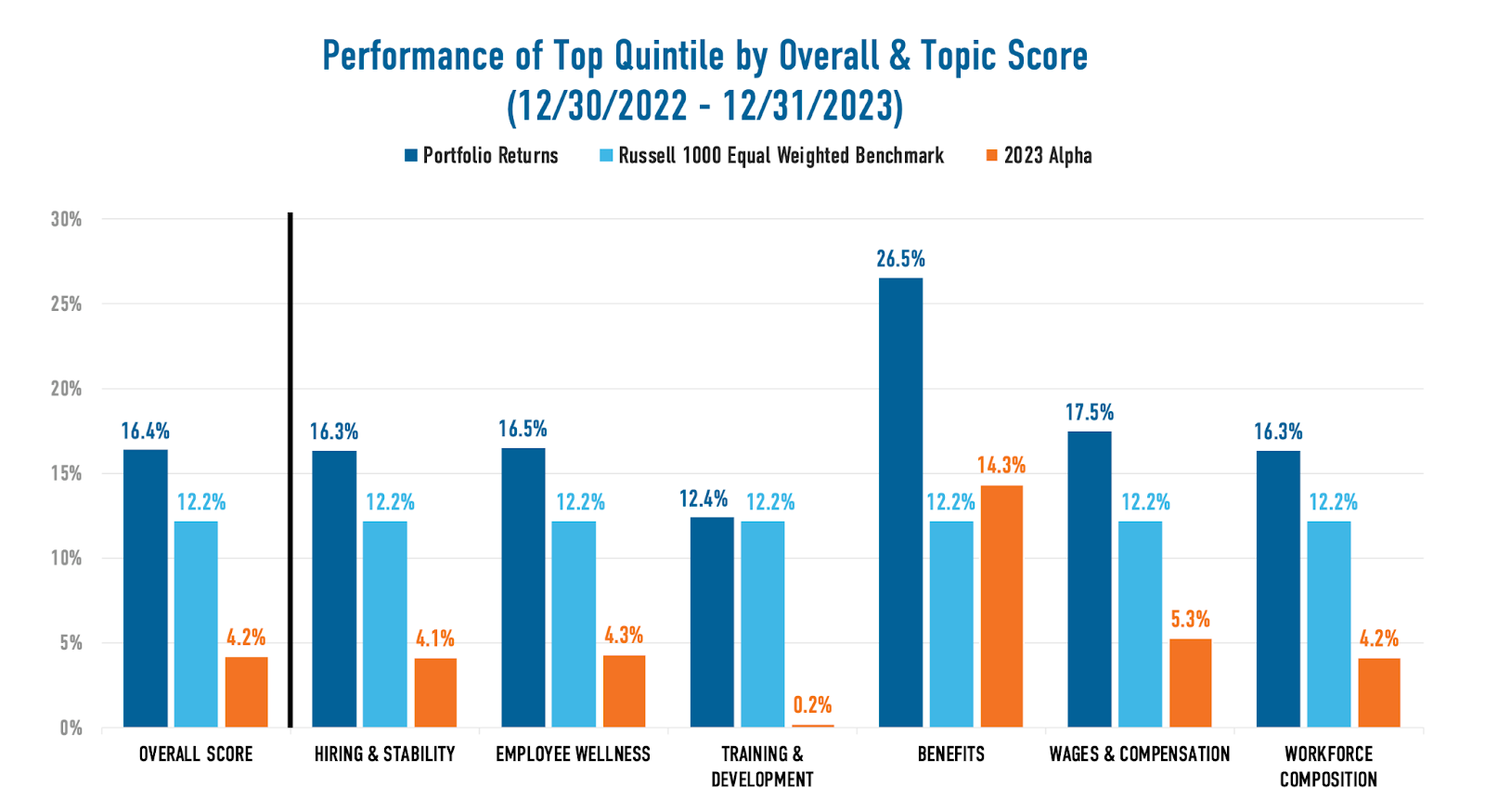
The chart comes from our deep-dive into the insights from our JUST Jobs Scorecard, particularly around stock performance. We examined the market performance of the highest-scoring companies within the top quintile, and discovered that, compared to the benchmark, we found that Scorecard leaders demonstrated substantially superior performance across nearly every Scorecard category, with the difference especially striking for companies that excelled in the Benefits and Wages & Compensation categories. Explore all the insights here.

Amid the fiery debate around “woke capitalism” and pressure from 13 Republican Attorneys General to Fortune 500 companies following the Supreme Court’s decision on race-based college admissions, some experts worried that CEOs would back down from diversity, equity, and inclusion commitments around things like pay equity.
But in actuality, the opposite is true – at least that’s according to Maria Colacurcio, CEO of Syndio, a software tech company that helps Fortune 500 companies and others advance policies promoting pay equity and career equity, or policies that promote fair pay and fair promotion, respectively. Prior to joining Syndio, Colacurcio co-founded Smartsheet, a workplace management platform, and held leadership roles at Starbucks and Microsoft.
According to Colacurcio – who works with clients like Salesforce, Walmart, American Airlines, and General Mills – many C-suite leaders are pursuing pay equity and fair promotion policies more aggressively than before. In fact, some are “ignoring” the letters from Republican Attorney Generals altogether, she noted.
Business leaders aren’t backing down from the issue of pay equity because it continues to be an issue of interest for employees, which plays into the war for talent, and because of new state-level pay transparency laws, which are forcing companies to disclose salary ranges, she said. In addition, she noted, there’s mounting regulatory pressure – amid growing interest from the the Equal Employment Opportunity Commission (EEOC), whose chair recently declared pay equity a top focus, and the European Union, which passed a directive requiring pay transparency.
In a recent Q+A with JUST Capital, the Syndio CEO discussed the financial case for pay equity, what she learned from serving as a director at Starbucks during the company’s pay equity analysis, how to begin conducting an internal pay equity audit, artificial intelligence, and more.
Editor’s note: The following has been lightly edited for length and clarity.
There’s growing political debate around issues like pay equity. Have you seen a scaling back of CEOs on these issues?
We work with primarily Fortune 2000 companies, and we’re actually seeing quite the opposite. So in the wake of salary transparency laws, and a competitive talent market, which continues even amidst all the news of layoffs, we’re seeing a lot of companies doubling down on this work, including bellwethers across tech like Microsoft, Walmart in retail, Moderna in healthcare, and so on.
I think part of that is because folks realize there’s no going back to the old way. This generation of employees expects companies to pay equitably.

So what I’m hearing is that companies are not scaling back.
Absolutely. I think a lot of folks started immediately presuming that the Supreme Court’s recent ruling would cause a big rollback in diversity practices. And I think what it’s doing is more so bringing to light, what is the right way to measure this? What is the right way to think about analytics and measurement to ensure that we’re tracking in the right way toward our goals? I think that’s the really important part of this conversation that we need to continue to focus on.
Walk me through the bottom-line case for advancing pay equity.
This is about not only attracting the right type of talent, the type of talent that’s going to drive business performance, but also retaining that talent, because retaining your way to some kind of aspirational goal is much more efficient and cost effective than hiring your way to that goal. Gartner research found that 58% of workers would consider switching jobs for more transparency. For Gen Z employees, that number jumps to 70%.
Studies have shown that businesses with more diverse teams and leadership have better financial performance. According to McKinsey & Company, companies in the top quartile for gender diversity were 25% more likely to have above-average profitability than those in the bottom quartile. Additionally, companies with more racial and ethnic diversity were 36% more likely to have above-average profitability.
You served as a director at Starbucks, where you played a role in the company becoming one of the first Fortune 50 companies to go public with its pay equity results. What did you learn from that? I imagine that it’s scary for a company to do that for the first time.
It is scary. And kudos to Starbucks for being so progressive and being first to really take transparency and want to take it to that level, because no one was really doing that at the time. And, you know, they continue to be just an absolute powerhouse in what they’re doing.
That experience – in addition to co-founding Smartsheet [a software as a service offering for collaboration and work management] – was the impetus for Syndio, for figuring out how to solve these issues through technology.
Rob Porcarelli was the VP Assistant General Counsel at Starbucks – he now works as Syndio’s Chief Legal Officer. Through him, I learned how pay equity initiatives worked. They’re usually done through an outside consulting firm or law firm – it’s just very cumbersome, it’s archaic. It’s a long process. And more importantly, the recipient of the information doesn’t learn much, they just get a big stack of paper back, which tells them who to pay and how much, but they don’t learn anything about the root cause of the policies and behaviors that are driving those disparities. So we started talking. It was really this idea of like, how do we fix starting pay?

Why are you passionate about pay equity and career equity on a personal level?
So when I left Smartsheet, I had taken a couple years off to stay at home with my young kids, and I went through a divorce as I was transitioning back into the workforce. The motherhood penalty was a very real thing for me, even with the experience I’d had having worked at Microsoft and having been in tech for a long time. My experience with the motherhood penalty was very much a gut punch.
So I think that, combined with what Rob taught me in the process of going through that effort for Starbucks, is what opened my eyes to the fact that there’s so many different facets to this problem. It’s not just the fact that companies don’t have their fingertips on this data and analysis, it’s that they can’t do analysis quickly and efficiently. It’s about perception. How are folks perceived when they move into that role of motherhood? How does that show up in pay? How do we begin to combat that?
If I was a company contemplating taking on a pay equity or an opportunity analysis, can you walk me through some of the steps involved? Who should I talk to?
So I think the folks to get in the room are your HR team, your CHRO, your head of compensation or whoever’s handling that, and then I think the legal perspective is another really great perspective to have in the room, so your chief legal officer.
Now I’m the CEO of Syndio, so I’m gonna highly recommend our platform – we have clients who are best in class in their industries. I’m also going to recommend some free resources we have like our guide titled “The New Way to Fair Pay,” and our helpful communications playbook.
Then start the conversation: How can we make pay and opportunity equity a strategic business priority?
The best time to address pay equity is now. For every minute you wait, it actually compounds on itself and gets worse. There’s remediation that you’re going to have to pay if you’re living in a place where you have disparities because of gender, race, ethnicity – not to mention the potential brand catastrophic risk, if that comes out, in addition to lawyers, fees, settlement costs, other things like that, if you are entangled in some sort of litigation.
On the opportunity equity side, or ensuring all employees have the same shot at promotion, I think the real selling point here is that without precise metrics, a broad-based DEI effort can spend a lot of time and money trying to fix the wrong thing. There’s tech out there to help companies tackle DEI efficiently, in a really modern and specific way, using analytics to drive the measurement. It will show you where progress has been made and where there’s still opportunities for progress.
Artificial intelligence has generated a lot of interest in how it will impact the way people work. What impact do you see AI having on the work you do?
While AI isn’t new, the sophistication of AI is growing, and that will inevitably have an impact on how HR understands and interacts with information, including workplace equity. Natural language capabilities will empower companies to democratize insights and infuse fairness into decision-making at a larger scale. AI’s speed and efficiency can streamline data preparation for analysis, facilitating faster and more frequent assessments. With caution and understanding around the use of inputs, AI’s predictive capabilities can drive companies from reactive to proactive equity management.
However, these potent tools are built upon existing language and data and can therefore amplify biases ingrained in the status quo. To address this, we must focus on developing generative AI, large language models, and natural language processing tools that actively counteract biases in pay and opportunity-related decisions.
Members of JUST Capital’s Corporate Impact Initiatives engage with Syndio, among other impact partners, to help them navigate workforce investments and deliver on their equity commitments.

At JUST Capital, we are excited about the tremendous potential of artificial intelligence to drive positive change in business and society. But we are also keenly aware that if deployed irresponsibly, AI risks exacerbating societal divisions and inequities.
As companies increasingly adopt AI tools, how can they ensure these technologies align with the priorities of the public and benefit all stakeholders? The Just AI Initiative by JUST Capital aims to shed light on this critical question.
Grounded in extensive public opinion research, the concept of Just AI is to help companies implement AI in ways that reflect Americans’ values around fairness, privacy, inclusivity, and shared prosperity. Its multifaceted approach encompasses measurement, education, and engagement to incentivize responsible AI across the private sector.
Here at JUST, we always focus our work on the issues the American public cares about most, not what special interests or opportunists want. Our ability to drive change depends on the value we provide companies seeking to make AI work better for all stakeholders.
Central to our approach to Just AI are principles like stakeholder orientation, transparency, and accountability. Companies are encouraged to consider AI’s impact on workers, customers, communities and the environment, and shareholders. To encourage trust, companies will want to be transparent both in their objectives as well as how their models are being created and deployed. Opening algorithms to outside audits and communicating the objectives they are pursuing with AI are also clearly emphasized.
The concept of Just AI is to help companies implement AI in ways that reflect Americans’ values around fairness, privacy, inclusivity, and shared prosperity.
For nearly ten years, JUST has tracked corporate stakeholder performance by gathering both quantitative data and qualitative feedback from diverse stakeholder groups. This will be central in our approach to AI as well. These insights will help inform what data we might track in future iterations of our rankings to identify leaders others will want to emulate.
As always our goal is to drive and scale adoption of just business behavior and support on-the-ground outcomes: Are workers being treated fairly? How is AI impacting customer service and privacy? What are the environmental impacts? Will shareholders be impacted by new risks? We want specifics. We want measurable results.
Partnership is another core tenet of the Initiative. Collaborating closely with academics, companies, and civil society will enable knowledge sharing on issues like algorithmic bias and help build best practices. Our aim with Just AI is to keep abreast of the latest research and stakeholder input to inform our models.
Within JUST Capital, rigorous internal governance and training will be reinforced. We aim to walk the walk when urging others to use AI responsibly. That means making accountability, ethics, and transparency central to our own AI capabilities. It will be a journey for us, too.
In spotlighting leadership and providing meaningful benchmarks, Just AI ultimately seeks to steer one of the most transformative technologies towards serving the public good. Its success will depend on delivering value to companies willing to embrace this vision.
The potential of AI to improve lives is immense, but it’s not a foregone conclusion. That’s why Just AI matters.
I invite other leaders passionate about ethical AI to connect and explore how we can partner. Together, we can ensure AI fulfills its promise to benefit all.
Get in touch by sending a note to corpengage@justcapital.com to explore ways to get involved in the work.
Robert Marsh is JUST Capital’s Chief Information Officer.
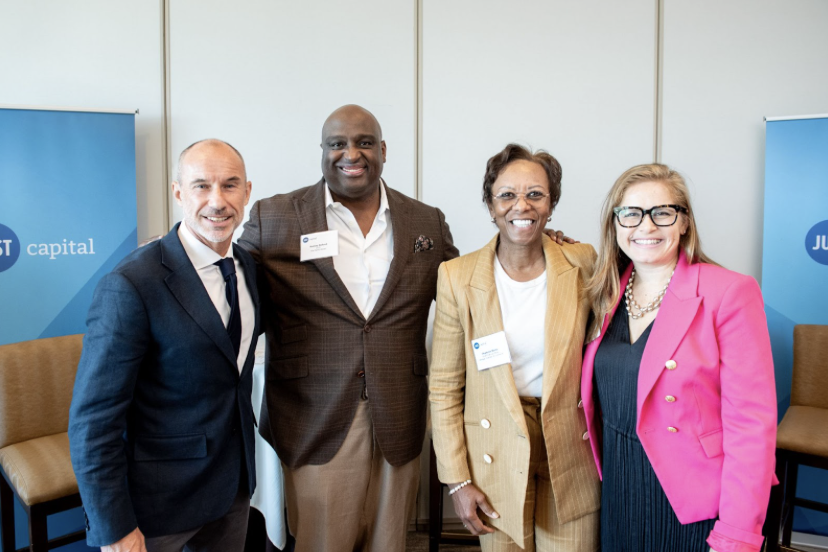
[Image via Picture This Photography, Atlanta]
How can corporations make a lasting difference to the financial, human, and social capital of cities in America? This was the question Roosevelt Giles, Chairman of the Stakeholder Impact Foundation, former Executive Chairman of Atlanta Life Financial Group, and JUST Capital Board member, put to a group of business leaders JUST Capital convened in Atlanta this week.
It’s a topic that doesn’t get the attention it deserves. Americans want companies to give more back to the cities and communities they do business in. Indeed, many corporations have a rich history of doing just that. Think of Rocket Mortgage in Detroit, Microsoft in Seattle, Prudential in Newark, Walmart in Bentonville. Investing in communities always features in our polling and is a core component of our Rankings.
Roosevelt’s question runs a little deeper though. It speaks to the obligations companies have to nurture strong economic and cultural bonds with the people and places they connect to; to invest in health, education, housing and infrastructure; to create good jobs. To be more just.
In Atlanta, we learned that despite the gleaming new office buildings in downtown Buckhead, economic mobility is low, deep inequality persists, and talent goes untapped. Rodney Bullard, CEO of The Same House and former executive at Chick-fil-A, put it this way; “In Atlanta if you were born in poverty, you have a 4.3% chance of getting out of poverty.”
Overall, our panel – which in addition to Rodney featured Stephanie Martin from the Georgia Chamber of Commerce and our own Ashley Marchand Orme – stressed that business leadership was needed now more than ever. “It’s all about cities like Atlanta figuring out how to deepen relationships with CEOs. When the community does well, companies do better,” said one prominent guest. With 17 Fortune 100 companies and a deep-rooted culture of philanthropy in the Greater Atlanta area, perhaps “the Atlanta way” of bringing private, public and philanthropic leaders together can inspire a new model for community development.
Be well,
Martin
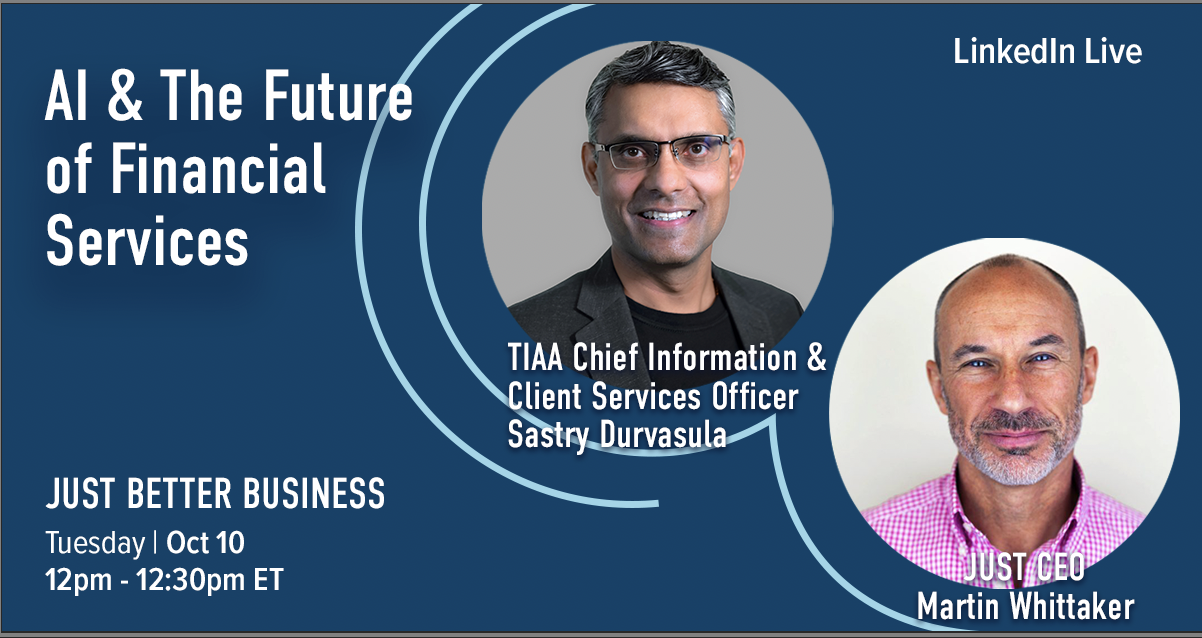
AI is reshaping the business landscape, and financial services is no exception. On October 10th at 12 p.m. ET, Martin Whittaker will sit down with TIAA Chief Information and Client Services Officer Sastry Durvasula for a LinkedIn Live to discuss how AI is impacting workers, investors, customers, and other stakeholders. The two will also discuss Durvasula’s extensive work upskilling and reskilling workers through technological changes, with takeaways for business leaders. Sign up to join the discussion here.
October 5 marks Latina Equal Pay Day, recognizing the number of days into the year that Latinas must work to earn as much as a white, non-Hispanic man typically earned in 2022. CNBC reports on the wage gap Latinas face, losing $1.2 million over the course of their careers, citing JUST Capital research that finds “24% of Russell 1000 companies disclose that they conduct a pay equity analysis with a specific focus on race and ethnicity. Within that group only 9% — or 85 companies — have disclosed the results of their analyses.”
Gartner features JUST Capital research in a new blog post highlighting our Worker Leaders index concept and making the case for the objective value of ESG. “When JUST Capital compares the market performance of companies on their annual ranking that score in the top 20% for worker issues to the broader Russell 1000 stock index, it has consistently shown outperformance by the Workers Leaders group.”
JUST Capital CEO Martin Whittaker joins the Enterprise Engagement Alliance (EEA) to discuss the state of stakeholder capitalism and ESG. Other panelists include EEA Managing Director Bruce Bolger and R. Edward Freeman, Professor of Business Administration at the University of Virginia. Watch the full conversation here.
B Lab’s B The Change newsletter features an article focusing on the “S” in ESG. JUST Capital’s Managing Director and Head of Investor Strategies Cambria Allen-Ratzlaff talks to the nonprofit about the expectations the American public has for companies to invest in good jobs and how companies’ relationships with their workers influence the bottom line.
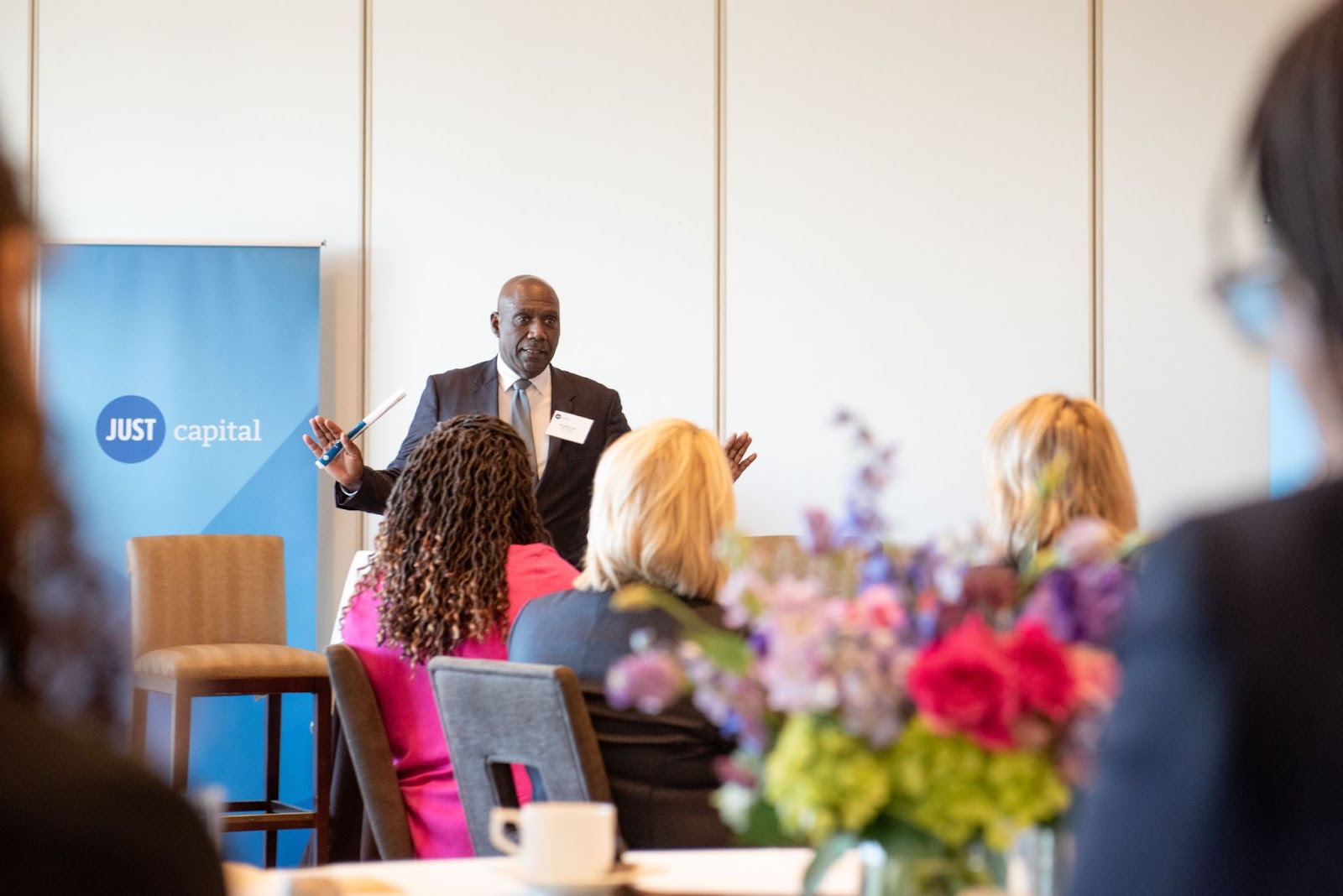
Roosevelt Giles, Image via Picture This Photography, Atlanta.
“When you talk about capital, there are three buckets. You’ve got financial capital, human capital, and social capital. When you look at a lot of the noise today around financial capital, it’s shareholder primacy. Well that is in conflict with human capital and social capital. Historically, there was a deep bond between corporations and employees. If there was a problem, I knew the company would take care of me. Also, people recruited their family members to their companies. People performed well because they did not want to embarrass the family, you had that built-in mechanism. But that’s broken now.
Now the relationship between human capital, social capital and financial capital is transaction based. That’s a problem. What JUST capital is doing is we’re working with companies with our data to bridge these things back together, so that capitalism works for everybody.”
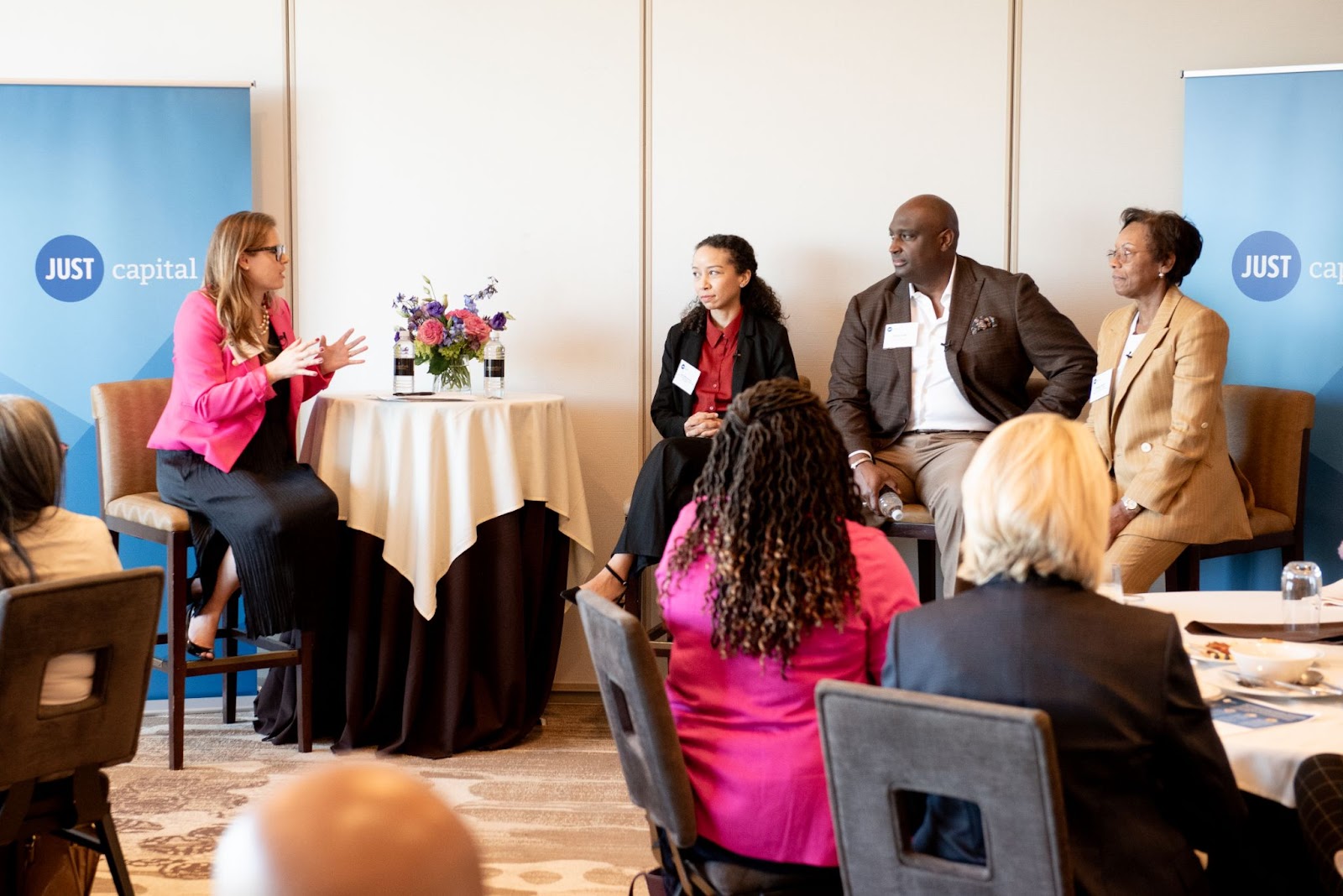
“There’s an outsized impact corporations have on society. Corporations have to be engaged in finding solutions. In looking for ways to guide change, we should be able to turn to boards. Board directors have much longer tenure than CEOs when you think about it, they can guide change for the long-term in ways CEOs can’t. They can raise their hand and ask company leaders, ‘What are our biggest human capital and equity challenges? How can our company address those?'”
Fortune’s CEO Daily touches on AI’s “shiny object” problem. CEOs are pushing for broad and rapid adoption of the new technology before businesses can implement proper guidelines and precautions.
JPMorgan Chase CEO Jamie Dimon says future generations will have 3.5-day work weeks and live much longer lives thanks to AI.
The New York Times publishes an opinion piece highlighting the precedent set by the new WGA deal in respect to AI and labor negotiations. The striking writers were able to center regulations around the new technology in their revised contract.
LinkedIn debuts a new platform for recruiters powered by AI. The new tool will streamline and simplify the way employers find candidates for new roles. Axios also reports on LinkedIn executives making the case that AI’s ability to upskill workers could reduce the value of a four-year college degree for job candidates.
A new opinion piece in The New York Times argues that higher wages for workers will not lead to the much feared wage-price spiral. New analysis from Goldman Sachs included in the article and also covered by Axios finds that increases are essentially an “echo” of raises in other sectors over the past two years.
More than 75,000 unionized Kaiser Permanente employees walk out on strike marking the largest labor action by healthcare workers in U.S. history. Workers are hoping to resolve staffing shortages that have left many of them feeling overworked and burned out.
CNBC reports on the tension brewing between automakers and union leaders. Both GM and Stellantis have accused UAW president Shawn Fain of a delay in sending counterproposals as the union threatens to expand its strike.
Ken Frazier, former CEO of Merck, spoke out during Fortune’s CEO Initiative conference, arguing that CEOs have a responsibility to speak out for democratic principles when they are not being upheld by elected officials.
Forbes writes about Walmart’s plan to remove college degree requirements from a large swathe of corporate job descriptions. The ongoing labor shortage has pushed companies to reconsider what they prioritize when considering a candidate.
According to Indeed, more than half of U.S. job postings now have salary and wage information, a 50% increase from 2020. HR Brew has the story.
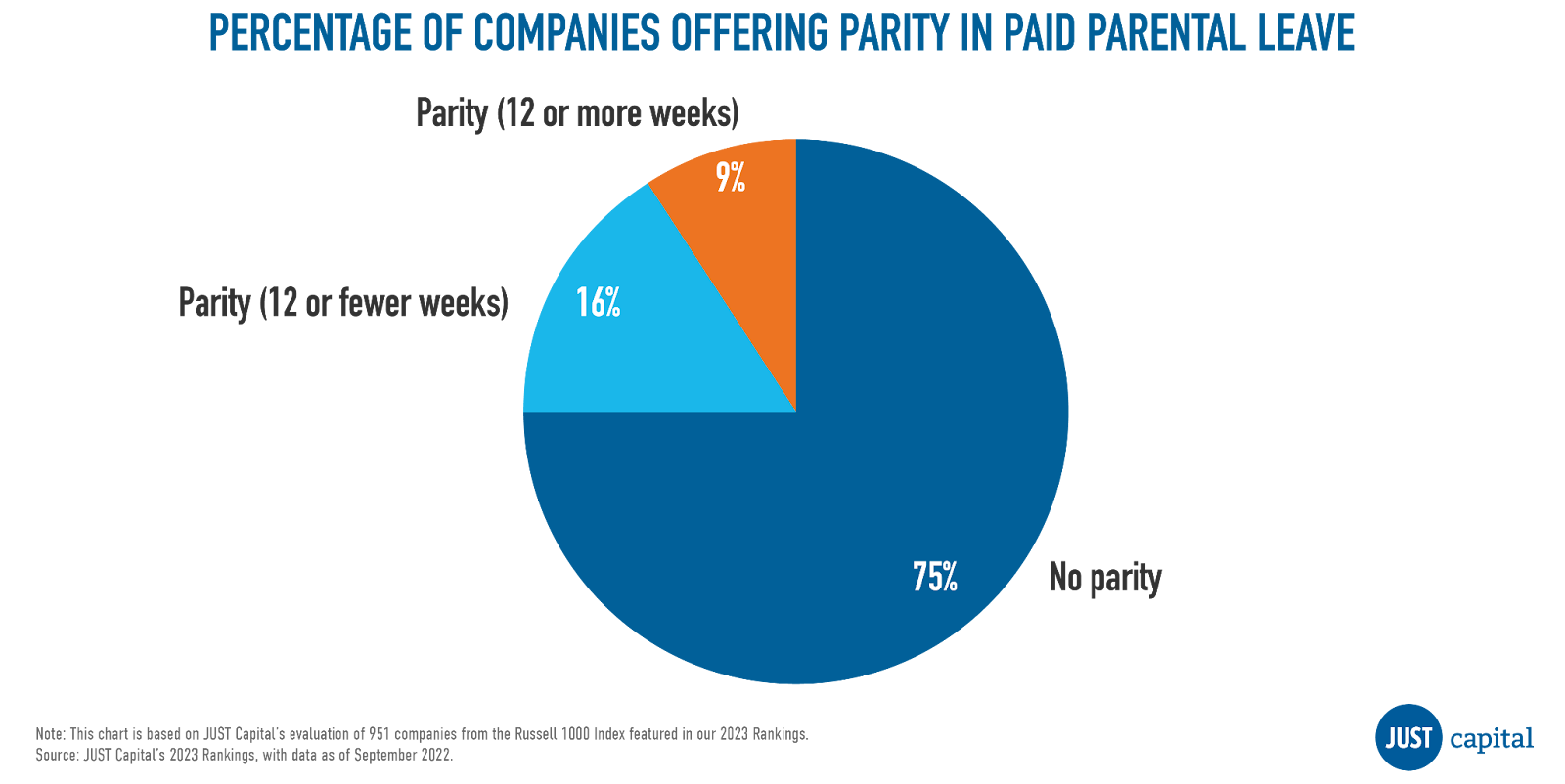
On September 30, $24 billion in federal funding distributed to childcare providers and facilities expired – creating what’s been termed a “childcare cliff” in the U.S. The stoppage could lead to 70,000 childcare programs closing, according to estimates from the Century Foundation, and employers may need to adapt care policies accordingly, including parental leave. JUST analysis finds that only 9% of Russell 1000 companies offer parity of 12+ weeks in paid parental leave for both primary and secondary caregivers. We also took a look at the top companies for working mothers and fathers among the largest U.S. employers, taking into account parental leave, backup dependent care policies, subsidized childcare, and flexible work practices. Learn more about how we’re helping companies prioritize care through our Corporate Care Network.
