Each year, we ask Americans what matters most to them when it comes to just business behavior. The results drive our Rankings, defining how we track, analyze, and rank the largest publicly traded companies in the U.S.
The priorities of the American public remained largely unchanged from 2017 to 2018. Overall, some issues are slightly higher in 2018, which means others are slightly lower, but the changes are small. This consistency shows that the American people are steadfast in their values and what they think defines a just company. Here are the year over year changes:
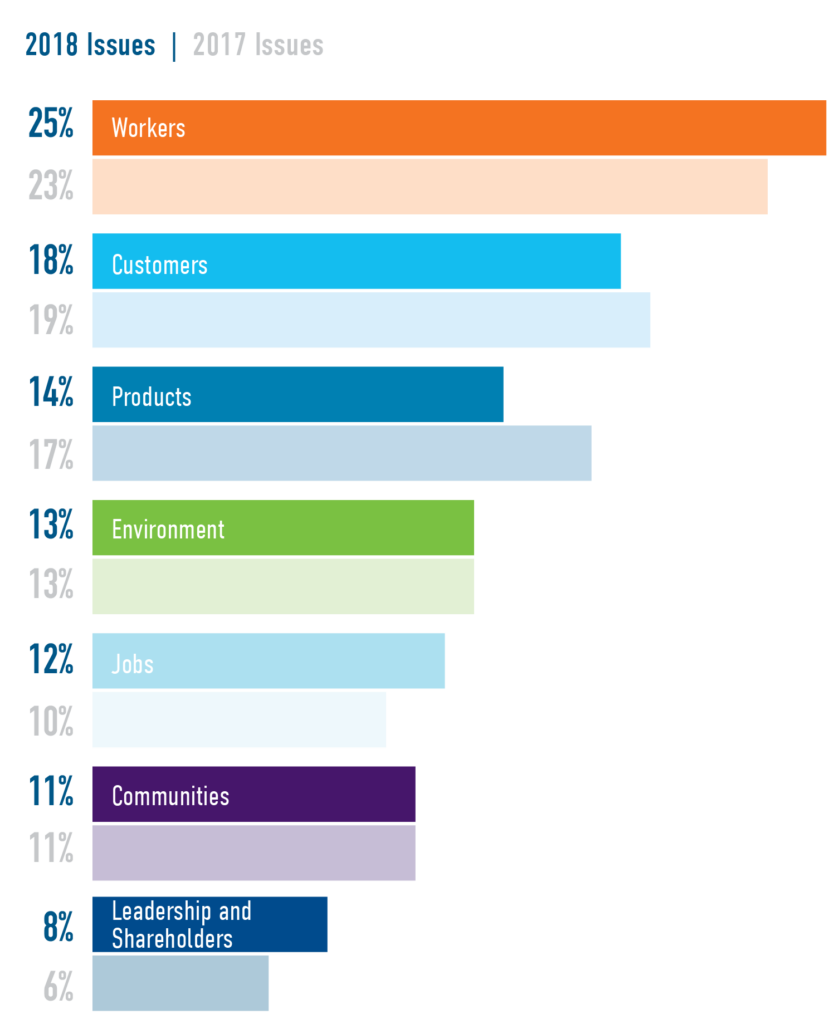
As they did last year, Americans placed the most importance – 25% – on worker pay and treatment in this year’s survey, and therefore this issue will comprise a quarter of a company’s overall score in our 2018 Rankings model. Across demographics, there is striking consistency, with groups prioritizing the needs of workers at roughly 25%.
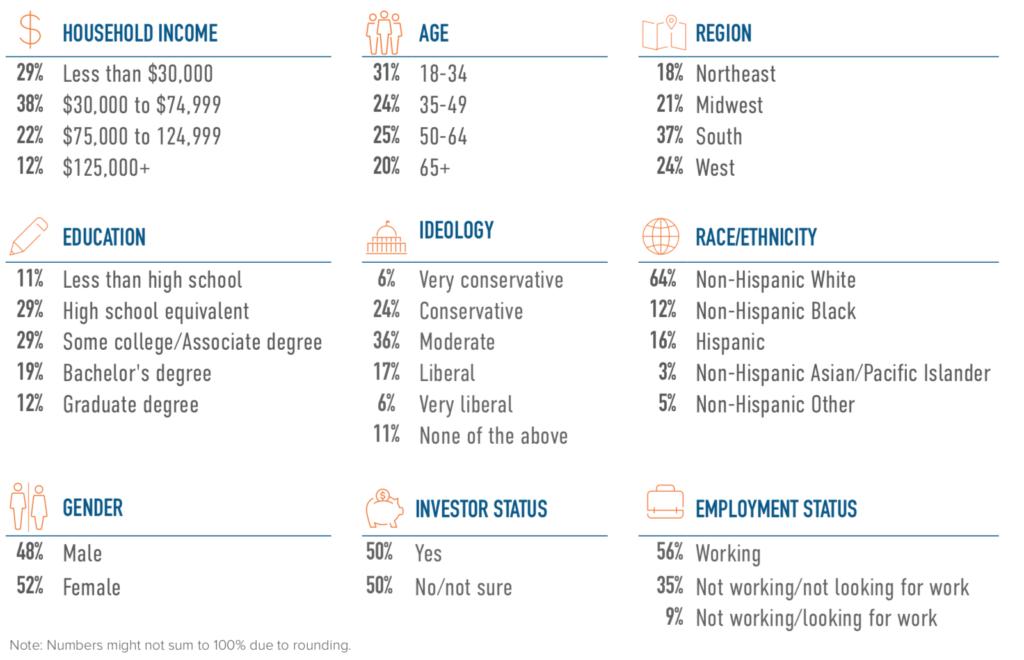
To see the complete list of Issues, Components, and their prioritization, which power our Rankings model, please download the 2018 Survey Report or visit the Issues section of our website.
Identifying the best data to collect, analyze, and rank companies is an evolving art and science. We are always looking for ways to improve our approach and converge on a more fine-tuned and comprehensive model. There are two main ways we improved the methodology in 2018 to provide more accurate measures of just business behavior:
In an effort to increase transparency, data quality (more accurate representation of the priorities of American people based on our polling), and coverage (number of companies with data points), we identified better ways to measure data within several issues by bringing more collection in-house and reducing the amount of data coming from third-party vendors.
To add more precision to the model wherever possible and to differentiate high performers from others, we changed the way we scored companies on specific data points, moving away from binary scores to scaling grades for evaluating companies.
Our survey and focus groups identified that the American population today cares about issues we did not specifically measure in 2017, such as whether a company has paid parental leave, tuition reimbursement, or a outplacement services policies. Our model now integrates these new data points into the model. We also found a better way to measure a company’s commitment to ensuring a safe workplace, and are now collecting this data in-house rather than using a third-party vendor.
In an effort to increase data quality and coverage, we changed our data sources for evaluating customer service ratings.
In 2018, we changed the way we assess whether companies make products that are beneficial to health, environment, or society. This year, we polled the American public to determine what products were more or less just, and we scored companies based on whether they offer such products. This year, we also improved our methodology for recalled products. We now include in our analysis the number of incidents reported, the number of products recalled, the company’s overall revenue, and its responsiveness (how many months the product was on the market). This new approach provides a better way to level the playing field and reflect the scale of the recall.
Measurement on this Issue changed substantially this year. We discontinued use of third-party data that aggregated performance across a range of environmental criteria and switched to sources that provide more specific coverage. We changed vendors for the Minimizes Pollution Component to allow us to have a more comprehensive view of companies’ greenhouse gas emissions. In 2018, we stopped measuring companies’ overall water usage and instead honed in on measuring their chemical (cancerous and non-cancerous) water discharge. We also stopped measuring electricity and fuel usage, focusing more on pollution outputs instead of resource inputs.
Through our survey and focus group work, the American people identified that creating jobs on a global scale mattered when defining just corporate behavior. As a result, we introduced a new Component this year – Creates Jobs Globally – which accounts for 13% of a company’s Jobs score.
As part of our efforts to enhance data quality and precision related to Communities, we focused on measuring more granular nuance. The scoring of a company’s supplier code of conduct is more detailed in 2018, enabling us to better distinguish companies with more robust policies. We have also diversified and added more specificity to our measures of charitable giving, moving away from binary scores in areas such as corporate giving sources and employee gift matching, to more nuanced scaling grades. Companies that offer matching employee gifts programs for a wide range of causes receive a higher score than those that only match giving to select causes or institutions, or companies that do not have an employee gift matching policy.
This year, we made adjustments for one-time tax expenses and benefits related to the Tax Cut and Jobs Act, which did not exist in prior years and added a new measurement of whether a company discloses a tax strategy that is in line with best practices. We also improved our board diversity evaluation to exclude diversity of nationality (country of birth), which experts agree is not the best measure to represent what people understand as diversity.
There’s no doubt that this work represents a much-needed improvement to the status quo for tracking and analyzing companies on the issues that matter most to the American public. We will continue to refine it as we learn more, and as companies increase transparency and data disclosures.
For additional detail, please read the Full Ranking Methodology.
If you have feedback or questions about our Methodology: We want to hear from you!
If you’re interested in the nitty-gritty details of the JUST ETF, this is a must read. Writer Felix Salmon does a deep dive into the research methodology behind our rankings and the JULCD Index driving the ETF, explaining why he thinks it’s a smart investment and a “welcome innovation.”
“The idea behind the Just 500 is that it’s an alternative to the S&P 500: It’s a diversified list of 500 of the biggest companies in America, but it’s better. The ETF, which is the fund comprising all the companies on the list, is not better than S&P 500 ETFs because it’s cheaper than them (although, with a fee of 0.2 percent per year, it’s not very expensive), and it’s not better because it’s going to outperform the S&P 500 funds (it might, it might not, no one knows). Instead, it’s better because the stocks in it are chosen according to what you might call a crowdsourced dynamic values-based algorithm. If you care about which companies you’re investing in, and you want to invest in good companies while boycotting bad ones, then this is a very easy and well-constructed way of doing that….The Just ETF is…good investment, however, because it is an easy and cheap way to get broad stock-market exposure while aligning your investment with generally positive values.”

Welcome to JUST Capital’s progress report for 2017. It was an incredible year of growth, learning and achievement. From the release of our 2017 list of America’s Most JUST Companies to the launch of our new, interactive website, this brief highlight reel will give you a clear picture of the considerable strides we have taken toward our mission of building a more just marketplace. If you are already a supporter, we thank you and hope that we are making you proud. If you are not yet a supporter, please consider becoming one! And in both cases, we look forward to making 2018 a year of even greater accomplishment.
JUST Capital is dedicated to giving Americans the information and the tools they need to drive change in Corporate America on the issues they care most about. Since 2015, we have surveyed over 72,000 people, and held nearly three dozen focus groups across 12 cities.
In 2017, we joined forces yet again with our partners at the National Opinion Research Center (NORC) at the University of Chicago, to conduct our nationwide surveys. We then produced our inaugural Roadmap for Corporate America, which was showcased in The Washington Post, Vice Impact, and Fast Company. The report, which will be updated every year, provides companies with the first ever data-driven roadmap for understanding how to balance just business performance for all stakeholders – employees, customers, communities, the environment, and shareholders.
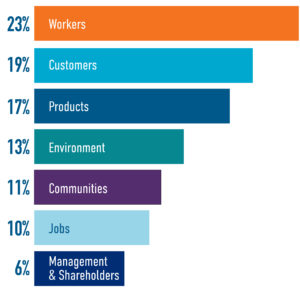
In 2017, when asked what is most important for companies to prioritize – creating a good product, reducing environmental impact, connecting with communities – Americans identified, by order of importance, seven key drivers of corporate behavior:
We augmented our core survey work with additional, issue-specific polling with YouGov, and enlisted the support of a nationally-recognized expert advisory council to ensure that the polling work was conducted with a high degree of scrutiny and sophistication. We believe our survey data now represents one of the most comprehensive and authoritative “living” databases of how people see big companies and what issues they truly prioritize. Our framework presents an attractive and distinctive new operating system to companies for tracking business performance on the issues that really matter.
The release of this year’s list of America’s Most JUST Companies and the launch of our new company rankings platform represented a huge leap forward for the organization, as it was the first time America’s largest corporations were measured on a head-to-head, absolute basis across all the critical issues. We increased accessibility to the data and built out the tools needed to understand it – including the new JUST Capital website. The new digital experience brings our rankings to life, enabling visitors to freely explore how companies rank overall, by industry, and on any of the specific issues that matter to them: from worker pay and living wage, to environmental impact and job creation, to product quality and discrimination. In the first month, the site saw considerable upticks in traffic, including an 88% increase in pageviews, 81% in session length, and 20% in individual users.
The top performers – the JUST 100 – were awarded our newly-designed Seal, and provide a powerful benchmark to incentivize just business behavior. We are heartened to report that of the 107 Seal winners, 72 have advertised it or are otherwise in discussions to do so.
Compared to others among the corporations we rank, the 2017 JUST 100 companies:
The rankings release became the focal point of the year for informing, engaging, and activating all of our stakeholders – corporate leaders, investors, foundations, influencers, and the general public – at one moment. Forbes, our media partner, showcased the JUST 100 and our highest ranked company CEO, Brian Krzanich of Intel, on their December 26 cover, and produced a wide array of in-depth coverage in their print issue and on their expanded microsite. Millions more engaged with the rankings via other media outlets including Fast Company, Bloomberg, CNBC’s Mad Money, Business Insider, and Sustainable Brands.

America’s Most JUST Companies and influencers, like Richard Branson, Deepak Chopra, and Arianna Huffington, helped to drive massive marketing reach and engagement, leveraging our creative campaign assets.
We received 138 million impressions on Twitter alone, with companies including Accenture, AT&T, Humana, IBM, Intel, P&G, and Rockwell Collins advertising their inclusion in the JUST 100 across their social media platforms, websites, blogs, and PR channels.
We’re honored to be named an Industry Leader in the @Forbes and @justcapital_ #AmericasMostJUST ranking: https://t.co/Dl4XhSvBPf pic.twitter.com/nnFM4Z57Lk
— IBM (@IBM) December 12, 2017
Our New York City Launch Event welcomed 400+ leaders from corporate, investor, and nonprofit communities, and featured an impressive slate of leaders from America’s Most JUST Companies, including Intel CEO Brian Krzanich, Humana CEO Bruce Broussard, Corporate VP and Head of Microsoft Philanthropies Mary Snapp, CHRO of North America Beverages and Nutrition at PepsiCo, Andrea Ferrara, and SVP of Corporate Affairs at Amazon, Jay Carney. We hosted a robust discussion with these leaders, who shared how they define a just company and prioritize competing interests to drive change.
To truly fulfil our mission of building a more just marketplace, we know that we must work with partners to drive adoption of the JUST Capital framework – the data, the rankings, and the tools they power – by each of the market’s primary stakeholders. This means reaching consumers, investors, policymakers, advocacy groups (the public and nonprofit sector), and of course the companies themselves to create the system effect we know is needed.
To that end, we have expanded our strategic corporate engagement team to work with C-Suite executives on behavior change and are facilitating ongoing conversations with the largest publicly-traded U.S. companies, including leading employers like Walmart, PepsiCo, Amazon, Microsoft, JP Morgan, and others. We’ve tripled the number of companies participating in our data review process through our corporate portal and received over one thousand data submissions, enabling us to create a more accurate measure of company performance while driving greater disclosure and activating conversations for change.
We also expanded our capacity as a key convener of business, investment, and nonprofit leaders on core issues of shared concern, crafting event experiences with thought leaders like Richard Branson and The B Team, Deepak Chopra, the Chamber of Commerce Foundation, and more.

We have deepened our ties with academic institutions and business schools, including Yale University’s Center for Business and the Environment, MIT – where we have an ongoing collaboration with Amy Glasmeier’s Living Wage Calculator as well as the Laboratory for Aviation and the Environment, the Darden School of Business at the University of Virginia, students and faculty at Harvard University, Columbia University, and New York University, which houses Ethical Systems, a collaboration of top researchers. Additionally, we brought together some of the leading public opinion research experts in the country to review our polling work, including Andy Weiss at Mathematica, Nancy Belden at Belden Russonello Strategists, Don Dilman at Washington State University, and Jeff Brazell at The Modellers. We also explored new data partnerships with The Data Incubator and Development International, in addition to expanding existing relationships with Glassdoor on wages and worker treatment metrics, Good Jobs First on fines and settlement data, and BoardEx on corporate governance metrics.
Finally, we’re strengthening relationships with advocacy groups, policymakers, and other agents of change who specialize in the issues identified in our polling, and in whose hands our data can leverage dramatic change. These include DoSomething.org, Out Leadership, and Inspiring Capital on community action; the Center for Popular Democracy and NELP on retail wages; Harvard’s Labor and Worklife Program and Root, Inc. on employee engagement; and Panorama on paid family leave. We’re also building out our work with state-based groups and policymakers in Washington to provide state and county-level data and insights around our core issue work.
Building the investment case for just business behavior is critical to our systems approach. We continue to produce groundbreaking new research and analysis that demonstrate the business case for and encourage investment in just companies (we call it “JUST Alpha”).
 Our first Index, the JUST Capital U.S. Large Cap Diversified (JULCD) Index, is a collection of the top 50 percent of just companies in each sector, and was launched in November 2016. It is one of only a handful of such indexes featured on Bloomberg’s Intelligence ESG dashboard and since inception has beaten its benchmark, the Russell 1000 Index, by over 3 percent with minimal tracking error. The Index meets the pressing need for a broad-based equity market benchmark, reflecting the values of the American public without sacrificing investment return. Over the last year, companies in the Index exhibited significantly higher returns, lower volatility, shallower stock price declines, and higher return on investment capital than bottom-ranked companies. In December 2017, Goldman Sachs filed a registration statement for a new passive ETF based on the JULCD.
In addition, we issued a steady stream of research work demonstrating that investing in just companies is not only good for America, it makes financial sense. And we’ve begun the research that will underpin the next wave of JUST indices, led by the JUST 100, as well as thematic indices highlighting the top performers in our Workers, Communities, Environment, and Job Creation drivers.
 Finally, we conducted an extensive program of outreach to the investment community to explore how our data may be used in their day-to-day strategies. This encompassed discussions with over 75 public pension funds, impact investors, foundation endowment managers, family offices, wealth managers, fund managers, investment advisors, and banks. The intelligence gathered from this process will drive our product strategies for the financial community in the coming year.

In 2018, we will accelerate our ongoing release of data and insights to continually raise awareness of both JUST Capital and the underlying issues related to creating a more just and equitable marketplace. We will deepen our research capabilities, expand our proprietary data sets, build strategic external engagement partnerships, and create actionable tools. Our relationships with the corporations we rank will deepen, and as trust grows, we expect to drive greater data disclosure and more meaningful action on America’s priorities.
Since worker-related issues consistently poll as the most important to Americans when it comes to just business behavior, we will focus in particular on this theme, especially the areas of work and pay, exploring ways to raise wages, reduce workplace discrimination, and promote quality jobs. We will also focus on how business can promote healthy, vibrant communities, working with Annie E. Casey Foundation, the Robert Wood Johnson Foundation, and others. And we’re moving forward with a strong environmental agenda, releasing data and insights on air pollution and other environmental indicators with EDF, NRDC, the VoLo Foundation, and the Zegar Family Foundation.
Some specific milestones we expect to meet in 2018 include:
As a 501(c)(3) registered charity, JUST Capital is substantially funded by grants. We’d like to thank all of our funders from the bottom of our hearts for their generosity and continued support.
The opioid epidemic is being called the worst public health crisis in American history. Drug overdoses are now the leading cause of death among Americans under 50. And Opioid addiction has developed such a powerful grip on Americans that some scientists have blamed it for lowering our life expectancy.
How to reflect this important and alarming issue in our rankings has been a matter of intense discussion. Our rankings are based on the voices of the American people – with 10,000 contributing to this year’s survey and 72,000 over the last three years. Throughout this work, it has become clear that the harmful effects of a company’s products, and the actions of corporate leaders on matters of social concern, are integral to just corporate behavior. And in our polling on the opioid issue in particular, almost a third of Americans noted concerns with companies linked to the opioid industry.
In our rankings universe, three of the nation’s largest drug distributors – Cardinal Health, McKesson, AmerisourceBergen – as well as three of the nation’s largest retailers – CVS Health, Rite Aid, and Walgreens – are heavily implicated in the crisis. Accordingly, we’ve been following news reports, litigation, and related fines throughout the year, and have already factored into the scoring model a range of inputs related to the opioid crisis to penalize these companies where appropriate and necessary. The issue gained greater urgency in mid-October when The Washington Post and 60 Minutes brought to light new whistleblower accounts from a former DEA deputy assistant administrator.
The reports’ criticism of the three major drug distributors – who control 85-90 percent of drug distribution in the U.S. – centers on them “turning a blind eye to pain pills being diverted to illicit use.” The reports cite as an example one pharmacy in Kermit, West Virginia, a town of just 392 people, which ordered and was supplied with nine million hydrocodone pills over two years.
All of the drug distributors and retailers in our ranking universe have made sizeable settlements to resolve allegations related to the distribution of opioids in recent years. Specifically, they’ve paid fines totalling more than $341 million over the last seven years. This has already been factored into this year’s rankings.
However, until we are confident we can fully and accurately reflect corporate behavior on this issue, and until the industry-wide actions being taken to help address this national crisis have had the chance to take effect, the Food & Drug Retail sector, specifically the six drug distributors and retailers, will remain “Under Review.” Furthermore, no Seal will be awarded to an Industry Leader in this industry.
As we move into 2018, we’ll continue to track ongoing developments, including:
We will update our rankings to reflect these developments, and prior to granting any company the JUST Seal, we will be seeking assurances from companies in the sector that they are working together to shape industry-wide and individual company-led actions to help stop this growing crisis in the U.S.
To say this year has been one of tumult, upheaval and breathless change is an understatement. Corporate America has not been immune, as they seek to respond to the relentlessly shifting political, social and economic landscape. No longer can business take a pass on matters of morality. They are becoming powerful social organizing forces. They must choose a path.
Today, JUST Capital, in partnership with Forbes, has released the 2017 list of America’s Most JUST Companies, our annual ranking of the largest publicly-traded U.S. corporations. This is more than just a ranking. It is a venue for those who would build a more just marketplace. It is a resource for anyone seeking information on how the companies they work for, buy from, invest in, or care about are doing on the issues that matter most to them. It’s also a guide, or roadmap, for companies seeking to regain the trust of the American People – for the companies ranked by JUST Capital are evaluated not against some expert notion of good citizenry, but against the values and priorities of the American people themselves.
The rankings are based on some of the most comprehensive surveys ever conducted on public attitudes towards corporate behavior, involving 10,000 American respondents in 2017, which we produced in partnership with one of the nation’s foremost data science organizations, NORC at the University of Chicago, using its powerful survey tool AmeriSpeak.
Ultimately, our goal is to harness the power of the private sector to drive positive change on the issues Americans care about most – worker compensation and well-being, customer treatment, product impacts, environmental pollution, strong communities, job generation, ethical sourcing and supply chains, transparency and more. Providing the rankings is the start. Driving their usage, so that markets incentivize and then reward just corporate behavior, is the key.
By having the public define this new business performance benchmark, we believe we can help to build trust in big corporations as a force for good, breathing new life into the idea that capitalism and markets can indeed serve the broader best interests of society. In other words, it doesn’t have to be a win-lose binary battle between shareholders and society. When compared to the overall universe of the 1,000 largest public corporations, our JUST 100 top performers across all industries:
America is a country that thrives on change, diversity and free market enterprise – precisely the conditions required to redefine the meaning of business success. JUST Capital’s rankings help provide a new moral compass for this inevitability, with the JUST Seal, awarded to the top performing companies, proudly displayed to light the way.
Check out the 2017 list of America’s Most JUST Companies, which includes the JUST 100 list of the top companies across all industries in absolute rank order, as well as the Industry Leader list, featuring the 33 top performers by sector. The companies will also be featured in the December 26, 2017 print issue of Forbes magazine, with additional feature stories online.
