Following the 125th anniversary of Labor Day in the U.S. – celebrating workers’ contributions to companies and the economy – JUST Capital is excited to announce a new initiative dedicated to increasing the prevalence of quality jobs in America.
Each year, we poll the American public to find out what matters most to them when it comes to just business practices. And each year they prioritize worker- and job-related issues above everything else. This transcends partisanship, geography, and income – in other words, the American people are aligned.
Importantly, the majority of Americans think companies are falling short when it comes to their workers: 80% of Americans believe that companies do not share enough of their success with employees, and nearly 60% think companies are putting their shareholders above everyone else.
The public’s desire for change is understandable when you consider the current economic climate. Wages are slowly rising, but inequality is rising faster, exacerbating longer-run trends. Since the Great Recession, more than half of total income growth has gone to the top 10% of Americans. There are signs that such fundamental change is happening: the Business Roundtable took an important step last week, stating that the purpose of a corporation is to provide value to all stakeholders from employees to customers to communities, not just their shareholders. Business leaders have an opportunity to pursue practices that will make this vision for corporate America a reality.
That’s why JUST Capital is excited to be investing in a new Quality Jobs Initiative as part of our mission to align the market with the values of the American people. The key purpose of the Quality Jobs Initiative is to tie together all the work we’re doing on worker- and job-related issues, surface the business case for good jobs, and showcase the current state of play – from corporate leadership to new insights about types of work and practices – on quality jobs. We’ll be conducting new research on workers, contractors, and quality job practices, engaging companies in a series of one-on-one conversations and small group convenings, working to create more clarity and case studies on human capital standards and practices, and celebrating companies leading the way.
Our FREE weekly newsletter about the future of capitalism and the movement to build a more equitable marketplace in America.
The Quality Jobs Initiative will comprise four key areas:
Transparency and Disclosure: We believe that human capital disclosure is the first step of performance analysis and a key step toward change. Already this year, JUST Capital launched the Win-Win of JUST Jobs and the JUST Jobs Policy Tracker, which surfaces worker policy data across all 890 companies we track on nine issues – including diversity and inclusion policies and targets, tuition reimbursement, and work-life balance – representing hundreds of hours of work from our research analysts. This tracker enables anyone – from workers to corporate leaders to investors – to see, for example, every company that has conducted and published the results of a gender pay equity analysis. Over the next year, we will engage companies that do not yet disclose all their policies to make the business case for greater transparency and serve as a thought-partner as they work to achieve higher disclosure.
We are also pleased to be partnering with NYU Stern Center for Sustainable Business to provide their researchers with data on quality jobs so they can assess correlation between quality jobs and corporate financial performance across different sectors, as well as assess how well the “S” in ESG is capturing quality jobs.
Frontline Workers: Business leaders know that frontline workers are crucial to the success of their businesses. We are engaging companies with significant frontline workforces to identify and share policies that ensure frontline jobs are good jobs. In partnership with MIT Sloan Professor Zeynep Ton’s the Good Jobs Institute, we will be co-hosting corporate leaders in a workshop for companies to detail the business case for transitioning to a good jobs strategy. We’ll also be working with companies in surfacing best practices in training, scheduling, and other management policies.
Contract Workers: Increasingly, companies are contracting with vendors, temporary help agencies, and other entities to contribute to and support the production of their goods and services. We are exploring the role of corporate America in creating economic opportunity for workers reliant on these companies regardless of their employment status. Through engagement with companies we seek to advance research on the business dynamics driving the utilization of contractors and alternative work arrangements.
Mapping Wages: Underpinning all of the work described above is the research that shows that many workers in America don’t earn enough to cover life’s expenses. In addition to engaging companies on specific policies that would improve the economic outcomes of workers, we will be putting forth new ideas for how to measure, quantify, and think about wages. That includes mapping companies’ wages in America, assessing intra-firm inequality, developing a “Living Wage Index” to track progress, and modeling the economic benefits of businesses paying their workers a living wage.
We’re incredibly excited about this new work, and believe that by partnering with companies and foundations on this new Initiative, we can introduce new insights that make the business and investor case for quality jobs, thereby supporting a shift in corporate practice toward more just business behavior as defined by the American public.
We’d like to thank our foundation partners for their support of elements of the Quality Jobs Initiative, including: the Robert Wood Johnson Foundation, the Ford Foundation, the Annie E. Casey Foundation, the Surdna Foundation, the Nathan Cummings Foundation, the Alfred P. Sloan Foundation, and others.
by Alison Omens with contributions from Patrick Oakford.
In 2018, the Russell 1000 companies we track and analyze for our rankings are set to receive a tax windfall of nearly $150 billion. How will companies distribute this money? Who will benefit most? Will corporations pass savings onto workers? Invest in growth? Give back to their communities? Reward management and shareholders?
At JUST Capital, we are dedicated to elevating the voice of the American public to track corporate behavior and build a more just economy. Since 2014, we’ve conducted some of the most exhaustive polling ever done (engaging 72,000 people to date) to identify what issues are most important to Americans when it comes to just business behavior. Worker pay and treatment have topped the list each and every year.
This tax cut presents companies with an ideal opportunity to begin allocating resources in ways that better align with the public’s priorities.
Our analysis shows that, of the 145 companies that have so far announced their intentions, six percent of tax cut-related savings are being allocated to workers, more than half of which takes the form of one-time bonuses, as opposed to permanent raises or benefits. An additional 18 percent is allocated to job creation. And if we assume that all proceeds not already earmarked for other uses actually flow to management and shareholders in the form of stock buybacks or direct distributions, then 56 percent of corporate spending will go back to investors. To improve comparability, all investments are before any applicable tax deductions.
JUST Capital shines a light on how companies perform on the issues Americans care about most. So in addition to tracking where the tax windfall is going overall, we created The Rankings on Corporate Tax Reform to help clarify how each tax announcement is being invested, and how those investments score against the priorities of the American people, which include better pay, bonuses, benefits, as well as job creation, beneficial products and customer experiences, and charitable donations.
The goal of this analysis – which the New York Times calls “one of the most detailed accountings to date” of how corporations are spending their tax windfall – is not only to give greater context, but incentivize more companies to take more just and equitable action. As more and better data becomes available, the rankings will be updated. We hope this serves as an unbiased source of data on this critical issue.
In 2018, as part of our annual survey effort, JUST Capital conducted a special poll of the American public, to better understand what people believe companies should be doing with their tax savings. When asked to indicate the percentage (ranging from 0% to 100%) of tax savings they thought should be allocated to each category, the results were:
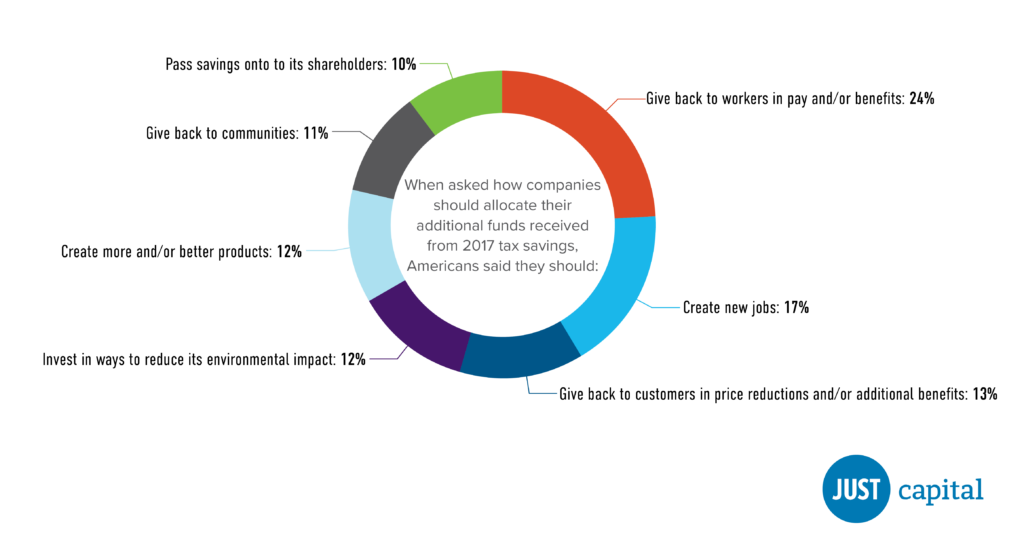
The feedback is striking when looked at alongside our analysis above. While Americans agreed that 24 percent of savings should go toward worker pay and benefits, worker issues account for just six percent of how companies are actually allocating their savings.
As part of our effort to inspire greater transparency around how corporations are using or intend to use their anticipated tax windfall, JUST Capital collaborated with the Illinois State Treasurer’s Office, and other institutional investors, including Sycomore Asset Management, Trillium Asset Management, CtW Investment Group, The Nathan Cummings Foundation, and Segal Marco Advisors, in a survey to the S&P 100 that asked how they expected to reinvest their savings from the Tax Cut and Jobs Act. The report, which details how 48 of the largest U.S. companies are spending their tax savings, was featured in Politico, and can be downloaded here.
In much of the country, investor-owned utilities have a monopoly, and state regulators allow them to charge rates high enough to recoup their costs and provide a return to their shareholders. So, when taxes go down, regulated utilities tend to pass a significant portion of their savings to their customers in the form of lower prices, as evidenced below:
JUST Capital will track and analyze corporate announcements related to worker raises and bonuses, stock buybacks, capital expenditures, executive compensation, and other measures, and will update the Rankings with the aim of capturing a comprehensive overview of where the tax savings is going across corporate America throughout the year. Read more about the methodology behind the rankings here.
Top performers are committing to long-term investments in workers, job creation, and strengthening local communities:
Last week, Amazon opened its first automated grocery store in Seattle – Amazon Go – allowing customers to stroll in, grab the items they need, and leave without having to stop at check out. This is all thanks to cameras and AI algorithms that track what shoppers pick up along the way, eliminating the need for cashiers entirely.
Known for its ever-changing, groundbreaking technological innovation, Amazon has been shifting the retail landscape since day one – not only for consumers but for employees. So what could this latest change mean for American retail workers?
JUST Capital’s wage model includes estimates for employment by title, wage, and location for over 14 million American workers at the 140 largest retail and service sector companies. Using this data, we looked at what would happen if cashier duties at all these companies becomes completely automated, as they are at Amazon Go. We found that nearly 1.8% of the U.S. private sector workforce – that’s 2.3 million Americans working for companies like Walmart, Target and The Gap – could be affected, representing roughly two-thirds of the 3.4 million cashiers throughout the U.S.
The potential impact at the local level could be profound. In Los Angeles for example, the total automation of cashier duties would reduce the number of retail workers within the greater Los Angeles County by an estimated 49,000. In Dallas County, 19,381 workers would be affected.
In terms of the impact on payroll, we estimate the 2.3 million jobs affected translate into nearly $37 billion in potentially lost income nationwide. While this is a mere 0.6% of the country’s $5.643 trillion private sector income, in some regions the impacts could be material, not only in terms of lost income, but also the additional participation in public support programs (such as food stamps and Medicaid) if these workers are unable to find new jobs.
Of course, this scenario is a hypothetical – not predictive – consideration of the shifting brick and mortar landscape, but the future of work no doubt stands as a growing question in America, particularly for workers in the retail industry. Technological progress is inevitable, but its potential implications are wide-ranging – Will automation destroy or create new jobs? Who will take the lead in the critical task of new skill development and job retraining? Will we generate more or less income with the advent of new technology? How might changes affect the government subsidies many Americans rely on to make ends meet? And where will these shifts be most felt?
As the top company in JUST Capital’s rankings when it comes to job creation, Amazon is expected to grow its business considerably throughout the next year – with 50,000 new jobs planned for its anticipated second headquarters. With U.S. jobs among the top priorities for the American people, JUST Capital will continue to track Amazon’s impact on both job creation and elimination in the company’s own stores, distribution centers, and corporate headquarters, as well as throughout the American retail landscape.
This article was originally published on Forbes.com.
