
Each year, JUST Capital asks the American public about its views on the current state of business in the country, and which corporate issues matter most to them. This year, of a representative sample of over 3,000, 68% agreed with “Our current form of capitalism is not working for the average American,” up a full 10% from last year.
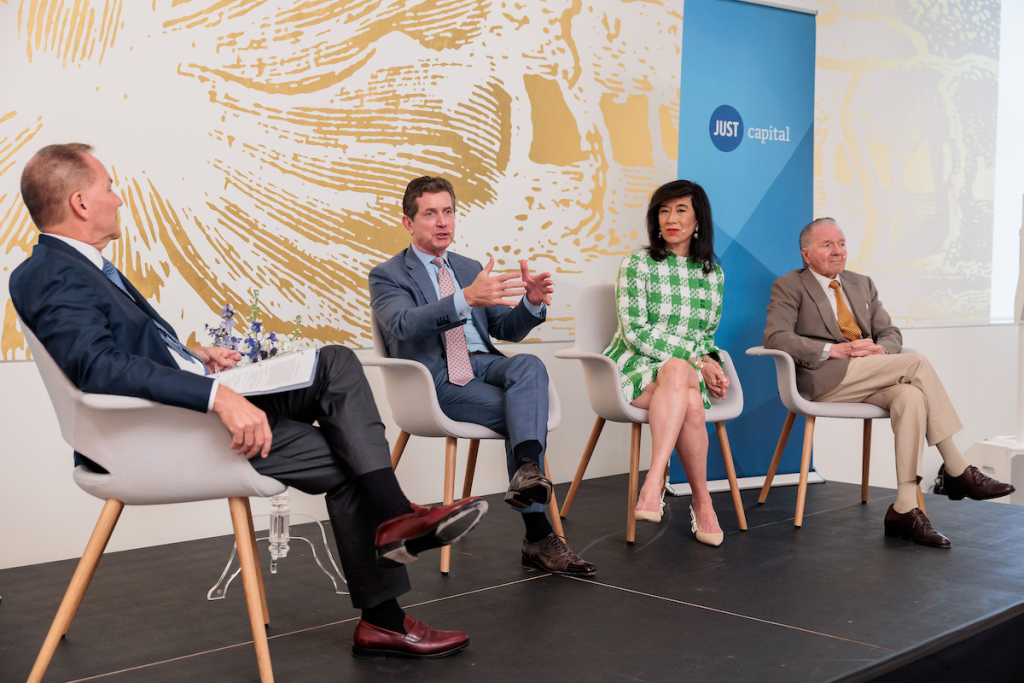
With that statistic in mind, along with the increasingly heated debate over ESG (environmental, social, governance) investing and stakeholder capitalism, our co-founder and chairman, Paul Tudor Jones, convened earlier this month a gathering of business leaders held at the Norton Museum of Art in West Palm Beach, Florida.
For the morning’s panel, Jones moderated a discussion with Alex Gorsky, former CEO and current chair of Johnson & Johnson, Andrea Jung, JUST board member and Grameen America CEO, and Thomas Peterffy, founder, former CEO, and current chair of Interactive Brokers. Gorsky sits on the boards of Apple, IBM, JPMorgan Chase, and New York Presbyterian Hospital, and Jung sits on the boards of Apple, Unilever, Rockefeller Capital Management, and Wayfair. Each brought a unique perspective: Gorsky helped lead the development of the Business Roundtable’s statement on the purpose of a corporation in 2019, shifting the CEO group’s stance away from shareholder primacy to an embrace of the stakeholder approach; Jung is dedicated to providing women entrepreneurs with capital and is especially concerned with matters of diversity, equity, and inclusion (DEI); and Peterffy, an ardent champion of free markets, filled the role of stakeholder capitalism skeptic.
But despite some disagreements over rhetoric, all endorsed the idea that a business’ stakeholders are inextricably linked. They also agreed that capitalism today in the United States was not serving regular people as much as it could be, and that the private sector played the primary role in addressing this. “How capitalism responds in this new period is going to be very important,” Gorsky said.
We’ve collected some key moments from the discussion below.
CEOs have a set of stakeholder obligations
Jones brought up the polling on Americans’ views on capitalism, noting that he feared the welcoming of socialism in the country, which he believes will weaken it. He added, however, that he still appreciates the intensifying debate as a means of encouraging progress. Gorsky responded by pointing to the common rebuttal to the stakeholder champions, who are often painted as focused on progressive policy goals disconnected from business. “I think the concept of obligations and responsibilities to shareholders is really important to balance that conversation,” he said.
Peterffy, who teased his fellow panelists by saying that the concept of stakeholder capitalism was “fake,” indirectly endorsed it. “Of course we have to take care of people, otherwise the company doesn’t get better,” he said, and then explained that if they don’t take care of their employees, then they will deliver worse service and products to their customers, and that in turn will hurt their shareholders. Peterffy may not be a fan of the stakeholder rhetoric, but he was echoing one of the theory’s pioneers, Ed Freeman. As Freeman explained to us last year, “Even if all you care about is making money for shareholders, how are you going to do it? You’re going to have great products and services for customers, suppliers who want to make you better, employees who want to be engaged in the company, and communities who want you or at least allow you to operate.”
The panel also brought up the way CEOs are increasingly expected to speak out on current events. In our 2022 Views on Business Survey, we found that a majority of respondents agreed that “CEOs of large companies do have a responsibility to take a stand on important societal issues” – but that was split 81% liberal, 75% moderate, and 44% conservative. “When I became the CEO of a public company at Avon in 1999, the environment was so different,” Jung said. But now, “the concept of a leader staying silent – and yes, it is extremely complicated – is impossible.”
Jung explained that as CEOs navigate this challenge, they need to determine which position is best aligned with a company’s purpose, thus serving its stakeholders.
Implementing ESG should be a careful balance of short- and long-term goals and actions
Peterffy’s son William started Interactive Broker’s ESG branch in 2019 and still chairs its ESG committee. And while Peterffy said he does not worry too much about endorsing or rejecting specific ESG metrics, he understands the appeal of ESG investing and believes “the environmental situation is a serious problem” and that investors and CEOs alike should be factoring in climate risk into their decisions.
Gorsky said that when considering these metrics, companies need to avoid ambitious goals set far into the future, which can be placating in the present but not proper North Stars. “Sometimes you’ve seen businesses confuse aspirational goals with realistic commitments that can be hit,” he said. He also made clear that he is wary of regulators creating “one size fits all” ESG metrics, given the sheer amount of variety across America’s public companies.
“It’s this balance, too, of short-term and long-term,” Jung said, noting that it wouldn’t require government legislation for a company to assess whether it is offering equal pay for the same job regardless of demographics and respond accordingly.
Workers are central
Jones brought up that JUST’s polling shows the public continually prioritizes worker issues, and that this year’s top issue across gender, race, age, and even political ideology is yet again that a company “Pays a fair, living wage.”
Jung endorsed the goal of the Worker Financial Wellness Initiative, which JUST cofounded with PayPal, the Good Jobs Institute, and Financial Health Network in 2020, saying that companies should undertake an assessment of whether their lowest paid workers are making a wage that allows them to provide for their families without struggling.
Peterffy took a broader stance, highlighting the word that kept coming up, “demand.” As he put it, “If they demand it, we’ll do it. I mean, we have to do everything to stay alive.”
“Look, I think COVID was a big wakeup call for businesses in this area,” Gorsky said, referring to the way the pandemic, along with the tight labor market in its recovery, shifted the power dynamic between labor and management. “Every board that we’re sitting on,” he said, referencing his fellow panelists, “has seen extraordinary pressure on wages.” Even during this challenging moment of inflation, with uncertainty of whether or not a recession is on the horizon, “you’re not going to be competitive unless you’re responding” to what both prospective and current workers are seeking.
You can watch the full panel discussion here:
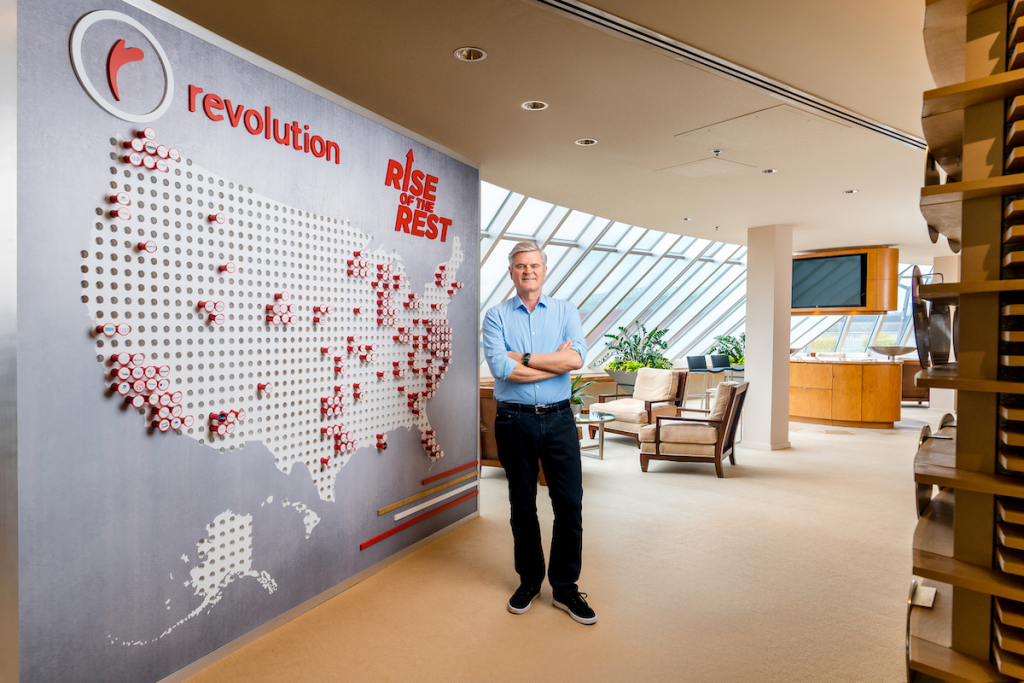

Inflation, a potential recession on the horizon, the lingering effects of a pandemic, a war with global impact, and bitterly divisive politics – it can be easy to be pessimistic about the direction of the United States. But Steve Case won’t indulge that.
For the past eight years, the AOL cofounder and founding CEO of the venture capital firm Revolution has been touring the United States in a big, bright bus, for the “Rise of the Rest” initiative, which shares its name with Case’s new book. The book is an exploration of his vision for an America boosted by startup economies tied to their communities – namely the ones not in Silicon Valley, New York City, or Boston, where 75% of venture capital in the U.S. goes. And it’s an expression of optimism that can feel exceedingly rare these days, but is one complementary to what we’ve found at JUST.
In the same way that we have found through our polling research that Americans across all the demographics we track agree that worker issues, especially providing a living wage, should be the number-one priority of American businesses, Case is driven by the idea that people across the country ultimately want the chance at a fulfilling career regardless of where they live. And, he says, we’re at the beginning of an era in technology that can help make this happen. Case believes that AOL represented the First Wave of the internet, followed by social media marking the Second Wave, and now we’re at the forefront of the Third Wave, where “internet of things” becomes the internet of everything and opens up transformative opportunities across all industries.
So far, Case and his team have been to 43 cities across the country and made 200 investments through two $150 million funds. They made eight bus tours before COVID forced them to temporarily go virtual, leading to one virtual tour focused on Black founders and another connecting talent from the coasts to opportunities at startups beyond the three primary hubs.
The new book is the next step in introducing his mission to a wider audience. We recently spoke with Case about what he wants to accomplish with it, and explored the overlap of Rise of the Rest with JUST’s own work.
The following transcript has been edited for length and clarity.
How has your perspective on Rise of the Rest – the fund, the tour, the idea – evolved over time?
We’ve seen steady progress each year in terms of interest in these cities, new companies starting and scaling, big exits that get attention, people shifting where they’re living, and people starting to think about investing in other places.
It was steady progress and then COVID has been a tipping point on multiple levels. For some people it was a moment to take a step back and rethink how and where you want to live, and how and where you want to work.
We stressed even when we got started that one of the things we needed to do was shift the talent discussion from being about bemoaning a “brain drain” of people leaving to celebrating a boomerang of people returning. So the pandemic has been helpful on that front.
It’s also been helpful on the venture investing side. Investors who were intrigued with some of what’s happening in rising cities but not necessarily intrigued enough to jump on a plane could now jump on Zoom and then talk to people in those cities. That led to a lot of pitch meetings on Zoom.
On the policy side of things, at the state and local level, a lot more governors and mayors are focusing on startups, and at the federal level, there’s been legislation passed like the Inflation Reduction Act and the CHIPS and Science Act, which includes authorization for investment in regional hubs.
A few weeks ago President Biden was in Columbus talking about regional entrepreneurship at the Intel plant. And then Treasury Secretary Yellen was talking about the idea of leveling the playing field and creating more opportunity for more people and places. So they’re mostly in sync with the arguments we’ve been making.
I’d say that it went from steady progress to an acceleration, which I think bodes well for the next chapter.
It sounds like there was, maybe this is the wrong phrase for it, but a silver lining of the pandemic.
It was such a terrible pandemic and I’d hate to say, “But oh, isn’t this great!” But yes, it was a silver lining, if you are looking for something positive in a difficult two-and-a-half years.
You included in the book some numbers that appear to be backing the Rise of the Rest thesis, in terms of where the money is starting to flow.
You’re referencing the Beyond Silicon Valley report we did with Pitchbook. There’s one data point particularly that was of surprise even to me, which is that in the last decade there have been 1,400 new regional venture firms outside of San Francisco, New York, and Boston. So basically you’ve got our Rise of the Rest footprint.
That’s super interesting and super encouraging because we’ve long said that the entrepreneurs in most parts of the country need more access to that initial capital as a seed stage, and having capital available locally is really important.

Business and community are inextricably linked
With a lot of the companies you highlight from the Rise of the Rest portfolio, it seems like these startups are baking in purpose-driven values and stakeholder issues JUST tracks for corporations. Are you seeing that?
A lot of these Rise of the Rest entrepreneurs are passionate about fixing or addressing some problem in society and opt to do that through the prism of starting a company. That leads to companies like AppHarvest in Kentucky with sustainable agriculture or TemperPack in Richmond, Virginia with sustainable packaging, and I could give you a couple of dozen others.
They are also quite intentional about how their companies also can lift up their community. For example, Jonathan Webb of AppHarvest was deliberately focusing on this and had a strategic reason to do it. Eastern Kentucky, outside of Lexington, is within a 24-hour drive of 70% of the U.S. population. But Jonathan also had a desire to create jobs and bring opportunity to coal country Appalachia, which for several decades had been struggling. So there was that broader societal impact.
On the DEI side, many of these cities are diverse, and we have been intentional about diversity for building our own team and backing entrepreneurs. Right now the Rise of the Rest portfolio, which is about 200 companies, is 41-42% female founders or founders of color, which is still not what it should be, but a lot better than you see in most venture firms.
The corporate and startup worlds of are often linked in ecosystems. One of the examples that you point to is Atlanta, where you have corporations like Delta, Home Depot, and UPS actively engaging their communities, including entrepreneurs there. Why should corporate leaders be paying attention to Rise of the Rest, regardless of where they are in the country?
Because their own success could be accentuated by focusing on Rise of the Rest. If they’re staying close to entrepreneurs who are doing innovative, disruptive things, they’re more likely to see the future as opposed to being overwhelmed by it, and might, if they’re agile, actually be able to partner with or, in some cases, acquire some of these companies to strengthen their competitive position.
Second, every company is ultimately about its people, and part of what JUST has done is highlight that and the benefits of investing and properly rewarding people. How do you attract great people who want to work at your company? Part of that is attracting people that want to live in your community.
Personally I remember my own experience in Cincinnati, where my first job out of college was at Procter & Gamble. At the time there were a few big companies there, but there were really no startups. The downtown area was occupied nine-to-five, was basically dead on evenings and weekends, and there wasn’t a real vibrancy to it. Some of the big companies eventually noticed that, too, and they got together and funded some programs like Cintrifuse, the Hatchery, and others to basically create a more fertile environment for startups. That paid off, and the city is now more interesting to live and work in. It makes it easier for those big companies to attract and keep the people they want to take their companies to the next level.
What Dan Gilbert’s done in Detroit comes to mind.
That’s obviously a great example. I’ll be there on Monday. He helped get the Forbes 30 Under 30 Summit to Detroit, and that’s exact thing we’re talking about. Dan made an effort to get more young people to understand what Detroit is now, with the idea that some people visiting for a conference would see it and some of them would end up deciding to move to Detroit. That’s happened. So it’s an example of this idea of trying to use your position as a corporate leader to have a broader impact in the community.
A mission to unite behind
You’ve got access to a lot of politicians and big influential players across the political spectrum. You’ve been all over the country, talked to people from every corner of America. Given your perspective and optimism, what are you seeing that could better unite the country when it’s so divided?
Well, part of the reason why I wrote the book is I think it’s an optimistic story of an America that’s not something that most people are aware of. There are a lot of things that are negative with inflation, Ukraine, the pandemic, all kind of things. But there’s a more positive, inspirational story that’s not just about certain people or certain places. I felt there’s a reason to be more hopeful, but we have to continue to build on some of the initial foundational efforts over the last decade.
I start and end the book with the idea that it’s not our God-given right as a country to remain the most innovative, entrepreneurial nation in the world. We can’t be complacent about that. We’ve got to lean into the future and I don’t think we can do that successfully if we’re only putting our eggs in a few baskets like Silicon Valley, New York, and Boston. We need to have a more diversified and decentralized approach to innovation.
But my hope is that this book will lead everybody in America to maybe feel a little bit better about our country’s potential future.
So this is based on the idea of economic opportunity for Americans regardless of where they are in the country, whether they want to create something or even just work within their own community with a good paying job?
Yes, one of the big problems is the opportunity gap where some people in some places are doing really well, and a lot of people in a lot of places are struggling and feeling left behind because they have been.
So the idea is that fertile startup ecosystems in more places brings more capital, which creates more jobs, which drives more economic growth, and which will then create more opportunity and more reasons for people to be more optimistic about the future. I think it’s critical that we do that if we are going to have a country that continues to lead the world. Now is the time to get it done.
I think it’s safe to say, then, that you’re bullish in America.
I believe in America! I believe in America, as long as we’re celebrating the next generation of entrepreneurs, how we’re doing it everywhere, not just in a few places.
The days of American workers quitting en masse have slowed. New findings from the Federal Reserve Bank of New York show the quit rate in July at 4.1% – compared to 5.9% in July 2021. Those numbers don’t mean, however, that companies should let up on their retention efforts. The same survey found a year-over-year increase in the percentage of employees actively searching for a new job. And, with a potential recession on the horizon, many companies are looking at what they can offer to avoid becoming another employer implementing layoffs or hiring freezes.
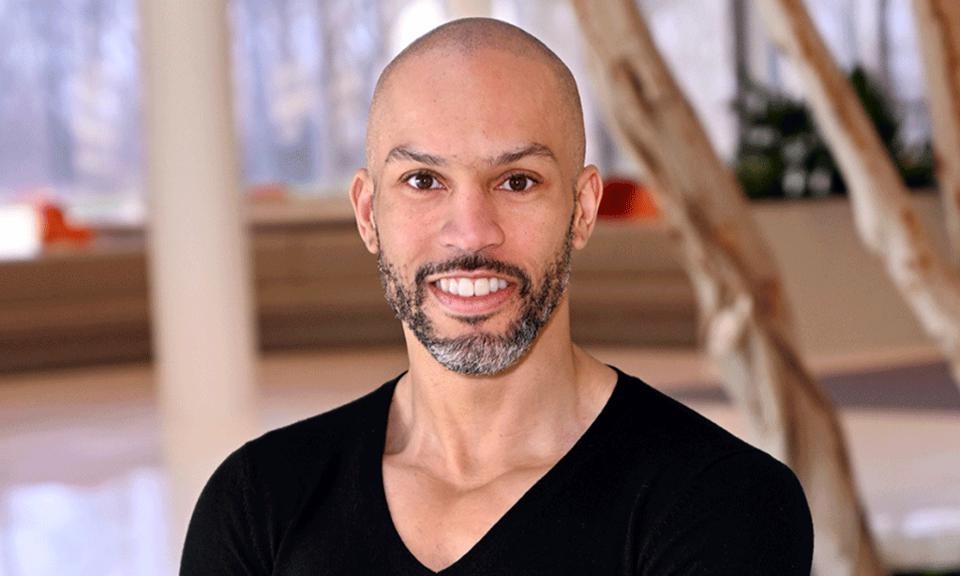
JUST Capital polling shows that, to the bulk of both workers and management, prioritizing diversity, equity, and inclusion (DEI) is a key way to recruit and retain talent. Of the major U.S. companies putting this into practice, Mastercard recently earned the number two spot on our 2022 Workforce Equity and Mobility Ranking. Executive Vice President and Chief Inclusion Officer Randall Tucker sees the company’s rank coming down to its DEI strategy and what’s shaped the company’s commitments and actions – starting with data. “DEI measurement should be no different than showing P&L for sales,” he said.
With $328 billion in market cap, Mastercard’s potential for impact, both within and outside company walls, plays a role in guiding its DEI work as well. We reached out to Tucker to hear how Mastercard has made DEI a priority across its 25,000-strong global workforce. In April, the Purchase, New York-headquartered company announced that bonuses for all employees, not just senior executives, would be tied to environmental, social, and governance (ESG) goals. This policy includes DEI metrics like pay parity, Tucker said, which a majority of Americans we polled see as having a positive impact on long-term business success.
Tucker shared more with JUST on what Mastercard’s learned from evolving its DEI work, and how those insights could benefit other leaders focused on building equity and upward mobility for their employees into company operations.
Mastercard’s approach to DEI is centered around impact and relevance, Tucker said. The company assesses what issues are most pressing to its stakeholders and how, and where, it can have the greatest impact. He pointed to Mastercard’s actions in the wake of the murder of George Floyd as an example. “There was a heightened interest in focusing on racial equity, both in terms of increasing Black representation in leadership roles as well as increasing Black suppliers that we work with and investing in closing the racial wealth and opportunity gap across American cities that have large Black populations,” Tucker said.
That interest resulted in Mastercard’s In Solidarity Initiative, which continues alongside the company’s other DEI work, he said. The five-year, $500 million Initiative includes an investment in Workforce Development Pathways and an Entrepreneurship Center created in partnership with the National Urban League to increase access to opportunity for historically excluded individuals and communities. It also includes an assessment of how Mastercard is supporting its Black employees’ education, skills development, and career advancement. Two years into this commitment, Mastercard has “seen tremendous progress in some areas, including doubling our Black suppliers” and, importantly, shared its progress in annual reports and through regular updates to its employees and board.
These insights help inform the areas the company needs to focus on, Tucker said. Data like detailed workforce demographics, which Mastercard discloses in its EEO-1 data, point out where gaps exist and where to take action. Tucker raised the company’s work on pay equity as an instance of where this focus on data has shaped progress. “Our pay equity numbers are ones we have been very deliberate about over the past few years. It’s an area in which we’ve achieved and maintain that every woman earns $1 for every $1 a man earns, and the same for a person of color as compared with a white employee,” he said. And, now, Mastercard’s taken this a step further by tying all employee bonus compensation to ESG metrics.
The company’s move to codify its commitment to pay equity is one way it’s made DEI a priority of all its employees. It’s also focused on actively bringing its employees into this work and sees their input and feedback as critical to achieving its commitments. Mastercard’s In Solidarity Initiative has a steering committee and advisory committees with employees driving the work and providing feedback along the way, Tucker said. “Part of my job more broadly is checking in with our employees to get a pulse check on how they’re doing and how the work my team is driving is resonating.”
The company views inclusion as a leadership skill that everyone can embody, including the most senior leadership. “We don’t have to contend with some of the most common problems that brands face, thankfully, in that we don’t have to sell our leadership on the importance of DEI – they get it and it’s a priority at Mastercard from the very top down,” Tucker said. Without leadership buy-in, he noted, that the company’s work would fall flat.
While leadership buy-in on DEI is not an issue for Mastercard, it faces other common challenges like distinguishing itself in the “fierce” competition for top talent and adapting its approach to suit a globally distributed workforce.
Making DEI a priority for all employees is a challenge, Tucker said, when you’re “a global brand that has 25,000 employees in many countries across the world with very different needs, hopes and concerns.” The company learned to tailor its approach by adopting a modular and inclusive approach across the five global regions where it operates. “We believe in regional customization to focus on the things that matter most in our five regions versus a one-size-fits-all approach,” he said, “Our DEI has to be inclusive so that no one is left out while also being specific and intentional as to where we need to move the needle to right-size representation and inequities.”
Tucker shared that Mastercard’s created regional and functional DEI strategies with leaders who are subject matter experts guiding the work. “Because what’s relevant to one group or geography is going to be different somewhere else,” he said. The company’s regional DEI action plans aim to create local relevance for the work and meet people where they are.
“Change doesn’t happen overnight, and it also doesn’t happen in a uniform way. The best thing you can do is meet people where they are, be a good listener and keep marching in the right direction – making sure others are marching alongside you,” Tucker said.
Approaching its DEI work as customizable, collaborative, and data-driven has allowed Mastercard to evolve its goals and make progress on key workforce equity and upward mobility metrics. For Tucker, this has further enhanced his deep personal commitment to tackling these issues.
“My motivation comes from an understanding that it is a privilege to be on this perch and to get to drive this work each and every day. If you asked the Randall of 25 years ago, a young gay Black man starting out, estranged from his family, bullied in broad daylight, it would have felt like a fairy tale to know that one day I would be able to step fully into my truth and devote my professional life to leading the charge on creating a more equitable and inclusive and safe workplace and world for others.”
The 2022 Workforce Equity and Mobility Ranking was funded by the Annie E. Casey Foundation. We thank the Foundation for its support. The findings and conclusions presented here are those of the authors alone, and do not necessarily reflect the opinions of the Foundation.
To learn more about how Mastercard and other companies are putting these best practices into action, explore our full 2022 Workforce Equity and Mobility Ranking and complementary Issue Brief. For more information on how we’re engaging with the country’s largest employers on these issues, reach out to our team at programs@justcapital.com.

A few years ago, a representative of an employee resource group at American Electric Power (AEP) told CEO Nick Akins at the ERGs’ annual meeting with him that there was not enough diversity in the company’s upper management and leadership team. “And he definitely appreciated that call out,” said Kim Hughes, a 21-year AEP veteran who has served as a diversity, equity, and inclusion (DEI) manager since last February. She may have heard that story secondhand, but said she saw firsthand the ways in which AEP sought to diversify its C-suite and board, and how Akins has been “adamant” about making DEI core to the company’s culture.
And in a report earlier this month about Akins and the board’s decision to pass the CEO mantle to current CFO, Julie Sloat, board director Sara Martinez Tucker noted that Akins’ tenure since 2011 has been marked not only by technical innovations setting the company up for future success, but also by “an open, collaborative culture that embraces diversity, equity and inclusion.”
It’s been a team-wide project for the Columbus, Ohio-based energy company, with roughly 16,700 employees across 11 states, and while its leadership is clear about the ongoing nature of its DEI work, its commitment to inclusion and career mobility for its workforce led to AEP’s recognition as No. 20 among the Russell 1000 in JUST Capital’s 2022 Workforce Equity and Mobility Ranking, built with support from the Annie E. Casey Foundation.
That ranking has particular relevance today, when corporations, whether they’re expanding or reining in growth plans, are figuring out how to retain top talent during a lingering tight labor market.
To learn from AEP’s example, we spoke with both Hughes and fellow DEI manager Alyvia Johnson. Their pairing provides a fascinating look at AEP’s journey.
Hughes has been at AEP for over two decades, has a background in engineering, is based in Dallas, and focuses on inward-facing DEI initiatives; Johnson joined AEP in March after a few years at Wendy’s, has a background in human resources, is based in Columbus, and focuses on DEI in recruitment. Through a recent discussion with both, we identified key insights into how AEP made inclusion and mobility a critical rather than ancillary function of its business strategy and continues to build on that.
It is intentional and iterative with its efforts
When she was a young engineer during her early years at AEP, Hughes said she initially wasn’t aware of any leadership development programs at the company. And when she did find out about them, she thought they targeted a limited set of people – mostly white men who worked in Columbus. As the company grew across the country, especially over the past decade, Hughes said, its leadership became more aware of its need to expand leadership pathways. When Hughes had the opportunity to enroll in a year-long Targeted Development Program two years ago, she took it.
Johnson said that coming in as a new employee earlier this year, she was able to first learn about and then experience HR’s commitment to the approach that Hughes saw evolve over time. “The commitment has become even deeper and intentional as the company has grown and our communities are becoming more diverse across the United States,” Johnson said. “We’ve had many conversations about how in order to be competitive and to attract and retain the best talent, we need to have that focus on DE&I to create those opportunities for diverse talent. It’s also just the right thing to do.”
When Hughes enrolled in the program, she was told that it gave her access to leadership across the company – and she said that wasn’t just talk. She asked a since-retired executive named Charles Patton to become her sponsor, and he gladly accepted. Hughes said she would tell Patton things like, “I’m not sure where my next step is at AEP,” or “I’m considering this…” and he would guide her through her options, ultimately leading to the path she’s on today.
Hughes also told us that the company is not afraid to iterate its opportunity programs, and pointed as an example to the Women in Linework program, dedicated to increasing women’s representation among AEP’s lineworkers, who maintain power lines – and who are almost entirely men. It was designed as a training program with the goal of becoming an AEP employee. But, Hughes said, it didn’t take long to realize that the women they were recruiting were juggling responsibilities, including families, and that they needed to be paid if the program was actually going to achieve its intent. Women in Linework is now a 14-month program that starts with stipends and progresses to an hourly wage.
It uses employee resource groups and HR as a sounding board for the C-suite
A common refrain in business today is “listen to your workers,” but when you’re leading a national or multinational organization with tens of thousands of employees or more, that can be easier said than done. It’s why AEP has established the ERG and CEO meetings mentioned at the top of this article, along with what Akins dubbed “Nick’s Network,” where a rotation of representatives from different business units meet with Akins at the company’s headquarters. In both instances, Akins encourages what Hughes called “unfiltered feedback” from employees.
And while ERGs are critical for this approach to communication, Hughes also noted that AEP’s recent internal employee surveys conducted with Gallup found that ERG members were more engaged than the rest of the AEP population. That finding wasn’t surprising, she said, but it allowed them to isolate areas of disconnect among earnestly involved leadership and management and the average employee, on topics like management training and inclusion programs.
Johnson added that AEP’s DEI team has also made HR leaders “DEI champions” since, “A lot of times when employees are having concerns or issues, our HR managers are the first people to hear about it.” These HR managers get DEI coaching and are encouraged to facilitate related difficult discussions when it can lead to company-wide improvements.
It sets metrics and then consistently and transparently tracks them
“We all know in DE&I, we never arrive. It’s always we’re striving to be better,” Hughes said.
And while AEP is clear that it is far from where it wants to be – as of the end of 2021, its executive and leadership makeup was 78% male and 88% white – it makes its DEI-related metrics public. The company publicly reports its workforce and board demographics, gender-based salary ratios, incidents of discrimination and responses, and community impact data.
This year, leadership has also been given access to a DEI Dashboard, updated monthly and intended to be shared among leaders’ teams. It provides monthly data related to DEI initiatives and includes tips on how teams can potentially improve certain aspects of relevant initiatives through actions like partnering with a talent acquisition team.
And, for all of the company-wide goals, the board gets buy-in.
It begins employees’ development journey on day one
AEP has deliberately set out to prevent situations like the one Hughes experienced in her early days at the company, where she felt like leadership pipelines were out of reach for a Black woman like herself.
Aside from increased efforts in recruiting diverse entry-level talent, “Retention is really key,” Hughes said. “One of the things we do with new employees in orientation is we make them aware of our employee resource groups. Again, it speaks to engagement. We want them to be aware that they exist and that they can plug in immediately.”
And then, because there are still plenty of veteran employees like Hughes at the company, the DEI team also works with HR to ensure that they get access to growth opportunities as AEP evolves
“I’ve talked to many employees where they’re on their 20th year or 10th year, and they’ve been able to move around if it’s lateral or vertical to different areas and get that exposure,” Johnson said.
It made DEI core to its business
Under Akins, AEP expanded its DEI team and made diversity, equity, and inclusion a stated component of its culture alongside its foundational commitment to safety for its workers and customers. Notably, AEP also began incorporating DEI components in its incentive compensation plans for leaders across the company.“It’s nice just saying it’s important, but it’s putting the money with it,” Hughes said. “Not only is it safety, is it – of course – company performance, is it culture, but it’s DEI, as well. So to see that importance placed there is really good, too.”
The 2022 Workforce Equity and Mobility Ranking was funded by the Annie E. Casey Foundation. We thank the Foundation for its support. The findings and conclusions presented here are those of the authors alone, and do not necessarily reflect the opinions of the Foundation.
To learn more about how AEP and other companies are putting these best practices into action, explore our full 2022 Workforce Equity and Mobility Ranking and complementary Issue Brief. For more information on how we’re engaging with the country’s largest employers on these issues, reach out to our team at programs@justcapital.com.

Hello everyone – Alison here, filling in for Martin.
The ESG blowback is here, and it’s real. So it’s more important than ever that those of us working to measure what matters ensure that we’re identifying real leadership, and we’re using that assessment to encourage change for stakeholders, and in our case, on the issues most important to the American people.
So that’s our lens as we release a new ranking encapsulating many people’s top issues, from wages to career mobility and diversity, equity, and inclusion. The list, supported by the Annie E. Casey Foundation, is looking at which companies are walking the walk when it comes to building equity and upward mobility for their workers. Salesforce, Mastercard, Microsoft, and Bank of America are at the top.
We’ll be spotlighting leadership examples over the next few weeks, and we started with an interview with Bank of America’s head of DEI, Cynthia Bowman. Bowman said BofA defines success when it comes to equity and mobility as, “about creating processes that diminish bias, allow you to promote within, generate more inclusion in our everyday practices from the time you hire, how you onboard, how you conduct calibrations, how you retain talent, how you recognize talent, and how talent leads your organization.”
Our team also talked to HBS Professor George Serafeim about his new book, “Purpose and Profit,” out this week (JUST makes a couple cameos). He’s the leader of the Impact-Weighted Accounts Project at HBS, which develops an evolving set of principles that measure the business impact of nonfinancial metrics – in other words, making sure there’s real impact behind the metrics. “As a society, do we want the people that manage not only financial capital, but also human, natural, social, and intellectual capital, to be accountable for their impact on all of those elements? That’s the only way to have actual meritocracy,” he told JUST in an interview.
Have a great weekend,
Alison Omens

Chipotle to pay $20 million in a settlement with NYC over violating scheduling and sick-leave laws.
Eli Lilly, Cummins and other Indiana-based companies criticize the state’s new abortion ban, with Eli Lilly stating that it will “be forced to plan for employment growth outside of the state.”
Ford announces that by 2025 every vehicle manufactured in Michigan will be assembled with the equivalent of 100% carbon-free electricity, 10 years earlier than its global goal.
H&M faces a class-action lawsuit over its misleading product environmental impact scores.
With support from the Annie E Casey Foundation, we released our 2022 Workforce Equity and Mobility Ranking. Salesforce, Mastercard, Microsoft, and Bank of America are at the top – see who else is leading the way inside. Alongside the ranking, we did a deeper dive into the individual hiring practices and career development policies of the leaders to see what best practices can be learned. Read that analysis here.
Speaking of mobility leaders, we had Cynthia Bowman, Head of Diversity & Inclusion at Bank of America, give us a closer look at how the company is broadening its employee base through smart, inclusive hiring practices. We also talked to HBS Professor George Serafeim about his new book, “Purpose and Profit,” out this week, and about many of the latest ESG controversies.
If you haven’t taken our Annual JUST Report Reader survey, please do! It helps us in shaping our coverage to include the content that’s most important to you.
Voting for SXSW 2023 is now open! Vote for our panel featuring leaders from Levi Strauss & Coand Edelman as we look at how corporations are redefining what leadership means in an era of rapidly evolving societal change.

(Bank of America)
“This process starts at the top, with our board of directors and CEO. Our CEO and management team set the diversity and inclusion goals of the company. Each management team member has action-oriented diversity goals, which are subject to our quarterly business review process, talent planning and scorecards reviewed by the board. … [O]ur skills-first and knowledge-based hiring approach trump any degree requirement and allow for more equitable hiring practices for traditionally marginalized groups.”
“I can actually see why somebody like Elon Musk would be very frustrated if a best-in-class framework ends up with a portfolio that includes an oil and gas company and excludes Tesla, where he would be like, ‘What are you talking about?’ Tesla is certainly a firm that I would include in a sustainable investing portfolio. While they need to work on the ‘S’ and the ‘G’ sides, the potential impact of the “E” effect seems to me to be an overwhelming one.”
“I don’t like the idea that if you’re a Republican, you have to bank with this company, and if you’re a Democrat, you have to bank with that company. We already have a lot of divisions in this country.”
The New York Times discusses the uneven impact of the inflation between high- and low-income households and the challenges the Fed faces in trying to tamp down inflation without causing a painful recession where “poorer families will almost certainly bear the brunt again, because low-wage workers are often the first to lose hours and jobs.”
McKinsey releases two connected studies – the first retorts key critiques of ESG and the second demonstrates a business-grounded, strategic, and systemic rationale for “making ESG real.”
Morningstar’s global head of sustainable investing research, Jon Hale, writes it’s time to “cut through the nonsense around ESG” and focus on three key points relating to communication, approaches, and desired impacts.
The Wall Street Journal investigates why the gender pay gap appears so early – often within three years of men and women gaining their first job.
Fortune posits why a recession would actually increase remote work, despite the predictions of many other analysts.
With Nasdaq’s board diversity rule set to in effect this month, Fortune looks at why it’s a great first step instead of a gold standard.

This chart from Morning Consult shows an interesting issue with strategic communications regarding key environmental issues – a majority of U.S. adults have no idea what “carbon-neutral” means, despite significant commitments from corporations across industries to push towards it.
The United States’ current economic and labor contexts seem to be at odds with each other. Debate around whether or not the country is, or will soon be, in a recession persists. Inflation reached its highest point in over 40 years this past June and dipped only slightly in July. At the same time, job growth remains strong. The latest jobs report saw numbers that nearly doubled economists’ estimates – with 528,000 jobs added in July, recovering those lost since the start of the pandemic.
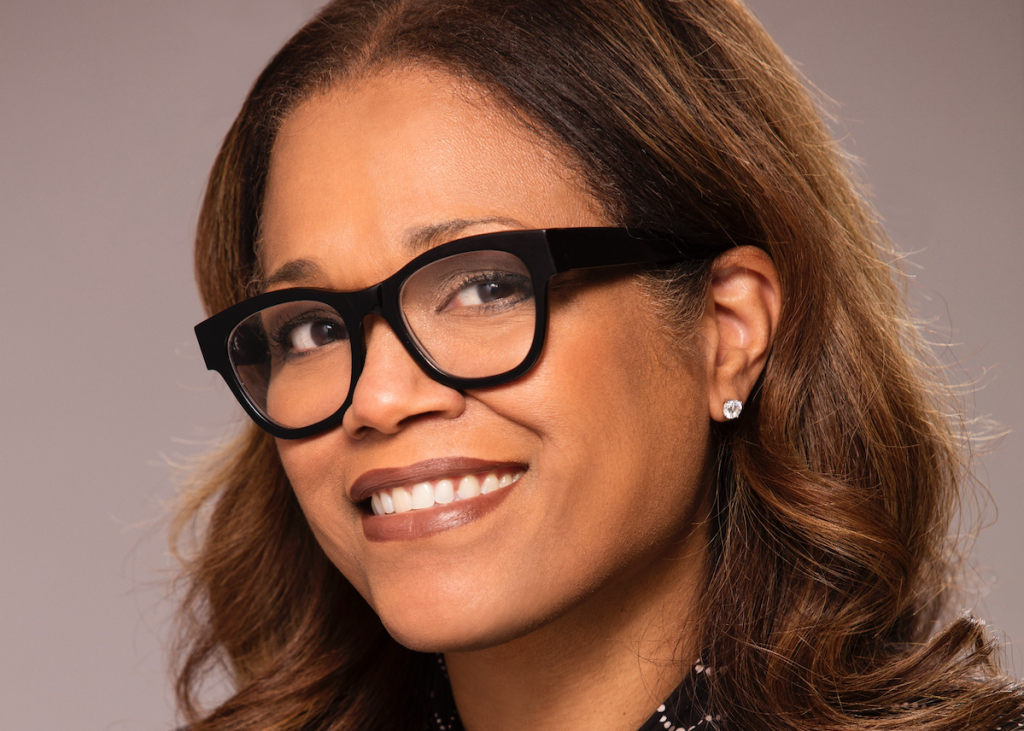
While jobs are being added across the country, whether or not these are truly good jobs that will retain top talent remains unclear. For Cynthia Bowman, Bank of America’s Chief Diversity & Inclusion and Talent Acquisition Officer, determining this requires a foundational commitment to data, accountability, and transparency. The Charlotte, North Carolina-headquartered bank’s detailed human capital and impact reporting has allowed it to take action with a “willingness to course correct when an activity isn’t having the intended outcome.” It’s part of the reason Bank of America comes in at the number 11 spot in our 2022 Workforce Equity and Mobility Ranking, which takes a look at how Russell 1000 companies are leading on the interconnected issues of diversity, equity, and inclusion (DEI) and upward mobility and advancement.
We spoke with Bowman to dig into how the company earned this rank. With a workforce of over 200,000 employees and $282.9 billion in market cap, she shared how the company’s leveraging its influence to break down the barriers to hiring and upward mobility that disproportionately affect workers of color – from rethinking degree requirements for roles to supporting career development for individuals from low- and middle-income communities. For her the importance of retention, not just hiring, has been key for both the company’s workers and its business. In May, Bank of America raised its U.S. minimum wage to $22/hour, a move investors viewed favorably.
This work is both an integral part of the company’s business strategy and, with increasing urgency, the right thing to do, she said. Read on to hear more from Bowman on how Bank of America is using data and addressing systemic barriers to embed equity and upward mobility in both its hiring and retention practices.
Findings from our 2022 Workforce Equity and Mobility Ranking make it clear that companies should start by getting specific on how they’re tracking and measuring their DEI efforts. Bank of America does just that and includes detailed reporting of its workforce demographics, and progress in diversifying, in annual reporting. The company discloses its EEO-1 reporting data, breaking down detailed workforce demographics by job level. Its latest measures show that 50% of its global workforce are women and 49% are people of color. In addition, 55% of its management team is diverse, including 32% women. Since 2015, representation of teammates of color in its top three management levels has increased by 60%.
Importantly, Bank of America has buy-in from the very top of the organization for this work. “This process starts at the top, with our Board of Directors and CEO. Our CEO and management team set the diversity and inclusion goals of the company. Each management team member has action-oriented diversity goals, which are subject to our quarterly business review process, talent planning and scorecards reviewed by the Board,” Bowman said. She mentioned that Bank of America has formed a Global Diversity & Inclusion Council to oversee DEI goal setting and embed these targets in performance management processes at all levels.
For Bowman, this focus on data and company-wide processes are critical. “At the end of the day, so much of it comes down to transparency and accountability,” she said. Not only does reporting ensure this level of transparency and hold leadership accountable, it also helps Bank of America improve its DEI efforts. Bowman shared that the company has been surveying employees for nearly 20 years and “the results inform a process of continuous improvement.”
This data-driven mentality has also informed Bank of America’s aim to tackle areas “where systemic, long-term gaps have existed and where significant change is required for progress to occur and be sustained.” One particular challenge Bowman noted is that, by the nature of the banking industry, potential job candidates assume that they need a four-year college degree. “In reality, our skills-first and knowledge-based hiring approach trump any degree requirement and allow for more equitable hiring practices for traditionally marginalized groups,” she said. The company partners with organizations including Year Up and UnidosUS to recruit talent without college degrees and is also looking to strengthen this pipeline through community college partnerships.
A key achievement Bowman noted for Bank of America in tackling these barriers is its community hiring and development program, Pathways. Pathways provides skills training, entry-level jobs, and career development for individuals from low- and moderate-income neighborhoods. The program ultimately aims to provide individuals with the preparation needed to take on ongoing job opportunities with Bank of America. In 2018, the company set out to hire 10,000 individuals through Pathways by 2023 – a target it exceeded in 2021 – and is now aiming to hire additional 10,000 individuals via Pathways by 2025.
Outside of its own workforce, Bowman noted that the company has committed $25 million to connect Black and Hispanic individuals to job opportunities in growth industries and, in turn, support long-term economic health in local communities. The commitment includes partnerships with 11 community colleges that serve predominantly Black and Hispanic students as well as 10 Historically Black Colleges and Universities and 11 Hispanic Serving Institutions. In its 2021 Annual Report, Bank of America reported having already allocated this money as part of larger reporting against its $1.25 billion racial equity commitment.
Bowman emphasized, however, that these efforts don’t stop at hiring and recruiting. “It’s about creating a workforce that looks like the world we live in across every level, including senior leadership. It’s about creating an environment where people don’t feel like they need to be someone else from the time they walk into work to the time they leave. And it’s about equity,” she said. “It’s about creating processes that diminish bias, allow you to promote within, generate more inclusion in our everyday practices from the time you hire, how you onboard, how you conduct calibrations, how you retain talent, how you recognize talent and how talent leads your organization.”
Bowman sees efforts like Bank of America’s commitment to raise its starting hourly wage to $25 by 2025 as crucial to creating an environment where equity is prioritized and, in turn, employees are motivated to stay. She raised the bank’s dedication to gender and racial pay equity, and reported near-equal pay ratios at over 99%, as another example of how equity can and should go beyond hiring and representation targets.
And, as Bank of America continues to put commitments that reinforce equity and upward mobility into practice, Bowman is eyeing both ambition and flexibility in how the company takes action. “You can celebrate impact and hold yourself accountable in areas where progress isn’t as strong,” she said. To her, this focus on data, accountability, and transparency also leaves room for companies to learn from each other. “When setting your strategy, look at what your peers are doing, look outside your industry and share your own best practices.”
The 2022 Workforce Equity and Mobility Ranking was funded by the Annie E. Casey Foundation. We thank the Foundation for its support. The findings and conclusions presented here are those of the authors alone, and do not necessarily reflect the opinions of the Foundation.
To learn more about how Bank of America and other companies are putting these best practices into action, explore our full 2022 Workforce Equity and Mobility Ranking and complementary Issue Brief. For more information on how we’re engaging with the country’s largest employers on these issues, reach out to our team at programs@justcapital.com.
