

This report was written by Laura Thornton, Senior Manager of Environment at JUST Capital, and Shannon Cabral, Research Analyst at JUST Capital.
When it comes to climate action, new data on America’s largest companies reveals mixed results.
JUST Capital’s latest analysis of Russell 1000 climate commitments and emission data shows real progress on long-term pledges – more CEOs are promising action over the next few decades. But there’s been less progress on actual emissions reductions over the last few years.
The data serves as a crucial discussion point for business and policy leaders ahead of Climate Week, which draws business, government and civil leaders to the UN General Assembly’s convening on climate issues.
Analyzing public disclosures from the Russell 1000 as of August 14, 2023, JUST Capital found inspiring news: commitments are growing. The bad news? Emissions are not always following suit.
As part of our Rankings of America’s Most JUST Companies, we monitor, track, and analyze corporate climate commitments across 37 industries. Our analysis centers around four categories, listed in order of increasing rigor:
Over the course of three years of measurement, we have seen an increase in every category of commitment – a hopeful sign for corporate action on climate issues. Net-Zero commitments have tripled, and our most rigorous category, Verified 1.5-Degree SBTi has doubled since the start of our measurement.
The increase, albeit small, in two categories, Emissions Reduction and Verified 2-Degree SBTi, could be attributed to a number of factors. Emissions reduction commitments are simple time-bound statements with a specific amount of committed reduction. With a push for more action on climate, we see companies increasing the rigor of their commitments by expanding their scope, shortening their time horizon, or attaining scientific verification of their goals. 2-degree SBTi commitments are being phased out, which explains their stagnant growth. Industries with the greatest increases of commitments include Industrial Goods, Software, and Commercial Support Services industries.
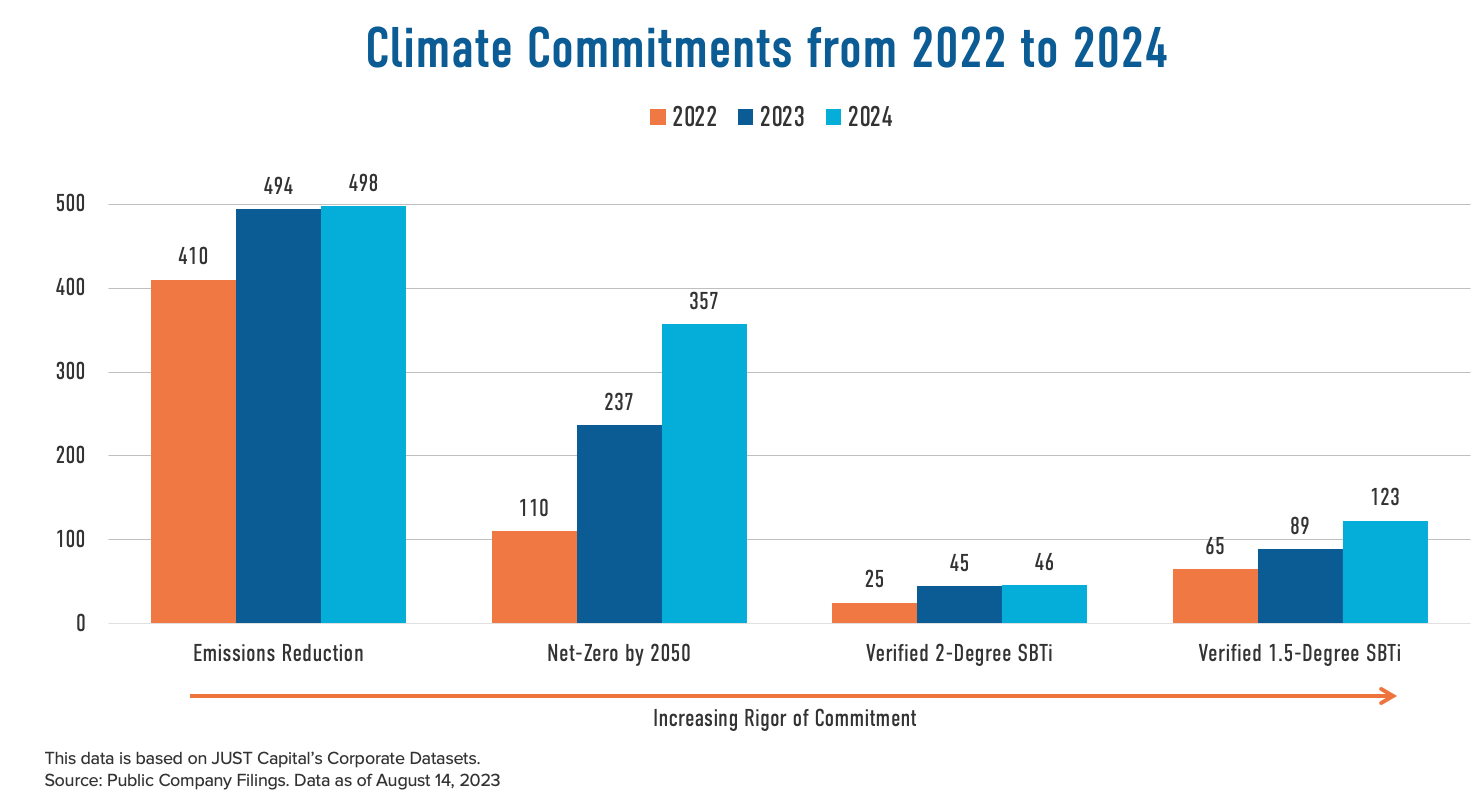
Despite the promising growth across these categories, corporate action on reducing actual emissions is lagging overall – signaling the need for more urgency around this issue.
In exploring which companies are in fact making real change, there were a few key takeaways. It is a fair assumption that companies most likely to be reducing emissions are the ones with more robust targets, while less rigorous commitments yield less reductions. We see this in action with companies that have committed to science-based targets – which have reduced their emissions the most over the past year.
26 of 123 with the most robust targets disclosed an actual reduction of emissions in the past year. Unfortunately, companies with a general commitment to reducing emissions (e.g. reduce 50% by 2045) or Net-Zero climate commitments have, on average, increased their emissions. This further supports the need for verified science-based commitments, as unverified commitments lack the accountability mechanism to drive meaningful change across a company’s sustainability strategy when there are external parties involved in the construction and progress of these goals.
Climate commitments are more than just a singular statement, there are many underlying details that inform the strategy and pathway to a company’s public goals. This is how we begin to see if companies are really walking the walk or sparking concerns around greenwashing.
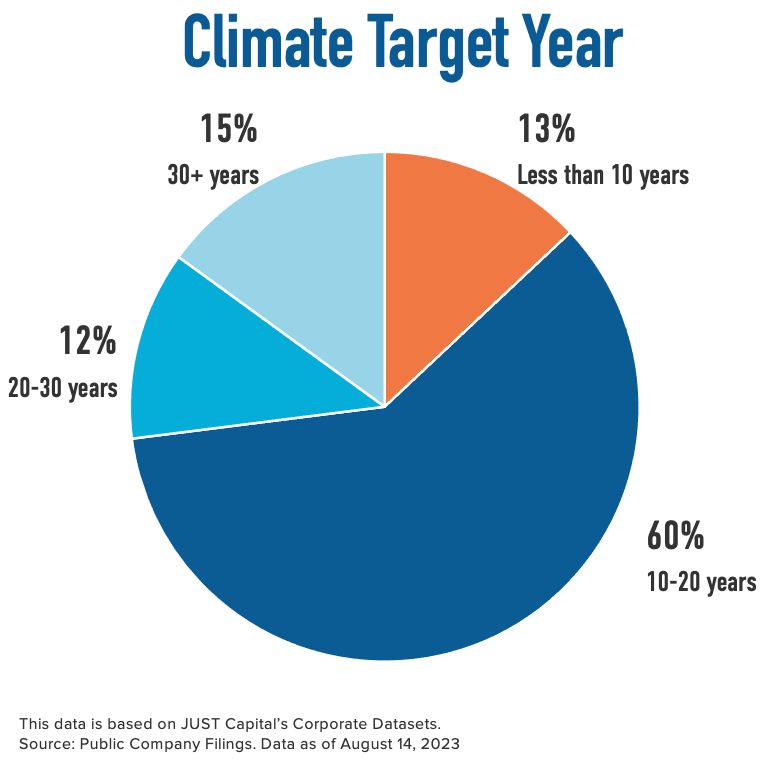
More than half of Russell 1000 companies are aiming to complete their reductions in the next 10-20 years, with the average target year being 2034. With 2050 being the absolute deadline to achieve Net-Zero to meet a 1.5 degree warming scenario, one hopes that the majority of companies are committing to an earlier deadline. Or if companies need the full amount of time to achieve reductions, they can set targets to achieve a portion of their overall reductions before the final target year, known as interim targets, to show their dedication to achieving their stated goals.
That said, among companies with Net-Zero commitments, only 11.48% have publicly set interim targets. This will be a key space to watch as time goes on and more aspects of these commitments get put into action and monitored by customers and investors alike.
This year, we also began tracking SBTi’s latest category of commitment – a verified Net-Zero target – for the first time, which 115 companies have committed to. We see the most of these disclosures in the Software and Commercial Support Services industries. The increasing amount of avenues for companies to verify the scientific accuracy of their commitments is a sign that companies value progress and integrity in this currently unregulated space, especially in a time where concerns of greenwashing are high.
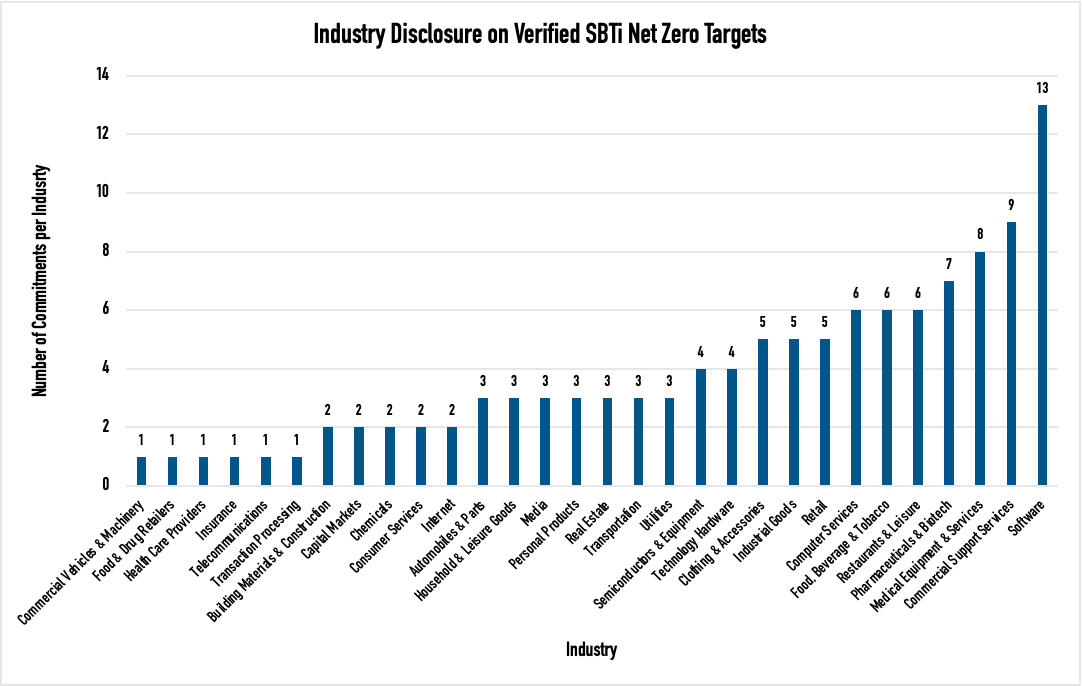
Looking ahead, business leaders can turn their attention to making more aggressive commitments by understanding the approach of industry peers and providing details on how and when they will achieve each portion of their commitments.
We are entering a transition between celebrating commitments and holding companies accountable to them by measuring action, and it will be telling who steps out to the front of the pack.
To unpack your company’s environmental performance in the 2023 Rankings and gain insights into how to improve on core climate issues, please reach out to corpengage@justcapital.com.

The world just had the hottest week on record, according to preliminary data published by the World Meteorological Organization. It follows the hottest June on record and, according to some scientists, possibly the hottest day on Earth – July 4th – in over 125,000 years.
Extreme weather events are now the norm. New Pew polling suggests 69% of Americans have experienced some type of extreme weather in their community over the last year. Hurricane season is reportedly off to a faster than predicted start because of record-hot ocean temperatures in the Atlantic. Increases in flooding and storm surges are also projected.
Unfortunately that’s not all. The cities of Chicago and New York are slowly sinking as a result of higher underground temperatures, scientific analysis shows. In the southwestern US, more than 113 million people are under some form of heat warning. The Colorado River Basin – on which seven other states depend – is experiencing a megadrought that threatens 40 million people and countless businesses. From my time at Swiss Re – one of the world’s leading reinsurance providers – I know it’s not all about property damage or business interruption. Changing disease vectors, agricultural yields, power grid integrity, global supply chains, humanitarian crises, and other systemic impacts are all in play.
Whatever your politics or your views on national and global climate policy, it’s clear that business has a huge role to play in helping us adapt to the worst impacts of a changing climate. And it’s not just about avoiding risk. The opportunities to provide solutions will be significant. How investors, business leaders, and boards – as a new survey by WTW and the Nasdaq Center for Board Excellence highlights – prepare for this new reality is going to be critical. Trillions of dollars – not to mention many millions of lives – may ultimately be at stake.
Be well,
Martin
(JUST Capital)
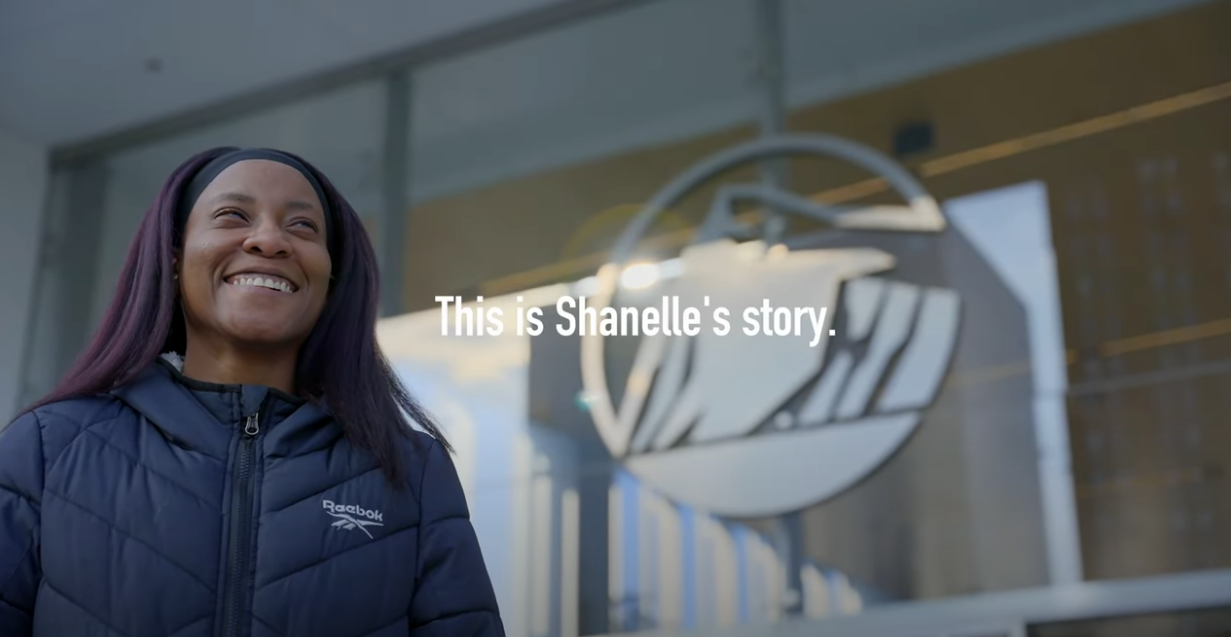
“When you support your workforce, your workforce absolutely supports you.” Shanelle Forde, an Associate Software Developer at Prudential Financial, speaks to the difference she’s felt in her four years at the company. For Shanelle, a single mother, her top priority is her son. Prudential’s investment in her growth and financial security “has allowed me to be a better parent. But it also allows me to be a better worker because now when I come to work, I’m happy. I don’t have to focus on those things like, ‘oh, how am I going to pay my rent?’ I can just come to work and focus on the work,” she tells us.
Hear directly from Shanelle about the impact of Prudential’s investments – along with insights from Prudential’s Senior Vice President of Inclusive Solutions – in a new video series we launched recently as part of our Worker Financial Wellness Initiative, which helps companies assess and improve their workers’ financial health.
JUST Capital board member Peter Georgescu pens an editorial in Forbes discussing the ramifications of the Supreme Court’s affirmative action decision. He argues that a diversity of opinion drives innovation in the business world and without a more inclusionary workforce, out-of-the-box solutions and new ways of problem solving will be harder to come by.
The Financial Times features JUST Capital Director of Corporate Equity Ashley Marchand Orme in an article examining the exits of several high-profile U.S. diversity executives from their posts, as well as corporate America’s commitment to racial equity in the face of tougher economic and political conditions.
Bloomberg cites JUST Capital’s research in a new piece on the Pregnant Workers Fairness Act, citing our work tracking paid parental leave across the Russell 1000. In a recent analysis we released on Father’s Day, we found that primary caregivers on average receive 10.5 weeks of paid parental leave, while secondary caregivers receive 7.6 weeks.

“A decade’s worth of research shows that when workers are more financially secure, key
business outcomes improve such as productivity, customer satisfaction, and employee turnover and engagement,”
Elon Musk announces the launch of his new AI startup xAI. The news comes as several tech giants ramp up the development of their artificial intelligence ventures.
Axios weighs potential responses to the coming barrage of AI-generated misinformation. Provenance, regulation, and media literacy are all possible ways to combat harmful and false content.
The Organisation for Economic Co-operation and Development says that 27% of jobs are at high risk of automation by AI. Meanwhile, three out of five workers fear that they could lose their jobs to AI over the next 10 years, per a 2022 OECD survey.
NVIDIA plans to invest $50 million in Recursion, a company specializing in artificial intelligence models that will aid in the discovery of new pharmaceutical drugs. Reuters has the story.
The Federal Trade Commission begins an investigation into OpenAI trying to understand whether or not the tech firm has harmed consumers by collecting personal data and publishing false information.
CNBC breaks down the latest from the ESG-centered House Financial Service Committee hearing this week. Lawmakers argued over federally mandated disclosure requirements.
The Wall Street Journal writes about DEI divisions in American workplaces in the wake of the Supreme Court’s affirmative action decision. A new Pew Research Center survey found that 54% of workers believe their company is doing enough, 14% believe their company is doing too much, and 15% believe their company is doing too little. A new editorial in Fortune offers advice for businesses on how to center DEI in the face of criticism from anti-ESG proponents.
Bloomberg highlights the stark news that Black workers account for around 90% of recent layoffs as hiring cools and businesses tighten budgets.
Fortune’s CHRO Daily Newsletter highlights the work of Chobani CEO Hamdi Ulukaya. The yogurt company advocates for hiring newly arrived refugees and provides their employees with benefits like childcare discounts – and has been rewarded by exceeding talent retention averages.
The New York Times’ Daily Podcast reports on the end of “the great resignation” as employers regain their edge in a more stagnant labor market.
Bloomberg explores how rising anti-ESG sentiment is impacting funds. An HSBC survey found that managers are taking the backlash into consideration as they decide how to invest their clients’ money.
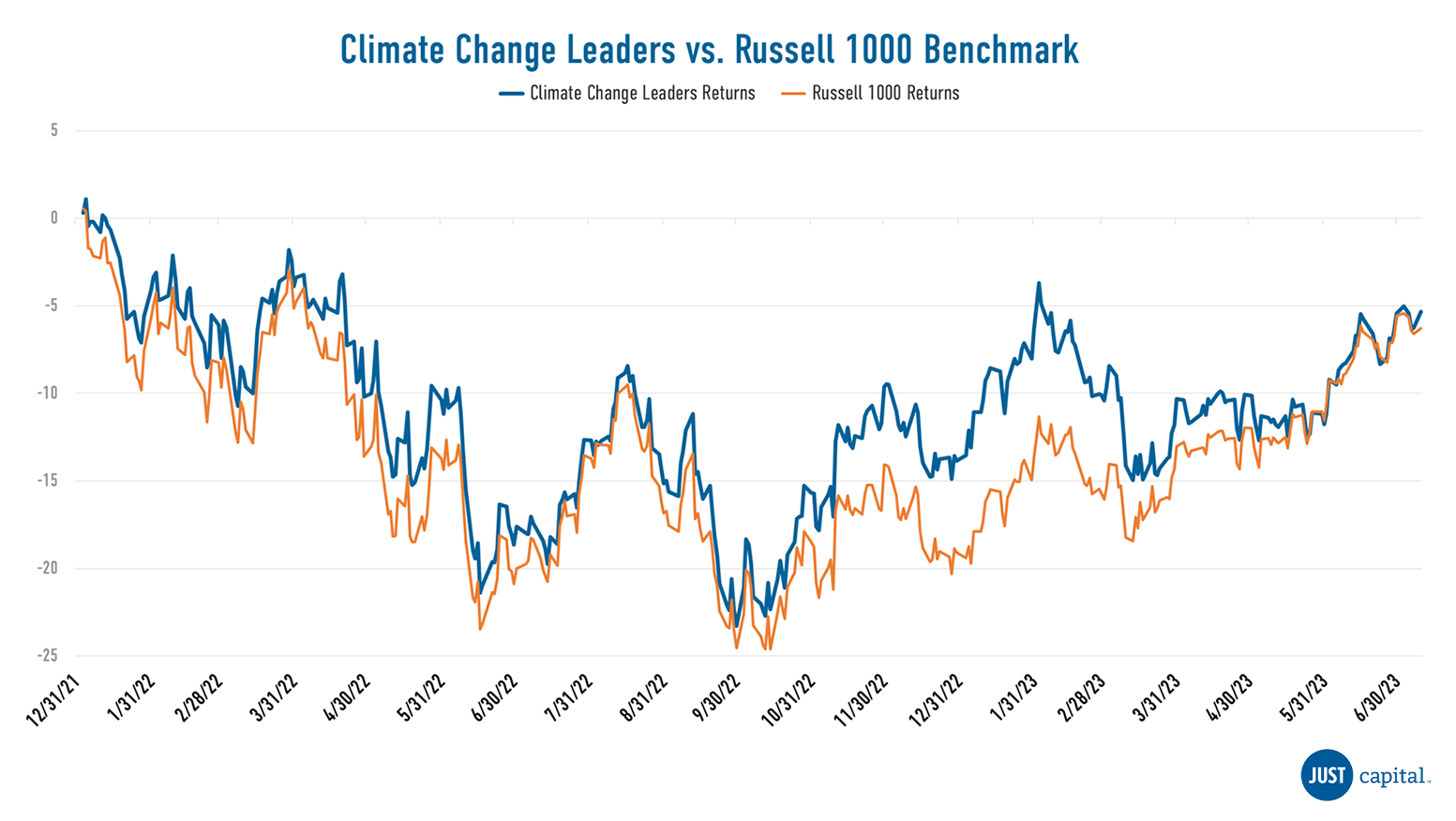
The Climate Change Leaders index concept features the top 20% of Russell 1000 companies in JUST’s annual Rankings that actively employ strategies to mitigate climate-related risks. This concept highlights the financial performance and impact of investing in companies that set clear operational commitments and goals designed to combat climate change. From inception on December 31, 2021 through July 10, 2023, the concept has outperformed its Russell 1000 benchmark by 0.93 percentage points.

The “E” in ESG remains a core focus for corporate leaders – along with regulators and lawmakers. Some state and federal legislators continue to challenge companies’ environmental actions. At the same time, companies are grappling with new sustainability disclosure requirements coming out of the EU and what’s to come from the SEC‘s rule on climate-related disclosures.
Amid these moves, and as this week marks the 53rd annual Earth Day, we took a look at how America’s largest employers are stepping up to manage their environmental impact.
A majority of Americans (88%) JUST Capital surveyed in partnership with Ceres and Public Citizen agree large companies have a responsibility to reduce their environmental impact. An additional 87% said it is important that large companies publicly report data about their impact on society regarding climate. Climate also remains high on the agenda of investors, making up a majority of ESG-related shareholder proposals this proxy season.
To see how companies are measuring up against these expectations, we evaluated the 10 companies with the best environmental performance in our 2023 Rankings of America’s Most JUST Companies. All 10 of these companies have set a Net-Zero target and we also found that these leaders are outpacing the remainder of the Russell 1000:
Read more about how these companies – some of which also appear in our round-up of industry leaders on environmental performance – are taking action. The Top 10 are listed below in ranked order on environmental performance based on the 2023 Rankings.
Ranked 33rd in America’s Most JUST Companies
Software company based in Pleasanton, California
Workday is the top-performing company on the Environment stakeholder, placing first in the overall Rankings and its industry. At Climate Week 2022, JUST CEO Martin Whittaker discussed with Workday’s Erik Hansen the company’s ambitious verified climate commitment, a 1.5-degree Science-Based Target, to reach Net-Zero emissions within its operations by 2030. Workday is also mitigating its historical emissions, becoming one of the first companies to achieve a lifetime net carbon footprint of zero. Additionally, Workday is tied for first within its industry for having the highest percentage of renewable energy within its overall energy use portfolio.
Ranked 7th in America’s Most JUST Companies
Computer Services company based in Spring, Texas
Hewlett Packard Enterprise‘s (HPE) verified 1.5-degree Science-Based Target contains near-term and long-term goals to achieve Net-Zero emissions by 2040, including an absolute reduction of all scope emissions by 90%. Through innovative technology, HPE is increasing the energy efficiency of its products and lowering the environmental cost for consumers. These efforts earned HPE a tied-for-first spot on the Sustainable Materials Issue in our Rankings, within the Computer Services industry. HPE is also tackling its supply chain emissions, and through direct collaboration with suppliers, has set a goal for 2030 that 80% of HPE product suppliers have their own Science-Based targets.
Ranked 78th in America’s Most JUST Companies
Internet company based in Cambridge, Massachusetts
Akamai is working toward a 2030 Net-Zero Target through clean energy projects, engagement with suppliers, and creating a 50% more energy-efficient platform. The company is aiming to achieve a goal of 100% of its global operations utilizing renewable energy by 2030 through partnerships with its data center providers. Akamai also ranks first in its industry for pollution reduction and resource efficiency.
Ranked 3rd in America’s Most JUST Companies
Software company based in Redmond, Washington
Microsoft has consistently positioned itself as a leader in sustainability and has pledged to go beyond Net-Zero, committing to being carbon negative by 2030. This ambitious commitment includes removing more carbon than the company emits by 2030 and, by 2050, removing all of the company’s historical emissions. Microsoft is also committed to becoming water positive by 2030, through collaborating with nonprofits and focusing on habitat restoration. Microsoft is investing in circularity by setting a target of zero waste by 2030, creating more sustainable products for consumers to eliminate waste, and optimizing waste diversion practices within its data centers and campuses.
Ranked 106th in America’s Most JUST Companies
Personal Products company based in Cincinnati, Ohio
Procter & Gamble’s (P&G) approach to sustainability includes four tiers – climate, waste, water, and nature. Procter & Gamble’s climate-focused initiatives include achieving Net-Zero by 2040, disclosing a Climate Transition Action Plan to track progress, and maintaining accountability to achieving its goals. The company’s reducing waste with a target to use all recyclable or reusable packaging for consumer products by 2030. P&G also aims to help build a water-positive future, focusing first on high water-stressed areas where the company operates. The company’s nature-centric goals also include engaging suppliers to source more ethical products and a commitment to no deforestation as a result of souring its palm, pulp, and paper packaging.
Ranked 1st in America’s Most JUST Companies
Bank based in Charlotte, North Carolina
Bank of America’s Approach to Zero strategy includes a commitment to reaching Net-Zero by 2050. The company achieved carbon neutrality in 2019, in addition to reaching its goal of using 100% renewable electricity. To achieve its Net-Zero goal, the company is leveraging its position as a financial institution and mobilizing $1 trillion by 2030 to accelerate its own climate transition. Bank of America’s Environmental Business Initiative has lent $200 billion toward sustainable business activities, including targeting industries essential to achieving the environmental transition such as transportation and clean energy.
Ranked 48th in America’s Most JUST Companies
Computer Services company based in Armonk, New York
IBM has disclosed 21 climate-related goals, including reaching Net-Zero across its operations by 2030. IBM also is focused on the conservation and preservation of biodiversity, pledging to source more sustainable materials and reduce water withdrawals in areas identified as high risk. Within its supply chain, IBM is building on its 2010 goal of all firsthand suppliers maintaining their own environmental management systems, and requiring suppliers in emission-intensive sectors to set scientific emission reduction targets aligned with a 1.5-degree warming scenario.
Ranked 101st in America’s Most JUST Companies
Pharmaceutical & Biotech company based in New Brunswick, New Jersey
Johnson & Johnson’s approach to sustainability is grounded in climate change as a global health crisis. The company’s targets include decarbonization in its operations and supply chain, providing more sustainable products to consumers, and furthering environmental health equity. Johnson & Johnson’s Net-Zero Target aims to achieve carbon neutrality by 2030, with the ultimate goal of reaching Net-Zero across its entire value chain by 2045. The company’s environmental health equity strategy is a part of a larger company initiative launched in 2020, “Our Race to Health Equity,” which identifies solutions to eliminating health inequality for individuals that are a part of at-risk communities.
Ranked 4th in America’s Most JUST Companies
Commercial Support Services company based in Chicago, Illinois
Accenture has a commitment to reaching its own Net-Zero Target by 2025 and is working with companies to assist in helping them achieve their own Net-Zero ambitions. Accenture is taking advantage of its unique position to further sustainability in a range of industries. The company works with C-suite executives to set Science-Based targets, procure renewable energy, and implement new sustainable business models. Accenture has also made progress on its 2025 zero waste target, committing to purchasing only reusable or plastic-free items for its global operating locations.
Ranked 87th in America’s Most JUST Companies
Industrial Goods company based in Broomfield, Colorado
Ball Corp has a Climate Transition Plan, which includes reaching Net-Zero prior to 2050 and reducing carbon emissions by 55% by 2030. Ball Corp ranks first in its industry on the Environment stakeholder, disclosing multiple plans to achieve its sustainability goals dependent on the decarbonization of aluminum. The company is embedding circularity in its product development, through a global recycling roadmap, working with suppliers to achieve 85% recycled content in its cans, and investing in green infrastructure. Through these efforts, Ball Corp leads Industrial Goods companies in our Rankings on the Sustainable Materials Issue.
To unpack your company’s environmental performance in the 2023 Rankings and gain insights into how to improve on the issues that matter most to the American public, please reach out to corpengage@justcapital.com.
As this year’s Earth Day approaches, the world continues to stare down massive global consequences if governments, businesses, and other institutions do not take ambitious climate action. Released last month, the IPCC’s 2023 Climate Change Report signals that a vast reduction in fossil fuel use is urgently needed to slow global warming and ensure a livable, sustainable future.
Following last year’s SEC proposal to require public companies to disclose climate metrics, it seemed that corporate America was poised to be held accountable for its contributions to climate change. One year later, the rule is still not finalized with the SEC potentially easing requirements for companies following its public comment period.
Our survey research has shown that 86% of Americans, on both sides of the political aisle, are in favor of federal climate disclosure requirements. And with proposed requirements still uncertain, it remains in the hands of corporate leaders to determine what action to take and how it should be disclosed. Transparency will be crucial in the decades to come, and our analysis has shown that corporate leaders across industries are already paving the way.
To shine a light on these leaders and show what “good” looks like, we’re unpacking the efforts of the 36 companies that topped their industries on environmental issues in our 2023 Rankings of America’s Most JUST Companies. Many of these companies, regardless of their sector, have set ambitious emissions targets in an effort to mitigate the climate crisis, going beyond standard disclosure practices to focus their sustainability efforts on elements most material to their business models. And some also appear in our round-up of the top 10 companies leading on environmental performance overall in our Rankings.
Read on to explore how these 36 industry leaders are taking action.
Bank of America
Industry: Banks
Overall Rank: 1
As one of eight companies in its industry to make a Net-Zero commitment, Bank of America leads its industry on Resource Efficiency and Pollution Reduction. Notably, Bank of America boasts high percentages of renewable energy use, tying for first on this metric, both in its industry and overall. Additionally, Bank of America offers lending to customers for renewable projects and is a member of the Glasgow Financial Alliance for Net-Zero.
Accenture
Industry: Commercial Support Services
Overall Rank: 4
Accenture leads its industry on Pollution Reduction and Resource Efficiency. One of four Commercial Support Services companies to have a verified 1.5-Degree Science-Based Target, Accenture is committed to reaching Net-Zero by 2025. Accenture engages with its suppliers to achieve its ambitions, requiring 90% of suppliers to disclose emissions reduction plans and providing sustainable value chain strategies focused on circularity.
Hewlett Packard Enterprise
Industry: Computer Services
Overall Rank: 7
Hewlett Packard Enterprise is the only company in the Computer Services Industry with a verified 1.5-Degree Science-Based Target. First in its industry on Pollution Reduction, Sustainable Materials, and Climate Commitments, HPE has set multiple ambitious sustainability targets. HPE requires the adoption of science-based emissions reduction targets for its supply chain and is an early adopter of the reporting recommendation guidelines from the G20 Financial Stability Board’s Task Force on Climate-Related Financial Disclosures (TCFD).
Apple
Industry: Technology Hardware
Overall Rank: 8
Apple is one of three companies in the Technology Hardware Industry to have a verified 1.5-Degree Science-Based Target and has set a near-term target to achieve carbon neutrality by 2030. Thanks to these ambitious commitments, Apple ranks first in its industry for Climate Commitments. Apple is also first in its industry for having the highest percentage of renewable energy usage.
Intel
Industry: Semiconductors & Equipment
Overall Rank: 9
Intel has disclosed a 2040 Net-Zero Commitment, aiming to achieve 100% renewable energy in all of its global operations by 2030. Tied for first in its industry for having high percentages of renewable energy usage, Intel maintained 100% renewable energy usage within its U.S.-based operations in 2021.
T-Mobile
Industry: Telecommunications
Overall Rank: 20
T-Mobile is first in its industry on Pollution Reduction, Climate Commitments, and Resource Efficiency. Setting a verified 1.5-Degree Science-Based Target to achieve Net-Zero by 2040, T-Mobile has already achieved its 2021 goal to source 100% of its electricity usage from renewable sources.
Ecolab Inc
Industry: Chemicals
Overall Rank: 21
Ecolab’s verified 1.5-Degree Science-Based Target aims to halve the company’s emissions by 2030 and achieve Net-Zero by 2050. Ecolab is one of two companies within its industry to have a verified Science-Based Target and is working to achieve its goals by electrifying fleet vehicles, committing to 100% renewable energy in global operations, and engaging with its supply chain. Ecolab also ties for first in its industry on Sustainable Materials, conducting Life Cycle Assessments on its products to assess their environmental impacts.
Mastercard
Industry: Transaction Processing
Overall Rank: 22
Mastercard has a verified 1.5-Degree Science-Based Target, aiming to reduce Scope 1 and 2 emissions by 38% and Scope 3 emissions by 20% by 2025. One of only three Transaction Processing Companies to have a verified commitment, Mastercard is focusing on the decarbonization of its operations and supply chain.
Elevance Health
Industry: Health Care Providers
Overall Rank: 30
Elevance Health’s approach to sustainability is divided into four targets: carbon-neutral operations, 100% renewable energy procurement, science-based emissions reduction targets set by suppliers, and support to individuals challenged with economic insecurity. One of just two Health Care Providers that have committed to a Net-Zero Target, Elevance Health achieved carbon neutrality in 2021.
Workday
Industry: Software
Overall Rank: 33
Workday ranks first for Environment across all industries. Leading the competitive Software Industry on Pollution Reduction, Sustainable Materials, and Resource Efficiency, Workday has invested $1 million in carbon removal, discloses a verified 1.5-Degree Science-Based Target, and is going a step further to mitigate all historical carbon emissions. Through this ambitious effort, Workday will become one of the first companies to have a lifetime negative carbon footprint.
Avangrid
Industry: Utilities
Overall Rank: 45
Tied for first in its industry for Climate Commitments, Avangrid is one of just two Utilities companies to have set a verified 1.5-Degree Science-Based Target. Avangrid is seeking to achieve carbon neutrality, committing to 100% renewable energy in its corporate buildings by 2030. Avangrid is also tied for first in its industry for having high percentages of renewable energy usage.
General Motors
Industry: Automobiles & Parts
Overall Rank: 50
General Motors is one of just two companies in the Automobiles & Parts industry to have set a verified 1.5-degree Science-Based Target. The company’s Climate Action Framework is centered around creating an equitable transition to electric vehicles and improving the overall sustainability of its current products. Tied in its industry on the Sustainable Materials Issue, General Motors also ranks first overall for Pollution Reduction.
Lockheed Martin
Industry: Aerospace & Defense
Overall Rank: 54
As part of its 2025 Sustainability Plan, Lockheed Martin set a 2030 target to reduce Scope 1 and 2 emissions by 70%. One of nine Aerospace & Defense companies to set an emissions reduction target, Lockheed Martin has pledged that, by 2025, it will offset 100% of carbon emissions from business travel as well as continue to invest in and install carbon removal technologies.
McCormick & Co
Industry: Food, Beverage, & Tobacco
Overall Rank: 57
McCormick & Co has set a verified 1.5-Degree Science-Based Target to reach Net-Zero by 2050, one of only six companies in its industry to do so. Tied for first in its industry for Climate Commitments, McCormick is also working to reduce its carbon footprint by adopting more sustainable packaging practices.
Cummins
Industry: Commercial Vehicles & Machinery
Overall Rank: 67
Cummins’ Planet 2050 sustainability strategy aims to reduce Scope 1 and 2 emissions by 50% and Scope 3 emissions of newly sold products by 25%. Also by 2050, Cummins pledges to reduce absolute water consumption by 30%. Cummins is one of just two companies in its industry to have a verified 1.5-Degree Science-Based Target and is tied for first in its industry on Climate Commitments.
Akamai
Industry: Internet
Overall Rank: 78
Akamai leads its industry with five main sustainability targets for 2030, including 100% renewable energy to power global operations, a 50% more energy efficient platform, 100% mitigation of operational emissions, engagement with suppliers to set their own emission reduction targets with results evident by 2030, and recycling 100% of e-waste. Through these initiatives, Akamai has committed to reaching Net-Zero emissions by 2030.
Ball Corp
Industry: Industrial Goods
Overall Rank: 87
Ball Corp has set a verified 1.5-Degree Science-Based Target to achieve Net-Zero by 2050 and continues to improve the sustainability of its products, aiming to source 100% of its aluminum from certified sustainable sources. First in its industry for Sustainable Materials, Ball Corp is working with its supply chain to ensure that the aluminum used in its cans and bottles are, on average, 85% recycled content.
Owens Corning
Industry: Building Materials & Construction
Overall Rank: 96
With a 2030 pledge to reduce Scope 1 and 2 emissions by 50% and Scope 3 emissions by 30%, Owens Corning ties for first in its industry for Climate Commitments, also setting a verified 1.5-Degree Science-Based Target – one of only two companies in its industry to do so. Owens Corning is a member of the Better Plants Program, a Department of Energy initiative to improve and advance energy efficiency in commercial and industrial buildings in the U.S.
Nike
Industry: Clothing & Accessories
Overall Rank: 97
Nike’s Move to Zero initiative has demonstrated the company’s commitment to emissions reduction. With a verified 1.5-Degree Science-Based Target, Nike has set three 2025 targets centered around reducing emissions by prioritizing sustainable materials, using recycled waste in Nike products, and reducing fresh water consumption by 25%. Nike leads its industry on Pollution Reduction, with the highest percentage of renewable energy usage among its peers.
Johnson & Johnson
Industry: Pharmaceuticals & Biotech
Overall Rank: 101
First in its industry for Pollution Reduction and Sustainable Materials, Johnson & Johnson is finding innovative ways to reduce the environmental impacts of its products through multiple sustainability-focused partnerships. Johnson & Johnson also has set a verified 1.5-Degree Science-Based Target and is committed to reaching Net-Zero by 2045.
Edwards Lifesciences
Industry: Medical Equipment & Services
Overall Rank: 104
First in its industry for Climate Commitments, Edwards Lifesciences is one of just two Medical Equipment & Services companies with a verified 1.5-Degree Science-Based Target to reach carbon neutrality by 2030. Additionally, Edwards Lifesciences has set 2025 targets to reduce both waste generation intensity and water withdrawal intensity by 10%.
eBay
Industry: Consumer Services
Overall Rank: 103
In 2021, eBay achieved carbon neutrality in its Scope 1 and 2 emissions. With a verified 1.5-Degree Science-Based Target to achieve Net Zero by 2030, eBay is also working to increase its renewable energy use and reduce its water consumption and waste generation. eBay is first in its industry for Pollution Reduction, Sustainable Materials, and Climate Commitments and is the only Consumer Services company with a 1.5-degree climate commitment.
Procter & Gamble
Industry: Personal Products
Overall Rank: 106
First in its industry for Pollution Reduction and Resource Efficiency, Procter and Gamble has set a verified 2-Degree Science-Based Target to reach Net-Zero by 2040. Disclosing a comprehensive Climate Transition Action Plan, the company is investing in renewable energy and is tied for first in its industry for the highest percentage of renewable energy usage.
Hasbro
Industry: Household & Leisure Goods
Overall Rank: 113
Second in its industry for Sustainable Materials, Hasbro is working to improve the sustainability of its products, using plant-based or recyclable materials in its toys, continuing its global toy recycling program, and implementing sustainable packaging principles. Hasbro is also setting a Net-Zero target for 2050, one of only four companies in its industry to do so.
CVS Health
Industry: Food & Drug Retailers
Overall Rank: 120
First in its industry for Climate Commitments, CVS has set a verified 1.5-Degree Science-Based target to reach Net-Zero by 2050 and a 2030 goal of achieving carbon neutrality. CVS has a three-tiered climate action plan focused on enabling sustainable operations, adopting new climate policies, and promoting animal welfare. CVS has also set a 2030 target to reduce plastic use in its operations by 50% and is tied for first in its industry for its commitment to using Sustainable Materials.
Ameriprise Financial
Industry: Consumer & Diversified Finance
Overall Rank: 124
Ameriprise Financial leads its industry on Sustainable Materials and Resource Efficiency. By implementing sustainable practices in its operations, including increasing building energy efficiency and reducing paper waste, Ameriprise Financial has lowered its Scope 1 and Scope 2 emissions.
Goldman Sachs
Industry: Capital Markets
Overall Rank: 131
Leading its industry on Climate Commitments, Goldman Sachs has set a 2030 Net-Zero target. Goldman Sachs also boasts high percentages of renewable energy use and has a 2025 goal of procuring 100% renewable energy for its global electricity consumption.
Principal Financial Group
Industry: Insurance
Overall Rank: 138
Principal Financial Group has set both near- and long-term climate targets, including a 2035 goal to reduce emissions by 40% and a 2050 goal to reach Net-Zero. Year-over-year since 2018, Principal Financial Group has consecutively reduced greenhouse gas emissions. Tying for first in its industry for Pollution Reduction, approximately 61% of Principal Financial’s energy consumption in the U.S. is from renewable resources.
Marathon Petroleum
Industry: Oil & Gas
Overall Rank: 173
Marathon Petroleum has set reduction targets across all three scopes of emissions, including a 30% reduction of Scope 1 and 2 by 2030 and a 15% reduction of Scope 3 Category 11 emissions by 2030. First in its industry for Sustainable Materials, Marathon Petroleum conducts biodiversity assessments and has set a 2025 target to integrate sustainable vegetation and habitat management into 50% of the areas surrounding pipelines.
FedEx
Industry: Transportation
Overall Rank: 178
FedEx has set a goal to achieve carbon neutral operations through the electrification of its fleet vehicles and the adoption of sustainable fuels. FedEx is also engaging with consumers and suppliers to offer carbon-offset shipping and sustainable packaging options.
Weyerhaeuser
Industry: Real Estate
Overall Rank: 205
Weyerhaeuser has set a verified 1.5-Degree Science-Based Target, pursuing Net-Zero by 2050. The company also launched the Forest to Frame Alliance to engage its entire supply chain in its Net-Zero ambitions. First in the Real Estate Industry in Pollution Reduction and Resource Efficiency, Weyheauser is second in its industry for high percentages of renewable energy usage.
Las Vegas Sands
Industry: Restaurants & Leisure
Overall Rank: 291
Las Vegas Sands has committed to a verified 2-Degree Science-Based Target, aiming to reduce greenhouse gas emissions by 17.5% by 2025. The company is implementing energy efficiency within its operations to undergo a low-carbon transition, as well as focusing on water stewardship by reducing water consumption.
Williams-Sonoma
Industry: Retail
Overall Rank: 331
Tied for first in its industry for Climate Commitments, Williams-Sonoma has a verified 1.5-Degree Science-Based Target and a near-term target of carbon neutrality by 2025. The company is first among Retail companies for having the highest percentage of renewable energy usage, as well as first in Sustainable Materials, thanks to its efforts to increase the circularity of its products.
International Paper
Industry: Basic Resources
Overall Rank: 408
Ranking first in its industry on Pollution Reduction, International Paper discloses the highest percentages of renewable energy use compared to peers. International Paper is also one of just two companies in its industry to have a verified 2-degree Science-Based Target, with a commitment to reduce 35% of absolute emissions across all three scopes by 2030.
News Corporation
Industry: Media
Overall Rank: 589
News Corporation is one of two companies within the Media Industry to have a verified 1.5-Degree Science-Based Target. Tied for first for Climate Commitments, News Corporation discloses an entire Net-Zero Transition Plan and has committed to reducing fuel and carbon emissions by 60% by 2030.
Enviva
Industry: Energy Equipment & Services
Overall Rank: 729
Enviva has made a 2030 Net-Zero commitment, along with five other companies in its industry. With efforts to sustainably source wood and invest in the conservation and restoration of forests, Enviva is first in its industry for Pollution Reduction and second for Climate Commitments.
To unpack your company’s environmental performance in the 2023 Rankings and gain insights into how to improve on the issues that matter most to the American public, please reach out to corpengage@justcapital.com.
Necessity breeds invention. Invention results in impact, opportunity, and growth. We’re seeing that play out right now in the climate world.
Scientists increasingly warn of an unmanageable future if we don’t act. Insufficient action on climate change could cost the U.S. economy $14.5 trillion over the next five decades, research shows. Yet we’re also seeing a wave of innovation working its way through corporate America.
Take transportation. Over the course of the last few weeks, we’ve seen Walmart announce plans to add electric vehicle charging stations to thousands of U.S. stores by 2030; GM lead a $50 million Series B financing round for Energy Exploration Technologies to develop EV batteries; Lamborghini and Toyota announce major new investments in EV models; Delta lay out its plans in the booming sustainable aviation fuel market; and United Airlines invest $100 million to support startups focused on cutting air travel’s carbon footprint through research, production, and technologies of sustainable aviation fuel.
Of course, this is merely a snapshot. Innovation and investment in climate solutions is spanning all industries and business sectors. Chipotle recently unveiled a prototype of its all-electric restaurant design aimed at helping the company reach its goal of cutting greenhouse gas emissions in half by 2030. Nike’s “Move to Zero” goal to become both zero carbon and zero waste across its business is having concrete operational benefits. Larry Fink’s 2023 annual shareholder letter listed “Helping clients navigate and invest in the global energy transition” as a key priority. The global renewable energy market, valued at over $768 billion in 2021, is projected to grow at a compound annual growth rate of 16.6% each year to 2030, market research shows.
Our research shows that Americans across all walks of life see the planet as a key business stakeholder. And as is the case for every other stakeholder, how companies position to invest, compete, and deliver solutions will drive value for all concerned long into the future.
Be well,
Martin
This week, we’re highlighting companies that employ innovative technologies in their products and services, a data point measured in the Sustainable Materials Issue.
As economic uncertainty persists, Americans are looking to companies to invest in their employees. In an editorial for MarketWatch, JUST Chief Strategy Officer Alison Omens writes on why doing so “offers much more to companies than just an assurance of moral good,” building the business case with examples Bank of America, NVIDIA, and Microsoft.
JUST and the Municipal Issuer Racial Equity and Inclusion Engagement working group launched a new tool to drive disclosure on racial equity practices in the municipal bonds market. JUST’s Director of Corporate Equity Ashley Marchand Orme explains how investors can now more easily access information on how municipalities are addressing racial equity via the Bloomberg terminal.
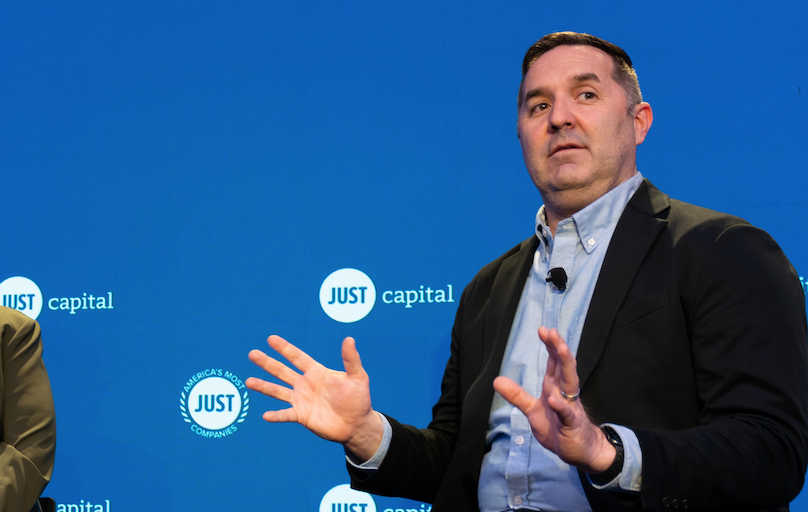
“I came into my first sustainability job five or six years ago with this hyper-competitive mindset […] but what I found out very quickly was that in the sustainability space, and all of its permutations, the problems are challenging and difficult enough that you kind of have to deal with your competitors. In a lot of ways, talking to my peers and direct competitors has been really really helpful because we’re all facing the same challenges.”
A new CNBC survey finds 70% of Americans feel stressed about their personal finances. Inflation, an uncertain economic environment, and lack of savings are all adding to the anxiety.
Quartz has the story on a new survey from Aflac that shows at least half of American workers are facing moderate levels of burnout.
The Wall Street Journal reports on more parents taking leave as eligibility to the benefit is expanded by both state governments and employers. According to Labor Department data, the 478,000 working parents absent in January 2023 was the most since records began in 1994.
A coalition of investors and activists are working to make companies publicly disclose the amount of taxes they pay on a country-by-country basis. The Financial Times writes about the growing movement and the strong opposition it still faces.
The Washington Post covers the FTC’s expected crackdown on ‘greenwashing.’ The regulator plans to tighten guidelines around what really constitutes environmentally sound companies and products.
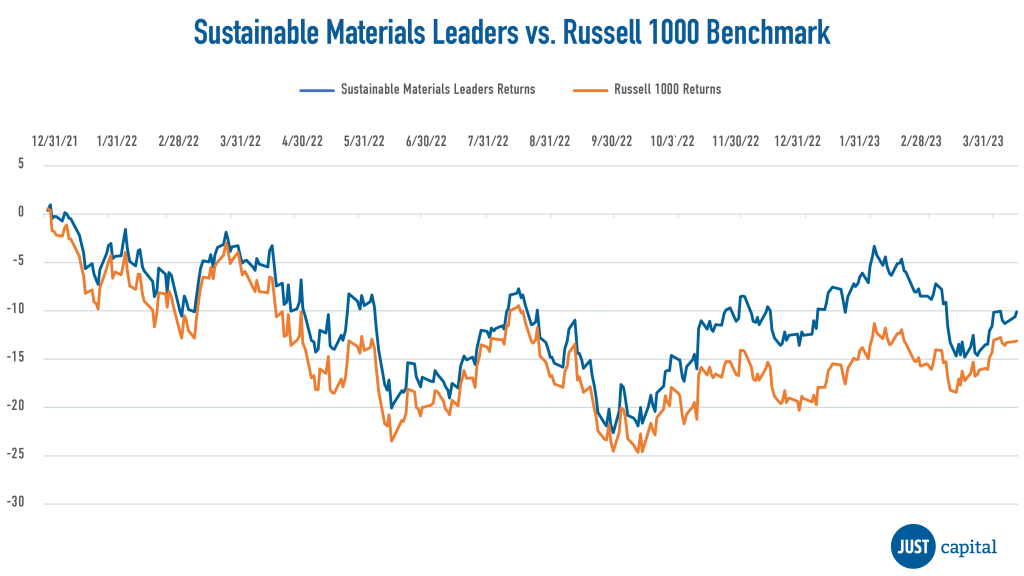
In anticipation of Earth Day, we’re spotlighting one of our new index concepts that tracks leading companies for the environment – the Sustainable Materials Leaders. This index features the top 20% of Russell 1000 companies we rank that prioritize the use of sustainable materials across their operations and supply chain. Since inception on 12/31/21 through 4/11/23, it has delivered 2.98% alpha compared to its Russell 1000 benchmark. The featured companies emit 49.4% CO2 per dollar of revenue and are 61.8% more likely to tie executive compensation to ESG performance.
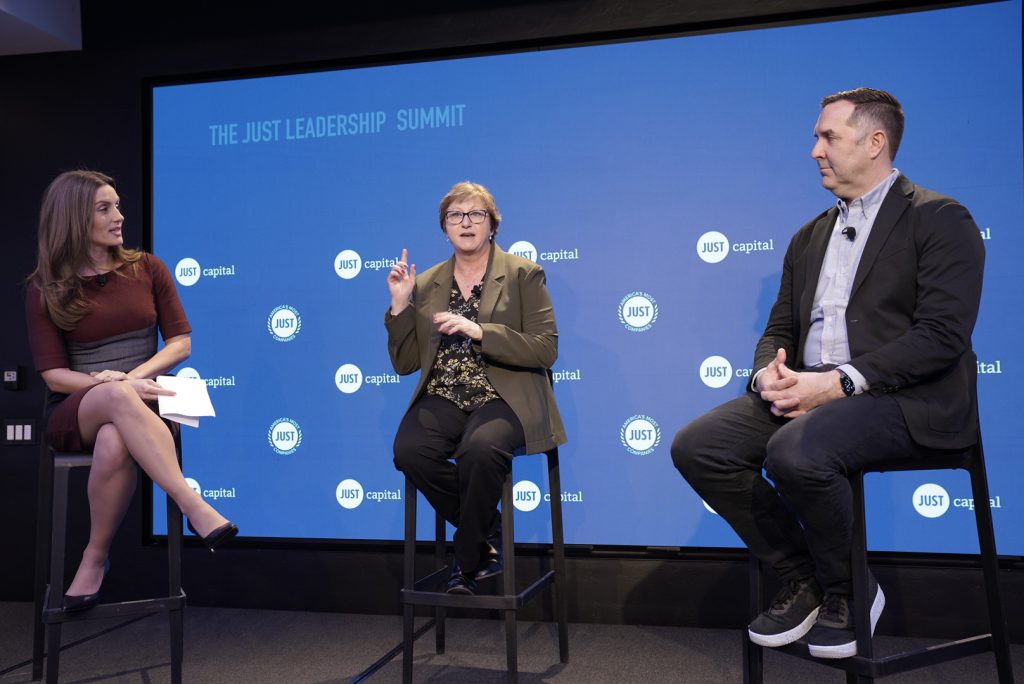
Amidst the rising ESG and sustainability backlash, it’s increasingly important to hear from corporate leaders taking concrete, meaningful steps to drive change on the key issues of our time. At last week’s JUST Leadership Summit, we heard from sustainability leaders of two of the top-performing companies in our 2023 Rankings – American Electric Power (AEP) (#14 overall and #1 in the Utilities industry) and Nike (#97 overall and #1 in the Clothing & Accessories industry).
In a panel moderated by CNBC Reporter Kristina Partsinevelos, AEP Chief Sustainability Officer Sandy Nessing and Nike Chief Sustainability Officer Noel Kinder highlighted the approaches and actions their teams have taken to create a more sustainable future for their companies, for their industries, and the planet overall. Nessing and Kinder spoke in depth about renewable energy and their companies’ efforts to reduce environmental impact, but both emphasized that a transparent, people-based approach is needed to drive lasting, meaningful change.
Watch the full conversation here, and dig into five key takeaways below – all of which provide broad tenets by which corporate leaders in any industry can forge their journey toward a more renewable and equitable future.
Operationalize sustainability
In talking about Nike’s “Move to Zero” goal to become both zero carbon and zero waste across operations, Kinder explained that setting clear targets and measurable outcomes is key, as well as identifying operational milestones to achieve along the way. These milestones represent an undeniable challenge to Nike’s leaders – holding the company accountable not only to its long-term ambitious goals, but to concrete steps on the path toward achieving them. These steps also provide an operational roadmap, detailing the role that teams across the organization can and must play to achieve larger carbon and waste reduction goals. They embed sustainability in all aspects of the company and deputize Nike’s team members to take ownership of the “Move to Zero” journey.
Think about people
For AEP, one of the nation’s largest generators of electricity, coal has historically been central to powering the communities the company serves. Faced with this monumental challenge to her company’s clean energy strategy, Nessing articulated the importance of putting people first – ensuring that the impact of this strategy on AEP’s employees and core communities is carefully considered. As the company prepared to close coal plants, AEP conducted economic analyses to better understand the impacts of doing so, seeing the plants themselves as community ecosystems that shape not only economic development but the lives of the people who live and work there. Nessing shared that almost all employees of closed plants have found jobs within AEP – emphasizing that, with a focus on communities and people, “there is a life after coal.”
Get out of your own echo chamber
As one of the founding members of the Sustainable Apparel Coalition, Nike has worked closely with its suppliers and direct competitors to develop shared practices and approaches to achieving sustainability goals. Key drivers of Nike’s carbon footprint include the materials and energy used to create its products – meaning that collaboration across its supply chain is crucial in the company’s renewable energy journey. This collaboration is often complex and challenging, necessitating discussion with competitors to ensure alignment and shared approaches in working with suppliers. Kinder noted that Nike’s success has been tied to his company’s willingness to step outside of its own “echo chamber” and instead harness the collective voice of its wider industry to drive change.
Look inward as you look outward
Unlike Nike, AEP’s global supply chain is not a major driver of its core operations – but the company profoundly impacts the communities where it operates both at home and abroad. Nessing explained that, as part of AEP’s people-based approach to sustainability, the company has begun to more carefully consider how its operations impact historically marginalized or disadvantaged communities, developing an Environmental & Social Justice Policy that commits to seeking input from impacted communities in its sustainability decision-making. By centering community voice in its clean energy transition, AEP has taken steps to shift its own priorities – ensuring an equitable approach to driving change. In discussing these leading efforts, Nessing noted that this is an “exciting time to be in this industry.”
Be transparent and show your work
Kinder emphasized that sustainability is a “catalyst for innovation,” and that in order for innovation to drive meaningful change beyond the walls of a single organization, transparency is key. With “ESG” currently a contentious term in corporate and investment communities, Kinder and Nessing both agree it’s important not to shy away from the conversation and most importantly, that corporate leaders stay the course. In coming to the table – with employees, investors, communities, partners, competitors, and more – it’s critical for corporate leaders to be able to show their homework, to demonstrate the reasons for their actions and the impacts of change. Nessing noted that AEP has gotten pushback, particularly from some of the company’s local communities. However, this pushback has not led her company to change course, but instead invite everyone into the conversation and share resources to ensure a just and equitable transition.
Watch the full conversation below.
For corporate leaders looking to unpack your company’s performance in the 2023 Rankings and gain insights into how to improve on the issues that matter most to the American public, please reach out to corpengage@justcapital.com.
