By Aleksandra Radeva, Lisa Simon (Revelio Labs), Zanele Munyikwa (Economist at Revelio Labs)
In today’s economic landscape – with looming uncertainty about the role of generative AI on the workforce and the pocketbook pinch of ongoing inflation – where and how can workers and their families find financial security and the stability it offers? When companies pay their employees a wage rate that meets local living expenses, they’re not only investing in operational success but also demonstrating leadership on one issue on which Americans across political affiliations agree, a seeming rarity in this election season.
To better understand the financial security of employees across America’s largest publicly traded companies, the Russell 1000, JUST Capital and Revelio Labs analyzed the amount by which employees’ wages exceed the local living wage necessary to cover basic budgetary needs. And while a living wage covers the basics, including housing, food, healthcare, and other essentials, the excess amount provides additional income that allows for the savings, discretionary spending, and improved quality of life necessary for true economic stability. The results – which indicate the financial viability of Russell 1000 employment, including among some entry-level positions, in some of America’s highest cost-of-living cities – may initially seem confounding. To learn more about how we made these calculations, click here.
When considering where workers can achieve financial stability, it’s surprising to find that some of the highest cost-of-living areas in the U.S. – like Seattle, cities in the Northeast, Silicon Valley, and Austin – also top the list for areas where a family of two working adults with two children can earn above a basic needs-based living wage. This finding indicates that the companies represented in these regions, as well as the wages offered in certain roles, can offset the high living costs.
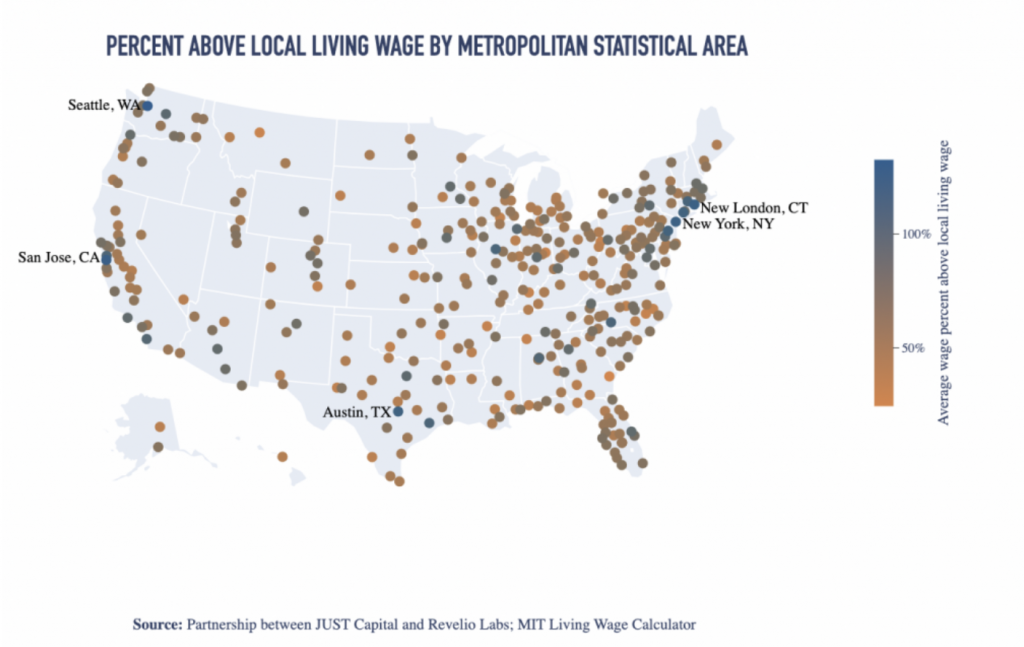
The map above shows where Russell 1000 company employees are paid a rate that, on average, exceeds the local living wage. For example, the living wage estimate, or amount needed to meet basic budgetary needs, for a family of two adults and two children in Austin, Texas is $52,800 per worker (assuming both adults work). Our data shows that on average, a Russell 1000 worker in Austin makes $114,000, which is 160% above the local living wage estimate for a family of four. This finding is certainly driven by the fact that Austin has a high concentration of high-paying companies with highly paid roles. But it also tells us that if one could be any worker with any role in a Russell 1000 company, a job in Austin would be more likely to ensure financial security.
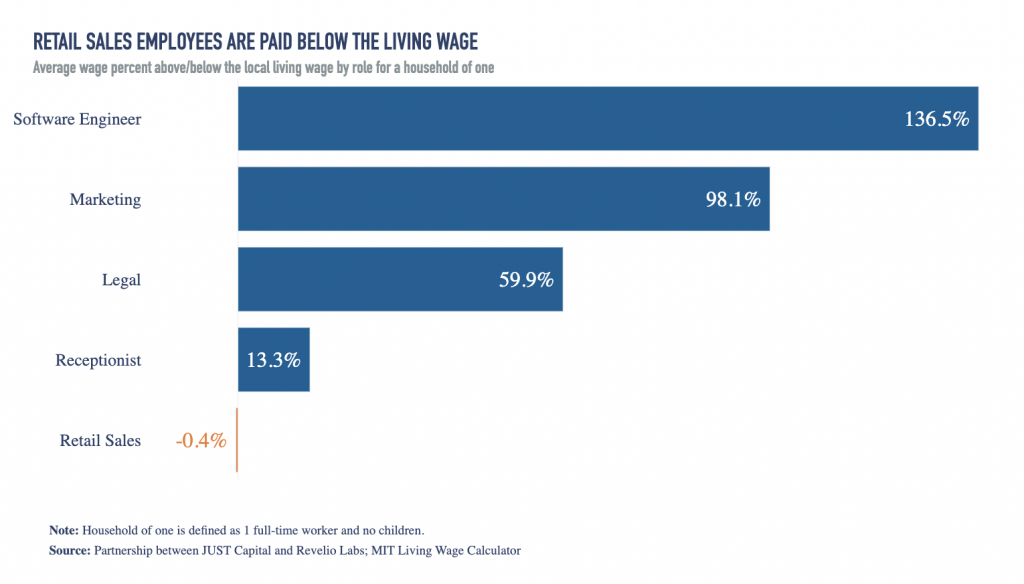
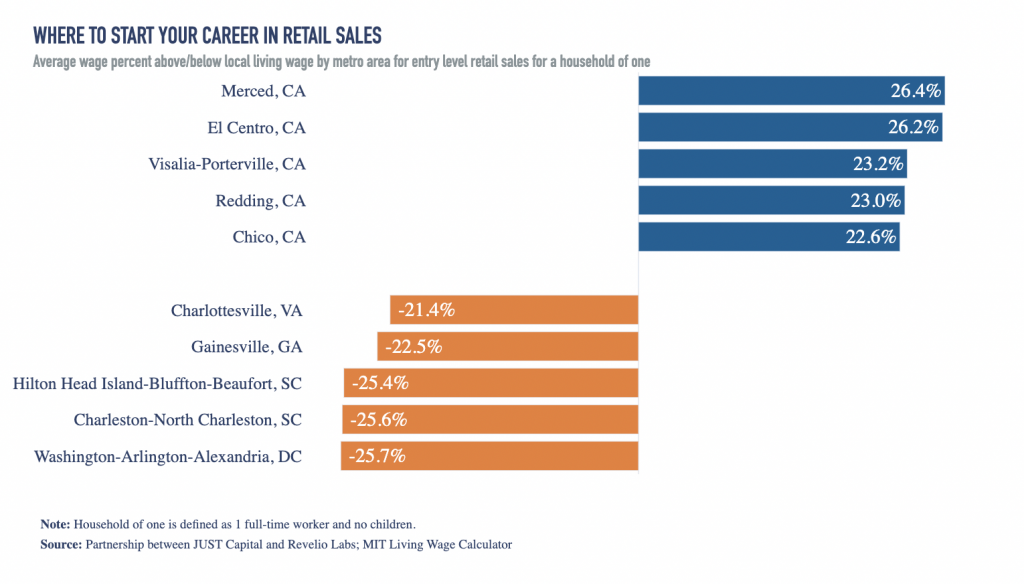
But when looking across different roles at Russell 1000 companies, not all tend to pay a living wage, let alone above it. The industry with some of the largest location-based variation in employees earning more than a local living wage is retail sales. That variation is driven by the industry’s large, diverse workforce and extensive presence across different regions. For those starting their careers in retail, the location of a given store plays a crucial role in determining financial viability. California, although a high cost-of-living state, not only provides a higher likelihood of achieving a wage exceeding the local living wage in retail roles but also maintains this advantage in entry-level positions.
For example, an entry-level retail sales employee working at a Russell 1000 company can make on average 26.4% more than the living wage for a household of one in Merced, California. In Charlottesville, Virginia, on the other hand, employees will make 21.4% percent less on average than their local living wage.
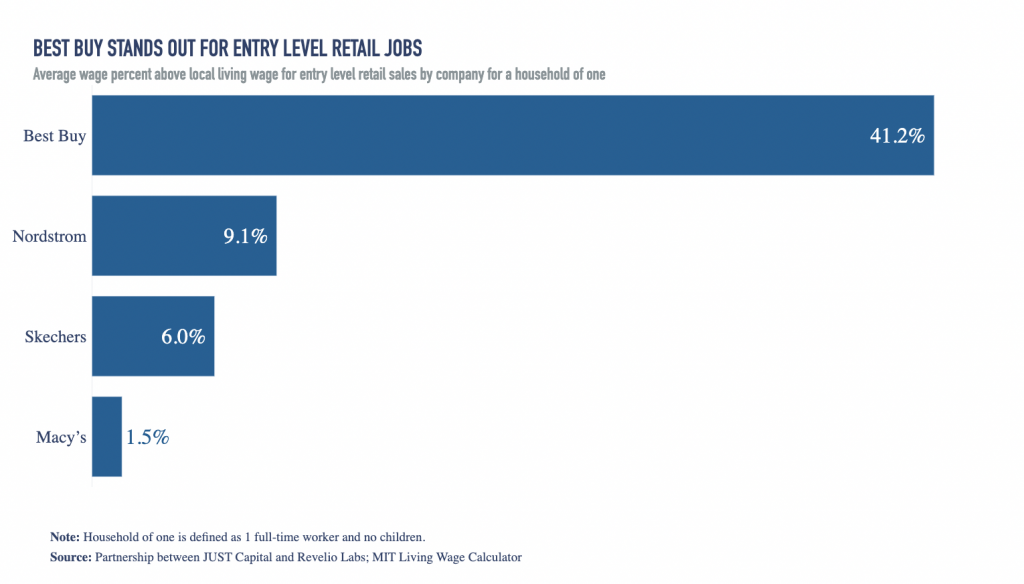
Besides location, the employer also plays a role in determining an entry-level role’s financial viability. Certain companies – including Best Buy – stand out for their higher pay for entry-level retail jobs. Best Buy, Nordstrom, Skechers, and Macy’s are notable for offering wages that exceed the local living wage estimates for a single adult working full-time, making them attractive options for those entering the retail sector. On average, entry-level sales employees at Nordstrom make 9.1% more than their local living wage for a household of one.
*The best companies for entry level retail positions are determined based on the percentage average wages fall above the local living wage for those positions.
And while some locations and employers offer a good starting point in retail, can such jobs support a family? A more detailed examination of retail roles reveals a sobering reality: supporting a family on a retail salary remains difficult in most areas. This finding is particularly true for entry-level positions, where wages often fail to meet the local living wage estimates. However, there are exceptions. California emerges as a state where retail sales roles can offer wages exceeding the local living wage, suggesting a more favorable economic environment for retail workers.
*For the purposes of this analysis, a family is defined as two full-time working adults with two children, and the living wage is what each of the adults needs to make to meet an estimated basic needs budget in their location.
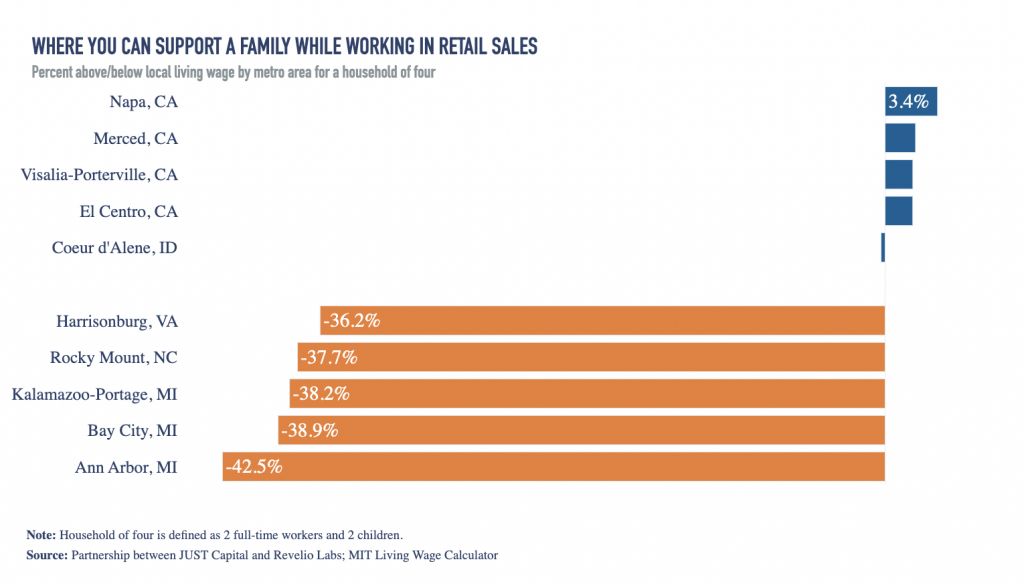
*The above graph represents the top and bottom five locations for relative wages earned by employees in retail sales roles compared to the local living wage .
These insights underscore the complex landscape of wages and living costs across the U.S., where variation exists even across Russell 1000 companies in the same industry. They highlight the importance of considering both geographic and role-specific factors when evaluating economic stability and opportunities for families.
JUST Capital and Revelio Labs are committed to identifying the corporate leaders on key workforce trends, particularly when it comes to companies investing in their workforce by paying a fair, living wage – a top priority of the American public for just business behavior. Learn more about leveraging the research insights, cabinet of experts, and peer-to-peer engagement available to corporate leaders through JUST Capital’s programming by reaching out at corpengage@justcapital.com.
Lisa Simon is the Chief Economist and Zanele Munyikwa is an Economist at Revelio Labs.
What is a living wage? A living wage is the amount of money needed for a given worker to cover the cost of their family’s minimum or basic needs where they live. Learn more about living wage as an important business benchmark here.
How do we calculate the percent that average wages fall below or above the local living wage in this analysis? To calculate the percentage average wages fall above or below the local living wage, we look at the average wage earned by employees working at Russell 1000 companies in a given metropolitan area, and compare that average to the local living wage. We then use the following formula to calculate the percentage above or below the local living wage:
(Average wages earned in MSA by Russell 1000 employees﹣Local living wage) / Local living wage
Why is a pay rate that exceeds the living wage important? For workers across incomes, knowing where your earnings are most likely to exceed the local, basic needs-based cost of living provides an indication of where your wages might be “worth” the most in terms of purchasing power. What’s more, the basic needs budget used to estimate living wage typically assumes the lowest-cost version of necessities, and does not include significant elements of financial security such as retirement savings. A worker earning a living wage would remain only one unexpected expense away from financial precarity. Learn more about how local living wage estimates are calculated here.
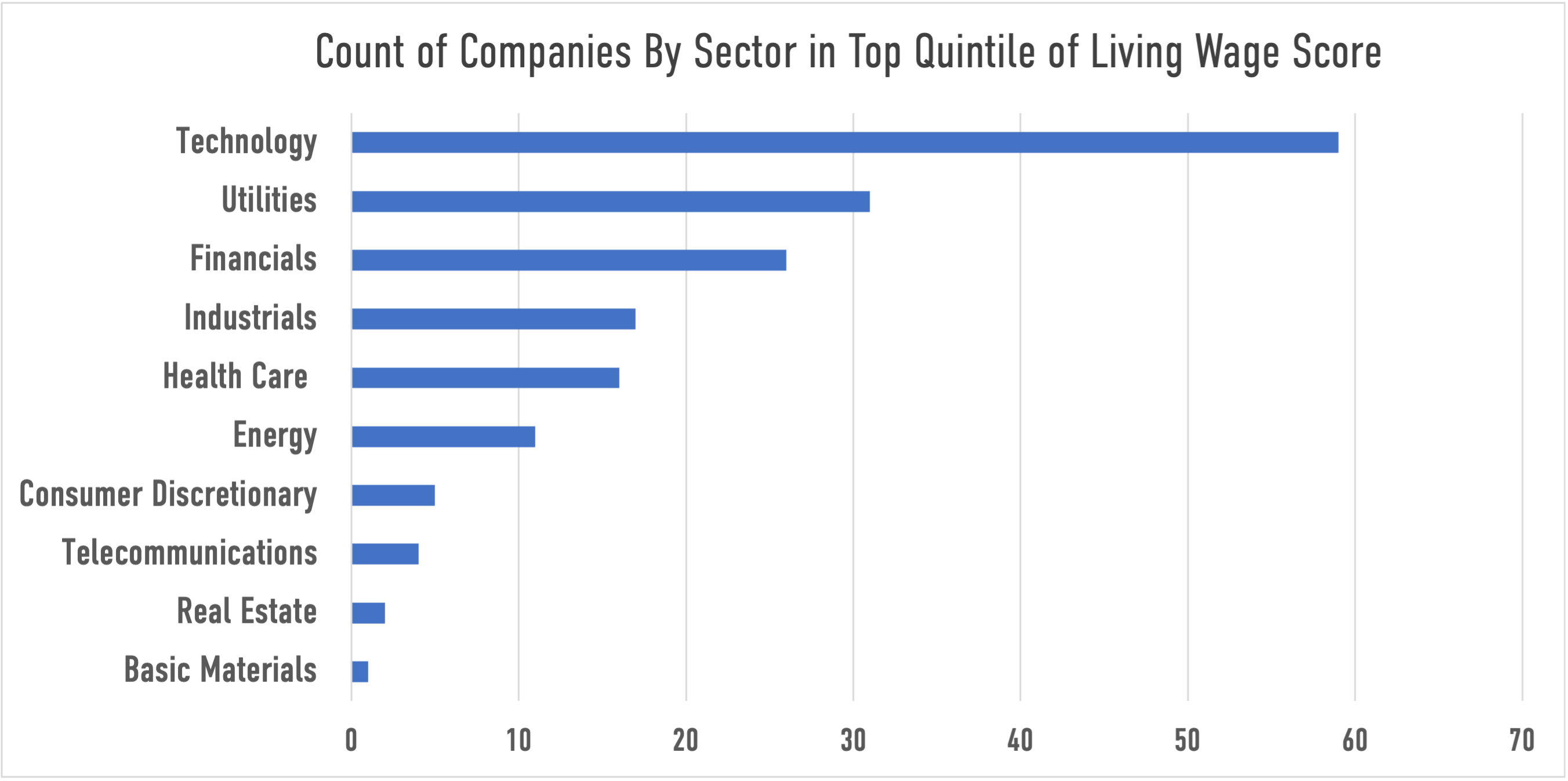
JUST Capital’s highest weighted issue in our 2021 Rankings of America’s Most JUST Companies, per our polling of the American public, is whether or not a company pays a fair, livable wage. Our chart this week looks at the sector breakdown of the companies that score highest on the living wage metric. Within the top quintile of living wage metric scorers, we find that Technology and Utilities companies comprise the majority of those that pay relatively more workers a living wage, or enough to cover the local cost of food, housing, and medical care, among other basic necessities.
The impetus: The Worker Financial Wellness Initiative was created in Q4 2020 by JUST Capital and PayPal, in collaboration with the Financial Health Network and the Good Jobs Institute, to make paying a fair, livable wage and assessing worker financial security and health a C-suite and investor priority.
The importance: On July 13, JUST Capital announced the first cohort of companies joining the Initiative, including Chipotle, Chobani, Even, Prudential Financial, and Verizon. With this first cohort representing approximately 260,000 American workers across a range of industries, the program presents a unique opportunity to demonstrate what companies can accomplish when they come together with a shared goal of improving the financial health and resilience of workers across the nation.
If you are interested in supporting our mission, we are happy to discuss data needs, index licensing, and other ways we can partner, please fill out our request form to answer a few questions, and someone from our Investor Solutions team will reach out to you within business days.
For the first time in 15 years, there is serious national momentum around raising the federal minimum wage, potentially to $15. With this momentum comes the opportunity to examine our national priorities around wages and jobs, particularly as we emerge from the pandemic and continue to grapple with racial inequity in the U.S.
The minimum wage emerged as an answer to the Great Depression, and was codified in the late 1930s as part of a broader push to establish the floor for labor standards in America. It was born from the recognition that the government needed to create a baseline for how companies and the market could treat people and value their work. It was a time not too different from the one we’re in now – featuring a major stratification of wealth, as well as a realization that society wasn’t protecting enough people and that the market wasn’t as reliable or transparent as we needed it to be.
In the 1970s, we ushered in a new set of expectations for our economy, when corporate America codified the conventional wisdom that minimizing labor costs and keeping wages low is key to profitability. So it’s no coincidence that wages haven’t meaningfully gone up in a long time. According to recent work by the Economic Policy Center, worker pay has grown 13.7% since 1978. By comparison, CEO pay grew over 1000% in that same time horizon. That extreme contrast signals a belief system about who brings value to business.
And the minimum wage is a barometer for the values of a society. It speaks to our collective baseline expectations for how any business should treat someone. According to our extensive annual survey research efforts, Americans across the ideological divide agree that business leaders should prioritize workers above all else, starting with wages. As a nation, we should be aspiring to create jobs that give people the freedom to support themselves and their families.
In recent months, we’ve heard an increasingly loud argument about the irrelevance of the federal minimum wage – that local economies across the U.S. are so vastly different that one standard simply isn’t applicable. And while I can relate to that central premise, it misses a key point – that society dictates what is acceptable and unacceptable. That reality makes wages a federal issue.
On the other hand, good wages do vary dramatically across different geographies and counties, and therefore I welcome those who seek to eliminate the federal minimum wage to seize the living wage as an alternative concept. According to the Living Wage Calculator created by MIT professor Amy Glasmier, the living wage in counties across the U.S. ranges from around $18 to $30 for a family of four. A living wage, conceptually, is compensation that covers an individual’s or a family’s monthly bills for essential needs. Childcare. Housing. Transportation. Food. Living wages fluctuate dramatically based on if an individual has a partner and/or children, in addition to where they live. When we talk about raising the minimum wage, we miss that nuance and context. The minimum wage is not a concept designed to cover any one person’s monthly costs, while a living wage is.
We also hear a lot about how increasing the minimum wage will cost jobs and hurt business. There continues to be a lot of work done, and disagreement around, if and how many jobs could be lost. Increasingly researchers are finding that significant job loss is unlikely. Critically, this line of reasoning again misses the broader point – poverty-level jobs should not be what we aspire to. $15 an hour will not be a living wage for a family of four anywhere in the country. It would only be a living wage for a single adult with no children in about half of the states in the country. And good jobs can help businesses and workers.
But despite the importance of the minimum wage, it’s also a blunt instrument, further undermined by the fact that, when it was first established, it was in the context of a broader push for safe and family-supporting jobs. With the establishment of the minimum wage came overtime, outlawing child labor, and the creation of today’s concept of employment. The minimum wage, and indeed wages overall, can and should be understood in the context of jobs, not as a standalone.
Many business leaders today understand this. In 2019, PayPal identified the importance of understanding if its workers were getting by and getting ahead, and so undertook a formal assessment of the financial security of call center workers, focusing on their “net disposable income.” This analysis essentially looked at the workers’ wages, in addition to costs of healthcare, ability to save, and pay for emergencies. Since this assessment took place, JUST Capital and PayPal, along with the Financial Health Network and the Good Jobs Institute, have partnered to create the Worker Financial Wellness Initiative, which asks all corporate executives to consider whether they know if their workers’ wages are covering the bills, and if workers are getting by overall – and if they don’t know, to conduct an assessment, like PayPal did, to find out. In short, we need to move away from thinking only about one piece of the puzzle (wages), and instead examine the full financial lives’ of people. And we need to expect business leaders, who are increasingly trusted more than politicians, to work toward a future that creates quality jobs within their own companies, regardless of industry.
Research shows that engaged and financially secure workers can bring significant value to businesses. MIT Sloan Professor Zeynep Ton, founder of the Good Jobs Institute, has done extensive research on the business case for good jobs in the retail sector. The data shows that this approach can lead to competitive advantage. It can increase retention and productivity, and in turn, customer satisfaction. Mercer found that employers report losing $250 billion each year due to the stress of their employees. And JUST Capital’s own work shows that companies that invest in their workers also outperform their peers in the market.
The moral of the story is that the minimum wage is a crucial step on the journey toward a society and an economy that recognizes and values good jobs and good wages. And to be clear: raising wages is a critical piece of the puzzle. But over the decades, we’ve lost the context for this conversation, and have treated it as a government issue rather than a business AND government issue. As the dialogue in Washington gets more intense about raising the minimum wage, political leaders should consider this issue in the context of the broader push to create good jobs in our country, and understand that even $15 is not a living wage. And business leaders should embrace this new reality, where paying people well leads to better long-term business outcomes, and shows real leadership. As we emerge from the pandemic to a changed economy, it’s time to create an economy where a certain caliber of job is simply unacceptable, and where all Americans are able to both get by and get ahead.
Events over the last year have tested the country’s frayed social fabric like no other year in recent memory. Growing partisan polarization has been well-documented, and partisan antipathy has intensified to a point where 91% of Americans say that they see strong conflicts between Democrats and Republicans. Everything, from the COVID-19 pandemic to presidential approval ratings, shows widening gaps in attitudes between Americans of different political views. It seems that the only thing that the American public – across all ideological factions – can agree on is that Democrats and Republicans disagree on even basic facts.
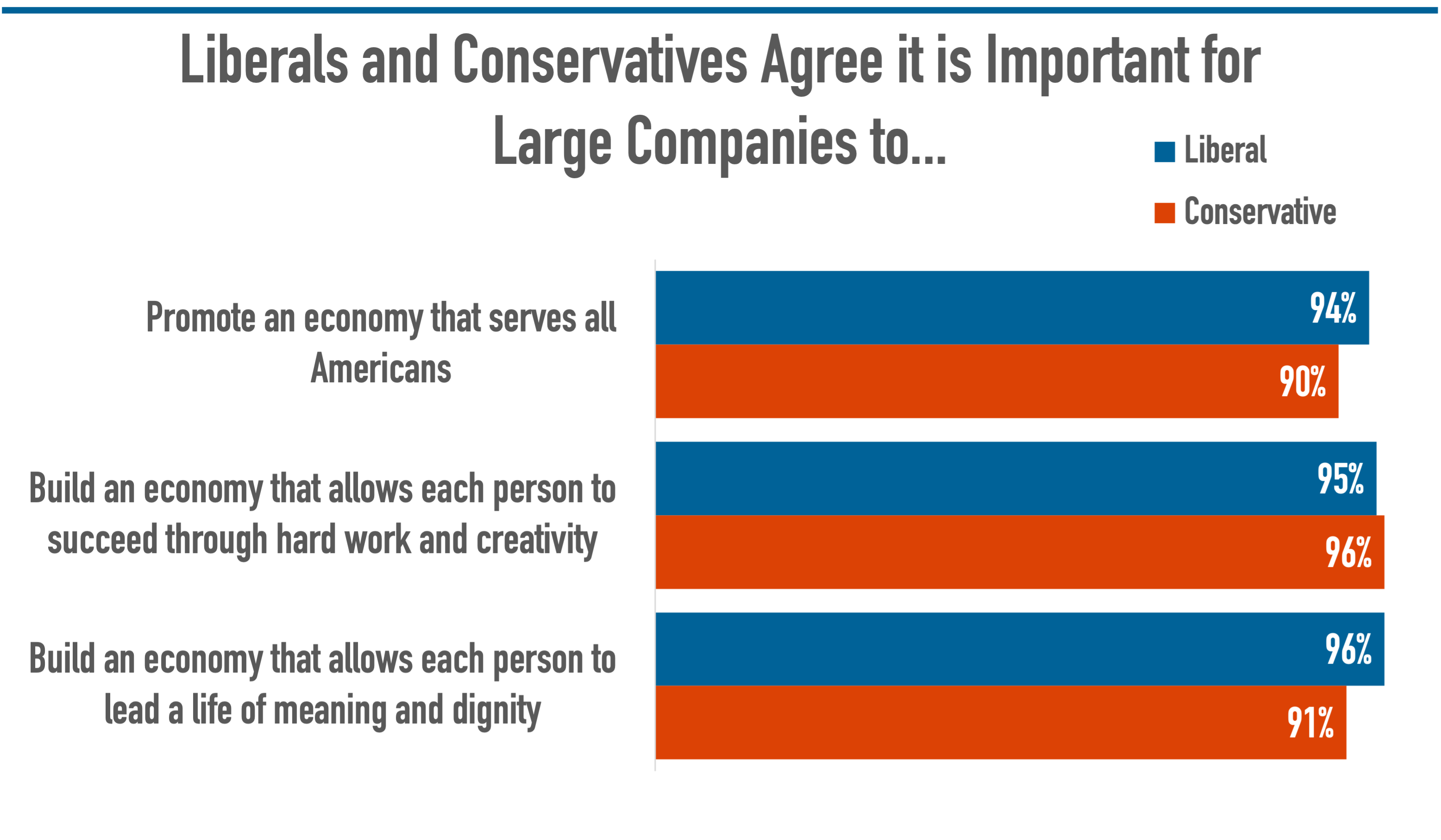
Our annual survey, however, has captured a common ground among liberal and conservative respondents when it comes to their views on stakeholder capitalism, with large majorities of each group agreeing that it’s important for companies to promote an economy that serves all Americans, as well as one that builds an economy that allows each person to succeed through hard work and creativity and to lead a life of meaning and dignity. And both groups largely agree that business can be a force for positive societal change (88% of liberals and 74% of conservatives).
Across ideological divides, Americans also agree on what the top eight priorities for creating this vision of stakeholder capitalism should be – among them, paying a living wage, cultivating an inclusive workplace, and protecting workplace health and safety. This alignment signals that stakeholder capitalism may represent a broad-based solution for achieving a more equitable economy that all Americans, regardless of their ideological perspectives, can get behind – in particular, when it comes to how companies treat their workers.
Overall, Americans want to see companies pay a fair, livable wage to their workers – it is the top priority for conservatives and #2 for liberals (securing human rights across the supply chain is the top priority for liberals). Ethical leadership ranks #4 for both groups on the list of priorities. And among the top eight priorities overall, liberals put slightly more emphasis on issues of human rights and workplace diversity compared to conservatives, while conservatives put slightly more emphasis on job creation and workforce investment compared to liberals.
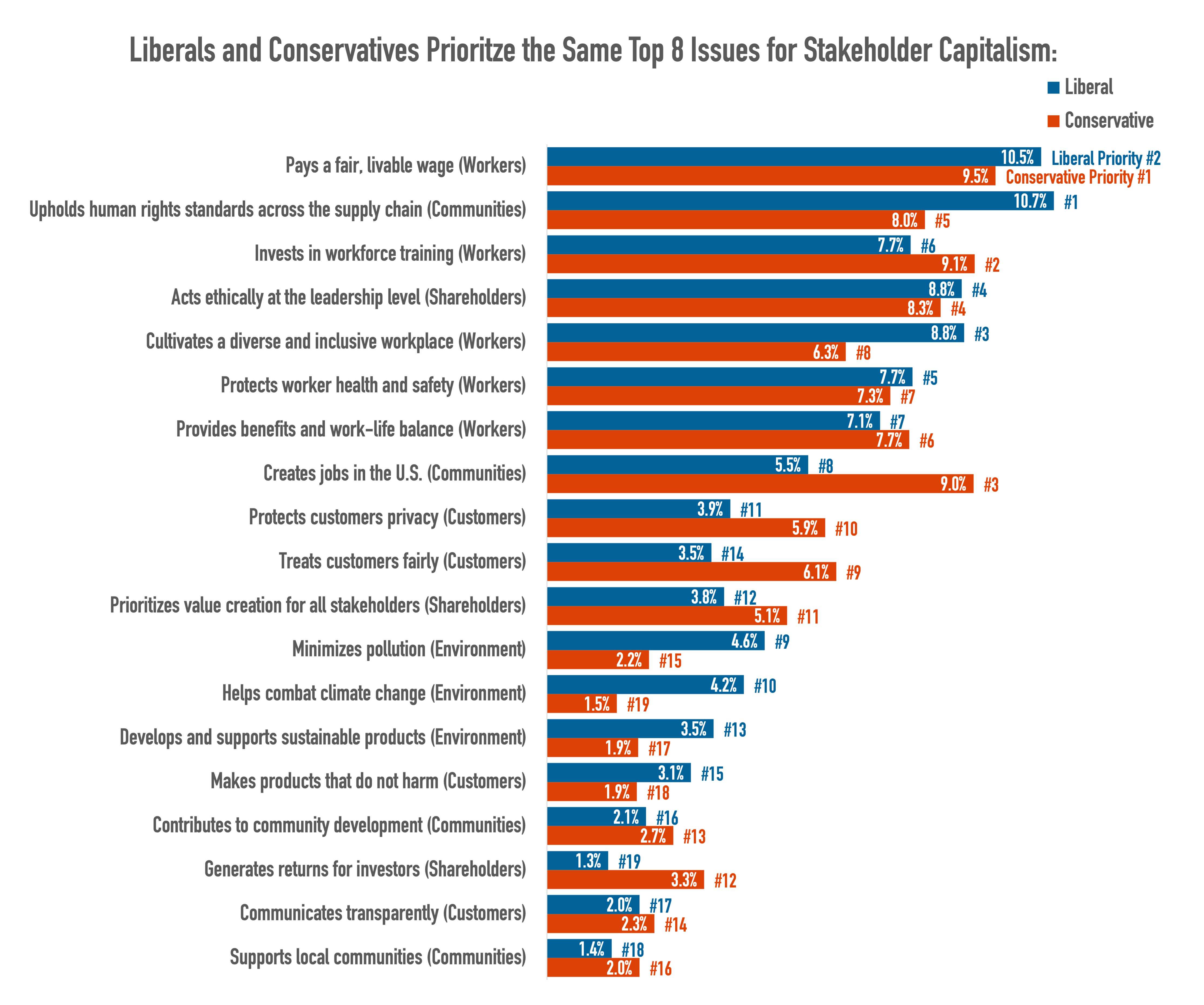
Further down the list of priorities, some predictable differences emerge. Liberals are more concerned about environmental issues compared to conservatives, such as limiting pollution (#9 for liberals and #15 for conservatives) and reducing carbon emissions (#10 for liberals and #19 for conservatives). Conservatives put a higher priority on generating profits (#12 for conservatives and #19 for liberals).
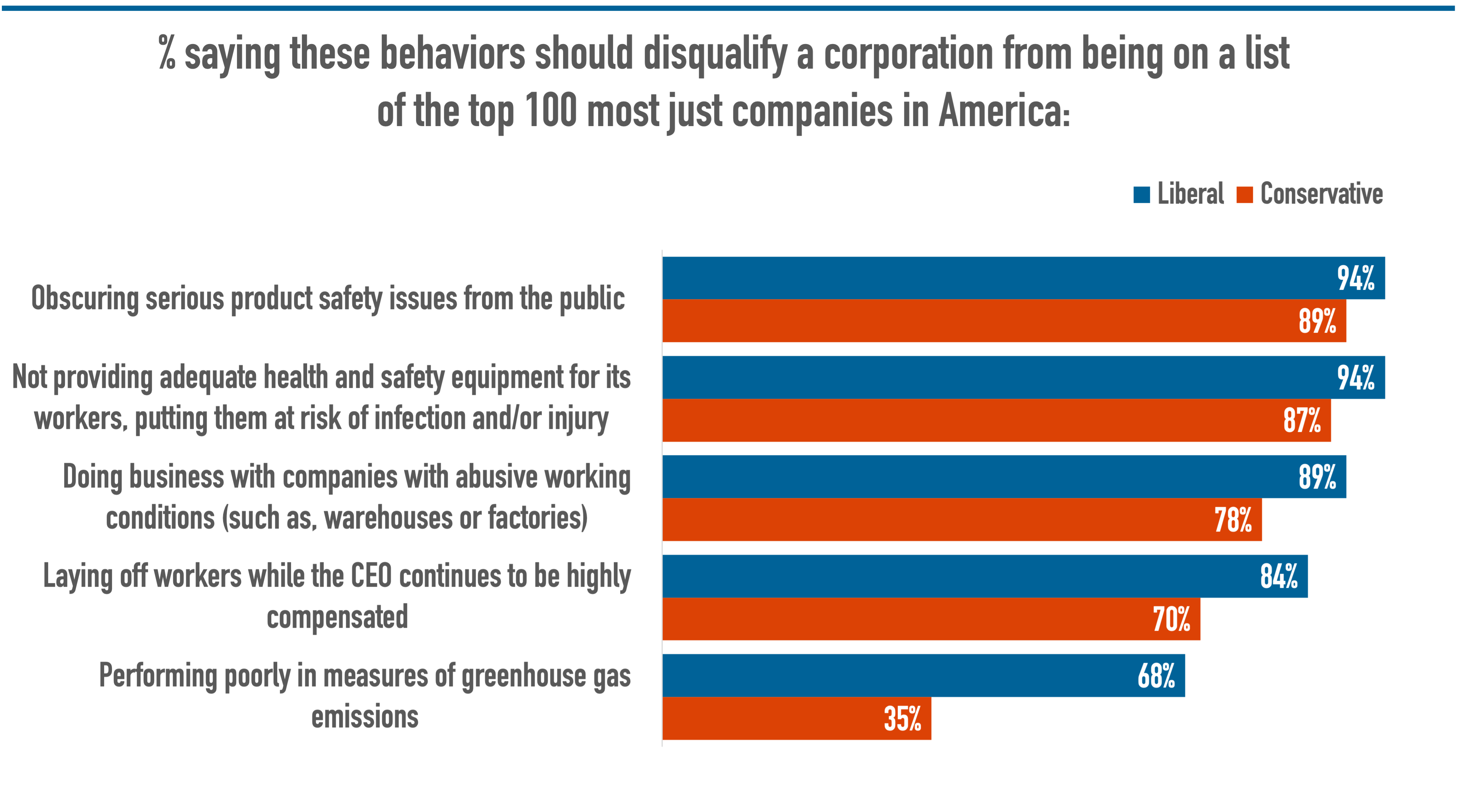
Liberals and conservatives also largely align on the business behaviors that they view as unjust. Large majorities of both groups believe it is unjust for corporations to hide product safety issues from the public, put workers at risk by not providing adequate health and safety measures, do business with companies that have abusive working conditions, and continue providing high pay to CEOs while laying off workers. The only issue that presented a split in opinion about unjust corporate behavior is greenhouse gas emissions – 68% of liberals believe corporations that produce more greenhouse gas emissions are unjust, compared to 35% of conservatives.
Despite the intense polarization that undeniably exists in our country today, a path toward unity seems to exist in how we approach stakeholder capitalism. Business leaders can do their part by putting forward a broader, more inclusive economic vision that allows all people to contribute and achieve their potential. And companies can take action by making the security and well-being of their workers their top priority – a move that truly bridges the ideological divide.
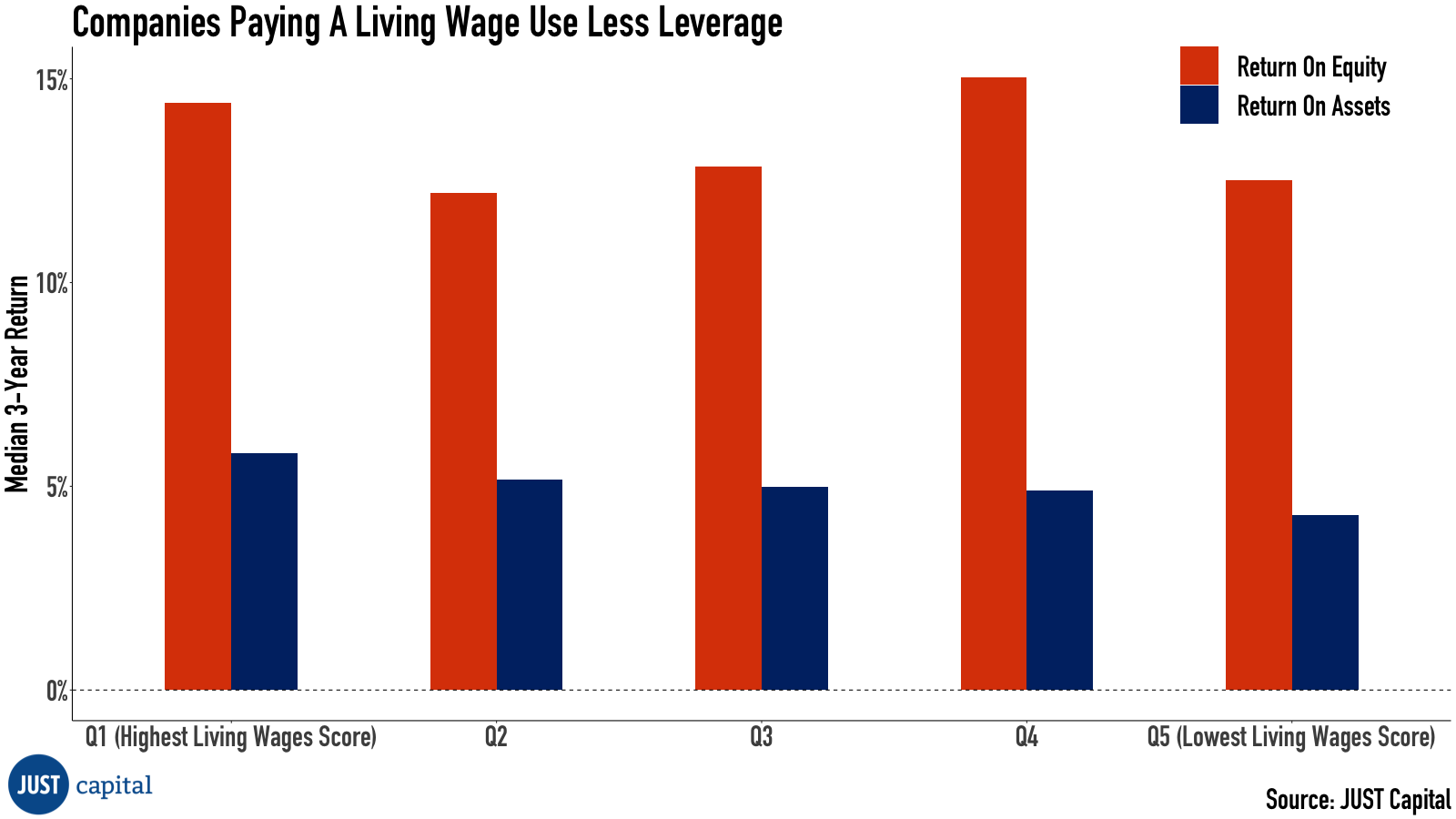
In this week’s Chart of the Week we take a look at the Living Wage Score* across all companies we rank within the Russell 1000 universe, splitting the companies into five quintiles from the highest score to the lowest on an industry-neutral basis.
Our Living Wage Score is based on an estimated percentage of on-site workers making a living wage, which is the level of income needed to meet basic needs, adjusted for location and family size, and not accounting for short- and long-term savings or burdensome expenses like debt.
Looking at the data for the Return on Equity (ROE) across the five quintiles, we see no meaningful trend using the trailing 3-year median. However, there is a trend in Return on Assets (ROA) with companies that we estimate pay more of their workers a living wage outperforming those that don’t.
(JUST Capital)
ROE is an important measure of a company’s financial performance and profitability. It represents how many dollars of net income a company generates in any given year per dollar of equity, and is driven by three main components: operating efficiency, asset efficiency, and financial leverage. The product of the first two is also known as ROA, or the net income per average assets.
Looking at the trend in ROA but not in ROE in the chart above, there is the implication that companies we estimate pay relatively fewer workers a living wage are also companies that take on more financial leverage – and thus more risk – than those that pay more workers a living wage in order to deliver the same level of profitability.
The Good Jobs Institute is one of our partners in the Worker Financial Wellness Initiative we cofounded with PayPal, and it has done extensive research on the benefits of what it calls “The Good Jobs Strategy,” which includes raising wages to avoid any worker struggling to make ends meet. From the WFWI’s guide on how what “worker financial wellness” means and how it can be measured, here’s an overview of a case study on Quest Diagnostics:
“After consolidating 20 call centers into two, Quest Diagnostics experienced 60% turnover, which cost the company $10.5 million each year in direct replacement costs alone. Quest implemented the Good Jobs Strategy by raising wages, creating a more clear career path with incremental pay raises, and improving training. It simultaneously raised expectations of employees, with a more stringent attendance policy and better performance metrics. It improved operations as well, reducing non-value-add call volume and creating ‘model pods’ to drive employee engagement and identify high-leverage improvement opportunities. Within 18 months, turnover rates were cut in half and unplanned absenteeism dropped from 12.4% to 4.2%. Quest’s service improved too: Its 60 second answer rate went from 50% to 70% and call transfer rate from 12% to 9.5%. And they realized $1.3 million in run-rate cost savings from process improvements, many driven by their call center reps.”
Put simply, GJI’s research has found that companies’ investments in living wages and complementary operations improvements drive worker engagement, which in turn drives productivity, and that ultimately creates value for shareholders. It has found that this has worked across different sizes of companies, and across all industries, including ones with notoriously low profit margins, like certain sectors of retail.
If you are interested in supporting our mission, we are happy to discuss data needs, index licensing, and other ways we can partner. Please reach out to our Director of Business Development, Charlie Mahoney, at cmahoney@justcapital.com to discuss how we can create a more JUST economy together.
*Note on the Living Wage Score: Our proprietary living wage model uses geocoded data on a company’s locations across the United States and the number of employees in each of these locations, to which we assign industry classifications (NAICS codes). Using data from the Bureau of Labor Statistics (BLS) on the distribution of occupations (Standard Occupational Classification code) within each industry, we estimate the number of workers in each occupation per location. We then match crowd- sourced wage data to each of these occupations and estimate a wage distribution for each company. Missing wage data for occupations are filled in with national averages from BLS. Finally, using data from our cooperation with MIT’s Living Wage Calculator to determine the national living wage for a family of one full- time worker, one part-time worker, and one child, we determine the share of workers per location who make at least the national living wage.

2020 has been a year of profound change and upheaval – from the COVID-19 pandemic to our national reckoning with racial injustice to last week’s unprecedented election and the continued fight for American democracy. Amidst these monumental and unusual events, the call for stakeholder capitalism has continued to mount, with workers’ needs – health, safety, security, fair treatment, and pay – at the forefront of the conversation.
Earlier this year, JUST Capital and PayPal launched the Worker Financial Wellness Initiative, a new, critical project to make workers’ financial security and health a C-suite and investor priority. And at the Forbes JUST 100 Virtual Summit – where we celebrated the 2021 Rankings of America’s Most JUST Companies on October 14 – we discussed why worker financial wellness must be a priority for corporate leaders, now more than ever, in conversation with PayPal CEO Dan Schulman, JUST Capital Cofounder & Chairman Paul Tudor Jones, and Chief Strategy Officer Alison Omens.
Explore our key takeaways below.
Even before the COVID-19 crisis hit the U.S., far too many Americans were struggling to pay their bills each month, an issue that has only been exacerbated as our economy has contended with the impacts of the pandemic. In 2018, PayPal CEO Dan Schulman decided to find out whether employees were able to make ends meet – and because his company paid employees at or above market, he expected a good news story. But when he surveyed his workers, he learned that more than two-thirds of call center and entry level employees were struggling to pay their bills each month, let alone save for their futures or for emergencies. Dan explained that “our mission as a company is to democratize financial access,” and that while PayPal’s focus had been to achieve this mission for customers, its employees were being left behind. In better understanding the financial health and security of his workers, Schulman was able to evaluate the broader implications of his mission, and make critical changes to ensure that workers were not simply the purveyors of this mission, but also its beneficiaries.
In our six years of polling the American public, we’ve heard every year that workers are the most important stakeholder for corporate America, and that paying a living wage is critical to creating a more just form of capitalism (this year, and last, Americans agree that paying a fair, livable wage should be the top priority for companies). In discussing why this issue is so important, Tudor Jones emphasized that “paying a living wage is the first great step to reducing the inequality gap, taking care of employees, and hopefully building a larger pie for the entire country.” Today, among the 20 million workers who work for the Russell 1000 companies we evaluate, we estimate that 50% currently do not make a living wage. Tudor Jones identified Schulman as “the flag bearer” in driving change on this issue, and believes that boards, shareholders, and employees themselves will increasingly demand a living wage.
There is a pervasive narrative on Wall Street that raising wages destroys value – something we saw play out recently when Costco stocks dropped after the company announced that it was maintaining COVID-19 wage hikes for its frontline workers. Schulman called this narrative “fundamentally wrong” – noting that the single biggest competitive advantage for any company is the talent and passion of its workers, and that the most talented people want to work for companies that both stand for a purpose and ensure their financial security. “I actually think if you don’t have a purpose as a company and don’t treat your workers as your most valuable asset,” Schulman explained, “then you minimize your profitability going forward.” Tudor Jones agreed, suggesting that the market is beginning to understand this, bolstered by growing research to suggest that a company’s “net contribution to society” is key to the formula for raising the company’s net value overall.
Healthier employees not only have the ability to strengthen the financial health of their companies (and in turn, the economy), they create a healthier democracy. Schulman noted that “democracy asks us to rise above our own self interest to support what’s right for the whole,” but when employees are financially insecure, they question the system. A strong economy, a healthier capitalism that really cares about everyone, is essential for a strong democracy – and that begins with treating workers right. Tudor Jones emphasized the critical importance of this work: “We’re not going to change this country, we’re not going to feel embarrassed to be Americans, we’re not going to be proud of what we do every day unless we change where we work first. It’s the only way we’re going to get gender equity, income equity, wealth equity, or racial equity. It’s the only way we’re going to do it.”
You can watch the full JUST 100 Virtual Summit here.
