
Last week, the partisan debate on ESG reached a new level. President Biden issued the first veto of his administration, on a piece of legislation that would have restricted pension fund managers’ ability to consider ESG factors in investment decisions. The decision sparked commentary from both sides of the political aisle. At JUST, we weighed in with our own perspective – emphasizing that ESG isn’t or shouldn’t be about politics. And our CEO, Martin Whittaker, reiterated this when speaking with GOP presidential candidate Vivek Ramaswamy on CNBC’s Last Call.
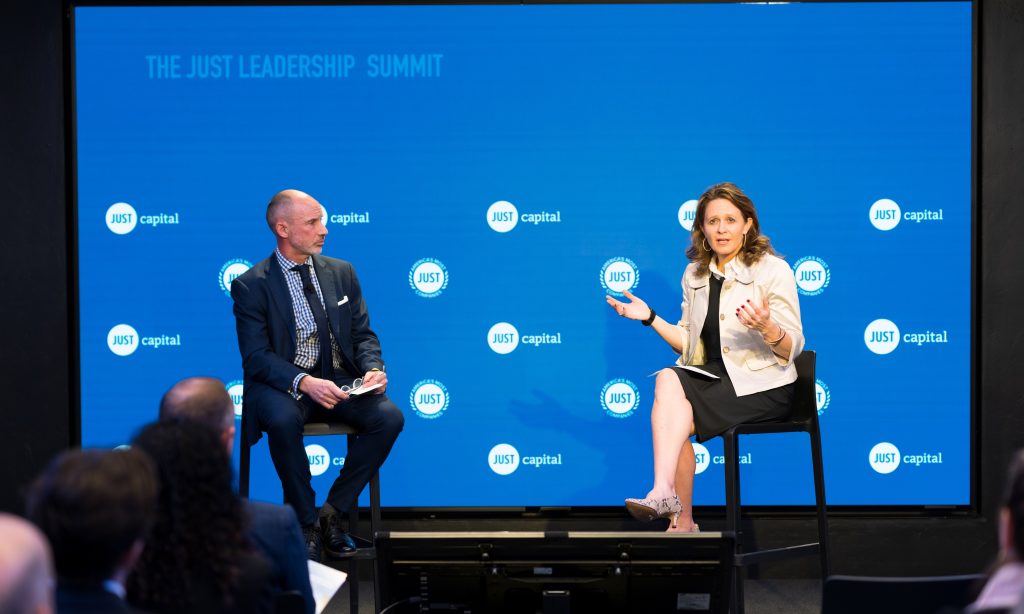
President Biden’s move came one week after we gathered corporate sustainability and ESG leaders and investors at our annual JUST Leadership Summit. Navigating attacks on ESG and politicization of this work came up throughout the day’s discussions. Kristen Sullivan, Partner, U.S. Sustainability and ESG Services Leader at Deloitte, spoke directly to it. Sitting down with Whittaker, she shared how Deloitte is advising its clients currently as political divisions over ESG are on the rise and climate disclosure regulation from the SEC nears.
Sullivan’s through-line in the discussion was the need to bring the dialogue back to the business case and to the “proof points” in the market. “Stepping back, ESG is just a data-driven way to understand long-term value and resilience,” she said. “When you continue to ground this whole conversation in the fact that this is about better understanding how to drive your strategy and minimize risk of disruption, that should not be political.” Watch the full conversation below and read on for key takeaways.
Sullivan acknowledged that there’s no shortage of data available on ESG at the moment. She pointed to one study that found that 96% of the S&P 500 issue an ESG report. But where she sees room for improvement is in the mechanisms companies use to report this data and evaluate it to inform their own strategies. She wants to see companies invest in establishing the “right governance” to understand where data is coming from and how it can be used to assess risks and opportunities in a more timely manner. “What’s that organizational capacity that’s truly needed to drive confident, clear, and quality data?,” she said.
Forthcoming regulation from the SEC on climate-related disclosures can be a catalyst for creating these systems. Sullivan sees 2023 as a critical inflection point – the year that we will see an SEC rule that will “move the market a great deal and empower market actors to unlock and allocate capital.” Regardless of where companies are currently, that shift is causing a major shift in the rigor and discipline applied to disclosure, she said. This also applies to companies with multi-jurisdictional reporting requirements. In addition to SEC regulation, she noted that companies will have to grapple with changing requirements in the EU. “The foundation of quality disclosure starts with what’s relevant to your business and what’s relevant to your stakeholders who are going to be consuming this information,” she said.
Those stakeholders aren’t just investors, she said. The new EU requirements could apply to companies with customers or data flow in the EU, not just with shareholders or operations located there. While regulation may spark an investment in data governance, ultimately Sullivan sees this as an opportunity – to build trust and business value. “I think that’s the opportunity for companies to get more systematic, disciplined, apply professional rigor to understanding these issues, putting the right governance management systems in place to truly tell that story in a compelling way that drives trust,” she said.
With a rigorous and disciplined approach to ESG data, Sullivan believes that companies can lean further into the business case and focus on showing how this work generates value. She raised recent Deloitte research that found that inaction on climate could cost the global economy $178 trillion over the next 50 years. The same study found that addressing climate impacts, however, could add $43 trillion to capital markets over the same time period. Sullivan sees companies increasingly understanding that massive economic opportunity and thinks now is a critical time to hone in on it.
This is especially the case as ESG has become further politicized. Regulation has fueled the political conversation, she said, but using the business and investor cases for action is a key way companies can cut through this rhetoric. Deloitte’s been telling its clients to “lean into the market.” “I do believe that we’re going to see the proof points that are going to counter and really bring transparency to the intentions behind these political conversations,” Sullivan said, noting that interventions to limit ESG to date have compromised market performance.
She also brought up that regulation and market infrastructure can help companies focus on business value. “This is about business value. And when you invest in an infrastructure – history has proven this out with financial reporting – that generates higher quality, more timely, more comparable, more reliable information, it informs decision-making. And that’s really at the heart of this conversation.”
While sustainability and ESG leaders may be facing uncharted territory, Sullivan noted that they’re as engaged as ever in getting it right. Deloitte hosted a “standing-room only” session at a recent GreenBiz Conference with over 350 professionals. “The sentiment coming out was ‘Yes I feel more prepared, I feel like I have a greater appreciation and command of practical, actionable steps I could be taking, but I’m really scared because I have this greater appreciation of the practical, actionable steps that I need to be taking.’,” she said. A disciplined approach to data and an emphasis on the business case can guide companies in taking these step.
Deloitte was an Impact Sponsor of The JUST Leadership Summit.
The job prospects, and on-the-job realities, American workers face today look different compared to a year, or even six months ago. Major employers continue to make announcements of layoffs or buyouts in some cases. The labor market is showing signs of slowing down, though it still remains tight. And inflation continues to hit the lowest-earning workers hardest. Amid this, a new Harris Poll survey found some Americans (42%) are worried about losing their jobs, but more (52%) are worried about worsening company culture.
Providing the jobs that will retain employees and help provide for them and their families in this environment has become increasingly imperative. It’s part of the reason we developed our JUST Jobs Scorecard, as we continue to hear from the American public in our polling that investing in workers’ should be an employer’s number one priority when it comes to just business behavior and as attacks on “woke” companies and ESG continue. Last week, at our JUST Leadership Summit, we introduced the Scorecard and heard from job quality-focused corporate leaders and on how they’re approaching these issues. Together, they discussed the importance of investing in workers in ways that will ultimately bolster business resilience.
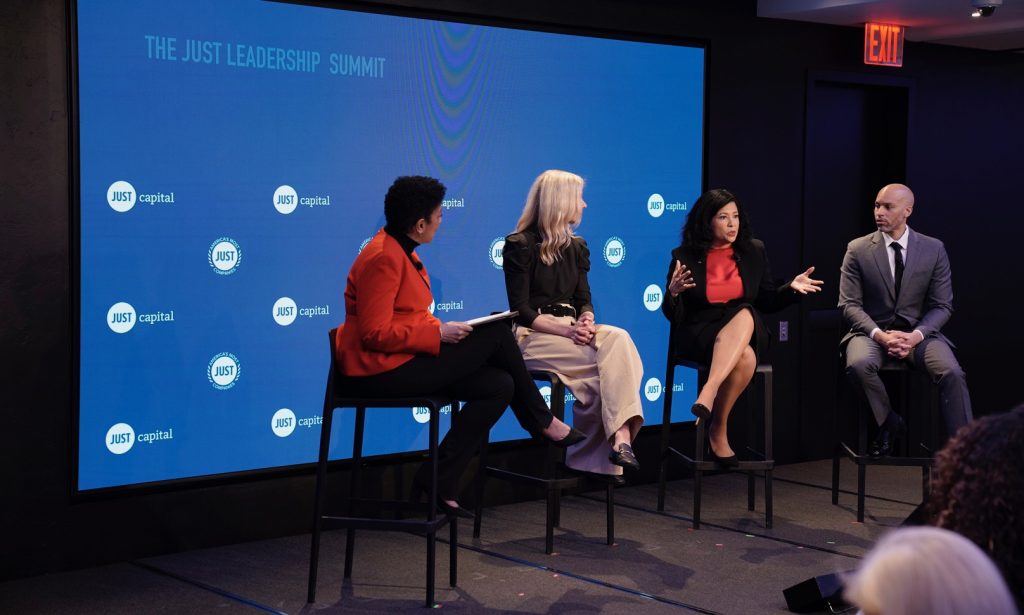
Our Chief Strategy Officer, Alison Omens, spoke with our Managing Director and Head of Corporate Impact, Tolu Lawrence, and Ann Ruble, Partner at Two Sigma Impact, to get insight into how tools like the Scorecard can help companies and investors systematically listen to workers. CNBC Senior Correspondent, Sharon Epperson, also sat down with Samantha Hammock, Chief Human Resources Officer at Verizon, Alicia Petross, Chief Diversity Officer at Hershey, and Randall Tucker, Chief Inclusion Officer at Mastercard to learn how they’re bolstering job quality right now, and what impact these actions are having on their workforce and business overall.
Watch the full discussion of each panel below and read on for key takeaways from both.
Both Lawrence and Ruble noted that part of the challenge in measuring job quality and taking action to address gaps is that companies don’t know where to start. For Two Sigma Impact, a private equity business advancing job quality within the companies in its portfolio, helping companies identify that data has been a key first step. “When you go into these mid-size companies, you’d think that that data [financial and operational metrics] would be clean and easy to access. But you go in there but they don’t have data lakes yet, they don’t have business intelligence tools,” Ruble said.
Two Sigma Impact might begin by suggesting that management look at internal mobility rates or retention rates by various diversity, equity, and inclusion (DEI) metrics, she said. Importantly, the voice of workers informs that process. Two Sigma Impact employs a “voice of worker” tool throughout the deal life cycle to “systematically” listen to workers, Ruble said.
Having a tool to identify and refine the right data to focus on is also a core element of the JUST Jobs Scorecard, Lawrence noted. “There’s a lot of data out there, but how do you make sure you’re measuring the data that’s going to have an impact? Because when you are measuring the data that’s going to have an impact, that’s when you see the long-term benefit and value of that data,” she said.
Part of the Scorecard’s focus is to help companies make sense of all the data out there and, in turn, see the long-term value in it, she added. Companies are able to take a look at how their performance on a particular metric compares to their peers or industry as a whole. Two Sigma Impact takes a similarly-minded approach in helping the leadership of companies it acquires better understand the state of job quality within their workforce. It decided on its four dimensions of job quality measurement – leadership, purpose, growth/advancement, fairness – to help executives more easily understand how they’re performing and underlying data points, Ruble said.
Once company leadership has a grasp on what data to measure, Ruble sees Two Sigma Impact’s next step as helping them “build the muscle” to continually track these metrics. The goal is to get companies to scale to the point where this is in their DNA, she said. And in her experience, having companies go through the process of understanding this data beyond “something on a balance sheet” changes them.
“As people learn more about how to measure the cost of turnover or not actually developing anyone in your workforce and having to hire from the outside every time…and really understand the engagement of your workforce and productivity measures, once people start learning about those things you kind of can’t not look at it again… It’s really just thinking about it differently,” Ruble said. Two Sigma Impact’s thesis is that good jobs make better companies and findings from the JUST Jobs Scorecard support that with leading companies in the Scorecard’s categories outperforming their peers.
Lawrence closed the session by raising a point JUST’s Head of Investor Strategies, Cambria Allen-Ratzlaff, often notes that 90% of the S&P 500’s market cap is in intangible assets, or human capital, though reporting on that hasn’t kept up. “When we talk about the future and what we need to be tracking in order to really understand how a company is performing, I think that’s really where we’re headed.”
Verizon’s Samantha Hammock, Hershey’s Alicia Petross, and Mastercard’s Randall Tucker joined CNBC’s Sharon Epperson for a discussion on JUST Jobs in Practice.
Hammock, Petross, and Tucker each kicked off the conversation defining what a JUST Job means for their company. Hammock raised being able to care for your own physical and mental well-being while Petross touched on the need for fair compensation that allows employees to care for their families and communities. “For us, we think of a JUST Job as creating a place or environment where the best people want to stay and thrive,” Tucker said of Mastercard’s point of view. This is what Epperson referred to as a “very measurable” perspective and one that Tucker sees connected to Mastercard’s performance overall.
Mastercard uses methods like employee engagement surveys, DEI metrics, and accessibility of its leadership team to measure job quality, he said. But he also raised the company’s move to tie ESG goals to compensation for all employees as another key mode of measurement. “The common denominator between everyone is that they want meaningful work, they want to know that they’ve contributed to society in a meaningful way…. And so everyone in our organization from the CEO to an analyst is also contributing to that goal,” Tucker said. Petross raised a similar, measurement- and business-relevant approach Hershey has taken toward its DEI efforts.
The company implemented its Say Hola initiative, which includes its first bilingual manufacturing facility, last year after seeing business-critical gaps in representation. “In 2020, when I started sharing some demographic stats, and I talked about the fact that in the U.S. and North America Black and Latino consumers are about 30% of our consumer portfolio. But at the time representation for those groups was about 15%. People could immediately feel the gap,” she said. Hershey’s employees have been proud of the program’s results too, she said. “Many in our manufacturing facilities have worked with us for 40-plus years, and they will say to me ‘I’m really proud that someone else who didn’t have my experience is able to get this job.'”
Part of the origin for Hershey’s Say Hola initiative came from the company’s Latino Business Resource Group, Petross said. And these groups have influenced other changes, as their mandate extends to “driving our commercial business and influencing company policy” – why Hershey refers to them as Business Resource Groups, instead of Employee Resource Groups.
When the company’s Women’s Business Resource Group came to management and noted that Hershey’s 14-week paid parental leave policy was lacking compared to its peers in the consumer packaged goods industry, the company took action. In January, following the Women’s Business Resource Group’s benchmarking, Hershey rolled out a 20-week paid parental leave program. “We’re in this spirit of co-creation and it’s one of the ways that we reinforce to employees that we hear you and we’re acting on what we’re hearing,” Petross said.
Hammock reinforced the importance on acting on what you’re hearing from employees – and acting quickly. “We all hear about survey fatigue. I don’t actually believe in survey fatigue. I believe what people are annoyed by is if you don’t do something about it. They’re happy to answer surveys all day long if you are listening and acting on what they are asking for,” she said. People want to see progress, she said, and they’re focused on the speed of change and if it’s implemented in a measurable way. To her, not acting on employee feedback is where businesses risk seeing employee “fatigue” around DEI and other areas of job quality.
In addition to employee feedback, Hammock raised adapting workforce investments based on the current economic climate or job market. While she said Verizon hasn’t been affected by cost cutting measures, the company is thinking about what the right investments to make are at a time when more Americans are switching jobs. Meeting people where they are through efforts like self-selecting benefits is key, she said. As is aligning those actions with strategic workforce plans – and being able to pivot when that’s not the case.
Petross made a similar point on Hershey’s approach to workforce investments amid shifts in the labor and economic markets. The company acquired three new brands over the past three years and never conducted layoffs, and, as a result, its focus is now on what it’ll take to retain employees. The company’s achieved gender and racial pay equity in the U.S. and is now looking to reach that globally by 2025, she said. Hershey has developed programs to foster internal growth, which was sparked in part by the realization that six of CEO Michelle Buck’s nine direct reports “grew up in the company.” Career growth is a big priority for the company’s workers and it’s adapted accordingly.
“Give me the skills and abilities to continue growing my career because that is the thing that is going to make my income sustainable,” Petross said, naming the second biggest piece of feedback, following compensation, Hershey receives from employees.
Whether a result of employee feedback, economic climate, or job markets, these leaders are adapting their job quality strategies. They’re not abandoning them. “It’s not going anywhere because it’s part of our value system,” Tucker said. “If we take a hit… our value system is who we are. That’s not changing.” And getting to the place of job quality as a core value starts with listening to workers, focusing on the right data related to those insights, and tying that to core business outcomes.
To unpack your company’s performance in the 2023 Rankings and JUST Jobs Scorecard and gain insights into how to improve on the issues that matter most to the American public, please reach out to corpengage@justcapital.com.

Over our years of polling the public, we’ve heard time and again that Americans agree it is important for companies to make workers their top priority. They want to see companies pay their workers a fair, living wage, create jobs in communities that need them, and establish diverse and inclusive workplaces that provide opportunities for all employees to succeed. When companies take concrete action to invest in diversity, equity, and inclusion (DEI) in the workplace, they demonstrate not only a commitment to advancing racial equity, but also to investing in their employees overall. By taking actionable steps – from conducting pay equity analyses to offering key benefits like paid parental leave to setting workforce diversity targets – corporate leaders are setting a higher standard for the treatment of all workers everywhere.
In our 2022 survey taking the pulse of the public on key diversity, equity, and inclusion issues, we found that a significant 92% of Americans agree it is important to promote racial equity in the workplace, but a strong majority (68%) say that corporations have more work to do. The public agreed that companies should take concrete steps toward advancing racial equity – including by conducting annual pay analyses (89%) and disclosing workforce demographics (76%).
With DEI representing an integral element of quality jobs, it appears as a core theme in our upcoming JUST Jobs Scorecard – an online interactive tool we will be releasing in the coming months, which highlights corporate disclosure on seven key topics around job quality, identifies leading practices, and demonstrates corporate pathways for improvement. Just under half of all the data points featured in the Scorecard are directly related to creating inclusive and equitable workspaces.
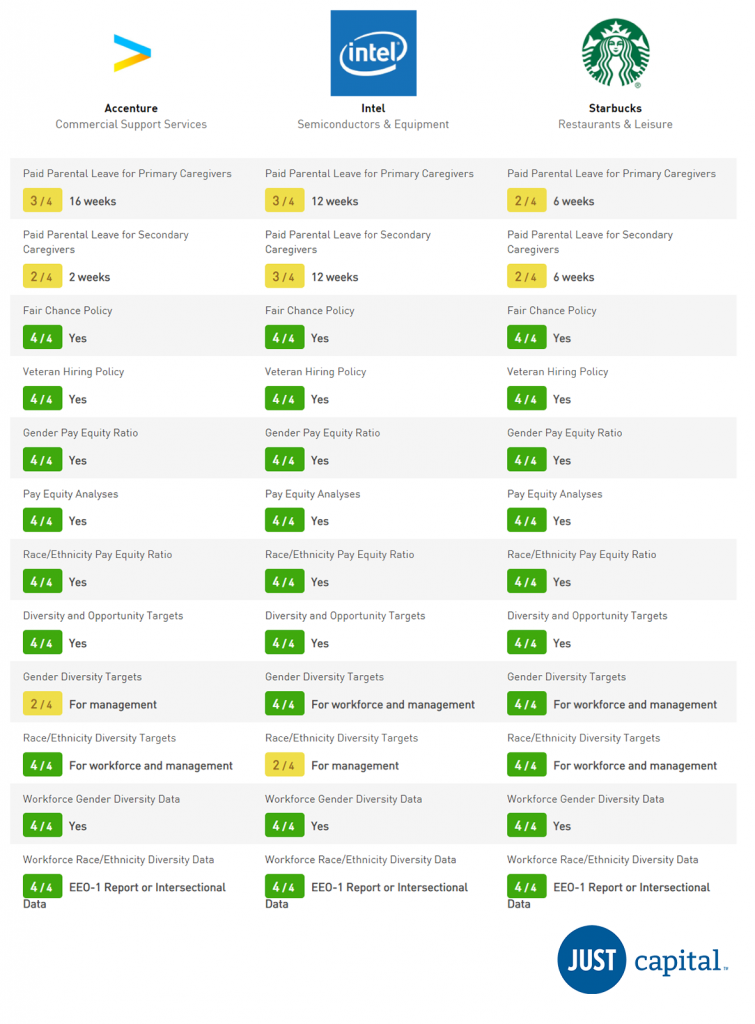
In an effort to showcase what strong DEI disclosure looks like, we’ve analyzed a subset of key data from our Rankings and new JUST Jobs Scorecard analysis and identified three companies with the highest scores – Starbucks, Intel, and Accenture.
Each of the leading companies:
Below, we explore the key actions these companies have taken that drive their strong outperformance.
Based in Seattle, Washington
As part of its efforts to increase diverse representation of workers in both retail and corporate roles, Starbucks has committed to reaching ambitious gender and race/ethnicity diversity targets. With pledges to fill 50% of corporate roles with women, as well as to have at least 30% BIPOC representation at the corporate level by 2025, Starbucks is setting meaningful goals to establish a more diverse workplace.
Starbucks also provides detailed disclosure of its workforce demographic data, broken out by gender and employment category, in its latest EEO-1 report. In 2018, Starbucks demonstrated its commitment to creating an equitable workplace by achieving 100% pay equity for workers of all genders and races in the U.S. Starbucks has maintained this achievement in 2022.
Additionally, Starbucks is a signatory of the White House’s Fair Chance Business Pledge, creating pathways for employment for veterans, formerly incarcerated individuals, and young people who face systematic barriers to education and employment.
Based in Santa Clara, California
Intel has made inclusivity in the workplace a pillar of its 2030 RISE Strategy and has already exceeded some of its initial milestones. In terms of gender diversity targets, the company has doubled the number of women in leadership positions and surpassed its goal of having 10% representation of Black/African American employees in senior, director, and executive roles, reaching 11% representation in 2022. Additionally, Intel has set a goal to increase accessibility in its workplace and aims to increase the number of workers who self-identify as having a disability to 10%.
Beyond increasing representation, Intel is also committed to creating an equitable workplace by offering 12 weeks of paid parental leave for all new caregivers. Intel’s commitment to DEI is evident in the public release of its comprehensive EEO-1 report, which also contains highly detailed information about workers’ pay broken down by race/ethnicity, job category, and salary band. Finally, Intel promotes hiring veterans and discloses detailed data tracking its yearly progress on veteran hiring.
Based in Chicago, Illinois
Accenture PLC conducts annual pay equity analyses by gender and race/ethnicity for its workforce and publicly discloses the findings. Using the information collected during these analyses, Accenture has been able to make informed future commitments to increasing diversity in its workplace for 2025. Accenture achieved 100% pay equity by race and gender in 2022 and is taking its commitment a step further, committing to achieve full gender parity at all levels by 2025, with 50% of its board seats and 45% of revenue-producing roles held by women.
In addition to disclosing detailed information about workforce demographics in its EEO-1 report, Accenture discloses other DEI metrics such as the number of workers who are veterans or self-identify as disabled or LGBTQ+. Accenture seeks to create opportunities for all individuals to thrive in the workplace, evidenced by its 16 weeks of paid parental leave offered to primary caregivers. Accenture also has a partnership with Goodwill to provide formerly incarcerated individuals with VR technology so they can participate in mock interviews, increasing their chances of finding employment.
Here’s a snapshot from our upcoming JUST Jobs Scorecard “compare” tools, showing how Starbucks, Intel, and Accenture are performing on these issues.
To unpack your company’s DEI performance in the 2023 Rankings and gain insights into how to improve on the issues that matter most to the American public, please reach out to corpengage@justcapital.com.
Employees at C.H.I., a garage door-manufacturer headquartered in Arthur, Illinois, received life-changing news last May. In 2015, private equity firm KKR acquired C.H.I. and granted its entire workforce – from those working in its factory to its corporate offices – ownership in the company. Last year, KKR sold C.H.I. in a $3 billion deal, marking one of the firm’s largest returns and, for C.H.I. employees, an opportunity to share in the wealth. With the sale, employees received equity payouts based on their tenure at C.H.I., with the average hourly worker earning $175,000 as a result.
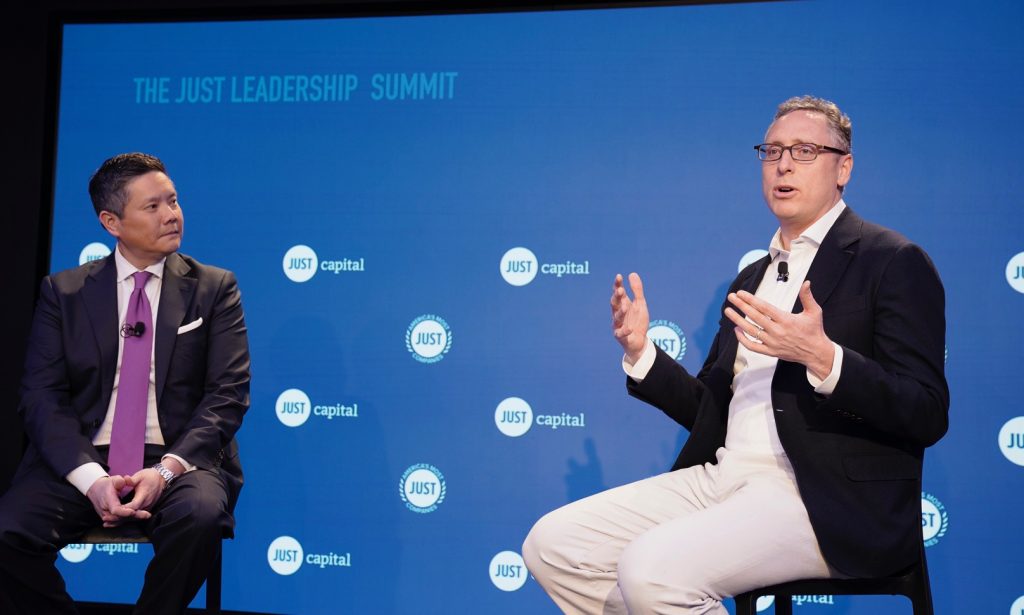
Hearing from C.H.I.’s workers themselves, the move was beyond what they had imagined from KKR’s employee ownership model and “all because someone held up their word to you.” These words grounded our conversation on employee ownership at the JUST Leadership Summit this week. KKR Partner and Co-Head of Private Equity Pete Stavros joined CNBC Senior Markets Correspondent Dominic Chu to discuss his work leading the firm’s employee ownership programs, how they’ve been successful, and their impact at the worker- and shareholder-level.
Stavros, who is also the Founder and Chairman of Ownership Works, a nonprofit supporting companies in implementing employee ownership models, touched on the origins of this work, referring to it as “an initial experiment” from his early days at KKR, but one that’s seen great success and has been in practice for nearly 14 years at 30 different companies.
“They don’t always go this well. This was a truly remarkable outcome,” he said. What’s been behind this outcome? For Stavros it’s come down to keeping the scale of opportunity top of mind, seeking CEO leadership that prioritizes accountability, and treating employee engagement at the same level as business.
At a time when jobs and the labor market remain at the forefront for corporate leaders, his points have weight for what companies should be prioritizing when it comes to employee engagement and job quality. Watch their conversation below and read on for key takeaways.
Stavros acknowledged that many employees at C.H.I. were understandably skeptical when KKR came in, not believing that this ownership program would amount to anything for them. And, six months later they still didn’t fully understand it, he said. The work to help workers understand how they could share in the company’s successes, and to tie that to more short-term outcomes, took years. Some of the results he shared for companies who have taken this long-term approach speak volumes to its benefits.
One of KKR’s biggest success stories, Ingersoll-Rand, saw its quit rate drop 90% over 10 years with this model in place, Stavros said. And C.H.I.’s profit margin rose from 20% to 35% under the employee ownership structure – a number that might be typical for a software company but is “unheard of” for a garage door-manufacturer. The longest-tenured employees at the company were given a payout worth 6.5 times their annual salary when it sold. Of the initial 10 companies the firm implemented this experiment at, half have sold with a return of more than three times the original equity invested and an additional four are projected to follow the same path, he said. “The track record is unparalleled in the history of private equity,” Stavros said. “None of our investors are sitting there going, ‘Wait a minute, who’s paying for this?’ and everyone is saying ‘How can we do more of this?'”
Chu opened the conversation noting that there’s a “touchy feely” aspect to this work that you don’t usually associate with private equity. And that, to Stavros, is an opportunity he’d like to see the industry capture. “For all of its problems, private equity is a very effective governance model and a very effective way of transmitting change,” he said. “If that governance model can be put to good use, it can be really powerful.”
The most important factor in the success of these programs, Stavros said, is leadership. “Like everything in the world, it starts and stops with leadership. If you have the right leader at the top this can be magic. If you don’t, forget it.”
As far as which companies are best suited to these programs, Stavros noted that public companies face quarterly reporting pressure, but that ultimately what matters more than company type or industry is leadership. CEOs with a lens and investment in the entirety of the company, including culture, are particularly primed for success he said. “One of the key screening criteria is, ‘what type of a human being is this?'”
Stavros believes this mindset is a mix of something inherent to CEOs and that comes over time. He pointed to the example of Kathy Bolahus, CEO of Charter Next Generation, a speciality film manufacturer that implemented an employee ownership program when KKR invested in the company in 2021. Kathy cries if her employee engagement scores aren’t good, Stavros said, because there’s a sincere, genuine passion for her people there – and a sense of responsibility. “They think the injustices in society exist, it is their problem to solve them for their people, and they can do it.” They’re not going to write off quit rates, for example, as just an industry problem, but take ownership for solving them, he said.
While some leaders may be more inclined toward this level of investment, Stavros believes all of them shift by merely going through the employee ownership process. “The process of going through this and rolling the model out and engaging, changes people. I don’t think you can coach them up in a room,” noting that one in three CEOs are moved to tears when they just start the process – not when the payouts come. Ownership Works is helping CEOs support each other through these changes, Stavros said, and build what Chu compared to a “coaching tree” in sports for executives to navigate these challenges.
That leadership mindset is most important when it comes to organizational culture. Stavros noted that what’s core to KKR’s approach is teaching CEOs and executives to approach culture-related issues and employee engagement in the same way they would operational issues. “The tools that we’ve developed are all about taking operational problem solving skills and applying them to fixing culture,” he said.
He brought up a hypothetical example of having a scrap problem at a manufacturing company. A CEO, in that instance, would run an analysis, problem solve on each of the issues, have a robust plan to measure against them, and “relentlessly” follow up with data, he said. He wants to see executives take the same approach to culture and engagement. “What we are trying to teach is ‘you know how to solve problems,'” he said. Using those problem solving skills to address low engagement and high quit rates has been key to KKR’s success.
And, importantly, to the ultimate reward for workers. By tying engagement and operational problem solving goals together, workers won out at C.H.I. “What had never been tried was engaging with the entirety of the workforce to drive operational improvement,” Stavros said of the previous C.H.I. owners’ strategies. C.H.I. had operational goals on issues like scrap reduction, labor productivity, and route density for deliveries that leadership would tie into short-term outcomes and investment for workers. Workers would receive reports on how they’d contributed to these goals day after day, he said, and receive rewards like a paid lunch if they’d met them.
“This was a million little things that took everyone pulling together to make happen,” Stavros said. Those small things added up to soaring profit margins, transformative payouts for employees, and a new example of the opportunity that lies in investing in workers.

The start of the COVID-19 pandemic marked the start of a tumultuous period for working women. Now, after a disproportionate number of job losses and barriers to seeking work, women are heading back into the job market. The latest figures find that women’s employment has nearly recovered compared to before the pandemic, with the labor force participation rate for women aged 25-54 higher as of January 2023 compared to 2019.
Job numbers alone, however, don’t tell the full story of how women are faring in the workforce. Despite the spike in women returning to work, men continue to outearn them across all age groups.
In 2022, according to the U.S. Census’ Current Population Survey, the median earnings for women who are full-time hourly and wage workers was 83% of the median earnings for men. This marks a slight improvement compared to 81.5% in 2019, but little changed from 81% in 2005. Today, March 14, marks Equal Pay Day – reflecting how many days into 2023 women must work to be paid the same as men in 2022. And the markers for women of color, who are paid less than their white counterparts, are even later. Equal Pay Day this year is July 27 for Black women, October 5 for Latinas, and November 30 for Native women.
A range of factors contributes to the gap’s persistence, including gender-based discrimination in the workforce. In our 2022 polling, JUST Capital found majorities of Americans acknowledge a range of problems that continue to plague women in the workforce, with 70% citing the gender wage gap and 66% citing equal opportunities for advancement. Critically, 80% of Americans believe that paying men more than women who are doing the same job is tantamount to discrimination.
In the same survey, a majority of Americans (55%) agreed that companies should prioritize equal pay for equal work to help women re-enter the workforce. In light of that, and with a rise in women now returning to work, we took a look at disclosures among Russell 1000 companies on gender pay equity. We analyzed whether companies disclose conducting a gender pay equity analysis and, if so, report the results of the process in a women-to-men pay ratio.
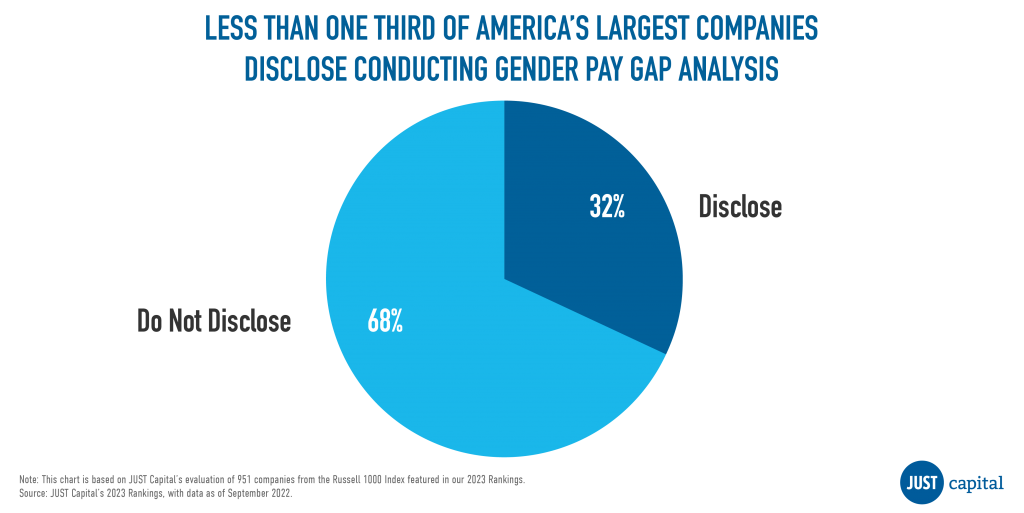
While our polling found Americans are looking for companies to prioritize gender pay equity, our analysis found that less than one-third (32% or 302) of America’s largest public U.S. companies disclose conducting a gender pay gap analysis. And only 14% of companies (130) report the results.
Read on to explore our full analysis of what companies are disclosing when it comes to the gender pay gap, including when we found companies are more likely to report their women-to-men pay ratios and how disclosures have changed over the years.
JUST Capital analyzes the issue of gender-based pay inequity by measuring adjusted gender pay gap analyses. An adjusted gender pay gap analysis analyzes the difference in median pay between men and women in the same position, controlling for factors like tenure, location, and education level, among others (as opposed to an unadjusted analysis which does not control for such factors). These internal company assessments are vital tools for evaluating and ameliorating the gender pay differences that exist at companies.
Our latest research suggests that disclosure surrounding gender pay gap analyses is still lagging among Russell 1000 companies. We found that only 32% (302 companies) of companies included in our 2023 Rankings currently disclose carrying out a gender pay gap analysis.
While disclosure on gender pay equity analysis among America’s largest companies remains generally low, our data suggests that companies are increasingly releasing this information publicly. When we conducted this analysis in September of 2021, just over a fifth of the companies we rank (23%) publicly disclosed that they conduct gender pay equity analyses. Only a year later, in September 2022 we found that roughly a third of our ranked universe (32%) disclose this information, which marks a nine percentage point increase in disclosure over the span of a year.
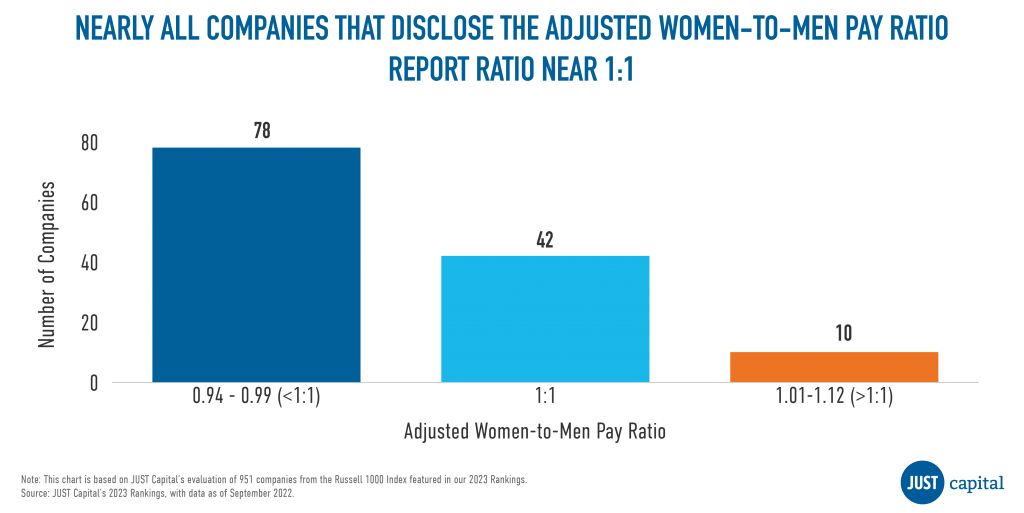
In addition to looking at company disclosures on conducting a gender pay gap analysis, we also evaluate if a company discloses the results of that analysis. Our data show that as of September 2022, 130 Russell 1000 companies, or 14%, disclose an adjusted women-to-men pay ratio, and most companies report a ratio at or near parity (1:1). Of these 130 companies, 78 (or 60%) report a ratio between 0.94-0.99 to 1, and 10 (or 8%) report a ratio between 1.01-1.12 to 1. Crucially, only 42 of these companies (32%) report parity in their adjusted pay between women and men.
Despite low disclosure of results, we noticed a similar trend of increasing transparency disclosure. In 2021, only 8% (75 companies) disclosed an adjusted women-to-men pay ratio. That rose to 14% (130 companies) in 2022, a six percentage point increase.
Though this may seem like a victory for gender pay equity, it is important to keep in mind that only 130 companies in the Russell 1000 report the adjusted women-to-men ratio, whereas 302 companies among this same group disclose conducting a gender pay gap analysis. And this does not take into consideration the 649 Russell 1000 companies that do not disclose if they conduct an analysis in the first place. We do not know what the pay ratios look like at these companies. Conducting an analysis to benchmark if and where gaps currently exist and disclosing the results, however, is key to achieving gender pay equity.
Closing the gender pay gap marks a significant opportunity for, first and foremost, women workers. By one estimate, the gender pay gap causes women to lose over $400,000 over a 40-year career, which translates into $1.6 million lost in retirement savings. It’s also costing the global economy $7 trillion, according to a new Moody’s analysis. And, crucially, companies taking action toward equal pay can help recruit and retain women at a critical juncture in their participation in the workforce.
Achieving gender pay parity involves many steps, but the first is to evaluate where a company currently stands – that means conducting a gender pay gap analysis. Our new JUST Jobs Scorecard helps companies to benchmark where they stand on gender pay equity, and other key metrics, among their peers.
To unpack your company’s pay equity performance in the 2023 Rankings and the JUST Jobs Scorecard and gain insights into how to improve on the issues that matter most to the American public, please reach out to corpengage@justcapital.com.

Philanthropy plays a pivotal role in American society, helping to uphold, safeguard, and support some of our most important traditions, institutions, and key social and environmental causes. In 2021, Americans gave a record $485 billion to a multitude of good causes, making us once again among the most philanthropically generous people on Earth.
Why then do we seem to be unable to make a dent in some of our most pressing economic and social problems? Why are poverty rates so stubbornly high? Why does the U.S. routinely fall below other developed nations on literacy, education, and health outcomes? Why is economic inequality so rampant in the U.S. versus other countries?
The truth is that tackling the root causes of our most intractable societal challenges requires a new way to think about philanthropy. Specifically, it requires transformational philanthropy that’s focused on the systems that are creating and compounding these root causes. Often, we see philanthropy interact with and support broad-based public policy change, or make specific, tangible interventions in one area or another. But there’s something vital missing. And that’s a push to catalyze the private sector to do more of the heavy lifting.
The math is obvious: At $21.6 trillion, the private sector is more than four and a half times the size of the public sector and 44 and a half times bigger than the philanthropic sector. Just as importantly, however, focusing on the private sector helps create a leverage effect so these vast resources can be marshaled to help us solve our greatest challenges, rather than exacerbate them.
Consider this: 165 million Americans work. It’s one of the major through-lines of the American experience. The workplace connects people, families and communities in every county in the country. How people earn a living is directly connected to societal outcomes.Yet JUST research focused on the top 1,000 public U.S. companies shows that 51% of those workers still don’t earn a family sustaining living wage at the local county level. If the 50 largest companies alone increased their minimum wage to a local living wage, we’d lift up roughly 10 million families and boost economic growth. If we shifted a mere 1% of private sector capital flow in a more just direction, that’s still more than $600 billion a year being channeled to support higher wages, better benefits, stronger communities, better protection of human rights and the environment, and more.
Imagine if we could get companies to improve job quality and invest more in their people. Think of the incredible social and economic benefit we would see if workers today had enough to support their families, put food on the table, cover childcare and preventive care, buy a home, save to send their kids to college, and begin to build wealth for the future.
Imagine if we could incentivize companies to invest more in the communities where they operate – to prioritize veterans and second chance hiring, ensure equality of opportunity within every workplace, support women- and minority owned suppliers, and invest in better healthcare and community education.
Imagine if we could get companies competing to do more to lower greenhouse gas emissions, reduce their environmental footprints, develop solutions to climate risk, protect fragile ecosystems, and safeguard water and land quality.
All of this is good for business, and good for society. This is JUST Capital’s vision – to drive competition and change within the country’s largest corporations to build more just business practices, and through that, a more just society.
To bring our vision to life, we focus on the 1,000 largest publicly traded companies in America. They create jobs for tens of millions of people; affect the lives of hundreds of millions; touch communities and supply chains across the U.S. and around the world; and have enormous social, political, and environmental influence. They set the agenda for best practices and social norms for business throughout the country and the world.
Transformational philanthropy doesn’t produce change overnight. It requires patience, creativity, and commitment. It requires more complex system thinking. It requires proponents to form communities of practice and to forge unlikely alliances and collaborations. But when it works, it produces lasting change at real scale.
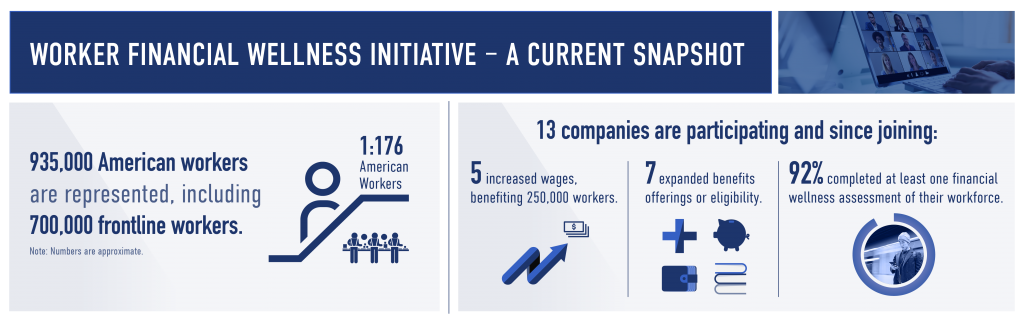
At JUST Capital, for example, over the last several years we’ve seen over 120 companies lift wages, benefiting 6.5 million workers. Over 350 companies now disclose conducting pay equity analyses (up from 132 in 2018), which is essential for fair pay practices to become the norm. Our Worker Financial Wellness Initiative comprises 13 corporations representing 935,000 workers, of which 12 have completed at least one financial wellness assessment of their workforce, five have announced wage increases for hourly workers, and seven have implemented new or expanded benefits programs.
Because we focus on the whole system, we also work closely with the media – our partnership with CNBC gets data on how companies are doing on these issues in front of millions of business and financial professionals on a regular basis – and with investors, so we drive capital to just companies as an incentive. We support 11 different investment products, including the JUST ETF, and we’re now working with some of the largest asset managers and asset owners in the country.
That’s just a snapshot of the transformational impact we’ve already achieved through our corporate engagement, partnerships, investor work, and more (take a deeper dive here). And, at JUST, all of this is grounded in the American public’s priorities. Our polling and public opinion research gets to the heart of what everyday Americans want companies to tackle – mainly, paying a fair, living wage and investing in workers. We use this as a base to incentivize change from the country’s largest employers, and partner with media outlets, nonprofits, and academics, and investors.
Taken together these efforts create a mutually-reinforcing suite of activities in support of systems change.
To be truly effective, transformational philanthropy also needs to be structured a bit differently.
It must have a scalable funding structure. That’s why, in JUST’s strategy, we are working to create pathways for funding flows from the corporations and investors we engage, in addition to increasing support from foundations, individuals, and other partners. In this model, philanthropic support is used to build the systems that will create a future funding flywheel, in much the same way that catalytic venture funding can help for-profit startups achieve financial sustainability.
It must also bring together people and partners who can provide more than simply grant money. It needs creative problem solving and expertise from those who understand the power of industry, believe in capitalism as a force for greater good, and see wealth and capital as a means to an end.
One of our longtime supporters, Darren Walker of the Ford Foundation, often points to a particular quote by Rev. Dr. Martin Luther King, Jr. when he talks about philanthropy, one that I believe embodies a transformational approach: “Philanthropy is commendable, but it must not cause the philanthropist to overlook the circumstances of economic injustice which make philanthropy necessary.” It is these circumstances that transformational philanthropy seeks to address. And unless and until the private sector is inspired to do more, traditional philanthropy will continue to fight an uphill battle.
To learn more and explore ways to get involved, please connect with us. An investment in JUST Capital will generate high-impact outcomes for workers, communities, and society at large, leveraging the power of business as a force for greater good – and transformational philanthropy – in America.
