Back in August, the Business Roundtable, an association of the chief executive officers of nearly 200 of America’s largest and most influential companies, released a new Statement on the Purpose of a Corporation. After 41 years of endorsing a governance model of shareholder primacy, the organization boldly committed to focus on delivering value to all its stakeholders, “for the future success of our companies, our communities and our country.”
181 CEOs signed the Statement, committing to lead their companies for the “benefit of all stakeholders – customers, employees, suppliers, communities and shareholders.”
Critics of the shift generally fell into two camps – those who believed the Statement went too far, undermining fiduciary duty, and skeptics who believed it didn’t go far enough, representing mere words, not actions.
For the converted, many saw the Statement as a reflection of how many top CEOs currently run their companies, while others saw it as a historic paradigm-shift that would help companies, boards, and investors chart a new course for the future of capitalism.
Regardless of where you stood on that skeptic-to-convert spectrum, everyone started asking for a scorecard that would help us understand how these companies were actually performing on key stakeholder issues.
JUST Capital has the answer. Our mission, as a nonprofit organization, is to openly and transparently measure, in a data-driven way, corporate performance on stakeholder issues, as well as to incentivize improvements. We have been doing this for four years. We are also the only organization tracking how the American public thinks about stakeholder performance, and which issues they prioritize.
Today we are pleased to release a stakeholder analysis for the Business Roundtable Signatories, based on the analysis that fuels our 2020 Rankings of America’s Most JUST Companies, as well as our own framing for how companies can optimize the creation of value in this new era of stakeholder capitalism.
JUST Capital has polled more than 96,000 Americans over the past five years to intimately understand which issues the public wants corporations to prioritize to restore trust and create an economy that serves all Americans. We also have four years of corporate performance data on those issues, as well as market analysis that shows the business and investment case for adopting these business behaviors.
By the Numbers
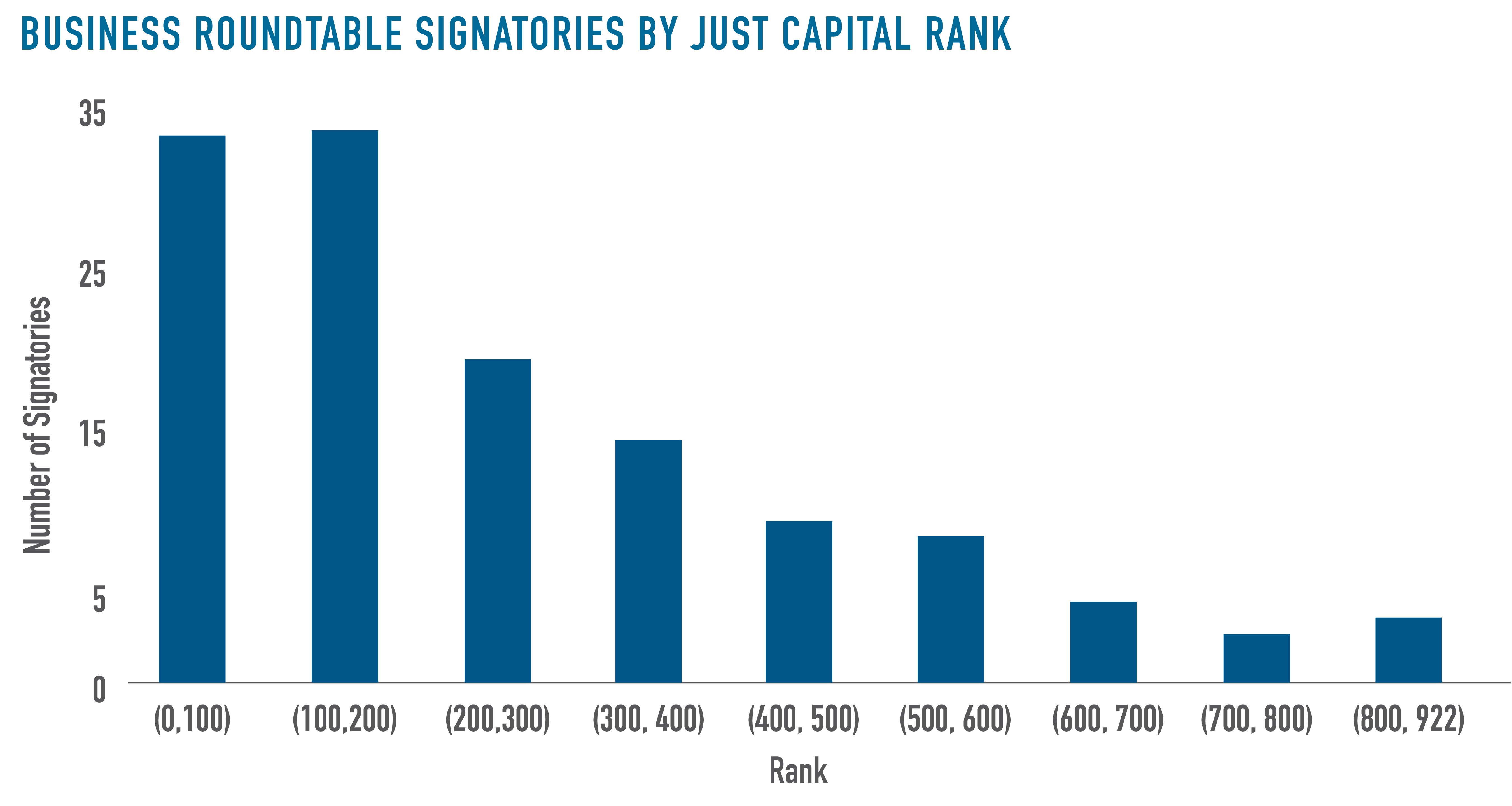
Overall, a healthy majority of the Roundtable’s signatories scored well this year. They are not performing quite as well as the top companies, the JUST 100, but are close. And 34 of the signatories are, in fact, featured in the JUST 100, including Apple, Salesforce, Anthem, P&G, Cisco, GM, IBM, AT&T, Accenture, and Xylem.
Our analysis is based specifically on 134 of the 181 signatory companies, as we track, measure, and rank Russell 1000 companies each and every year. If a company is not included in the Russell because they are a private corporation or for other rules-based reasons, we do not yet have data on those companies. For the 134 signatories that were included in our universe, we analyzed those companies across five stakeholder groups – including Workers, Customers, Communities, the Environment, and Shareholders – covering 29 Issues – like whether companies pay a living wage or protect the environment, and over 400 data points – from paid parental leave to veteran hiring and supplier policies.
Here’s how 134 of the Business Roundtable signatories stack up:
Serving Stakeholders
So aggregate performance was high. We next explored how the Business Roundtable signatories performed regarding key issues relating to each stakeholder.
First a note to explain that our stakeholder definitions are modestly different than the Business Roundtable’s purpose statement framing. We think similarly about employees (which we categorize as “Workers”), Customers, and Shareholders. The Roundtable considers issues relating to the environment and sustainable business practices as a component of how they serve communities, whereas the American public sees the Environment as a separate stakeholder. JUST combines supplier issues that matter most to the public – like upholding human rights standards in the international supply chain and supporting local, diverse, and veteran suppliers in the communities in which they operate – within our Communities stakeholder, rather than breaking suppliers out as a separate stakeholder.
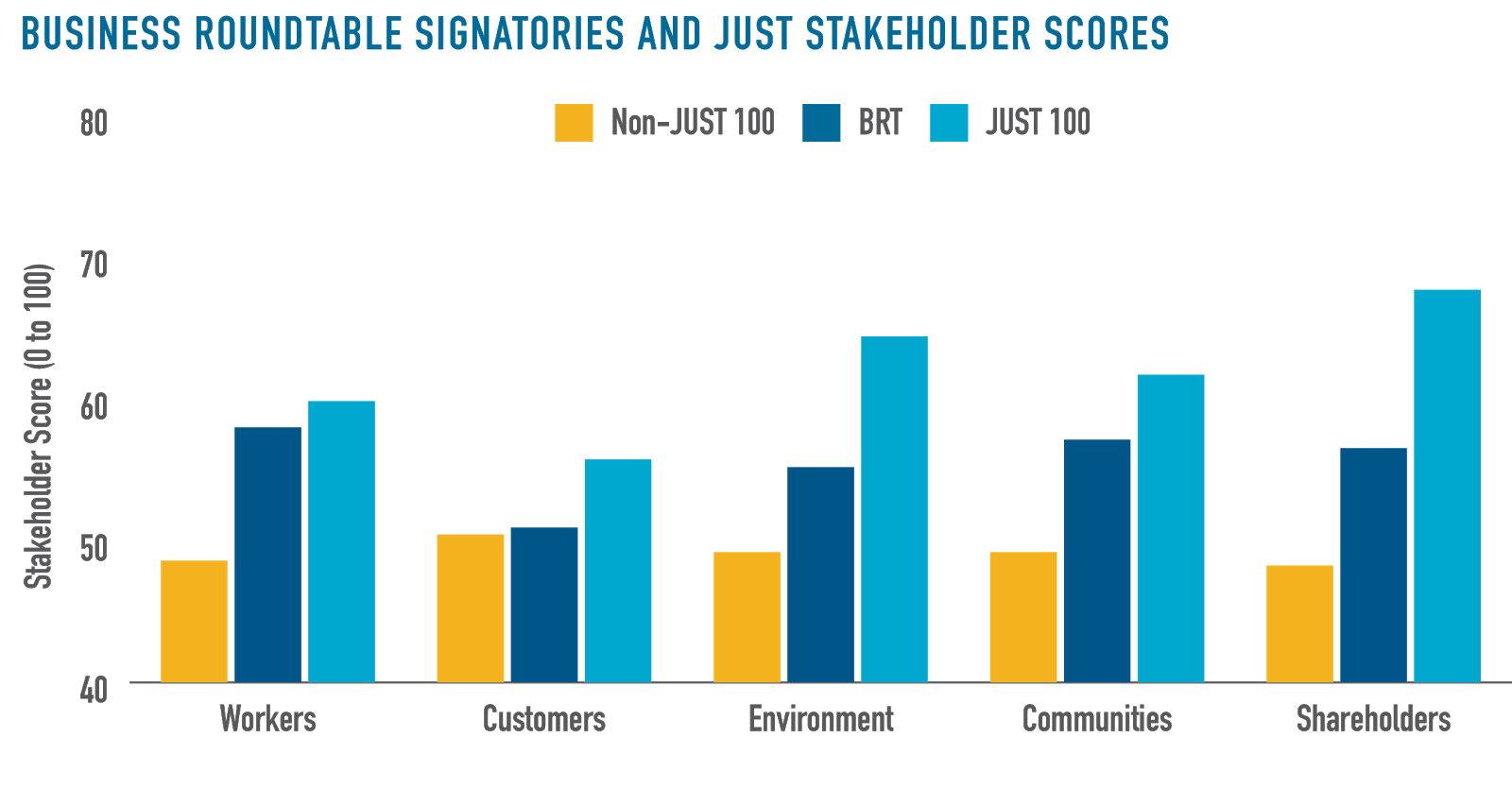
Overall, you can see that the 134 Business Roundtable signatories are performing well above average when it comes to serving their stakeholders, except for Customers, where we are measuring issues like creating quality, safe products that do not harm health, the environment, or society, and protecting privacy.
Specifically, compared to other Russell 1000 peers not in the JUST 100, the Business Roundtable signatories perform:
Note: the “Non-JUST 100” category above includes all of the Russell 1000 companies we rank minus the JUST 100.
Impacting the Future
While the current performance of the Business Roundtable signatories shows that many of the top companies are already operating with a stakeholder-focused mindset compared to their peers, increased investments by this incredibly influential community of corporations could have massive ripple effects throughout our economy.
For instance:
In the coming year, we will continue to track the actions they make toward their commitment – to support their workers, customers, communities, and more – in an effort to understand how this shift toward stakeholder capitalism impacts our economy, and the lives of all Americans.
Mastercard CEO Ajay Banga says “DQ” is as important as IQ or EQ.
The Business Roundtable redefines the purpose of a corporation for the 21st century

Earlier this summer, in conversation with Larry Fink at the Aspen Ideas Festival, Darren Walker, President of the Ford Foundation, said, “As an asset owner…I would like to put a nail in the coffin of the ideology of Milton Friedman that the only purpose of the firm is profits – because that ideology will asphyxiate our democracy and ultimately be harmful and be the end of us all.”
Today sees a major step being taken in that direction.
The Business Roundtable, an association of the chief executive officers of nearly 200 of America’s largest and most influential companies, released a new Statement on the Purpose of a Corporation. After 41 years of endorsing a business governance model of shareholder primacy – in which corporations exist principally to serve shareholders – the organization committed to a new ethos in which the purpose of a corporation is to benefit “all stakeholders – customers, employees, suppliers, communities and shareholders.”
The move was warmly welcomed by Walker in the Roundtable’s press release, “This is tremendous news because it is more critical than ever that businesses in the 21st century are focused on generating long-term value for all stakeholders, addressing the challenges we face, and resulting in mutual prosperity and sustainability for both business and society.”
Based on our research, the American people wholeheartedly agree. Every year since 2015 we’ve polled thousands of Americans on a fully representative basis to ask them what matters most regarding business behavior today. The key takeaway, every year, is that regardless of income, age, political affiliation, or location, the public is united in their desire for corporate America to stop prioritizing shareholders above all else, and to start sharing success with all business stakeholders, including employees (primarily), as well as customers, communities, and the environment. They also want corporations to lead with integrity and to embrace more ethical governance principles.
Seen in that context, the Business Roundtable’s move may be viewed as heralding a new era in business thinking, one that aligns much more closely with the values of the public and which, if successful, can help to restore faith in business and markets as a force for good for all Americans.
What matters now is implementation. Corporate CEOs need to operate every day with all their stakeholders in mind, and investors need to recognize that those choices make for more successful companies. The system needs to align to enable a more virtuous cycle.
As companies and investors move in this direction, we have solutions here at JUST to support the journey. We have the definitive Roadmap on what corporate America should prioritize regarding each stakeholder, and four years of corporate performance data, research, and rankings to help companies benchmark themselves against their peers on all the important issues, identify best practices, and assess the business and investment case for adopting just businesses behaviors.
From JUST Capital CEO, Martin Whittaker: “Corporate America is going through a sea change in terms of how the core purpose of business is defined. We applaud the Business Roundtable’s leadership on this issue and their embrace of the stakeholder ethos in which businesses are committed to greater shared prosperity for all Americans. We look forward to working with them and all corporations to bring this vision to life.”
If you are a corporation, especially one in the Russell 1000, and haven’t yet engaged with JUST Capital, please reach out to our corporate engagement team to learn more. We’re eager to help you on your journey to justness and create a more inclusive economy for all Americans.
Our FREE weekly newsletter about the future of capitalism and the movement to build a more equitable marketplace in America.
Read the full text of the Business Roundtable’s New Statement on the Purpose of a Corporation
Americans deserve an economy that allows each person to succeed through hard work and creativity and to lead a life of meaning and dignity. We believe the free-market system is the best means of generating good jobs, a strong and sustainable economy, innovation, a healthy environment and economic opportunity for all.
Businesses play a vital role in the economy by creating jobs, fostering innovation and providing essential goods and services. Businesses make and sell consumer products; manufacture equipment and vehicles; support the national defense; grow and produce food; provide health care; generate and deliver energy; and offer financial, communications and other services that underpin economic growth.
While each of our individual companies serves its own corporate purpose, we share a fundamental commitment to all of our stakeholders. We commit to:
Each of our stakeholders is essential. We commit to deliver value to all of them, for the future success of our companies, our communities and our country.
In today’s tight labor market, companies are facing high turnover and fierce competition. Across industries, benefits like paid parental leave and career development are becoming more commonplace as companies work to attract and retain talent, as well as reskill employees for an increasingly automated workplace.
Employers are investing in their workers in new and significant ways, and in recent years, more companies are offering tuition reimbursement and other education assistance programs. And with about 60% of the entire civilian labor force without a Bachelor’s degree as of 2018, this offering has the potential to transform the lives of workers across the U.S.
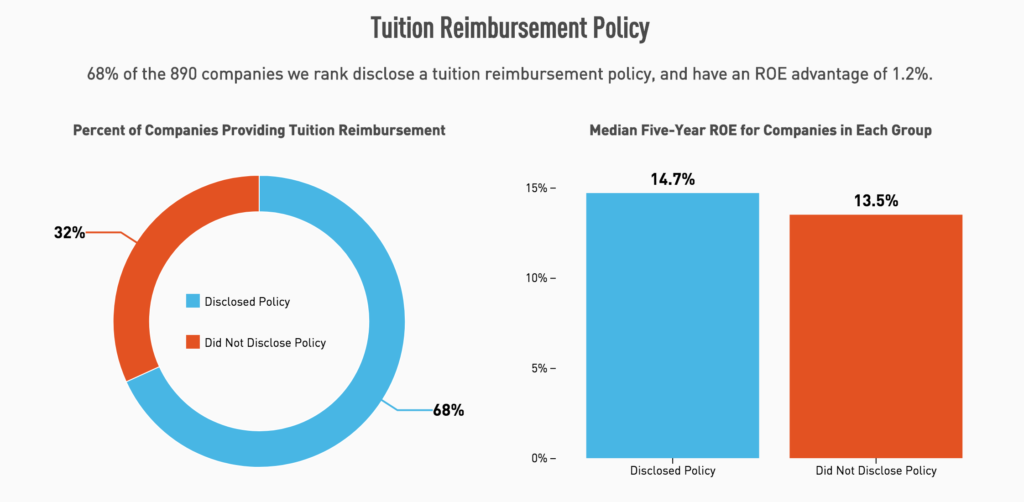
According to our recent JUST Jobs analysis on company disclosure related to nine key worker issues, about two-thirds of the largest, publicly traded U.S. companies offer tuition reimbursement to their employees. And, good news – those disclosing a tuition reimbursement policy also generate an ROE advantage 1.2 percentage points higher than their peers.
While the majority of companies offer tuition reimbursement to their employees, this benefit might not always reach the workers who really need it – like those on the front lines of traditionally lower wage industries such as retail and restaurants. In 2018, 86% of workers earning at or below the federal minimum wage did not have a Bachelor’s degree – typically an entrance requirement for higher paying jobs.
In these industries, we’ve found that, interestingly, higher proportions of companies offer tuition reimbursement – with 78% of Food & Drug Retailers and 73% of Restaurants & Leisure companies disclosing tuition reimbursement (while Retail lags behind at 59%).
However, tuition reimbursement might not ultimately reach the cashiers, servers, call center workers, and store associates earning lower wages on the front lines. Companies like Macy’s, Domino’s, and Dunkin’ Brands offer education assistance only to their corporate staff, excluding front-line workers and hourly associates. Arguably, front-line workers could benefit significantly from tuition reimbursement, gaining access to higher wages and greater economic mobility.
Still, there is a handful of leaders – including Walmart, Starbucks, and H&R Block – ensuring that tuition reimbursement is available to all workers, extending the benefit beyond its headquarters, salaried, and corporate staff. The restaurant industry, especially – faced with the highest quit rates since 2001 – has stepped up to provide better benefits and career opportunities to its workers. Last year, for example, McDonald’s announced an initiative – following its windfall from the Tax Cut & Jobs Act – that it would allocate $150 million over five years toward providing almost 400,000 U.S. restaurant employees with accessibility to its education program.
Companies that invest in the education of their workforce are likely to see employees stay longer and move into senior positions more frequently. And as corporate America moves toward automation and the future of work, employers are seeking out more skilled employees. By investing in education, companies can foster the skills they need in their own workforce, focusing on retention and alleviating the high costs of replacing or hiring workers.
With our research showing that tuition reimbursement correlates with a return on investment, it’s clear that programs like this can create a win-win for companies and employees alike – both upskilling workers and improving the bottom line. And for companies in low wage industries especially, investments in better benefits and higher wages have the potential to influence not only their workers’ well-being and their company’s performance, but the overall course of income inequality in our country.
In the coming year, we will continue to track what companies offer around this and other core worker benefits – in an effort to better understand both the state of just business behavior and its impact on American workers today.
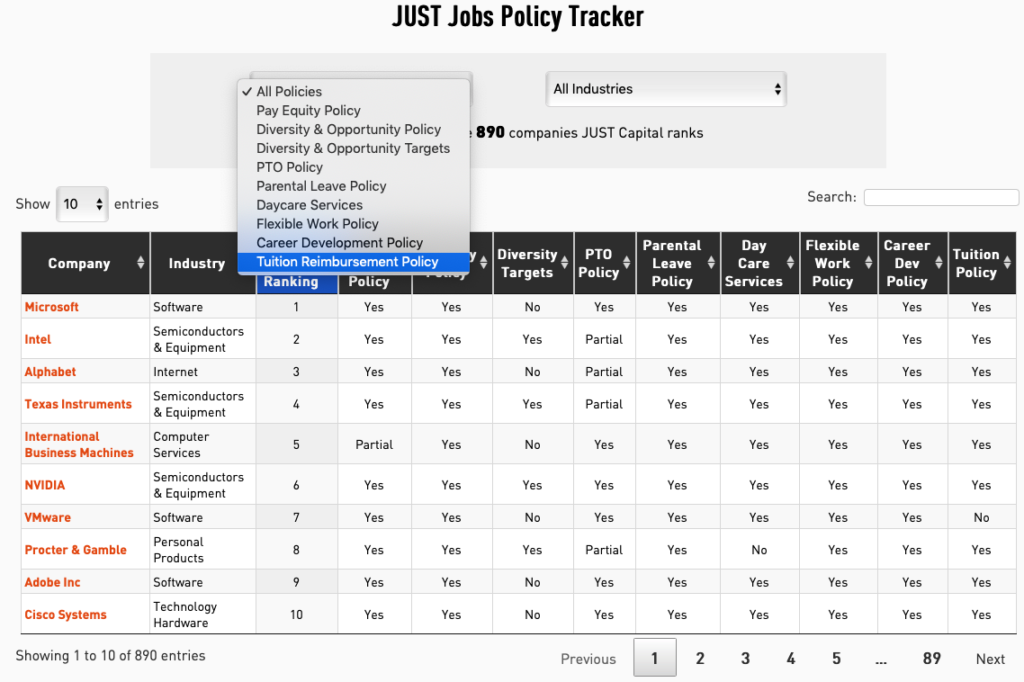
To explore the data and links to all the relevant policies at the 890 companies we analyze, visit the JUST Jobs Policy Tracker, and select “Tuition Reimbursement” from the pull down menu.